ABUTMENTS IN
FIXED PARTIAL
DENTURES
Dr. Aamir Godil
Department of Prosthodontics
M.A.R.D.C
CONTENTS
Introduction
Ante’s law
Ideal abutment
Abutment selection
Questionable abutment
Cantilever abutment
Pier abutment
Tilted abutment
Extensively damaged abutment
Conclusion
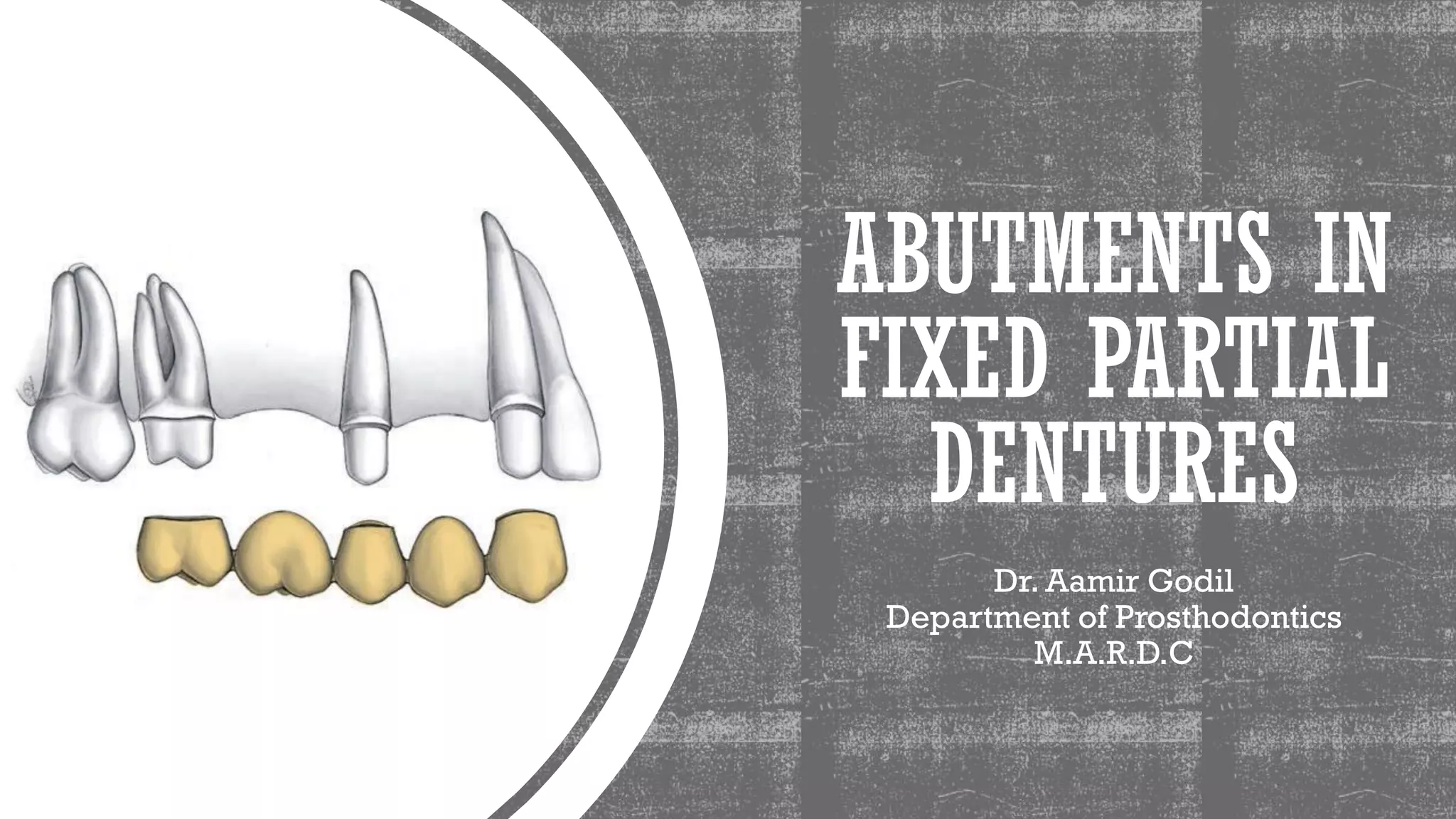
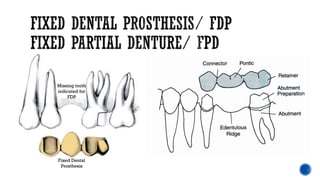
Missing tooth
indicated for
FDP
Fixed Dental
Prosthesis
▪ abutment a-but΄ment n (1634):
“a tooth, a portion of a tooth, or that portion of a dental implant that serves to
support and/or retain a prosthesis”
-Glossary of Prosthodontic Terms- (GPT) 9
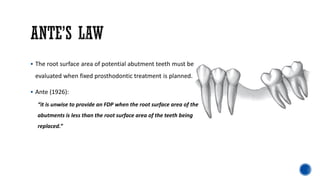
▪ The root surface area of potential abutment teeth must be
evaluated when fixed prosthodontic treatment is planned.
▪ Ante (1926):
“it is unwise to provide an FDP when the root surface area of the
abutments is less than the root surface area of the teeth being
replaced.”
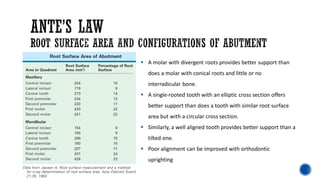
▪ A molar with divergent roots provides better support than
does a molar with conical roots and little or no
interradicular bone.
▪ A single-rooted tooth with an elliptic cross section offers
better support than does a tooth with similar root surface
area but with a circular cross section.
▪ Similarly, a well aligned tooth provides better support than a
tilted one.
▪ Poor alignment can be improved with orthodontic
uprighting
▪ Nyman and Ericsson:
▪ Doubted the validity of Ante’s law by demonstrating that teeth with considerably reduced
bone support can be successfully used as FDP abutments.
▪ Observed that the abutment root surface area was less than half that of the replaced
teeth, and there was no loss of attachment after 8 to 11 years.
▪ attributed this success to meticulous root planning during the active phase of treatment,
proper plaque control during the observed period, and meticulous occlusal design of the
prostheses.
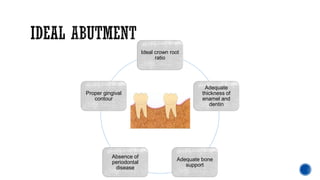
Ideal crown root
ratio
Adequate
thickness of
enamel and
dentin
Adequate bone
support
Absence of
periodontal
disease
Proper gingival
contour
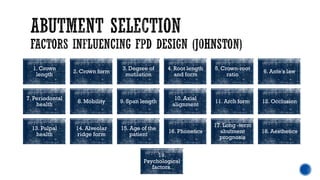
1. Crown
length
2. Crown form
3. Degree of
mutilation
4. Root length
and form
5. Crown-root
ratio
6. Ante's law
7. Periodontal
health
8. Mobility 9. Span length
10. Axial
alignment
11. Arch form 12. Occlusion
13. Pulpal
health
14. Alveolar
ridge form
15. Age of the
patient
16. Phonetics
17. Long -term
abutment
prognosis
18. Aesthetics
19.
Psychological
factors.
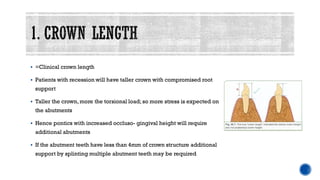
▪ =Clinical crown length
▪ Patients with recession will have taller crown with compromised root
support
▪ Taller the crown,more the torsional load; so more stress is expected on
the abutments
▪ Hence pontics with increased occluso- gingival height will require
additional abutments
▪ If the abutment teeth have less than 4mm of crown structure additional
support by splinting multiple abutment teeth may be required
▪ If the neighboring teeth have tall cusps and well designed morphology then we
should anticipate additional lateral loads on the abutment teeth.
▪ If the pontics have a larger occlusal table than the abutment teeth then additional
abutments may be required to evenly distribute the load.
▪ Abutment teeth should have a height of atleast 4mm. If the occlusogingival height is less
than 4 mm core build up with composite resin should be done to increase crown height
▪ If the occlusogingival height is less than 2mm, post and core along with crown lengthening
should be considered
▪ If the decay extends into the root surface the abutment should be extracted and should
NEVER be used for FPD
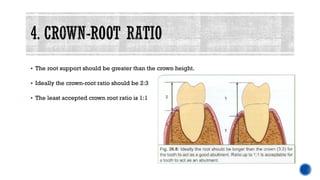
▪ The root support should be greater than the crown height.
▪ Ideally the crown-root ratio should be 2:3
▪ The least accepted crown root ratio is 1:1
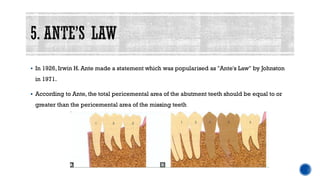
▪ In 1926, Irwin H. Ante made a statement which was popularised as "Ante's Law" by Johnston
in 1971.
▪ According to Ante, the total pericemental area of the abutment teeth should be equal to or
greater than the pericemental area of the missing teeth
▪ Periodontally compromised teeth should not be selected as abutments for FPDs.
▪ If the tooth had bone loss but the periodontal condition is stabilised and it is not mobile,
then it can be used as an abutment even if it does not have a 1:1 crown root ratio.
▪ Teeth with firm periodontal support are ideal abutments
▪ In case the abutment tooth has grade 1 mobility it can be splinted with additional abutments
for support
▪ Teeth with grade 2 mobility are contraindicated as abutments for FPD
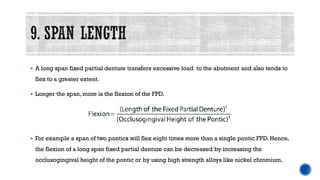
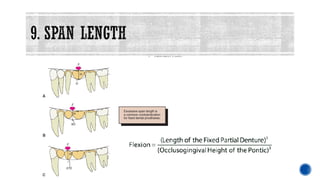
▪ A long span fixed partial denture transfers excessive load to the abutment and also tends to
flex to a greater extent.
▪ Longer the span, more is the flexion of the FPD.
▪ For example a span of two pontics will flex eight times more than a single pontic FPD. Hence,
the flexion of a long span fixed partial denture can be decreased by increasing the
occlusogingival height of the pontic or by using high strength alloys like nickel chromium.
▪ The term axial alignment refers to the alignment of the long axis of the abutment teeth to
each other.
▪ A tilt of upto 25° can be accommodated by modifying tooth preparation for full veneer
preparations and a tilt of upto 15° can be accommodated in case of resin bonded bridges.
▪ Cornerstone teeth like the canine and first molar can be used as abutments for distributing
forces in wider arches
▪ Acutely curved arches require additional abutment teeth to dissipate the lateral stresses
occurring in two directions at the region of curvature
▪ Based on each scheme of occlusion, the abutment can be selected.
▪ For FPDs with mutually protected occlusion, minimal lateral load is expected and so a single
abutment should be sufficient on either side.
▪ If group function is planned and if the patient has para-functional habits, it may be advisable
to have a secondary abutment splinted to the FPD to improve load distribution.
▪ If the patient has trauma from occlusion then the abutment should be splinted with
secondary retainers to support the FPD.
▪ FPD abutments should preferably be vital teeth to have better proprioception.
▪ If there is severe attrition,many doctors prefer to do prophylactic root canal therapy before
abutment preparation.
▪ Partial veneer crowns are preferred for vital abutments so that vitality testing and plural
health can be evaluated after cementation of the prosthesis.
▪ Wide and flat ridges are ideal for FPD
▪ Thin and low ridges due to severe resorption
increase the pontic height and increase torsional
loads on the abutment teeth.
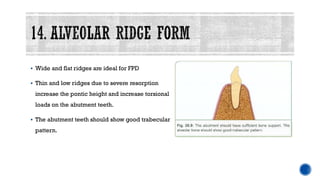
▪ The abutment teeth should show good trabecular
pattern.
▪ Young patients:
▪ A high degree of aesthetics is required for young patients. Resin bonded bridges can be provided for
such patients
▪ Young individuals have teeth with large pulp chambers and are more prone to pulpal exposure during
tooth preparation
▪ Elderly patients:
▪ Older individuals have darker with layers of reparative and sclerotic dentin with reduced pulp
chambers;More amount of tooth structure can be reduced without fear of plural exposure
▪ More incidences of cervical abrasions and shortened crowns due to attrition are also observed in elderly
patients. Additional abutment teeth may be required to provide support to the prostheses
▪ Abutment with FPD retainers are generally bulkier than their natural counterparts.
▪ This can affect the phonetics of the patient, in such conditions it may be beneficial to avoid
an anterior abutment and build a spring cantilever FPD using a posterior abutment.
▪ Generally FPDs are designed to last 60% of the time over a period of 20 years.
▪ If the abutment's health is compromised such that it would not last this long, then it should be
avoided.
▪ Long connectors in anterior abutments can be aesthetically compromising.
▪ Resin bonded retainers may have unesthetic metal show-through.
▪ If there is a diastema then loop connectors can be used to join adjacent abutments.
▪ If the anterior abutments are compromised good aesthetics can also be obtained with a
spring cantilever bridge.
▪ Patient with mental disability may require multiple splinted abutments rather than individual
crowns because they may not have the dexterity to floss and maintain gingival hygiene.
▪ Patient with neurogenic stress are more prone to bruxism. In such clinical scenarios, splinted
abutments may be required to distribute the para functional forces.
THANK YOU

ABUTMENTS IN FIXED PARTIAL DENTURE

  • 1.
    ABUTMENTS IN FIXED PARTIAL DENTURES Dr.Aamir Godil Department of Prosthodontics M.A.R.D.C
  • 2.
    CONTENTS Introduction Ante’s law Ideal abutment Abutmentselection Questionable abutment Cantilever abutment Pier abutment Tilted abutment Extensively damaged abutment Conclusion
  • 4.
  • 5.
    ▪ abutment a-but΄mentn (1634): “a tooth, a portion of a tooth, or that portion of a dental implant that serves to support and/or retain a prosthesis” -Glossary of Prosthodontic Terms- (GPT) 9
  • 7.
    ▪ The rootsurface area of potential abutment teeth must be evaluated when fixed prosthodontic treatment is planned. ▪ Ante (1926): “it is unwise to provide an FDP when the root surface area of the abutments is less than the root surface area of the teeth being replaced.”
  • 8.
    ▪ A molarwith divergent roots provides better support than does a molar with conical roots and little or no interradicular bone. ▪ A single-rooted tooth with an elliptic cross section offers better support than does a tooth with similar root surface area but with a circular cross section. ▪ Similarly, a well aligned tooth provides better support than a tilted one. ▪ Poor alignment can be improved with orthodontic uprighting
  • 9.
    ▪ Nyman andEricsson: ▪ Doubted the validity of Ante’s law by demonstrating that teeth with considerably reduced bone support can be successfully used as FDP abutments. ▪ Observed that the abutment root surface area was less than half that of the replaced teeth, and there was no loss of attachment after 8 to 11 years. ▪ attributed this success to meticulous root planning during the active phase of treatment, proper plaque control during the observed period, and meticulous occlusal design of the prostheses.
  • 11.
    Ideal crown root ratio Adequate thicknessof enamel and dentin Adequate bone support Absence of periodontal disease Proper gingival contour
  • 13.
    1. Crown length 2. Crownform 3. Degree of mutilation 4. Root length and form 5. Crown-root ratio 6. Ante's law 7. Periodontal health 8. Mobility 9. Span length 10. Axial alignment 11. Arch form 12. Occlusion 13. Pulpal health 14. Alveolar ridge form 15. Age of the patient 16. Phonetics 17. Long -term abutment prognosis 18. Aesthetics 19. Psychological factors.
  • 14.
    ▪ =Clinical crownlength ▪ Patients with recession will have taller crown with compromised root support ▪ Taller the crown,more the torsional load; so more stress is expected on the abutments ▪ Hence pontics with increased occluso- gingival height will require additional abutments ▪ If the abutment teeth have less than 4mm of crown structure additional support by splinting multiple abutment teeth may be required
  • 15.
    ▪ If theneighboring teeth have tall cusps and well designed morphology then we should anticipate additional lateral loads on the abutment teeth. ▪ If the pontics have a larger occlusal table than the abutment teeth then additional abutments may be required to evenly distribute the load.
  • 16.
    ▪ Abutment teethshould have a height of atleast 4mm. If the occlusogingival height is less than 4 mm core build up with composite resin should be done to increase crown height ▪ If the occlusogingival height is less than 2mm, post and core along with crown lengthening should be considered ▪ If the decay extends into the root surface the abutment should be extracted and should NEVER be used for FPD
  • 17.
    ▪ The rootsupport should be greater than the crown height. ▪ Ideally the crown-root ratio should be 2:3 ▪ The least accepted crown root ratio is 1:1
  • 18.
    ▪ In 1926,Irwin H. Ante made a statement which was popularised as "Ante's Law" by Johnston in 1971. ▪ According to Ante, the total pericemental area of the abutment teeth should be equal to or greater than the pericemental area of the missing teeth
  • 19.
    ▪ Periodontally compromisedteeth should not be selected as abutments for FPDs. ▪ If the tooth had bone loss but the periodontal condition is stabilised and it is not mobile, then it can be used as an abutment even if it does not have a 1:1 crown root ratio.
  • 20.
    ▪ Teeth withfirm periodontal support are ideal abutments ▪ In case the abutment tooth has grade 1 mobility it can be splinted with additional abutments for support ▪ Teeth with grade 2 mobility are contraindicated as abutments for FPD
  • 21.
    ▪ A longspan fixed partial denture transfers excessive load to the abutment and also tends to flex to a greater extent. ▪ Longer the span, more is the flexion of the FPD. ▪ For example a span of two pontics will flex eight times more than a single pontic FPD. Hence, the flexion of a long span fixed partial denture can be decreased by increasing the occlusogingival height of the pontic or by using high strength alloys like nickel chromium.
  • 23.
    ▪ The termaxial alignment refers to the alignment of the long axis of the abutment teeth to each other. ▪ A tilt of upto 25° can be accommodated by modifying tooth preparation for full veneer preparations and a tilt of upto 15° can be accommodated in case of resin bonded bridges.
  • 24.
    ▪ Cornerstone teethlike the canine and first molar can be used as abutments for distributing forces in wider arches ▪ Acutely curved arches require additional abutment teeth to dissipate the lateral stresses occurring in two directions at the region of curvature
  • 25.
    ▪ Based oneach scheme of occlusion, the abutment can be selected. ▪ For FPDs with mutually protected occlusion, minimal lateral load is expected and so a single abutment should be sufficient on either side. ▪ If group function is planned and if the patient has para-functional habits, it may be advisable to have a secondary abutment splinted to the FPD to improve load distribution. ▪ If the patient has trauma from occlusion then the abutment should be splinted with secondary retainers to support the FPD.
  • 26.
    ▪ FPD abutmentsshould preferably be vital teeth to have better proprioception. ▪ If there is severe attrition,many doctors prefer to do prophylactic root canal therapy before abutment preparation. ▪ Partial veneer crowns are preferred for vital abutments so that vitality testing and plural health can be evaluated after cementation of the prosthesis.
  • 27.
    ▪ Wide andflat ridges are ideal for FPD ▪ Thin and low ridges due to severe resorption increase the pontic height and increase torsional loads on the abutment teeth. ▪ The abutment teeth should show good trabecular pattern.
  • 28.
    ▪ Young patients: ▪A high degree of aesthetics is required for young patients. Resin bonded bridges can be provided for such patients ▪ Young individuals have teeth with large pulp chambers and are more prone to pulpal exposure during tooth preparation ▪ Elderly patients: ▪ Older individuals have darker with layers of reparative and sclerotic dentin with reduced pulp chambers;More amount of tooth structure can be reduced without fear of plural exposure ▪ More incidences of cervical abrasions and shortened crowns due to attrition are also observed in elderly patients. Additional abutment teeth may be required to provide support to the prostheses
  • 29.
    ▪ Abutment withFPD retainers are generally bulkier than their natural counterparts. ▪ This can affect the phonetics of the patient, in such conditions it may be beneficial to avoid an anterior abutment and build a spring cantilever FPD using a posterior abutment.
  • 30.
    ▪ Generally FPDsare designed to last 60% of the time over a period of 20 years. ▪ If the abutment's health is compromised such that it would not last this long, then it should be avoided.
  • 31.
    ▪ Long connectorsin anterior abutments can be aesthetically compromising. ▪ Resin bonded retainers may have unesthetic metal show-through. ▪ If there is a diastema then loop connectors can be used to join adjacent abutments. ▪ If the anterior abutments are compromised good aesthetics can also be obtained with a spring cantilever bridge.
  • 32.
    ▪ Patient withmental disability may require multiple splinted abutments rather than individual crowns because they may not have the dexterity to floss and maintain gingival hygiene. ▪ Patient with neurogenic stress are more prone to bruxism. In such clinical scenarios, splinted abutments may be required to distribute the para functional forces.
  • 34.