1
VARIOUS CAVITY DESIGNS
FOR AMALGAM
RESTORATIONS
Dr. SV.SATISH
Professor & HOD
Dept of Conservative Dentistry & Endodontics
Navodaya Dental College
Nomenclature
2
 Cavity
3
Line angle Point angle
 Class l 8 4
 Class 2 11 6
 M O D 14 8
 Class l
l
l 6 3
 Class lV 11 6
 Class V 8 4
There are many angles in a cavity
prepared cavity such as:
4
Cavosurface angle
This refers to the angle
of the tooth structure
formed by the junction
of a prepared wall and
the external tooth
surface.
5
Cavosurface margin
6
Cavity
7
 Simple cavity: only one tooth
surface is involved.
 Compound cavity: two surfaces
are involved.
 Complex cavity: three or more
surfaces are involved.
Simple
Compound 8
Classification of cavity
9
 G.V .Black classification
 Class l – pit and fissure restoration
on occlusalsurface of premolar and
-Restoration
molars
-Restoration on occlusaltw o thirds of facial and
lingual surfaces of molars
-Restoration on lingual surface of maxillary incisors
 Class ll –Restoration on proximal surfaces of
posterior teeth
 Class l
l
l- Restoration on proximal surfaces of
anterior teeth that do not involve the incisal angle
 Class lV -Restoration on proximal surfaces of
anterior teeth that do involve the incisal angle
 Class V – Restorations on the gingival third of the
facial or lingual surfaces of all teeth
 Class Vl – Restoration on the incisal edge of
anterior teeth or the occlusalcusp heights of
posterior teeth
10
11
The four sizes of carious lesions
12
 Size 1. Minimal involvement of dentine just
beyond treatment by remineralization alone.
 Size 2. Moderate involvement of dentine. sound,.
That is, the remaining tooth structure is
sufficiently strong to support the restoration .
 Size 3. The cavity is enlarged beyond
moderate.The remaining tooth structure is
w e akened to the extent that cusps or incisal
edges are split,
 Size 4. Extensive caries with bulk loss of tooth
structure has already occurred.
Principles of
tooth preparation
for amalgam
13
14
Outline Form
15
 means extending the preparation margins to the place they
will occupy in the final preparation
 Removal of all carious and defective pits and fissures to
healthy tooth structure
 Removal of all unsupported enamel rods
 To avoid ending preparation margins in high stress areas
like cusp tip and crest of the ridges
 Placing margins on sound tooth structure.
Steps
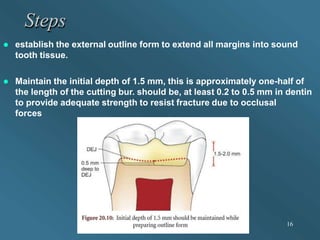
 establish the external outline form to extend all margins into sound
tooth tissue.
 Maintain the initial depth of 1.5 mm, this is approximately one-half of
the length of the cutting bur. should be, at least 0.2 to 0.5 mm in dentin
to provide adequate strength to resist fracture due to occlusal
forces
16
 Extend the margin mesially and distally but do not involve marginal
ridges. These walls should have dovetail shape to provide retention to
the restoration
17
 While working towards mesial and distal surface, orient
the bur towards respective marginal ridge. This will
result in slight divergence of mesial and distal walls
which helps to provide dentinal support for marginal
ridges
18
 The isthmus width should be as narrow as possible
 The deep pit and fissure defects less than 0.5 mm apart
should be included within the outline form.
 The external outline form should have smooth curves,
straight lines and rounded angles. All unsupported and
demineralized enamel should be removed.
19
Primary Resistance Form
20
 The shape given to a prepared tooth
cavity imparting strength and durability
to the masticatory dislodging forces of
a dental restoration and remaining
tooth structure.
21
Cavosurface margin
22
Resistance form
23
Reverse curve
Primary retention form
25
Class l designs
26
Class l, design 1
27
 Caries penetration into dentin does
not exceed 0.5-1mm
 Width- I/4 intercuspal distance
 Low caries index
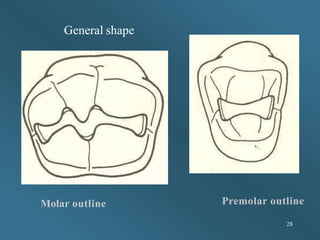
Molar outline
28
Premolar outline
General shape
Mesio distal cross section
• Pulpal Floor mesio-distally is flat and
perpendicular to the long axis of the tooth
30
31
Pulpal floor of
32
Lower premolar
Class l, design 2
33
Indication ; caries cones in dentin extend 1mm or more
from the DEJ
Pulpal floors have different levels
Mesiodistal cross section
34
Class l, design 3
Indication ; in occlusal one to two thirds of facial
and lingual surfaces of molars and on lingual surfaces
of anterior teeth
General shape
35
Internal anatomy
36
Class l, design 4
Applied to molars involving their occlusal surfaces,the
grooved part of the facial or lingual surfaces
37
--Pulpal wall elevated occlusaly
--Use in mandibular first molar
38
Class l, design 5 : Indications
 Occlusal surface, most of the facial or lingual surface
involved
 Occlusal surface is not conducive to retention of
restoration
 Location of m a rgins
 In occlusalcavity mesial
and distalm a rgins located at
Corresponding axialangles
 Gingivalm a rgins
 –gingivalthird of the facial
or lingual Surface
 Pulpal floor – internalboxes (mesialthird)
39
Mesio distal cross section
40
Class l
,design 6 :
Includes occlusal surfaces of molars or premolars
as well as portion of facial, proximal
or lingual surface in form of a table of an entire
cusp or section of cusp (marginal ridges )
Gingivalm a rgin should extend to allow
Occlusalclearance of 1.5-3 m m from
Opposing teeth
41
Class l, Design 7
 Involves occlusal , facial and lingual surfaces of
molars and premolars
 Pins and posts are indicated
42
Class l, design 8
 Endodontically treated tooth
 Pulp chamber is retention form
43
44
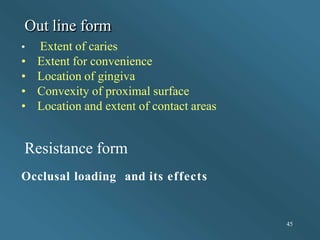
Out line form
45
• Extent of caries
• Extent for convenience
• Location of gingiva
• Convexity of proximal surface
• Location and extent of contact areas
Resistance form
Occlusal loading and its effects
Small cusps
Tensile stress
Compressive stress
Large cusps 46
Axial wall
47
Design features for the protection of mechanical integrity of
restoration
Reverse curve
48
49
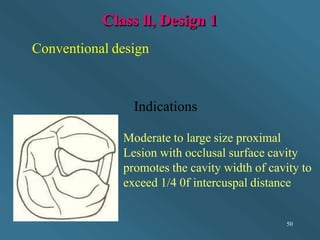
Class ll, Design 1
Conventional design
50
Indications
Moderate to large size proximal
Lesion with occlusal surface cavity
promotes the cavity width of cavity to
exceed 1/4 0f intercuspal distance
Proximal box
Inverted truncated shape
51
Tunnel preparation
52
Class ll, Design 2 (moderate design )
Indications
•Moderate to small sized proximal lesions
•In stress concentration area
•Width not exceeding 1/4 of intercuspal distance
General shape width 53
Bucco lingually
Mesiodistally 54
Class ll, Design 3 (conservative design )
•Involves primarily proximal surface and very limited part
of occlusal Surface, not extending beyond adjacent
triangular fossa
•Sound occlusal crossing ridges
•Minimal loading areas
General shape
Internal anatom55y
Gingival margin
Middle third
56
Gingival third
Class ll, Design 4 (Simple design )
•Proximal surface only
•Indications; Decay restricted to contacting or proximal
surface without undermining marginal ridges
Diastema or adjacent tooth is missing
57
Bucco-lingual
Cross section
58
Occlusal-gingival
Cross section
Class ll, Design 5
Part of proximal surface ,with a limited access area on facial
or lingual surface
1)Do not have dovetail
2) Have dovetail
Indications •:1)Preparation will have 4 surrounding walls
•small proximal lesions
•Marginal ridge intact
•Does not involve contact area
2) Preparation will not
have surrounding walls
•medium proximal lesion
59
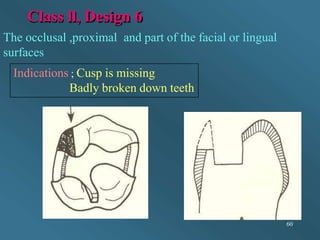
Class ll, Design 6
The occlusal ,proximal and part of the facial or lingual
surfaces
Indications ; Cusp is missing
Badly broken down teeth
60
Class ll, Design 7
ShapeA Shape B
(Combinations of class ll with class V )
ShapeA: junctions between the class ll and class V via, the
Proximal , crossing the axial angles
Shape B : via buccal / lingual groove
61
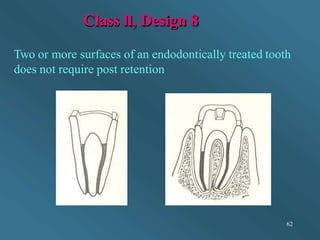
Class ll, Design 8
Two or more surfaces of an endodontically treated tooth
does not require post retention
62
Class lll
Amalgam is usually not indicated for anterior teeth due to
its esthetic , but distal surface of the cuspid is a unique
location
63
G e neralprinciples are similar to class l
l
cavity
preparation but with emphasis laid on in
areas of preparation
1 esthetic concern
2 extension for access
3stress consideration enamel rod direction
Incisalaccess
Designs of cavity preparation at the distal slope of
the cuspid
64
Indications;
1The lesion does not involve or undermine the distal
slope of cupid
2bulky walls will remain, incisally, after removal of
Undermine tissues
3 the labials axial angle is intact
4the restoration will be directly loaded by vertical
forces
Internal anatomy ;
Axial convex
Depth - .5
from DEJ
Retention
points :
Depth 1 to
2 mm in
dentin
65
Class lV
Indications :
•Incisal angle is undermined
•Labial and lingual walls intact
Labio lingual cross section
66
Modifications
67
Class V cavity
Involvement :smooth surfaces apical to height of contour
on facial and lingual surfaces of all teeth eg ; erosion,
abrasion , hypoplasia, aplasia
 Resistance and retention
 To minimize the effects of displacing
forces forces grooves occlusal and
gingival walls are essential
- cementum completely removed
- Gingival margins follow the curvature of
the furcation
68
•lesion are confined to
gingival third of the
facisal or lingual third
of the facial or lingual
surface
- axial angles intact
- no furcation
involvement
Class V design 1
69
70
Class V ,design 2
 Lesions on facial or lingual gingival third have
involved axial angle
 Lesion on facial or lingual gingival third are
apical to contact area
General shape
Mesiodistal cross section
71
Mesio distal
Occluso gingival 72
Class V Design 3
Indications;
Lesion on gingival third facially or linguallly is continuous
with isolated decalcifications or lesions occlusal to height of
contour
Bilateral extension 73
Class V Design 4
Multiple lesions in gingival third with sound tooth
structure separating them
General shape 74
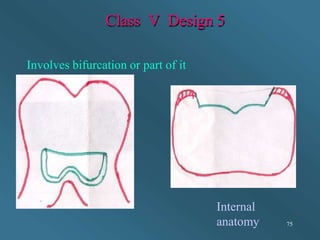
Class V Design 5
Internal
anatomy
Involves bifurcation or part of it
75
Class VI
76
Retention coves
77
Retention locks
78
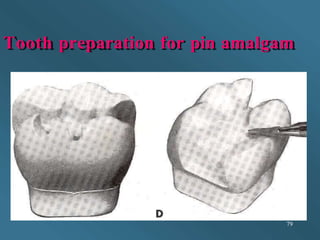
Tooth preparation for pin amalgam
79
Pin location
80
Cavosurface angle
81
Enamel –amalgam junction
82

cavity designs.pptx

  • 1.
    1 VARIOUS CAVITY DESIGNS FORAMALGAM RESTORATIONS Dr. SV.SATISH Professor & HOD Dept of Conservative Dentistry & Endodontics Navodaya Dental College
  • 2.
  • 3.
     Cavity 3 Line anglePoint angle  Class l 8 4  Class 2 11 6  M O D 14 8  Class l l l 6 3  Class lV 11 6  Class V 8 4
  • 4.
    There are manyangles in a cavity prepared cavity such as: 4
  • 5.
    Cavosurface angle This refersto the angle of the tooth structure formed by the junction of a prepared wall and the external tooth surface. 5
  • 6.
  • 7.
    Cavity 7  Simple cavity:only one tooth surface is involved.  Compound cavity: two surfaces are involved.  Complex cavity: three or more surfaces are involved.
  • 8.
  • 9.
    Classification of cavity 9 G.V .Black classification  Class l – pit and fissure restoration on occlusalsurface of premolar and -Restoration molars -Restoration on occlusaltw o thirds of facial and lingual surfaces of molars -Restoration on lingual surface of maxillary incisors
  • 10.
     Class ll–Restoration on proximal surfaces of posterior teeth  Class l l l- Restoration on proximal surfaces of anterior teeth that do not involve the incisal angle  Class lV -Restoration on proximal surfaces of anterior teeth that do involve the incisal angle  Class V – Restorations on the gingival third of the facial or lingual surfaces of all teeth  Class Vl – Restoration on the incisal edge of anterior teeth or the occlusalcusp heights of posterior teeth 10
  • 11.
  • 12.
    The four sizesof carious lesions 12  Size 1. Minimal involvement of dentine just beyond treatment by remineralization alone.  Size 2. Moderate involvement of dentine. sound,. That is, the remaining tooth structure is sufficiently strong to support the restoration .  Size 3. The cavity is enlarged beyond moderate.The remaining tooth structure is w e akened to the extent that cusps or incisal edges are split,  Size 4. Extensive caries with bulk loss of tooth structure has already occurred.
  • 13.
  • 14.
  • 15.
    Outline Form 15  meansextending the preparation margins to the place they will occupy in the final preparation  Removal of all carious and defective pits and fissures to healthy tooth structure  Removal of all unsupported enamel rods  To avoid ending preparation margins in high stress areas like cusp tip and crest of the ridges  Placing margins on sound tooth structure.
  • 16.
    Steps  establish theexternal outline form to extend all margins into sound tooth tissue.  Maintain the initial depth of 1.5 mm, this is approximately one-half of the length of the cutting bur. should be, at least 0.2 to 0.5 mm in dentin to provide adequate strength to resist fracture due to occlusal forces 16
  • 17.
     Extend themargin mesially and distally but do not involve marginal ridges. These walls should have dovetail shape to provide retention to the restoration 17
  • 18.
     While workingtowards mesial and distal surface, orient the bur towards respective marginal ridge. This will result in slight divergence of mesial and distal walls which helps to provide dentinal support for marginal ridges 18
  • 19.
     The isthmuswidth should be as narrow as possible  The deep pit and fissure defects less than 0.5 mm apart should be included within the outline form.  The external outline form should have smooth curves, straight lines and rounded angles. All unsupported and demineralized enamel should be removed. 19
  • 20.
  • 21.
     The shapegiven to a prepared tooth cavity imparting strength and durability to the masticatory dislodging forces of a dental restoration and remaining tooth structure. 21
  • 22.
  • 23.
  • 24.
  • 25.
  • 26.
  • 27.
    Class l, design1 27  Caries penetration into dentin does not exceed 0.5-1mm  Width- I/4 intercuspal distance  Low caries index
  • 28.
  • 29.
  • 30.
    • Pulpal Floormesio-distally is flat and perpendicular to the long axis of the tooth 30
  • 31.
  • 32.
  • 33.
    Class l, design2 33 Indication ; caries cones in dentin extend 1mm or more from the DEJ Pulpal floors have different levels
  • 34.
  • 35.
    Class l, design3 Indication ; in occlusal one to two thirds of facial and lingual surfaces of molars and on lingual surfaces of anterior teeth General shape 35
  • 36.
  • 37.
    Class l, design4 Applied to molars involving their occlusal surfaces,the grooved part of the facial or lingual surfaces 37
  • 38.
    --Pulpal wall elevatedocclusaly --Use in mandibular first molar 38
  • 39.
    Class l, design5 : Indications  Occlusal surface, most of the facial or lingual surface involved  Occlusal surface is not conducive to retention of restoration  Location of m a rgins  In occlusalcavity mesial and distalm a rgins located at Corresponding axialangles  Gingivalm a rgins  –gingivalthird of the facial or lingual Surface  Pulpal floor – internalboxes (mesialthird) 39
  • 40.
  • 41.
    Class l ,design 6: Includes occlusal surfaces of molars or premolars as well as portion of facial, proximal or lingual surface in form of a table of an entire cusp or section of cusp (marginal ridges ) Gingivalm a rgin should extend to allow Occlusalclearance of 1.5-3 m m from Opposing teeth 41
  • 42.
    Class l, Design7  Involves occlusal , facial and lingual surfaces of molars and premolars  Pins and posts are indicated 42
  • 43.
    Class l, design8  Endodontically treated tooth  Pulp chamber is retention form 43
  • 44.
  • 45.
    Out line form 45 •Extent of caries • Extent for convenience • Location of gingiva • Convexity of proximal surface • Location and extent of contact areas Resistance form Occlusal loading and its effects
  • 46.
  • 47.
    Axial wall 47 Design featuresfor the protection of mechanical integrity of restoration
  • 48.
  • 49.
  • 50.
    Class ll, Design1 Conventional design 50 Indications Moderate to large size proximal Lesion with occlusal surface cavity promotes the cavity width of cavity to exceed 1/4 0f intercuspal distance
  • 51.
  • 52.
  • 53.
    Class ll, Design2 (moderate design ) Indications •Moderate to small sized proximal lesions •In stress concentration area •Width not exceeding 1/4 of intercuspal distance General shape width 53
  • 54.
  • 55.
    Class ll, Design3 (conservative design ) •Involves primarily proximal surface and very limited part of occlusal Surface, not extending beyond adjacent triangular fossa •Sound occlusal crossing ridges •Minimal loading areas General shape Internal anatom55y
  • 56.
  • 57.
    Class ll, Design4 (Simple design ) •Proximal surface only •Indications; Decay restricted to contacting or proximal surface without undermining marginal ridges Diastema or adjacent tooth is missing 57
  • 58.
  • 59.
    Class ll, Design5 Part of proximal surface ,with a limited access area on facial or lingual surface 1)Do not have dovetail 2) Have dovetail Indications •:1)Preparation will have 4 surrounding walls •small proximal lesions •Marginal ridge intact •Does not involve contact area 2) Preparation will not have surrounding walls •medium proximal lesion 59
  • 60.
    Class ll, Design6 The occlusal ,proximal and part of the facial or lingual surfaces Indications ; Cusp is missing Badly broken down teeth 60
  • 61.
    Class ll, Design7 ShapeA Shape B (Combinations of class ll with class V ) ShapeA: junctions between the class ll and class V via, the Proximal , crossing the axial angles Shape B : via buccal / lingual groove 61
  • 62.
    Class ll, Design8 Two or more surfaces of an endodontically treated tooth does not require post retention 62
  • 63.
    Class lll Amalgam isusually not indicated for anterior teeth due to its esthetic , but distal surface of the cuspid is a unique location 63 G e neralprinciples are similar to class l l cavity preparation but with emphasis laid on in areas of preparation 1 esthetic concern 2 extension for access 3stress consideration enamel rod direction Incisalaccess
  • 64.
    Designs of cavitypreparation at the distal slope of the cuspid 64 Indications; 1The lesion does not involve or undermine the distal slope of cupid 2bulky walls will remain, incisally, after removal of Undermine tissues 3 the labials axial angle is intact 4the restoration will be directly loaded by vertical forces
  • 65.
    Internal anatomy ; Axialconvex Depth - .5 from DEJ Retention points : Depth 1 to 2 mm in dentin 65
  • 66.
    Class lV Indications : •Incisalangle is undermined •Labial and lingual walls intact Labio lingual cross section 66
  • 67.
  • 68.
    Class V cavity Involvement:smooth surfaces apical to height of contour on facial and lingual surfaces of all teeth eg ; erosion, abrasion , hypoplasia, aplasia  Resistance and retention  To minimize the effects of displacing forces forces grooves occlusal and gingival walls are essential - cementum completely removed - Gingival margins follow the curvature of the furcation 68
  • 69.
    •lesion are confinedto gingival third of the facisal or lingual third of the facial or lingual surface - axial angles intact - no furcation involvement Class V design 1 69
  • 70.
  • 71.
    Class V ,design2  Lesions on facial or lingual gingival third have involved axial angle  Lesion on facial or lingual gingival third are apical to contact area General shape Mesiodistal cross section 71
  • 72.
  • 73.
    Class V Design3 Indications; Lesion on gingival third facially or linguallly is continuous with isolated decalcifications or lesions occlusal to height of contour Bilateral extension 73
  • 74.
    Class V Design4 Multiple lesions in gingival third with sound tooth structure separating them General shape 74
  • 75.
    Class V Design5 Internal anatomy Involves bifurcation or part of it 75
  • 76.
  • 77.
  • 78.
  • 79.
    Tooth preparation forpin amalgam 79
  • 80.
  • 81.
  • 82.