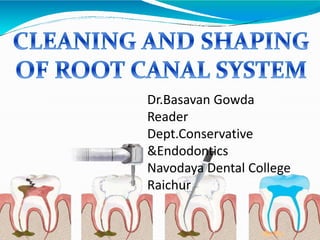
Dr.Basavan Gowda
Reader
Dept.Conservative
&Endodontics
Navodaya Dental College
Raichur
INTRODUCTION
Endodontic treatment mainly consists of three
steps:
1. Cleaning and shaping of root canal system
2.Disinfection
3.Obturation
What Is Cleaning And Shaping ?
Cleaning- It comprises the removal of all potentially pathogenic contents
from the root canal system.
Shaping- It is the establishment of a specifically shaped cavity which
performs the dual role of-
 three dimensional access into canal
Creating an apical preparation which will permit the final obturation
instruments to fit easily.
Objectives of Root Canal Preparation
(given by Schilder)
A.MECHANICAL OBJECTIVES
B.BIOLOGICAL OBJECTIVES
C.CLINICAL OBJECTIVES
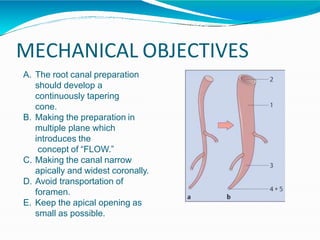
MECHANICAL OBJECTIVES
A. The root canal preparation
should develop a
continuously tapering
cone.
B. Making the preparation in
multiple plane which
introduces the
concept of “FLOW.”
C. Making the canal narrow
apically and widest coronally.
D. Avoid transportation of
foramen.
E. Keep the apical opening as
small as possible.
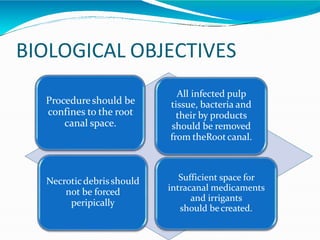
BIOLOGICAL OBJECTIVES
Procedureshould be
confines to the root
canal space.
All infected pulp
tissue, bacteria and
their by products
should be removed
from theRootcanal.
Necroticdebrisshould
not be forced
peripically
Sufficient space for
intracanal medicaments
and irrigants
should becreated.
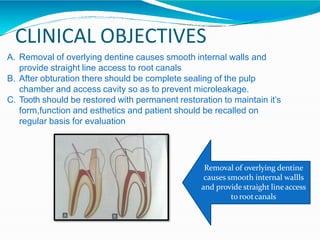
CLINICAL OBJECTIVES
A. Removal of overlying dentine causes smooth internal walls and
provide straight line access to root canals
B. After obturation there should be complete sealing of the pulp
chamber and access cavity so as to prevent microleakage.
C. Tooth should be restored with permanent restoration to maintain it’s
form,function and esthetics and patient should be recalled on
regular basis for evaluation
Removal of overlying dentine
causes smooth internal wallls
and provide straight lineaccess
to rootcanals
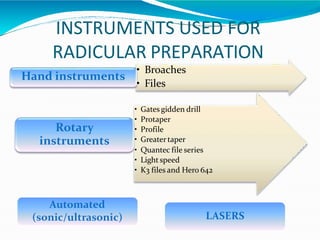
INSTRUMENTS USED FOR
RADICULAR PREPARATION
• Broaches
• Files
Hand instruments
• Gates gidden drill
• Protaper
• Profile
• Greatertaper
• Quantec file series
• Light speed
• K3 files and Hero 642
Rotary
instruments
LASERS
Automated
(sonic/ultrasonic)
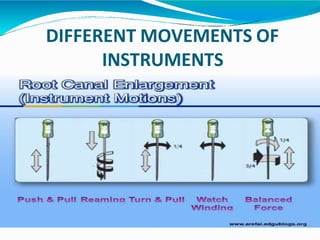
DIFFERENT MOVEMENTS OF
INSTRUMENTS
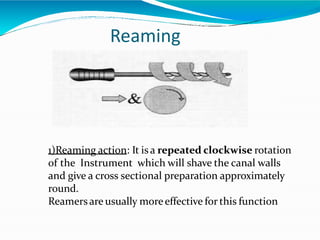
Reaming
1)Reaming action: It is a repeated clockwise rotation
of the Instrument which will shave the canal walls
and give a cross sectional preparation approximately
round.
Reamersare usually moreeffective for this function
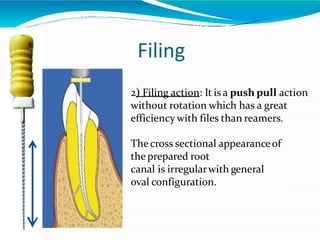
Filing
2) Filing action: It is a push pull action
without rotation which has a great
efficiency with files than reamers.
Thecross sectional appearanceof
theprepared root
canal is irregularwith general
oval configuration.
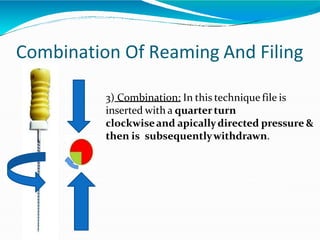
Combination Of Reaming And Filing
3) Combination: In this technique file is
inserted with a quarterturn
clockwiseand apicallydirected pressure &
then is subsequentlywithdrawn.
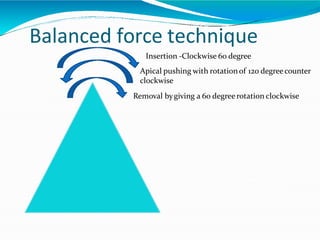
Balanced force technique
Insertion -Clockwise 60 degree
Apical pushing with rotationof 120 degreecounter
clockwise
Removal bygiving a 60 degree rotation clockwise
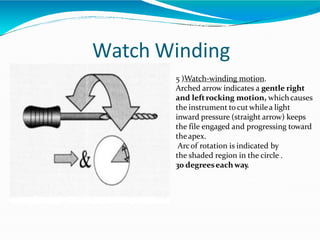
Watch Winding
5 )Watch-winding motion.
Arched arrow indicates a gentle right
and leftrocking motion, whichcauses
the instrument to cut whilea light
inward pressure (straight arrow) keeps
the file engaged and progressing toward
theapex.
Arcof rotation is indicated by
the shaded region in the circle .
30 degreeseachway.
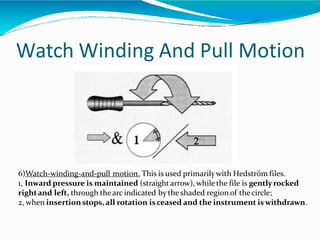
Watch Winding And Pull Motion
6)Watch-winding-and-pull motion. This is used primarilywith Hedström files.
1, Inward pressure is maintained (straight arrow), whilethe file is gentlyrocked
rightand left, through thearc indicated by theshaded regionof thecircle;
2, when insertionstops, all rotation is ceased and the instrument iswithdrawn.
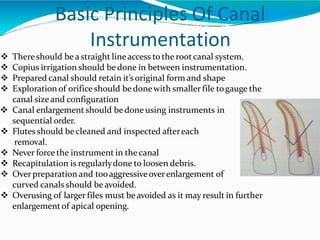
Basic Principles Of Canal
Instrumentation
 Thereshould bea straight lineaccess to the rootcanal system.
 Copius irrigation should bedone in between instrumentation.
 Prepared canal should retain it’soriginal form and shape
 Exploration of orificeshould be donewith smaller file togauge the
canal sizeand configuration
 Canal enlargement should bedone using instruments in
sequential order.
 Flutes should be cleaned and inspected aftereach
removal.
 Never force the instrument in thecanal
 Recapitulation is regularlydone to loosen debris.
 Overpreparation and tooaggressiveoverenlargement of
curved canals should beavoided.
 Overusing of larger files must beavoided as it may result in further
enlargementof apical opening.
Techniques Of Root Canal
Preparations
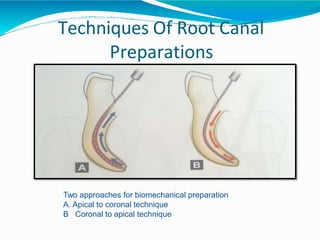
Two approaches for biomechanical preparation
A. Apical to coronal technique
B Coronal to apical technique
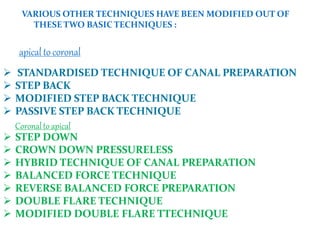
VARIOUS OTHER TECHNIQUES HAVE BEEN MODIFIED OUT OF
THESETWO BASIC TECHNIQUES :
apicaltocoronal
 STANDARDISED TECHNIQUE OF CANAL PREPARATION
 STEP BACK
 MODIFIED STEP BACK TECHNIQUE
 PASSIVE STEP BACK TECHNIQUE
Coronalto apical
 STEP DOWN
 CROWN DOWN PRESSURELESS
 HYBRID TECHNIQUE OF CANAL PREPARATION
 BALANCED FORCE TECHNIQUE
 REVERSE BALANCED FORCE PREPARATION
 DOUBLE FLARE TECHNIQUE
 MODIFIED DOUBLE FLARE TTECHNIQUE
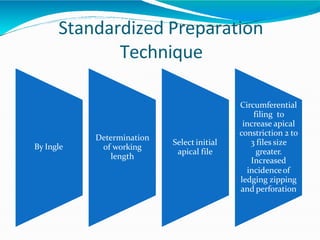
Standardized Preparation
Technique
By Ingle
Determination
of working
length
Select initial
apical file
Circumferential
filing to
increase apical
constriction 2 to
3 files size
greater.
Increased
incidenceof
ledging zipping
and perforation
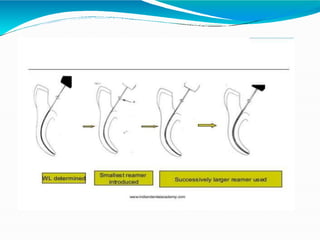
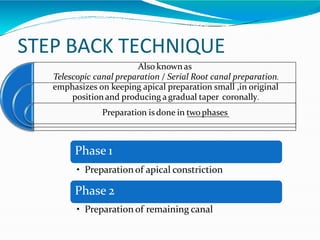
STEP BACK TECHNIQUE
Also known as
Telescopic canal preparation / Serial Root canal preparation.
emphasizes on keeping apical preparation small ,in original
positionand producing agradual taper coronally.
Preparation is done in twophases
Phase 1
• Preparation of apical constriction
Phase 2
• Preparation of remaining canal
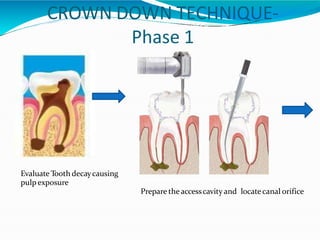
CROWN DOWN TECHNIQUE-
Phase 1
Evaluate Tooth decaycausing
pulp exposure
Prepare theaccesscavity and locatecanal orifice
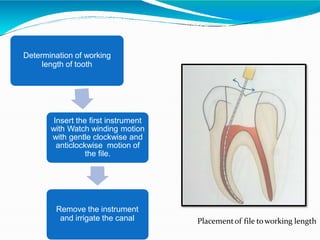
Determination of working
length of tooth
Insert the first instrument
with Watch winding motion
with gentle clockwise and
anticlockwise motion of
the file.
Remove the instrument
and irrigate the canal Placementof file toworking length
Remove intrumnt and irrigate the canal.
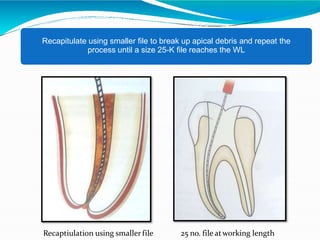
Recapitulate using smaller file to break up apical debris and repeat the
process until a size 25-K file reaches the WL
Recaptiulation using smaller file 25 no. file atworking length
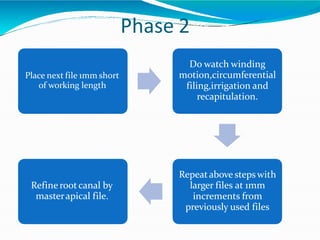
Phase 2
Place next file 1mm short
of working length
Do watch winding
motion,circumferential
filing,irrigation and
recapitulation.
Repeatabove stepswith
larger files at 1mm
increments from
previously used files
Refine rootcanal by
masterapical file.
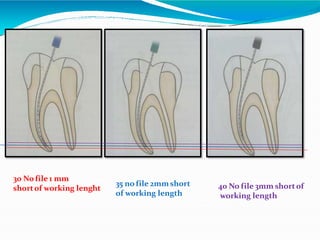
30 No file 1 mm
shortof working lenght
35 no file 2mm short
of working length
40 No file 3mm shortof
working length
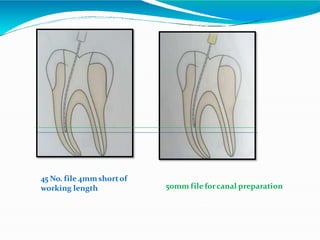
45 No. file 4mmshortof
working length 50mm file forcanal preparation
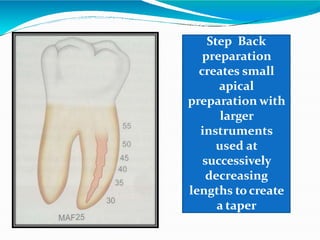
Step Back
preparation
creates small
apical
preparation with
larger
instruments
used at
successively
decreasing
lengths tocreate
a taper
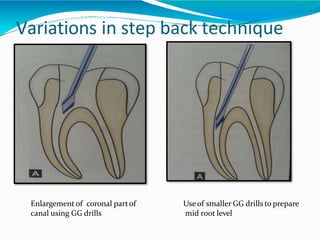
Variations in step back technique
Enlargement of coronal partof
canal using GG drills
Useof smaller GG drills to prepare
mid root level
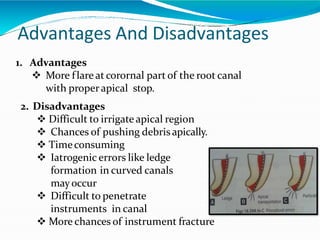
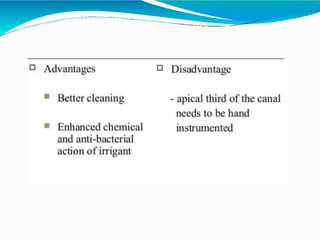
Advantages And Disadvantages
1. Advantages
 More flare at corornal part of the root canal
with properapical stop.
2. Disadvantages
 Difficult to irrigate apical region
 Chances of pushing debris apically.
 Timeconsuming
 Iatrogenic errors like ledge
formation in curved canals
mayoccur
 Difficult to penetrate
instruments in canal
 More chances of instrument fracture
Modified step back technique
Preparation is completed in apical third of canal
Step back procedure strted 2-3 mm short of apical
constriction so as to give an
almost parallel retention from apical area
This recieves the primary gutta percha point
which shows slight tug back ,when
point is removed.
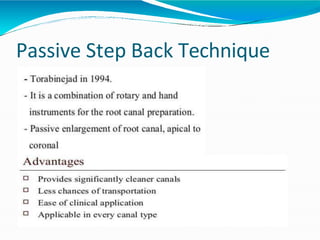
Passive Step Back Technique
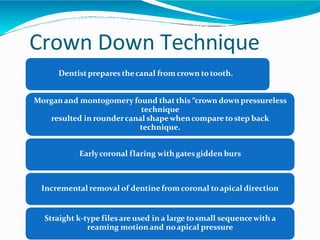
Crown Down Technique
Dentistprepares thecanal from crown to tooth.
Morganand montogomery found that this “crown down pressureless
technique
resulted in roundercanal shapewhencompare to step back
technique.
Earlycoronal flaring withgatesgidden burs
Incremental removal of dentinefrom coronal toapical direction
Straight k-type filesare used in a large tosmall sequencewith a
reaming motionand noapical pressure
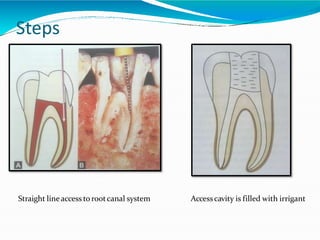
Steps
Straight lineaccess to rootcanal system Accesscavity is filled with irrigant
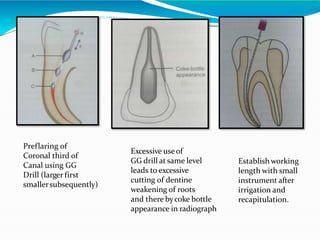
Preflaring of
Coronal third of
Canal using GG
Drill (larger first
smallersubsequently)
Excessive useof
GG drill at same level
leads to excessive
cutting of dentine
weakening of roots
and there bycoke bottle
appearance in radiograph
Establish working
length with small
instrument after
irrigation and
recapitulation.
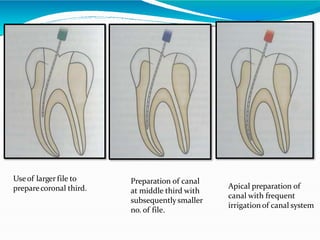
Useof larger file to
preparecoronal third.
Preparation of canal
at middle third with
subsequently smaller
no. of file.
Apical preparation of
canal with frequent
irrigation of canal system
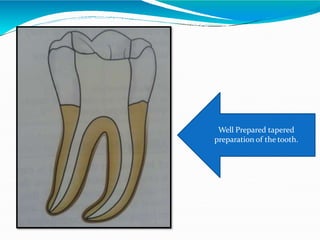
Well Prepared tapered
preparation of the tooth.
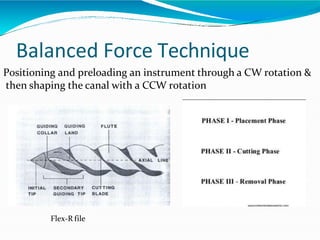
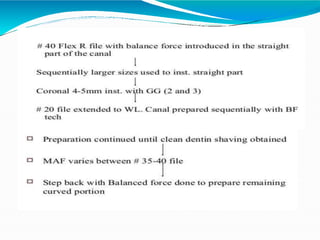
Balanced Force Technique
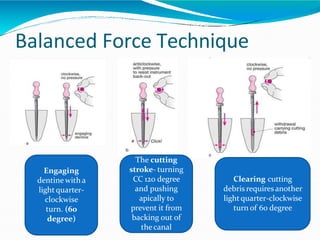
Positioning and preloading an instrument through a CW rotation &
then shaping the canal with a CCW rotation
Flex-R file
Balanced Force Technique
Engaging
dentine with a
lightquarter-
clockwise
turn. (60
degree)
The cutting
stroke- turning
CC 120 degree
and pushing
apically to
prevent it from
backing out of
thecanal
Clearing cutting
debris requires another
lightquarter-clockwise
turn of 60 degree
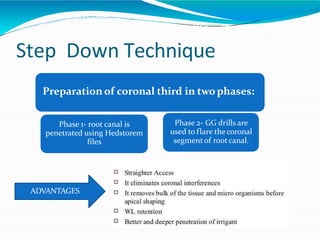
Step Down Technique
Preparation of coronal third in two phases:
Phase 1- root canal is
penetrated using Hedstorem
files
Phase 2- GG drills are
used to flare thecoronal
segmentof rootcanal.
ADVANTAGES
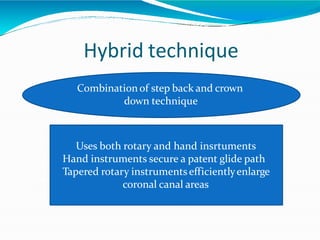
Hybrid technique
Combinationof step back and crown
down technique
Uses both rotary and hand insrtuments
Hand instruments secure a patent glide path
Tapered rotary instrumentsefficientlyenlarge
coronal canal areas
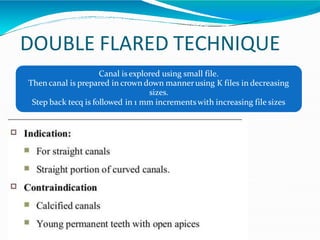
DOUBLE FLARED TECHNIQUE
Canal is explored using small file.
Then canal is prepared in crown down mannerusing K files in decreasing
sizes.
Step back tecq is followed in 1 mm incrementswith increasing file sizes
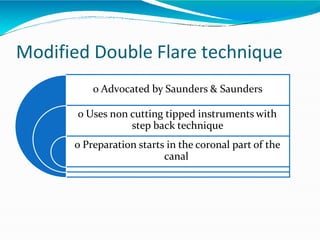
Modified Double Flare technique
o Advocated by Saunders & Saunders
o Uses non cutting tipped instruments with
step back technique
o Preparation starts in the coronal part of the
canal
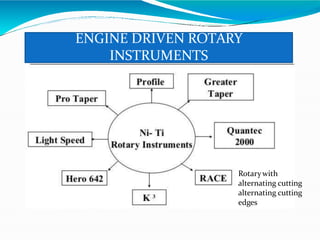
ENGINE DRIVEN ROTARY
INSTRUMENTS
Rotarywith
alternating cutting
alternating cutting
edges
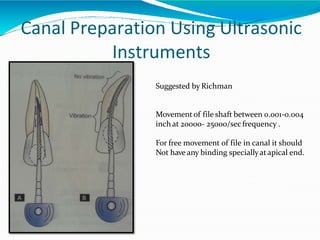
Canal Preparation Using Ultrasonic
Instruments
Suggested by Richman
Movementof file shaft between 0.001-0.004
inch at 20000- 25000/sec frequency .
For free movement of file in canal it should
Not have any binding speciallyatapical end.
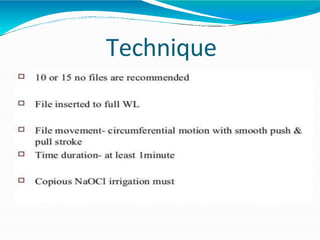
Technique
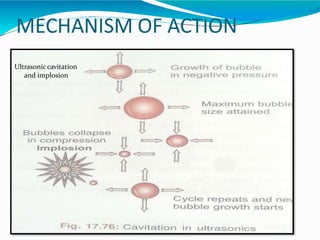
MECHANISM OF ACTION
Ultrasoniccavitation
and implosion
cleaningandshaping.pptx

cleaningandshaping.pptx

  • 1.
  • 2.
    INTRODUCTION Endodontic treatment mainlyconsists of three steps: 1. Cleaning and shaping of root canal system 2.Disinfection 3.Obturation
  • 3.
    What Is CleaningAnd Shaping ? Cleaning- It comprises the removal of all potentially pathogenic contents from the root canal system. Shaping- It is the establishment of a specifically shaped cavity which performs the dual role of-  three dimensional access into canal Creating an apical preparation which will permit the final obturation instruments to fit easily.
  • 4.
    Objectives of RootCanal Preparation (given by Schilder) A.MECHANICAL OBJECTIVES B.BIOLOGICAL OBJECTIVES C.CLINICAL OBJECTIVES
  • 5.
    MECHANICAL OBJECTIVES A. Theroot canal preparation should develop a continuously tapering cone. B. Making the preparation in multiple plane which introduces the concept of “FLOW.” C. Making the canal narrow apically and widest coronally. D. Avoid transportation of foramen. E. Keep the apical opening as small as possible.
  • 6.
    BIOLOGICAL OBJECTIVES Procedureshould be confinesto the root canal space. All infected pulp tissue, bacteria and their by products should be removed from theRootcanal. Necroticdebrisshould not be forced peripically Sufficient space for intracanal medicaments and irrigants should becreated.
  • 7.
    CLINICAL OBJECTIVES A. Removalof overlying dentine causes smooth internal walls and provide straight line access to root canals B. After obturation there should be complete sealing of the pulp chamber and access cavity so as to prevent microleakage. C. Tooth should be restored with permanent restoration to maintain it’s form,function and esthetics and patient should be recalled on regular basis for evaluation Removal of overlying dentine causes smooth internal wallls and provide straight lineaccess to rootcanals
  • 8.
    INSTRUMENTS USED FOR RADICULARPREPARATION • Broaches • Files Hand instruments • Gates gidden drill • Protaper • Profile • Greatertaper • Quantec file series • Light speed • K3 files and Hero 642 Rotary instruments LASERS Automated (sonic/ultrasonic)
  • 9.
  • 10.
    Reaming 1)Reaming action: Itis a repeated clockwise rotation of the Instrument which will shave the canal walls and give a cross sectional preparation approximately round. Reamersare usually moreeffective for this function
  • 11.
    Filing 2) Filing action:It is a push pull action without rotation which has a great efficiency with files than reamers. Thecross sectional appearanceof theprepared root canal is irregularwith general oval configuration.
  • 12.
    Combination Of ReamingAnd Filing 3) Combination: In this technique file is inserted with a quarterturn clockwiseand apicallydirected pressure & then is subsequentlywithdrawn.
  • 13.
    Balanced force technique Insertion-Clockwise 60 degree Apical pushing with rotationof 120 degreecounter clockwise Removal bygiving a 60 degree rotation clockwise
  • 14.
    Watch Winding 5 )Watch-windingmotion. Arched arrow indicates a gentle right and leftrocking motion, whichcauses the instrument to cut whilea light inward pressure (straight arrow) keeps the file engaged and progressing toward theapex. Arcof rotation is indicated by the shaded region in the circle . 30 degreeseachway.
  • 15.
    Watch Winding AndPull Motion 6)Watch-winding-and-pull motion. This is used primarilywith Hedström files. 1, Inward pressure is maintained (straight arrow), whilethe file is gentlyrocked rightand left, through thearc indicated by theshaded regionof thecircle; 2, when insertionstops, all rotation is ceased and the instrument iswithdrawn.
  • 16.
    Basic Principles OfCanal Instrumentation  Thereshould bea straight lineaccess to the rootcanal system.  Copius irrigation should bedone in between instrumentation.  Prepared canal should retain it’soriginal form and shape  Exploration of orificeshould be donewith smaller file togauge the canal sizeand configuration  Canal enlargement should bedone using instruments in sequential order.  Flutes should be cleaned and inspected aftereach removal.  Never force the instrument in thecanal  Recapitulation is regularlydone to loosen debris.  Overpreparation and tooaggressiveoverenlargement of curved canals should beavoided.  Overusing of larger files must beavoided as it may result in further enlargementof apical opening.
  • 17.
    Techniques Of RootCanal Preparations Two approaches for biomechanical preparation A. Apical to coronal technique B Coronal to apical technique
  • 18.
    VARIOUS OTHER TECHNIQUESHAVE BEEN MODIFIED OUT OF THESETWO BASIC TECHNIQUES : apicaltocoronal  STANDARDISED TECHNIQUE OF CANAL PREPARATION  STEP BACK  MODIFIED STEP BACK TECHNIQUE  PASSIVE STEP BACK TECHNIQUE Coronalto apical  STEP DOWN  CROWN DOWN PRESSURELESS  HYBRID TECHNIQUE OF CANAL PREPARATION  BALANCED FORCE TECHNIQUE  REVERSE BALANCED FORCE PREPARATION  DOUBLE FLARE TECHNIQUE  MODIFIED DOUBLE FLARE TTECHNIQUE
  • 19.
    Standardized Preparation Technique By Ingle Determination ofworking length Select initial apical file Circumferential filing to increase apical constriction 2 to 3 files size greater. Increased incidenceof ledging zipping and perforation
  • 21.
    STEP BACK TECHNIQUE Alsoknown as Telescopic canal preparation / Serial Root canal preparation. emphasizes on keeping apical preparation small ,in original positionand producing agradual taper coronally. Preparation is done in twophases Phase 1 • Preparation of apical constriction Phase 2 • Preparation of remaining canal
  • 22.
    CROWN DOWN TECHNIQUE- Phase1 Evaluate Tooth decaycausing pulp exposure Prepare theaccesscavity and locatecanal orifice
  • 23.
    Determination of working lengthof tooth Insert the first instrument with Watch winding motion with gentle clockwise and anticlockwise motion of the file. Remove the instrument and irrigate the canal Placementof file toworking length
  • 24.
    Remove intrumnt andirrigate the canal. Recapitulate using smaller file to break up apical debris and repeat the process until a size 25-K file reaches the WL Recaptiulation using smaller file 25 no. file atworking length
  • 25.
    Phase 2 Place nextfile 1mm short of working length Do watch winding motion,circumferential filing,irrigation and recapitulation. Repeatabove stepswith larger files at 1mm increments from previously used files Refine rootcanal by masterapical file.
  • 26.
    30 No file1 mm shortof working lenght 35 no file 2mm short of working length 40 No file 3mm shortof working length
  • 27.
    45 No. file4mmshortof working length 50mm file forcanal preparation
  • 28.
    Step Back preparation creates small apical preparationwith larger instruments used at successively decreasing lengths tocreate a taper
  • 29.
    Variations in stepback technique Enlargement of coronal partof canal using GG drills Useof smaller GG drills to prepare mid root level
  • 30.
    Advantages And Disadvantages 1.Advantages  More flare at corornal part of the root canal with properapical stop. 2. Disadvantages  Difficult to irrigate apical region  Chances of pushing debris apically.  Timeconsuming  Iatrogenic errors like ledge formation in curved canals mayoccur  Difficult to penetrate instruments in canal  More chances of instrument fracture
  • 31.
    Modified step backtechnique Preparation is completed in apical third of canal Step back procedure strted 2-3 mm short of apical constriction so as to give an almost parallel retention from apical area This recieves the primary gutta percha point which shows slight tug back ,when point is removed.
  • 32.
  • 33.
    Crown Down Technique Dentistpreparesthecanal from crown to tooth. Morganand montogomery found that this “crown down pressureless technique resulted in roundercanal shapewhencompare to step back technique. Earlycoronal flaring withgatesgidden burs Incremental removal of dentinefrom coronal toapical direction Straight k-type filesare used in a large tosmall sequencewith a reaming motionand noapical pressure
  • 34.
    Steps Straight lineaccess torootcanal system Accesscavity is filled with irrigant
  • 35.
    Preflaring of Coronal thirdof Canal using GG Drill (larger first smallersubsequently) Excessive useof GG drill at same level leads to excessive cutting of dentine weakening of roots and there bycoke bottle appearance in radiograph Establish working length with small instrument after irrigation and recapitulation.
  • 36.
    Useof larger fileto preparecoronal third. Preparation of canal at middle third with subsequently smaller no. of file. Apical preparation of canal with frequent irrigation of canal system
  • 37.
  • 38.
    Balanced Force Technique Positioningand preloading an instrument through a CW rotation & then shaping the canal with a CCW rotation Flex-R file
  • 39.
    Balanced Force Technique Engaging dentinewith a lightquarter- clockwise turn. (60 degree) The cutting stroke- turning CC 120 degree and pushing apically to prevent it from backing out of thecanal Clearing cutting debris requires another lightquarter-clockwise turn of 60 degree
  • 41.
    Step Down Technique Preparationof coronal third in two phases: Phase 1- root canal is penetrated using Hedstorem files Phase 2- GG drills are used to flare thecoronal segmentof rootcanal. ADVANTAGES
  • 42.
    Hybrid technique Combinationof stepback and crown down technique Uses both rotary and hand insrtuments Hand instruments secure a patent glide path Tapered rotary instrumentsefficientlyenlarge coronal canal areas
  • 43.
    DOUBLE FLARED TECHNIQUE Canalis explored using small file. Then canal is prepared in crown down mannerusing K files in decreasing sizes. Step back tecq is followed in 1 mm incrementswith increasing file sizes
  • 44.
    Modified Double Flaretechnique o Advocated by Saunders & Saunders o Uses non cutting tipped instruments with step back technique o Preparation starts in the coronal part of the canal
  • 46.
  • 47.
    Canal Preparation UsingUltrasonic Instruments Suggested by Richman Movementof file shaft between 0.001-0.004 inch at 20000- 25000/sec frequency . For free movement of file in canal it should Not have any binding speciallyatapical end.
  • 48.
  • 49.