Smile Design Dr. Shari S R
Dept. of Prosthodontics
GDC - TVM
2
 Introduction
 Definitions and classification
 Components of esthetic smiling
 Properties of color
 Perceptual aspects – the art of illusion
 Shade selection
 Esthetic treatment planning
 Esthetic contouring of teeth
 Esthetics with composites
Index
3
Contents
Esthetic with Ceramics Esthetic with veneers Esthetic with componeers
Dental bleaching Perio, Implant esthetics
Recent advances in smile designing
Review of literature
Conclusion
4
Introduction
The focus of dentistry in
the present times is not only
the prevention and treatment
of diseases but on meeting
the demands for better
esthetics.
Esthetic dentistry is emerging
as one of the most progressive
and challenging branches of
this field
But every person is not fortunate enough to
have a beautiful smile. The answer to the
above problem is the esthetic dentistry
5
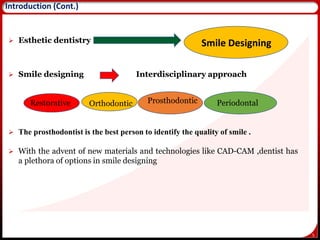
 Esthetic dentistry
 Smile designing Interdisciplinary approach
 The prosthodontist is the best person to identify the quality of smile .
 With the advent of new materials and technologies like CAD-CAM ,dentist has
a plethora of options in smile designing
Introduction (Cont.)
Smile Designing
Restorative Orthodontic Prosthodontic Periodontal
6
Esthetics (ADJ. 1798)
The branch of philosophy dealing with beauty.
Dental Esthetics
The application of the principles of esthetics to the natural or artificial
teeth and restorations.
(GPT 1999)
Definitions
7
Smile designing
Is a process whereby the complete oral hard and soft
tissues are studied and evaluated, and certain changes
are brought about which will have a positive influence on
the overall esthetics of the face. These changes are
governed by the principles of esthetic dentistry.
8
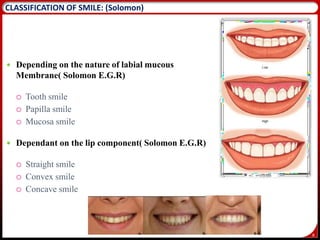
CLASSIFICATION OF SMILE: (Solomon)
 Depending on the nature of labial mucous
Membrane( Solomon E.G.R)
 Tooth smile
 Papilla smile
 Mucosa smile
 Dependant on the lip component( Solomon E.G.R)
 Straight smile
 Convex smile
 Concave smile
9
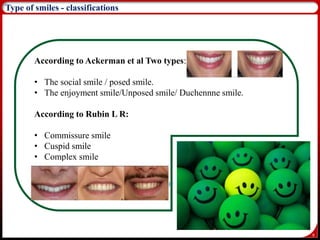
Type of smiles - classifications
According to Ackerman et al Two types:
• The social smile / posed smile.
• The enjoyment smile/Unposed smile/ Duchennne smile.
According to Rubin L R:
• Commissure smile
• Cuspid smile
• Complex smile
10
Type of smiles – classifications (Cont.)
According to Edward 4 stages of smile:
Stage I : Lips closed
Stage II: Resting display
Stage III: Natural smile
Stage IV: Expanded smile.
According to Edward Types of smile:
Type I: Maxillary only
Type II: Maxillary and 3mm gingiva
Type III: Mandibular only
Type IV:Maxillary and mandibular
Type V: Neither Maxillary nor Mandibular.
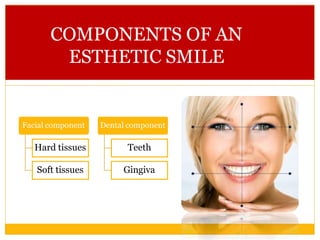
COMPONENTS OF AN
ESTHETIC SMILE
Facial component
Hard tissues
Soft tissues
Dental component
Teeth
Gingiva
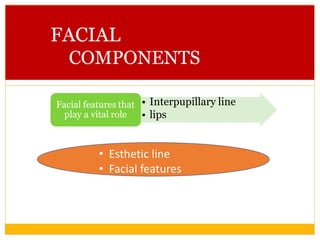
FACIAL
COMPONENTS
Facial component
• Interpupillary line
• lips
Facial features that
play a vital role
• Esthetic line
• Facial features
13
16
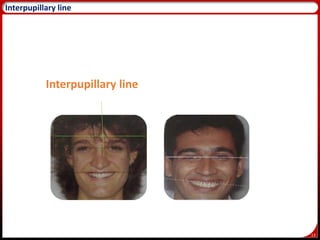
Interpupillary line
Interpupillary line
14
16
 LIP MORPHOLOGY
• Width
• Fullness
• Symmetry
 LIP MOBILITY
 Ideal
 3mm gingival display
 Gummy smile
Lips
15
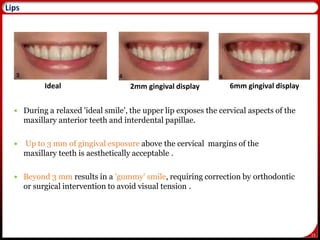
 During a relaxed 'ideal smile', the upper lip exposes the cervical aspects of the
maxillary anterior teeth and interdental papillae.
 Up to 3 mm of gingival exposure above the cervical margins of the
maxillary teeth is aesthetically acceptable .
 Beyond 3 mm results in a 'gummy' smile, requiring correction by orthodontic
or surgical intervention to avoid visual tension .
17
Ideal 2mm gingival display 6mm gingival display
Lips
16
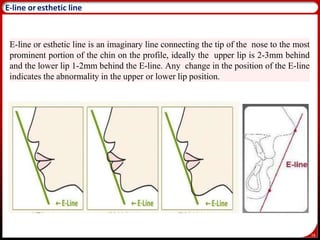
E-line or esthetic line is an imaginary line connecting the tip of the nose to the most
prominent portion of the chin on the profile, ideally the upper lip is 2-3mm behind
and the lower lip 1-2mm behind the E-line. Any change in the position of the E-line
indicates the abnormality in the upper or lower lip position.
19
E-line or esthetic line
17
• Facial width
• Facial height
Facial features in smile design
• Facial shape
• Facial profile.
18
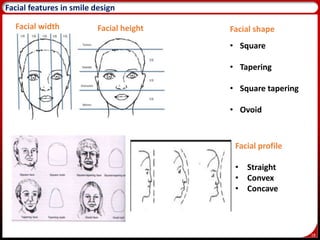
Facial width Facial height Facial shape
• Square
• Tapering
• Square tapering
• Ovoid
Facial profile
• Straight
• Convex
• Concave
Facial features in smile design
19
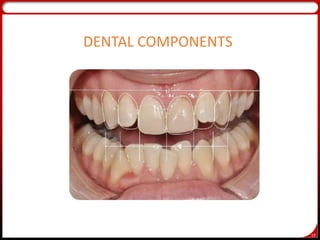
DENTAL COMPONENTS
20
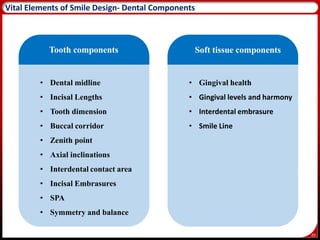
Vital Elements of Smile Design- Dental Components
Tooth components
• Dental midline
• Incisal Lengths
• Tooth dimension
• Buccal corridor
• Zenith point
• Axial inclinations
• Interdental contact area
• Incisal Embrasures
• SPA
• Symmetry and balance
Soft tissue components
• Gingival health
• Gingival levels and harmony
• Interdental embrasure
• Smile Line
21
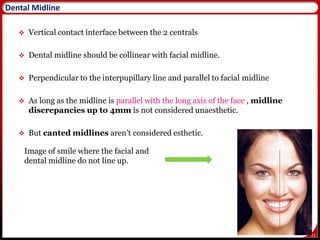
 Vertical contact interface between the 2 centrals
 Dental midline should be collinear with facial midline.
 Perpendicular to the interpupillary line and parallel to facial midline
 As long as the midline is parallel with the long axis of the face , midline
discrepancies up to 4mm is not considered unaesthetic.
 But canted midlines aren’t considered esthetic.
Image of smile where the facial and
dental midline do not line up.
21
Dental Midline
22
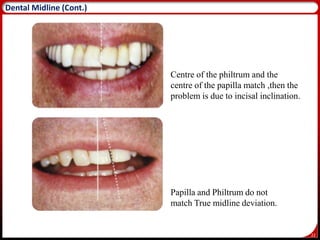
Centre of the philtrum and the
centre of the papilla match ,then the
problem is due to incisal inclination.
Papilla and Philtrum do not
match True midline deviation.
22
Dental Midline (Cont.)
23
Incisal lengths( edge position)
• Most important determinant in smile creation.
• It serves as a reference point for establishing the proper tooth proportion
and gingival levels.
IMPORTANT PARAMETERS
 Degree of tooth display.
 Phonetics.
 Patient input.
24
Degree of tooth display
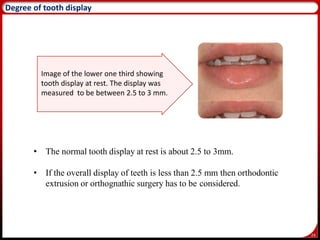
Image of the lower one third showing
tooth display at rest. The display was
measured to be between 2.5 to 3 mm.
• The normal tooth display at rest is about 2.5 to 3mm.
• If the overall display of teeth is less than 2.5 mm then orthodontic
extrusion or orthognathic surgery has to be considered.
25
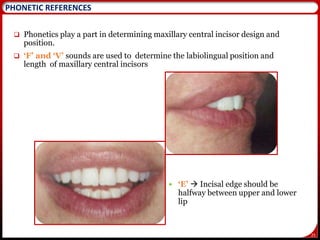
PHONETIC REFERENCES
 ‘E’  Incisal edge should be
halfway between upper and lower
lip
 Phonetics play a part in determining maxillary central incisor design and
position.
 ‘F’ and ‘V’ sounds are used to determine the labiolingual position and
length of maxillary central incisors
26
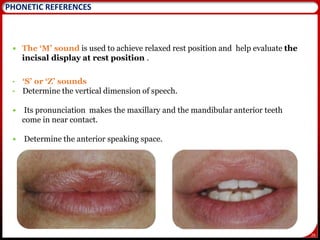
 The ‘M’ sound is used to achieve relaxed rest position and help evaluate the
incisal display at rest position .
• ‘S’ or ‘Z’ sounds
• Determine the vertical dimension of speech.
 Its pronunciation makes the maxillary and the mandibular anterior teeth
come in near contact.
 Determine the anterior speaking space.
26
PHONETIC REFERENCES
27
TOOTH DIMENSIONS
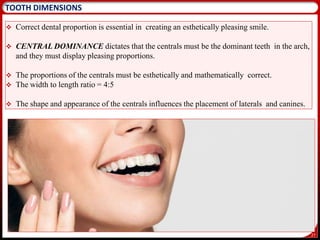
 Correct dental proportion is essential in creating an esthetically pleasing smile.
 CENTRAL DOMINANCE dictates that the centrals must be the dominant teeth in the arch,
and they must display pleasing proportions.
 The proportions of the centrals must be esthetically and mathematically correct.
 The width to length ratio = 4:5
 The shape and appearance of the centrals influences the placement of laterals and canines.
28
Guidelines for correct proportions.
Recurring esthetic
dental proportion
(Ward)
Golden proportion
(Lombardi)
M Proportion
(Methot)
CHU’S Esthetic
gauge
29
Golden Proportion
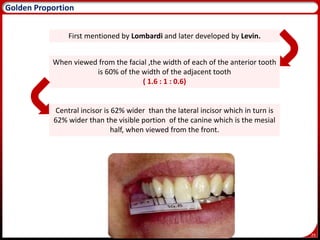
First mentioned by Lombardi and later developed by Levin.
When viewed from the facial ,the width of each of the anterior tooth
is 60% of the width of the adjacent tooth
( 1.6 : 1 : 0.6)
Central incisor is 62% wider than the lateral incisor which in turn is
62% wider than the visible portion of the canine which is the mesial
half, when viewed from the front.
30
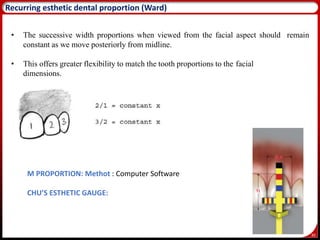
Recurring esthetic dental proportion (Ward)
• The successive width proportions when viewed from the facial aspect should remain
constant as we move posteriorly from midline.
• This offers greater flexibility to match the tooth proportions to the facial
dimensions.
M PROPORTION: Methot : Computer Software
CHU’S ESTHETIC GAUGE:
31
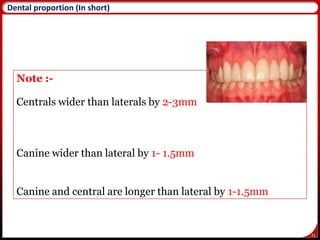
Note :-
Centrals wider than laterals by 2-3mm
Canine wider than lateral by 1- 1.5mm
Canine and central are longer than lateral by 1-1.5mm
Dental proportion (In short)
32
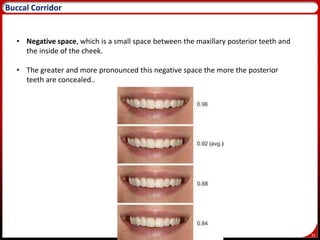
Buccal Corridor
• Negative space, which is a small space between the maxillary posterior teeth and
the inside of the cheek.
• The greater and more pronounced this negative space the more the posterior
teeth are concealed..
33
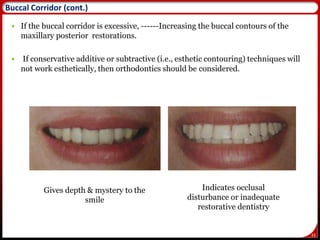
 If the buccal corridor is excessive, ------Increasing the buccal contours of the
maxillary posterior restorations.
 If conservative additive or subtractive (i.e., esthetic contouring) techniques will
not work esthetically, then orthodontics should be considered.
Gives depth & mystery to the
smile
Indicates occlusal
disturbance or inadequate
restorative dentistry
34
Buccal Corridor (cont.)
34
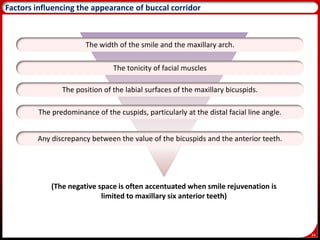
Factors influencing the appearance of buccal corridor
(The negative space is often accentuated when smile rejuvenation is
limited to maxillary six anterior teeth)
The width of the smile and the maxillary arch.
The tonicity of facial muscles
The position of the labial surfaces of the maxillary bicuspids.
The predominance of the cuspids, particularly at the distal facial line angle.
Any discrepancy between the value of the bicuspids and the anterior teeth.
35
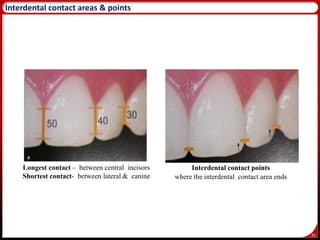
Interdental contact areas & points
Longest contact – between central incisors
Shortest contact- between lateral & canine
Interdental contact points
where the interdental contact area ends
36
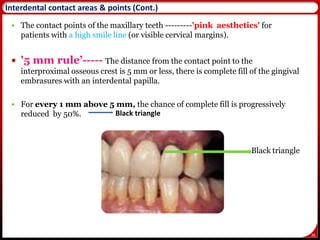
 The contact points of the maxillary teeth ---------'pink aesthetics' for
patients with a high smile line (or visible cervical margins).
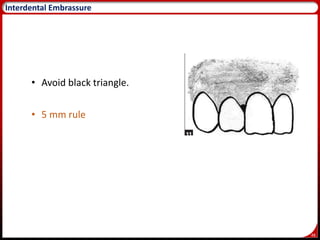
 '5 mm rule’----- The distance from the contact point to the
interproximal osseous crest is 5 mm or less, there is complete fill of the gingival
embrasures with an interdental papilla.
 For every 1 mm above 5 mm, the chance of complete fill is progressively
reduced by 50%.
Black triangle
36
Black triangle
Interdental contact areas & points (Cont.)
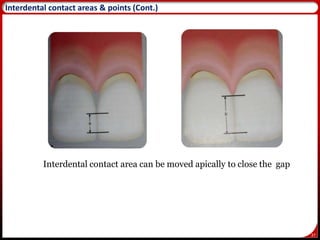
37
Interdental contact area can be moved apically to close the gap
37
Interdental contact areas & points (Cont.)
38
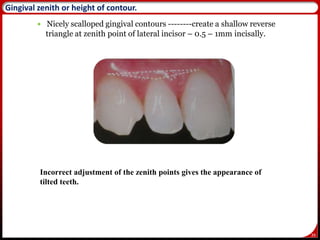
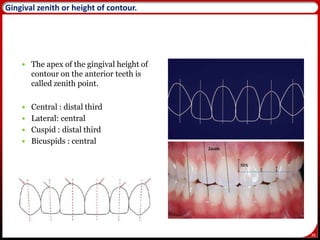
Gingival zenith or height of contour.
 The apex of the gingival height of
contour on the anterior teeth is
called zenith point.
 Central : distal third
 Lateral: central
 Cuspid : distal third
 Bicuspids : central
39
 Nicely scalloped gingival contours --------create a shallow reverse
triangle at zenith point of lateral incisor – 0.5 – 1mm incisally.
39
Incorrect adjustment of the zenith points gives the appearance of
tilted teeth.
Gingival zenith or height of contour.
40
Incisal embrasures
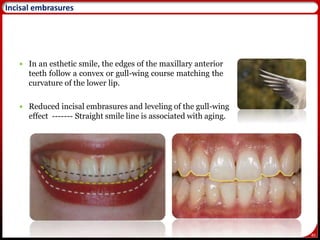
 In an esthetic smile, the edges of the maxillary anterior
teeth follow a convex or gull-wing course matching the
curvature of the lower lip.
 Reduced incisal embrasures and leveling of the gull-wing
effect ------- Straight smile line is associated with aging.
41
Incisal embrasures
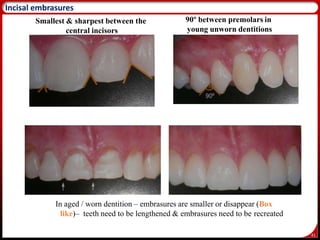
90º between premolars in
young unworn dentitions
In aged / worn dentition – embrasures are smaller or disappear (Box
like)– teeth need to be lengthened & embrasures need to be recreated
41
Smallest & sharpest between the
central incisors
42
Tooth inclination
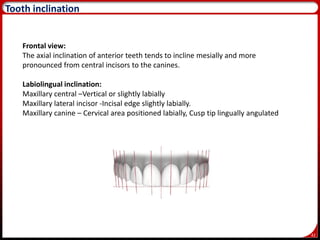
Frontal view:
The axial inclination of anterior teeth tends to incline mesially and more
pronounced from central incisors to the canines.
Labiolingual inclination:
Maxillary central –Vertical or slightly labially
Maxillary lateral incisor -Incisal edge slightly labially.
Maxillary canine – Cervical area positioned labially, Cusp tip lingually angulated
43
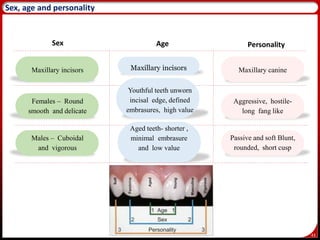
Sex, age and personality
Maxillary incisors
Females – Round
smooth and delicate
Males – Cuboidal
and vigorous
Youthful teeth unworn
incisal edge, defined
embrasures, high value
Aged teeth- shorter ,
minimal embrasure
and low value
Maxillary canine
Aggressive, hostile-
long fang like
Passive and soft Blunt,
rounded, short cusp
Sex Age Personality
Maxillary incisors
44
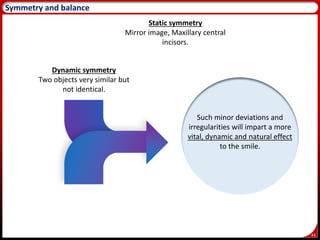
Symmetry and balance
Static symmetry
Mirror image, Maxillary central
incisors.
Dynamic symmetry
Two objects very similar but
not identical.
Such minor deviations and
irregularities will impart a more
vital, dynamic and natural effect
to the smile.
45
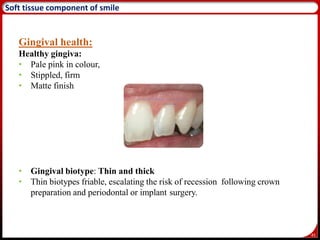
Soft tissue component of smile
Gingival health:
Healthy gingiva:
• Pale pink in colour,
• Stippled, firm
• Matte finish
• Gingival biotype: Thin and thick
• Thin biotypes friable, escalating the risk of recession following crown
preparation and periodontal or implant surgery.
46
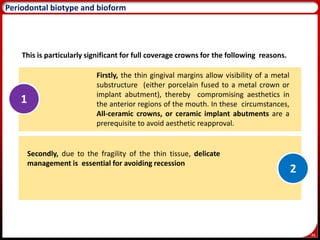
Periodontal biotype and bioform
This is particularly significant for full coverage crowns for the following reasons.
Firstly, the thin gingival margins allow visibility of a metal
substructure (either porcelain fused to a metal crown or
implant abutment), thereby compromising aesthetics in
the anterior regions of the mouth. In these circumstances,
All-ceramic crowns, or ceramic implant abutments are a
prerequisite to avoid aesthetic reapproval.
Secondly, due to the fragility of the thin tissue, delicate
management is essential for avoiding recession
1
2
47
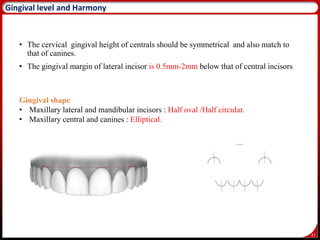
Gingival level and Harmony
• The cervical gingival height of centrals should be symmetrical and also match to
that of canines.
• The gingival margin of lateral incisor is 0.5mm-2mm below that of central incisors
Gingival shape
• Maxillary lateral and mandibular incisors : Half oval /Half circular.
• Maxillary central and canines : Elliptical.
48
Interdental Embrassure
• Avoid black triangle.
• 5 mm rule
49
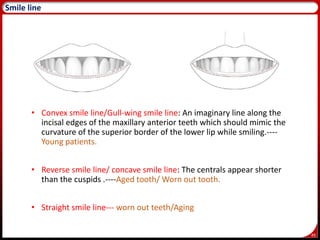
Smile line
• Convex smile line/Gull-wing smile line: An imaginary line along the
incisal edges of the maxillary anterior teeth which should mimic the
curvature of the superior border of the lower lip while smiling.----
Young patients.
• Reverse smile line/ concave smile line: The centrals appear shorter
than the cuspids .----Aged tooth/ Worn out tooth.
• Straight smile line--- worn out teeth/Aging
50
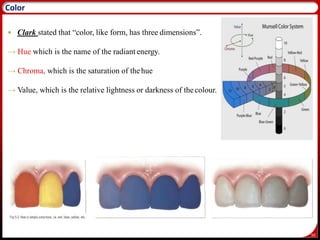
Color
 Clark stated that “color, like form, has three dimensions”.
→ Hue which is the name of the radiant energy.
→ Chroma, which is the saturation of thehue
→ Value, which is the relative lightness or darkness of thecolour.
51
Properties of Colour
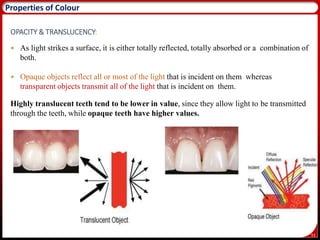
OPACITY & TRANSLUCENCY:
 As light strikes a surface, it is either totally reflected, totally absorbed or a combination of
both.
 Opaque objects reflect all or most of the light that is incident on them whereas
transparent objects transmit all of the light that is incident on them.
Highly translucent teeth tend to be lower in value, since they allow light to be transmitted
through the teeth, while opaque teeth have higher values.
52
Metamerism
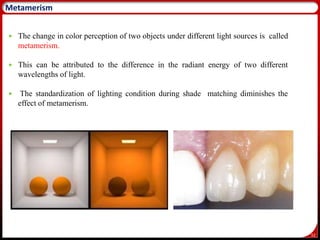
 The change in color perception of two objects under different light sources is called
metamerism.
 This can be attributed to the difference in the radiant energy of two different
wavelengths of light.
 The standardization of lighting condition during shade matching diminishes the
effect of metamerism.
53
Fluorescence
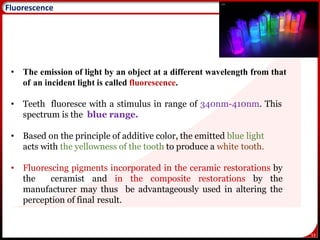
• The emission of light by an object at a different wavelength from that
of an incident light is called fluorescence.
• Teeth fluoresce with a stimulus in range of 340nm-410nm. This
spectrum is the blue range.
• Based on the principle of additive color, the emitted blue light
acts with the yellowness of the tooth to produce a white tooth.
• Fluorescing pigments incorporated in the ceramic restorations by
the ceramist and in the composite restorations by the
manufacturer may thus be advantageously used in altering the
perception of final result.
54
Principles of Shade Selection
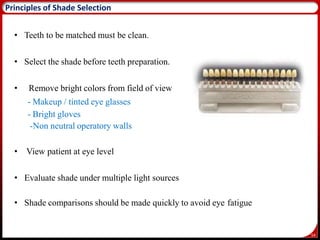
• Teeth to be matched must be clean.
• Select the shade before teeth preparation.
• Remove bright colors from field of view
- Makeup / tinted eye glasses
- Bright gloves
-Non neutral operatory walls
• View patient at eye level
• Evaluate shade under multiple light sources
• Shade comparisons should be made quickly to avoid eye fatigue
55
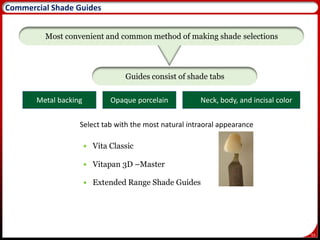
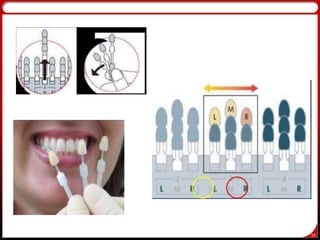
Commercial Shade Guides
 Vita Classic
 Vitapan 3D –Master
 Extended Range Shade Guides
Most convenient and common method of making shade selections
Guides consist of shade tabs
Metal backing Opaque porcelain Neck, body, and incisal color
Select tab with the most natural intraoral appearance
56
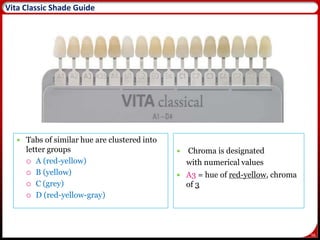
Vita Classic Shade Guide
 Tabs of similar hue are clustered into
letter groups
 A (red-yellow)
 B (yellow)
 C (grey)
 D (red-yellow-gray)
 Chroma is designated
with numerical values
 A3 = hue of red-yellow, chroma
of 3
57
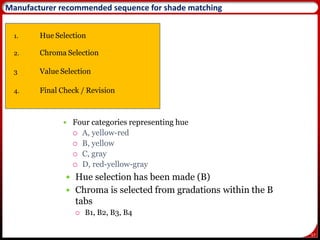
Manufacturer recommended sequence for shade matching
1. Hue Selection
2. Chroma Selection
3. Value Selection
4. Final Check / Revision
 Four categories representing hue
 A, yellow-red
 B, yellow
 C, gray
 D, red-yellow-gray
 Hue selection has been made (B)
 Chroma is selected from gradations within the B
tabs
 B1, B2, B3, B4
58
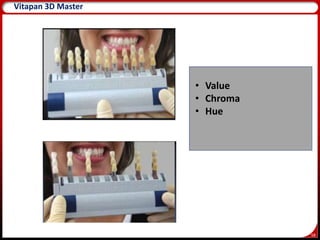
Vitapan 3D Master
• Value
• Chroma
• Hue
59
60
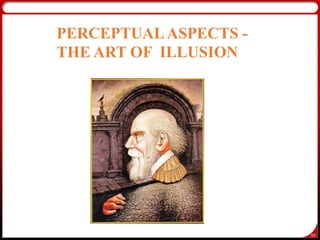
PERCEPTUALASPECTS -
THE ART OF ILLUSION
61
PERCEPTUALASPECTS - THE ART OF ILLUSION
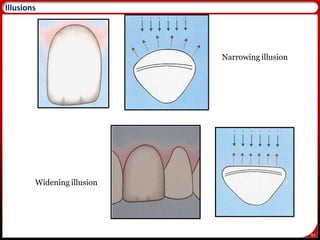
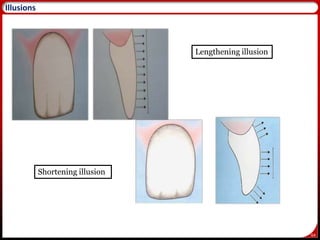
The art of creating illusion consists of changing
perception, to cause an object to appear different
from what it is.
Teeth can be made to appear smaller, larger, wider,
narrower, shorter, longer, younger, older, masculine
or feminine.
62
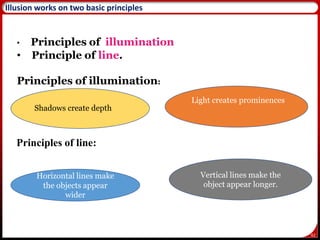
• Principles of illumination
• Principle of line.
Principles of illumination:
.
Principles of line:
63
Illusion works on two basic principles
Shadows create depth
Light creates prominences
Horizontal lines make
the objects appear
wider
Vertical lines make the
object appear longer.
63
Narrowing illusion
Widening illusion
64
Illusions
64
Lengthening illusion
Shortening illusion
65
Illusions
65
ESTHETIC DIAGNOSIS AND
TREATMENT PLANNING
66
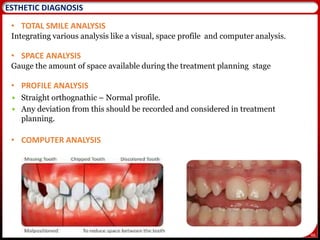
ESTHETIC DIAGNOSIS
• TOTAL SMILE ANALYSIS
Integrating various analysis like a visual, space profile and computer analysis.
• SPACE ANALYSIS
Gauge the amount of space available during the treatment planning stage
• PROFILE ANALYSIS
 Straight orthognathic – Normal profile.
 Any deviation from this should be recorded and considered in treatment
planning.
• COMPUTER ANALYSIS
67
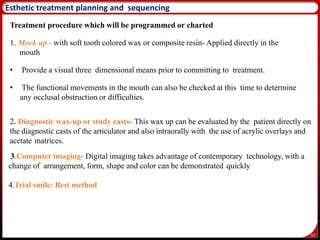
Esthetic treatment planning and sequencing
Treatment procedure which will be programmed or charted
1. Mock up - with soft tooth colored wax or composite resin- Applied directly in the
mouth
• Provide a visual three dimensional means prior to committing to treatment.
• The functional movements in the mouth can also be checked at this time to determine
any occlusal obstruction or difficulties.
2. Diagnostic wax-up or study casts- This wax up can be evaluated by the patient directly on
the diagnostic casts of the articulator and also intraorally with the use of acrylic overlays and
acetate matrices.
3.Computer imaging- Digital imaging takes advantage of contemporary technology, with a
change of arrangement, form, shape and color can be demonstrated quickly
4.Trial smile: Best method
68
TREATMENT
69
ESTHETIC CONTOURING
INDICATIONS
 Alteration of tooth structure
 Correction of
developmental anomalies
 Minor orthodontic problems
 Removal of stains & discolorations
CONTRAINDICATIONS
 Hypersensitivity of teeth.
 Large pulp canals
 Thin enamel
 Deeply pigmented stains
 Susceptibility to caries
 Extensive anterior crowding &
occlusal disharmony
70
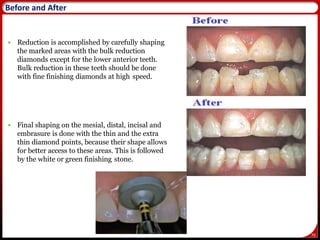
 Reduction is accomplished by carefully shaping
the marked areas with the bulk reduction
diamonds except for the lower anterior teeth.
Bulk reduction in these teeth should be done
with fine finishing diamonds at high speed.
 Final shaping on the mesial, distal, incisal and
embrasure is done with the thin and the extra
thin diamond points, because their shape allows
for better access to these areas. This is followed
by the white or green finishing stone.
71
Before and After
71
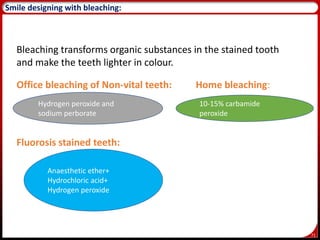
Smile designing with bleaching:
Bleaching transforms organic substances in the stained tooth
and make the teeth lighter in colour.
Office bleaching of Non-vital teeth: Home bleaching:
Fluorosis stained teeth:
Hydrogen peroxide and
sodium perborate
10-15% carbamide
peroxide
Anaesthetic ether+
Hydrochloric acid+
Hydrogen peroxide
72
Quick, esthetic, economical.
 Preserve sound tooth structure
 Can be placed directly onto the tooth surface
 It is a conservative restoration
 Can easily change the emergence profile and angle
 Can alter the shapes and length of the tooth
 Can close diastema.
 Can be repaired easily
 Can be polished and repolished to a high shine
 Long lasting
• Not expensive treatment option
Smile designing with composites
73
Disadvantages of direct composites.
 Can chip and break
 Can discolor if older composite used
 Can develop marginal leakage (Walls 1988)
 Can pick up stain easily in those patients who smoke and have poor oral
hygiene
74
Considerations for preparation design for anterior teeth
• Preparation design for composite resins do not follow a prescribed
pattern : Make it as conservative as possible, leaving as much enamel
as possible for effective bonding.
• The preparation design for anterior composite restorations should
encompass
1. Elimination of decay,
2. Function and longevity and
3. Esthetic predictability.
EFE
75
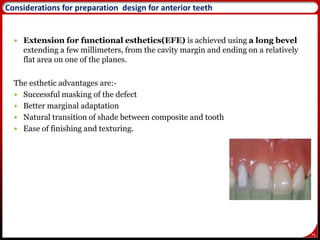
Considerations for preparation design for anterior teeth
 Extension for functional esthetics(EFE) is achieved using a long bevel
extending a few millimeters, from the cavity margin and ending on a relatively
flat area on one of the planes.
The esthetic advantages are:-
 Successful masking of the defect
 Better marginal adaptation
 Natural transition of shade between composite and tooth
 Ease of finishing and texturing.
78
76
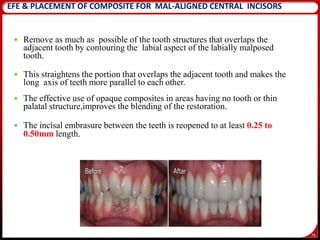
 Remove as much as possible of the tooth structures that overlaps the
adjacent tooth by contouring the labial aspect of the labially malposed
tooth.
 This straightens the portion that overlaps the adjacent tooth and makes the
long axis of teeth more parallel to each other.
 The effective use of opaque composites in areas having no tooth or thin
palatal structure,improves the blending of the restoration.
 The incisal embrasure between the teeth is reopened to at least 0.25 to
0.50mm length.
EFE & PLACEMENT OF COMPOSITE FOR MAL-ALIGNED CENTRAL INCISORS
77
 In cavities having palatal access, leaving a thin shell of enamel of facial surface is not
recommended as it is difficult to blend the composite restoration with the rest of the
tooth.
 In such cases the labial unsupported enamel is reduced and the composite is extended
on the facial surface.
 If the carious lesion is large , then a full facial veneer preparation may be the
best option for optimal esthetic results.
EFE & Placement of composite for carious teeth
 During the placement of composite in the proximal areas, a mylar/metal strip is
placed between the preparation and adjacent tooth while acid etching and bonding.
 A small amount of flowable composite is placed along the wall and cured.
 A layer of an opaque hybrid composite is placed more on the palatal half of the
restoration and also in conditions where palatal wall is absent.
 This blocks the path of light passing through and through and avoids grey
translucency to the restoration.
78
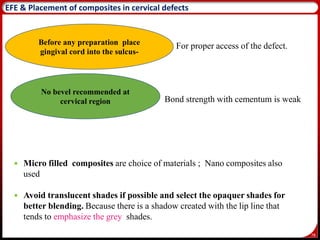
EFE & Placement of composites in cervical defects
For proper access of the defect.
Bond strength with cementum is weak
 Micro filled composites are choice of materials ; Nano composites also
used
 Avoid translucent shades if possible and select the opaquer shades for
better blending. Because there is a shadow created with the lip line that
tends to emphasize the grey shades.
82
Before any preparation place
gingival cord into the sulcus-
No bevel recommended at
cervical region
79
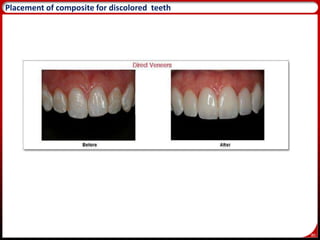
 Discolored teeth are usually challenging to treat.
 The dentist has to consider the masking of the dentin surface not only at the facial
surface but also at the cervical margins and incisal edges.
 The preparation should allow a uniform thickness of composite to create a
polychromatic appearance in the final result.
 In cases of severe discoloration the depth of preparation should allow an
additional thin layer of opaque composite to mask the dark dentin.
EFE and Placement of composite for discolored teeth
A facial veneer is usually preferred for such situations.
80
86
Placement of composite for discolored teeth
81
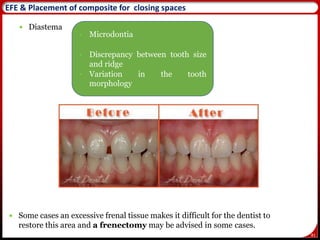
 Diastema
EFE & Placement of composite for closing spaces
• Microdontia
• Discrepancy between tooth size
and ridge
• Variation in the tooth
morphology
 Some cases an excessive frenal tissue makes it difficult for the dentist to
restore this area and a frenectomy may be advised in some cases.
82
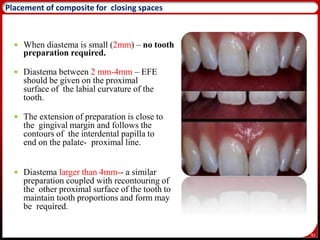
 When diastema is small (2mm) – no tooth
preparation required.
 Diastema between 2 mm-4mm – EFE
should be given on the proximal
surface of the labial curvature of the
tooth.
 The extension of preparation is close to
the gingival margin and follows the
contours of the interdental papilla to
end on the palate- proximal line.
 Diastema larger than 4mm-- a similar
preparation coupled with recontouring of
the other proximal surface of the tooth to
maintain tooth proportions and form may
be required.
89
Placement of composite for closing spaces
83
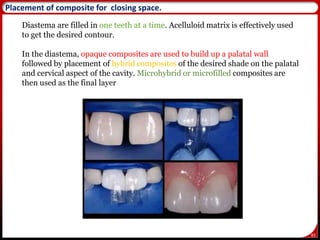
Placement of composite for closing space.
Diastema are filled in one teeth at a time. Acelluloid matrix is effectively used
to get the desired contour.
In the diastema, opaque composites are used to build up a palatal wall
followed by placement of hybrid composites of the desired shade on the palatal
and cervical aspect of the cavity. Microhybrid or microfilled composites are
then used as the final layer
84
Esthetics with ceramics
 Metal ceramic and all ceramic restorations have
excellent esthetic potential.
 All ceramic restorations are characterized by a dentin like
core which makes it possible to mimic the translucency of
natural teeth.
 Biocompatible with the gingival tissue.
 Excellent marginal fit
85
Indications of metal ceramic crowns
 Tooth requiring full coverage with high demand for esthetics.
 Retainer for fixed partial denture.
 Extensively destroyed teeth as a result of caries, trauma, or existing
previous restorations.
.
Contraindications
 Patients with active caries or untreated periodontal disease.
 Young patients with large pulp chambers.
 When the use of more conservative retainer is possible.
86
All ceramic restorations:
Indications
 High esthetic requirement.
 Considerable proximal caries where the tooth can no longer be restored by
composite resin.
 Incisal ridge reasonably intact.
 Favorable distribution of occlusal load.
 Contraindications
 When superior strength is required then metal ceramic crown is more
appropriate.
 High caries index.
 Insufficient coronal tooth structure for support.
 Thin teeth faciolingually.
 Unfavourable distribution of occlusal load.
 Bruxism.
87
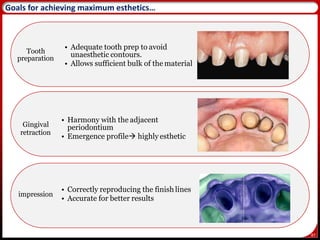
Goals for achieving maximum esthetics…
Tooth
preparation
• Adequate tooth prep to avoid
unaesthetic contours.
• Allows sufficient bulk of the material
Gingival
retraction
• Harmony with the adjacent
periodontium
• Emergence profile highly esthetic
impression
• Correctly reproducing the finish lines
• Accurate for better results
88
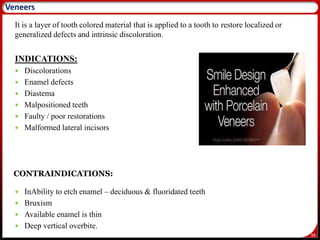
It is a layer of tooth colored material that is applied to a tooth to restore localized or
generalized defects and intrinsic discoloration.
INDICATIONS:
 Discolorations
 Enamel defects
 Diastema
 Malpositioned teeth
 Faulty / poor restorations
 Malformed lateral incisors
Veneers
CONTRAINDICATIONS:
 InAbility to etch enamel – deciduous & fluoridated teeth
 Bruxism
 Available enamel is thin
 Deep vertical overbite.
89
Porcelain laminate veneers
DISADVANTAGES:
 Repair is difficult once luted to enamel
 Technique sensitive
 Difficulty in color Modification
 Tooth preparation
 Fragility of porcelain
 Cost is high
ADVANTAGES:
 Color
 Bond strength
 Periodontal health
 Resistance to abrasion
 Resistance to fluid absorption
 Esthetics
• Sintered feldspathic porcelain
• Glass based ceramics---IDEAL
90
Smile design with componeers
• Polymerized, prefabricated, nanohybrid composite enamel shells.
• Combine the advantages of direct composite restoration with the
advantages of lab veneers.
• 87% success rate in terms of esthetics and durability.
• Sizes: Small, Medium, Large.
• Enamel translucent and enamel bleach
Nano hybrid
composites
91
Implant esthetics
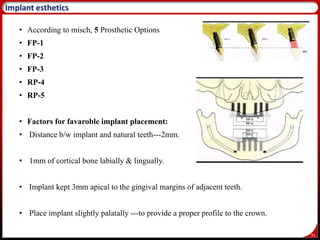
• According to misch, 5 Prosthetic Options
• FP-1
• FP-2
• FP-3
• RP-4
• RP-5
• Factors for favaroble implant placement:
• Distance b/w implant and natural teeth---2mm.
• 1mm of cortical bone labially & lingually.
• Implant kept 3mm apical to the gingival margins of adjacent teeth.
• Place implant slightly palatally ---to provide a proper profile to the crown.
92
Perio-Esthetics
Periodontal defects posing an esthetic problem:
• Gingival asymmetries
• Excessive gingival display
• Localised gingival recessions
• Deficient pontic areas
• Abnormal frena
• Excessive gingival pigmentation
• Inadequate interproximal papilla.
Treatment:
• Esthetic crown lengthening
• Frenectomy and frenotomy
• Surgical and orthodontic treatment for gummy smile
93
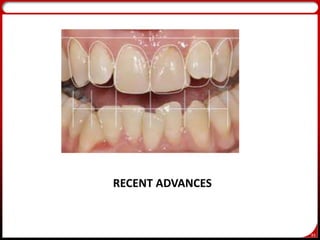
RECENT ADVANCES
94
Digital Smile design---Christian coachman
Smile design softwares
• Digital smile design
• CEREC smile design
• Digital smile system
• G design
• Romexis smile design
• Smile composer
• Smile design Pro
• Keynote
• Exocad dental
Recent advances in shade selection:
• Colorimeter
• Spectrophotometer
• Spectroradiometer
• Digital cameras
• Sopro.
Recent advances in intraoral scanners
• CEREC
• iTero
• E4D
• IOS Fast scan
• Trios
• DPI-3D
95
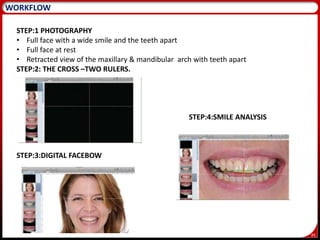
WORKFLOW
STEP:1 PHOTOGRAPHY
• Full face with a wide smile and the teeth apart
• Full face at rest
• Retracted view of the maxillary & mandibular arch with teeth apart
STEP:2: THE CROSS –TWO RULERS.
STEP:4:SMILE ANALYSIS
STEP:3:DIGITAL FACEBOW
96
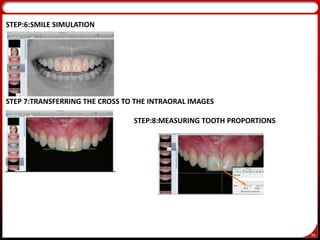
STEP:6:SMILE SIMULATION
STEP 7:TRANSFERRING THE CROSS TO THE INTRAORAL IMAGES
STEP:8:MEASURING TOOTH PROPORTIONS
97
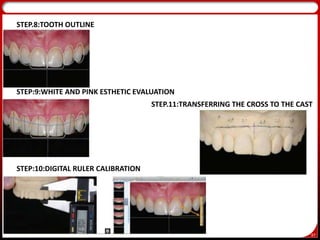
STEP.8:TOOTH OUTLINE
STEP:9:WHITE AND PINK ESTHETIC EVALUATION
STEP:10:DIGITAL RULER CALIBRATION
STEP.11:TRANSFERRING THE CROSS TO THE CAST
98
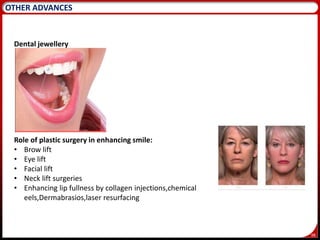
OTHER ADVANCES
Dental jewellery
Role of plastic surgery in enhancing smile:
• Brow lift
• Eye lift
• Facial lift
• Neck lift surgeries
• Enhancing lip fullness by collagen injections,chemical
eels,Dermabrasios,laser resurfacing
99
REVIEW OF LITERATURE
100
Review of literature
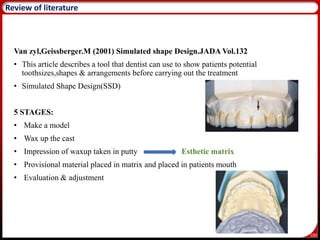
Van zyl,Geissberger.M (2001) Simulated shape Design.JADA Vol.132
• This article describes a tool that dentist can use to show patients potential
toothsizes,shapes & arrangements before carrying out the treatment
• Simulated Shape Design(SSD)
5 STAGES:
• Make a model
• Wax up the cast
• Impression of waxup taken in putty Esthetic matrix
• Provisional material placed in matrix and placed in patients mouth
• Evaluation & adjustment
101
Review of literature
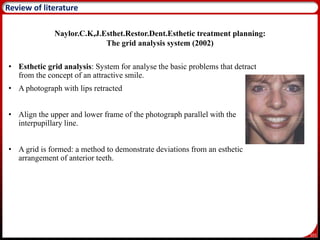
Naylor.C.K,J.Esthet.Restor.Dent.Esthetic treatment planning:
The grid analysis system (2002)
• Esthetic grid analysis: System for analyse the basic problems that detract
from the concept of an attractive smile.
• A photograph with lips retracted
• Align the upper and lower frame of the photograph parallel with the
interpupillary line.
• A grid is formed: a method to demonstrate deviations from an esthetic
arrangement of anterior teeth.
CONCLUSION
The crafting of an ideal smile requires analyses and evaluations of the face, lips, gingival
tissues, and teeth and an appreciation of how they appear collectively .
Such an ideal smile depends on the symmetry and balance of facial and dental features.
The color, shape, and position of the teeth are all part of the equation. Recognizing that
form allows function and that the anterior teeth serve a vital role in the overall health and
well being of the patient is paramount.
Using a comprehensive approach to diagnosing and treatment planning of esthetics can
help achieve the smile that best enhances the overall facial appearance of the patient and
provides the additional benefit of enhanced oral health.
103
REFERENCES
• Van zyl,Geissberger.M (2001) Simulated shape Design.JADA Vol.132
• Naylor.C.K,J.Esthet.Restor.Dent.Esthetic treatment planning:The grid analysis system
(2002)
• Galip gurel -The Science and Art of Porcelain Laminate Veneers.
• Ronald .E.Goldstein –Esthetics in dentistry
• Smile Design Nicholas C. Davis, SMILE DESIGN,DCNA
• Mohan Bhuvaneswaran , Principles of smile designJournal of Conservative
Dentistry ,2010
• Anita Kapri Recent advances in smile designing in prosthodontics,Annals of
prosthodontics and restorative dentistry,2018
• Deepak nallaswamy 2nd edition
106
Thank You…!

SMILE DESIGN

  • 1.
    Smile Design Dr.Shari S R Dept. of Prosthodontics GDC - TVM
  • 2.
    2  Introduction  Definitionsand classification  Components of esthetic smiling  Properties of color  Perceptual aspects – the art of illusion  Shade selection  Esthetic treatment planning  Esthetic contouring of teeth  Esthetics with composites Index
  • 3.
    3 Contents Esthetic with CeramicsEsthetic with veneers Esthetic with componeers Dental bleaching Perio, Implant esthetics Recent advances in smile designing Review of literature Conclusion
  • 4.
    4 Introduction The focus ofdentistry in the present times is not only the prevention and treatment of diseases but on meeting the demands for better esthetics. Esthetic dentistry is emerging as one of the most progressive and challenging branches of this field But every person is not fortunate enough to have a beautiful smile. The answer to the above problem is the esthetic dentistry
  • 5.
    5  Esthetic dentistry Smile designing Interdisciplinary approach  The prosthodontist is the best person to identify the quality of smile .  With the advent of new materials and technologies like CAD-CAM ,dentist has a plethora of options in smile designing Introduction (Cont.) Smile Designing Restorative Orthodontic Prosthodontic Periodontal
  • 6.
    6 Esthetics (ADJ. 1798) Thebranch of philosophy dealing with beauty. Dental Esthetics The application of the principles of esthetics to the natural or artificial teeth and restorations. (GPT 1999) Definitions
  • 7.
    7 Smile designing Is aprocess whereby the complete oral hard and soft tissues are studied and evaluated, and certain changes are brought about which will have a positive influence on the overall esthetics of the face. These changes are governed by the principles of esthetic dentistry.
  • 8.
    8 CLASSIFICATION OF SMILE:(Solomon)  Depending on the nature of labial mucous Membrane( Solomon E.G.R)  Tooth smile  Papilla smile  Mucosa smile  Dependant on the lip component( Solomon E.G.R)  Straight smile  Convex smile  Concave smile
  • 9.
    9 Type of smiles- classifications According to Ackerman et al Two types: • The social smile / posed smile. • The enjoyment smile/Unposed smile/ Duchennne smile. According to Rubin L R: • Commissure smile • Cuspid smile • Complex smile
  • 10.
    10 Type of smiles– classifications (Cont.) According to Edward 4 stages of smile: Stage I : Lips closed Stage II: Resting display Stage III: Natural smile Stage IV: Expanded smile. According to Edward Types of smile: Type I: Maxillary only Type II: Maxillary and 3mm gingiva Type III: Mandibular only Type IV:Maxillary and mandibular Type V: Neither Maxillary nor Mandibular.
  • 11.
    COMPONENTS OF AN ESTHETICSMILE Facial component Hard tissues Soft tissues Dental component Teeth Gingiva
  • 12.
    FACIAL COMPONENTS Facial component • Interpupillaryline • lips Facial features that play a vital role • Esthetic line • Facial features
  • 13.
  • 14.
    14 16  LIP MORPHOLOGY •Width • Fullness • Symmetry  LIP MOBILITY  Ideal  3mm gingival display  Gummy smile Lips
  • 15.
    15  During arelaxed 'ideal smile', the upper lip exposes the cervical aspects of the maxillary anterior teeth and interdental papillae.  Up to 3 mm of gingival exposure above the cervical margins of the maxillary teeth is aesthetically acceptable .  Beyond 3 mm results in a 'gummy' smile, requiring correction by orthodontic or surgical intervention to avoid visual tension . 17 Ideal 2mm gingival display 6mm gingival display Lips
  • 16.
    16 E-line or estheticline is an imaginary line connecting the tip of the nose to the most prominent portion of the chin on the profile, ideally the upper lip is 2-3mm behind and the lower lip 1-2mm behind the E-line. Any change in the position of the E-line indicates the abnormality in the upper or lower lip position. 19 E-line or esthetic line
  • 17.
    17 • Facial width •Facial height Facial features in smile design • Facial shape • Facial profile.
  • 18.
    18 Facial width Facialheight Facial shape • Square • Tapering • Square tapering • Ovoid Facial profile • Straight • Convex • Concave Facial features in smile design
  • 19.
  • 20.
    20 Vital Elements ofSmile Design- Dental Components Tooth components • Dental midline • Incisal Lengths • Tooth dimension • Buccal corridor • Zenith point • Axial inclinations • Interdental contact area • Incisal Embrasures • SPA • Symmetry and balance Soft tissue components • Gingival health • Gingival levels and harmony • Interdental embrasure • Smile Line
  • 21.
    21  Vertical contactinterface between the 2 centrals  Dental midline should be collinear with facial midline.  Perpendicular to the interpupillary line and parallel to facial midline  As long as the midline is parallel with the long axis of the face , midline discrepancies up to 4mm is not considered unaesthetic.  But canted midlines aren’t considered esthetic. Image of smile where the facial and dental midline do not line up. 21 Dental Midline
  • 22.
    22 Centre of thephiltrum and the centre of the papilla match ,then the problem is due to incisal inclination. Papilla and Philtrum do not match True midline deviation. 22 Dental Midline (Cont.)
  • 23.
    23 Incisal lengths( edgeposition) • Most important determinant in smile creation. • It serves as a reference point for establishing the proper tooth proportion and gingival levels. IMPORTANT PARAMETERS  Degree of tooth display.  Phonetics.  Patient input.
  • 24.
    24 Degree of toothdisplay Image of the lower one third showing tooth display at rest. The display was measured to be between 2.5 to 3 mm. • The normal tooth display at rest is about 2.5 to 3mm. • If the overall display of teeth is less than 2.5 mm then orthodontic extrusion or orthognathic surgery has to be considered.
  • 25.
    25 PHONETIC REFERENCES  ‘E’ Incisal edge should be halfway between upper and lower lip  Phonetics play a part in determining maxillary central incisor design and position.  ‘F’ and ‘V’ sounds are used to determine the labiolingual position and length of maxillary central incisors
  • 26.
    26  The ‘M’sound is used to achieve relaxed rest position and help evaluate the incisal display at rest position . • ‘S’ or ‘Z’ sounds • Determine the vertical dimension of speech.  Its pronunciation makes the maxillary and the mandibular anterior teeth come in near contact.  Determine the anterior speaking space. 26 PHONETIC REFERENCES
  • 27.
    27 TOOTH DIMENSIONS  Correctdental proportion is essential in creating an esthetically pleasing smile.  CENTRAL DOMINANCE dictates that the centrals must be the dominant teeth in the arch, and they must display pleasing proportions.  The proportions of the centrals must be esthetically and mathematically correct.  The width to length ratio = 4:5  The shape and appearance of the centrals influences the placement of laterals and canines.
  • 28.
    28 Guidelines for correctproportions. Recurring esthetic dental proportion (Ward) Golden proportion (Lombardi) M Proportion (Methot) CHU’S Esthetic gauge
  • 29.
    29 Golden Proportion First mentionedby Lombardi and later developed by Levin. When viewed from the facial ,the width of each of the anterior tooth is 60% of the width of the adjacent tooth ( 1.6 : 1 : 0.6) Central incisor is 62% wider than the lateral incisor which in turn is 62% wider than the visible portion of the canine which is the mesial half, when viewed from the front.
  • 30.
    30 Recurring esthetic dentalproportion (Ward) • The successive width proportions when viewed from the facial aspect should remain constant as we move posteriorly from midline. • This offers greater flexibility to match the tooth proportions to the facial dimensions. M PROPORTION: Methot : Computer Software CHU’S ESTHETIC GAUGE:
  • 31.
    31 Note :- Centrals widerthan laterals by 2-3mm Canine wider than lateral by 1- 1.5mm Canine and central are longer than lateral by 1-1.5mm Dental proportion (In short)
  • 32.
    32 Buccal Corridor • Negativespace, which is a small space between the maxillary posterior teeth and the inside of the cheek. • The greater and more pronounced this negative space the more the posterior teeth are concealed..
  • 33.
    33  If thebuccal corridor is excessive, ------Increasing the buccal contours of the maxillary posterior restorations.  If conservative additive or subtractive (i.e., esthetic contouring) techniques will not work esthetically, then orthodontics should be considered. Gives depth & mystery to the smile Indicates occlusal disturbance or inadequate restorative dentistry 34 Buccal Corridor (cont.)
  • 34.
    34 Factors influencing theappearance of buccal corridor (The negative space is often accentuated when smile rejuvenation is limited to maxillary six anterior teeth) The width of the smile and the maxillary arch. The tonicity of facial muscles The position of the labial surfaces of the maxillary bicuspids. The predominance of the cuspids, particularly at the distal facial line angle. Any discrepancy between the value of the bicuspids and the anterior teeth.
  • 35.
    35 Interdental contact areas& points Longest contact – between central incisors Shortest contact- between lateral & canine Interdental contact points where the interdental contact area ends
  • 36.
    36  The contactpoints of the maxillary teeth ---------'pink aesthetics' for patients with a high smile line (or visible cervical margins).  '5 mm rule’----- The distance from the contact point to the interproximal osseous crest is 5 mm or less, there is complete fill of the gingival embrasures with an interdental papilla.  For every 1 mm above 5 mm, the chance of complete fill is progressively reduced by 50%. Black triangle 36 Black triangle Interdental contact areas & points (Cont.)
  • 37.
    37 Interdental contact areacan be moved apically to close the gap 37 Interdental contact areas & points (Cont.)
  • 38.
    38 Gingival zenith orheight of contour.  The apex of the gingival height of contour on the anterior teeth is called zenith point.  Central : distal third  Lateral: central  Cuspid : distal third  Bicuspids : central
  • 39.
    39  Nicely scallopedgingival contours --------create a shallow reverse triangle at zenith point of lateral incisor – 0.5 – 1mm incisally. 39 Incorrect adjustment of the zenith points gives the appearance of tilted teeth. Gingival zenith or height of contour.
  • 40.
    40 Incisal embrasures  Inan esthetic smile, the edges of the maxillary anterior teeth follow a convex or gull-wing course matching the curvature of the lower lip.  Reduced incisal embrasures and leveling of the gull-wing effect ------- Straight smile line is associated with aging.
  • 41.
    41 Incisal embrasures 90º betweenpremolars in young unworn dentitions In aged / worn dentition – embrasures are smaller or disappear (Box like)– teeth need to be lengthened & embrasures need to be recreated 41 Smallest & sharpest between the central incisors
  • 42.
    42 Tooth inclination Frontal view: Theaxial inclination of anterior teeth tends to incline mesially and more pronounced from central incisors to the canines. Labiolingual inclination: Maxillary central –Vertical or slightly labially Maxillary lateral incisor -Incisal edge slightly labially. Maxillary canine – Cervical area positioned labially, Cusp tip lingually angulated
  • 43.
    43 Sex, age andpersonality Maxillary incisors Females – Round smooth and delicate Males – Cuboidal and vigorous Youthful teeth unworn incisal edge, defined embrasures, high value Aged teeth- shorter , minimal embrasure and low value Maxillary canine Aggressive, hostile- long fang like Passive and soft Blunt, rounded, short cusp Sex Age Personality Maxillary incisors
  • 44.
    44 Symmetry and balance Staticsymmetry Mirror image, Maxillary central incisors. Dynamic symmetry Two objects very similar but not identical. Such minor deviations and irregularities will impart a more vital, dynamic and natural effect to the smile.
  • 45.
    45 Soft tissue componentof smile Gingival health: Healthy gingiva: • Pale pink in colour, • Stippled, firm • Matte finish • Gingival biotype: Thin and thick • Thin biotypes friable, escalating the risk of recession following crown preparation and periodontal or implant surgery.
  • 46.
    46 Periodontal biotype andbioform This is particularly significant for full coverage crowns for the following reasons. Firstly, the thin gingival margins allow visibility of a metal substructure (either porcelain fused to a metal crown or implant abutment), thereby compromising aesthetics in the anterior regions of the mouth. In these circumstances, All-ceramic crowns, or ceramic implant abutments are a prerequisite to avoid aesthetic reapproval. Secondly, due to the fragility of the thin tissue, delicate management is essential for avoiding recession 1 2
  • 47.
    47 Gingival level andHarmony • The cervical gingival height of centrals should be symmetrical and also match to that of canines. • The gingival margin of lateral incisor is 0.5mm-2mm below that of central incisors Gingival shape • Maxillary lateral and mandibular incisors : Half oval /Half circular. • Maxillary central and canines : Elliptical.
  • 48.
    48 Interdental Embrassure • Avoidblack triangle. • 5 mm rule
  • 49.
    49 Smile line • Convexsmile line/Gull-wing smile line: An imaginary line along the incisal edges of the maxillary anterior teeth which should mimic the curvature of the superior border of the lower lip while smiling.---- Young patients. • Reverse smile line/ concave smile line: The centrals appear shorter than the cuspids .----Aged tooth/ Worn out tooth. • Straight smile line--- worn out teeth/Aging
  • 50.
    50 Color  Clark statedthat “color, like form, has three dimensions”. → Hue which is the name of the radiant energy. → Chroma, which is the saturation of thehue → Value, which is the relative lightness or darkness of thecolour.
  • 51.
    51 Properties of Colour OPACITY& TRANSLUCENCY:  As light strikes a surface, it is either totally reflected, totally absorbed or a combination of both.  Opaque objects reflect all or most of the light that is incident on them whereas transparent objects transmit all of the light that is incident on them. Highly translucent teeth tend to be lower in value, since they allow light to be transmitted through the teeth, while opaque teeth have higher values.
  • 52.
    52 Metamerism  The changein color perception of two objects under different light sources is called metamerism.  This can be attributed to the difference in the radiant energy of two different wavelengths of light.  The standardization of lighting condition during shade matching diminishes the effect of metamerism.
  • 53.
    53 Fluorescence • The emissionof light by an object at a different wavelength from that of an incident light is called fluorescence. • Teeth fluoresce with a stimulus in range of 340nm-410nm. This spectrum is the blue range. • Based on the principle of additive color, the emitted blue light acts with the yellowness of the tooth to produce a white tooth. • Fluorescing pigments incorporated in the ceramic restorations by the ceramist and in the composite restorations by the manufacturer may thus be advantageously used in altering the perception of final result.
  • 54.
    54 Principles of ShadeSelection • Teeth to be matched must be clean. • Select the shade before teeth preparation. • Remove bright colors from field of view - Makeup / tinted eye glasses - Bright gloves -Non neutral operatory walls • View patient at eye level • Evaluate shade under multiple light sources • Shade comparisons should be made quickly to avoid eye fatigue
  • 55.
    55 Commercial Shade Guides Vita Classic  Vitapan 3D –Master  Extended Range Shade Guides Most convenient and common method of making shade selections Guides consist of shade tabs Metal backing Opaque porcelain Neck, body, and incisal color Select tab with the most natural intraoral appearance
  • 56.
    56 Vita Classic ShadeGuide  Tabs of similar hue are clustered into letter groups  A (red-yellow)  B (yellow)  C (grey)  D (red-yellow-gray)  Chroma is designated with numerical values  A3 = hue of red-yellow, chroma of 3
  • 57.
    57 Manufacturer recommended sequencefor shade matching 1. Hue Selection 2. Chroma Selection 3. Value Selection 4. Final Check / Revision  Four categories representing hue  A, yellow-red  B, yellow  C, gray  D, red-yellow-gray  Hue selection has been made (B)  Chroma is selected from gradations within the B tabs  B1, B2, B3, B4
  • 58.
    58 Vitapan 3D Master •Value • Chroma • Hue
  • 59.
  • 60.
  • 61.
    61 PERCEPTUALASPECTS - THEART OF ILLUSION The art of creating illusion consists of changing perception, to cause an object to appear different from what it is. Teeth can be made to appear smaller, larger, wider, narrower, shorter, longer, younger, older, masculine or feminine.
  • 62.
    62 • Principles ofillumination • Principle of line. Principles of illumination: . Principles of line: 63 Illusion works on two basic principles Shadows create depth Light creates prominences Horizontal lines make the objects appear wider Vertical lines make the object appear longer.
  • 63.
  • 64.
  • 65.
  • 66.
    66 ESTHETIC DIAGNOSIS • TOTALSMILE ANALYSIS Integrating various analysis like a visual, space profile and computer analysis. • SPACE ANALYSIS Gauge the amount of space available during the treatment planning stage • PROFILE ANALYSIS  Straight orthognathic – Normal profile.  Any deviation from this should be recorded and considered in treatment planning. • COMPUTER ANALYSIS
  • 67.
    67 Esthetic treatment planningand sequencing Treatment procedure which will be programmed or charted 1. Mock up - with soft tooth colored wax or composite resin- Applied directly in the mouth • Provide a visual three dimensional means prior to committing to treatment. • The functional movements in the mouth can also be checked at this time to determine any occlusal obstruction or difficulties. 2. Diagnostic wax-up or study casts- This wax up can be evaluated by the patient directly on the diagnostic casts of the articulator and also intraorally with the use of acrylic overlays and acetate matrices. 3.Computer imaging- Digital imaging takes advantage of contemporary technology, with a change of arrangement, form, shape and color can be demonstrated quickly 4.Trial smile: Best method
  • 68.
  • 69.
    69 ESTHETIC CONTOURING INDICATIONS  Alterationof tooth structure  Correction of developmental anomalies  Minor orthodontic problems  Removal of stains & discolorations CONTRAINDICATIONS  Hypersensitivity of teeth.  Large pulp canals  Thin enamel  Deeply pigmented stains  Susceptibility to caries  Extensive anterior crowding & occlusal disharmony
  • 70.
    70  Reduction isaccomplished by carefully shaping the marked areas with the bulk reduction diamonds except for the lower anterior teeth. Bulk reduction in these teeth should be done with fine finishing diamonds at high speed.  Final shaping on the mesial, distal, incisal and embrasure is done with the thin and the extra thin diamond points, because their shape allows for better access to these areas. This is followed by the white or green finishing stone. 71 Before and After
  • 71.
    71 Smile designing withbleaching: Bleaching transforms organic substances in the stained tooth and make the teeth lighter in colour. Office bleaching of Non-vital teeth: Home bleaching: Fluorosis stained teeth: Hydrogen peroxide and sodium perborate 10-15% carbamide peroxide Anaesthetic ether+ Hydrochloric acid+ Hydrogen peroxide
  • 72.
    72 Quick, esthetic, economical. Preserve sound tooth structure  Can be placed directly onto the tooth surface  It is a conservative restoration  Can easily change the emergence profile and angle  Can alter the shapes and length of the tooth  Can close diastema.  Can be repaired easily  Can be polished and repolished to a high shine  Long lasting • Not expensive treatment option Smile designing with composites
  • 73.
    73 Disadvantages of directcomposites.  Can chip and break  Can discolor if older composite used  Can develop marginal leakage (Walls 1988)  Can pick up stain easily in those patients who smoke and have poor oral hygiene
  • 74.
    74 Considerations for preparationdesign for anterior teeth • Preparation design for composite resins do not follow a prescribed pattern : Make it as conservative as possible, leaving as much enamel as possible for effective bonding. • The preparation design for anterior composite restorations should encompass 1. Elimination of decay, 2. Function and longevity and 3. Esthetic predictability. EFE
  • 75.
    75 Considerations for preparationdesign for anterior teeth  Extension for functional esthetics(EFE) is achieved using a long bevel extending a few millimeters, from the cavity margin and ending on a relatively flat area on one of the planes. The esthetic advantages are:-  Successful masking of the defect  Better marginal adaptation  Natural transition of shade between composite and tooth  Ease of finishing and texturing. 78
  • 76.
    76  Remove asmuch as possible of the tooth structures that overlaps the adjacent tooth by contouring the labial aspect of the labially malposed tooth.  This straightens the portion that overlaps the adjacent tooth and makes the long axis of teeth more parallel to each other.  The effective use of opaque composites in areas having no tooth or thin palatal structure,improves the blending of the restoration.  The incisal embrasure between the teeth is reopened to at least 0.25 to 0.50mm length. EFE & PLACEMENT OF COMPOSITE FOR MAL-ALIGNED CENTRAL INCISORS
  • 77.
    77  In cavitieshaving palatal access, leaving a thin shell of enamel of facial surface is not recommended as it is difficult to blend the composite restoration with the rest of the tooth.  In such cases the labial unsupported enamel is reduced and the composite is extended on the facial surface.  If the carious lesion is large , then a full facial veneer preparation may be the best option for optimal esthetic results. EFE & Placement of composite for carious teeth  During the placement of composite in the proximal areas, a mylar/metal strip is placed between the preparation and adjacent tooth while acid etching and bonding.  A small amount of flowable composite is placed along the wall and cured.  A layer of an opaque hybrid composite is placed more on the palatal half of the restoration and also in conditions where palatal wall is absent.  This blocks the path of light passing through and through and avoids grey translucency to the restoration.
  • 78.
    78 EFE & Placementof composites in cervical defects For proper access of the defect. Bond strength with cementum is weak  Micro filled composites are choice of materials ; Nano composites also used  Avoid translucent shades if possible and select the opaquer shades for better blending. Because there is a shadow created with the lip line that tends to emphasize the grey shades. 82 Before any preparation place gingival cord into the sulcus- No bevel recommended at cervical region
  • 79.
    79  Discolored teethare usually challenging to treat.  The dentist has to consider the masking of the dentin surface not only at the facial surface but also at the cervical margins and incisal edges.  The preparation should allow a uniform thickness of composite to create a polychromatic appearance in the final result.  In cases of severe discoloration the depth of preparation should allow an additional thin layer of opaque composite to mask the dark dentin. EFE and Placement of composite for discolored teeth A facial veneer is usually preferred for such situations.
  • 80.
    80 86 Placement of compositefor discolored teeth
  • 81.
    81  Diastema EFE &Placement of composite for closing spaces • Microdontia • Discrepancy between tooth size and ridge • Variation in the tooth morphology  Some cases an excessive frenal tissue makes it difficult for the dentist to restore this area and a frenectomy may be advised in some cases.
  • 82.
    82  When diastemais small (2mm) – no tooth preparation required.  Diastema between 2 mm-4mm – EFE should be given on the proximal surface of the labial curvature of the tooth.  The extension of preparation is close to the gingival margin and follows the contours of the interdental papilla to end on the palate- proximal line.  Diastema larger than 4mm-- a similar preparation coupled with recontouring of the other proximal surface of the tooth to maintain tooth proportions and form may be required. 89 Placement of composite for closing spaces
  • 83.
    83 Placement of compositefor closing space. Diastema are filled in one teeth at a time. Acelluloid matrix is effectively used to get the desired contour. In the diastema, opaque composites are used to build up a palatal wall followed by placement of hybrid composites of the desired shade on the palatal and cervical aspect of the cavity. Microhybrid or microfilled composites are then used as the final layer
  • 84.
    84 Esthetics with ceramics Metal ceramic and all ceramic restorations have excellent esthetic potential.  All ceramic restorations are characterized by a dentin like core which makes it possible to mimic the translucency of natural teeth.  Biocompatible with the gingival tissue.  Excellent marginal fit
  • 85.
    85 Indications of metalceramic crowns  Tooth requiring full coverage with high demand for esthetics.  Retainer for fixed partial denture.  Extensively destroyed teeth as a result of caries, trauma, or existing previous restorations. . Contraindications  Patients with active caries or untreated periodontal disease.  Young patients with large pulp chambers.  When the use of more conservative retainer is possible.
  • 86.
    86 All ceramic restorations: Indications High esthetic requirement.  Considerable proximal caries where the tooth can no longer be restored by composite resin.  Incisal ridge reasonably intact.  Favorable distribution of occlusal load.  Contraindications  When superior strength is required then metal ceramic crown is more appropriate.  High caries index.  Insufficient coronal tooth structure for support.  Thin teeth faciolingually.  Unfavourable distribution of occlusal load.  Bruxism.
  • 87.
    87 Goals for achievingmaximum esthetics… Tooth preparation • Adequate tooth prep to avoid unaesthetic contours. • Allows sufficient bulk of the material Gingival retraction • Harmony with the adjacent periodontium • Emergence profile highly esthetic impression • Correctly reproducing the finish lines • Accurate for better results
  • 88.
    88 It is alayer of tooth colored material that is applied to a tooth to restore localized or generalized defects and intrinsic discoloration. INDICATIONS:  Discolorations  Enamel defects  Diastema  Malpositioned teeth  Faulty / poor restorations  Malformed lateral incisors Veneers CONTRAINDICATIONS:  InAbility to etch enamel – deciduous & fluoridated teeth  Bruxism  Available enamel is thin  Deep vertical overbite.
  • 89.
    89 Porcelain laminate veneers DISADVANTAGES: Repair is difficult once luted to enamel  Technique sensitive  Difficulty in color Modification  Tooth preparation  Fragility of porcelain  Cost is high ADVANTAGES:  Color  Bond strength  Periodontal health  Resistance to abrasion  Resistance to fluid absorption  Esthetics • Sintered feldspathic porcelain • Glass based ceramics---IDEAL
  • 90.
    90 Smile design withcomponeers • Polymerized, prefabricated, nanohybrid composite enamel shells. • Combine the advantages of direct composite restoration with the advantages of lab veneers. • 87% success rate in terms of esthetics and durability. • Sizes: Small, Medium, Large. • Enamel translucent and enamel bleach Nano hybrid composites
  • 91.
    91 Implant esthetics • Accordingto misch, 5 Prosthetic Options • FP-1 • FP-2 • FP-3 • RP-4 • RP-5 • Factors for favaroble implant placement: • Distance b/w implant and natural teeth---2mm. • 1mm of cortical bone labially & lingually. • Implant kept 3mm apical to the gingival margins of adjacent teeth. • Place implant slightly palatally ---to provide a proper profile to the crown.
  • 92.
    92 Perio-Esthetics Periodontal defects posingan esthetic problem: • Gingival asymmetries • Excessive gingival display • Localised gingival recessions • Deficient pontic areas • Abnormal frena • Excessive gingival pigmentation • Inadequate interproximal papilla. Treatment: • Esthetic crown lengthening • Frenectomy and frenotomy • Surgical and orthodontic treatment for gummy smile
  • 93.
  • 94.
    94 Digital Smile design---Christiancoachman Smile design softwares • Digital smile design • CEREC smile design • Digital smile system • G design • Romexis smile design • Smile composer • Smile design Pro • Keynote • Exocad dental Recent advances in shade selection: • Colorimeter • Spectrophotometer • Spectroradiometer • Digital cameras • Sopro. Recent advances in intraoral scanners • CEREC • iTero • E4D • IOS Fast scan • Trios • DPI-3D
  • 95.
    95 WORKFLOW STEP:1 PHOTOGRAPHY • Fullface with a wide smile and the teeth apart • Full face at rest • Retracted view of the maxillary & mandibular arch with teeth apart STEP:2: THE CROSS –TWO RULERS. STEP:4:SMILE ANALYSIS STEP:3:DIGITAL FACEBOW
  • 96.
    96 STEP:6:SMILE SIMULATION STEP 7:TRANSFERRINGTHE CROSS TO THE INTRAORAL IMAGES STEP:8:MEASURING TOOTH PROPORTIONS
  • 97.
    97 STEP.8:TOOTH OUTLINE STEP:9:WHITE ANDPINK ESTHETIC EVALUATION STEP:10:DIGITAL RULER CALIBRATION STEP.11:TRANSFERRING THE CROSS TO THE CAST
  • 98.
    98 OTHER ADVANCES Dental jewellery Roleof plastic surgery in enhancing smile: • Brow lift • Eye lift • Facial lift • Neck lift surgeries • Enhancing lip fullness by collagen injections,chemical eels,Dermabrasios,laser resurfacing
  • 99.
  • 100.
    100 Review of literature Vanzyl,Geissberger.M (2001) Simulated shape Design.JADA Vol.132 • This article describes a tool that dentist can use to show patients potential toothsizes,shapes & arrangements before carrying out the treatment • Simulated Shape Design(SSD) 5 STAGES: • Make a model • Wax up the cast • Impression of waxup taken in putty Esthetic matrix • Provisional material placed in matrix and placed in patients mouth • Evaluation & adjustment
  • 101.
    101 Review of literature Naylor.C.K,J.Esthet.Restor.Dent.Esthetictreatment planning: The grid analysis system (2002) • Esthetic grid analysis: System for analyse the basic problems that detract from the concept of an attractive smile. • A photograph with lips retracted • Align the upper and lower frame of the photograph parallel with the interpupillary line. • A grid is formed: a method to demonstrate deviations from an esthetic arrangement of anterior teeth.
  • 102.
    CONCLUSION The crafting ofan ideal smile requires analyses and evaluations of the face, lips, gingival tissues, and teeth and an appreciation of how they appear collectively . Such an ideal smile depends on the symmetry and balance of facial and dental features. The color, shape, and position of the teeth are all part of the equation. Recognizing that form allows function and that the anterior teeth serve a vital role in the overall health and well being of the patient is paramount. Using a comprehensive approach to diagnosing and treatment planning of esthetics can help achieve the smile that best enhances the overall facial appearance of the patient and provides the additional benefit of enhanced oral health.
  • 103.
    103 REFERENCES • Van zyl,Geissberger.M(2001) Simulated shape Design.JADA Vol.132 • Naylor.C.K,J.Esthet.Restor.Dent.Esthetic treatment planning:The grid analysis system (2002) • Galip gurel -The Science and Art of Porcelain Laminate Veneers. • Ronald .E.Goldstein –Esthetics in dentistry • Smile Design Nicholas C. Davis, SMILE DESIGN,DCNA • Mohan Bhuvaneswaran , Principles of smile designJournal of Conservative Dentistry ,2010 • Anita Kapri Recent advances in smile designing in prosthodontics,Annals of prosthodontics and restorative dentistry,2018 • Deepak nallaswamy 2nd edition
  • 104.