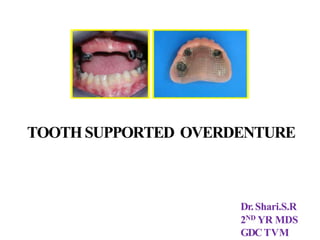
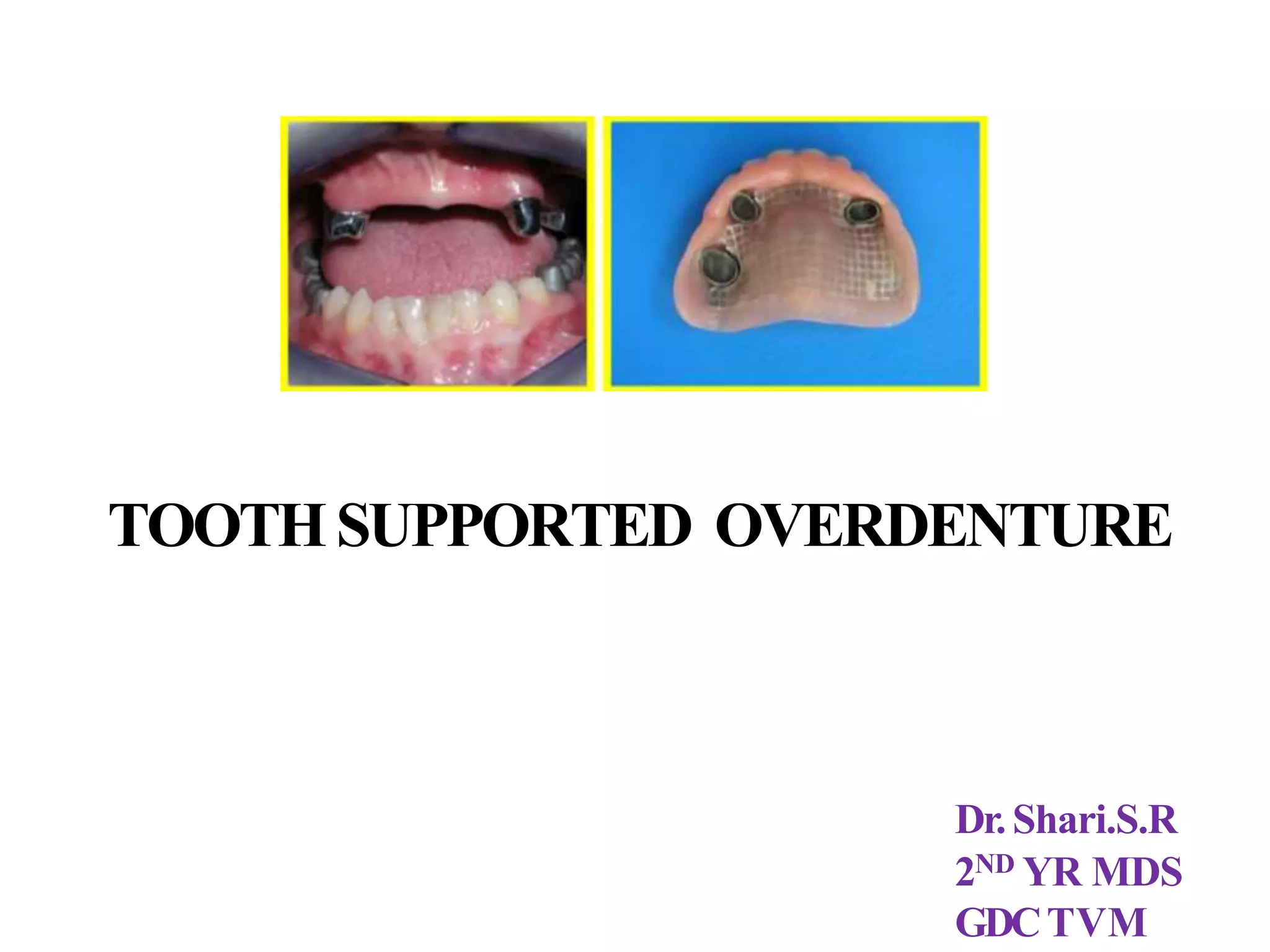
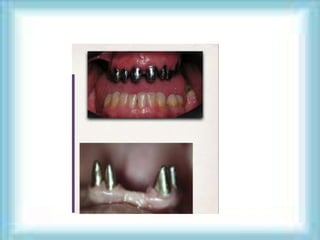
TOOTHSUPPORTED OVERDENTURE
Dr.Shari.S.R
2ND YR MDS
GDCTVM
 Introduction
• .
Conventional dentures are commonly fabricated in dental practice. But in
some situations, dentures other than conventional dentures can be used.
Such types of dentures are called as unconventional dentures.
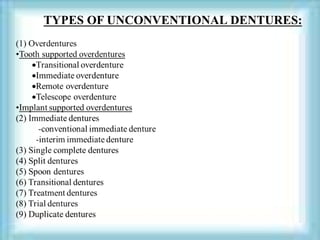
GPT-8 (2005) ,
Overdenture is defined as a
removable partial denture or a complete
denture that covers and rests on one or
more remaining natural teeth, the roots
of natural teeth, and/or dental implants
DEFINITION
•Toothsupported denture
•Overlay denture/ Onlay denture/ Inlay denture
• Telescopic denture
• Superimposed prosthesis
• Hybrid denture
•Biological denture
•Coping prosthesis
TOOTH SUPPORTED OVER DENTURE
SYNONYMS
Tooth supported overdenture
Heartwell,
A tooth supported overdenture is a
dental prosthesis that replaces lost or
missing natural dentition and associated
structures of the maxilla and/or mandible
and receives partial support and stability
from one or more modified natural teeth
• LEDGER (1856)prescribed a prosthesis
resembling an overdenture. His restorations
werereferredto as plates covering fangs
(teeth)
• EVANS(1888) described a method for using
roots to retain restorations after intentional
devitalisation of the roots.
• ESSIG(1896) described a telescopic‐like
coping
• 1906–WILLIAM HUNTER put forward his focal
sepsis theory and this dealt a great blowto the
overdenture mode of treatment.
Themain point of contention was that the
exposedroots act as foci of infection.
• 1916‐PEESO was employing removable
telescopic crowns. Later on, the bartype of
construction was developed.
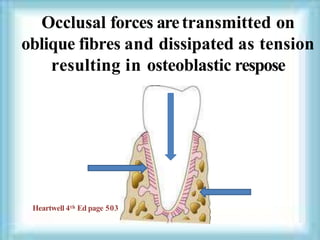
Occlusal forces aretransmitted on
oblique fibres and dissipated as tension
resulting in osteoblastic respose
Heartwell 4th Ed page 503
• MILLER(1958 ) published his classic article
wherethe retention of previously unusable
teeth and their advantageous use in
overdenture treatment was explained as a
basic tenet in management.
• Prieskal(1968)described various
commercially available overdenture
attachments
Preiskel HW. Prefabricated attachments for compete overlay dentures.
Br Dent J
1967;123:161.
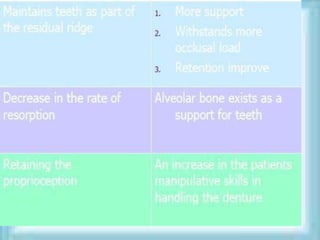
ADVANTAGES
• Ridge preservation
• Proprioception
• Superior patients acceptance
• Openpalate possible
• Definitive vertical stop for denture base
• Support, stability and retention are improved
• Less trauma to supporting tissues
• Feverpost insertion problems than conventional
complete denture
• Conversion to complete denture
• Increased biting force (Pacer FJ,Bowman DC.Occlusalforce
discrimination bydenture patients. J
Prosthet Dent 1975;33:602–9)
• Psychological Advantage
DISADVANTAGES
 Caries susceptibility.
 Periodontal disease around
abutments
 Bony undercuts. (due to limited
path of insertion)
 Encroachment of inter occlusal
distance.
 Meticulous oral hygiene is
required.
 Time consuming.
 Technique sensitive.
INDICATIONS
 Patient with badly worn teeth.
 Pt. with few natural remaining teeth.
 Poorprognosis for routine completedenture.
 Congenital oracquired intra oraldefects.
 Mandibular arch whereloss of boneis morerapid
 Edentulous maxilla opposing intact mandibular
dentition.
 Post traumatic orpost surgical cases.
 Severe attrition and loss of vertical dimension.
 Young patient.
 Cleft palate causing large free way space.
 Hypodontia
 Toothwear cases
CONTRAINDICATIONS
 High caries index.
 Poororalhygiene.
 Poorprognosis ofabutment.
 Reduced inter-arch space.
 Undercuts.
 Sufficient attached gingiva not present.
 Whereendo and periotreatment can not be
performed satisfactorily.
 Grade IIImobility
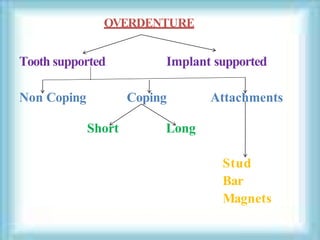
Classification
 ACCORDINGTOMETHODOF
ABUTMENT PREPARATION
(Heartwell)
OVERDENTURE
Tooth supported Implant supported
Non Coping Coping Attachments
Short Long
Stud
Bar
Magnets
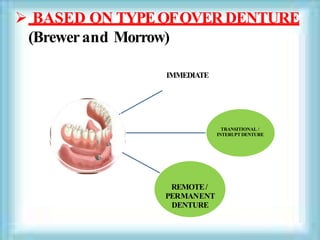
 BASED ON TYPEOFOVERDENTURE
(Brewerand Morrow)
IMMEDIATE
TRANSITIONAL /
INTERUPTDENTURE
REMOTE/
PERMANENT
DENTURE
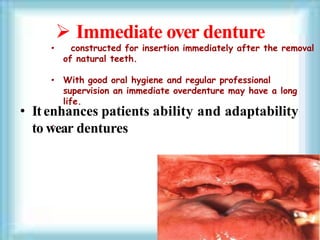
 Immediate over denture
• Itenhances patients ability and adaptability
to wear dentures
• constructed for insertion immediately after the removal
of natural teeth.
• With good oral hygiene and regular professional
supervision an immediate overdenture may have a long
life.
.
• Sometimes, it can be a
prognostic aid before a more
comprehensive overdenture
procedure.
• If prognosis is poor and
response to treatment is poor
an immediate overdenture can
be converted into a serviceable
complete denture
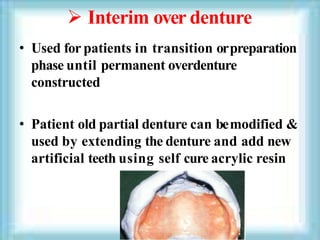
 Interim over denture
• Used for patients in transition orpreparation
phase until permanent overdenture
constructed
• Patient old partial denture can bemodified &
used by extending the denture and add new
artificial teeth using self cure acrylic resin
Advantages:
1. Less expensive
2. Smooth transition
3. Minimal interference with function and
appearance
Disadvantages
1.Border extension, esthetics, occlusion, support
and stability of the R.P.D. often are
inadequate, particularly after many years of
use, making satisfactory conversion difficult.
2.Weaker overdenture
3.Therefore, the converted prosthesis is
considered as interim or temporary
overdenture, to be replaced by a definitive
prosthesis.
 Remote orDefinitive overdenture
• Conventional complete overdenture
constructed overone ormoreabutmentteeth
• Could bemade entirely of acrylic resin orin
conjunction with metal bases
• -usually placed on well healed ridges
• -usually after a period of satisfactory
experience with an interim overdenture
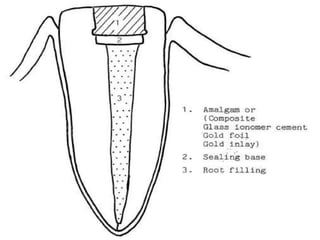
NON COPING ABUTMENTS
Selected tooth abutments arereduced to a
coronal height of 2 to 3 mm. and then
contoured to a convex ordome shaped surface.
Most teeth required endodontic therapy and
in final step arepreparedconservatively to
receivean amalgam orcomposite type
restoration.
 Advantages
• Least expensive option
• Moreamenable to treatment, retreatment and
modification in contingency situations
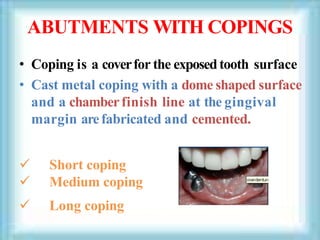
ABUTMENTS WITH COPINGS
• Coping is a coverfor the exposedtooth surface
• Cast metal coping with a dome shaped surface
and a chamberfinish line at the gingival
margin arefabricated and cemented.
 Short coping
 Medium coping
 Long coping
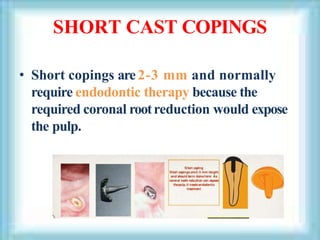
SHORT CAST COPINGS
• Short copings are2-3 mm and normally
require endodontic therapy because the
required coronal rootreduction would expose
the pulp.
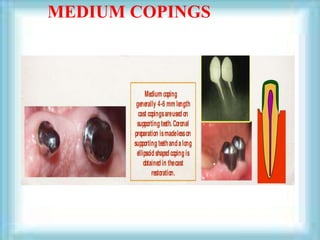
MEDIUM COPINGS
Long cast coping
Long cast copings arenormally 5-8 mm
long, conservative reduction of coronal tooth
structure is done.
Theend result is long ellipsoidal shaped
coronal coping and a larger crown root ratio.
Consequently, long cast coping require a
greater level of osseous support.
ABUTMENT WITH ATTACHMENTS
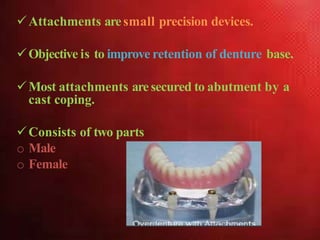
Attachments aresmall precision devices.
Objective is to improve retention of denture base.
Most attachments aresecured to abutment by a
cast coping.
Consists of two parts
o Male
o Female
Requirements for the Attachments
Patients should have a low caries index.
Perform properhome care
Sound periodontal health
Properbonesupport
Rigid attachment
• Doesn’t allow movement of denture base
• Provide adequate retention
• May induce moretorque on abutment
Resilient attachment
• Allows some control of movements
• Induces less torque on abutments
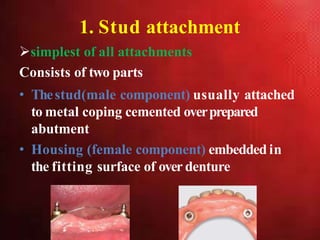
1. Stud attachment
simplest of all attachments
Consists of two parts
• Thestud(male component) usually attached
to metal coping cemented overprepared
abutment
• Housing (female component) embedded in
the fitting surface of over denture
Extra radicular stud attachment
Male element projects from the rootsurface
Thestud is attached to the metal coping
cemented overthe preparedabutment, while the
housing is embedded in the fitting surface of
denture.
• Gerber
• Ceka
• Rotherman
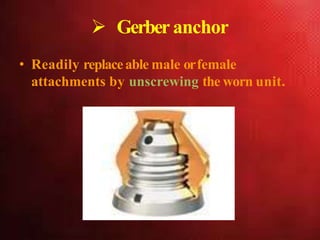
 Gerberanchor
• Readily replaceable male orfemale
attachments by unscrewing the worn unit.
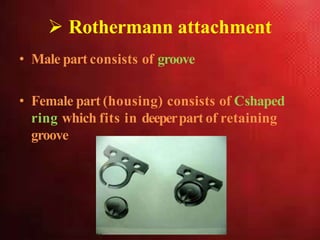
 Rothermann attachment
• Male part consists of groove
• Female part (housing) consists of Cshaped
ring which fits in deeperpart of retaining
groove
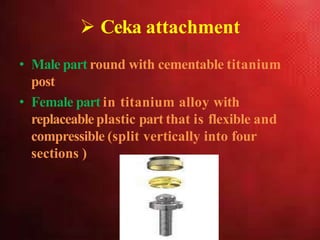
 Ceka attachment
• Male part round with cementable titanium
post
• Female part in titanium alloy with
replaceableplastic part that is flexible and
compressible (split vertically into four
sections )
 Otherattachments of importance
Ancrofix attachment
Introfix attachment
Schubiger attachment
Quinlivan attachmentr
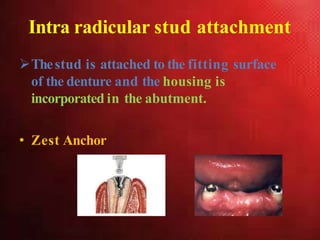
Intra radicular stud attachment
Thestud is attached to the fitting surface
of the denture and the housing is
incorporated in the abutment.
• Zest Anchor
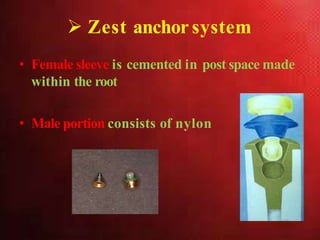
 Zest anchorsystem
• Female sleeve is cemented in post space made
within the root
• Male portion consists of nylon
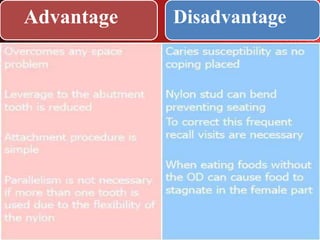
Advantage Disadvantage
• Theattachments should bealigned to each
other
• Should bein line with the path of insertion
of the denture.
• A divergence of 10 degree can be tolerated
• Significant divergence of roots or implants
should be considered a contra indication for
this approach.
• One stud attachment on either side of the arch
will suffice; the remaining roots can becovered
by simple copings.
• Increasing the number of attachments does not
necessarily increase retention; it may
contribute to improved stability, but leads to a
weaker structure.
• Two stud attachments on adjacent roots are
unnecessary as it would complicate hygiene
measures and also weaken the denture base
Bar attachments
o A barcontoured to connect abutment teeth
together, run parallel &
overlie residual ridge
o Preformed metal or plastic.
Thepurposeof using barsare:
• Splinting of abutment teeth
• Retention and support of prosthetic appliance
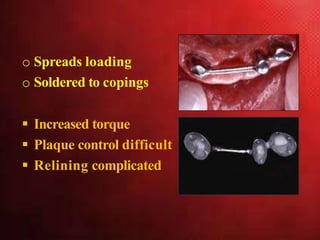
o Spreads loading
o Soldered to copings
 Increased torque
 Plaque control difficult
 Relining complicated
• Thebulk of barand related structures raises
several problems.
• Vertical and buccolingual space
requirements limit their applications.
• Bar attachments also demand moreoral
hygiene maintenance from the patients.
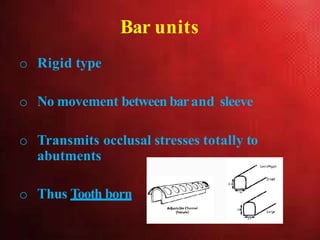
Bar units
o Rigid type
o No movement between barand sleeve
o Transmits occlusal stresses totally to
abutments
o Thus Tooth born
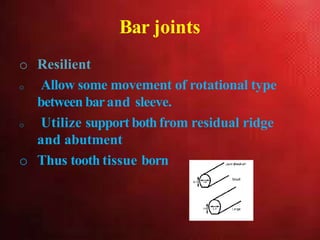
Bar joints
o Resilient
o Allow some movement of rotational type
between barand sleeve.
o Utilize support bothfrom residual ridge
and abutment
o Thus tooth tissue born
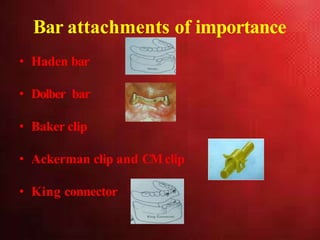
Bar attachments of importance
• Haden bar
• Dolber bar
• Baker clip
• Ackerman clip and CMclip
• King connector
 Magnetic attachment
o Detachable keeperelement
• Made of stainless steel that is fixed to abutment
teeth by
Cementing
Screwing
o Denture retention element
• Has paired, cylindrical Co-Sm magnets
axially magnetized and arranged with their
opposite poles adjacent
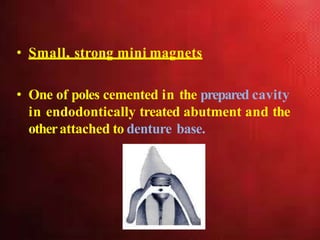
• Small, strong mini magnets
• One of poles cemented in the prepared cavity
in endodontically treated abutment and the
otherattached to denture base.
DIAGNOSIS, TREATMENT
PLANNING AND CASE
SELECTION
No Diagnosis
No Treatment
If you don’t know whereyou go,
you never get lost
History
Examination
 Articulated diagnostic casts
Full mouth radiographs
Overall patient concerns
PATIENT SELECTION
Possibility of fixed orremovable
partial dentures:
• If the remaining teeth arecapable of
supporting a fixed orremovable prosthesis,
then that should bethe primary mode of
treatment.
Patient age
• Extractions areto beavoided in a young
patient as far as possible, so overdenture do
play a majorrolein treating young patients
with mutilated dentition.
Factors influencing selection
of abutment teeth
• Periodontal status
• Mobility
• Location
• Endodontic considerations
• Cost
Periodontal &
Mobility status
• Ideally tooth should present minimal
mobility, have acceptable bonesupport and be
responsive to periodontal therapy.
• Circumferential band of attached gingiva is
an absolute necessity.
• Compromised teeth with good treatment
prognosis aresuitable candidates even when
horizontal boneloss is present
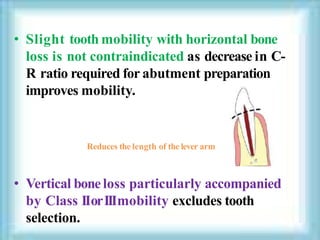
• Slight tooth mobility with horizontal bone
loss is not contraindicated as decrease in C-
R ratio required for abutment preparation
improves mobility.
Reduces the length of the lever arm
• Vertical boneloss particularly accompanied
by Class IIorIIImobility excludes tooth
selection.
Abutment location
• Ideal:Twoteeth perquadrant (stress is
distributed overa rectangulararea)
• Tripodis next most favorable form for
support and stability.
• Clinical experience recommends at least one
tooth per quadrant.
• Isolated teeth arepreferredto several adjacent
teeth as inter dental areas aredifficult to
clean and susceptible to gingivitis.
Robert M. Morrow,Colonel , Ret. USAFDC, Virginia, 1970
• Anterior mandibular ridge is most
vulnerable to time dependent RRR
• Canines and premolars areregarded as best
overdenture abutments
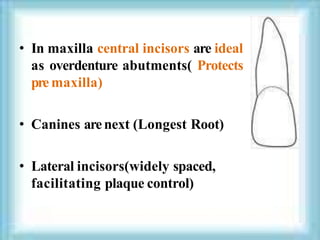
• In maxilla central incisors are ideal
as overdenture abutments( Protects
pre maxilla)
• Canines arenext (Longest Root)
• Lateral incisors(widely spaced,
facilitating plaque control)
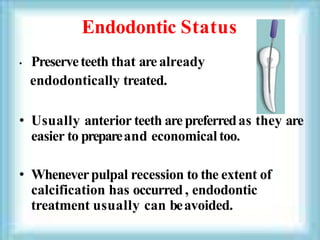
Endodontic Status
• Preserveteeth that arealready
endodontically treated.
• Usually anterior teeth arepreferredas they are
easier to prepareand economical too.
• Wheneverpulpal recession to the extent of
calcification has occurred, endodontic
treatment usually can beavoided.
• Ettinger in 1990 showed that the most
common cause of abutment failure was vital
teeth developing periapical lesions as a result
of pulpal necrosis ( 53.8%).
According to Zarb 13th edition
• After 5-6years, about 10%of abutment teeth
supporting overdentures were lost
Periodontal disease 70%
Caries 25%
Endo complications 5%
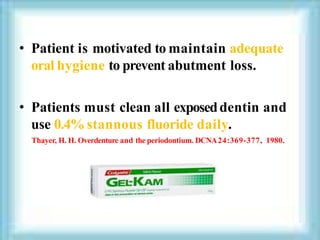
• Patient is motivated to maintain adequate
oral hygiene to prevent abutment loss.
• Patients must clean all exposeddentin and
use 0.4% stannous fluoride daily.
Thayer, H. H. Overdenture and the periodontium. DCNA24:369-377, 1980.
PREPARATORY TREATMENT
FOLLOWINGSEQUENCE OFTTREATMENT CAN BE USED AS A
GENERAL GUIDEBUT MAYNOT BE SPECIFICALLYAPPLICABLE
TOALLPATIENTS:
1. Construct an immediate treatment clasp less
denture. Itreplaces missing and hopelessly
involved teeth for esthetic reason and retain jaw
relations.
2. Remove hopeless teeth and insert the removable
prosthesis.
3. During the healing period,institute the
periodontic and endodontic treatment.
TOOTH PREPARATION
• Remove sufficient tooth structure to provide
favorable rootcrown ratio.
• Reduce the crown length up to 2 mm abovethe
gingival crest orextend a chambertype margin
slightly beneath free gingival margin.
• Taperthe preparation in occlusogingival
direction.
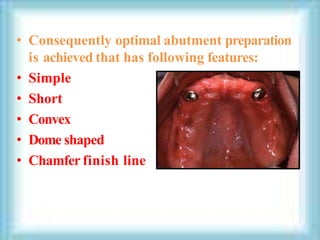
• Consequently optimal abutment preparation
is achieved that has following features:
• Simple
• Short
• Convex
• Dome shaped
• Chamfer finish line
Thefinished tooth with cast coping is male
member of denture. Thefemale member is
part of denture base.
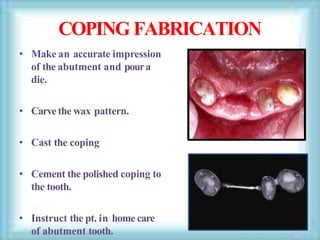
COPING FABRICATION
• Make an accurate impression
of the abutment and poura
die.
• Carvethe wax pattern.
• Cast the coping
• Cement the polished coping to
the tooth.
• Instruct the pt. in home care
of abutment tooth.
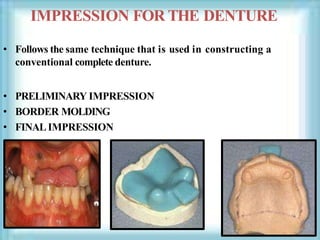
IMPRESSION FOR THE DENTURE
• Follows the same technique that is used in constructing a
conventional complete denture.
• PRELIMINARY IMPRESSION
• BORDER MOLDING
• FINALIMPRESSION
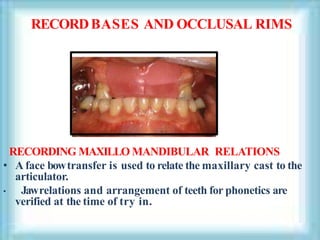
RECORDBASES AND OCCLUSAL RIMS
RECORDING MAXILLO MANDIBULAR RELATIONS
• A face bowtransfer is used to relate the maxillary cast to the
articulator.
• Jawrelations and arrangement of teeth for phonetics are
verified at the time of try in.
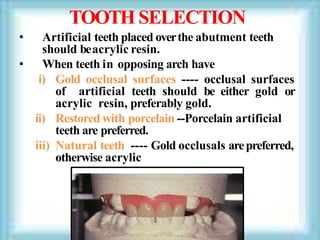
TOOTH SELECTION
• Artificial teeth placed overthe abutment teeth
should beacrylic resin.
• When teeth in opposing arch have
i) Gold occlusal surfaces ---- occlusal surfaces
of artificial teeth should be either gold or
acrylic resin, preferably gold.
ii) Restored with porcelain --Porcelain artificial
teeth are preferred.
iii) Natural teeth ---- Gold occlusals arepreferred,
otherwise acrylic
TRYING THE DENTURE
• Verify jaw relation records
• Make eccentric jaw relation records and adjust the
articulator.
• Assure esthetic acceptability by the patient.
• Verify phonetic acceptability.
LABORATORY PROCEDURES
• CONTOURTHE WAX
• FLASK THE DENTURE
• ELIMINATETHEWAX
• PRAPARE RESIN
• PACKING
• RELIEFFOR MARGINAL GINGIVA
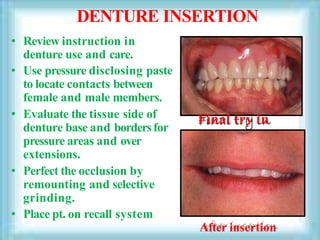
DENTURE INSERTION
• Review instruction in
denture use and care.
• Use pressure disclosing paste
to locate contacts between
female and male members.
• Evaluate the tissue side of
denture base and bordersfor
pressure areas and over
extensions.
• Perfect the occlusion by
remounting and selective
grinding.
• Place pt. on recall system
After insertion
Final try in
SUBMERGED VITAL ROOTS
Selected vital roots areselected and reduced to 2
mm. belowthe crestal bone and then covered by
mucoperiosteal flap
Still in experimentalstage.
Themethod is innovative attempt to obviatethe
basic problems like caries, gingivitis,
periodontitis
Majorpost operative problems are:development of
dehiscences overretained roots and pulpal
pathologies.
REVIEW OF LITERATURE
1. Tooth supported overdenture retained with
custom made attachments A case report.J
Indian Prosthodont Soc Dec 2014
A novel method of fabricating a tooth supported
overdenture retained with custom made ball
attachments using orthodontic seperators.
2. Fabrication of custom overdenture
attachments using indigeniously made
parellometer .A technique-JIPS Vol 19 issue 1
jan-march 2019
This eliminates need for making full arch
impression,surveying the attachments before
casting.parallelism of castable attachment
patterns become chairside procedure
CONCLUSION
• Overdenture is an excellent viable treatment
alternatives.
• Emphasis must beplaced on properpatient
selection, pt. motivation, basic prosthodontic
principle &
detail program of home care
instruction &
frequent recall.
• Theoverdenture is an out standing mode of
treatment. Breakdown in tooth structure ora
breakdown in their periodontal support
immediately negates an overdentureconcept.
REFERENCES
• Essentials of complete denture prosthodontics –
Sheldon Winkler 2ndedition
• Prosthodontic treatment for edentulous patients
–Zarb-Bolender 12thedition
• Complete denture prosthodontics –JohnJ.Sharry
• Syllabus of complete dentures –Charles M.
Heartwell &
Arthur O. Rahn 4thedition
• Dental Implant Prosthetics –Carl E. Misch
• Articles from different journals mentioned
earlier
TOOTH SUPPORTED OVERDENTURE

TOOTH SUPPORTED OVERDENTURE

  • 1.
  • 2.
     Introduction • . Conventionaldentures are commonly fabricated in dental practice. But in some situations, dentures other than conventional dentures can be used. Such types of dentures are called as unconventional dentures.
  • 4.
    GPT-8 (2005) , Overdentureis defined as a removable partial denture or a complete denture that covers and rests on one or more remaining natural teeth, the roots of natural teeth, and/or dental implants DEFINITION
  • 5.
    •Toothsupported denture •Overlay denture/Onlay denture/ Inlay denture • Telescopic denture • Superimposed prosthesis • Hybrid denture •Biological denture •Coping prosthesis TOOTH SUPPORTED OVER DENTURE SYNONYMS
  • 6.
    Tooth supported overdenture Heartwell, Atooth supported overdenture is a dental prosthesis that replaces lost or missing natural dentition and associated structures of the maxilla and/or mandible and receives partial support and stability from one or more modified natural teeth
  • 8.
    • LEDGER (1856)prescribeda prosthesis resembling an overdenture. His restorations werereferredto as plates covering fangs (teeth) • EVANS(1888) described a method for using roots to retain restorations after intentional devitalisation of the roots. • ESSIG(1896) described a telescopic‐like coping
  • 9.
    • 1906–WILLIAM HUNTERput forward his focal sepsis theory and this dealt a great blowto the overdenture mode of treatment. Themain point of contention was that the exposedroots act as foci of infection. • 1916‐PEESO was employing removable telescopic crowns. Later on, the bartype of construction was developed.
  • 12.
    Occlusal forces aretransmittedon oblique fibres and dissipated as tension resulting in osteoblastic respose Heartwell 4th Ed page 503
  • 13.
    • MILLER(1958 )published his classic article wherethe retention of previously unusable teeth and their advantageous use in overdenture treatment was explained as a basic tenet in management. • Prieskal(1968)described various commercially available overdenture attachments Preiskel HW. Prefabricated attachments for compete overlay dentures. Br Dent J 1967;123:161.
  • 14.
  • 15.
    • Ridge preservation •Proprioception • Superior patients acceptance • Openpalate possible • Definitive vertical stop for denture base • Support, stability and retention are improved • Less trauma to supporting tissues • Feverpost insertion problems than conventional complete denture • Conversion to complete denture • Increased biting force (Pacer FJ,Bowman DC.Occlusalforce discrimination bydenture patients. J Prosthet Dent 1975;33:602–9) • Psychological Advantage
  • 17.
  • 18.
     Caries susceptibility. Periodontal disease around abutments  Bony undercuts. (due to limited path of insertion)  Encroachment of inter occlusal distance.  Meticulous oral hygiene is required.  Time consuming.  Technique sensitive.
  • 19.
  • 20.
     Patient withbadly worn teeth.  Pt. with few natural remaining teeth.  Poorprognosis for routine completedenture.  Congenital oracquired intra oraldefects.  Mandibular arch whereloss of boneis morerapid  Edentulous maxilla opposing intact mandibular dentition.  Post traumatic orpost surgical cases.  Severe attrition and loss of vertical dimension.  Young patient.  Cleft palate causing large free way space.  Hypodontia  Toothwear cases
  • 21.
  • 22.
     High cariesindex.  Poororalhygiene.  Poorprognosis ofabutment.  Reduced inter-arch space.  Undercuts.  Sufficient attached gingiva not present.  Whereendo and periotreatment can not be performed satisfactorily.  Grade IIImobility
  • 23.
  • 24.
  • 25.
    OVERDENTURE Tooth supported Implantsupported Non Coping Coping Attachments Short Long Stud Bar Magnets
  • 26.
     BASED ONTYPEOFOVERDENTURE (Brewerand Morrow) IMMEDIATE TRANSITIONAL / INTERUPTDENTURE REMOTE/ PERMANENT DENTURE
  • 27.
     Immediate overdenture • Itenhances patients ability and adaptability to wear dentures • constructed for insertion immediately after the removal of natural teeth. • With good oral hygiene and regular professional supervision an immediate overdenture may have a long life. .
  • 28.
    • Sometimes, itcan be a prognostic aid before a more comprehensive overdenture procedure. • If prognosis is poor and response to treatment is poor an immediate overdenture can be converted into a serviceable complete denture
  • 29.
     Interim overdenture • Used for patients in transition orpreparation phase until permanent overdenture constructed • Patient old partial denture can bemodified & used by extending the denture and add new artificial teeth using self cure acrylic resin
  • 30.
    Advantages: 1. Less expensive 2.Smooth transition 3. Minimal interference with function and appearance Disadvantages 1.Border extension, esthetics, occlusion, support and stability of the R.P.D. often are inadequate, particularly after many years of use, making satisfactory conversion difficult. 2.Weaker overdenture 3.Therefore, the converted prosthesis is considered as interim or temporary overdenture, to be replaced by a definitive prosthesis.
  • 31.
     Remote orDefinitiveoverdenture • Conventional complete overdenture constructed overone ormoreabutmentteeth • Could bemade entirely of acrylic resin orin conjunction with metal bases • -usually placed on well healed ridges • -usually after a period of satisfactory experience with an interim overdenture
  • 32.
    NON COPING ABUTMENTS Selectedtooth abutments arereduced to a coronal height of 2 to 3 mm. and then contoured to a convex ordome shaped surface. Most teeth required endodontic therapy and in final step arepreparedconservatively to receivean amalgam orcomposite type restoration.
  • 34.
     Advantages • Leastexpensive option • Moreamenable to treatment, retreatment and modification in contingency situations
  • 35.
    ABUTMENTS WITH COPINGS •Coping is a coverfor the exposedtooth surface • Cast metal coping with a dome shaped surface and a chamberfinish line at the gingival margin arefabricated and cemented.  Short coping  Medium coping  Long coping
  • 36.
    SHORT CAST COPINGS •Short copings are2-3 mm and normally require endodontic therapy because the required coronal rootreduction would expose the pulp.
  • 37.
  • 38.
    Long cast coping Longcast copings arenormally 5-8 mm long, conservative reduction of coronal tooth structure is done. Theend result is long ellipsoidal shaped coronal coping and a larger crown root ratio. Consequently, long cast coping require a greater level of osseous support.
  • 40.
  • 41.
    Attachments aresmall precisiondevices. Objective is to improve retention of denture base. Most attachments aresecured to abutment by a cast coping. Consists of two parts o Male o Female
  • 42.
    Requirements for theAttachments Patients should have a low caries index. Perform properhome care Sound periodontal health Properbonesupport
  • 43.
    Rigid attachment • Doesn’tallow movement of denture base • Provide adequate retention • May induce moretorque on abutment Resilient attachment • Allows some control of movements • Induces less torque on abutments
  • 44.
    1. Stud attachment simplestof all attachments Consists of two parts • Thestud(male component) usually attached to metal coping cemented overprepared abutment • Housing (female component) embedded in the fitting surface of over denture
  • 45.
    Extra radicular studattachment Male element projects from the rootsurface Thestud is attached to the metal coping cemented overthe preparedabutment, while the housing is embedded in the fitting surface of denture. • Gerber • Ceka • Rotherman
  • 46.
     Gerberanchor • Readilyreplaceable male orfemale attachments by unscrewing the worn unit.
  • 47.
     Rothermann attachment •Male part consists of groove • Female part (housing) consists of Cshaped ring which fits in deeperpart of retaining groove
  • 48.
     Ceka attachment •Male part round with cementable titanium post • Female part in titanium alloy with replaceableplastic part that is flexible and compressible (split vertically into four sections )
  • 49.
     Otherattachments ofimportance Ancrofix attachment Introfix attachment Schubiger attachment Quinlivan attachmentr
  • 50.
    Intra radicular studattachment Thestud is attached to the fitting surface of the denture and the housing is incorporated in the abutment. • Zest Anchor
  • 51.
     Zest anchorsystem •Female sleeve is cemented in post space made within the root • Male portion consists of nylon
  • 52.
  • 53.
    • Theattachments shouldbealigned to each other • Should bein line with the path of insertion of the denture. • A divergence of 10 degree can be tolerated • Significant divergence of roots or implants should be considered a contra indication for this approach.
  • 54.
    • One studattachment on either side of the arch will suffice; the remaining roots can becovered by simple copings. • Increasing the number of attachments does not necessarily increase retention; it may contribute to improved stability, but leads to a weaker structure. • Two stud attachments on adjacent roots are unnecessary as it would complicate hygiene measures and also weaken the denture base
  • 55.
    Bar attachments o Abarcontoured to connect abutment teeth together, run parallel & overlie residual ridge o Preformed metal or plastic. Thepurposeof using barsare: • Splinting of abutment teeth • Retention and support of prosthetic appliance
  • 56.
    o Spreads loading oSoldered to copings  Increased torque  Plaque control difficult  Relining complicated
  • 57.
    • Thebulk ofbarand related structures raises several problems. • Vertical and buccolingual space requirements limit their applications. • Bar attachments also demand moreoral hygiene maintenance from the patients.
  • 58.
    Bar units o Rigidtype o No movement between barand sleeve o Transmits occlusal stresses totally to abutments o Thus Tooth born
  • 59.
    Bar joints o Resilient oAllow some movement of rotational type between barand sleeve. o Utilize support bothfrom residual ridge and abutment o Thus tooth tissue born
  • 60.
    Bar attachments ofimportance • Haden bar • Dolber bar • Baker clip • Ackerman clip and CMclip • King connector
  • 61.
     Magnetic attachment oDetachable keeperelement • Made of stainless steel that is fixed to abutment teeth by Cementing Screwing o Denture retention element • Has paired, cylindrical Co-Sm magnets axially magnetized and arranged with their opposite poles adjacent
  • 62.
    • Small, strongmini magnets • One of poles cemented in the prepared cavity in endodontically treated abutment and the otherattached to denture base.
  • 63.
  • 64.
    No Diagnosis No Treatment Ifyou don’t know whereyou go, you never get lost
  • 65.
    History Examination  Articulated diagnosticcasts Full mouth radiographs Overall patient concerns
  • 66.
  • 67.
    Possibility of fixedorremovable partial dentures: • If the remaining teeth arecapable of supporting a fixed orremovable prosthesis, then that should bethe primary mode of treatment.
  • 68.
    Patient age • Extractionsareto beavoided in a young patient as far as possible, so overdenture do play a majorrolein treating young patients with mutilated dentition.
  • 69.
    Factors influencing selection ofabutment teeth • Periodontal status • Mobility • Location • Endodontic considerations • Cost
  • 70.
    Periodontal & Mobility status •Ideally tooth should present minimal mobility, have acceptable bonesupport and be responsive to periodontal therapy. • Circumferential band of attached gingiva is an absolute necessity. • Compromised teeth with good treatment prognosis aresuitable candidates even when horizontal boneloss is present
  • 71.
    • Slight toothmobility with horizontal bone loss is not contraindicated as decrease in C- R ratio required for abutment preparation improves mobility. Reduces the length of the lever arm • Vertical boneloss particularly accompanied by Class IIorIIImobility excludes tooth selection.
  • 72.
    Abutment location • Ideal:Twoteethperquadrant (stress is distributed overa rectangulararea) • Tripodis next most favorable form for support and stability. • Clinical experience recommends at least one tooth per quadrant.
  • 73.
    • Isolated teetharepreferredto several adjacent teeth as inter dental areas aredifficult to clean and susceptible to gingivitis. Robert M. Morrow,Colonel , Ret. USAFDC, Virginia, 1970
  • 74.
    • Anterior mandibularridge is most vulnerable to time dependent RRR • Canines and premolars areregarded as best overdenture abutments
  • 75.
    • In maxillacentral incisors are ideal as overdenture abutments( Protects pre maxilla) • Canines arenext (Longest Root) • Lateral incisors(widely spaced, facilitating plaque control)
  • 76.
    Endodontic Status • Preserveteeththat arealready endodontically treated. • Usually anterior teeth arepreferredas they are easier to prepareand economical too. • Wheneverpulpal recession to the extent of calcification has occurred, endodontic treatment usually can beavoided.
  • 77.
    • Ettinger in1990 showed that the most common cause of abutment failure was vital teeth developing periapical lesions as a result of pulpal necrosis ( 53.8%).
  • 78.
    According to Zarb13th edition • After 5-6years, about 10%of abutment teeth supporting overdentures were lost Periodontal disease 70% Caries 25% Endo complications 5%
  • 79.
    • Patient ismotivated to maintain adequate oral hygiene to prevent abutment loss. • Patients must clean all exposeddentin and use 0.4% stannous fluoride daily. Thayer, H. H. Overdenture and the periodontium. DCNA24:369-377, 1980.
  • 80.
    PREPARATORY TREATMENT FOLLOWINGSEQUENCE OFTTREATMENTCAN BE USED AS A GENERAL GUIDEBUT MAYNOT BE SPECIFICALLYAPPLICABLE TOALLPATIENTS: 1. Construct an immediate treatment clasp less denture. Itreplaces missing and hopelessly involved teeth for esthetic reason and retain jaw relations. 2. Remove hopeless teeth and insert the removable prosthesis. 3. During the healing period,institute the periodontic and endodontic treatment.
  • 81.
    TOOTH PREPARATION • Removesufficient tooth structure to provide favorable rootcrown ratio. • Reduce the crown length up to 2 mm abovethe gingival crest orextend a chambertype margin slightly beneath free gingival margin. • Taperthe preparation in occlusogingival direction.
  • 82.
    • Consequently optimalabutment preparation is achieved that has following features: • Simple • Short • Convex • Dome shaped • Chamfer finish line
  • 83.
    Thefinished tooth withcast coping is male member of denture. Thefemale member is part of denture base.
  • 84.
    COPING FABRICATION • Makean accurate impression of the abutment and poura die. • Carvethe wax pattern. • Cast the coping • Cement the polished coping to the tooth. • Instruct the pt. in home care of abutment tooth.
  • 85.
    IMPRESSION FOR THEDENTURE • Follows the same technique that is used in constructing a conventional complete denture. • PRELIMINARY IMPRESSION • BORDER MOLDING • FINALIMPRESSION
  • 86.
    RECORDBASES AND OCCLUSALRIMS RECORDING MAXILLO MANDIBULAR RELATIONS • A face bowtransfer is used to relate the maxillary cast to the articulator. • Jawrelations and arrangement of teeth for phonetics are verified at the time of try in.
  • 87.
    TOOTH SELECTION • Artificialteeth placed overthe abutment teeth should beacrylic resin. • When teeth in opposing arch have i) Gold occlusal surfaces ---- occlusal surfaces of artificial teeth should be either gold or acrylic resin, preferably gold. ii) Restored with porcelain --Porcelain artificial teeth are preferred. iii) Natural teeth ---- Gold occlusals arepreferred, otherwise acrylic
  • 88.
    TRYING THE DENTURE •Verify jaw relation records • Make eccentric jaw relation records and adjust the articulator. • Assure esthetic acceptability by the patient. • Verify phonetic acceptability. LABORATORY PROCEDURES • CONTOURTHE WAX • FLASK THE DENTURE • ELIMINATETHEWAX • PRAPARE RESIN • PACKING • RELIEFFOR MARGINAL GINGIVA
  • 89.
    DENTURE INSERTION • Reviewinstruction in denture use and care. • Use pressure disclosing paste to locate contacts between female and male members. • Evaluate the tissue side of denture base and bordersfor pressure areas and over extensions. • Perfect the occlusion by remounting and selective grinding. • Place pt. on recall system After insertion Final try in
  • 90.
    SUBMERGED VITAL ROOTS Selectedvital roots areselected and reduced to 2 mm. belowthe crestal bone and then covered by mucoperiosteal flap Still in experimentalstage. Themethod is innovative attempt to obviatethe basic problems like caries, gingivitis, periodontitis Majorpost operative problems are:development of dehiscences overretained roots and pulpal pathologies.
  • 91.
    REVIEW OF LITERATURE 1.Tooth supported overdenture retained with custom made attachments A case report.J Indian Prosthodont Soc Dec 2014 A novel method of fabricating a tooth supported overdenture retained with custom made ball attachments using orthodontic seperators. 2. Fabrication of custom overdenture attachments using indigeniously made parellometer .A technique-JIPS Vol 19 issue 1 jan-march 2019 This eliminates need for making full arch impression,surveying the attachments before casting.parallelism of castable attachment patterns become chairside procedure
  • 92.
    CONCLUSION • Overdenture isan excellent viable treatment alternatives. • Emphasis must beplaced on properpatient selection, pt. motivation, basic prosthodontic principle & detail program of home care instruction & frequent recall. • Theoverdenture is an out standing mode of treatment. Breakdown in tooth structure ora breakdown in their periodontal support immediately negates an overdentureconcept.
  • 93.
  • 94.
    • Essentials ofcomplete denture prosthodontics – Sheldon Winkler 2ndedition • Prosthodontic treatment for edentulous patients –Zarb-Bolender 12thedition • Complete denture prosthodontics –JohnJ.Sharry • Syllabus of complete dentures –Charles M. Heartwell & Arthur O. Rahn 4thedition • Dental Implant Prosthetics –Carl E. Misch • Articles from different journals mentioned earlier