CONTENTS
• INTODUCTION
• INDICATIONS
• CONTRAINDICATIONS
• COMMON TERMS
• PARTS OF FPD
• FUNCTIONS OF FPD
• REFERENCES
INTRODUCTION
DEFINATION
A fixed partial denture is defined as “ A partial
denture that is cemented to natural teeth or roots
which furnish the primary support to the
prosthesis.”-GPT
A Fixed prosthesis is defined as “ A restoration or
replacement which is attached by a cementing
medium to natural teeth, roots, implants,” -GPT
INDICATIONS
1. Short span edentulous arches.
2. Periodontally strong supporting teeth(abutment).
3. Inadequate tissue support ex; Excessive ridge resorption.
4. Aesthetic consideration
CONTRAINDICATIONS
1. Young patients with large pulp chamber.
2. Long span edentulous spaces.
3. Presence of periodontally compromised abutments.
4. Bilateral edentulous spaces, which require cross arch
stabilization.
COMMON TERMS USED IN FIXED
PROSTHODONTICS
Crowns
Laminate and Veneers/facial Veneers
Inlay
Onlay
Abument
Pontic
Connectors
Retainers
CROWNS
• It is a cemented extracoronal restoration that covers the outer surface
of clinical crown.
• Primary function is to protect the underlying tooth structure and
restore the function, form and esthestics.
TYPES
1. Full veneer crown
2. Partial venner crown
- Three quarter crowns
- Reverse three quarter crowns
- Seven eight crowns
- Pin ledges
- Inlay
- onlay
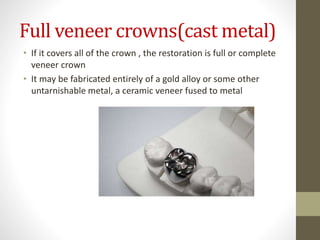
Full veneer crowns(cast metal)
• If it covers all of the crown , the restoration is full or complete
veneer crown
• It may be fabricated entirely of a gold alloy or some other
untarnishable metal, a ceramic veneer fused to metal
Indications:
• Teeth that have extensive coronal destructions by caries or trauma.
• Restoration of choice whenever maximum retention is needed.
• Indicated on endodontically treated teeth
• Correction of occlusal plane
Contraindications:
• If less than maximum retention and resistance is needed
• Wherever intact buccal or lingual wall exists
• Enameloplasty
• For high esthetic needed exists like anterior teeth
ADVANTAGES
• Strong
• High retentive qualities
• Can be modify form and function
• Easy to obtain adequate resistance form
DISADVANTAGES
• Removal of large amount of tooth structure
• Display of metal
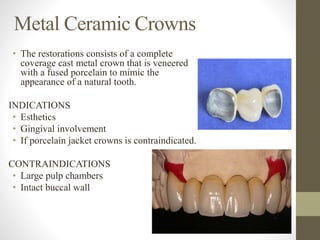
Metal Ceramic Crowns
• The restorations consists of a complete
coverage cast metal crown that is veneered
with a fused porcelain to mimic the
appearance of a natural tooth.
INDICATIONS
• Esthetics
• Gingival involvement
• If porcelain jacket crowns is contraindicated.
CONTRAINDICATIONS
• Large pulp chambers
• Intact buccal wall
Advantages
- Superior esthetics
- Retentive qualities are excellent
Disadvantages
- Removal of substantial tooth structure
- Fracture can occur
- Difficult to obtain accurate occlusion in glazed porcelain
- expensive
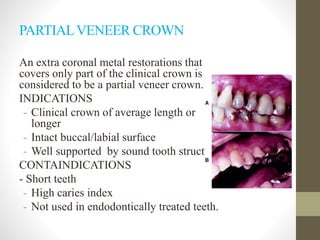
PARTIALVENEER CROWN
An extra coronal metal restorations that
covers only part of the clinical crown is
considered to be a partial veneer crown.
INDICATIONS
- Clinical crown of average length or
longer
- Intact buccal/labial surface
- Well supported by sound tooth structure
CONTAINDICATIONS
- Short teeth
- High caries index
- Not used in endodontically treated teeth.
ADVANTAGES
• Conservative tooth reduction
• Easy access to margins
• Less gingival involvement
DISADVANTAGES
• Less retentive than full crown
• Limited adjustment of path of withdrawal
• Not indicated on vital tooth
THREE- QUARTER CROWNS
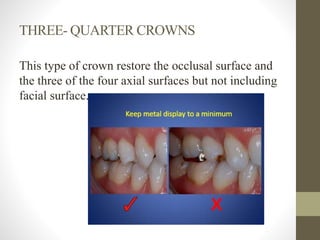
This type of crown restore the occlusal surface and
the three of the four axial surfaces but not including
facial surface.
INLAY
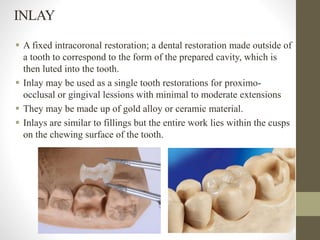
 A fixed intracoronal restoration; a dental restoration made outside of
a tooth to correspond to the form of the prepared cavity, which is
then luted into the tooth.
 Inlay may be used as a single tooth restorations for proximo-
occlusal or gingival lessions with minimal to moderate extensions
 They may be made up of gold alloy or ceramic material.
 Inlays are similar to fillings but the entire work lies within the cusps
on the chewing surface of the tooth.
ONLAY
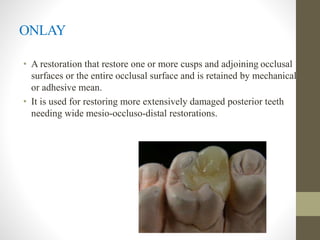
• A restoration that restore one or more cusps and adjoining occlusal
surfaces or the entire occlusal surface and is retained by mechanical
or adhesive mean.
• It is used for restoring more extensively damaged posterior teeth
needing wide mesio-occluso-distal restorations.
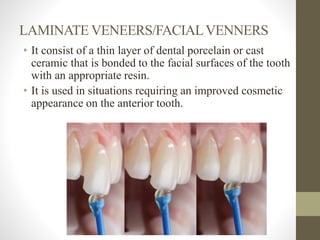
LAMINATE VENEERS/FACIALVENNERS
• It consist of a thin layer of dental porcelain or cast
ceramic that is bonded to the facial surfaces of the tooth
with an appropriate resin.
• It is used in situations requiring an improved cosmetic
appearance on the anterior tooth.
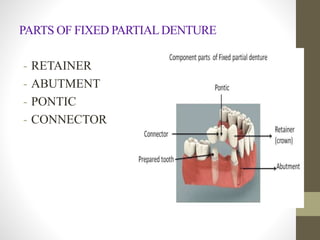
PARTS OF FIXED PARTIALDENTURE
- RETAINER
- ABUTMENT
- PONTIC
- CONNECTOR
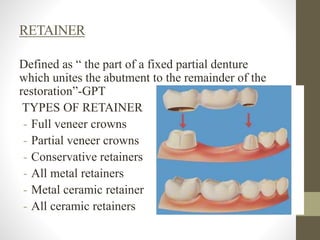
RETAINER
Defined as “ the part of a fixed partial denture
which unites the abutment to the remainder of the
restoration”-GPT
TYPES OF RETAINER
- Full veneer crowns
- Partial veneer crowns
- Conservative retainers
- All metal retainers
- Metal ceramic retainers
- All ceramic retainers
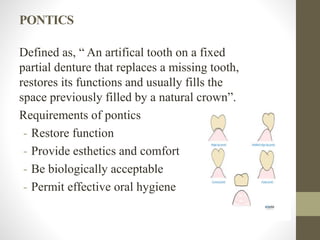
PONTICS
Defined as, “ An artifical tooth on a fixed
partial denture that replaces a missing tooth,
restores its functions and usually fills the
space previously filled by a natural crown”.
Requirements of pontics
- Restore function
- Provide esthetics and comfort
- Be biologically acceptable
- Permit effective oral hygiene
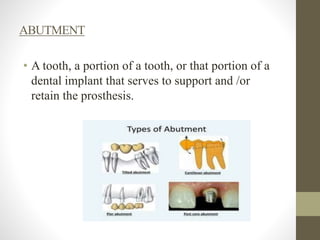
ABUTMENT
• A tooth, a portion of a tooth, or that portion of a
dental implant that serves to support and /or
retain the prosthesis.
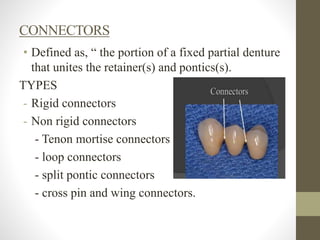
CONNECTORS
• Defined as, “ the portion of a fixed partial denture
that unites the retainer(s) and pontics(s).
TYPES
- Rigid connectors
- Non rigid connectors
- Tenon mortise connectors
- loop connectors
- split pontic connectors
- cross pin and wing connectors.
FUNCTIONS OF FPD
• Provide proper occlusal function
• Maintain arch integrity/tooth position
• Maintain occlusal relationships
• Protect and preserve the remaining structure.
REFERENCES
• Fundamentals of Fixed Prosthodontics third edition. Herbert.
T.Shillingburg.
• Theory and practice of Fixed Prosthodontics. Tylman’s
• Contemporary Fixed Prosthodontics. Stephen F Rosenstiel.
INTRODUCTION TO FIXED PROSTHODONTICS.pptx

INTRODUCTION TO FIXED PROSTHODONTICS.pptx

  • 3.
    CONTENTS • INTODUCTION • INDICATIONS •CONTRAINDICATIONS • COMMON TERMS • PARTS OF FPD • FUNCTIONS OF FPD • REFERENCES
  • 4.
    INTRODUCTION DEFINATION A fixed partialdenture is defined as “ A partial denture that is cemented to natural teeth or roots which furnish the primary support to the prosthesis.”-GPT A Fixed prosthesis is defined as “ A restoration or replacement which is attached by a cementing medium to natural teeth, roots, implants,” -GPT
  • 5.
    INDICATIONS 1. Short spanedentulous arches. 2. Periodontally strong supporting teeth(abutment). 3. Inadequate tissue support ex; Excessive ridge resorption. 4. Aesthetic consideration
  • 6.
    CONTRAINDICATIONS 1. Young patientswith large pulp chamber. 2. Long span edentulous spaces. 3. Presence of periodontally compromised abutments. 4. Bilateral edentulous spaces, which require cross arch stabilization.
  • 7.
    COMMON TERMS USEDIN FIXED PROSTHODONTICS Crowns Laminate and Veneers/facial Veneers Inlay Onlay Abument Pontic Connectors Retainers
  • 8.
    CROWNS • It isa cemented extracoronal restoration that covers the outer surface of clinical crown. • Primary function is to protect the underlying tooth structure and restore the function, form and esthestics. TYPES 1. Full veneer crown 2. Partial venner crown - Three quarter crowns - Reverse three quarter crowns - Seven eight crowns - Pin ledges - Inlay - onlay
  • 9.
    Full veneer crowns(castmetal) • If it covers all of the crown , the restoration is full or complete veneer crown • It may be fabricated entirely of a gold alloy or some other untarnishable metal, a ceramic veneer fused to metal
  • 10.
    Indications: • Teeth thathave extensive coronal destructions by caries or trauma. • Restoration of choice whenever maximum retention is needed. • Indicated on endodontically treated teeth • Correction of occlusal plane Contraindications: • If less than maximum retention and resistance is needed • Wherever intact buccal or lingual wall exists • Enameloplasty • For high esthetic needed exists like anterior teeth
  • 11.
    ADVANTAGES • Strong • Highretentive qualities • Can be modify form and function • Easy to obtain adequate resistance form DISADVANTAGES • Removal of large amount of tooth structure • Display of metal
  • 12.
    Metal Ceramic Crowns •The restorations consists of a complete coverage cast metal crown that is veneered with a fused porcelain to mimic the appearance of a natural tooth. INDICATIONS • Esthetics • Gingival involvement • If porcelain jacket crowns is contraindicated. CONTRAINDICATIONS • Large pulp chambers • Intact buccal wall
  • 13.
    Advantages - Superior esthetics -Retentive qualities are excellent Disadvantages - Removal of substantial tooth structure - Fracture can occur - Difficult to obtain accurate occlusion in glazed porcelain - expensive
  • 14.
    PARTIALVENEER CROWN An extracoronal metal restorations that covers only part of the clinical crown is considered to be a partial veneer crown. INDICATIONS - Clinical crown of average length or longer - Intact buccal/labial surface - Well supported by sound tooth structure CONTAINDICATIONS - Short teeth - High caries index - Not used in endodontically treated teeth.
  • 15.
    ADVANTAGES • Conservative toothreduction • Easy access to margins • Less gingival involvement DISADVANTAGES • Less retentive than full crown • Limited adjustment of path of withdrawal • Not indicated on vital tooth
  • 16.
    THREE- QUARTER CROWNS Thistype of crown restore the occlusal surface and the three of the four axial surfaces but not including facial surface.
  • 17.
    INLAY  A fixedintracoronal restoration; a dental restoration made outside of a tooth to correspond to the form of the prepared cavity, which is then luted into the tooth.  Inlay may be used as a single tooth restorations for proximo- occlusal or gingival lessions with minimal to moderate extensions  They may be made up of gold alloy or ceramic material.  Inlays are similar to fillings but the entire work lies within the cusps on the chewing surface of the tooth.
  • 18.
    ONLAY • A restorationthat restore one or more cusps and adjoining occlusal surfaces or the entire occlusal surface and is retained by mechanical or adhesive mean. • It is used for restoring more extensively damaged posterior teeth needing wide mesio-occluso-distal restorations.
  • 19.
    LAMINATE VENEERS/FACIALVENNERS • Itconsist of a thin layer of dental porcelain or cast ceramic that is bonded to the facial surfaces of the tooth with an appropriate resin. • It is used in situations requiring an improved cosmetic appearance on the anterior tooth.
  • 20.
    PARTS OF FIXEDPARTIALDENTURE - RETAINER - ABUTMENT - PONTIC - CONNECTOR
  • 21.
    RETAINER Defined as “the part of a fixed partial denture which unites the abutment to the remainder of the restoration”-GPT TYPES OF RETAINER - Full veneer crowns - Partial veneer crowns - Conservative retainers - All metal retainers - Metal ceramic retainers - All ceramic retainers
  • 22.
    PONTICS Defined as, “An artifical tooth on a fixed partial denture that replaces a missing tooth, restores its functions and usually fills the space previously filled by a natural crown”. Requirements of pontics - Restore function - Provide esthetics and comfort - Be biologically acceptable - Permit effective oral hygiene
  • 23.
    ABUTMENT • A tooth,a portion of a tooth, or that portion of a dental implant that serves to support and /or retain the prosthesis.
  • 24.
    CONNECTORS • Defined as,“ the portion of a fixed partial denture that unites the retainer(s) and pontics(s). TYPES - Rigid connectors - Non rigid connectors - Tenon mortise connectors - loop connectors - split pontic connectors - cross pin and wing connectors.
  • 25.
    FUNCTIONS OF FPD •Provide proper occlusal function • Maintain arch integrity/tooth position • Maintain occlusal relationships • Protect and preserve the remaining structure.
  • 26.
    REFERENCES • Fundamentals ofFixed Prosthodontics third edition. Herbert. T.Shillingburg. • Theory and practice of Fixed Prosthodontics. Tylman’s • Contemporary Fixed Prosthodontics. Stephen F Rosenstiel.