Resin-BondedResin-Bonded FPDsFPDs
Prepared by: Benju Sharma Presented to: Dr Ankita Rathi
Roll no 35
Department of prosthodontics
• Introduction
• Introduce to minimize the main drawback of conventional
fixed partial dentures i.e destruction of sound tooth
structure.
• Development of acid etching of enamel to improve the
retention of resin led to the concept of resin bonded
FPDs.
• In these FPDs metal framework is like a wing attached to
the abutment teeth.
• Conventional FPDs
– Greater amount of sound
tooth destruction.
– Esthetically may not be
very pleasing
– Missing as well as
abutment teeth has to be
replaced.
• Resin bonded FPDs
– Adjacent tooth preparation
is minimal.
– Can be given in both
anterior and posterior
region because of its
pleasing esthetics.
– Only the missing tooth is
to be replaced.
• Types of resin bonded FPDs
1. Rochette bridge
2. Maryland bridge
3. Cast mesh fixed partial denture
4. Virginia bridge
1. Rochette bridge
• Have funnel shaped perforations in the wings to
enhance retention.
• Combined silane coupling agent to produce adhesion to
the metal.
2. Maryland bridge
• Adapted electrochemical pit corroding technique.
• 3.5 % soln of nitric acid for 5 minutes with current of 250
mA/crn^2 followed by immersion 18% hydrochloric acid
soln in a ultrasonic cleaner for 10 minutes.
• Resin-alloy bond strength of 27.3 MPa.
• Specific to nonberyllium nickel-chromium alloy.
• 2.9 times more retentive than perforated type.
• Technique sensitive, overetching produces electro
polished surface.
• Other surface treatment techniques are;
Nonelectrolytic technique of placing a nickel-chromium-
baryllium alloy in etching solution in a waterbath for an
hour.
Combination of etching with silane.
Air abrading metal to increase bonding strength.
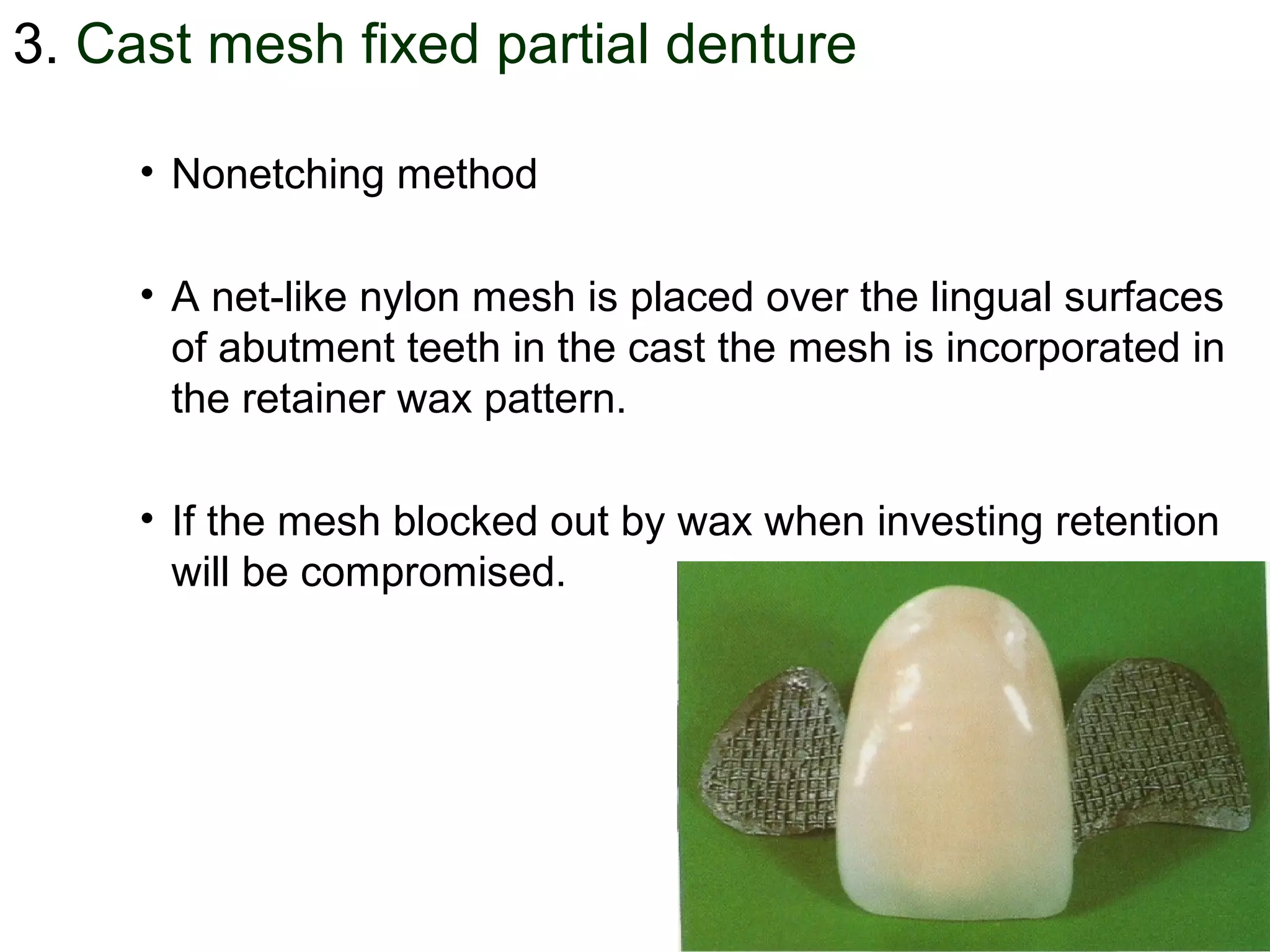
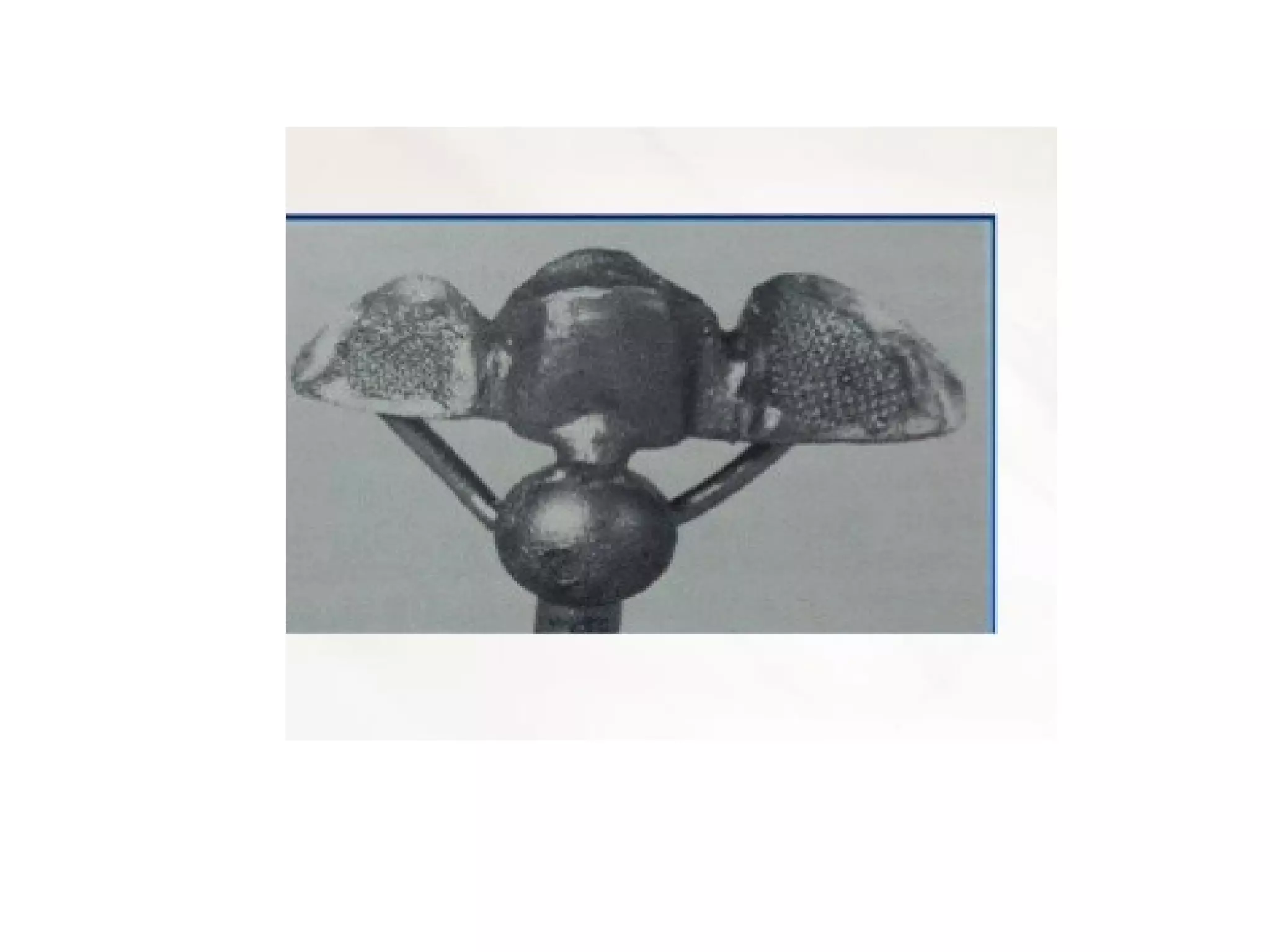
3. Cast mesh fixed partial denture
• Nonetching method
• A net-like nylon mesh is placed over the lingual surfaces
of abutment teeth in the cast the mesh is incorporated in
the retainer wax pattern.
• If the mesh blocked out by wax when investing retention
will be compromised.
4. Virginia bridge
• Incorporation of salt crystals into retainers to produce
roughness in inner surface called as lost salt technique.
• Retainer pattern fabricated with resin with 1mm wide
crystal free zone around the outline.
• The salt is dissolved in water after the resin polymerizes,
cubic voids act as the retentive component.
• Aluminum oxide use as surface treatment to improve
bonding with resin.
Resin cement
– First bonded restorations used unfilled resin for
retention.
– Unfilled or filled resins were used with perforated
retainers
– Thin film thickness resins were then introduced for
luting resin bonded FPDs
– Then the chemically active resin cements were
introduced they could adhere to metal surface
producing retention.
– Tin plated metal alloy had better bonding with
chemically active resins, air abrasion with aluminum
oxide particles was also employed.
Advantages
– No local anesthetic required because most tooth
preparation involves enamel.
– Supragingival margins.
– Minimal tooth preparation required
– Can be rebounded if the axial adhesion get loose.
Disadvantages
– Some amount of sound tooth structure has to be
lost.
– Questionable longevity
– No alignment correction is possible.
– A provisional prosthesis cannot be fabricated.
Indications
– Caries free abutment teeth
– Mandibular incisor replacement
– Maxillary incisors replacement
– Periodontally compromised abutment with
reinforcement of resistance features while preparing
the tooth.
– Single posterior tooth replacement.
Contraindications
– Extensive caries
– Nickel sensitivity
– Deep vertical overbite
Tooth preparation
– Axial reduction and guide plane on proximal surface
with slight extension onto the facial surface
providing faciolingual lock.
– Light chamfer finish line 1mm supragingivally.
– To enhance resistance 180 degree tooth
preparation is to be done.
– Large surface area is involved to improve bonding.
– Occlusal clearance sometimes employed.
– Vertical stops are placed like flat countersinks on
lingual surface of incisors, cingulum rest on canine,
occlual rest seat on premolars and molars.
– Grooves are used near the facioproximal line angle
and opposite side of cingulam or lingual cusp
creating a wrap around effect.
– For mandibular premolars full coverage of lingual
cusp is done .
– Molars also have lingual cusp coverage
preparation, inlays can be attached to anatomical
groves on distolingual surface, axial coverage
extending through proximal contact to connect with
occlusal rests.
• Armentarium
– High speed hand piece
– Articulating ribbon
– Small wheel and short needle diamond bur
– Flat-end and round-end tapered diamond bur.
• Reference
• Fundamentals of pixed partial prosthodontics by
Harbert T.Shillingburg
• Internet
Resin bonded FPDs

Resin bonded FPDs

  • 1.
    Resin-BondedResin-Bonded FPDsFPDs Prepared by:Benju Sharma Presented to: Dr Ankita Rathi Roll no 35 Department of prosthodontics
  • 2.
    • Introduction • Introduceto minimize the main drawback of conventional fixed partial dentures i.e destruction of sound tooth structure. • Development of acid etching of enamel to improve the retention of resin led to the concept of resin bonded FPDs. • In these FPDs metal framework is like a wing attached to the abutment teeth.
  • 3.
    • Conventional FPDs –Greater amount of sound tooth destruction. – Esthetically may not be very pleasing – Missing as well as abutment teeth has to be replaced. • Resin bonded FPDs – Adjacent tooth preparation is minimal. – Can be given in both anterior and posterior region because of its pleasing esthetics. – Only the missing tooth is to be replaced.
  • 4.
    • Types ofresin bonded FPDs 1. Rochette bridge 2. Maryland bridge 3. Cast mesh fixed partial denture 4. Virginia bridge
  • 5.
    1. Rochette bridge •Have funnel shaped perforations in the wings to enhance retention. • Combined silane coupling agent to produce adhesion to the metal.
  • 6.
    2. Maryland bridge •Adapted electrochemical pit corroding technique. • 3.5 % soln of nitric acid for 5 minutes with current of 250 mA/crn^2 followed by immersion 18% hydrochloric acid soln in a ultrasonic cleaner for 10 minutes. • Resin-alloy bond strength of 27.3 MPa. • Specific to nonberyllium nickel-chromium alloy. • 2.9 times more retentive than perforated type.
  • 7.
    • Technique sensitive,overetching produces electro polished surface. • Other surface treatment techniques are; Nonelectrolytic technique of placing a nickel-chromium- baryllium alloy in etching solution in a waterbath for an hour. Combination of etching with silane. Air abrading metal to increase bonding strength.
  • 8.
    3. Cast meshfixed partial denture • Nonetching method • A net-like nylon mesh is placed over the lingual surfaces of abutment teeth in the cast the mesh is incorporated in the retainer wax pattern. • If the mesh blocked out by wax when investing retention will be compromised.
  • 9.
    4. Virginia bridge •Incorporation of salt crystals into retainers to produce roughness in inner surface called as lost salt technique. • Retainer pattern fabricated with resin with 1mm wide crystal free zone around the outline. • The salt is dissolved in water after the resin polymerizes, cubic voids act as the retentive component. • Aluminum oxide use as surface treatment to improve bonding with resin.
  • 11.
    Resin cement – Firstbonded restorations used unfilled resin for retention. – Unfilled or filled resins were used with perforated retainers – Thin film thickness resins were then introduced for luting resin bonded FPDs – Then the chemically active resin cements were introduced they could adhere to metal surface producing retention. – Tin plated metal alloy had better bonding with chemically active resins, air abrasion with aluminum oxide particles was also employed.
  • 12.
    Advantages – No localanesthetic required because most tooth preparation involves enamel. – Supragingival margins. – Minimal tooth preparation required – Can be rebounded if the axial adhesion get loose.
  • 13.
    Disadvantages – Some amountof sound tooth structure has to be lost. – Questionable longevity – No alignment correction is possible. – A provisional prosthesis cannot be fabricated.
  • 14.
    Indications – Caries freeabutment teeth – Mandibular incisor replacement – Maxillary incisors replacement – Periodontally compromised abutment with reinforcement of resistance features while preparing the tooth. – Single posterior tooth replacement.
  • 15.
    Contraindications – Extensive caries –Nickel sensitivity – Deep vertical overbite
  • 16.
    Tooth preparation – Axialreduction and guide plane on proximal surface with slight extension onto the facial surface providing faciolingual lock. – Light chamfer finish line 1mm supragingivally. – To enhance resistance 180 degree tooth preparation is to be done.
  • 18.
    – Large surfacearea is involved to improve bonding. – Occlusal clearance sometimes employed. – Vertical stops are placed like flat countersinks on lingual surface of incisors, cingulum rest on canine, occlual rest seat on premolars and molars. – Grooves are used near the facioproximal line angle and opposite side of cingulam or lingual cusp creating a wrap around effect. – For mandibular premolars full coverage of lingual cusp is done .
  • 19.
    – Molars alsohave lingual cusp coverage preparation, inlays can be attached to anatomical groves on distolingual surface, axial coverage extending through proximal contact to connect with occlusal rests.
  • 20.
    • Armentarium – Highspeed hand piece – Articulating ribbon – Small wheel and short needle diamond bur – Flat-end and round-end tapered diamond bur.
  • 22.
    • Reference • Fundamentalsof pixed partial prosthodontics by Harbert T.Shillingburg • Internet