The neutral zone in
complete dentures
BY
PAAVANA
II MDS
CONTENTS
• INTRODUCTION
• DEFINITION
• MUSCLE FORCES IN THE DENTAL ARCH
• CHANGES IN THE EDENTULOUS MOUTH
• DENTURE SURFACE AND ITS ROLE
• RECORDING OF NEUTRAL ZONE
• CASE REPORTS
• REFERENCES
INTRODUCTION
• Complete dentures are primarily mechanical devices which
are fabricated in harmony with normal neuromuscular
function.
ALL ORAL FUNCTIONS
SYNERGISTIC ACTIONS OF THE TONGUE, LIPS, CHEEKS
AND FLOOR OF THE MOUTH
FAILURE TO RECOGNIZE THE CARDINAL IMPORTANCE
OF TOOTH POSITION AND FLANGE FORM AND
CONTOUR OFTEN RESULTS IN DENTURES WHICH ARE
UNSTABLE AND UNSATISFACTORY
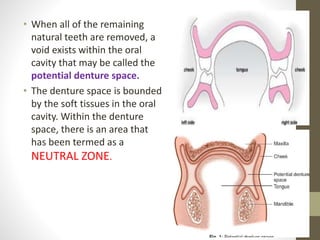
• When all of the remaining
natural teeth are removed, a
void exists within the oral
cavity that may be called the
potential denture space.
• The denture space is bounded
by the soft tissues in the oral
cavity. Within the denture
space, there is an area that
has been termed as a
NEUTRAL ZONE.
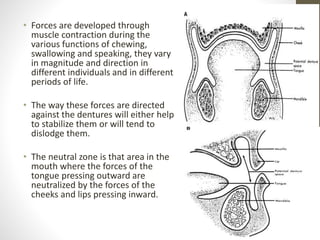
• Forces are developed through
muscle contraction during the
various functions of chewing,
swallowing and speaking, they vary
in magnitude and direction in
different individuals and in different
periods of life.
• The way these forces are directed
against the dentures will either help
to stabilize them or will tend to
dislodge them.
• The neutral zone is that area in the
mouth where the forces of the
tongue pressing outward are
neutralized by the forces of the
cheeks and lips pressing inward.
In the literature, NEUTRAL ZONE has been called as
• Dead Zone ( Fish, 1933 )
• Potential Denture Space (Robert, 1960)
• Stable Zone ( Brill & Tryde,1965)
• Biometric Denture Space (Watt & Mc Gregor,1986)
• Zone of Least Interference ( Wright, 1991)
Various theories have been put forward to enhance
stability of the mandibular denture.
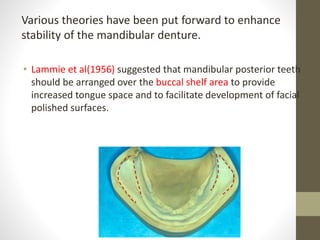
• Lammie et al(1956) suggested that mandibular posterior teeth
should be arranged over the buccal shelf area to provide
increased tongue space and to facilitate development of facial
polished surfaces.
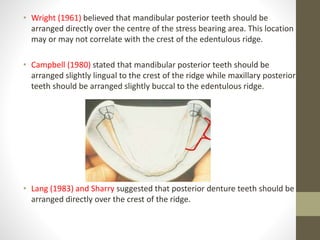
• Wright (1961) believed that mandibular posterior teeth should be
arranged directly over the centre of the stress bearing area. This location
may or may not correlate with the crest of the edentulous ridge.
• Campbell (1980) stated that mandibular posterior teeth should be
arranged slightly lingual to the crest of the ridge while maxillary posterior
teeth should be arranged slightly buccal to the edentulous ridge.
• Lang (1983) and Sharry suggested that posterior denture teeth should be
arranged directly over the crest of the ridge.
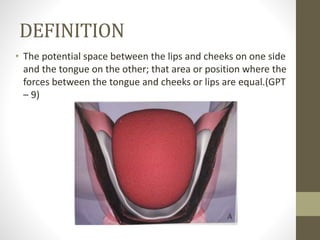
DEFINITION
• The potential space between the lips and cheeks on one side
and the tongue on the other; that area or position where the
forces between the tongue and cheeks or lips are equal.(GPT
– 9)
INFLUENCE OF MUSCLE FORCES IN
THE DENTAL ARCH
• Teeth erupt into the mouth under the influence of
muscular, environmental and genetic factor.
• This environment which is created by the forces
between the tongue, cheeks and lips has a definite
influence on the position of the erupting teeth, the
resultant arch form and occlusion.
• When the teeth are erupting into the oral cavity during
childhood and adolescence, the muscular activity and habits
that develop continues through life.
• Even after the teeth are lost, the forces created by these
habits and actions still persist and will have a great influence
on any complete or extensive partial removable prosthesis
that is placed into the mouth.
• It is therefore extremely important that the teeth be placed in
that part of the mouth and with an arch form that falls within
the area formed by muscular forces.
• Fish in 1933 highlighted the importance of the muscular
function of the tongue, cheeks and lips as being critical
factors for denture stability.
• The soft tissues that form the internal and external
boundaries of the denture space greatly affect and
influence the stability of the dentures and help to
determine the
-Peripheral borders
-Tooth position
-External contours of the dentures.
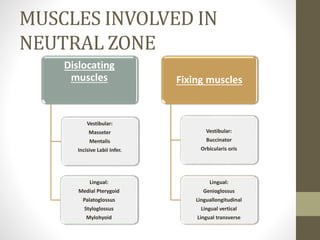
MUSCLES INVOLVED IN
NEUTRAL ZONE
Dislocating
muscles
Vestibular:
Masseter
Mentalis
Incisive Labii Infer.
Lingual:
Medial Pterygoid
Palatoglossus
Styloglossus
Mylohyoid
Fixing muscles
Vestibular:
Buccinator
Orbicularis oris
Lingual:
Genioglossus
Linguallongitudinal
Lingual vertical
Lingual transverse
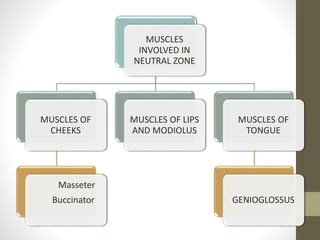
MUSCLES
INVOLVED IN
NEUTRAL ZONE
MUSCLES OF
CHEEKS
Masseter
Buccinator
MUSCLES OF LIPS
AND MODIOLUS
MUSCLES OF
TONGUE
GENIOGLOSSUS
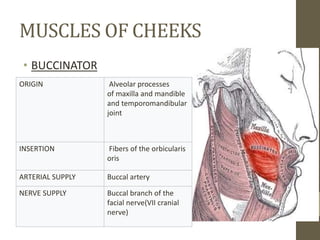
MUSCLES OF CHEEKS
• BUCCINATOR
ORIGIN Alveolar processes
of maxilla and mandible
and temporomandibular
joint
INSERTION Fibers of the orbicularis
oris
ARTERIAL SUPPLY Buccal artery
NERVE SUPPLY Buccal branch of the
facial nerve(VII cranial
nerve)
SIGNIFICANCE
• Buccinator presses against the dental arches when it contracts.
During chewing and swallowing the muscle rhythmically contracts
with muscles of mastication.
• It assists in placing the food between the teeth and returning the
food to occlusal table which has escaped into the vestibule.
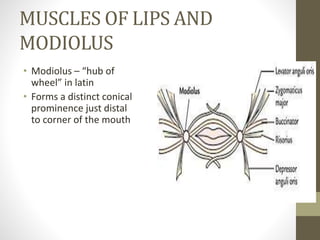
MUSCLES OF LIPS AND
MODIOLUS
• Modiolus – ā€œhub of
wheelā€ in latin
• Forms a distinct conical
prominence just distal
to corner of the mouth
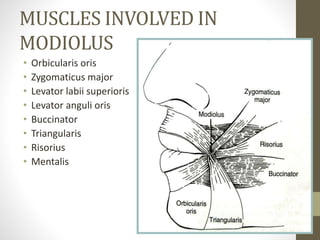
MUSCLES INVOLVED IN
MODIOLUS
• Orbicularis oris
• Zygomaticus major
• Levator labii superioris
• Levator anguli oris
• Buccinator
• Triangularis
• Risorius
• Mentalis
SIGNIFICANCE
• As situated at the corner of the mouth it is in a strategic
position to unseat the lower denture and sometimes the
upper denture too.
• This may occur if the arch form is too wide and restricts the
movement of the modiolus.
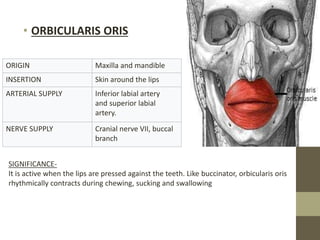
• ORBICULARIS ORIS
ORIGIN Maxilla and mandible
INSERTION Skin around the lips
ARTERIAL SUPPLY Inferior labial artery
and superior labial
artery.
NERVE SUPPLY Cranial nerve VII, buccal
branch
SIGNIFICANCE-
It is active when the lips are pressed against the teeth. Like buccinator, orbicularis oris
rhythmically contracts during chewing, sucking and swallowing
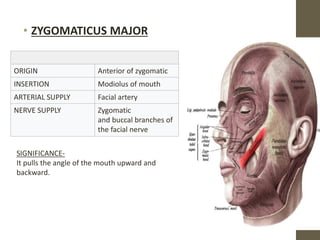
• ZYGOMATICUS MAJOR
ORIGIN Anterior of zygomatic
INSERTION Modiolus of mouth
ARTERIAL SUPPLY Facial artery
NERVE SUPPLY Zygomatic
and buccal branches of
the facial nerve
SIGNIFICANCE-
It pulls the angle of the mouth upward and
backward.
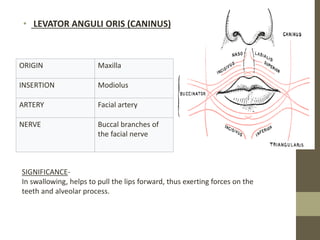
• LEVATOR ANGULI ORIS (CANINUS)
ORIGIN Maxilla
INSERTION Modiolus
ARTERY Facial artery
NERVE Buccal branches of
the facial nerve
SIGNIFICANCE-
In swallowing, helps to pull the lips forward, thus exerting forces on the
teeth and alveolar process.
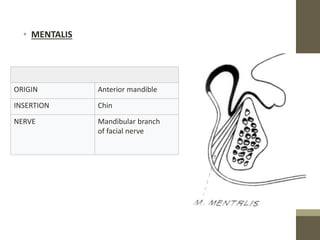
• MENTALIS
ORIGIN Anterior mandible
INSERTION Chin
NERVE Mandibular branch
of facial nerve
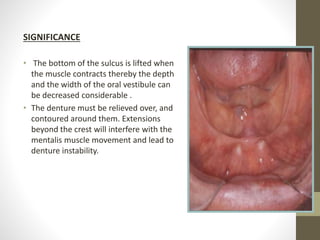
SIGNIFICANCE
• The bottom of the sulcus is lifted when
the muscle contracts thereby the depth
and the width of the oral vestibule can
be decreased considerable .
• The denture must be relieved over, and
contoured around them. Extensions
beyond the crest will interfere with the
mentalis muscle movement and lead to
denture instability.
• INCISIVE LABII INFERIORIS
Origin Oblique line of the mandible,
between the symphysis and
the mental foramen
Insertion Integument of the lower
lip, Orbicularis oris fibers on
both sides.
Nerve Facial nerve - Mandibular
branch
Actions Depression of the lower lip
• SIGNIFICANCE
• Contraction of the muscle can reduce the denture space.*
• In action it pulls the modioli forward and tenses the buccinator
thereby applying pressure on the polished surface.
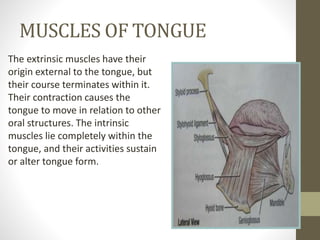
MUSCLES OF TONGUE
The extrinsic muscles have their
origin external to the tongue, but
their course terminates within it.
Their contraction causes the
tongue to move in relation to other
oral structures. The intrinsic
muscles lie completely within the
tongue, and their activities sustain
or alter tongue form.
• SIGNIFICANCE
• The tongue is capable of many varied shapes and positions during
speech, mastication, and swallowing and in all of these functions is
in constant contact with the lingual surface of the teeth, the lingual
flange of the lower denture and the palatal surface of the upper
denture.
• Because of this contact, the tongue is a dominant factor in
establishing the neutral zone and therefore in the stability or lack of
stability of the lower denture.
CHANGES IN EDENTULOUS MOUTH
MAXILLA AND MANDIBLE
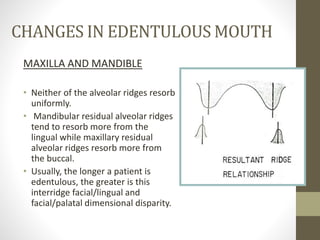
• Neither of the alveolar ridges resorb
uniformly.
• Mandibular residual alveolar ridges
tend to resorb more from the
lingual while maxillary residual
alveolar ridges resorb more from
the buccal.
• Usually, the longer a patient is
edentulous, the greater is this
interridge facial/lingual and
facial/palatal dimensional disparity.
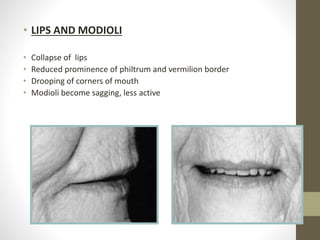
• LIPS AND MODIOLI
• Collapse of lips
• Reduced prominence of philtrum and vermilion border
• Drooping of corners of mouth
• Modioli become sagging, less active
• MUSCLE ATTACHMENT
• As the mandibular ridge resorbs the crest falls below the
level of the mentalis. As a result mentalis tends to fold
over and rests on the ridge. It pushes the neutral zone
posteriorly.
• The freni occupy a more superior position on the ridge.
• In some cases the buccinator attachment over the
external oblique ridge is lost after severe resorption .
• TONGUE
• It is estimated that tongue size increases by approximately 10% in
the edentulous patient.
• The position of the neutral zone in relation to the alveolar ridge was
found to be highly affected by the period of edentulousness .
• The longer the edentulousness ,the more buccally / labially located
was the neutral zone
DENTURE SURFACES
Sir Wilfred Fish (1948) described a denture having three surfaces, with each
surface playing an independent and important role in the overall fit, stability, and
comfort of the denture.
INFLUENCE OF FORCES ON
DENTURE SURFACES
• The greater the ridge loss, the lesser the area of the denture
base and lesser the influence of the impression surface area will
have on the stability and retention of the denture.
• Where more of the ridge has been lost, the more the denture
stability and retention is dependent on the polished surface
than on the impression surface.
• The forces on the polished surface are constantly changing in
magnitude and direction during swallowing, speaking, and
mastication.
• It is only when the mouth is completely at rest that the forces
are constant.
• When the occlusal surfaces of the teeth are not in contact, the
stability of the denture is determined by the fit of the
impression surface and the direction and amount of forces
transmitted through the polished surfaces.
• In order to construct dentures that function properly not only
in chewing but also in speaking and swallowing, we must
develop the fit and contour of the polished surface just as
accurately and meticulously as the fit and contour of the
impression and the occlusal surfaces.
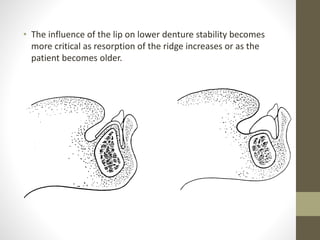
• The influence of the lip on lower denture stability becomes
more critical as resorption of the ridge increases or as the
patient becomes older.
NEUTRALIZATION OF FORCES
• The theory of the neutralization of forces is that to stabilize
dentures; and the rationale involved was one of the major
contributions made by Dr. Russell Tench (1952) and his co-
workers.
• The lips, cheek and tongue in the passive and functioning state
exert forces on the natural teeth. In natural dentition, arch
integrity and tooth position are maintained when all the
forces generated by the musculature are neutralized.
• Any changes in the forces generated by the musculature
because of increased size, altered muscle function, or
abnormal habit patterns will upset the equilibrium and result
in alteration of tooth position and the arch form.
RECORDING OF
NEUTRAL ZONE
DIFFERENT METHODS
• AFTER IMPRESSION
• AFTER TENTATIVE JAW
RELATION
• DURING TRY IN
PROCEDURES
• SWALLOWING METHOD
• PHONATION METHOD
NEUTRAL-ZONEAPPROACH,REVERSEDSEQUENCE
IN DENTURECONSTRUCTION
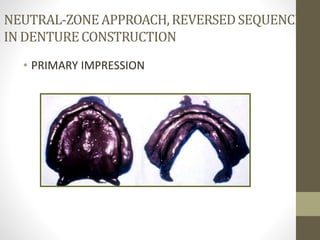
• PRIMARY IMPRESSION
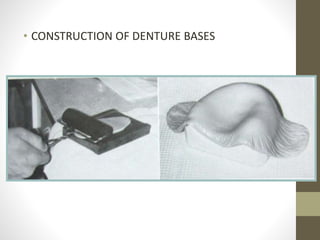
• CONSTRUCTION OF DENTURE BASES
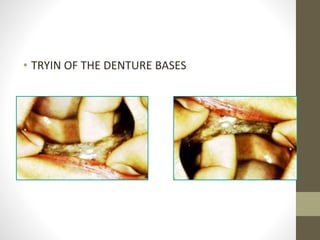
• TRYIN OF THE DENTURE BASES
MATERIALS USED
Many materials have been suggested for shaping the neutral
zone:
• Modeling plastic impression compound (Tench)
• Soft wax (Buchman & Gelb, Lott & Levin , and Russell)
• A polymer of dimethyl siloxane filled with calcium
• silicate( Heath)
• Tissue conditioners (Gahan & Walmsley)
CLINICALPROCEDURESIN LOCATINGTHE
NEUTRALZONE
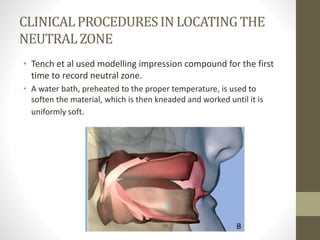
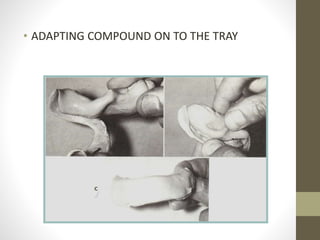
• Tench et al used modelling impression compound for the first
time to record neutral zone.
• A water bath, preheated to the proper temperature, is used to
soften the material, which is then kneaded and worked until it is
uniformly soft.
• ADAPTING COMPOUND ON TO THE TRAY
LOCATINGTHE NEUTRALZONEFOR THE
MANDIBULARARCH
To locate the neutral zone for the
lower arch the patient's lips are
lubricated with petrolatum jelly.
The tray with the softened
modeling compound is carefully
seated into the mouth.
The patient is instructed to
swallow and then purse the lips as
in sucking.
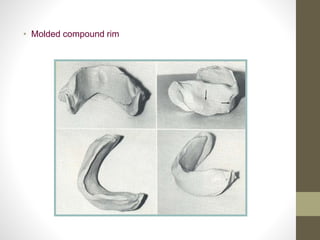
• Molded compound rim
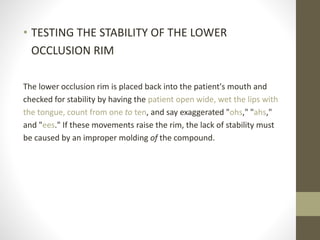
• TESTING THE STABILITY OF THE LOWER
OCCLUSION RIM
The lower occlusion rim is placed back into the patient's mouth and
checked for stability by having the patient open wide, wet the lips with
the tongue, count from one to ten, and say exaggerated "ohs," "ahs,"
and "ees." If these movements raise the rim, the lack of stability must
be caused by an improper molding of the compound.
LOCATINGTHE NEUTRALZONEFOR THE
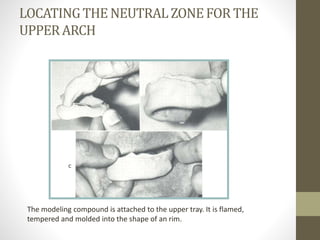
UPPERARCH
The modeling compound is attached to the upper tray. It is flamed,
tempered and molded into the shape of an rim.
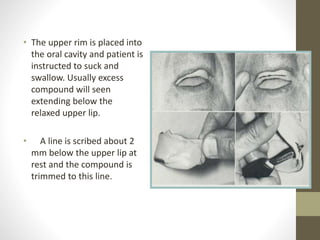
• The upper rim is placed into
the oral cavity and patient is
instructed to suck and
swallow. Usually excess
compound will seen
extending below the
relaxed upper lip.
• A line is scribed about 2
mm below the upper lip at
rest and the compound is
trimmed to this line.
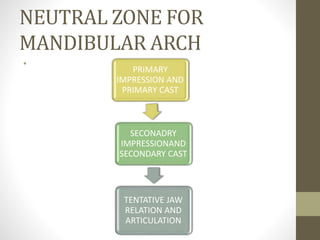
NEUTRAL ZONE FOR
MANDIBULAR ARCH
•
PRIMARY
IMPRESSION AND
PRIMARY CAST
SECONADRY
IMPRESSIONAND
SECONDARY CAST
TENTATIVE JAW
RELATION AND
ARTICULATION
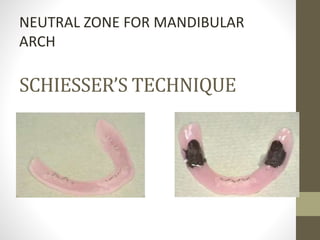
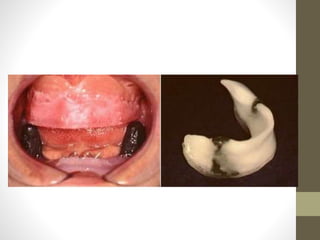
SCHIESSER’S TECHNIQUE
NEUTRAL ZONE FOR MANDIBULAR
ARCH
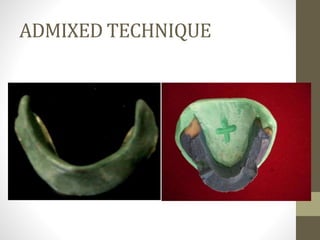
ADMIXED TECHNIQUE
SECONDARY IMPRESSIONS
• To achieve optimum success in complete denture prosthesis,
the dentures should be both retentive and stable. The
retention of a denture is mainly dependent on the accuracy of
impression and fit of denture base to the tissues.
• Closed or open mouth impression technique is used
• More accurate functional border molding with minimal
displacement of soft tissues
• Even distribution of pressure and impression material with
less likelihood of excessive pressure in one area or another
FABRICATION OF A TONGUE,
LIP, AND CHEEK MATRICES
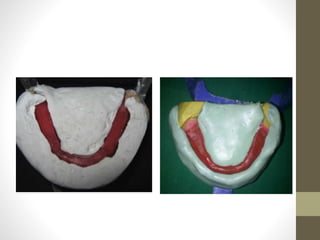
• To be sure that the teeth will been set within the neutral
zone, matrices are constructed around the occlusion
rims.
• The matrices may be made of plaster, stone, or modeling
compound.
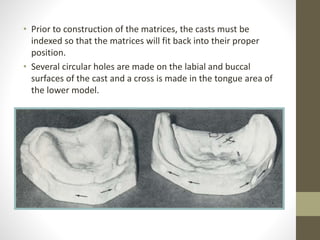
• Prior to construction of the matrices, the casts must be
indexed so that the matrices will fit back into their proper
position.
• Several circular holes are made on the labial and buccal
surfaces of the cast and a cross is made in the tongue area of
the lower model.
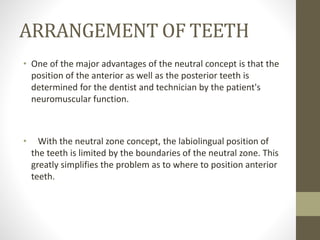
ARRANGEMENT OF TEETH
• One of the major advantages of the neutral concept is that the
position of the anterior as well as the posterior teeth is
determined for the dentist and technician by the patient's
neuromuscular function.
• With the neutral zone concept, the labiolingual position of
the teeth is limited by the boundaries of the neutral zone. This
greatly simplifies the problem as to where to position anterior
teeth.
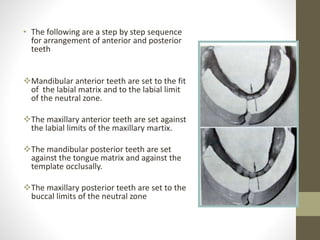
• The following are a step by step sequence
for arrangement of anterior and posterior
teeth
Mandibular anterior teeth are set to the fit
of the labial matrix and to the labial limit
of the neutral zone.
The maxillary anterior teeth are set against
the labial limits of the maxillary martix.
The mandibular posterior teeth are set
against the tongue matrix and against the
template occlusally.
The maxillary posterior teeth are set to the
buccal limits of the neutral zone
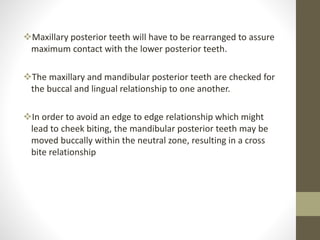
Maxillary posterior teeth will have to be rearranged to assure
maximum contact with the lower posterior teeth.
The maxillary and mandibular posterior teeth are checked for
the buccal and lingual relationship to one another.
In order to avoid an edge to edge relationship which might
lead to cheek biting, the mandibular posterior teeth may be
moved buccally within the neutral zone, resulting in a cross
bite relationship
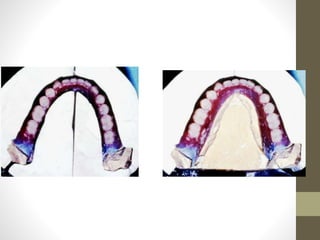
EXTERNAL IMPRESSIONS
• With the neutral zone approach, there is another
extremely important step to be completed during the
trial denture try-in, that is, the making of external
impressions on the labial, buccal, and lingual surfaces of
the dentures.
• These will determine the thickness, contours, and shape
of the polished surfaces of the denture.
• By means of external impressions, a physiologic molding is made so
that the external surfaces are functionally compatible with muscle
function.
• Materials for external impressions are zinc oxide eugenol,
conditioning materials or light body addition silicon impression
material.
• Another important reason for using this procedure is that it tends to
minimize the accumulation of food on the external surface of the
denture.
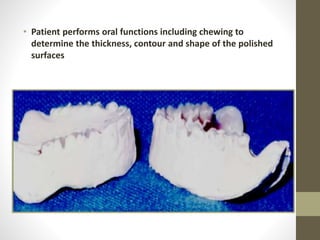
• Patient performs oral functions including chewing to
determine the thickness, contour and shape of the polished
surfaces
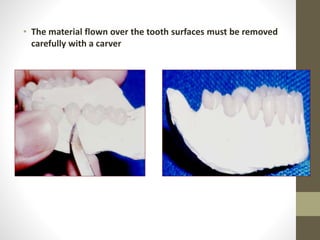
• The material flown over the tooth surfaces must be removed
carefully with a carver
• The laboratory procedures for investing,
packing, and processing of dentures when
using the neutral zone technique is
generally the same as used for
conventional dentures.
CASE REPORT
• Improvised Neutral Zone Technique in a Completely
Edentulous Patient with an Atrophic Mandibular Ridge and
Neuromuscular Incoordination: A Clinical Tip
Saravanakumar P, Thangarajan ST, Mani U.Cureus. 2017 Apr;9(4).
CHIEF COMPLAINT-A 64-year-old man reported to the Department of
Prosthodontics, Faculty of Dental Sciences, Sri Ramachandra University,
Chennai, India, with the chief complaint of an unstable loose mandibular
denture.
MEDICAL HISTORY -Diabetic,
hypertensive, and under medication.
• The patient presented with a history of
neuromuscular incoordination for the
past four years.
• He also complained of difficulty
moving his jaws, normally being a
complete denture wearer for the past
seven years, leading to difficulty in
chewing and speech, primarily due to
loose lower dentures.
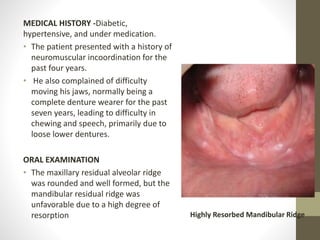
ORAL EXAMINATION
• The maxillary residual alveolar ridge
was rounded and well formed, but the
mandibular residual ridge was
unfavorable due to a high degree of
resorption Highly Resorbed Mandibular Ridge
• The treatment approach for this patient was to
construct a mandibular denture using the
conventional neutral zone technique and to use
improvised procedures to minimize the chairside
visits for the patient.
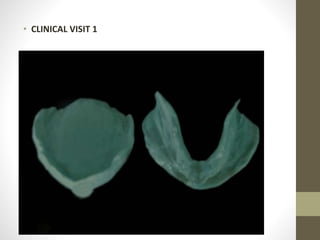
• CLINICAL VISIT 1
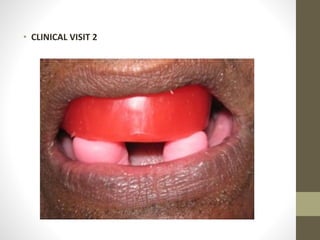
• CLINICAL VISIT 2
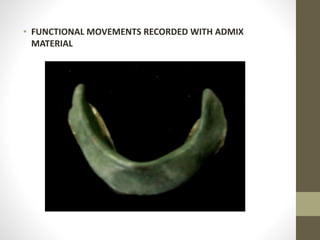
• FUNCTIONAL MOVEMENTS RECORDED WITH ADMIX
MATERIAL
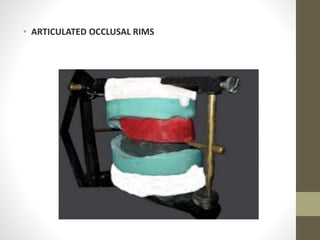
• ARTICULATED OCCLUSAL RIMS
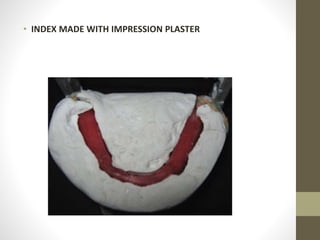
• INDEX MADE WITH IMPRESSION PLASTER
CLINICAL VISIT 3
• A wax try-in was performed to evaluate mandibular record
base stability, aesthetics, and intraoral occlusion.
• The patient successfully performed all the movements
mentioned earlier.
• The trial dentures were processed with heat-cure acrylic resin.
• The denture was polished so that the customized contours
remained unaltered.
• CLINICAL VISIST 4
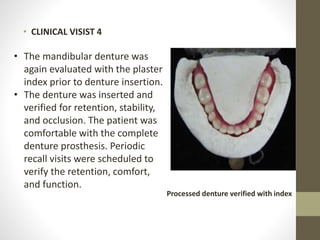
• The mandibular denture was
again evaluated with the plaster
index prior to denture insertion.
• The denture was inserted and
verified for retention, stability,
and occlusion. The patient was
comfortable with the complete
denture prosthesis. Periodic
recall visits were scheduled to
verify the retention, comfort,
and function.
Processed denture verified with index
Morphologic comparison of two neutral zone impression
techniques: A pilot study
MakzoumƩ JE. The Journal of prosthetic dentistry. 2004 Dec 1;92(6):563-8.
AIM-The purpose of this pilot study was to compare the outline
form of the phonetic and swallowing neutral zone impression
techniques for the same subjects.
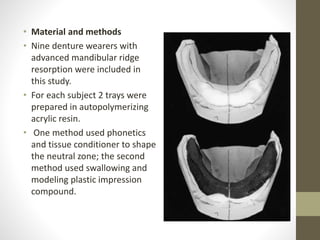
• Material and methods
• Nine denture wearers with
advanced mandibular ridge
resorption were included in
this study.
• For each subject 2 trays were
prepared in autopolymerizing
acrylic resin.
• One method used phonetics
and tissue conditioner to shape
the neutral zone; the second
method used swallowing and
modeling plastic impression
compound.
• The resulting neutral zone impressions were leveled to the
same occlusal height by gently grinding the occlusal surface on
sandpaper until it corresponded with landmarks noted on the
cast.
• The impression was inverted onto graph paper, and the
contour was outlined with a lead pencil.
• One impression was made for each subject, for each
technique. The buccal contours of both neutral zones
coincided at the median line.
• The maximum distance between the zones was measured in a
buccolingual direction in the anterior, premolar, and molar
regions bilaterally.
• When the location of the phonetic neutral zone in relation
compared to the swallowing neutral zone was buccally
oriented, a plus score was given.
• When the phonetic neutral zone was lingually located, a minus
score was given. When the 2 lines coincided, a score of 0 was
given. Measurements were made from direct readings on the
graph paper.
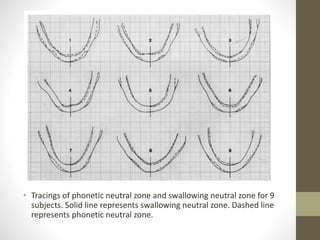
• Tracings of phonetic neutral zone and swallowing neutral zone for 9
subjects. Solid line represents swallowing neutral zone. Dashed line
represents phonetic neutral zone.
Conclusion.
Within the limits of this study, the phonetic neutral zone
appears to be narrower posteriorly compared to the swallowing
neutral zone, thus limiting premolar and molar positioning.
Arrangement of artificial teeth in the neutral zone after surgical
reconstruction of the mandible: A clinical report
Kokubo, Y., Fukushima, S., Sato, J., & Seto, K. (2002). The Journal of Prosthetic
Dentistry, 88(2), 125–127.
• CLINICAL REPORT
• A 57-year-old woman was referred to the oral and
maxillofacial clinic of Tsurumi University Hospital (Yokohama,
Japan) for examination of gingival swelling in the mandible.
• After being diagnosed with squamous cell carcinoma, the
patient underwent partial resection of the right mandible and
one-fourth resection of the tongue and floor of the oral cavity.
• Immediate surgical reconstruction was performed with
vascularized iliac crest bone fixed with a reconstruction plate
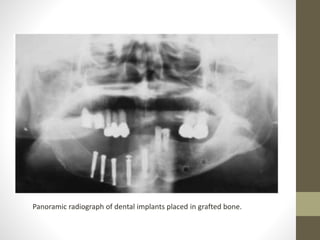
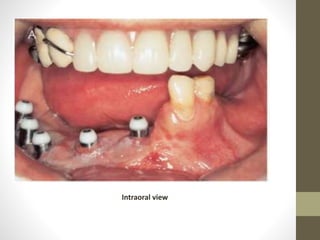
• One year and 7 months after the reconstruction, five 3.75 X
18-mm dental implants were placed in the grafted bone of the
mandible
• At the same time, the reconstruction plate was removed. The
implants were exposed after a healing time of 15 months, and
standard abutments were connected 2 weeks after exposure
Panoramic radiograph of dental implants placed in grafted bone.
Intraoral view
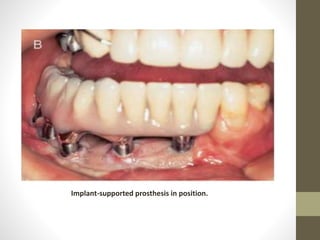
• After impressions and soft tissue working casts were made,
the casts were surveyed and the design of the final prosthesis
was determined.
• Registration of the maxillo-mandibular relation was
performed, the casts were mounted in an articulator,
composite replacement teeth were selected and arranged,
and jaw relations and esthetics were evaluated intraorally.
• The composite artificial teeth were adjusted to accommodate
the position of the implants and the opposing maxillary dental
arch.
• The prosthesis was completed and attached to the implants
with gold screws
•
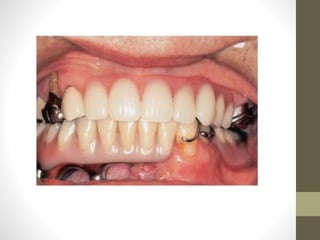
Implant-supported prosthesis in position.
• After 2 weeks, the patient returned to the clinic with the
complaint of tongue and cheek biting in the molar region on
the right side.
• The tongue and cheek had been severely injured from biting,
so an attempt was made to modify the artificial teeth through
grinding with pressure-indicating material (Fit-checker; GC
Corp, Tokyo, Japan) as the disclosing agent.
• Unfortunately, this modification did not eliminate the
problem.
• The artificial teeth in the molar region were removed from
the denture base, and a waiting period followed until the
tongue and cheek healed.
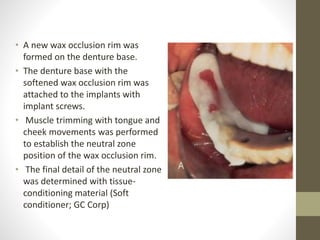
• A new wax occlusion rim was
formed on the denture base.
• The denture base with the
softened wax occlusion rim was
attached to the implants with
implant screws.
• Muscle trimming with tongue and
cheek movements was performed
to establish the neutral zone
position of the wax occlusion rim.
• The final detail of the neutral zone
was determined with tissue-
conditioning material (Soft
conditioner; GC Corp)
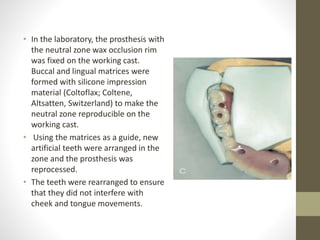
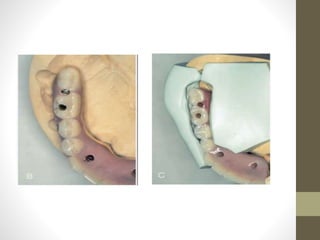
• In the laboratory, the prosthesis with
the neutral zone wax occlusion rim
was fixed on the working cast.
Buccal and lingual matrices were
formed with silicone impression
material (Coltoflax; Coltene,
Altsatten, Switzerland) to make the
neutral zone reproducible on the
working cast.
• Using the matrices as a guide, new
artificial teeth were arranged in the
zone and the prosthesis was
reprocessed.
• The teeth were rearranged to ensure
that they did not interfere with
cheek and tongue movements.
• After this procedure, no tongue biting was noted, and the
patient expressed satisfaction with the implant-retained
prosthesis.
CONCLUSION
• Neutral zone is an alternative technique for the construction
of lower complete dentures on highly atrophic ridges.
• The aim of the neutral zone is to construct a denture in muscle
balance, as muscular control will be the main stabilising and
retentive factor during function.
• The technique is relatively simple but there is increased chair
side time and laboratory costs.
REFERENCES
• Brill N,Tryde G,Cantor R.The dynamic nature of the lower denture
space. J Prosthet Dent 1965;15(3):401-418
• Wright CR.Evaluation of factors necessary to develop stability in
mandibular dentures. J Prosthet Dent 1966;16:414-30
• Fahmy FM.A study of the importance of the neutral zone in
complete dentures. J Prosthet Dent 1990;64:459-62
• Gahn MJ,Walmskey AD. The neutral zone revisited. Br Dent J
2005;198:269-72
• Beresin VE,Schiesser FJ.The neutral zone in complete denture. J
Prosthet Dent 2006;95(2):93-100
• Cagna DR,Masaad JJ, Schiesser FJ. The neutral zone revisites:from
historical concepts to modern application. J Prosthet Dent
2009;101:405-12
• Srivastava V,Gupta NK, Tandan A. The neutral zone: concept and
technique. Journal of Orofacial Research 2012;2(1):42-47
• Porwal A, Sasaki Keiichi. Current status of the neutral zone:A
literature review. J Prosthet Dent 2013;109:129-134
Neutral zone in complete dentures

Neutral zone in complete dentures

  • 1.
    The neutral zonein complete dentures BY PAAVANA II MDS
  • 2.
    CONTENTS • INTRODUCTION • DEFINITION •MUSCLE FORCES IN THE DENTAL ARCH • CHANGES IN THE EDENTULOUS MOUTH • DENTURE SURFACE AND ITS ROLE • RECORDING OF NEUTRAL ZONE • CASE REPORTS • REFERENCES
  • 3.
    INTRODUCTION • Complete denturesare primarily mechanical devices which are fabricated in harmony with normal neuromuscular function. ALL ORAL FUNCTIONS SYNERGISTIC ACTIONS OF THE TONGUE, LIPS, CHEEKS AND FLOOR OF THE MOUTH FAILURE TO RECOGNIZE THE CARDINAL IMPORTANCE OF TOOTH POSITION AND FLANGE FORM AND CONTOUR OFTEN RESULTS IN DENTURES WHICH ARE UNSTABLE AND UNSATISFACTORY
  • 4.
    • When allof the remaining natural teeth are removed, a void exists within the oral cavity that may be called the potential denture space. • The denture space is bounded by the soft tissues in the oral cavity. Within the denture space, there is an area that has been termed as a NEUTRAL ZONE.
  • 5.
    • Forces aredeveloped through muscle contraction during the various functions of chewing, swallowing and speaking, they vary in magnitude and direction in different individuals and in different periods of life. • The way these forces are directed against the dentures will either help to stabilize them or will tend to dislodge them. • The neutral zone is that area in the mouth where the forces of the tongue pressing outward are neutralized by the forces of the cheeks and lips pressing inward.
  • 6.
    In the literature,NEUTRAL ZONE has been called as • Dead Zone ( Fish, 1933 ) • Potential Denture Space (Robert, 1960) • Stable Zone ( Brill & Tryde,1965) • Biometric Denture Space (Watt & Mc Gregor,1986) • Zone of Least Interference ( Wright, 1991)
  • 7.
    Various theories havebeen put forward to enhance stability of the mandibular denture. • Lammie et al(1956) suggested that mandibular posterior teeth should be arranged over the buccal shelf area to provide increased tongue space and to facilitate development of facial polished surfaces.
  • 8.
    • Wright (1961)believed that mandibular posterior teeth should be arranged directly over the centre of the stress bearing area. This location may or may not correlate with the crest of the edentulous ridge. • Campbell (1980) stated that mandibular posterior teeth should be arranged slightly lingual to the crest of the ridge while maxillary posterior teeth should be arranged slightly buccal to the edentulous ridge. • Lang (1983) and Sharry suggested that posterior denture teeth should be arranged directly over the crest of the ridge.
  • 9.
    DEFINITION • The potentialspace between the lips and cheeks on one side and the tongue on the other; that area or position where the forces between the tongue and cheeks or lips are equal.(GPT – 9)
  • 10.
    INFLUENCE OF MUSCLEFORCES IN THE DENTAL ARCH • Teeth erupt into the mouth under the influence of muscular, environmental and genetic factor. • This environment which is created by the forces between the tongue, cheeks and lips has a definite influence on the position of the erupting teeth, the resultant arch form and occlusion.
  • 11.
    • When theteeth are erupting into the oral cavity during childhood and adolescence, the muscular activity and habits that develop continues through life. • Even after the teeth are lost, the forces created by these habits and actions still persist and will have a great influence on any complete or extensive partial removable prosthesis that is placed into the mouth. • It is therefore extremely important that the teeth be placed in that part of the mouth and with an arch form that falls within the area formed by muscular forces.
  • 13.
    • Fish in1933 highlighted the importance of the muscular function of the tongue, cheeks and lips as being critical factors for denture stability. • The soft tissues that form the internal and external boundaries of the denture space greatly affect and influence the stability of the dentures and help to determine the -Peripheral borders -Tooth position -External contours of the dentures.
  • 14.
    MUSCLES INVOLVED IN NEUTRALZONE Dislocating muscles Vestibular: Masseter Mentalis Incisive Labii Infer. Lingual: Medial Pterygoid Palatoglossus Styloglossus Mylohyoid Fixing muscles Vestibular: Buccinator Orbicularis oris Lingual: Genioglossus Linguallongitudinal Lingual vertical Lingual transverse
  • 15.
    MUSCLES INVOLVED IN NEUTRAL ZONE MUSCLESOF CHEEKS Masseter Buccinator MUSCLES OF LIPS AND MODIOLUS MUSCLES OF TONGUE GENIOGLOSSUS
  • 16.
    MUSCLES OF CHEEKS •BUCCINATOR ORIGIN Alveolar processes of maxilla and mandible and temporomandibular joint INSERTION Fibers of the orbicularis oris ARTERIAL SUPPLY Buccal artery NERVE SUPPLY Buccal branch of the facial nerve(VII cranial nerve)
  • 17.
    SIGNIFICANCE • Buccinator pressesagainst the dental arches when it contracts. During chewing and swallowing the muscle rhythmically contracts with muscles of mastication. • It assists in placing the food between the teeth and returning the food to occlusal table which has escaped into the vestibule.
  • 18.
    MUSCLES OF LIPSAND MODIOLUS • Modiolus – ā€œhub of wheelā€ in latin • Forms a distinct conical prominence just distal to corner of the mouth
  • 19.
    MUSCLES INVOLVED IN MODIOLUS •Orbicularis oris • Zygomaticus major • Levator labii superioris • Levator anguli oris • Buccinator • Triangularis • Risorius • Mentalis
  • 20.
    SIGNIFICANCE • As situatedat the corner of the mouth it is in a strategic position to unseat the lower denture and sometimes the upper denture too. • This may occur if the arch form is too wide and restricts the movement of the modiolus.
  • 21.
    • ORBICULARIS ORIS ORIGINMaxilla and mandible INSERTION Skin around the lips ARTERIAL SUPPLY Inferior labial artery and superior labial artery. NERVE SUPPLY Cranial nerve VII, buccal branch SIGNIFICANCE- It is active when the lips are pressed against the teeth. Like buccinator, orbicularis oris rhythmically contracts during chewing, sucking and swallowing
  • 22.
    • ZYGOMATICUS MAJOR ORIGINAnterior of zygomatic INSERTION Modiolus of mouth ARTERIAL SUPPLY Facial artery NERVE SUPPLY Zygomatic and buccal branches of the facial nerve SIGNIFICANCE- It pulls the angle of the mouth upward and backward.
  • 23.
    • LEVATOR ANGULIORIS (CANINUS) ORIGIN Maxilla INSERTION Modiolus ARTERY Facial artery NERVE Buccal branches of the facial nerve SIGNIFICANCE- In swallowing, helps to pull the lips forward, thus exerting forces on the teeth and alveolar process.
  • 24.
    • MENTALIS ORIGIN Anteriormandible INSERTION Chin NERVE Mandibular branch of facial nerve
  • 25.
    SIGNIFICANCE • The bottomof the sulcus is lifted when the muscle contracts thereby the depth and the width of the oral vestibule can be decreased considerable . • The denture must be relieved over, and contoured around them. Extensions beyond the crest will interfere with the mentalis muscle movement and lead to denture instability.
  • 26.
    • INCISIVE LABIIINFERIORIS Origin Oblique line of the mandible, between the symphysis and the mental foramen Insertion Integument of the lower lip, Orbicularis oris fibers on both sides. Nerve Facial nerve - Mandibular branch Actions Depression of the lower lip
  • 27.
    • SIGNIFICANCE • Contractionof the muscle can reduce the denture space.* • In action it pulls the modioli forward and tenses the buccinator thereby applying pressure on the polished surface.
  • 28.
    MUSCLES OF TONGUE Theextrinsic muscles have their origin external to the tongue, but their course terminates within it. Their contraction causes the tongue to move in relation to other oral structures. The intrinsic muscles lie completely within the tongue, and their activities sustain or alter tongue form.
  • 29.
    • SIGNIFICANCE • Thetongue is capable of many varied shapes and positions during speech, mastication, and swallowing and in all of these functions is in constant contact with the lingual surface of the teeth, the lingual flange of the lower denture and the palatal surface of the upper denture. • Because of this contact, the tongue is a dominant factor in establishing the neutral zone and therefore in the stability or lack of stability of the lower denture.
  • 30.
    CHANGES IN EDENTULOUSMOUTH MAXILLA AND MANDIBLE • Neither of the alveolar ridges resorb uniformly. • Mandibular residual alveolar ridges tend to resorb more from the lingual while maxillary residual alveolar ridges resorb more from the buccal. • Usually, the longer a patient is edentulous, the greater is this interridge facial/lingual and facial/palatal dimensional disparity.
  • 31.
    • LIPS ANDMODIOLI • Collapse of lips • Reduced prominence of philtrum and vermilion border • Drooping of corners of mouth • Modioli become sagging, less active
  • 32.
    • MUSCLE ATTACHMENT •As the mandibular ridge resorbs the crest falls below the level of the mentalis. As a result mentalis tends to fold over and rests on the ridge. It pushes the neutral zone posteriorly. • The freni occupy a more superior position on the ridge. • In some cases the buccinator attachment over the external oblique ridge is lost after severe resorption .
  • 33.
    • TONGUE • Itis estimated that tongue size increases by approximately 10% in the edentulous patient. • The position of the neutral zone in relation to the alveolar ridge was found to be highly affected by the period of edentulousness . • The longer the edentulousness ,the more buccally / labially located was the neutral zone
  • 34.
    DENTURE SURFACES Sir WilfredFish (1948) described a denture having three surfaces, with each surface playing an independent and important role in the overall fit, stability, and comfort of the denture.
  • 35.
    INFLUENCE OF FORCESON DENTURE SURFACES • The greater the ridge loss, the lesser the area of the denture base and lesser the influence of the impression surface area will have on the stability and retention of the denture. • Where more of the ridge has been lost, the more the denture stability and retention is dependent on the polished surface than on the impression surface.
  • 36.
    • The forceson the polished surface are constantly changing in magnitude and direction during swallowing, speaking, and mastication. • It is only when the mouth is completely at rest that the forces are constant. • When the occlusal surfaces of the teeth are not in contact, the stability of the denture is determined by the fit of the impression surface and the direction and amount of forces transmitted through the polished surfaces. • In order to construct dentures that function properly not only in chewing but also in speaking and swallowing, we must develop the fit and contour of the polished surface just as accurately and meticulously as the fit and contour of the impression and the occlusal surfaces.
  • 37.
    • The influenceof the lip on lower denture stability becomes more critical as resorption of the ridge increases or as the patient becomes older.
  • 38.
    NEUTRALIZATION OF FORCES •The theory of the neutralization of forces is that to stabilize dentures; and the rationale involved was one of the major contributions made by Dr. Russell Tench (1952) and his co- workers. • The lips, cheek and tongue in the passive and functioning state exert forces on the natural teeth. In natural dentition, arch integrity and tooth position are maintained when all the forces generated by the musculature are neutralized. • Any changes in the forces generated by the musculature because of increased size, altered muscle function, or abnormal habit patterns will upset the equilibrium and result in alteration of tooth position and the arch form.
  • 39.
  • 40.
    DIFFERENT METHODS • AFTERIMPRESSION • AFTER TENTATIVE JAW RELATION • DURING TRY IN PROCEDURES • SWALLOWING METHOD • PHONATION METHOD
  • 41.
  • 42.
  • 43.
    • TRYIN OFTHE DENTURE BASES
  • 44.
    MATERIALS USED Many materialshave been suggested for shaping the neutral zone: • Modeling plastic impression compound (Tench) • Soft wax (Buchman & Gelb, Lott & Levin , and Russell) • A polymer of dimethyl siloxane filled with calcium • silicate( Heath) • Tissue conditioners (Gahan & Walmsley)
  • 45.
    CLINICALPROCEDURESIN LOCATINGTHE NEUTRALZONE • Tenchet al used modelling impression compound for the first time to record neutral zone. • A water bath, preheated to the proper temperature, is used to soften the material, which is then kneaded and worked until it is uniformly soft.
  • 46.
  • 47.
    LOCATINGTHE NEUTRALZONEFOR THE MANDIBULARARCH Tolocate the neutral zone for the lower arch the patient's lips are lubricated with petrolatum jelly. The tray with the softened modeling compound is carefully seated into the mouth. The patient is instructed to swallow and then purse the lips as in sucking.
  • 48.
  • 49.
    • TESTING THESTABILITY OF THE LOWER OCCLUSION RIM The lower occlusion rim is placed back into the patient's mouth and checked for stability by having the patient open wide, wet the lips with the tongue, count from one to ten, and say exaggerated "ohs," "ahs," and "ees." If these movements raise the rim, the lack of stability must be caused by an improper molding of the compound.
  • 50.
    LOCATINGTHE NEUTRALZONEFOR THE UPPERARCH Themodeling compound is attached to the upper tray. It is flamed, tempered and molded into the shape of an rim.
  • 51.
    • The upperrim is placed into the oral cavity and patient is instructed to suck and swallow. Usually excess compound will seen extending below the relaxed upper lip. • A line is scribed about 2 mm below the upper lip at rest and the compound is trimmed to this line.
  • 52.
    NEUTRAL ZONE FOR MANDIBULARARCH • PRIMARY IMPRESSION AND PRIMARY CAST SECONADRY IMPRESSIONAND SECONDARY CAST TENTATIVE JAW RELATION AND ARTICULATION
  • 53.
  • 55.
  • 56.
    SECONDARY IMPRESSIONS • Toachieve optimum success in complete denture prosthesis, the dentures should be both retentive and stable. The retention of a denture is mainly dependent on the accuracy of impression and fit of denture base to the tissues. • Closed or open mouth impression technique is used • More accurate functional border molding with minimal displacement of soft tissues • Even distribution of pressure and impression material with less likelihood of excessive pressure in one area or another
  • 57.
    FABRICATION OF ATONGUE, LIP, AND CHEEK MATRICES • To be sure that the teeth will been set within the neutral zone, matrices are constructed around the occlusion rims. • The matrices may be made of plaster, stone, or modeling compound.
  • 58.
    • Prior toconstruction of the matrices, the casts must be indexed so that the matrices will fit back into their proper position. • Several circular holes are made on the labial and buccal surfaces of the cast and a cross is made in the tongue area of the lower model.
  • 60.
    ARRANGEMENT OF TEETH •One of the major advantages of the neutral concept is that the position of the anterior as well as the posterior teeth is determined for the dentist and technician by the patient's neuromuscular function. • With the neutral zone concept, the labiolingual position of the teeth is limited by the boundaries of the neutral zone. This greatly simplifies the problem as to where to position anterior teeth.
  • 61.
    • The followingare a step by step sequence for arrangement of anterior and posterior teeth Mandibular anterior teeth are set to the fit of the labial matrix and to the labial limit of the neutral zone. The maxillary anterior teeth are set against the labial limits of the maxillary martix. The mandibular posterior teeth are set against the tongue matrix and against the template occlusally. The maxillary posterior teeth are set to the buccal limits of the neutral zone
  • 62.
    Maxillary posterior teethwill have to be rearranged to assure maximum contact with the lower posterior teeth. The maxillary and mandibular posterior teeth are checked for the buccal and lingual relationship to one another. In order to avoid an edge to edge relationship which might lead to cheek biting, the mandibular posterior teeth may be moved buccally within the neutral zone, resulting in a cross bite relationship
  • 64.
    EXTERNAL IMPRESSIONS • Withthe neutral zone approach, there is another extremely important step to be completed during the trial denture try-in, that is, the making of external impressions on the labial, buccal, and lingual surfaces of the dentures. • These will determine the thickness, contours, and shape of the polished surfaces of the denture.
  • 65.
    • By meansof external impressions, a physiologic molding is made so that the external surfaces are functionally compatible with muscle function. • Materials for external impressions are zinc oxide eugenol, conditioning materials or light body addition silicon impression material. • Another important reason for using this procedure is that it tends to minimize the accumulation of food on the external surface of the denture.
  • 66.
    • Patient performsoral functions including chewing to determine the thickness, contour and shape of the polished surfaces
  • 67.
    • The materialflown over the tooth surfaces must be removed carefully with a carver
  • 68.
    • The laboratoryprocedures for investing, packing, and processing of dentures when using the neutral zone technique is generally the same as used for conventional dentures.
  • 69.
    CASE REPORT • ImprovisedNeutral Zone Technique in a Completely Edentulous Patient with an Atrophic Mandibular Ridge and Neuromuscular Incoordination: A Clinical Tip Saravanakumar P, Thangarajan ST, Mani U.Cureus. 2017 Apr;9(4). CHIEF COMPLAINT-A 64-year-old man reported to the Department of Prosthodontics, Faculty of Dental Sciences, Sri Ramachandra University, Chennai, India, with the chief complaint of an unstable loose mandibular denture.
  • 70.
    MEDICAL HISTORY -Diabetic, hypertensive,and under medication. • The patient presented with a history of neuromuscular incoordination for the past four years. • He also complained of difficulty moving his jaws, normally being a complete denture wearer for the past seven years, leading to difficulty in chewing and speech, primarily due to loose lower dentures. ORAL EXAMINATION • The maxillary residual alveolar ridge was rounded and well formed, but the mandibular residual ridge was unfavorable due to a high degree of resorption Highly Resorbed Mandibular Ridge
  • 71.
    • The treatmentapproach for this patient was to construct a mandibular denture using the conventional neutral zone technique and to use improvised procedures to minimize the chairside visits for the patient.
  • 72.
  • 73.
  • 74.
    • FUNCTIONAL MOVEMENTSRECORDED WITH ADMIX MATERIAL
  • 75.
  • 76.
    • INDEX MADEWITH IMPRESSION PLASTER
  • 77.
    CLINICAL VISIT 3 •A wax try-in was performed to evaluate mandibular record base stability, aesthetics, and intraoral occlusion. • The patient successfully performed all the movements mentioned earlier. • The trial dentures were processed with heat-cure acrylic resin. • The denture was polished so that the customized contours remained unaltered.
  • 78.
    • CLINICAL VISIST4 • The mandibular denture was again evaluated with the plaster index prior to denture insertion. • The denture was inserted and verified for retention, stability, and occlusion. The patient was comfortable with the complete denture prosthesis. Periodic recall visits were scheduled to verify the retention, comfort, and function. Processed denture verified with index
  • 79.
    Morphologic comparison oftwo neutral zone impression techniques: A pilot study MakzoumƩ JE. The Journal of prosthetic dentistry. 2004 Dec 1;92(6):563-8. AIM-The purpose of this pilot study was to compare the outline form of the phonetic and swallowing neutral zone impression techniques for the same subjects.
  • 80.
    • Material andmethods • Nine denture wearers with advanced mandibular ridge resorption were included in this study. • For each subject 2 trays were prepared in autopolymerizing acrylic resin. • One method used phonetics and tissue conditioner to shape the neutral zone; the second method used swallowing and modeling plastic impression compound.
  • 81.
    • The resultingneutral zone impressions were leveled to the same occlusal height by gently grinding the occlusal surface on sandpaper until it corresponded with landmarks noted on the cast. • The impression was inverted onto graph paper, and the contour was outlined with a lead pencil. • One impression was made for each subject, for each technique. The buccal contours of both neutral zones coincided at the median line.
  • 82.
    • The maximumdistance between the zones was measured in a buccolingual direction in the anterior, premolar, and molar regions bilaterally. • When the location of the phonetic neutral zone in relation compared to the swallowing neutral zone was buccally oriented, a plus score was given. • When the phonetic neutral zone was lingually located, a minus score was given. When the 2 lines coincided, a score of 0 was given. Measurements were made from direct readings on the graph paper.
  • 83.
    • Tracings ofphonetic neutral zone and swallowing neutral zone for 9 subjects. Solid line represents swallowing neutral zone. Dashed line represents phonetic neutral zone.
  • 84.
    Conclusion. Within the limitsof this study, the phonetic neutral zone appears to be narrower posteriorly compared to the swallowing neutral zone, thus limiting premolar and molar positioning.
  • 85.
    Arrangement of artificialteeth in the neutral zone after surgical reconstruction of the mandible: A clinical report Kokubo, Y., Fukushima, S., Sato, J., & Seto, K. (2002). The Journal of Prosthetic Dentistry, 88(2), 125–127.
  • 86.
    • CLINICAL REPORT •A 57-year-old woman was referred to the oral and maxillofacial clinic of Tsurumi University Hospital (Yokohama, Japan) for examination of gingival swelling in the mandible. • After being diagnosed with squamous cell carcinoma, the patient underwent partial resection of the right mandible and one-fourth resection of the tongue and floor of the oral cavity. • Immediate surgical reconstruction was performed with vascularized iliac crest bone fixed with a reconstruction plate
  • 87.
    • One yearand 7 months after the reconstruction, five 3.75 X 18-mm dental implants were placed in the grafted bone of the mandible • At the same time, the reconstruction plate was removed. The implants were exposed after a healing time of 15 months, and standard abutments were connected 2 weeks after exposure
  • 88.
    Panoramic radiograph ofdental implants placed in grafted bone.
  • 89.
  • 90.
    • After impressionsand soft tissue working casts were made, the casts were surveyed and the design of the final prosthesis was determined. • Registration of the maxillo-mandibular relation was performed, the casts were mounted in an articulator, composite replacement teeth were selected and arranged, and jaw relations and esthetics were evaluated intraorally. • The composite artificial teeth were adjusted to accommodate the position of the implants and the opposing maxillary dental arch. • The prosthesis was completed and attached to the implants with gold screws
  • 91.
  • 92.
    • After 2weeks, the patient returned to the clinic with the complaint of tongue and cheek biting in the molar region on the right side. • The tongue and cheek had been severely injured from biting, so an attempt was made to modify the artificial teeth through grinding with pressure-indicating material (Fit-checker; GC Corp, Tokyo, Japan) as the disclosing agent. • Unfortunately, this modification did not eliminate the problem. • The artificial teeth in the molar region were removed from the denture base, and a waiting period followed until the tongue and cheek healed.
  • 93.
    • A newwax occlusion rim was formed on the denture base. • The denture base with the softened wax occlusion rim was attached to the implants with implant screws. • Muscle trimming with tongue and cheek movements was performed to establish the neutral zone position of the wax occlusion rim. • The final detail of the neutral zone was determined with tissue- conditioning material (Soft conditioner; GC Corp)
  • 94.
    • In thelaboratory, the prosthesis with the neutral zone wax occlusion rim was fixed on the working cast. Buccal and lingual matrices were formed with silicone impression material (Coltoflax; Coltene, Altsatten, Switzerland) to make the neutral zone reproducible on the working cast. • Using the matrices as a guide, new artificial teeth were arranged in the zone and the prosthesis was reprocessed. • The teeth were rearranged to ensure that they did not interfere with cheek and tongue movements.
  • 97.
    • After thisprocedure, no tongue biting was noted, and the patient expressed satisfaction with the implant-retained prosthesis.
  • 98.
    CONCLUSION • Neutral zoneis an alternative technique for the construction of lower complete dentures on highly atrophic ridges. • The aim of the neutral zone is to construct a denture in muscle balance, as muscular control will be the main stabilising and retentive factor during function. • The technique is relatively simple but there is increased chair side time and laboratory costs.
  • 99.
    REFERENCES • Brill N,TrydeG,Cantor R.The dynamic nature of the lower denture space. J Prosthet Dent 1965;15(3):401-418 • Wright CR.Evaluation of factors necessary to develop stability in mandibular dentures. J Prosthet Dent 1966;16:414-30 • Fahmy FM.A study of the importance of the neutral zone in complete dentures. J Prosthet Dent 1990;64:459-62 • Gahn MJ,Walmskey AD. The neutral zone revisited. Br Dent J 2005;198:269-72 • Beresin VE,Schiesser FJ.The neutral zone in complete denture. J Prosthet Dent 2006;95(2):93-100 • Cagna DR,Masaad JJ, Schiesser FJ. The neutral zone revisites:from historical concepts to modern application. J Prosthet Dent 2009;101:405-12 • Srivastava V,Gupta NK, Tandan A. The neutral zone: concept and technique. Journal of Orofacial Research 2012;2(1):42-47 • Porwal A, Sasaki Keiichi. Current status of the neutral zone:A literature review. J Prosthet Dent 2013;109:129-134