RETAINER SELECTION IN
FPD
CONTENTS
 INTRODUCTION
 IDEAL REQUIREMENTS
 CRITERIA FOR SELECTION OF RETAINERS
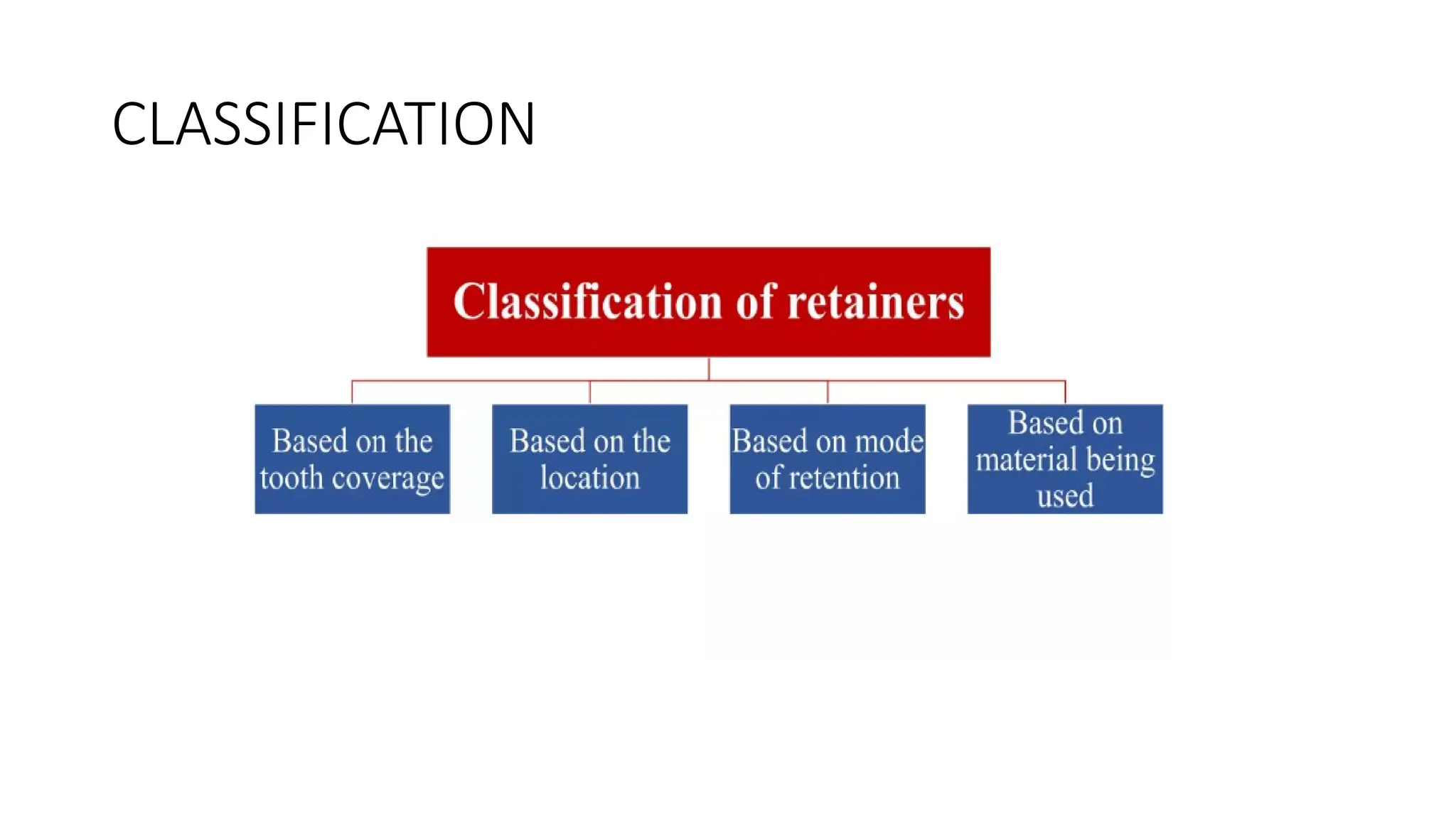
 CLASSIFICATION
 EXTRACORONAL RETAINERS
 INTRACORONAL RETAINERS
 RADICULAR RETAINERS
 FACTORS AFFECTING THE SELECTION OF RETAINERS
 RECENT ADVANCES
 CONCLUSION
 REFERENCES
INTRODUCTION
• A fixed partial denture is commonly fabricated by preparing the teeth present on either
side of the missing tooth or teeth.
• These supporting prepared teeth are the abutments onto which the prosthesis is
cemented.
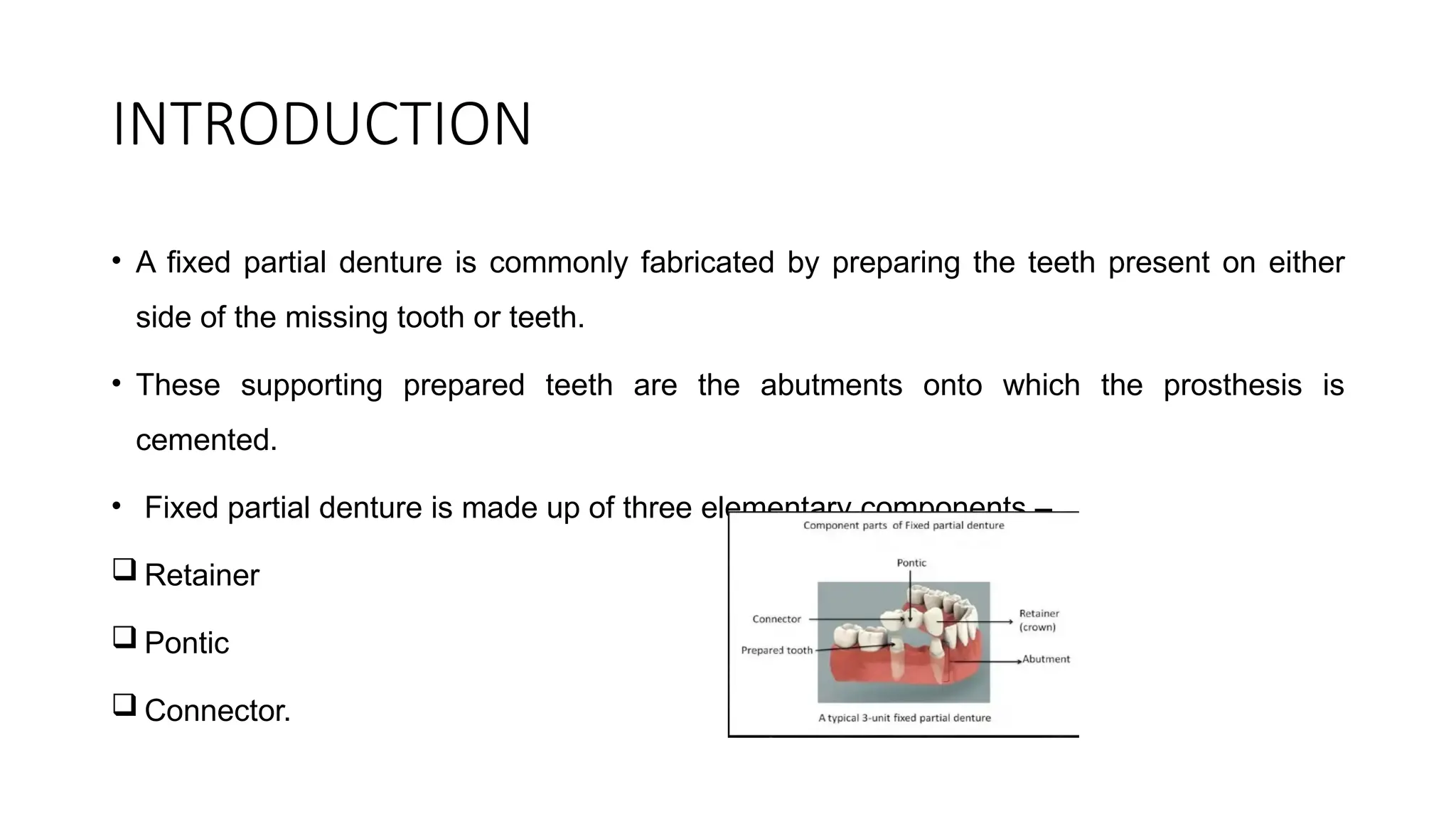
• Fixed partial denture is made up of three elementary components –
 Retainer
 Pontic
 Connector.
• Retainer: The part of a fixed dental prosthesis that unites the abutment(s)
to the remainder of the restoration(GPT8).
• It is used for the stabilization or retention of prosthesis
• Pontic: An artificial tooth on a fixed dental prosthesis that replaces a
missing natural tooth, restores its function and usually fills the space
previously occupied by the clinical crown.
• Connector: The portion of affixed dental prosthesis that unites the retainers
and pontic.
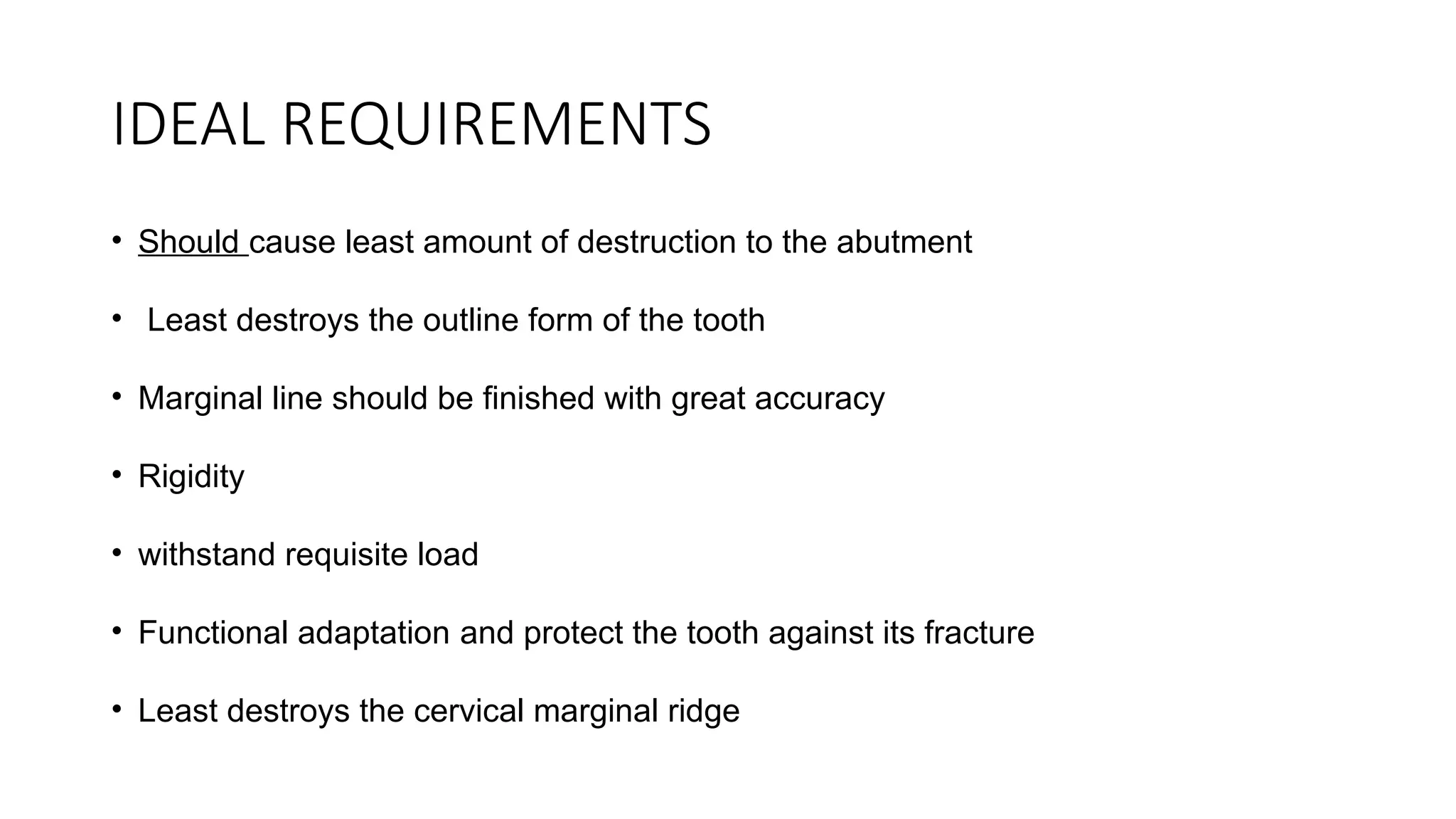
IDEAL REQUIREMENTS
• Should cause least amount of destruction to the abutment
• Least destroys the outline form of the tooth
• Marginal line should be finished with great accuracy
• Rigidity
• withstand requisite load
• Functional adaptation and protect the tooth against its fracture
• Least destroys the cervical marginal ridge
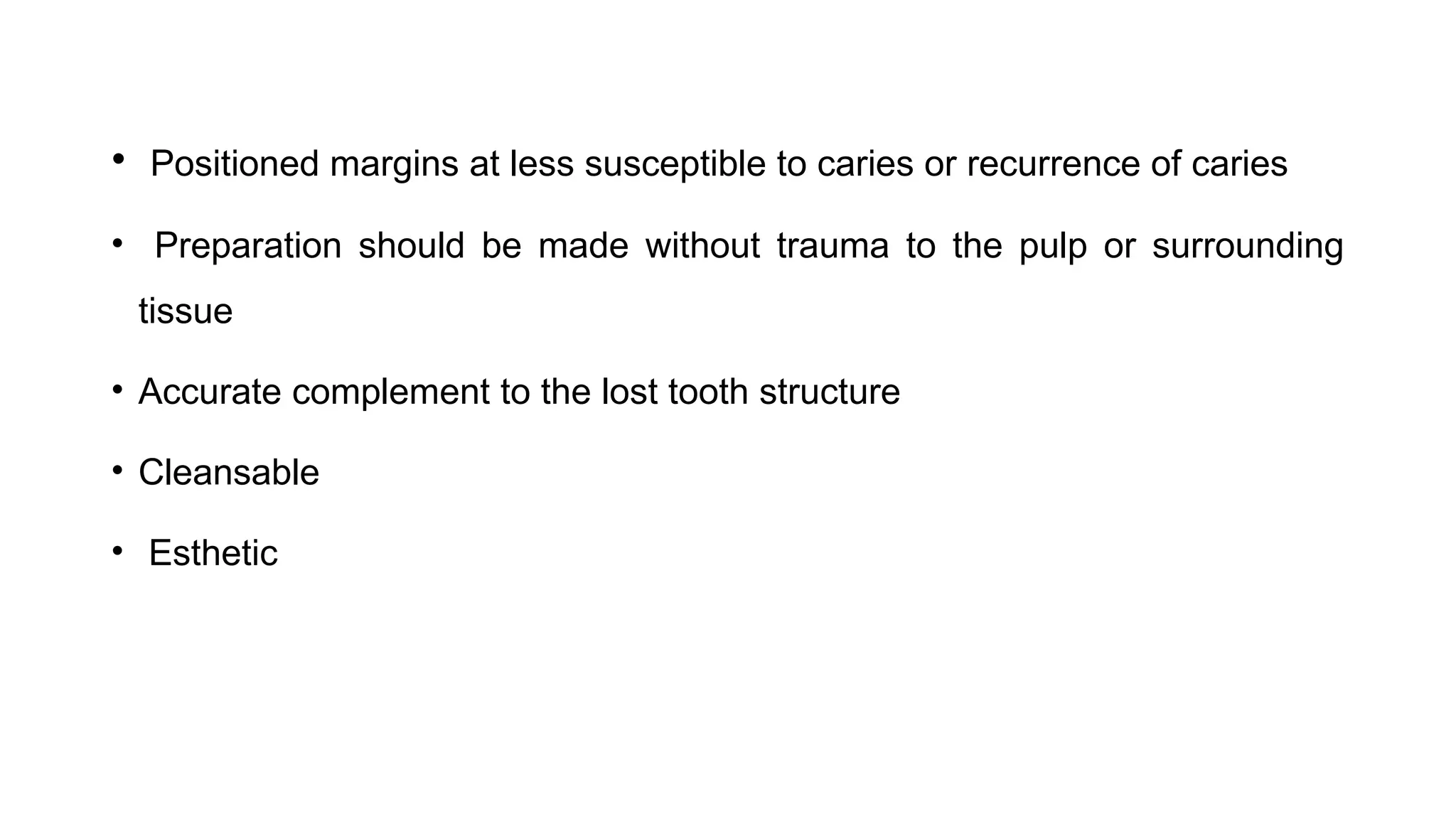
• Positioned margins at less susceptible to caries or recurrence of caries
• Preparation should be made without trauma to the pulp or surrounding
tissue
• Accurate complement to the lost tooth structure
• Cleansable
• Esthetic
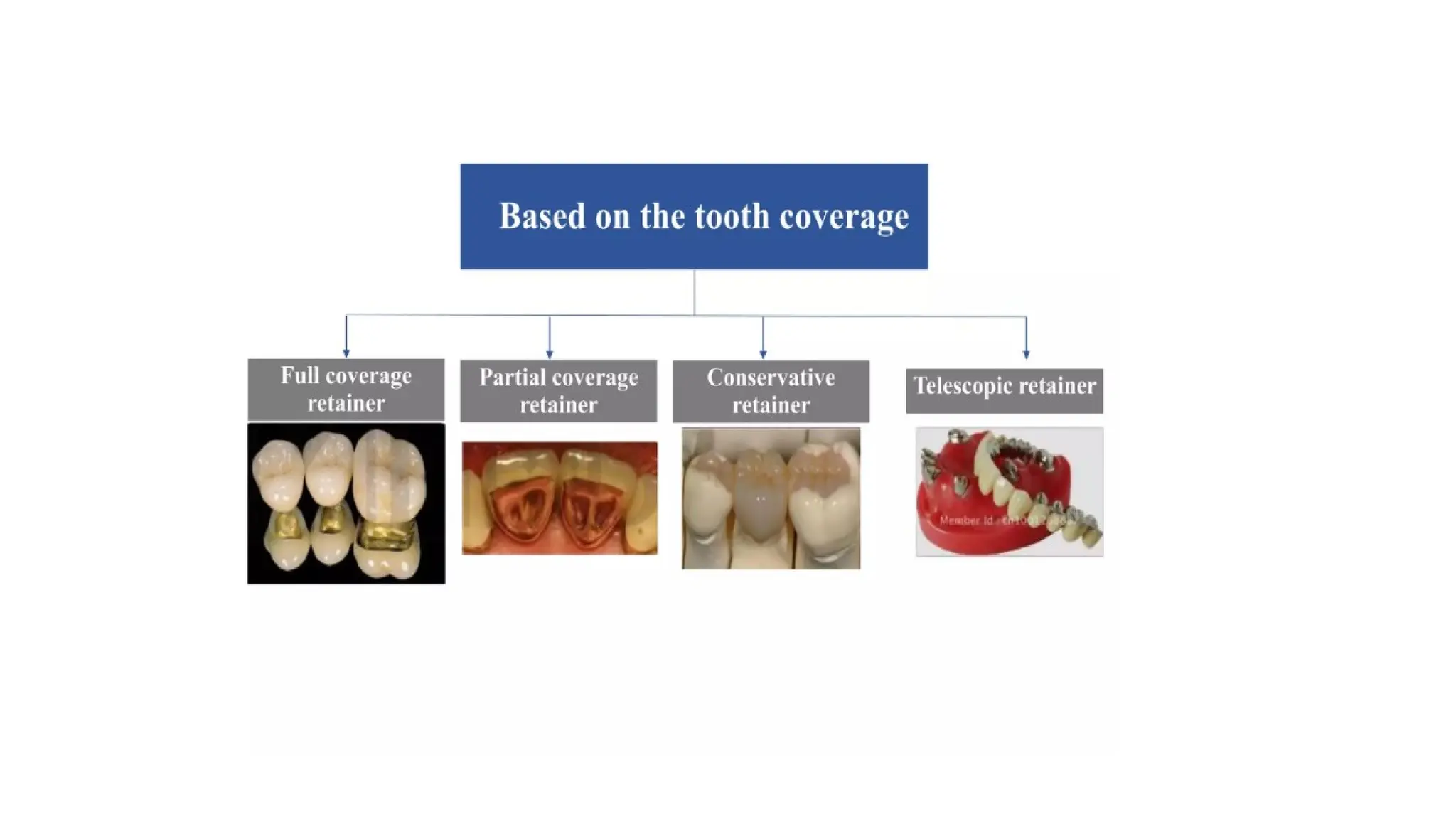
CLASSIFICATION
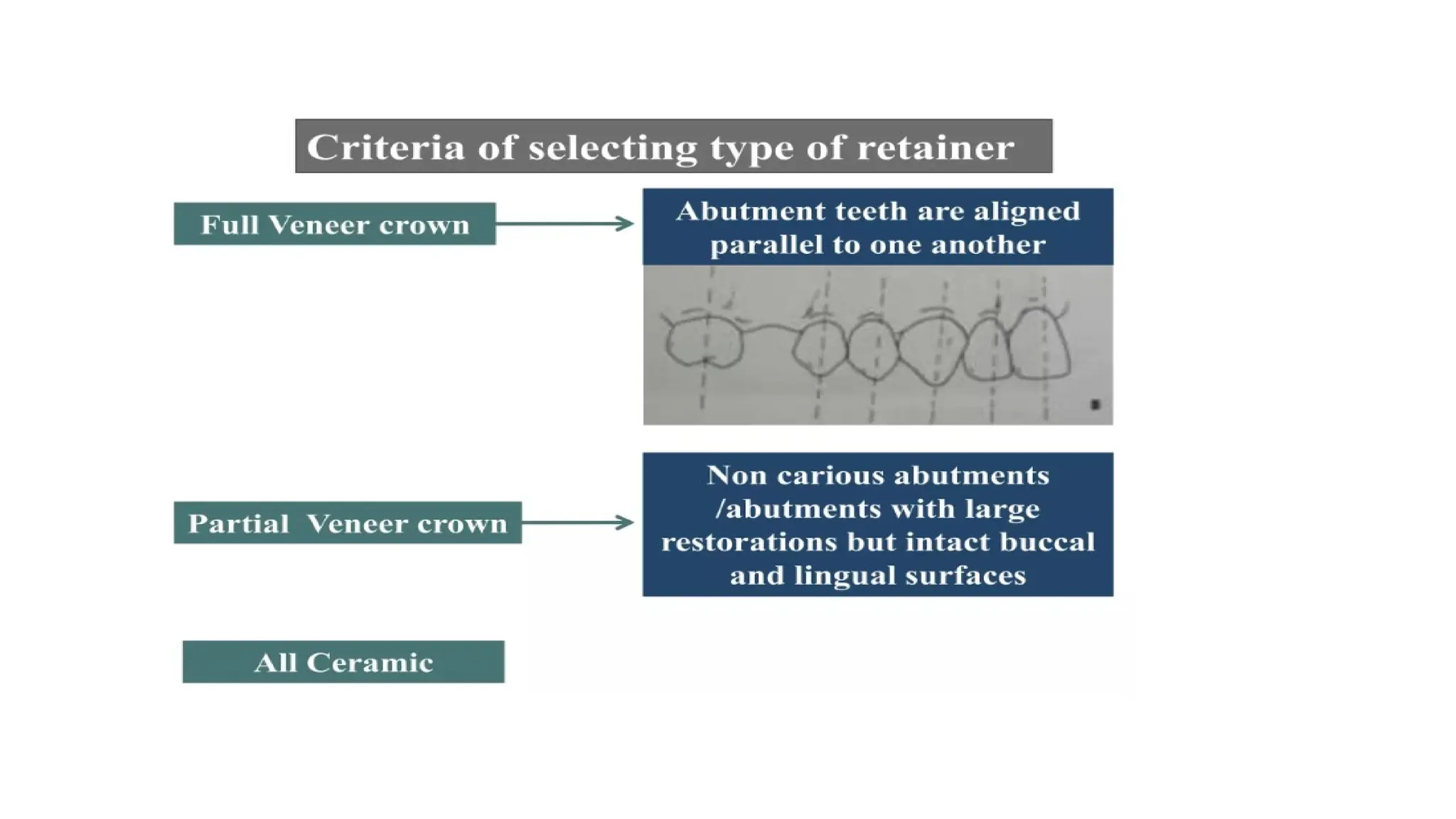
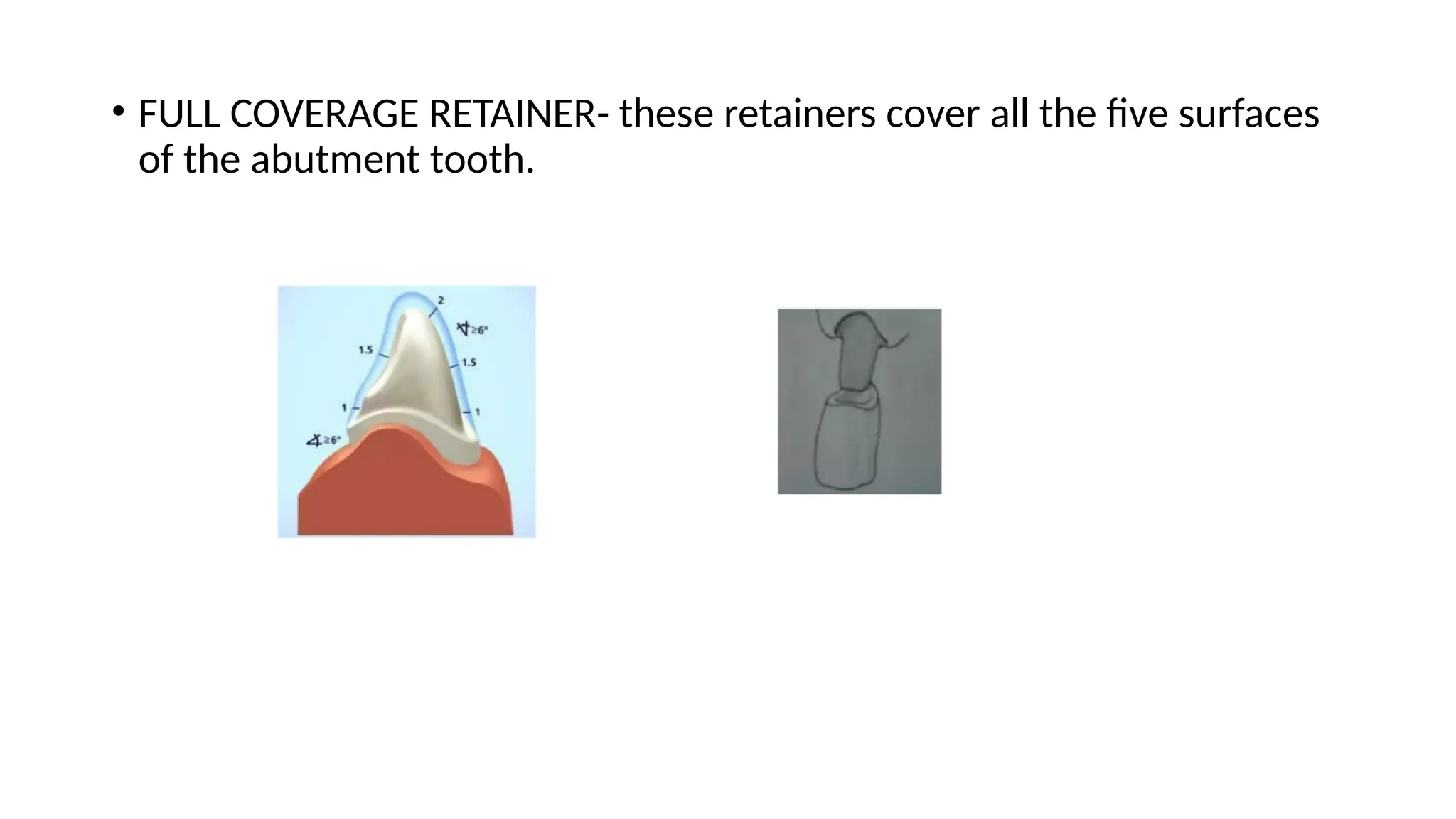
• FULL COVERAGE RETAINER- these retainers cover all the five surfaces
of the abutment tooth.
• ADVANTAGES
• Contact area can be properly developed
• Embrasure area can be enhanced
• Buccal contours can be correctly developed
• Facilitate occlusal plane modifications
• Indicated for endodontically treated abutments
• Ideal for restoring edentulous area in patients with craniofacial anomalies
INDICATIONS
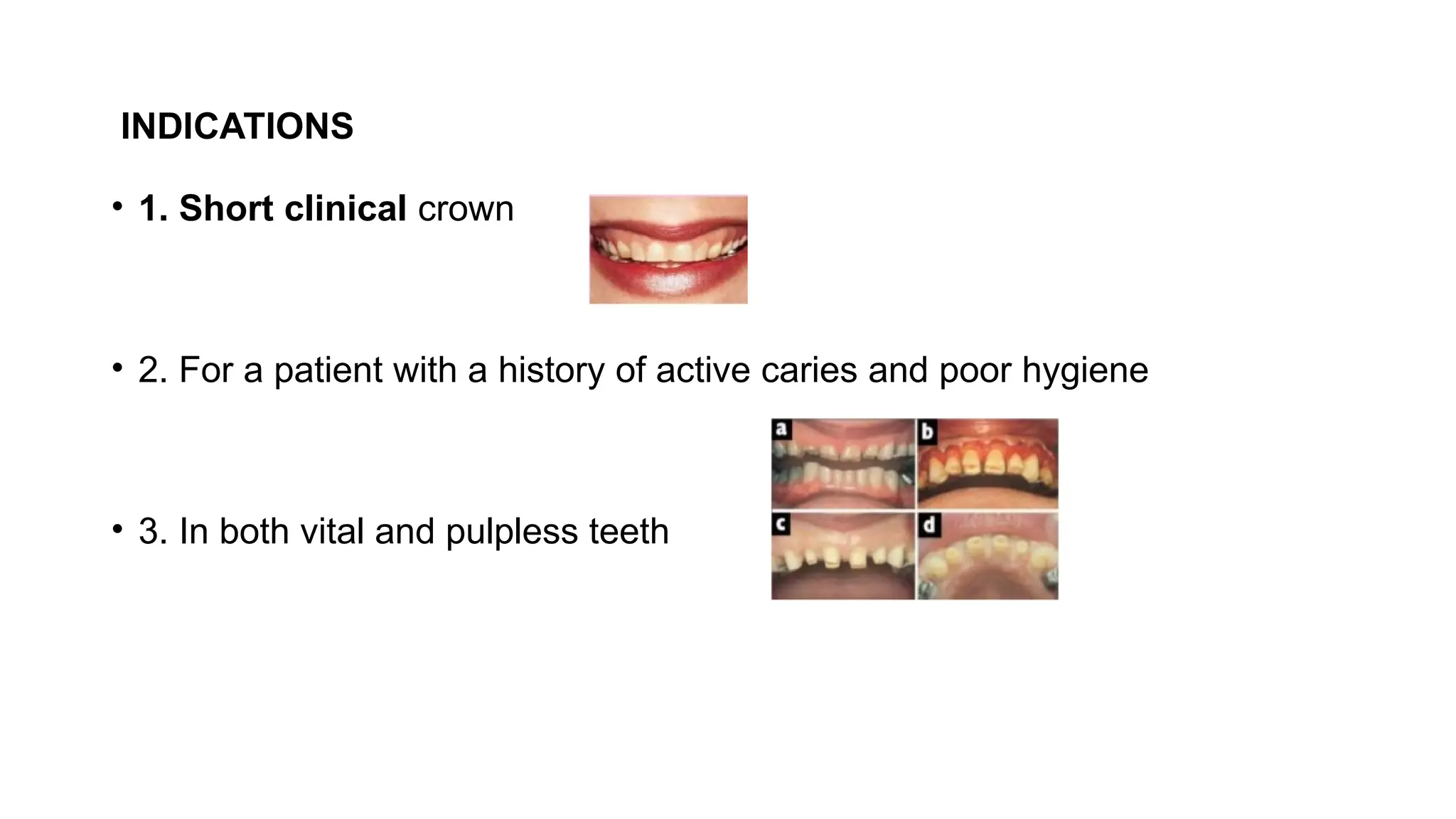
• 1. Short clinical crown
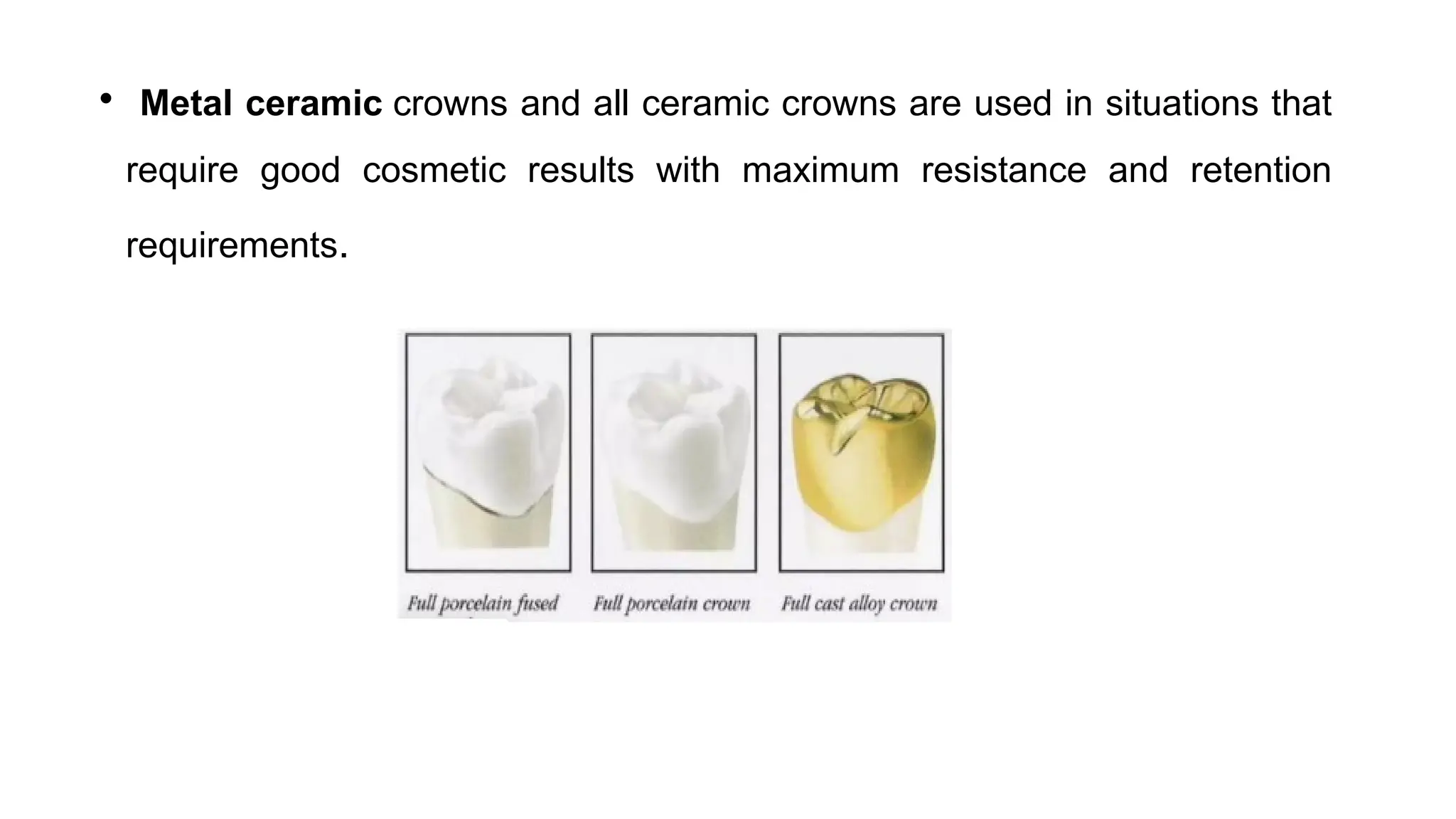
• 2. For a patient with a history of active caries and poor hygiene
• 3. In both vital and pulpless teeth
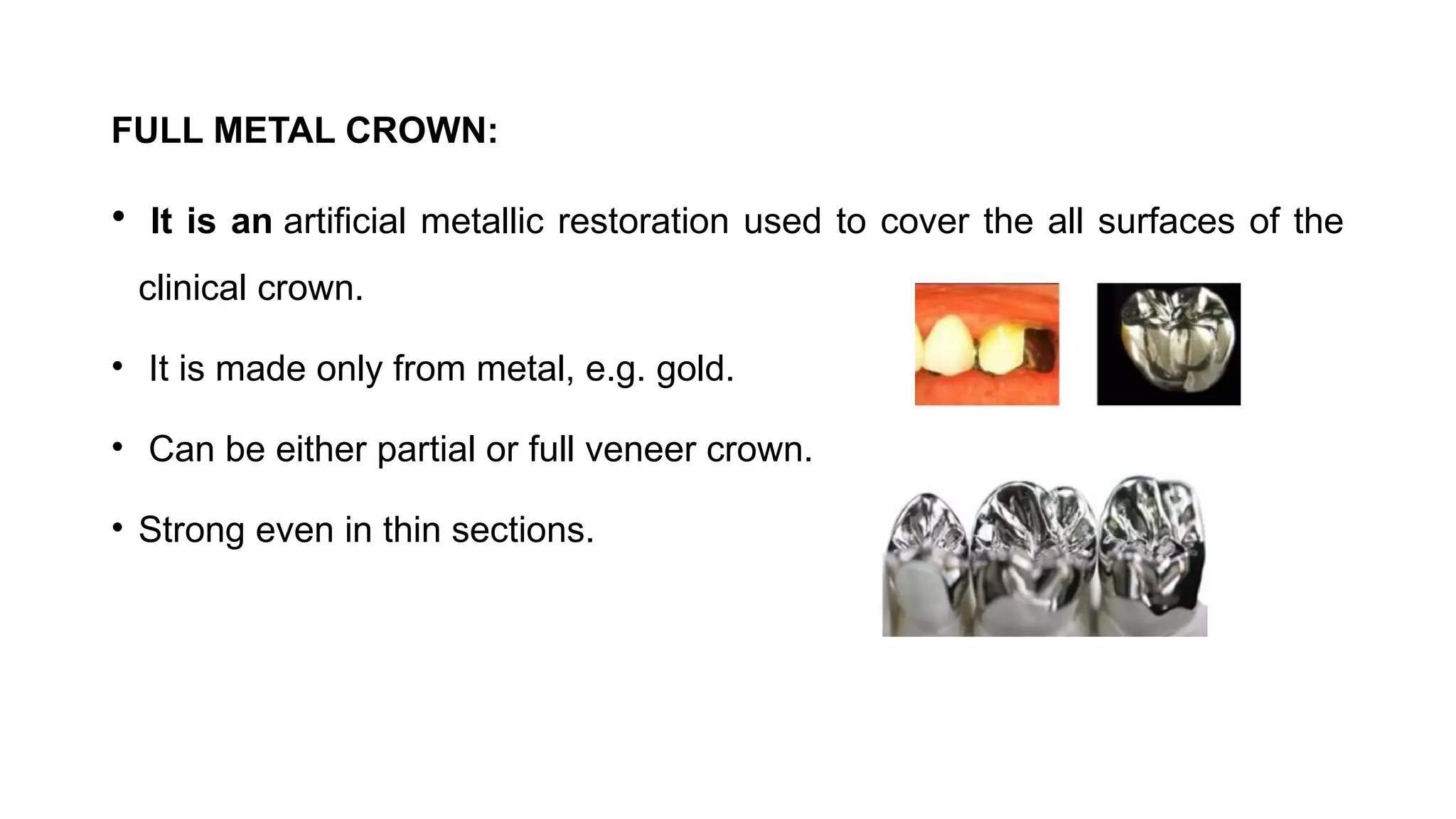
• Metal ceramic crowns and all ceramic crowns are used in situations that
require good cosmetic results with maximum resistance and retention
requirements.
FULL METAL CROWN:
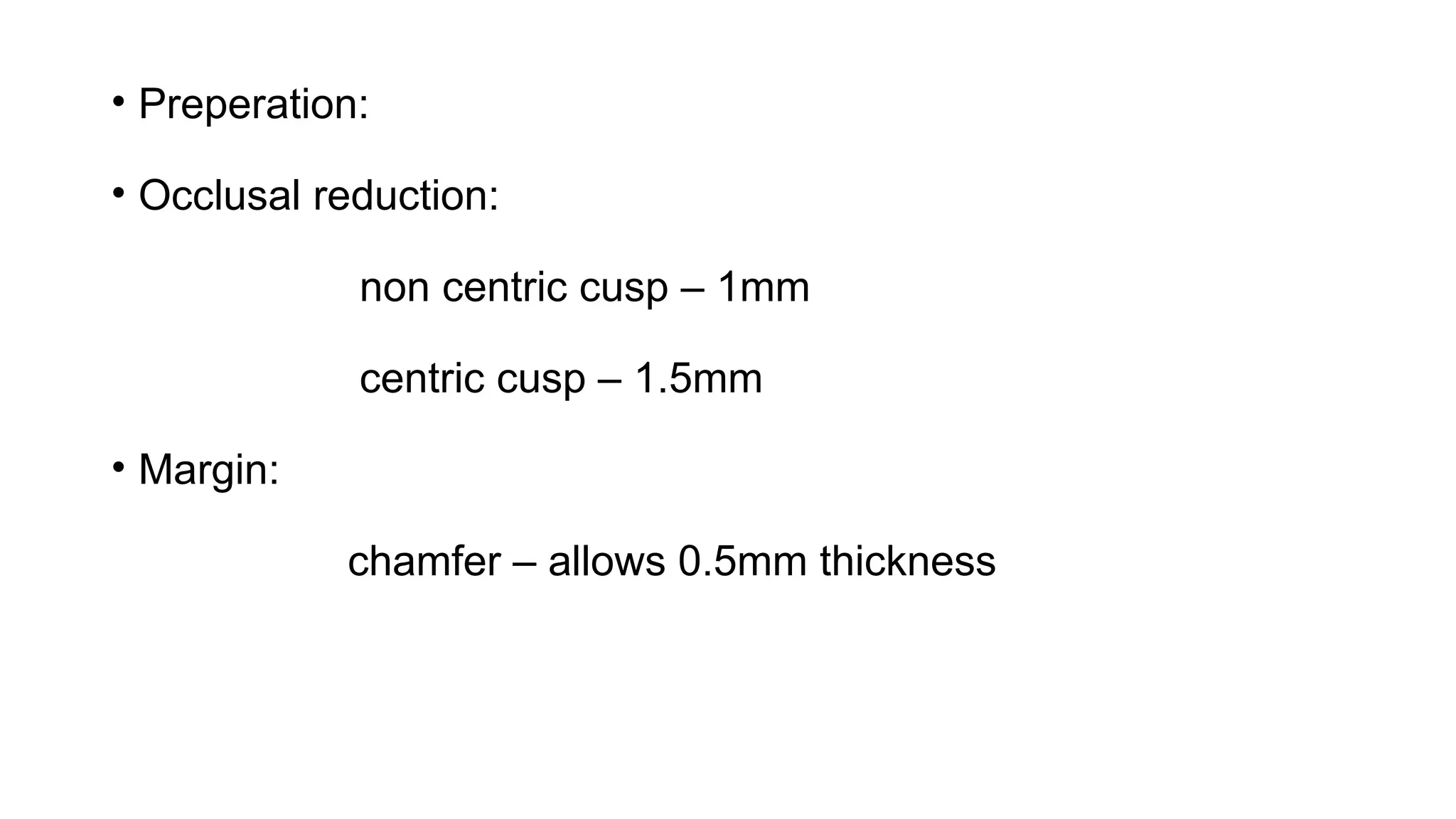
• It is an artificial metallic restoration used to cover the all surfaces of the
clinical crown.
• It is made only from metal, e.g. gold.
• Can be either partial or full veneer crown.
• Strong even in thin sections.
• Preperation:
• Occlusal reduction:
non centric cusp – 1mm
centric cusp – 1.5mm
• Margin:
chamfer – allows 0.5mm thickness
INDICATIONS:
1.As single crown or as a bridge.
2.Only for posterior teeth.
3.In patients with high caries index.
4.For an endodontically treated tooth/or teeth.
5.For malalignment tooth/or teeth.
6.For teeth with a short occluso-gingival height.
7.For a badly broken clinical crown.
8. In a long span bridge. Indications
CONTRAINDICATIONS:
1.In case of anterior teeth, for esthetic reasons.
2. In a situation where anther conservative preparation can be used.
3. When less than maximum resistance and retention is needed.
4. When caries extend gingivally, as that the finish line cannot be made.
5. In case of uncontrolled caries.
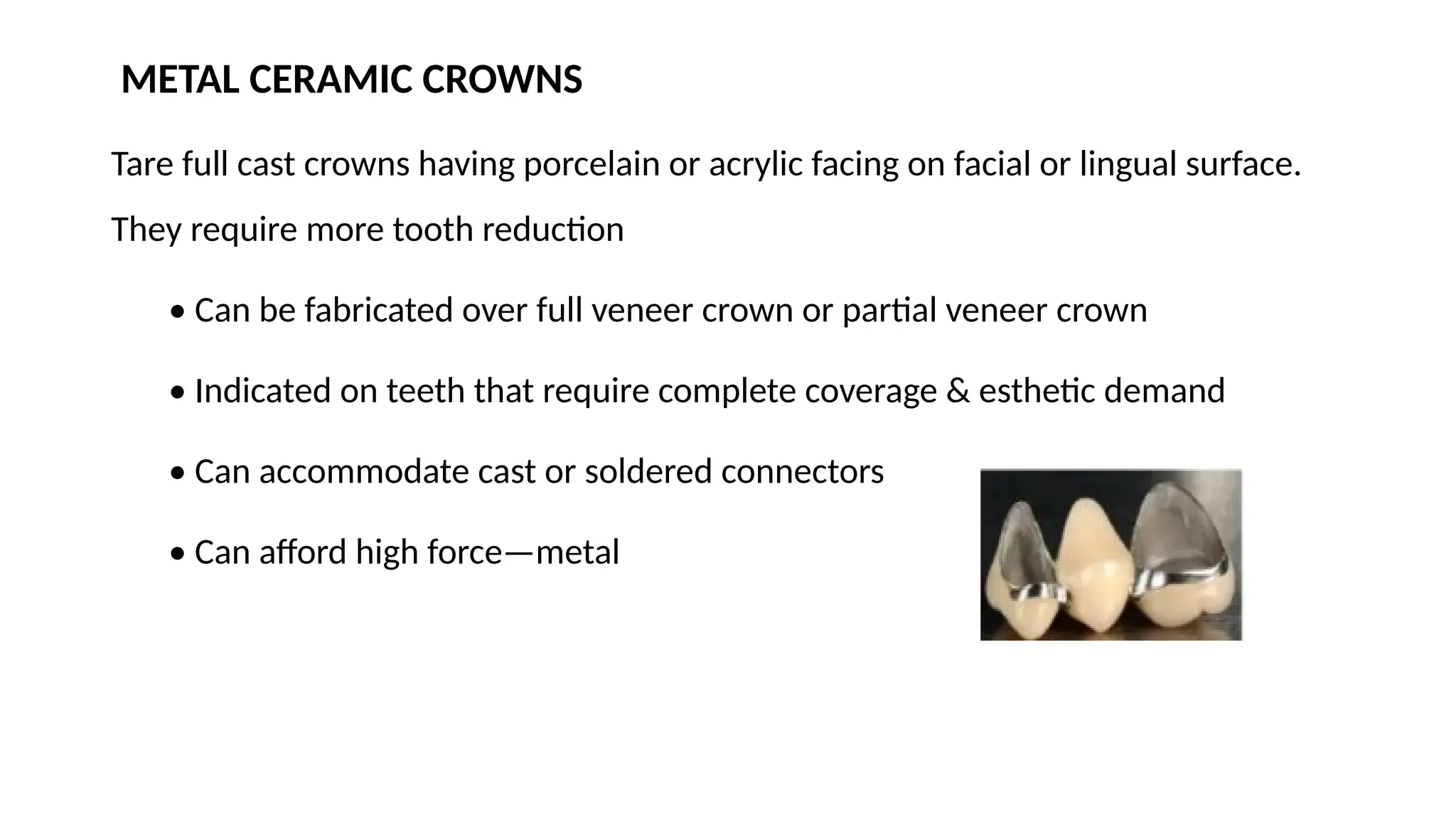
METAL CERAMIC CROWNS
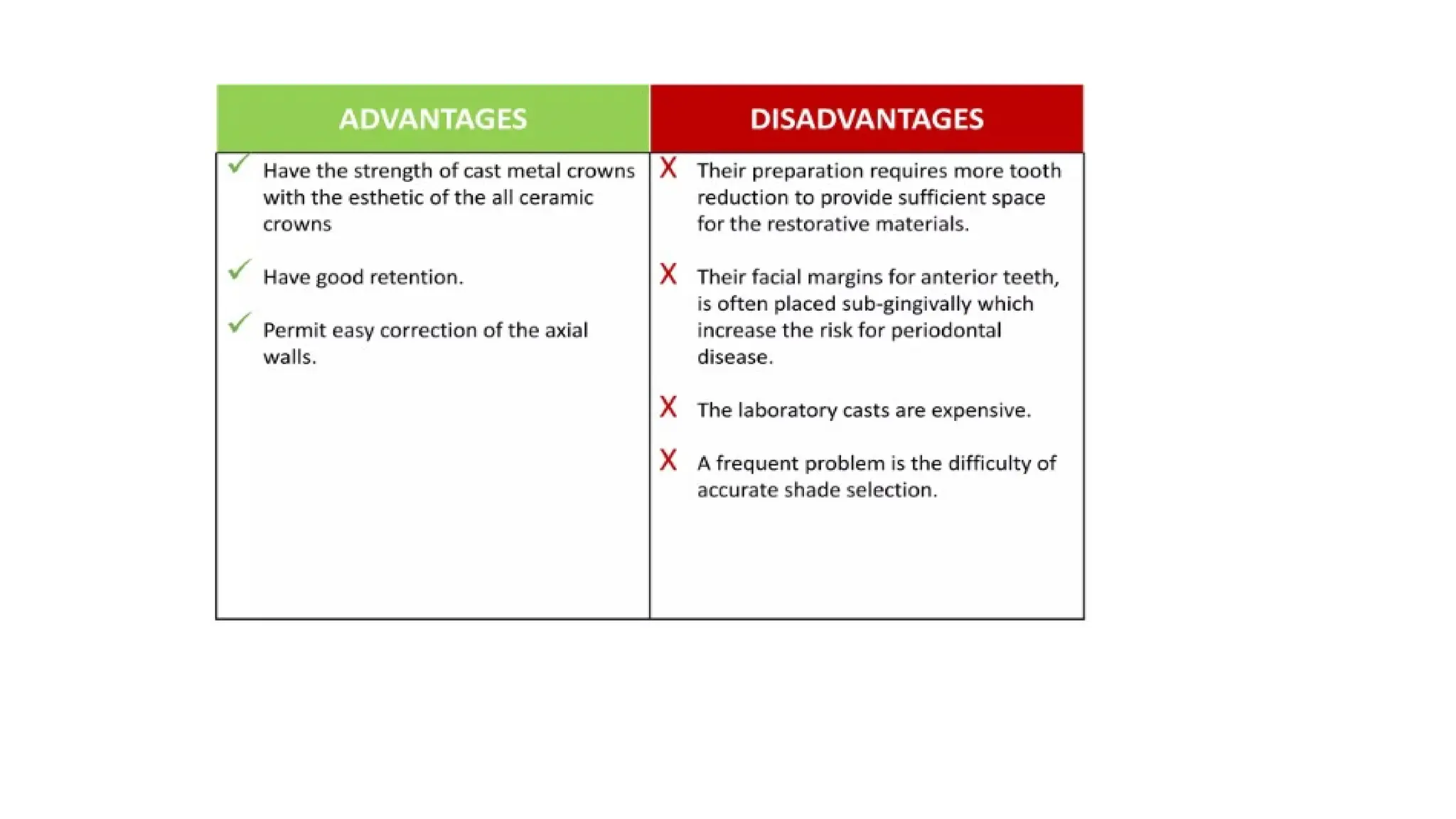
Tare full cast crowns having porcelain or acrylic facing on facial or lingual surface.
They require more tooth reduction
• Can be fabricated over full veneer crown or partial veneer crown
• Indicated on teeth that require complete coverage & esthetic demand
• Can accommodate cast or soldered connectors
• Can afford high force—metal
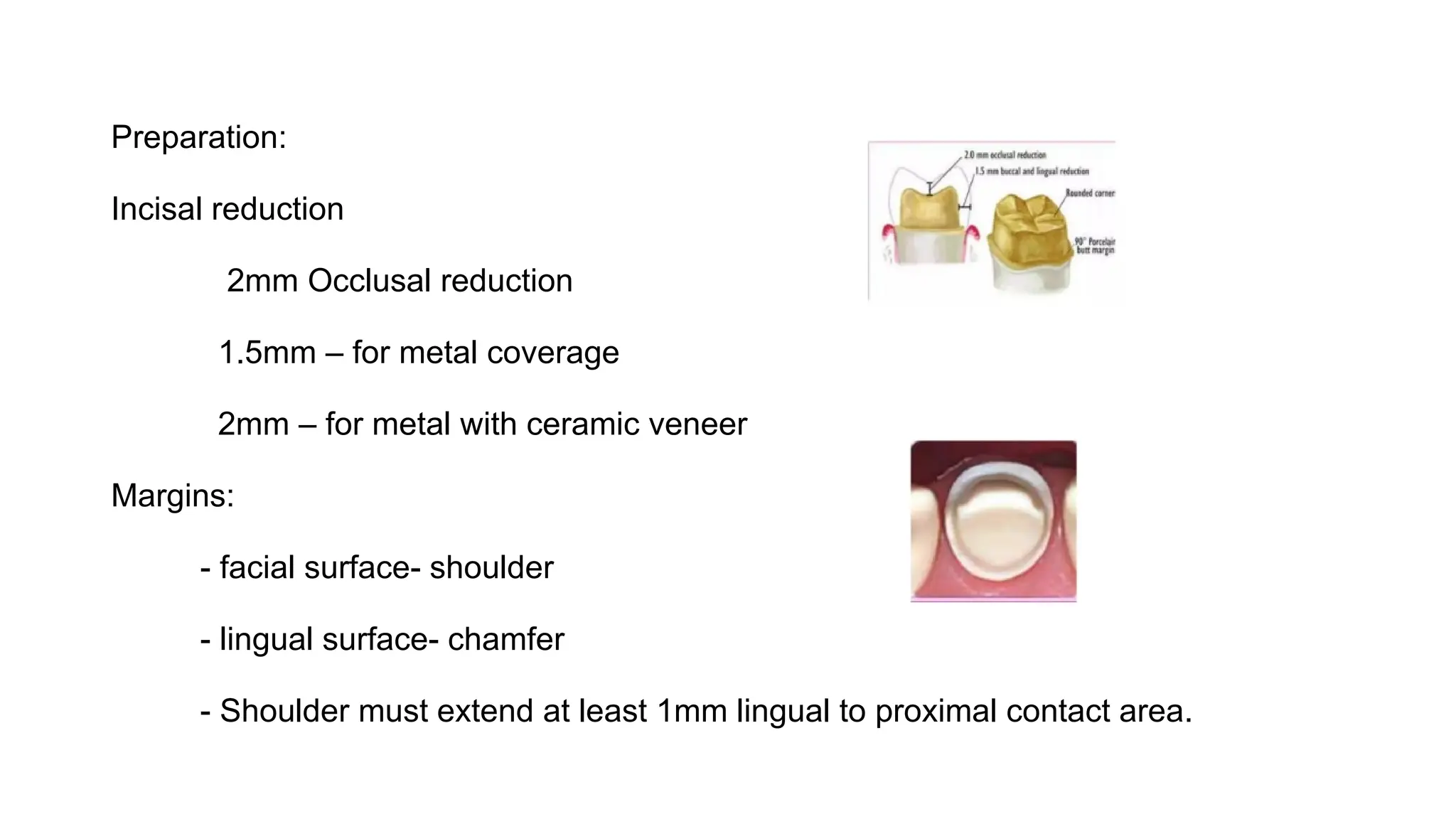
Preparation:
Incisal reduction
2mm Occlusal reduction
1.5mm – for metal coverage
2mm – for metal with ceramic veneer
Margins:
- facial surface- shoulder
- lingual surface- chamfer
- Shoulder must extend at least 1mm lingual to proximal contact area.
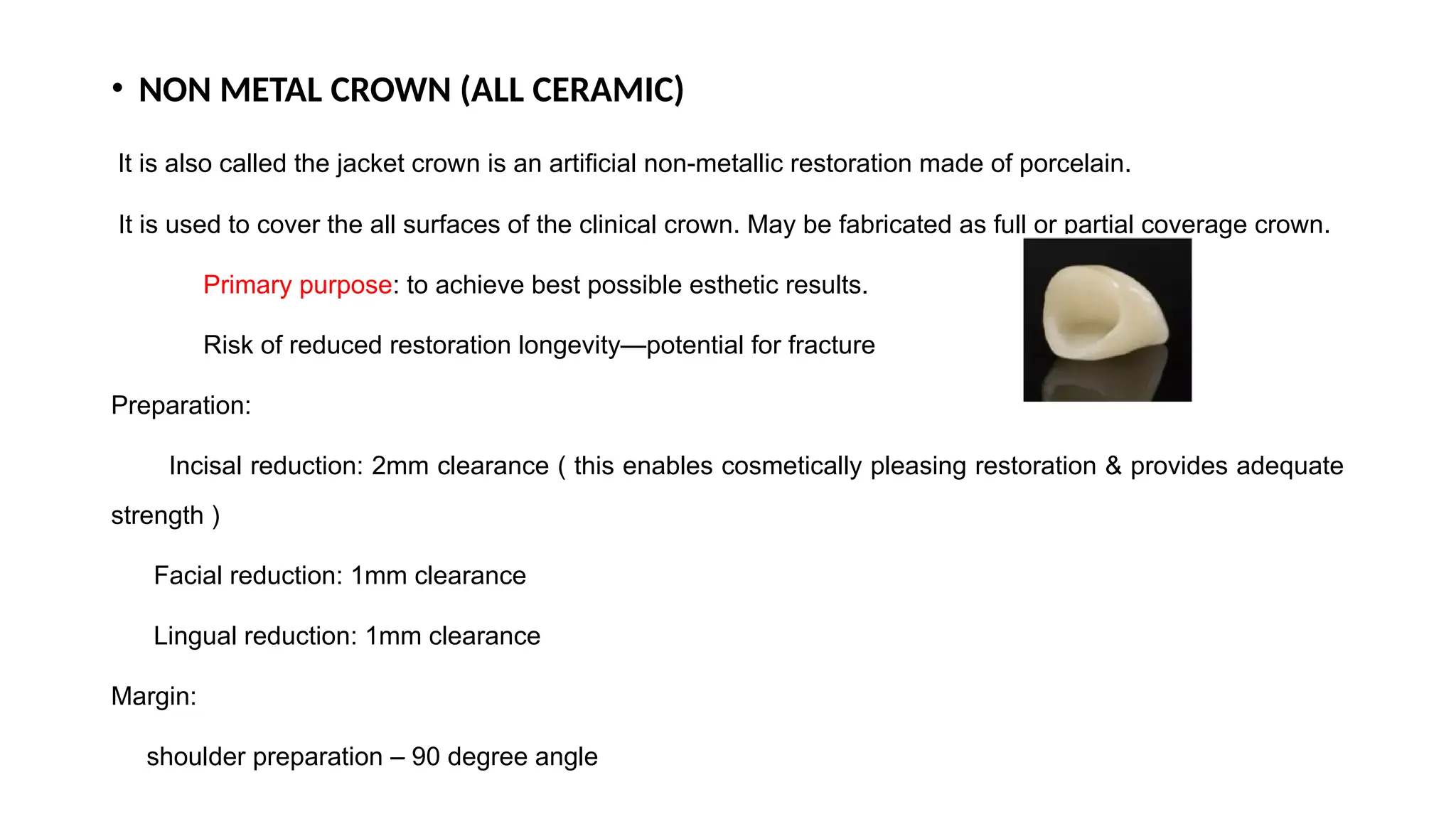
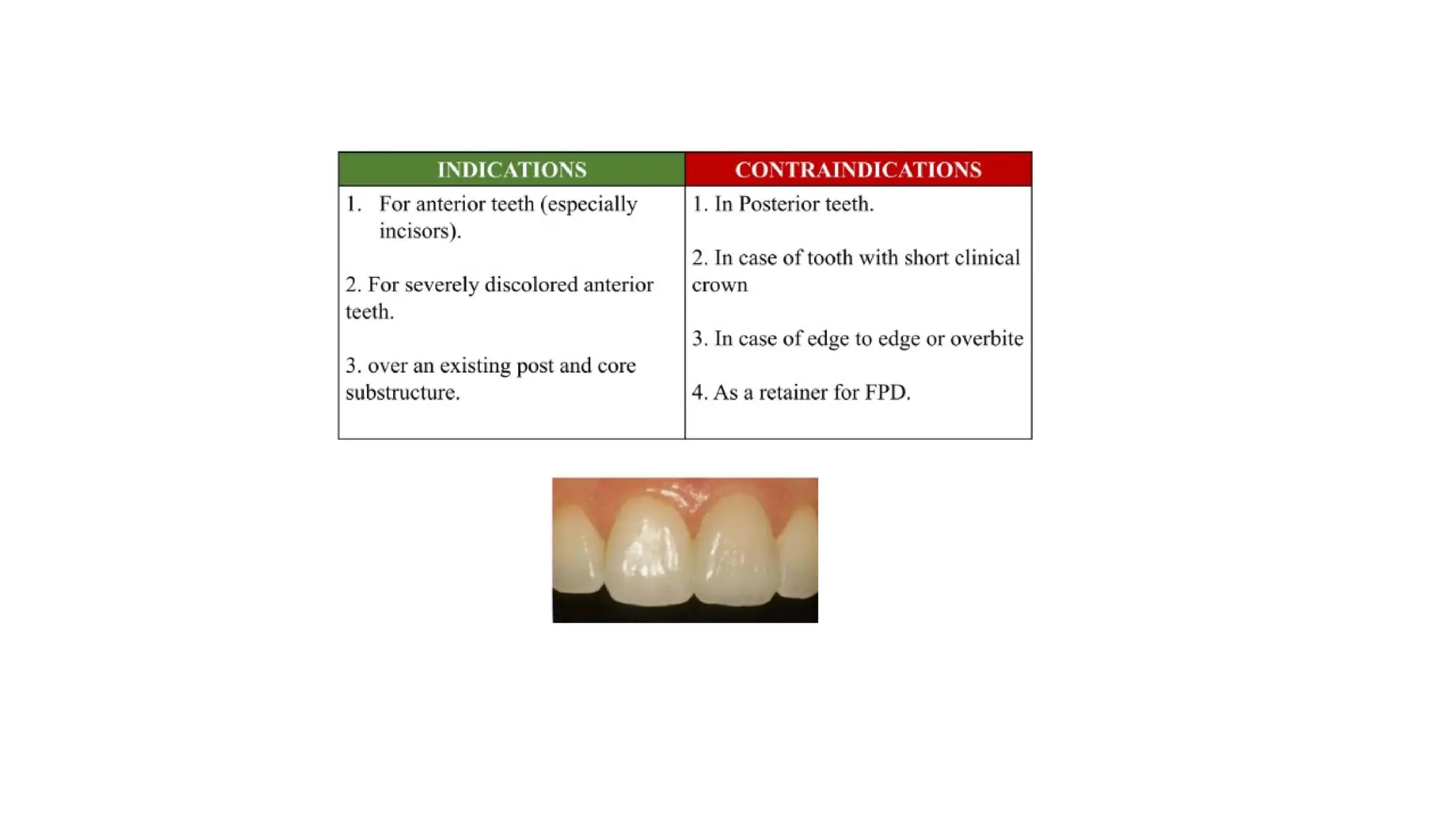
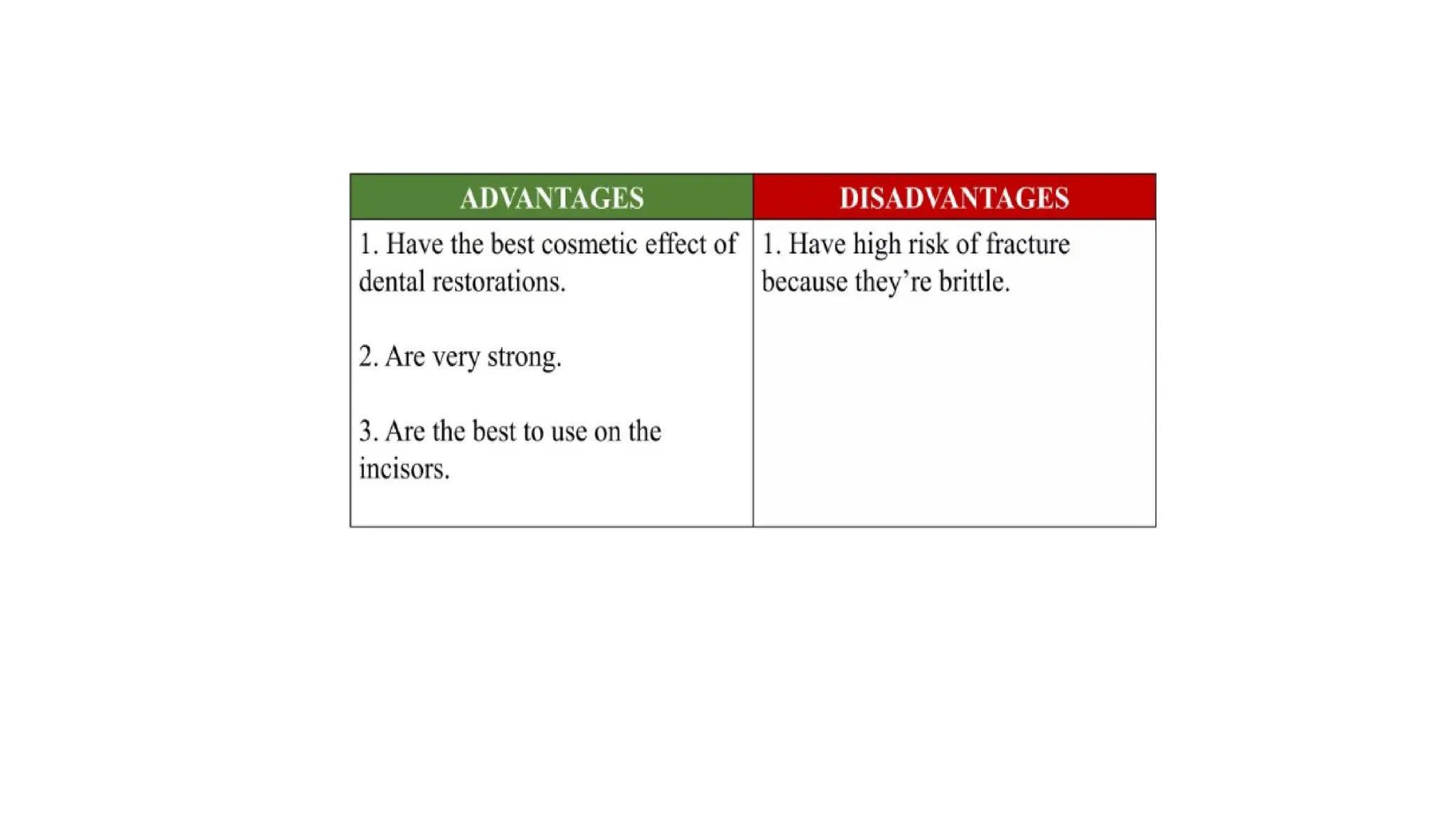
• NON METAL CROWN (ALL CERAMIC)
It is also called the jacket crown is an artificial non-metallic restoration made of porcelain.
It is used to cover the all surfaces of the clinical crown. May be fabricated as full or partial coverage crown.
Primary purpose: to achieve best possible esthetic results.
Risk of reduced restoration longevity—potential for fracture
Preparation:
Incisal reduction: 2mm clearance ( this enables cosmetically pleasing restoration & provides adequate
strength )
Facial reduction: 1mm clearance
Lingual reduction: 1mm clearance
Margin:
shoulder preparation – 90 degree angle
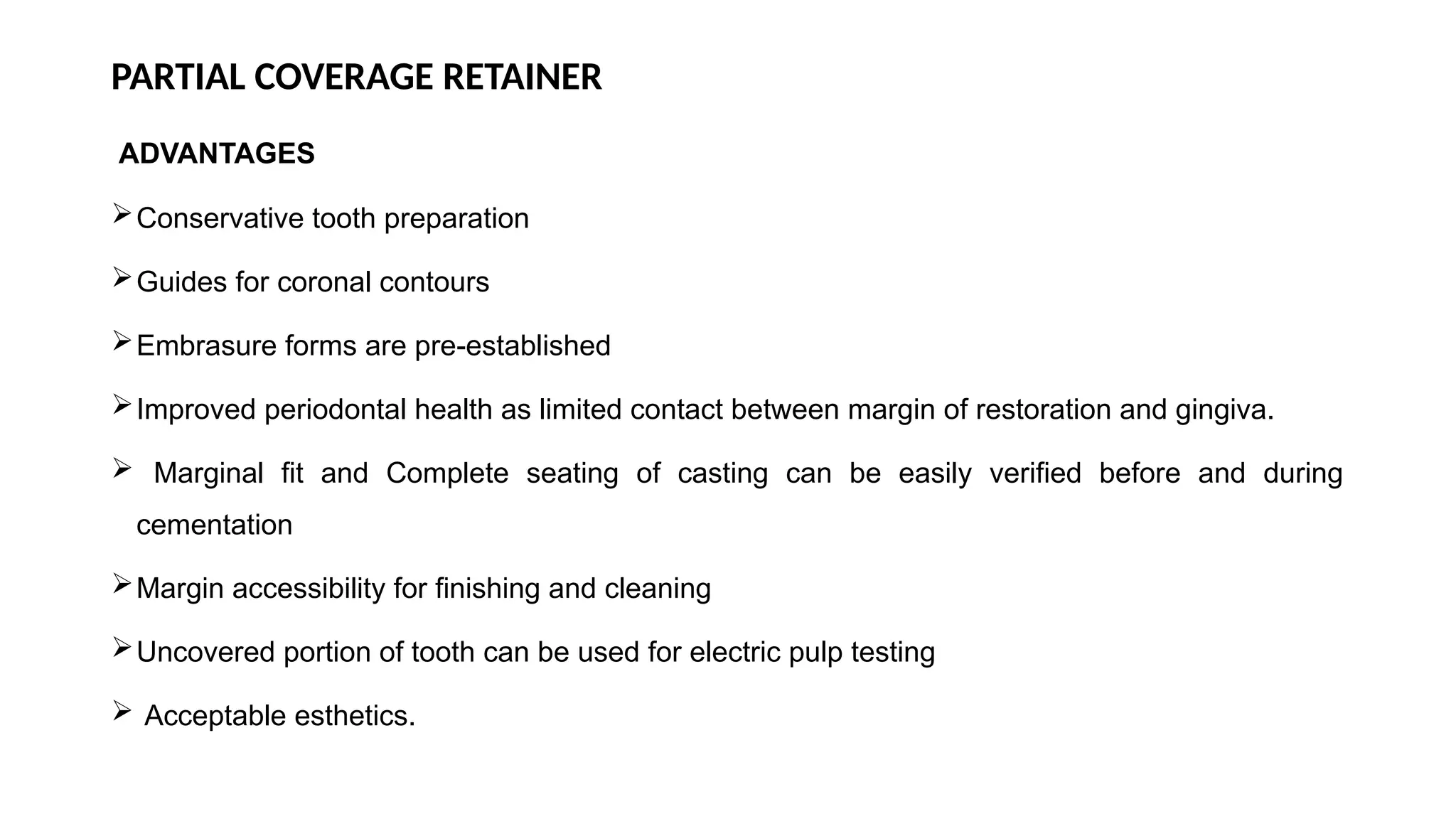
PARTIAL COVERAGE RETAINER
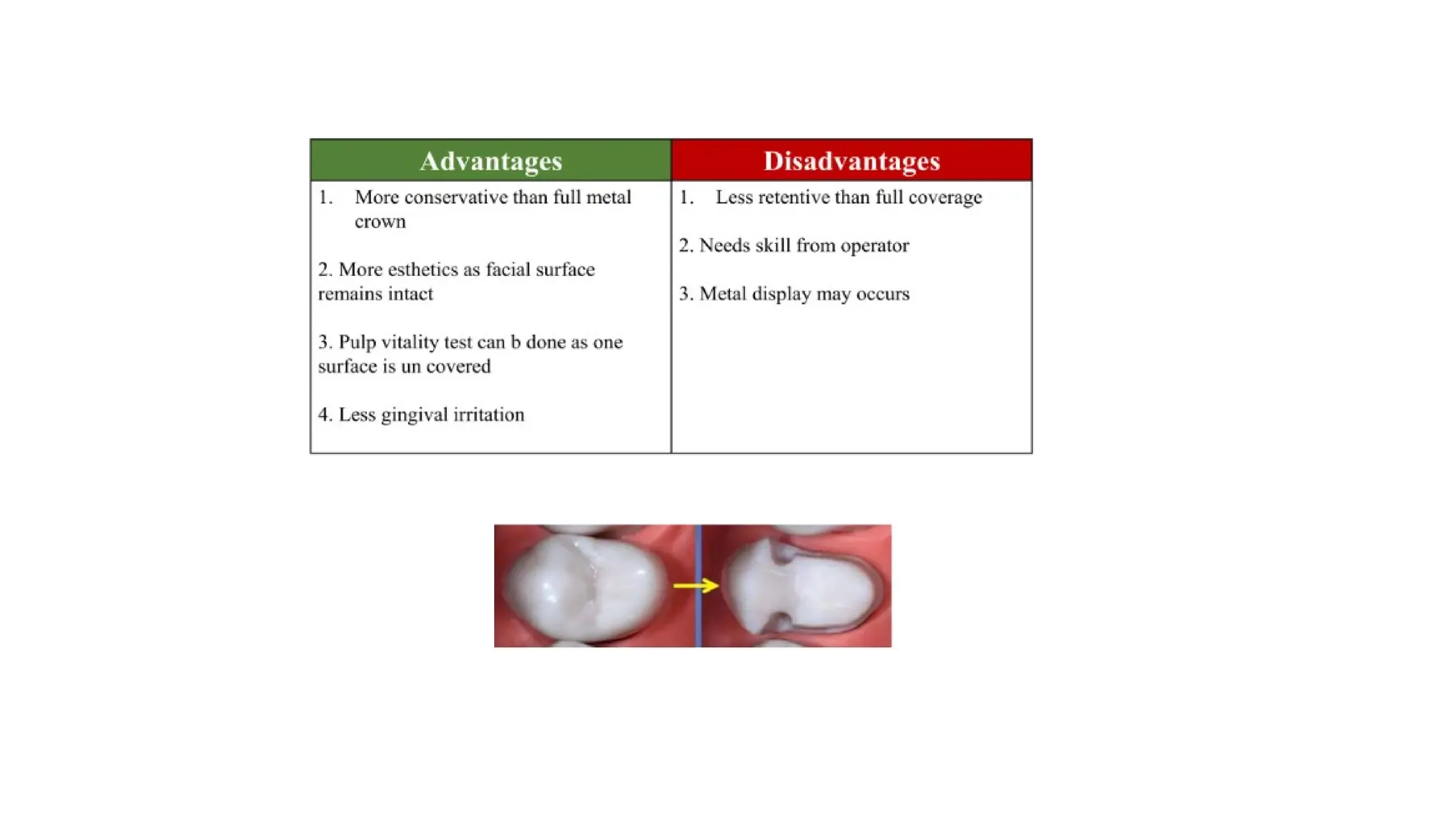
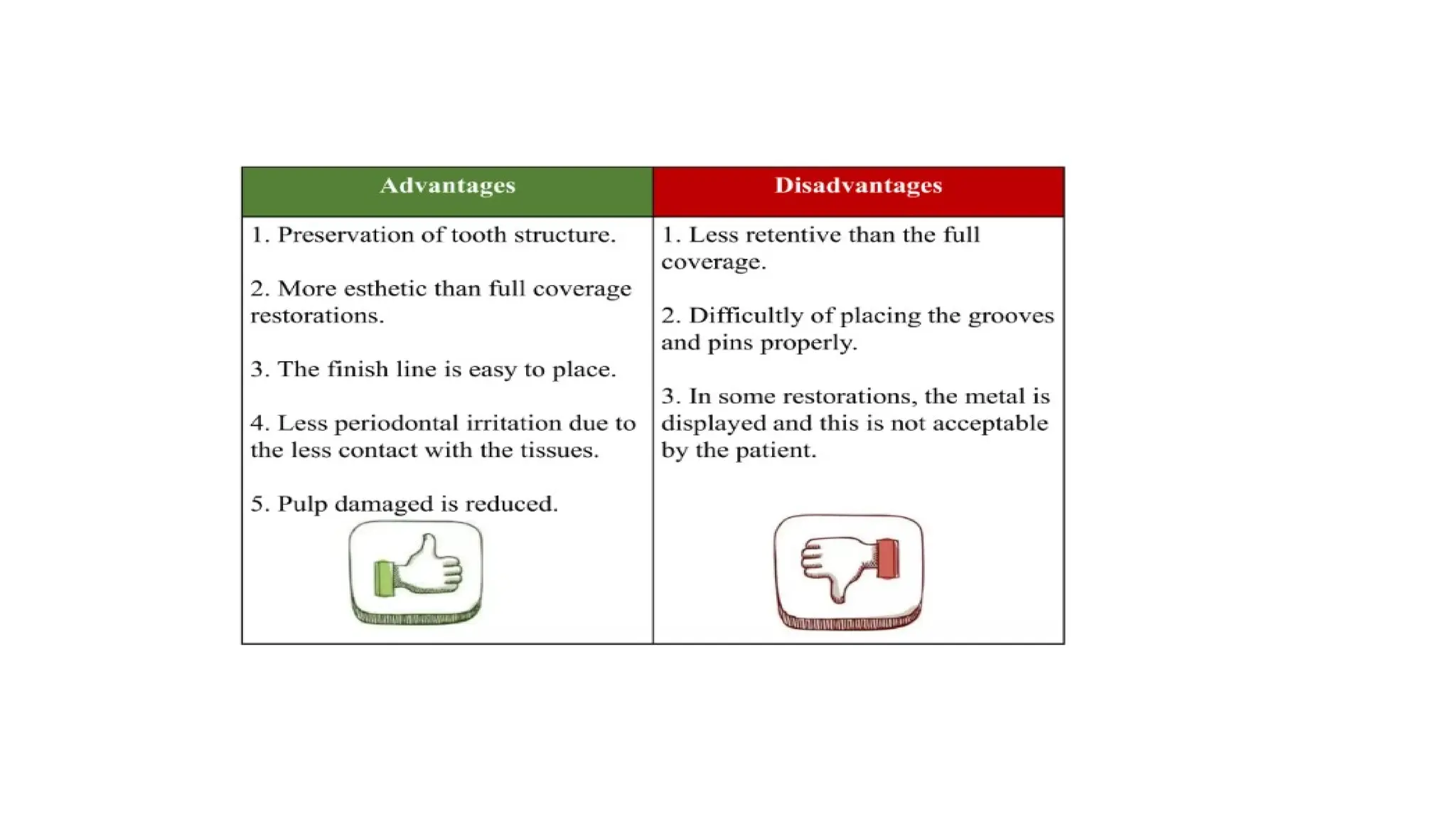
ADVANTAGES
Conservative tooth preparation
Guides for coronal contours
Embrasure forms are pre-established
Improved periodontal health as limited contact between margin of restoration and gingiva.
 Marginal fit and Complete seating of casting can be easily verified before and during
cementation
Margin accessibility for finishing and cleaning
Uncovered portion of tooth can be used for electric pulp testing
 Acceptable esthetics.
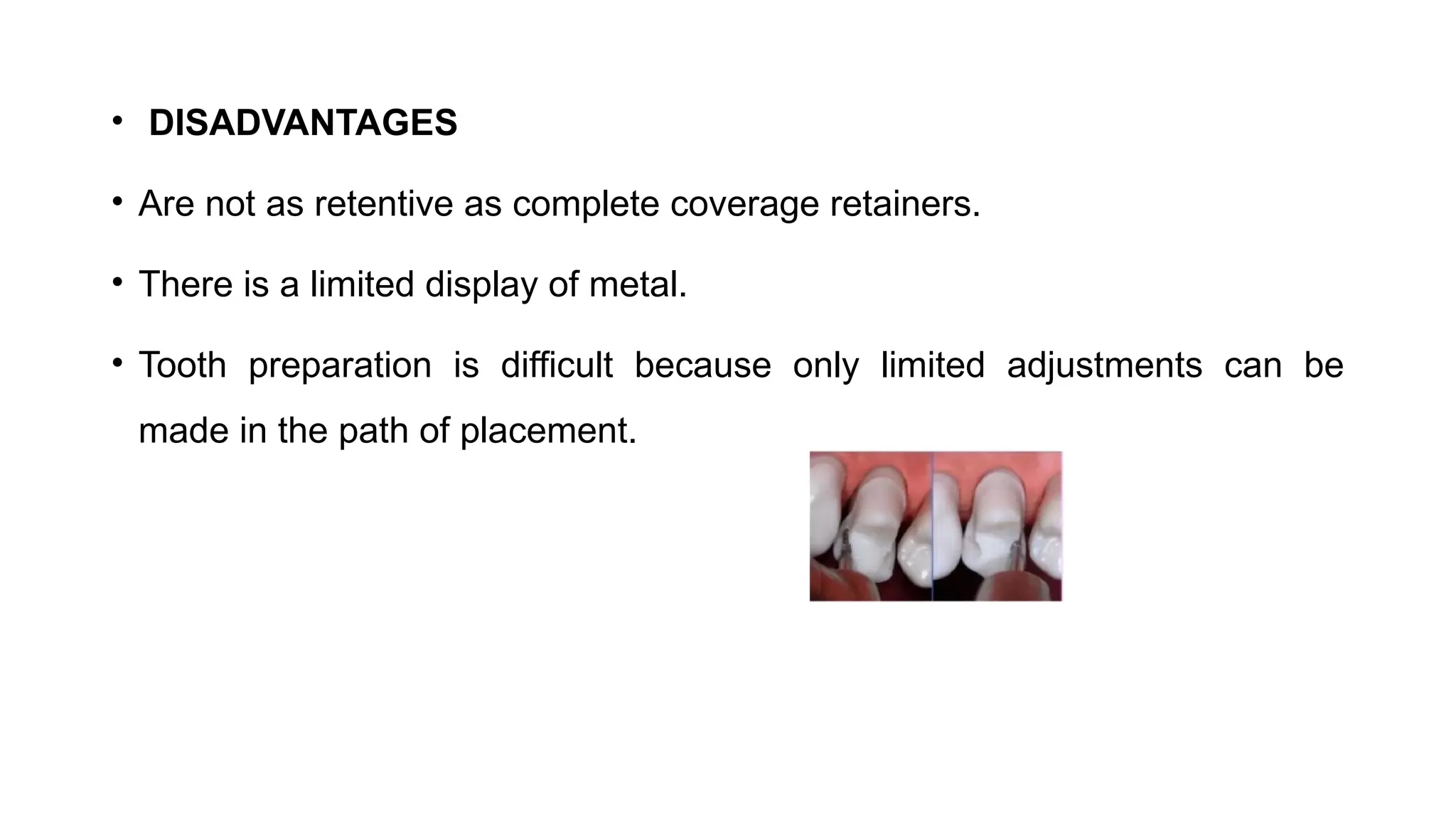
• DISADVANTAGES
• Are not as retentive as complete coverage retainers.
• There is a limited display of metal.
• Tooth preparation is difficult because only limited adjustments can be
made in the path of placement.
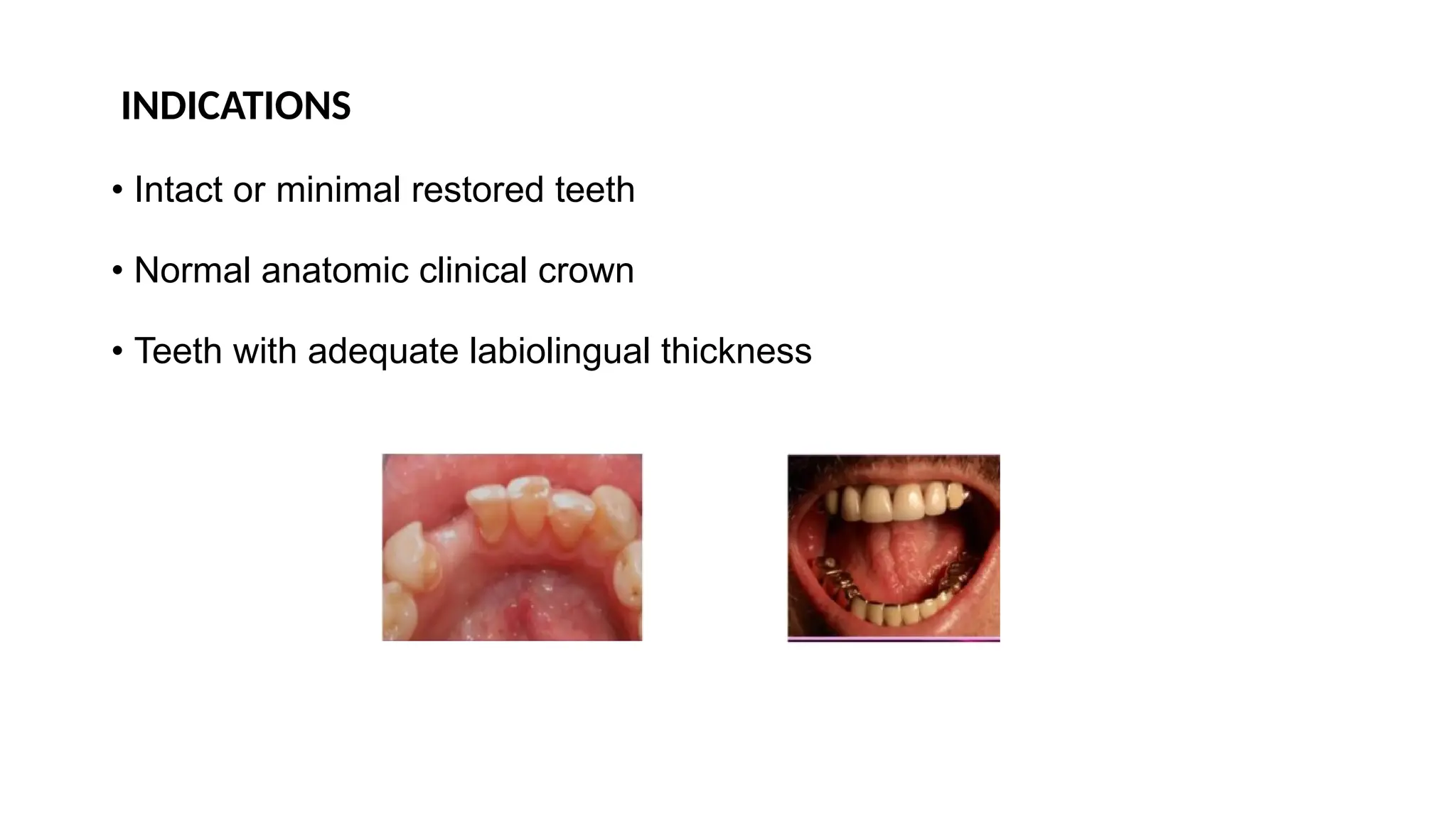
INDICATIONS
• Intact or minimal restored teeth
• Normal anatomic clinical crown
• Teeth with adequate labiolingual thickness
CONTRAINDICATIONS
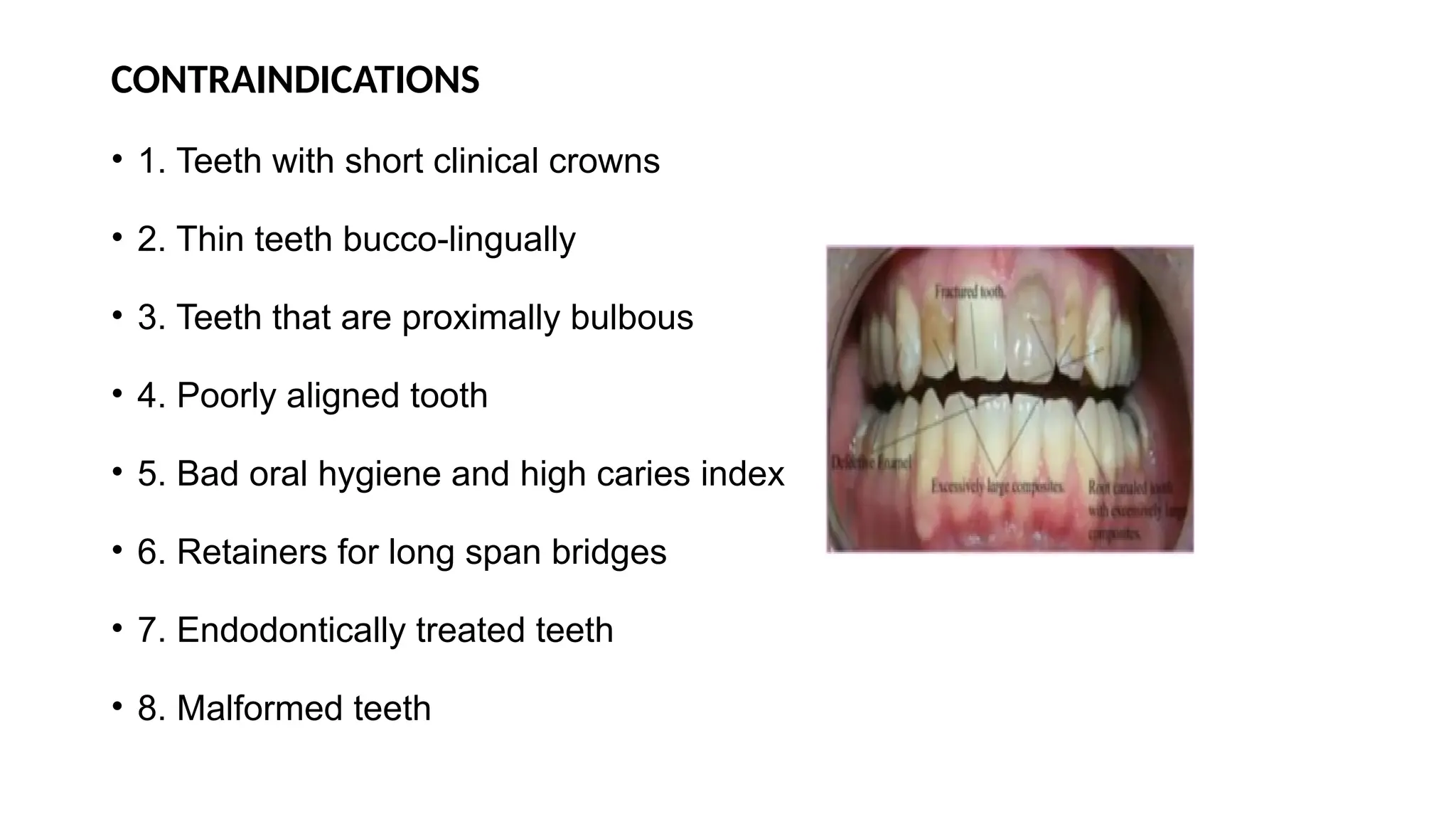
• 1. Teeth with short clinical crowns
• 2. Thin teeth bucco-lingually
• 3. Teeth that are proximally bulbous
• 4. Poorly aligned tooth
• 5. Bad oral hygiene and high caries index
• 6. Retainers for long span bridges
• 7. Endodontically treated teeth
• 8. Malformed teeth
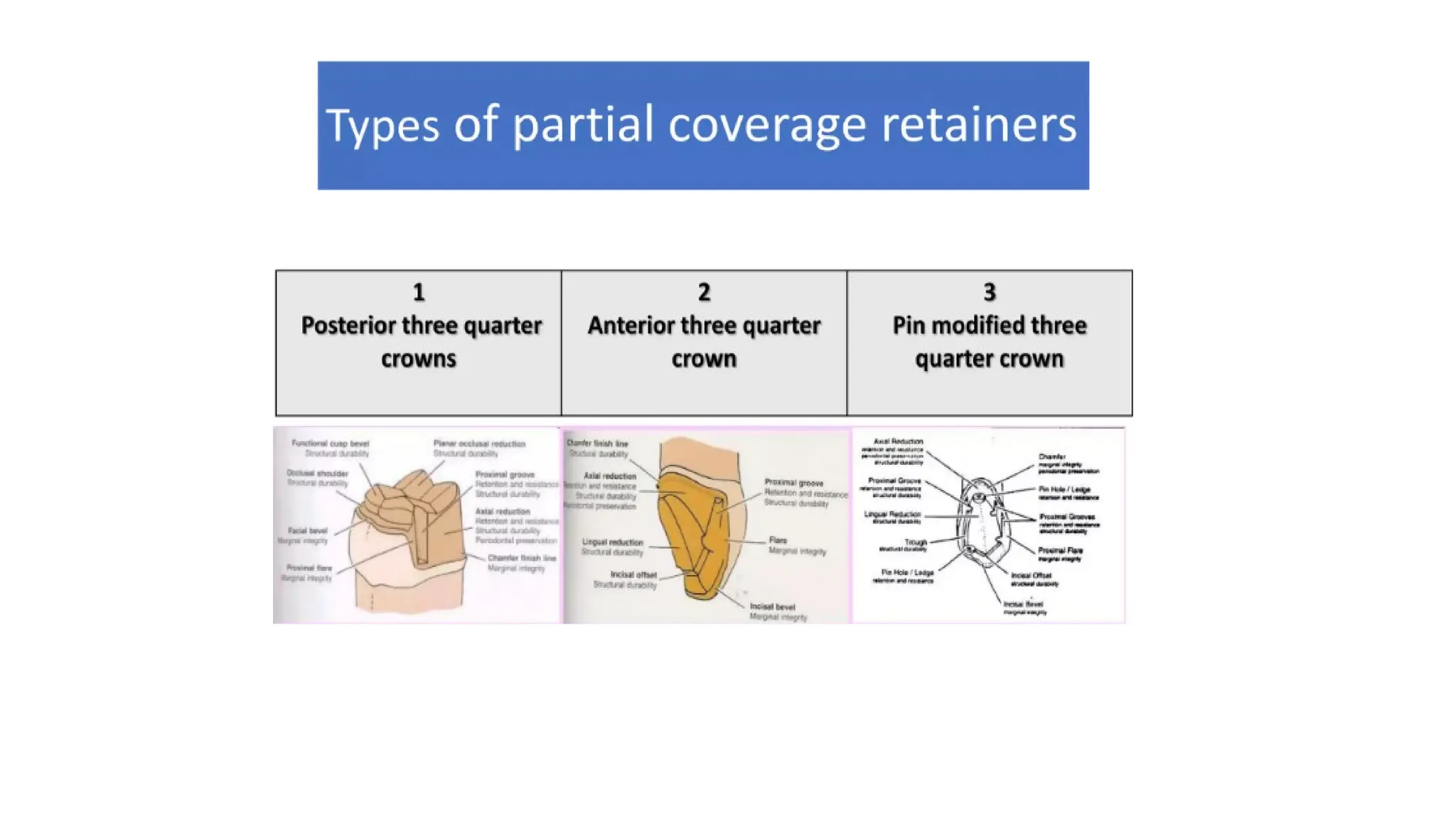
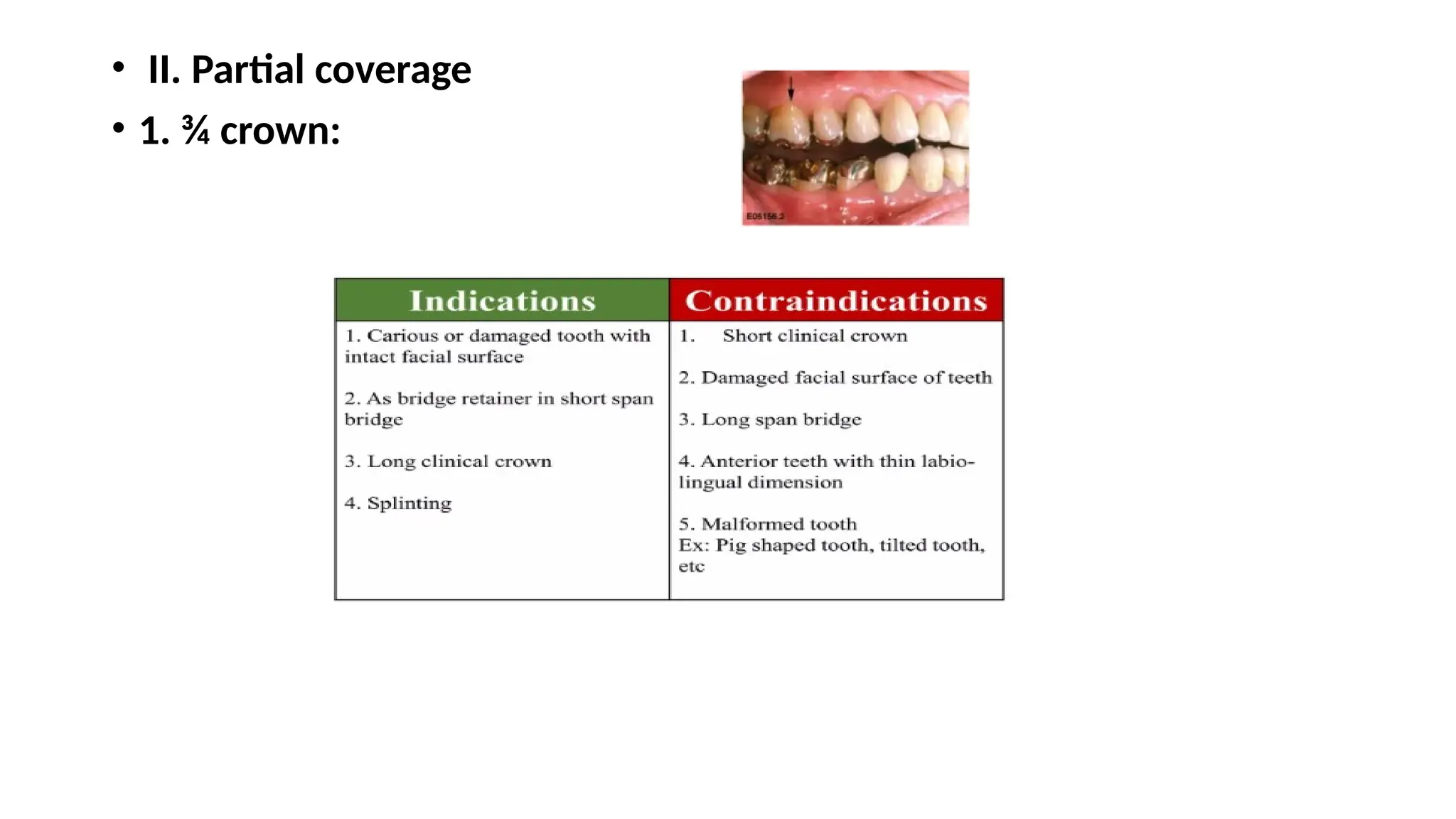
• II. Partial coverage
• 1. ¾ crown:
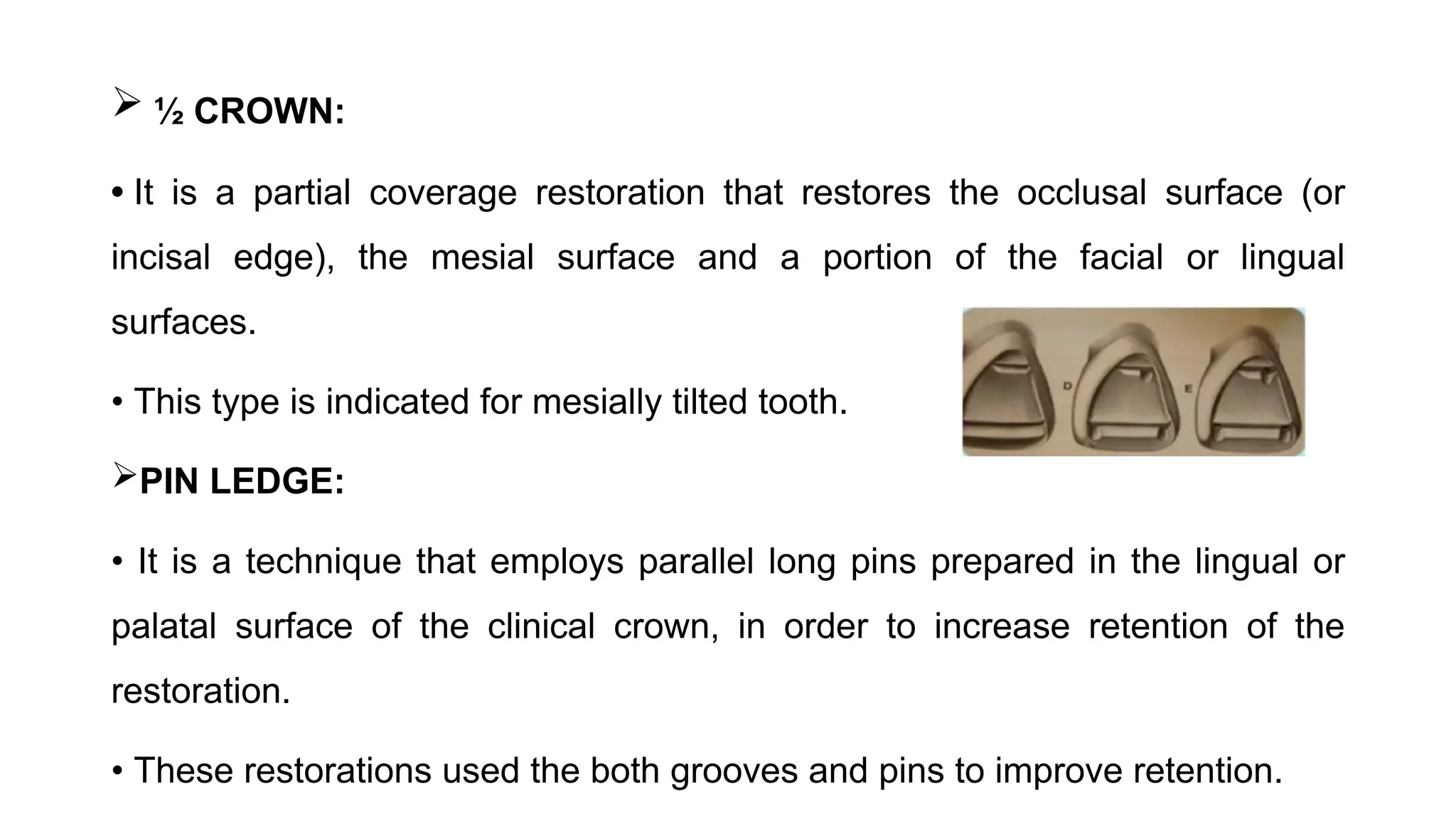
 ½ CROWN:
• It is a partial coverage restoration that restores the occlusal surface (or
incisal edge), the mesial surface and a portion of the facial or lingual
surfaces.
• This type is indicated for mesially tilted tooth.
PIN LEDGE:
• It is a technique that employs parallel long pins prepared in the lingual or
palatal surface of the clinical crown, in order to increase retention of the
restoration.
• These restorations used the both grooves and pins to improve retention.
 ¾ REVERSED CROWN:
• It is a partial coverage restoration that restores the occlusal surface (or
incisal edge), and three axial surface of the clinical crown (the lingual
surface is not included).
• This type is indicated for lower posterior teeth. And it is useful for server
lingual indications.
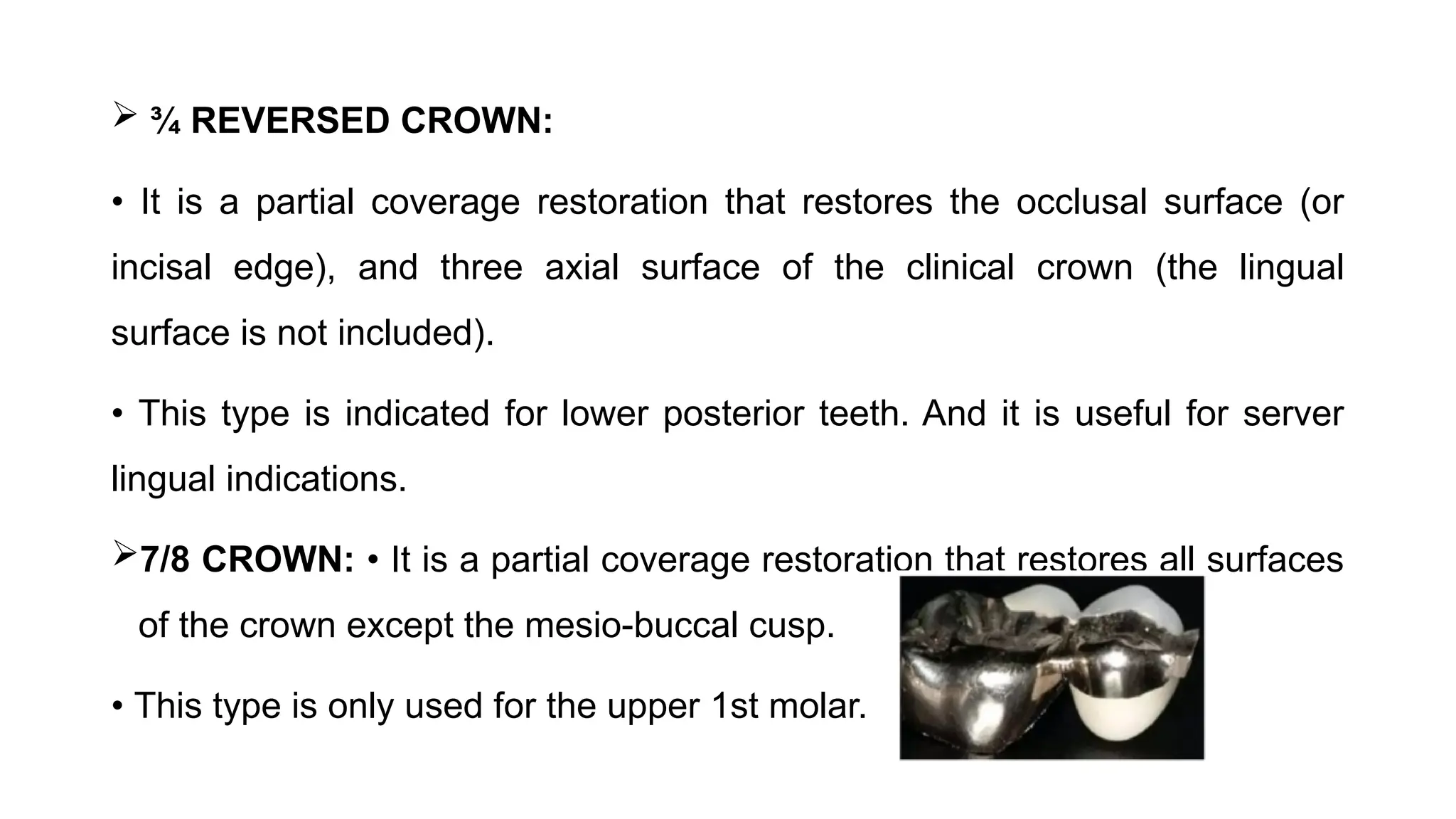
7/8 CROWN: • It is a partial coverage restoration that restores all surfaces
of the crown except the mesio-buccal cusp.
• This type is only used for the upper 1st molar.
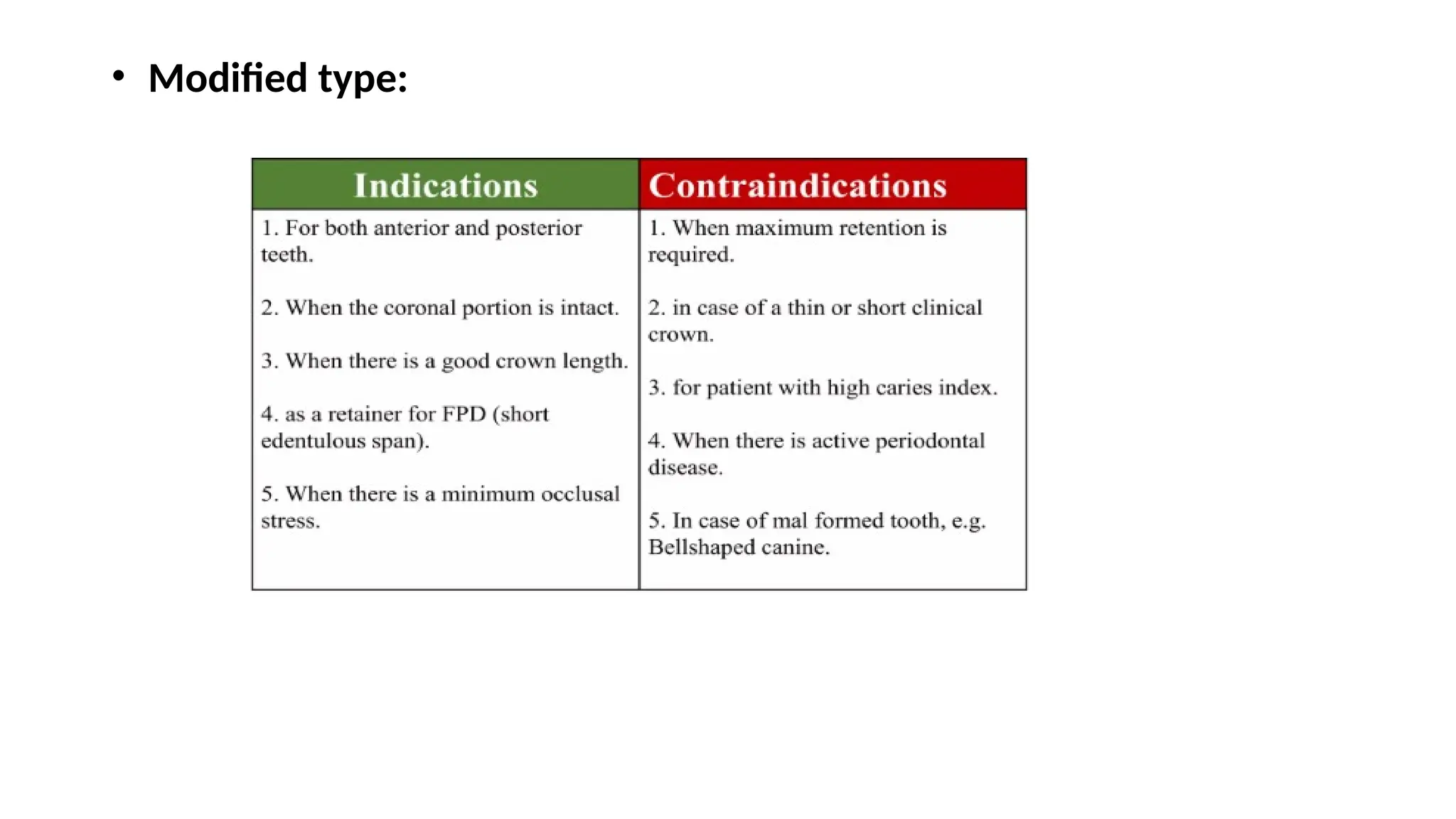
• Modified type:
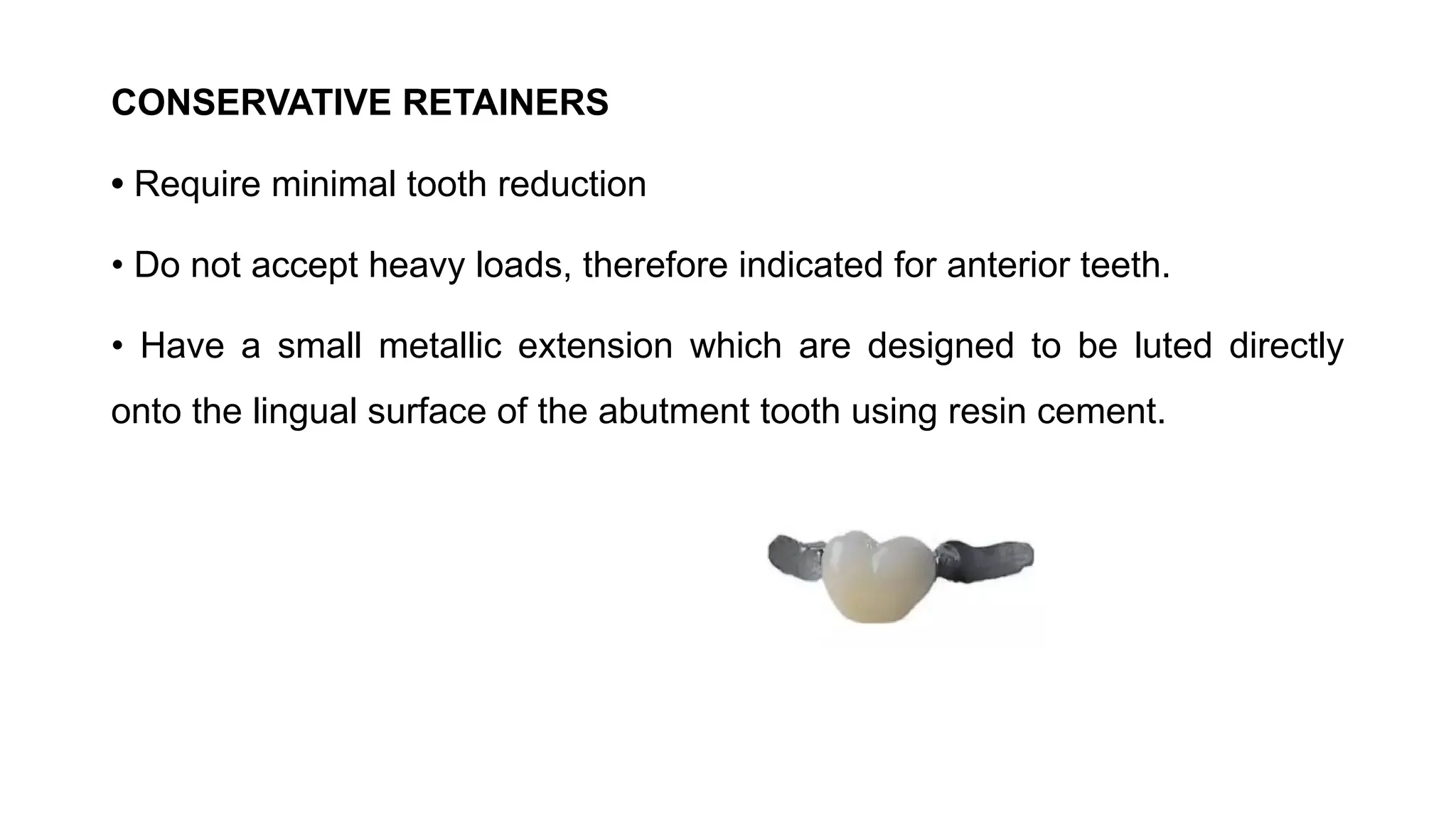
CONSERVATIVE RETAINERS
• Require minimal tooth reduction
• Do not accept heavy loads, therefore indicated for anterior teeth.
• Have a small metallic extension which are designed to be luted directly
onto the lingual surface of the abutment tooth using resin cement.
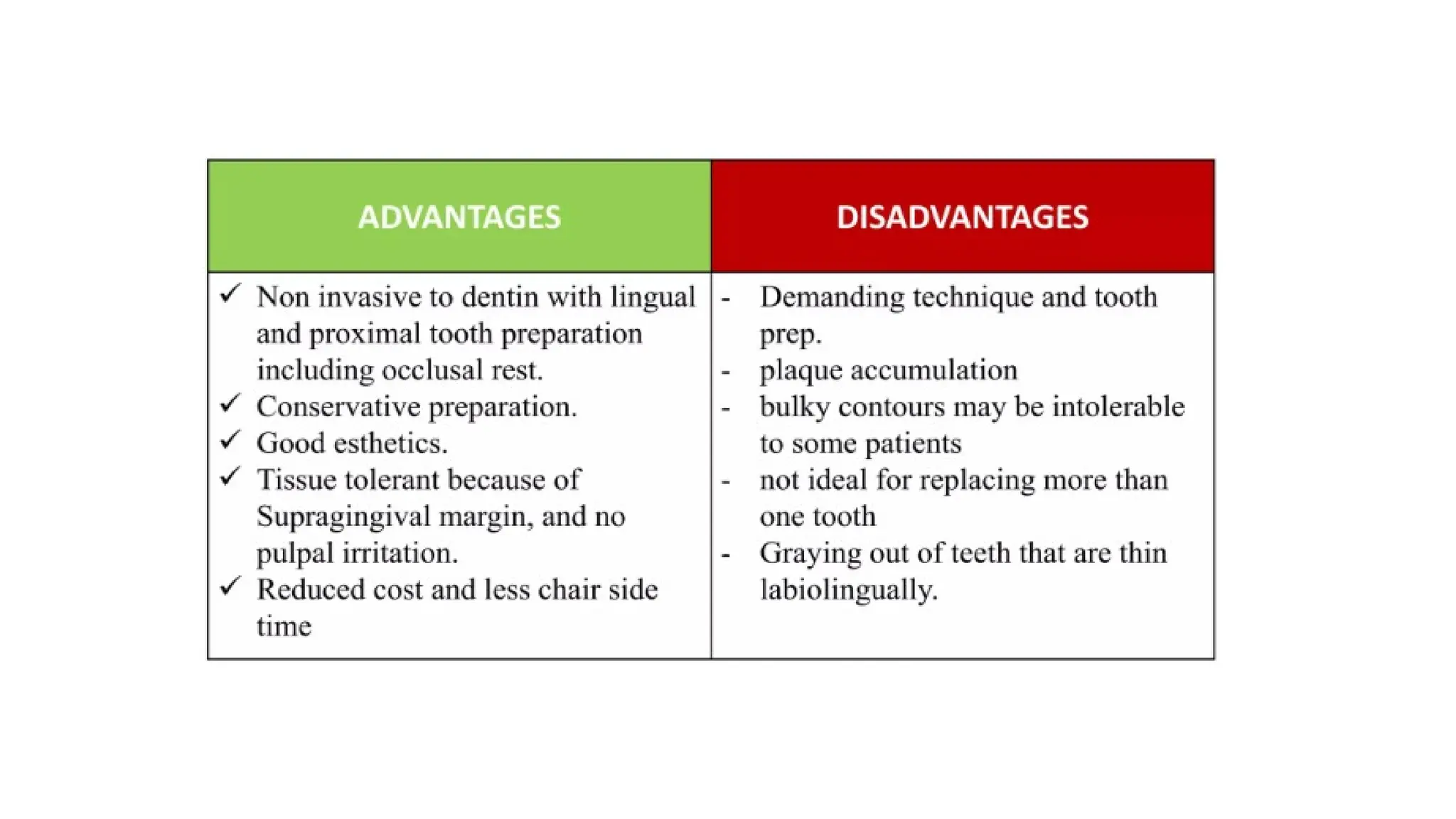
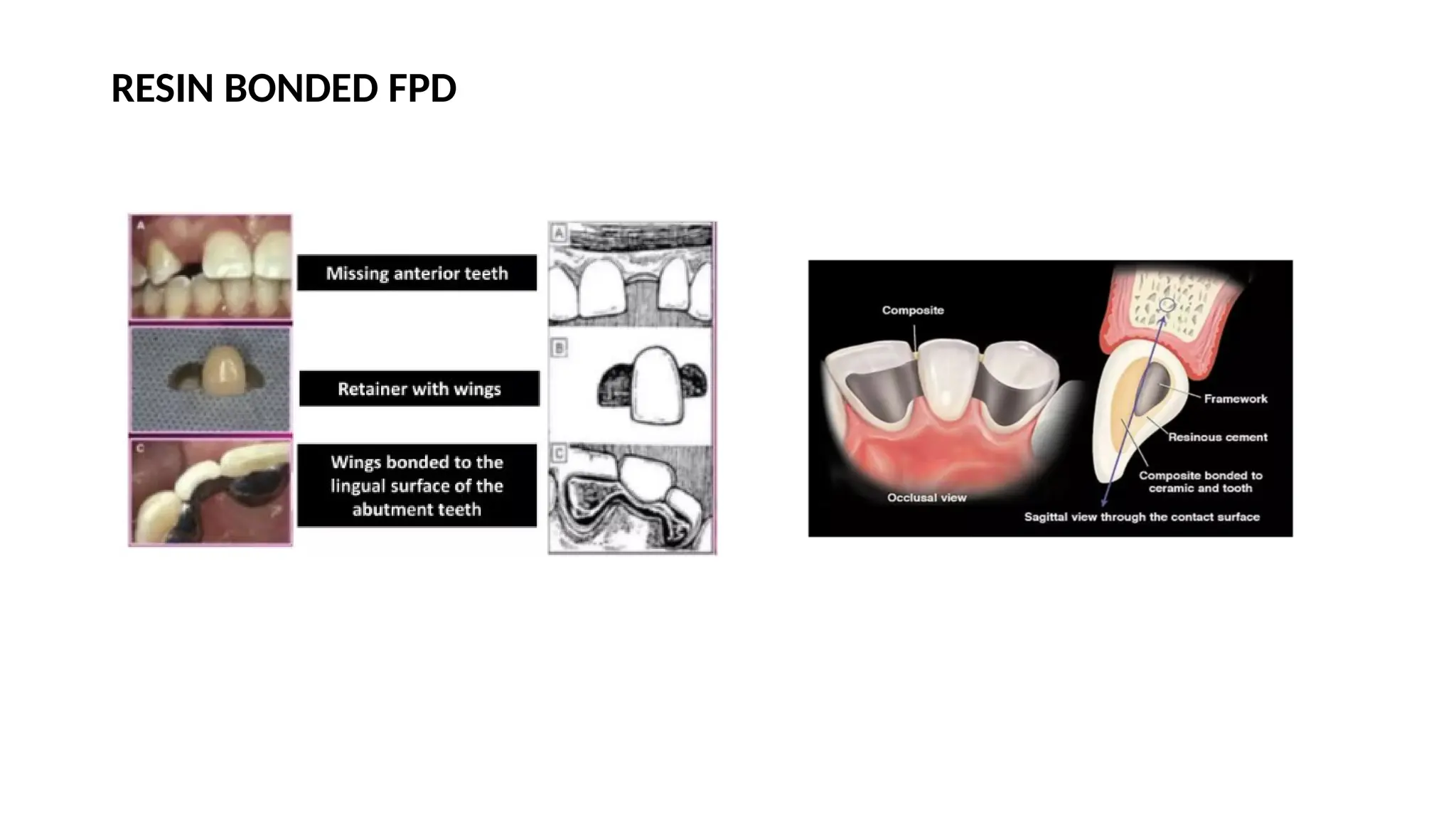
RESIN BONDED FPD
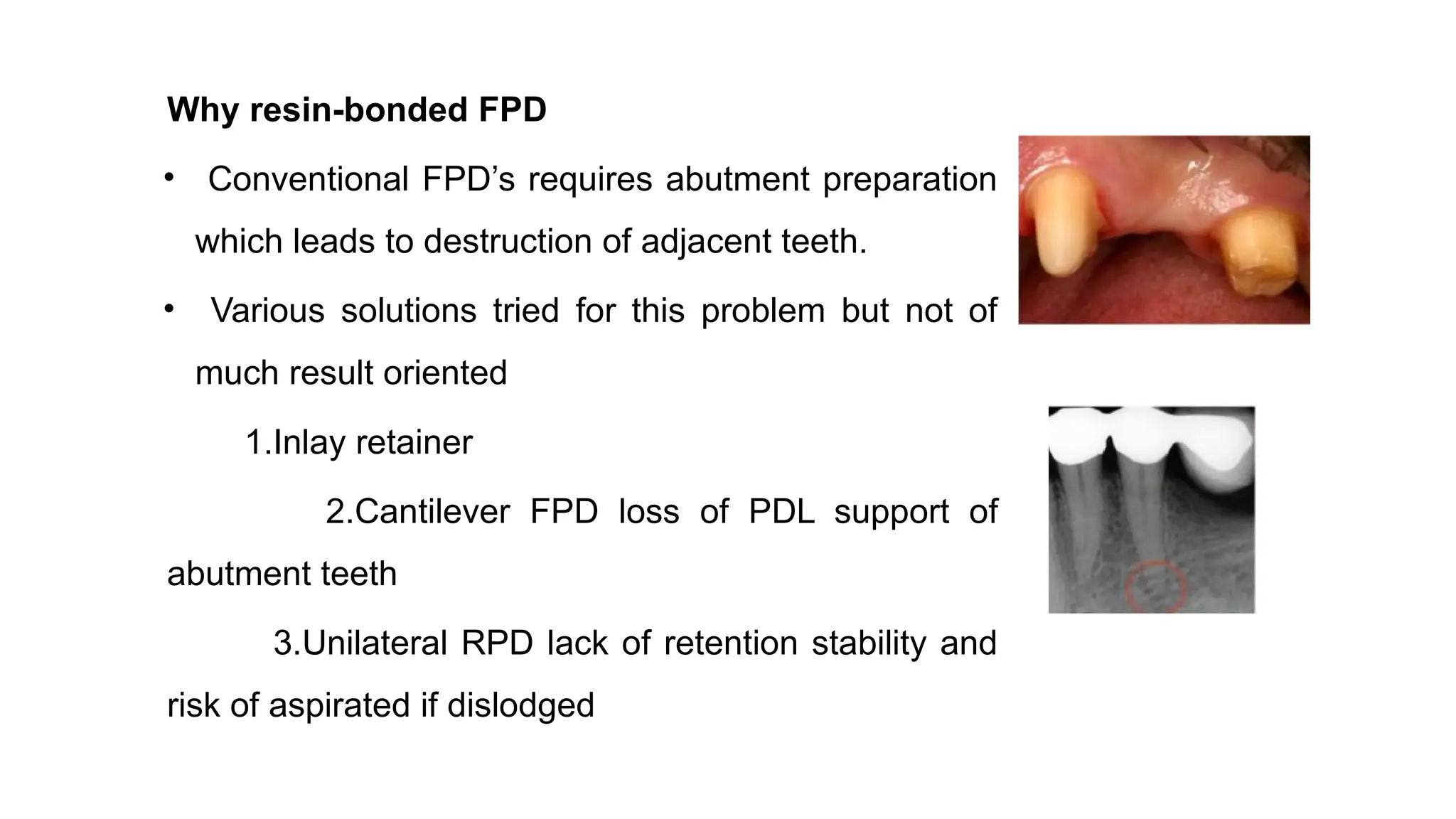
Why resin-bonded FPD
• Conventional FPD’s requires abutment preparation
which leads to destruction of adjacent teeth.
• Various solutions tried for this problem but not of
much result oriented
1.Inlay retainer
2.Cantilever FPD loss of PDL support of
abutment teeth
3.Unilateral RPD lack of retention stability and
risk of aspirated if dislodged
• CLASSIFICATION OF RBFPD
Classified on the basis progression of development:
Rochettebridge
Maryland bridge
Cast Mesh
Virginia bridges
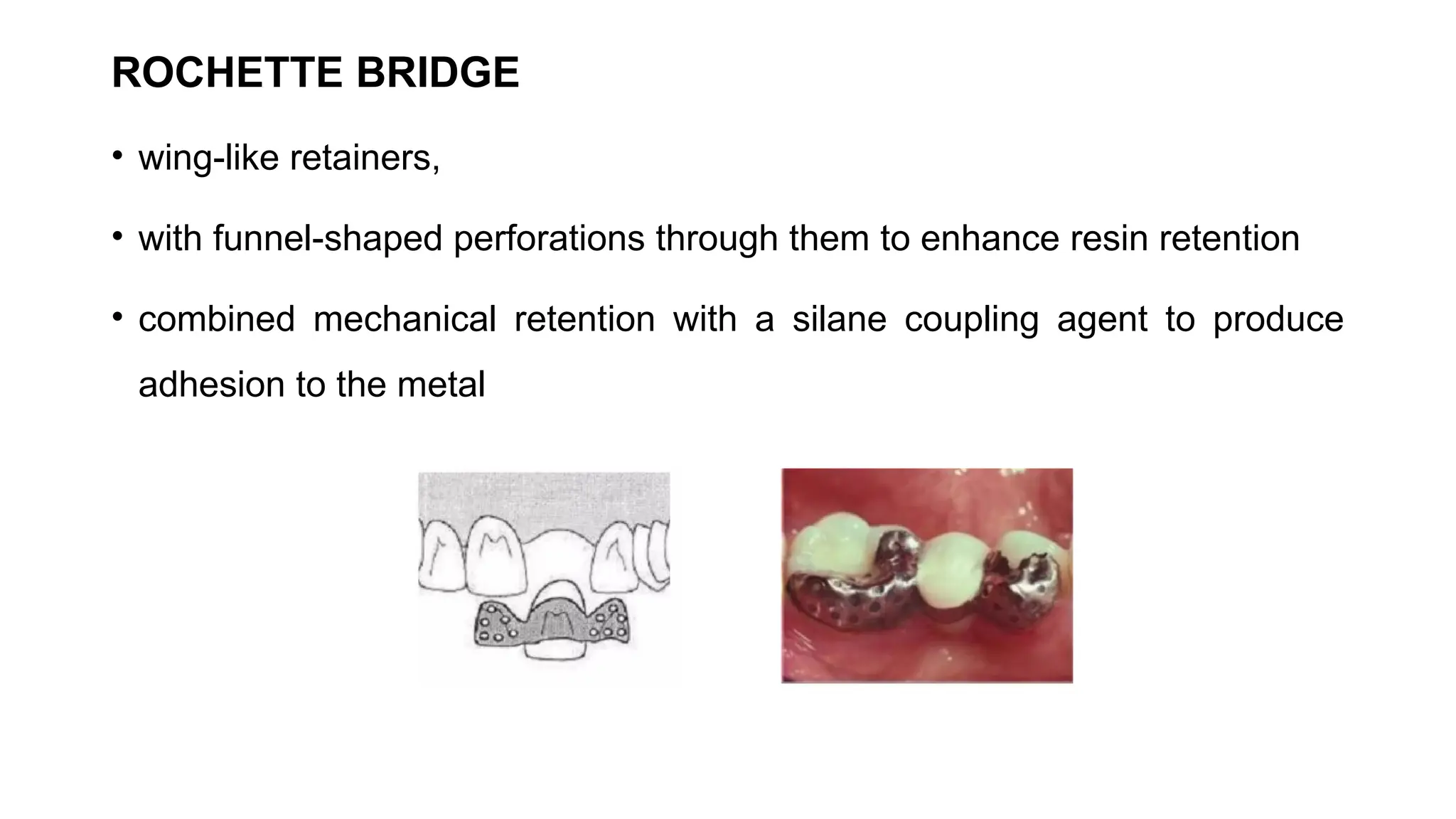
ROCHETTE BRIDGE
• wing-like retainers,
• with funnel-shaped perforations through them to enhance resin retention
• combined mechanical retention with a silane coupling agent to produce
adhesion to the metal
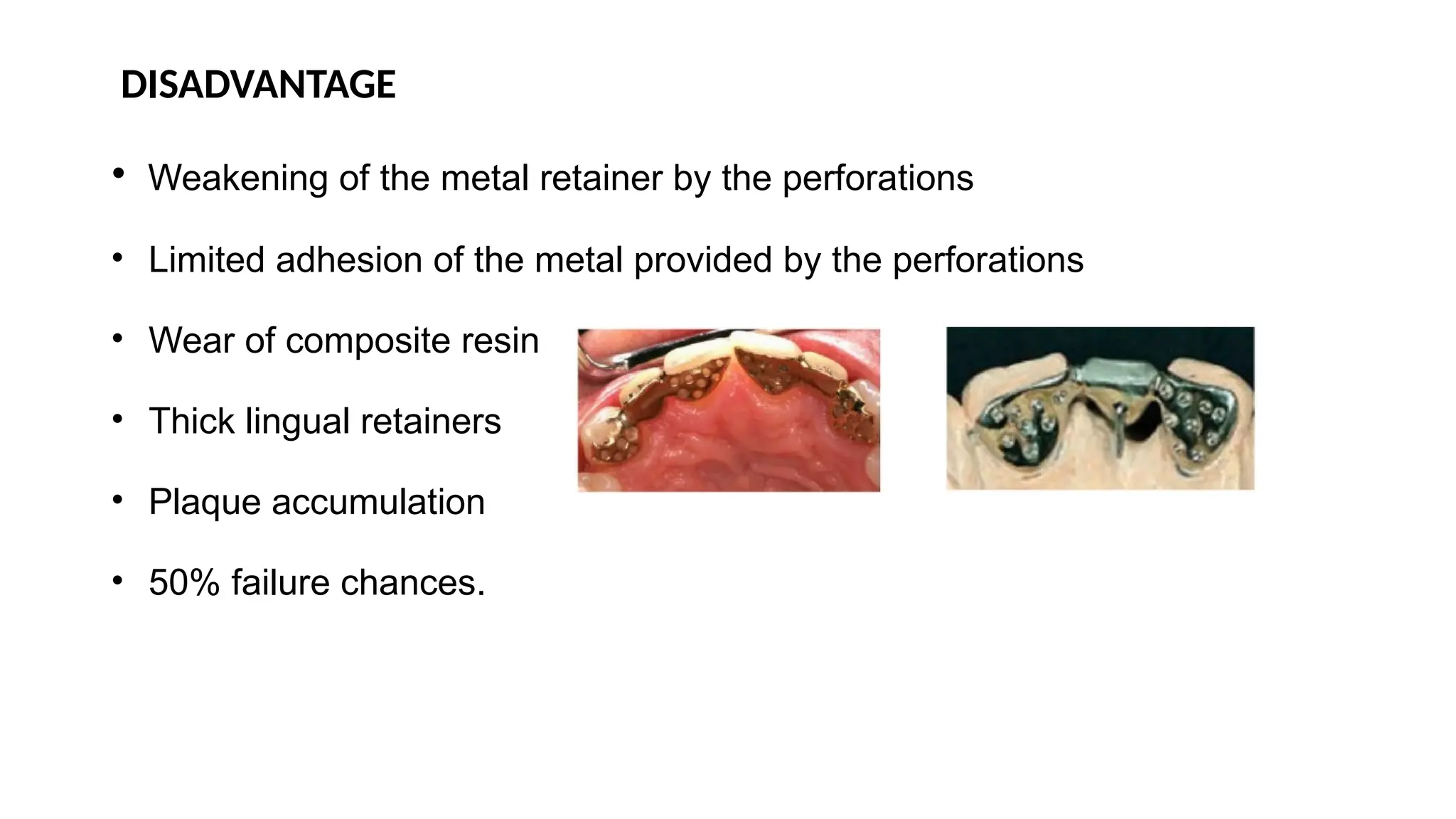
DISADVANTAGE
• Weakening of the metal retainer by the perforations
• Limited adhesion of the metal provided by the perforations
• Wear of composite resin
• Thick lingual retainers
• Plaque accumulation
• 50% failure chances.
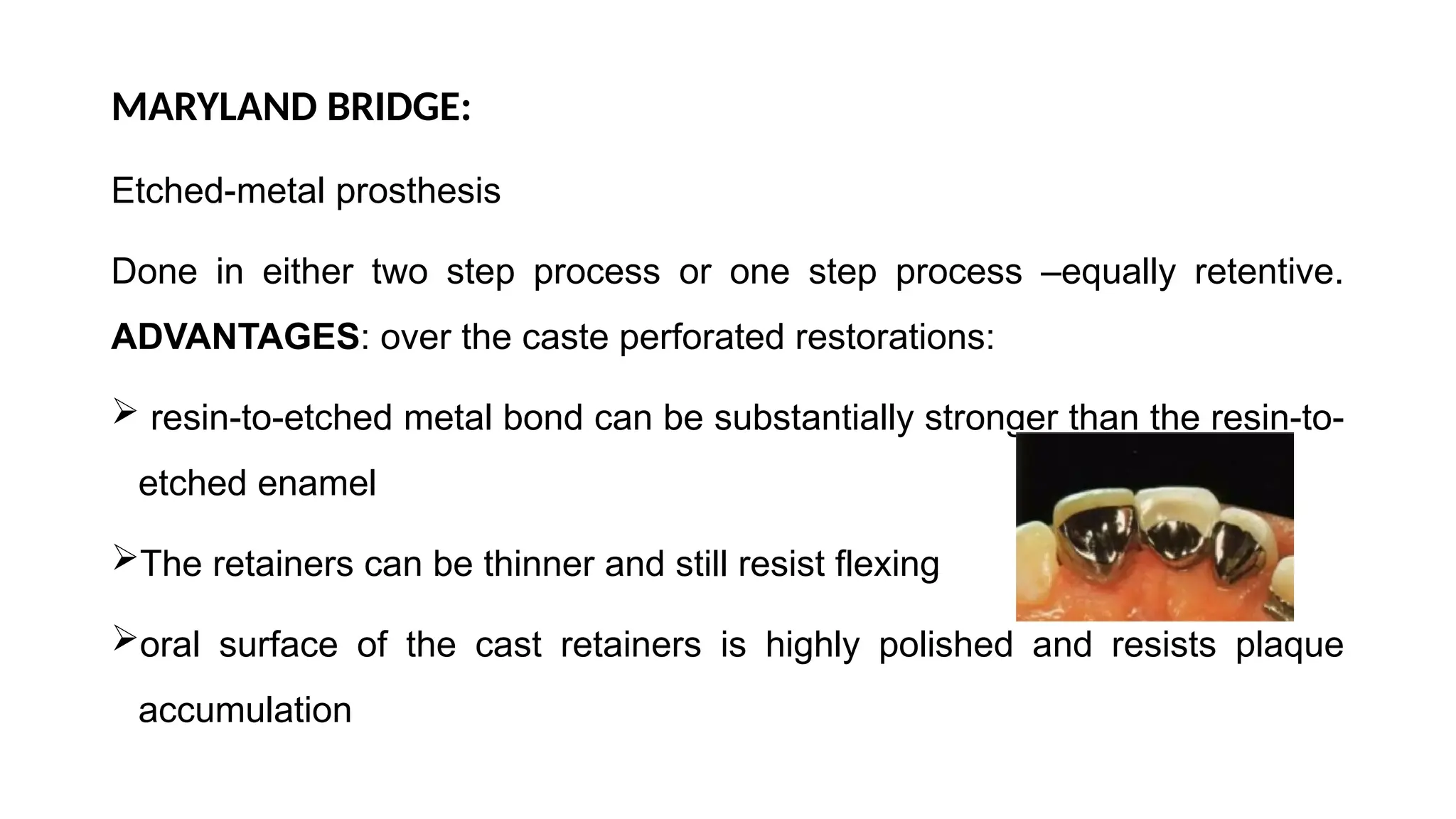
MARYLAND BRIDGE:
Etched-metal prosthesis
Done in either two step process or one step process –equally retentive.
ADVANTAGES: over the caste perforated restorations:
 resin-to-etched metal bond can be substantially stronger than the resin-to-
etched enamel
The retainers can be thinner and still resist flexing
oral surface of the cast retainers is highly polished and resists plaque
accumulation
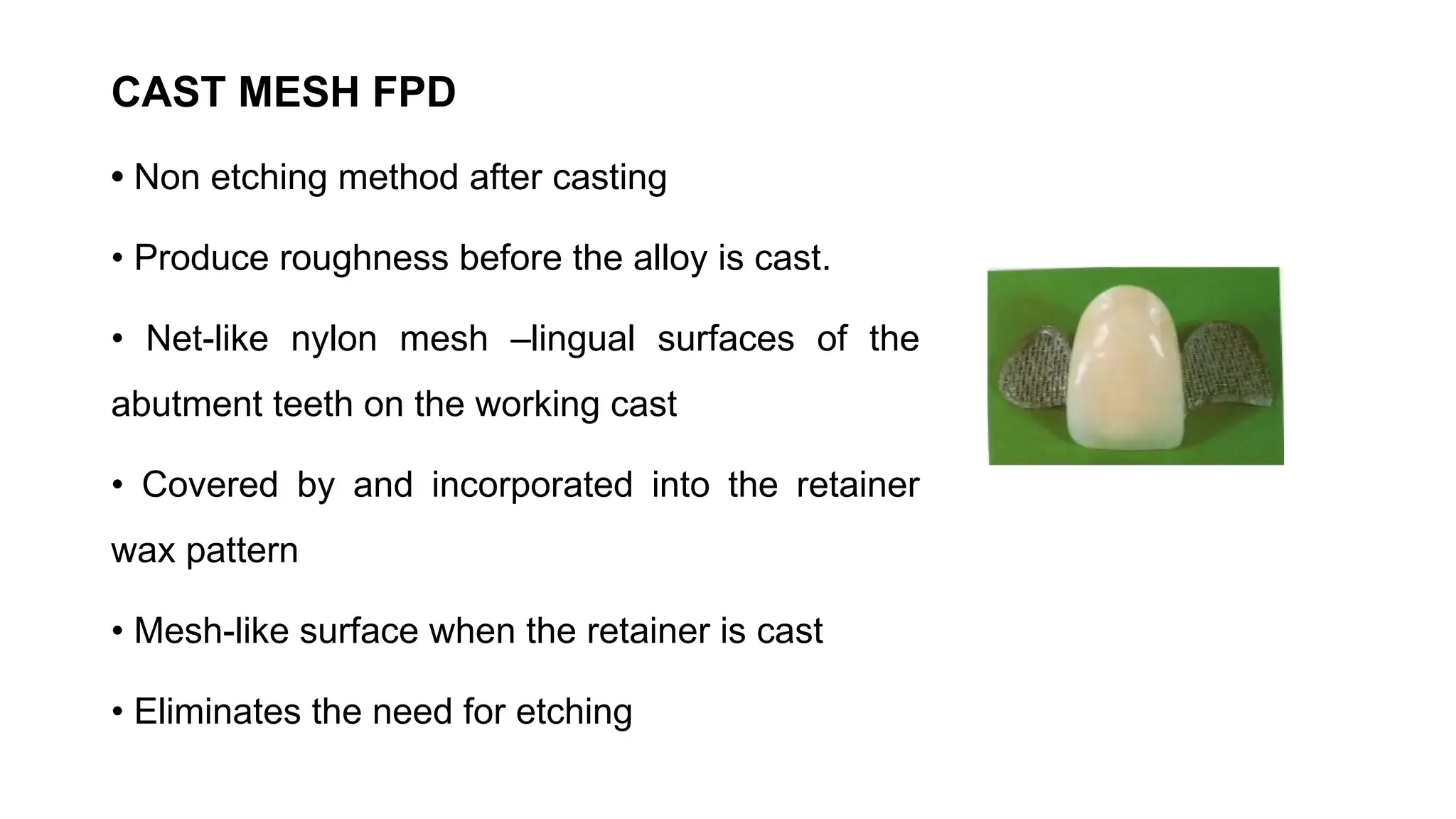
CAST MESH FPD
• Non etching method after casting
• Produce roughness before the alloy is cast.
• Net-like nylon mesh –lingual surfaces of the
abutment teeth on the working cast
• Covered by and incorporated into the retainer
wax pattern
• Mesh-like surface when the retainer is cast
• Eliminates the need for etching
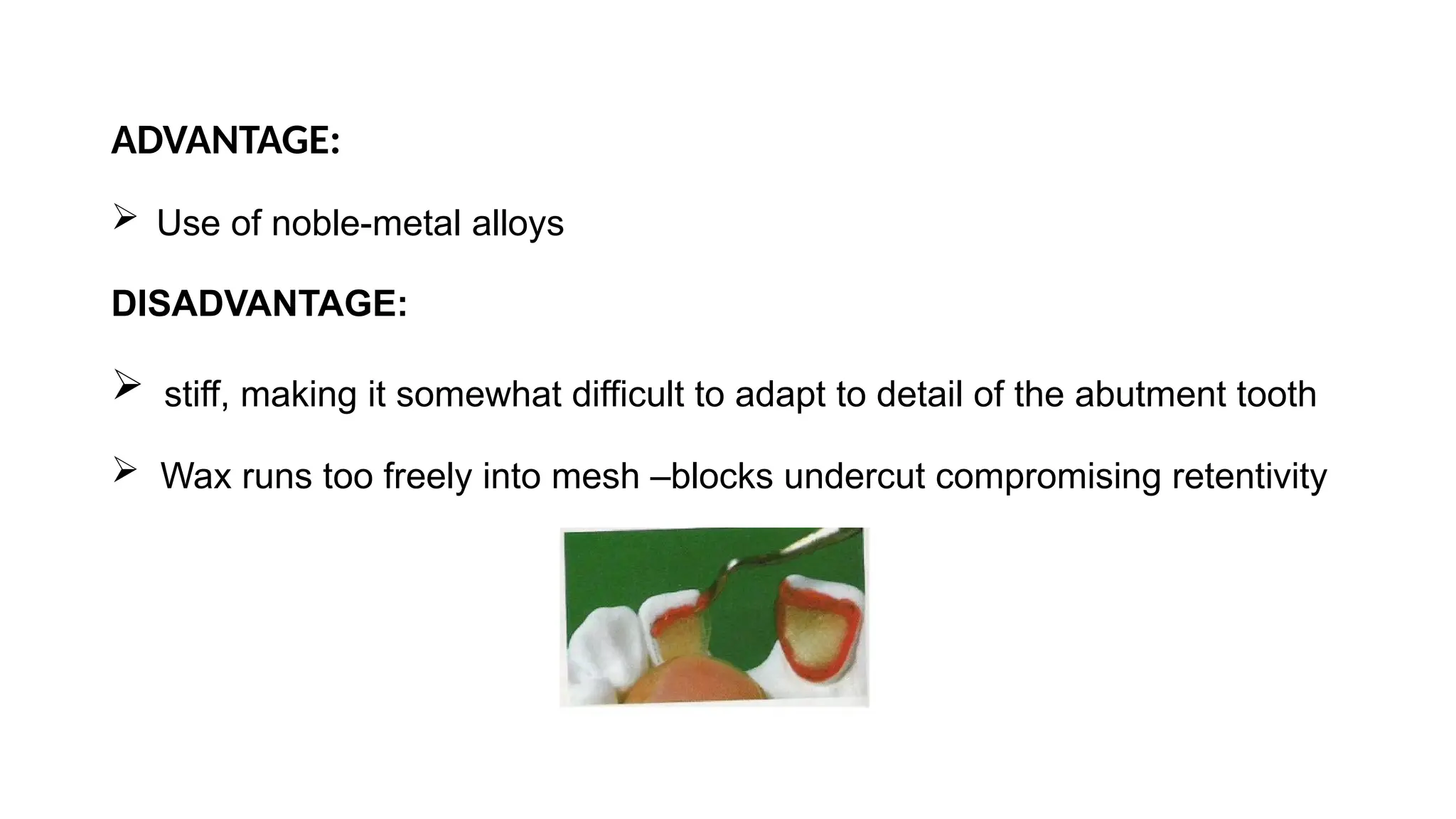
ADVANTAGE:
 Use of noble-metal alloys
DISADVANTAGE:
 stiff, making it somewhat difficult to adapt to detail of the abutment tooth
 Wax runs too freely into mesh –blocks undercut compromising retentivity
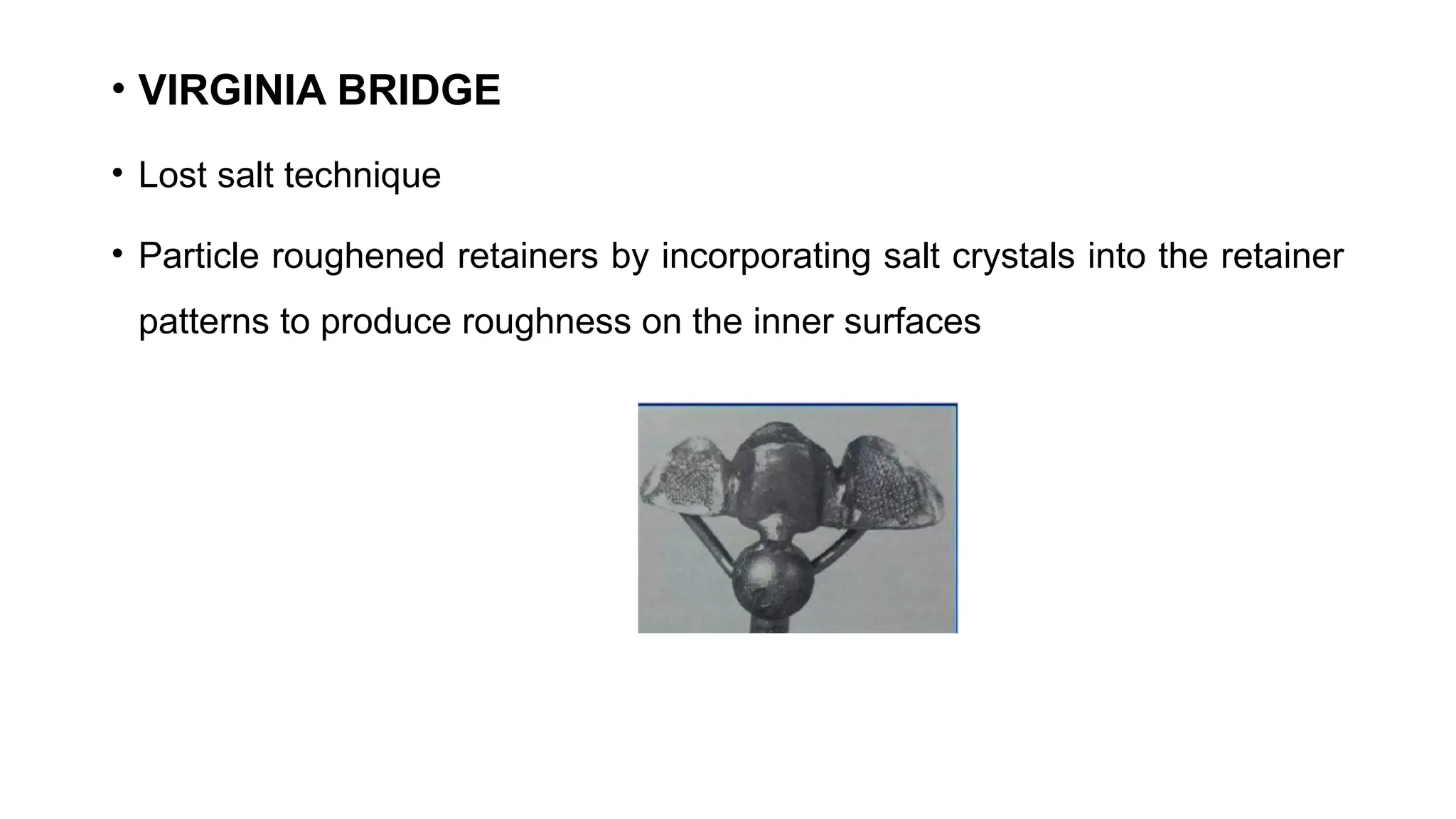
• VIRGINIA BRIDGE
• Lost salt technique
• Particle roughened retainers by incorporating salt crystals into the retainer
patterns to produce roughness on the inner surfaces
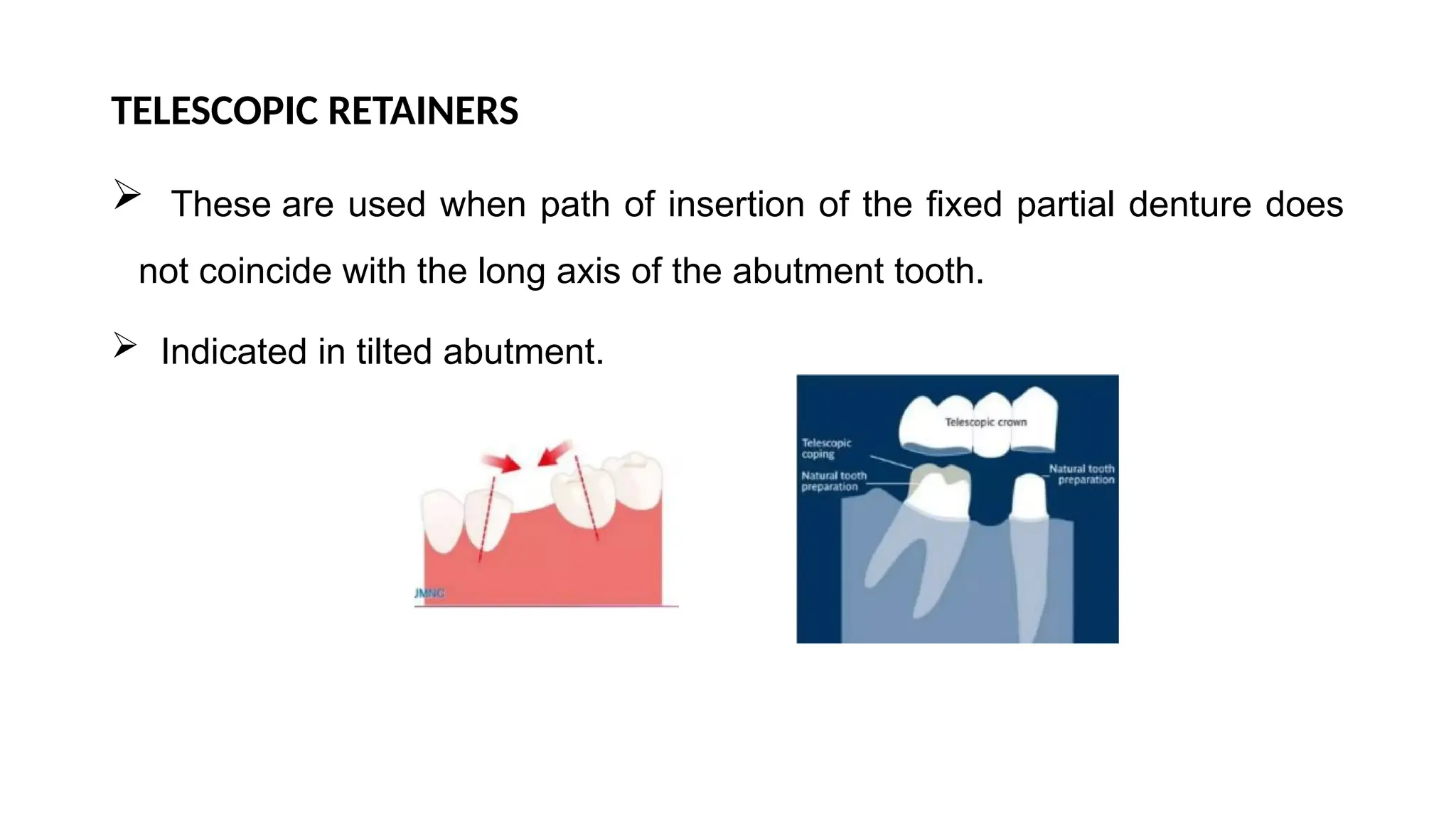
TELESCOPIC RETAINERS
 These are used when path of insertion of the fixed partial denture does
not coincide with the long axis of the abutment tooth.
 Indicated in tilted abutment.
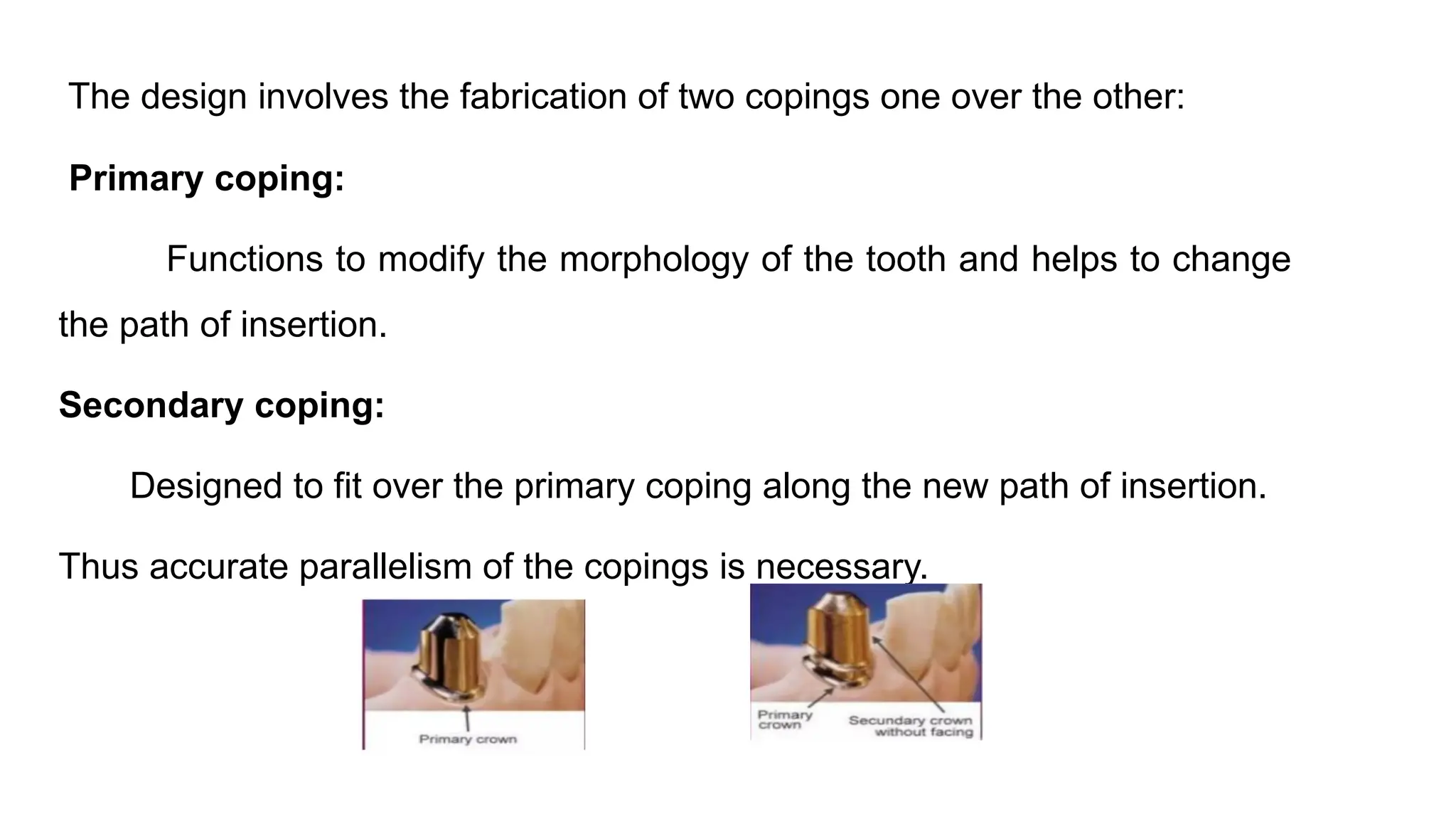
The design involves the fabrication of two copings one over the other:
Primary coping:
Functions to modify the morphology of the tooth and helps to change
the path of insertion.
Secondary coping:
Designed to fit over the primary coping along the new path of insertion.
Thus accurate parallelism of the copings is necessary.
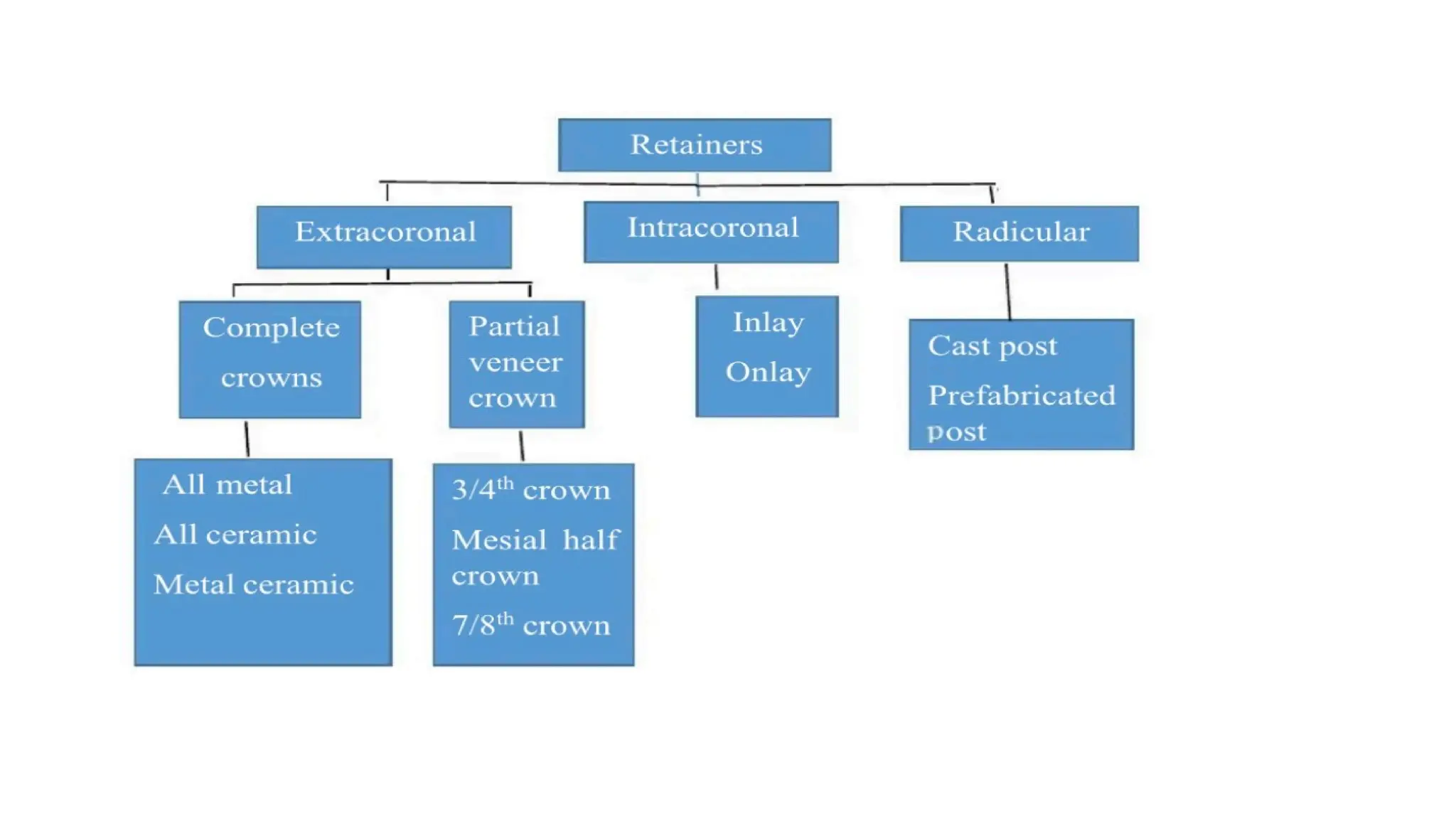
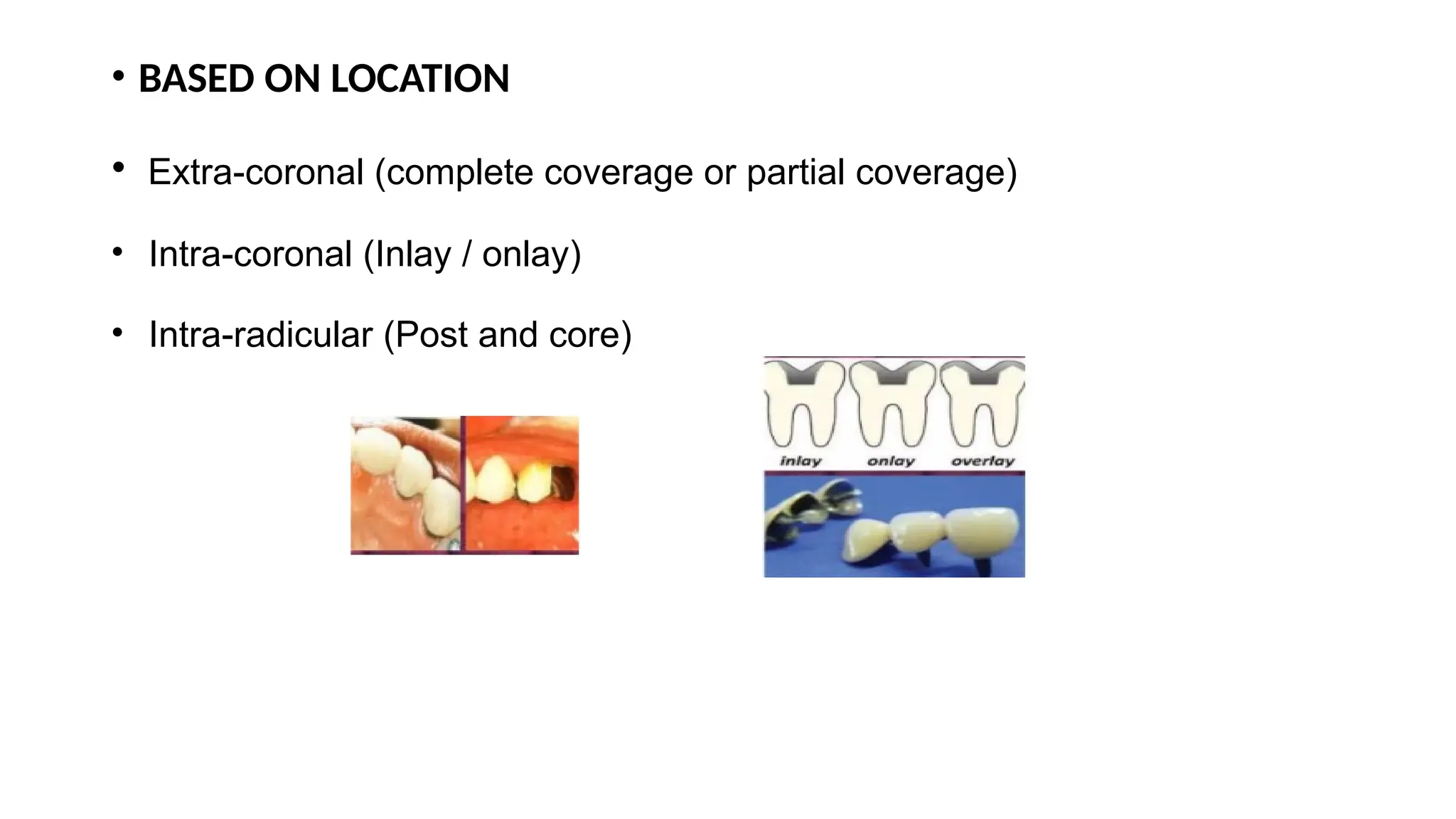
• BASED ON LOCATION
• Extra-coronal (complete coverage or partial coverage)
• Intra-coronal (Inlay / onlay)
• Intra-radicular (Post and core)
INTRA-CORONAL RETAINERS
can either be
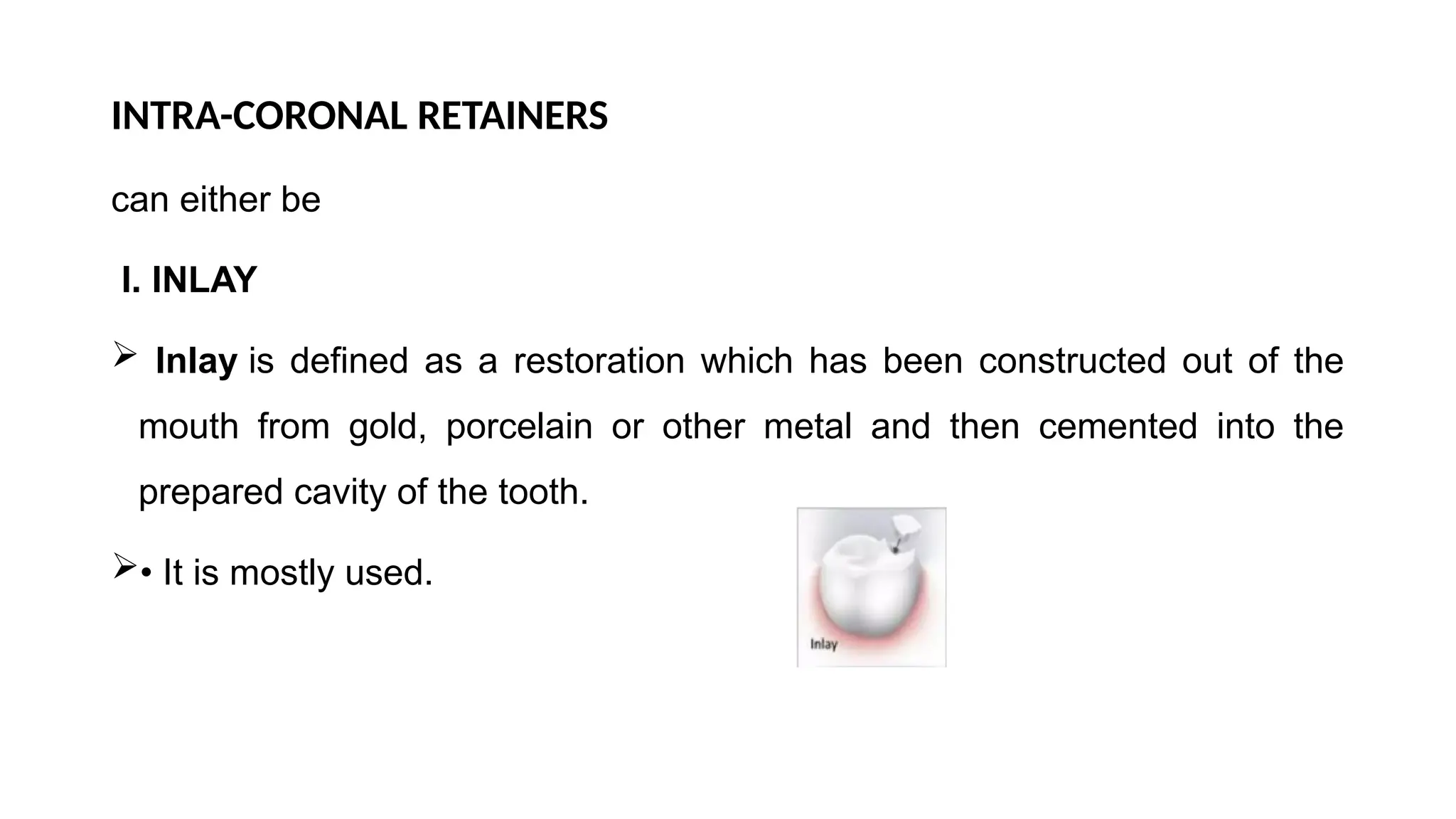
I. INLAY
 Inlay is defined as a restoration which has been constructed out of the
mouth from gold, porcelain or other metal and then cemented into the
prepared cavity of the tooth.
• It is mostly used.
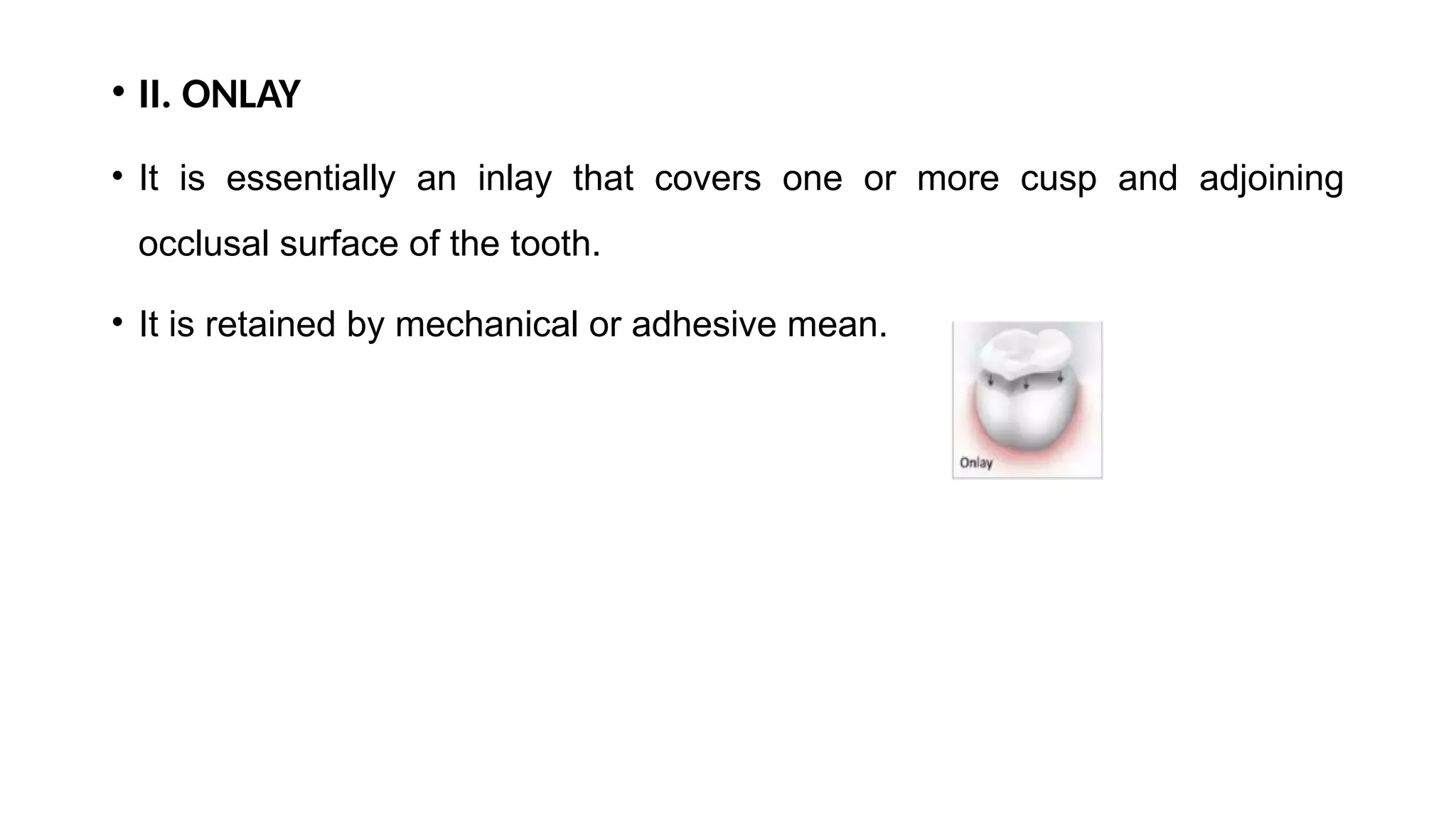
• II. ONLAY
• It is essentially an inlay that covers one or more cusp and adjoining
occlusal surface of the tooth.
• It is retained by mechanical or adhesive mean.
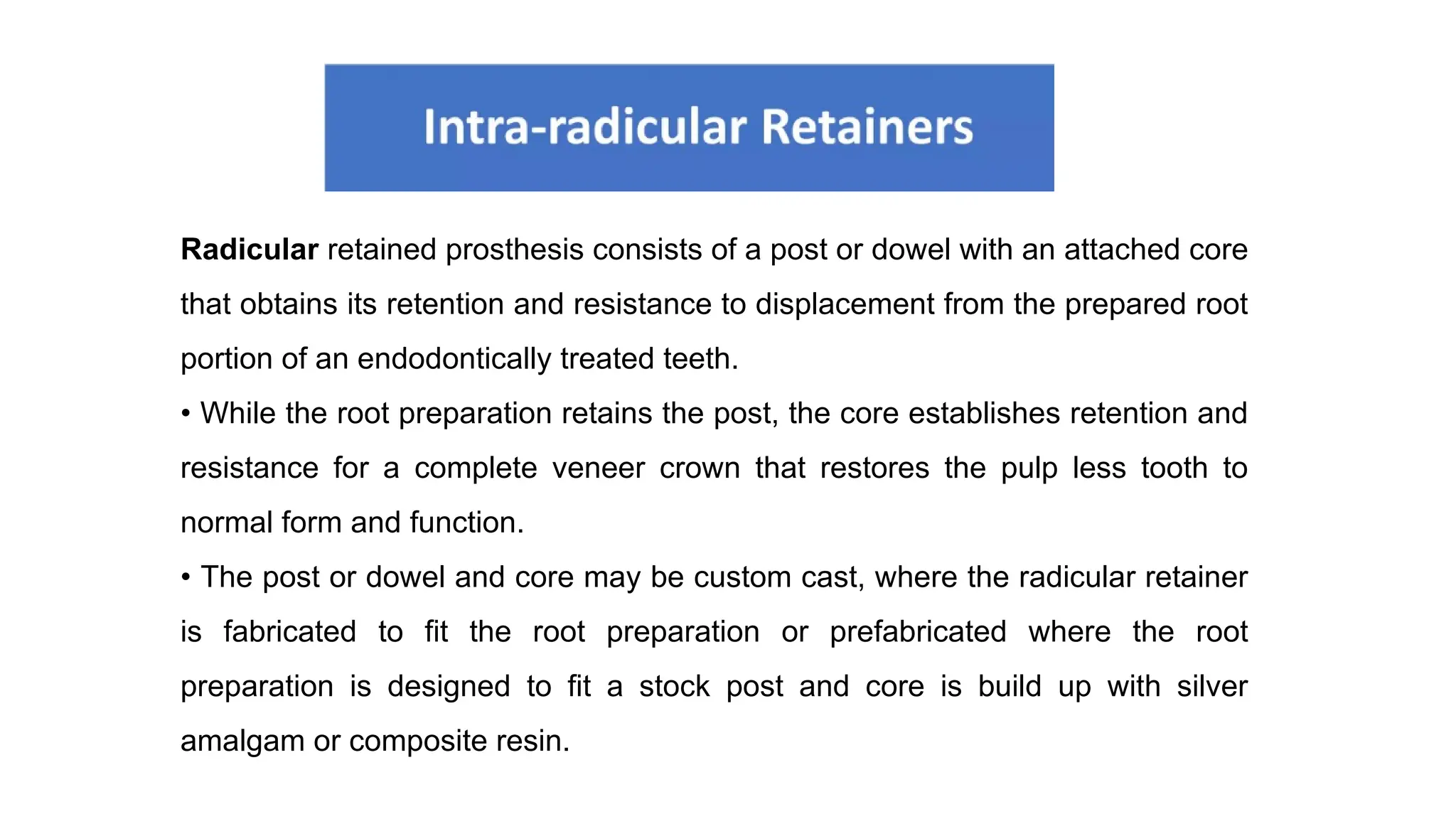
Radicular retained prosthesis consists of a post or dowel with an attached core
that obtains its retention and resistance to displacement from the prepared root
portion of an endodontically treated teeth.
• While the root preparation retains the post, the core establishes retention and
resistance for a complete veneer crown that restores the pulp less tooth to
normal form and function.
• The post or dowel and core may be custom cast, where the radicular retainer
is fabricated to fit the root preparation or prefabricated where the root
preparation is designed to fit a stock post and core is build up with silver
amalgam or composite resin.
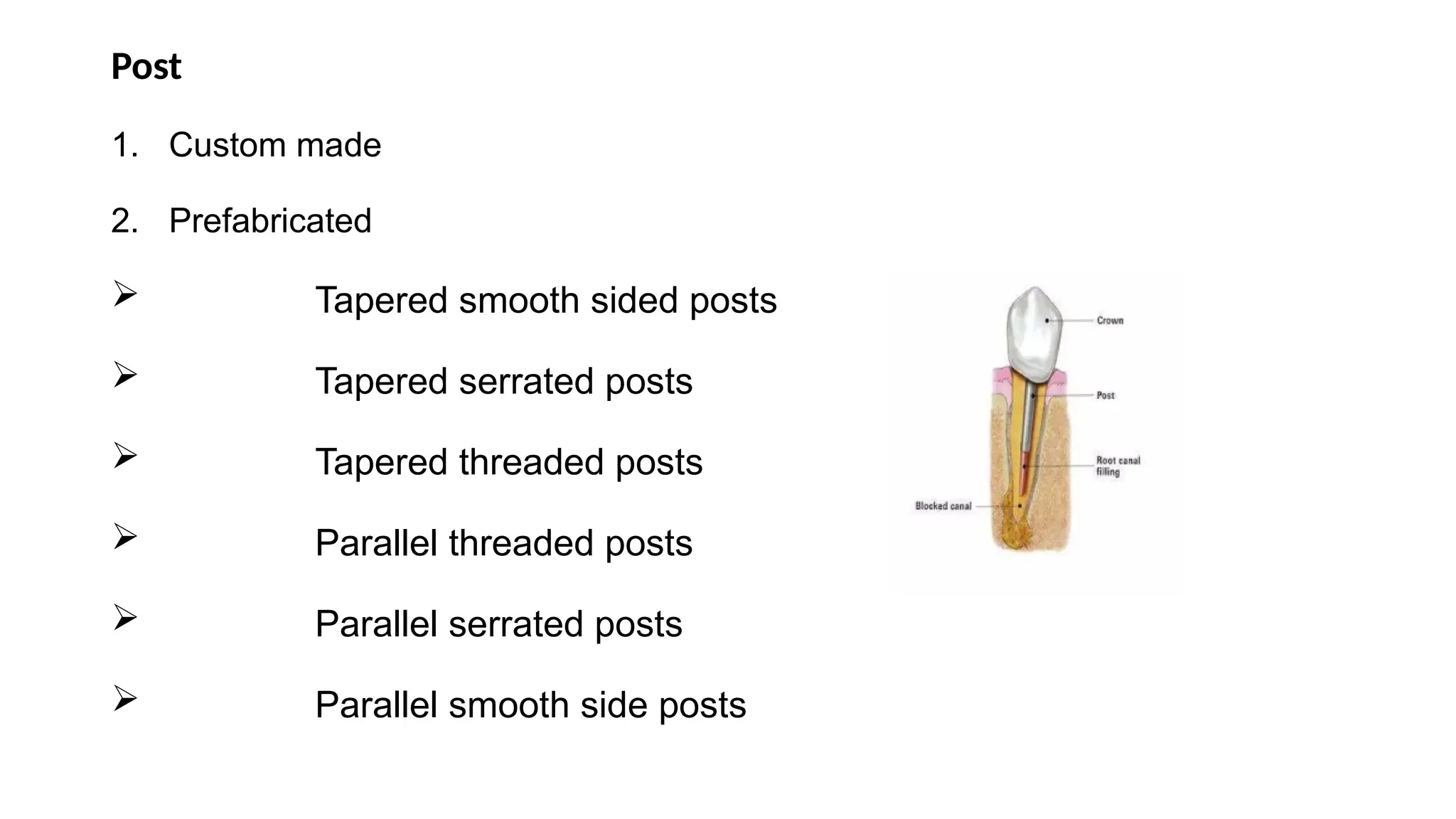
Post
1. Custom made
2. Prefabricated
 Tapered smooth sided posts
 Tapered serrated posts
 Tapered threaded posts
 Parallel threaded posts
 Parallel serrated posts
 Parallel smooth side posts
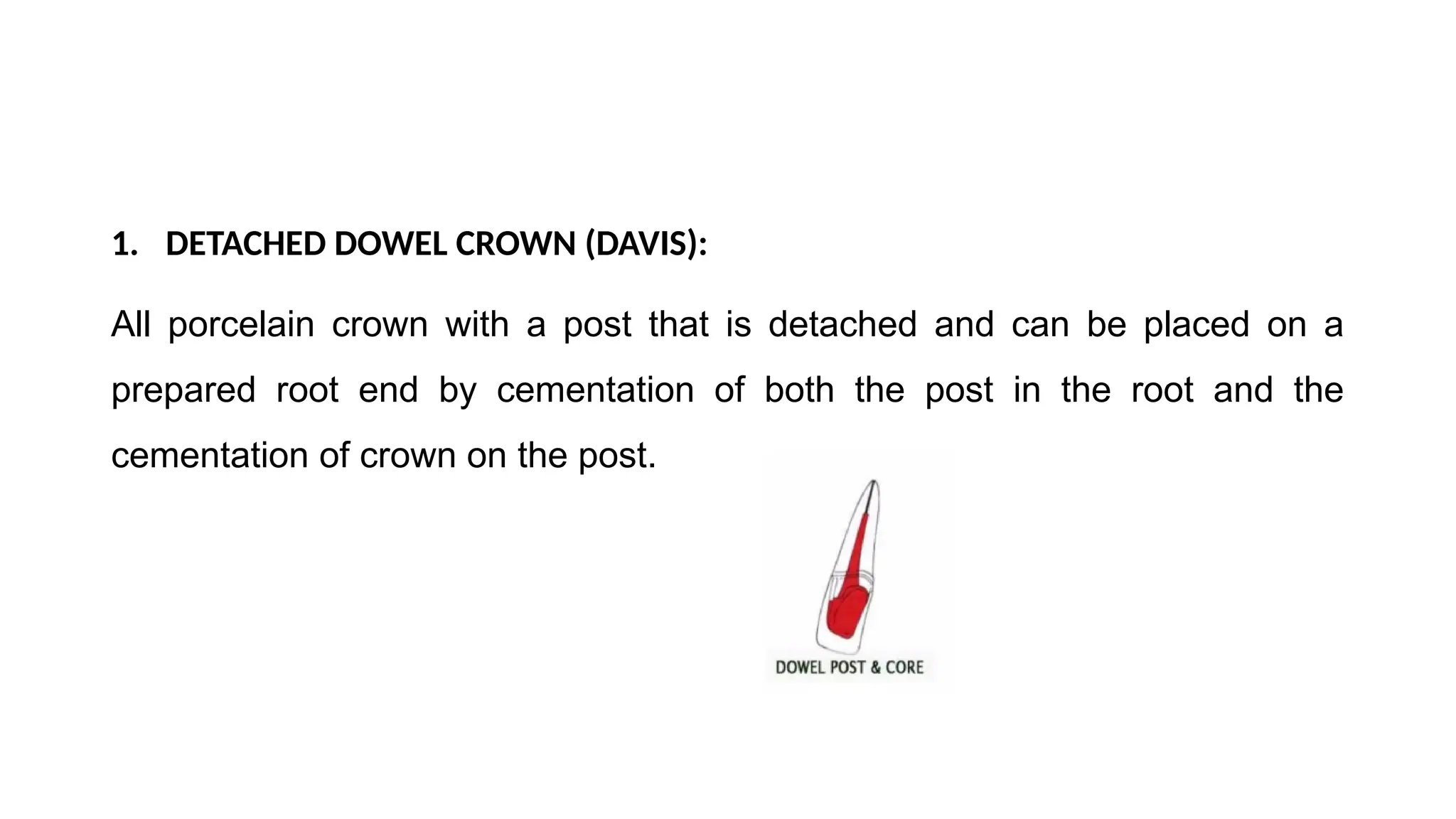
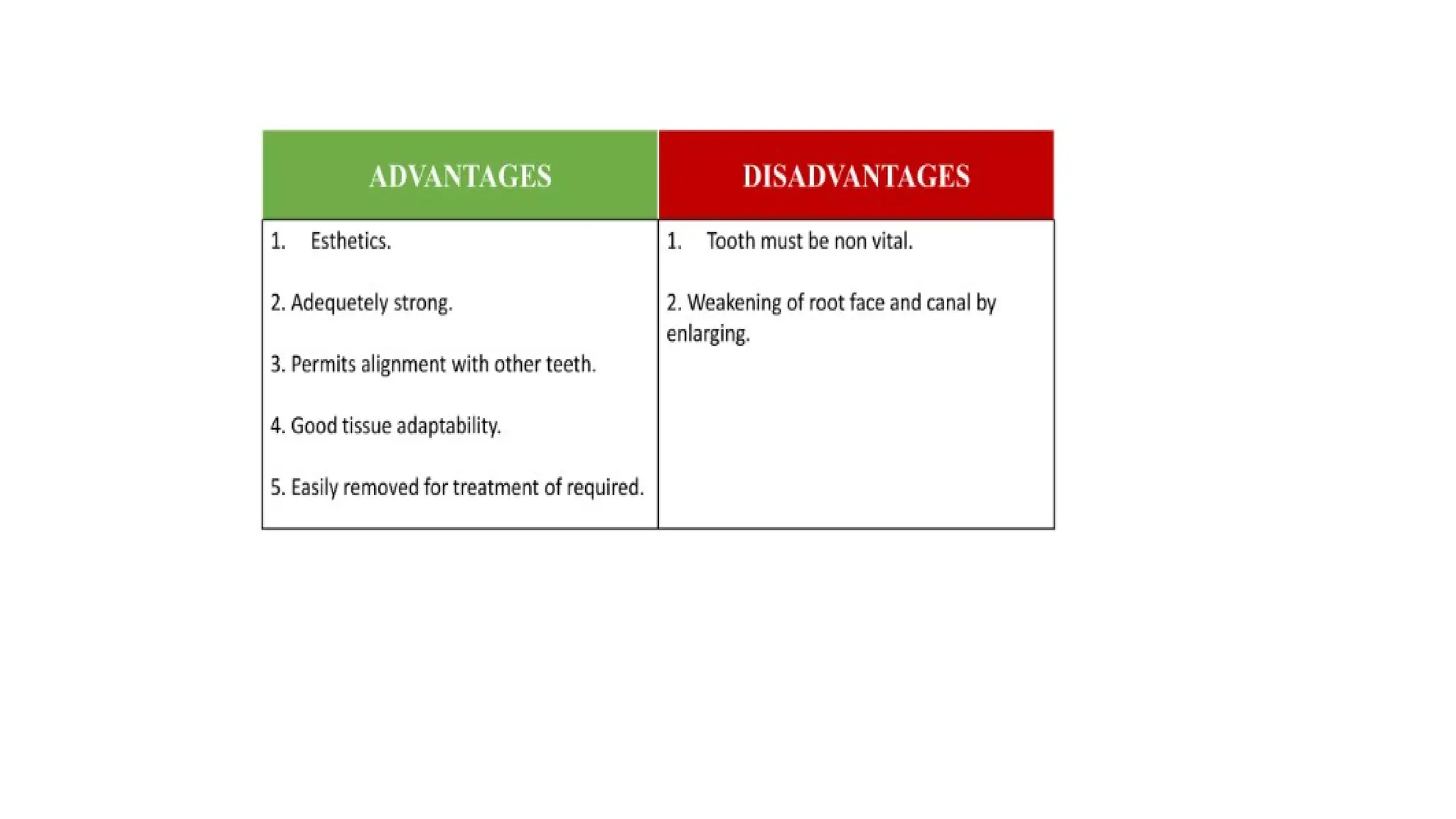
1. DETACHED DOWEL CROWN (DAVIS):
All porcelain crown with a post that is detached and can be placed on a
prepared root end by cementation of both the post in the root and the
cementation of crown on the post.
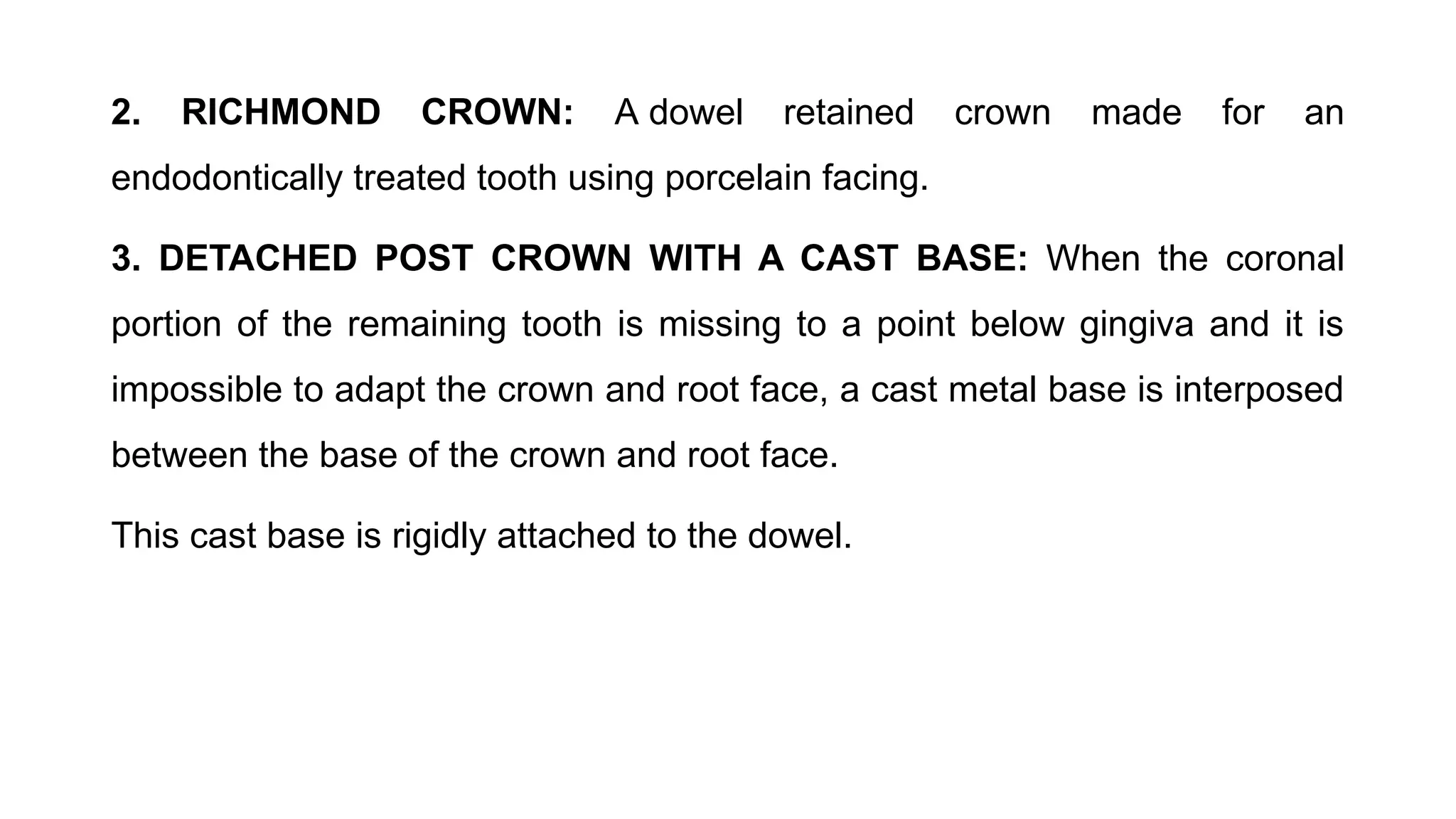
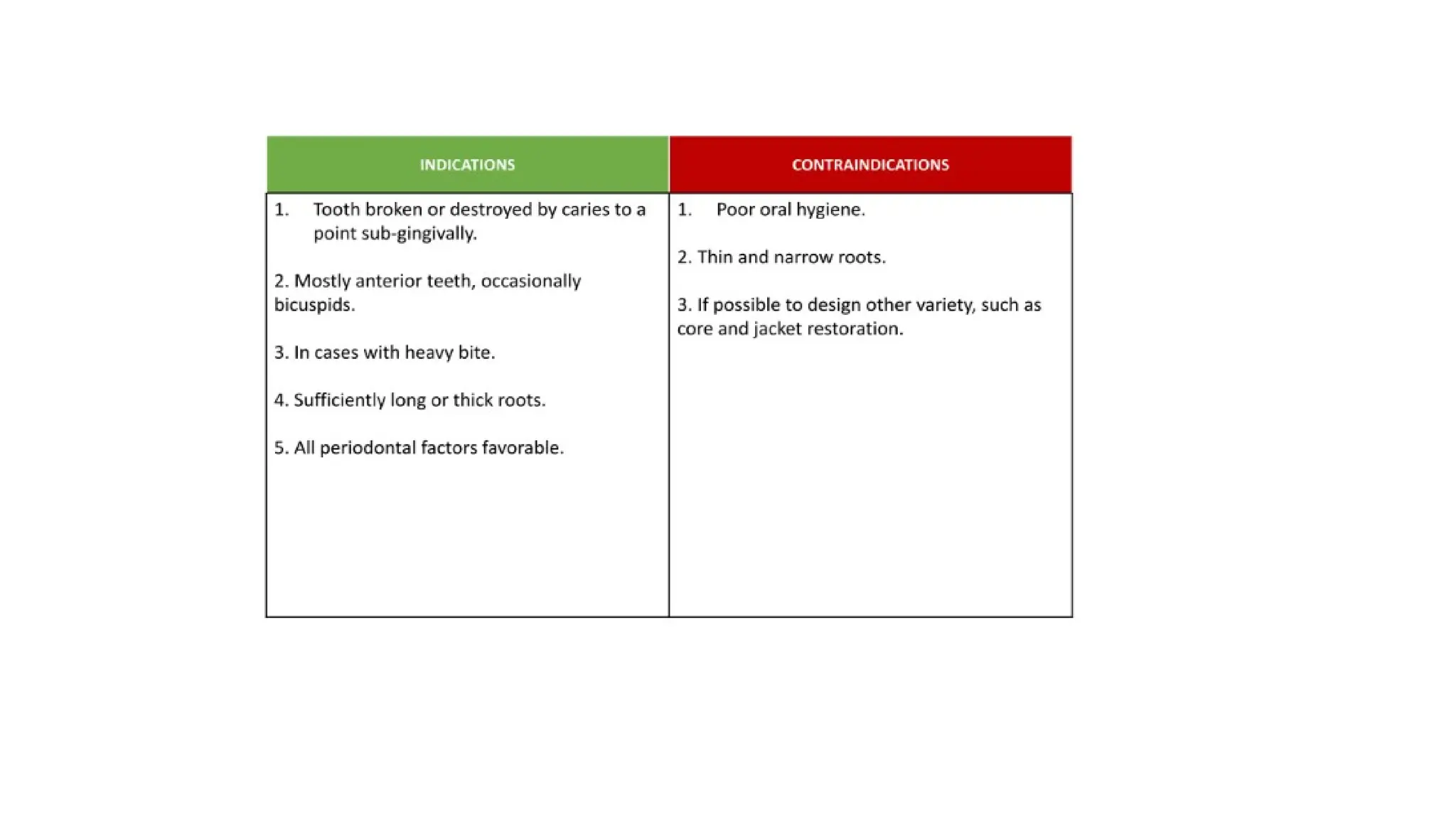
2. RICHMOND CROWN: A dowel retained crown made for an
endodontically treated tooth using porcelain facing.
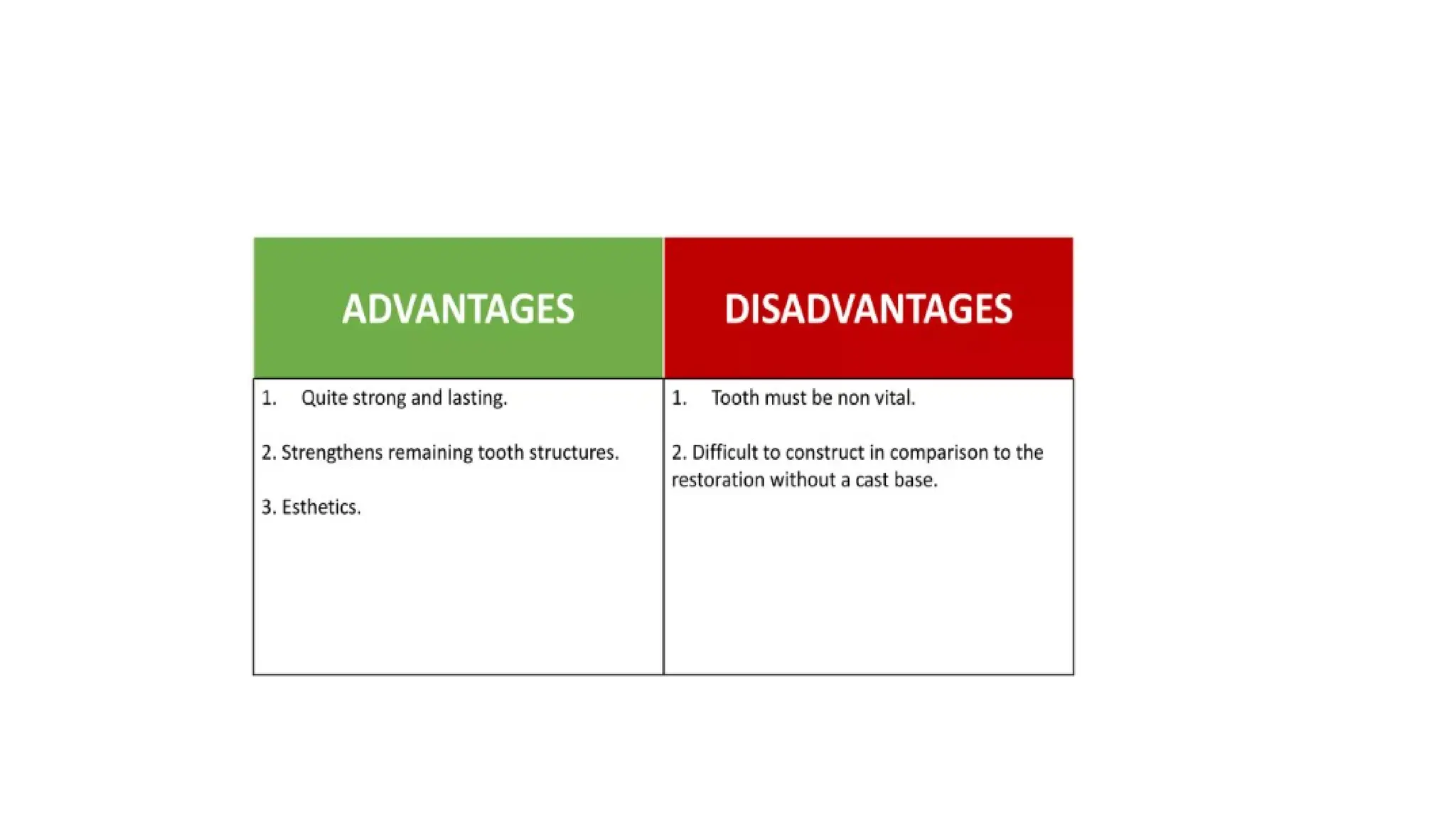
3. DETACHED POST CROWN WITH A CAST BASE: When the coronal
portion of the remaining tooth is missing to a point below gingiva and it is
impossible to adapt the crown and root face, a cast metal base is interposed
between the base of the crown and root face.
This cast base is rigidly attached to the dowel.
FACTORS AFFECTING SELECTION OF RETAINERS
1- RETENTION
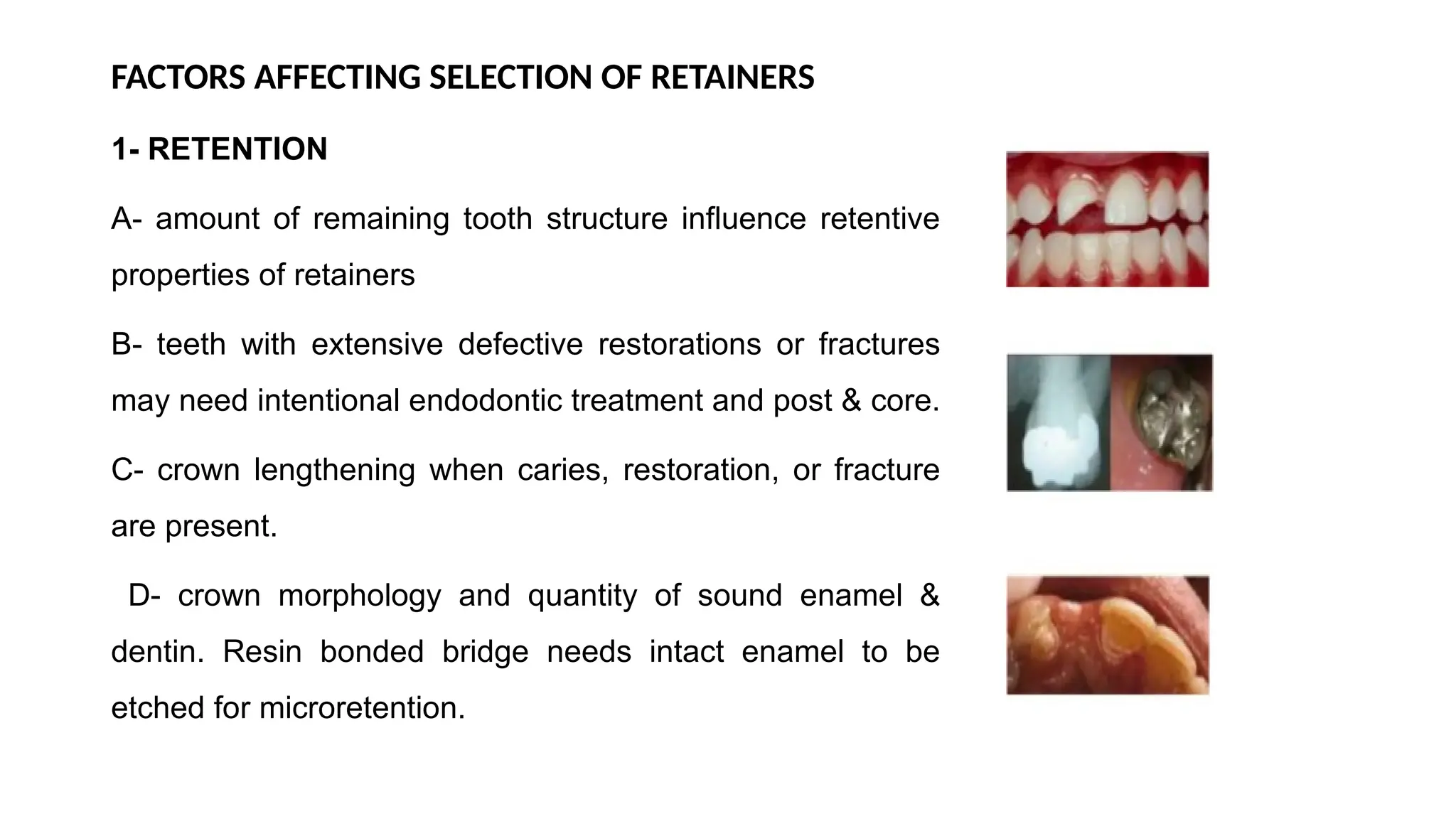
A- amount of remaining tooth structure influence retentive
properties of retainers
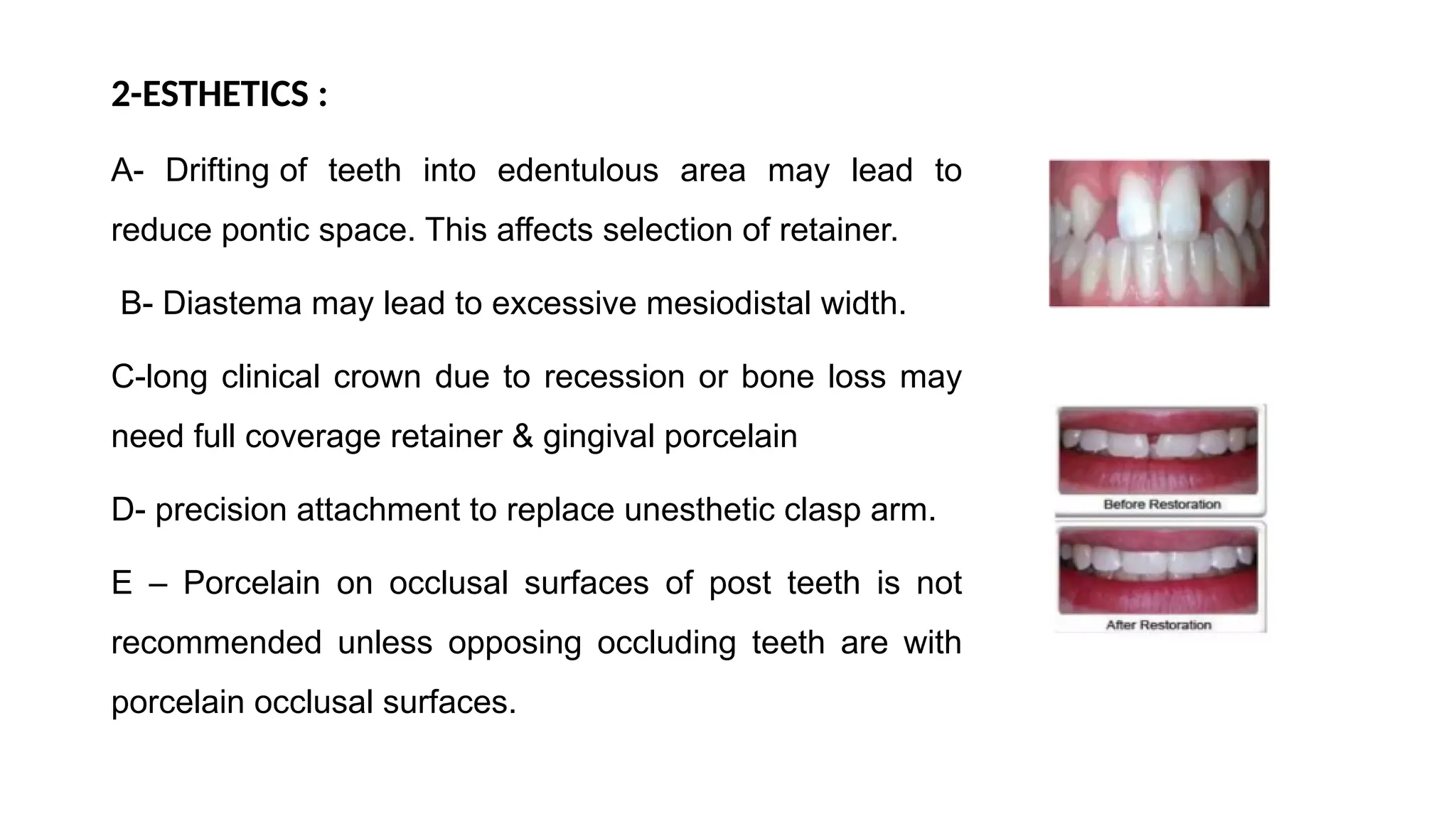
B- teeth with extensive defective restorations or fractures
may need intentional endodontic treatment and post & core.
C- crown lengthening when caries, restoration, or fracture
are present.
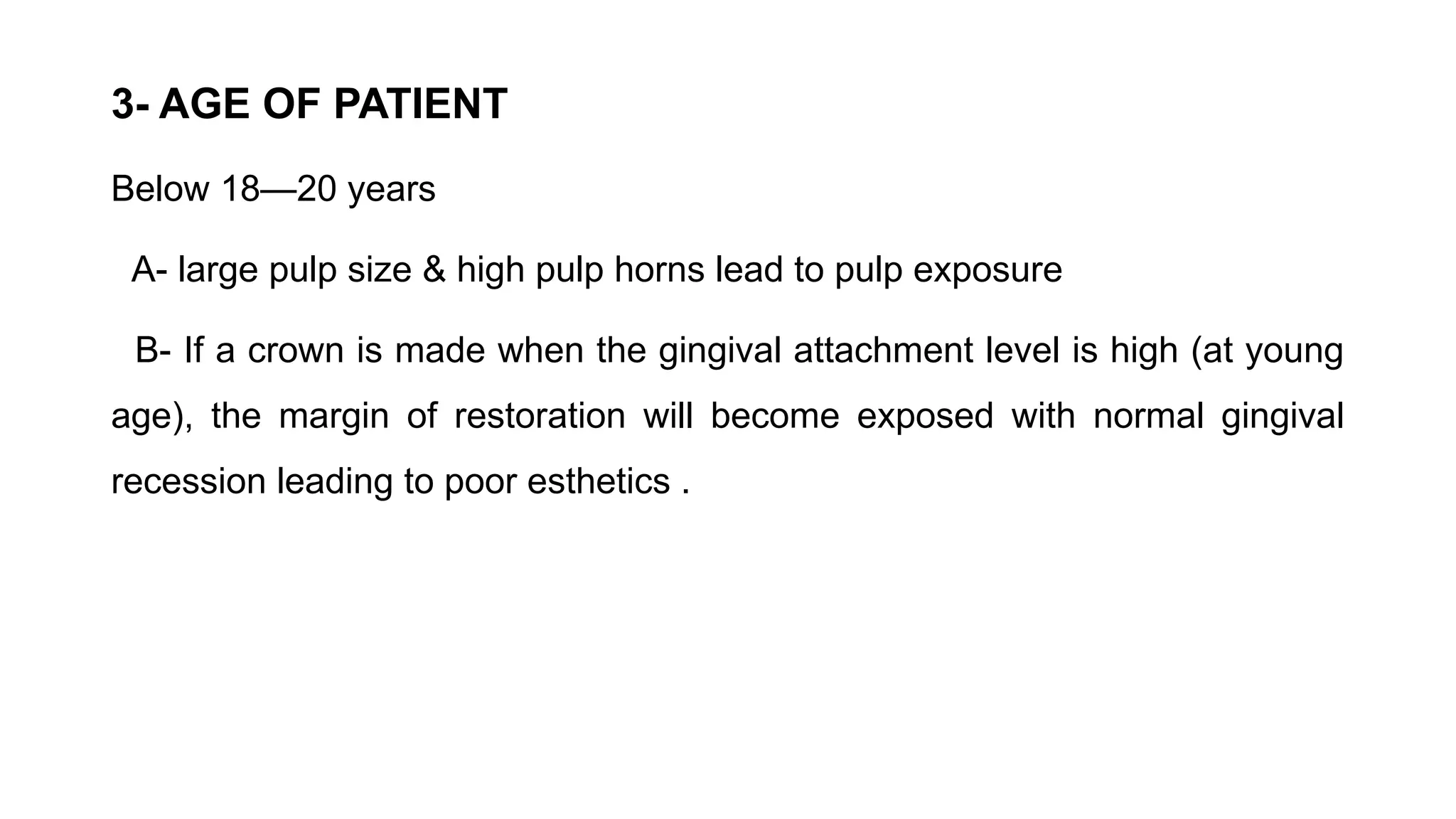
D- crown morphology and quantity of sound enamel &
dentin. Resin bonded bridge needs intact enamel to be
etched for microretention.
2-ESTHETICS :
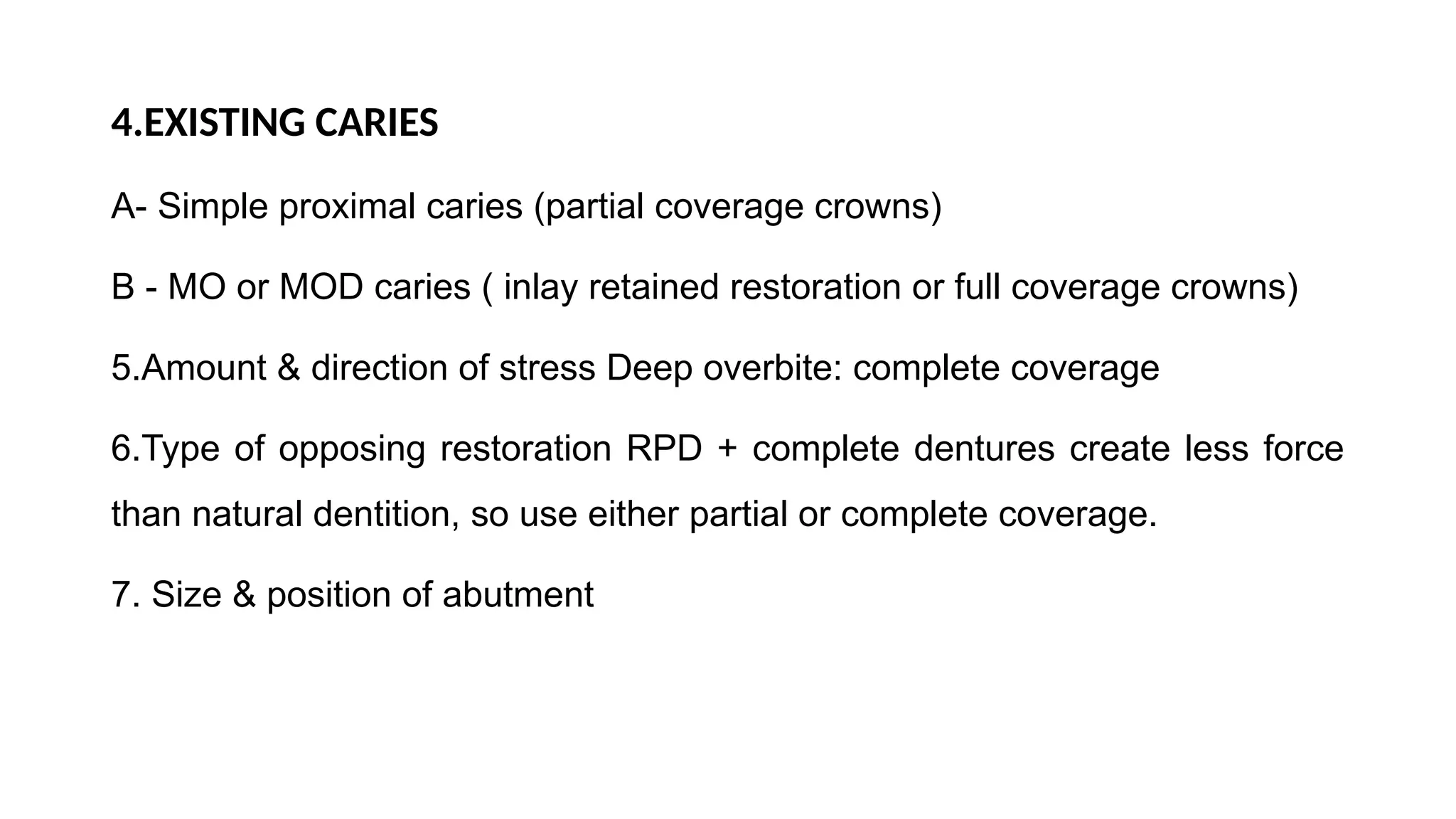
A- Drifting of teeth into edentulous area may lead to
reduce pontic space. This affects selection of retainer.
B- Diastema may lead to excessive mesiodistal width.
C-long clinical crown due to recession or bone loss may
need full coverage retainer & gingival porcelain
D- precision attachment to replace unesthetic clasp arm.
E – Porcelain on occlusal surfaces of post teeth is not
recommended unless opposing occluding teeth are with
porcelain occlusal surfaces.
3- AGE OF PATIENT
Below 18—20 years
A- large pulp size & high pulp horns lead to pulp exposure
B- If a crown is made when the gingival attachment level is high (at young
age), the margin of restoration will become exposed with normal gingival
recession leading to poor esthetics .
4.EXISTING CARIES
A- Simple proximal caries (partial coverage crowns)
B - MO or MOD caries ( inlay retained restoration or full coverage crowns)
5.Amount & direction of stress Deep overbite: complete coverage
6.Type of opposing restoration RPD + complete dentures create less force
than natural dentition, so use either partial or complete coverage.
7. Size & position of abutment
8.CONDITION OF ABUTMENT
Crown, roots, bone level, gingiva, mobility, tilting , pulp vitality, post & core
all affect retainer selection.
9.Caries Index- poor oral hygiene +high caries index necessitate full
coverage retainers
10.length of edentulous span- Increased span length needs retentive &
strong retainers (complete coverage restoration)
11.Patient musculature- males have heavy muscules (complete coverage
restoration.
CONCLUSION
 The objective in selection of retainer whether it involves a single tooth,
several teeth or complete restoration of masticatory mechanism.
It should restore and maintain function of dental-arch.
It should be therefore both restorative and preventive.
To accomplish this objective preventive as well as therapeutic measures
should be utilized.
The efficiency in selecting the retainer depends on the intelligent
application of mechanical, physiological, hygenic and aesthetic principles
within the limits of the supporting tissues.
As it is the critical component of fixed partial denture we have to give
atmost care in selection of retainer to achieve the goal in the success of
fixed partial denture
REFERENCES
T.Shillinburg.Fundamentals of Fixed Prosthodontics, III edition
T.Shillinburg. Fundamentals of Fixed Prosthodontics, IV edition
Rosenstiel, Land, Fujimoto. Contemperory Fixed Prosthodontics, III edition
A.E. Kahn, Partial Versus Full Coverage. J. Prosthet. Dent. 10:167-178, 1960.
 Johnstons, Modern Practice in Fixed Prosthodontics 4th edition 1986

RETAINERS IN FPD and their importance ppt

  • 1.
  • 2.
    CONTENTS  INTRODUCTION  IDEALREQUIREMENTS  CRITERIA FOR SELECTION OF RETAINERS  CLASSIFICATION  EXTRACORONAL RETAINERS  INTRACORONAL RETAINERS  RADICULAR RETAINERS  FACTORS AFFECTING THE SELECTION OF RETAINERS  RECENT ADVANCES  CONCLUSION  REFERENCES
  • 3.
    INTRODUCTION • A fixedpartial denture is commonly fabricated by preparing the teeth present on either side of the missing tooth or teeth. • These supporting prepared teeth are the abutments onto which the prosthesis is cemented. • Fixed partial denture is made up of three elementary components –  Retainer  Pontic  Connector.
  • 4.
    • Retainer: Thepart of a fixed dental prosthesis that unites the abutment(s) to the remainder of the restoration(GPT8). • It is used for the stabilization or retention of prosthesis • Pontic: An artificial tooth on a fixed dental prosthesis that replaces a missing natural tooth, restores its function and usually fills the space previously occupied by the clinical crown. • Connector: The portion of affixed dental prosthesis that unites the retainers and pontic.
  • 5.
    IDEAL REQUIREMENTS • Shouldcause least amount of destruction to the abutment • Least destroys the outline form of the tooth • Marginal line should be finished with great accuracy • Rigidity • withstand requisite load • Functional adaptation and protect the tooth against its fracture • Least destroys the cervical marginal ridge
  • 6.
    • Positioned marginsat less susceptible to caries or recurrence of caries • Preparation should be made without trauma to the pulp or surrounding tissue • Accurate complement to the lost tooth structure • Cleansable • Esthetic
  • 9.
  • 11.
    • FULL COVERAGERETAINER- these retainers cover all the five surfaces of the abutment tooth.
  • 12.
    • ADVANTAGES • Contactarea can be properly developed • Embrasure area can be enhanced • Buccal contours can be correctly developed • Facilitate occlusal plane modifications • Indicated for endodontically treated abutments • Ideal for restoring edentulous area in patients with craniofacial anomalies
  • 13.
    INDICATIONS • 1. Shortclinical crown • 2. For a patient with a history of active caries and poor hygiene • 3. In both vital and pulpless teeth
  • 14.
    • Metal ceramiccrowns and all ceramic crowns are used in situations that require good cosmetic results with maximum resistance and retention requirements.
  • 15.
    FULL METAL CROWN: •It is an artificial metallic restoration used to cover the all surfaces of the clinical crown. • It is made only from metal, e.g. gold. • Can be either partial or full veneer crown. • Strong even in thin sections.
  • 16.
    • Preperation: • Occlusalreduction: non centric cusp – 1mm centric cusp – 1.5mm • Margin: chamfer – allows 0.5mm thickness
  • 17.
    INDICATIONS: 1.As single crownor as a bridge. 2.Only for posterior teeth. 3.In patients with high caries index. 4.For an endodontically treated tooth/or teeth. 5.For malalignment tooth/or teeth. 6.For teeth with a short occluso-gingival height. 7.For a badly broken clinical crown. 8. In a long span bridge. Indications
  • 18.
    CONTRAINDICATIONS: 1.In case ofanterior teeth, for esthetic reasons. 2. In a situation where anther conservative preparation can be used. 3. When less than maximum resistance and retention is needed. 4. When caries extend gingivally, as that the finish line cannot be made. 5. In case of uncontrolled caries.
  • 20.
    METAL CERAMIC CROWNS Tarefull cast crowns having porcelain or acrylic facing on facial or lingual surface. They require more tooth reduction • Can be fabricated over full veneer crown or partial veneer crown • Indicated on teeth that require complete coverage & esthetic demand • Can accommodate cast or soldered connectors • Can afford high force—metal
  • 21.
    Preparation: Incisal reduction 2mm Occlusalreduction 1.5mm – for metal coverage 2mm – for metal with ceramic veneer Margins: - facial surface- shoulder - lingual surface- chamfer - Shoulder must extend at least 1mm lingual to proximal contact area.
  • 23.
    • NON METALCROWN (ALL CERAMIC) It is also called the jacket crown is an artificial non-metallic restoration made of porcelain. It is used to cover the all surfaces of the clinical crown. May be fabricated as full or partial coverage crown. Primary purpose: to achieve best possible esthetic results. Risk of reduced restoration longevity—potential for fracture Preparation: Incisal reduction: 2mm clearance ( this enables cosmetically pleasing restoration & provides adequate strength ) Facial reduction: 1mm clearance Lingual reduction: 1mm clearance Margin: shoulder preparation – 90 degree angle
  • 26.
    PARTIAL COVERAGE RETAINER ADVANTAGES Conservativetooth preparation Guides for coronal contours Embrasure forms are pre-established Improved periodontal health as limited contact between margin of restoration and gingiva.  Marginal fit and Complete seating of casting can be easily verified before and during cementation Margin accessibility for finishing and cleaning Uncovered portion of tooth can be used for electric pulp testing  Acceptable esthetics.
  • 27.
    • DISADVANTAGES • Arenot as retentive as complete coverage retainers. • There is a limited display of metal. • Tooth preparation is difficult because only limited adjustments can be made in the path of placement.
  • 28.
    INDICATIONS • Intact orminimal restored teeth • Normal anatomic clinical crown • Teeth with adequate labiolingual thickness
  • 29.
    CONTRAINDICATIONS • 1. Teethwith short clinical crowns • 2. Thin teeth bucco-lingually • 3. Teeth that are proximally bulbous • 4. Poorly aligned tooth • 5. Bad oral hygiene and high caries index • 6. Retainers for long span bridges • 7. Endodontically treated teeth • 8. Malformed teeth
  • 31.
    • II. Partialcoverage • 1. ¾ crown:
  • 33.
     ½ CROWN: •It is a partial coverage restoration that restores the occlusal surface (or incisal edge), the mesial surface and a portion of the facial or lingual surfaces. • This type is indicated for mesially tilted tooth. PIN LEDGE: • It is a technique that employs parallel long pins prepared in the lingual or palatal surface of the clinical crown, in order to increase retention of the restoration. • These restorations used the both grooves and pins to improve retention.
  • 34.
     ¾ REVERSEDCROWN: • It is a partial coverage restoration that restores the occlusal surface (or incisal edge), and three axial surface of the clinical crown (the lingual surface is not included). • This type is indicated for lower posterior teeth. And it is useful for server lingual indications. 7/8 CROWN: • It is a partial coverage restoration that restores all surfaces of the crown except the mesio-buccal cusp. • This type is only used for the upper 1st molar.
  • 35.
  • 37.
    CONSERVATIVE RETAINERS • Requireminimal tooth reduction • Do not accept heavy loads, therefore indicated for anterior teeth. • Have a small metallic extension which are designed to be luted directly onto the lingual surface of the abutment tooth using resin cement.
  • 38.
  • 39.
    Why resin-bonded FPD •Conventional FPD’s requires abutment preparation which leads to destruction of adjacent teeth. • Various solutions tried for this problem but not of much result oriented 1.Inlay retainer 2.Cantilever FPD loss of PDL support of abutment teeth 3.Unilateral RPD lack of retention stability and risk of aspirated if dislodged
  • 40.
    • CLASSIFICATION OFRBFPD Classified on the basis progression of development: Rochettebridge Maryland bridge Cast Mesh Virginia bridges
  • 41.
    ROCHETTE BRIDGE • wing-likeretainers, • with funnel-shaped perforations through them to enhance resin retention • combined mechanical retention with a silane coupling agent to produce adhesion to the metal
  • 42.
    DISADVANTAGE • Weakening ofthe metal retainer by the perforations • Limited adhesion of the metal provided by the perforations • Wear of composite resin • Thick lingual retainers • Plaque accumulation • 50% failure chances.
  • 43.
    MARYLAND BRIDGE: Etched-metal prosthesis Donein either two step process or one step process –equally retentive. ADVANTAGES: over the caste perforated restorations:  resin-to-etched metal bond can be substantially stronger than the resin-to- etched enamel The retainers can be thinner and still resist flexing oral surface of the cast retainers is highly polished and resists plaque accumulation
  • 44.
    CAST MESH FPD •Non etching method after casting • Produce roughness before the alloy is cast. • Net-like nylon mesh –lingual surfaces of the abutment teeth on the working cast • Covered by and incorporated into the retainer wax pattern • Mesh-like surface when the retainer is cast • Eliminates the need for etching
  • 45.
    ADVANTAGE:  Use ofnoble-metal alloys DISADVANTAGE:  stiff, making it somewhat difficult to adapt to detail of the abutment tooth  Wax runs too freely into mesh –blocks undercut compromising retentivity
  • 46.
    • VIRGINIA BRIDGE •Lost salt technique • Particle roughened retainers by incorporating salt crystals into the retainer patterns to produce roughness on the inner surfaces
  • 49.
    TELESCOPIC RETAINERS  Theseare used when path of insertion of the fixed partial denture does not coincide with the long axis of the abutment tooth.  Indicated in tilted abutment.
  • 50.
    The design involvesthe fabrication of two copings one over the other: Primary coping: Functions to modify the morphology of the tooth and helps to change the path of insertion. Secondary coping: Designed to fit over the primary coping along the new path of insertion. Thus accurate parallelism of the copings is necessary.
  • 51.
    • BASED ONLOCATION • Extra-coronal (complete coverage or partial coverage) • Intra-coronal (Inlay / onlay) • Intra-radicular (Post and core)
  • 52.
    INTRA-CORONAL RETAINERS can eitherbe I. INLAY  Inlay is defined as a restoration which has been constructed out of the mouth from gold, porcelain or other metal and then cemented into the prepared cavity of the tooth. • It is mostly used.
  • 53.
    • II. ONLAY •It is essentially an inlay that covers one or more cusp and adjoining occlusal surface of the tooth. • It is retained by mechanical or adhesive mean.
  • 56.
    Radicular retained prosthesisconsists of a post or dowel with an attached core that obtains its retention and resistance to displacement from the prepared root portion of an endodontically treated teeth. • While the root preparation retains the post, the core establishes retention and resistance for a complete veneer crown that restores the pulp less tooth to normal form and function. • The post or dowel and core may be custom cast, where the radicular retainer is fabricated to fit the root preparation or prefabricated where the root preparation is designed to fit a stock post and core is build up with silver amalgam or composite resin.
  • 57.
    Post 1. Custom made 2.Prefabricated  Tapered smooth sided posts  Tapered serrated posts  Tapered threaded posts  Parallel threaded posts  Parallel serrated posts  Parallel smooth side posts
  • 58.
    1. DETACHED DOWELCROWN (DAVIS): All porcelain crown with a post that is detached and can be placed on a prepared root end by cementation of both the post in the root and the cementation of crown on the post.
  • 61.
    2. RICHMOND CROWN:A dowel retained crown made for an endodontically treated tooth using porcelain facing. 3. DETACHED POST CROWN WITH A CAST BASE: When the coronal portion of the remaining tooth is missing to a point below gingiva and it is impossible to adapt the crown and root face, a cast metal base is interposed between the base of the crown and root face. This cast base is rigidly attached to the dowel.
  • 64.
    FACTORS AFFECTING SELECTIONOF RETAINERS 1- RETENTION A- amount of remaining tooth structure influence retentive properties of retainers B- teeth with extensive defective restorations or fractures may need intentional endodontic treatment and post & core. C- crown lengthening when caries, restoration, or fracture are present. D- crown morphology and quantity of sound enamel & dentin. Resin bonded bridge needs intact enamel to be etched for microretention.
  • 65.
    2-ESTHETICS : A- Driftingof teeth into edentulous area may lead to reduce pontic space. This affects selection of retainer. B- Diastema may lead to excessive mesiodistal width. C-long clinical crown due to recession or bone loss may need full coverage retainer & gingival porcelain D- precision attachment to replace unesthetic clasp arm. E – Porcelain on occlusal surfaces of post teeth is not recommended unless opposing occluding teeth are with porcelain occlusal surfaces.
  • 66.
    3- AGE OFPATIENT Below 18—20 years A- large pulp size & high pulp horns lead to pulp exposure B- If a crown is made when the gingival attachment level is high (at young age), the margin of restoration will become exposed with normal gingival recession leading to poor esthetics .
  • 67.
    4.EXISTING CARIES A- Simpleproximal caries (partial coverage crowns) B - MO or MOD caries ( inlay retained restoration or full coverage crowns) 5.Amount & direction of stress Deep overbite: complete coverage 6.Type of opposing restoration RPD + complete dentures create less force than natural dentition, so use either partial or complete coverage. 7. Size & position of abutment
  • 68.
    8.CONDITION OF ABUTMENT Crown,roots, bone level, gingiva, mobility, tilting , pulp vitality, post & core all affect retainer selection. 9.Caries Index- poor oral hygiene +high caries index necessitate full coverage retainers 10.length of edentulous span- Increased span length needs retentive & strong retainers (complete coverage restoration) 11.Patient musculature- males have heavy muscules (complete coverage restoration.
  • 69.
    CONCLUSION  The objectivein selection of retainer whether it involves a single tooth, several teeth or complete restoration of masticatory mechanism. It should restore and maintain function of dental-arch. It should be therefore both restorative and preventive. To accomplish this objective preventive as well as therapeutic measures should be utilized.
  • 70.
    The efficiency inselecting the retainer depends on the intelligent application of mechanical, physiological, hygenic and aesthetic principles within the limits of the supporting tissues. As it is the critical component of fixed partial denture we have to give atmost care in selection of retainer to achieve the goal in the success of fixed partial denture
  • 71.
    REFERENCES T.Shillinburg.Fundamentals of FixedProsthodontics, III edition T.Shillinburg. Fundamentals of Fixed Prosthodontics, IV edition Rosenstiel, Land, Fujimoto. Contemperory Fixed Prosthodontics, III edition A.E. Kahn, Partial Versus Full Coverage. J. Prosthet. Dent. 10:167-178, 1960.  Johnstons, Modern Practice in Fixed Prosthodontics 4th edition 1986

Editor's Notes

  • #46 coated first with model spray and then with lubricant, then salt crystals (NACL) ranging in size from 149-250Mm are sprinkled over the outlined area. The retainer pattern is fabricated from resin, leaving a 0.5 to 1.0mm wide, crystal free margin around the outlined area. When the resin has polymerized, the patterns are removed from the cast, cleaned with a solvent, and then placed in water in an ultrasonic cleaner to dissolve the salt crystals. This leaves cubic voids in the surface that are reproduced in the cast retainers, producing retention for the fixed partial denture.