TOOTHSUPPORTED
OVERDENTURES
Presented by:-
DR. SNEHA.
INTRODUCTION
 In the past the extraction of entire dentitions with
complete denture replacements used to be promoted as
an inexpensive and permanent solution for oral health
care.
 Preventive prosthodontics emphasizes the importance of
any procedure that can delay or eliminate future
prosthodontic problems.The overdenture is a logical
method for the dentist to use preventive prosthodontics.
SEQUALAE
OFACD
PATIENT
LOSS OF OCCLUSAL
STABILITY
RESIDUAL RIDGE
RESORPTION
UNDERMINED ESTHETICS
IMPAIRED
MASTICATION
NEED FOR
OVERDENTURE ????
Reconcile a need for
maximum support in
morphologically
compromised dental
arches
Equally compromised
esthetic
appearance resulting from
undersupported circumoral
tissues
DEFINITION
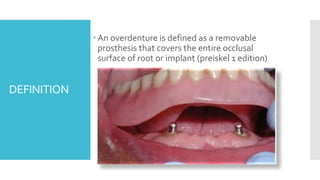
 An overdenture is defined as a removable
prosthesis that covers the entire occlusal
surface of root or implant (preiskel 1 edition)
MORE RESIDUAL RIDGE
INTEGRITY
MORE DENTURE
STABILITYAND
RETENTION
RETAINED “NATURAL
FEELING”
SIMPLEALTERNATIVE
ADVANTAGES
Disadvantages
Depends on patients oral hygiene
comittments.
Extensive abutment design modifications
required in inadequate interarch space.
Increases cost in the patients with
compromised periodontal heath of the
abutments.
It is considered as a time dependent
transition to complete denture therapy.
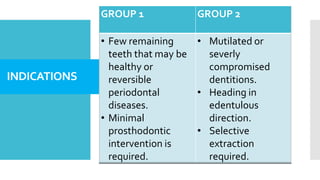
INDICATIONS
GROUP 1 GROUP 2
• Few remaining
teeth that may be
healthy or
reversible
periodontal
diseases.
• Minimal
prosthodontic
intervention is
required.
• Mutilated or
severly
compromised
dentitions.
• Heading in
edentulous
direction.
• Selective
extraction
required.
SELECTION OF
ABUTMENTTEETH
PERIODONTAL
STATUS
MOBILITY
LOCATION COST
ENDO AND
PROSTHODONTIC
CONSIDERATION
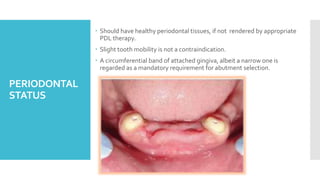
PERIODONTAL
STATUS
 Should have healthy periodontal tissues, if not rendered by appropriate
PDL therapy.
 Slight tooth mobility is not a contraindication.
 A circumferential band of attached gingiva, albeit a narrow one is
regarded as a mandatory requirement for abutment selection.
ABUTMENTSELECTION
IN mandible canines and premolars
are best overdenture abutments
In maxilla incisors are
frequently used.
Maxillary teeth advantages Disadvantages
• CENTRAL INCISORS
• LATERAL INCISORS
 Ideal location, provide protection
to premaxilla.
 Widely separated, facilitating
Diminished root surface area
plaque control.
 Tissue undercuts do not pose a
problem.
 Path of placement/removal is not
compromised.
 Ability to create a flange/
peripheral seal.
× Proximity and alveolar
prominence may complicate
utilization.
× Diminished root surface area.
• CANINES  Longest root of the
anterior teeth.
× Diverging facial
tissue undercuts
× Overcontoured
flanges
× Excessive lip
support
× Potentially
uncomfortable
placement/removal
of prosthesis
× Complicates
placement of
prosthetic teeth
× compromise the
peripheral seal
From Nelson DR, von Gonten AS: Biomechanical and esthetic considerations for maxillary anterior
overdenture abutment selection, J Prosthet Dent 72:133-136, 1994.
One tooth per quadrant is
recommended.
If recommendations is exceeded,
retained teeth should be preferably not
the adjacent ones. or there should be
several millimeters of space between the
reduced tooth forms.
Hammer and anvil concept should be
kept in mind.
ENDODONTIC
AND
PROSTHODONTIC
STATUS
Anterior single rooted teeth are easier
and less expensive to manage .
Recent year cast copings are eclipsed by
composite and alloy restorations.
The clinical crowns can be modified for
technical convenience and treated with
sealant restorations or fluoride
applications.
METHODOFABUTMENT PREPARATION
It is our impression that the essential
feature in this technique is not the type of
attachment used per se but the following
basic principles:
1. “Bare tooth”:-Maximum reduction of
the coronal portion of the tooth
should be accomplished.
 Patients with advanced pulpal
recession can undergo coronal
reduction without the need for
endodontic treatment.
 This preparation is made when time is
needed to evaluate the status of
selected abutment teeth and when a
patient’s (usually an elderly one’s)
general health precludes several dental
appointments.
 COST effective.
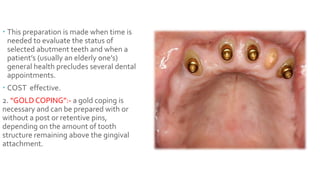
2. “GOLD COPING”:- a gold coping is
necessary and can be prepared with or
without a post or retentive pins,
depending on the amount of tooth
structure remaining above the gingival
attachment.
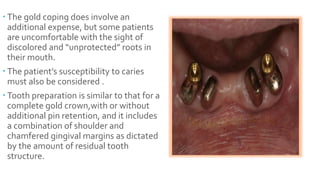
 The gold coping does involve an
additional expense, but some patients
are uncomfortable with the sight of
discolored and “unprotected” roots in
their mouth.
 The patient’s susceptibility to caries
must also be considered .
 Tooth preparation is similar to that for a
complete gold crown,with or without
additional pin retention, and it includes
a combination of shoulder and
chamfered gingival margins as dictated
by the amount of residual tooth
structure.
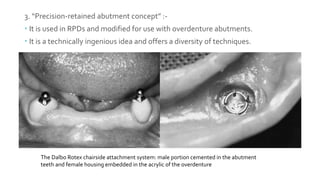
3. “Precision-retained abutment concept” :-
 It is used in RPDs and modified for use with overdenture abutments.
 It is a technically ingenious idea and offers a diversity of techniques.
The Dalbo Rotex chairside attachment system: male portion cemented in the abutment
teeth and female housing embedded in the acrylic of the overdenture
Ceka-Revax attachment system: the male stud-type attachment is soldered to a coping.
Fixation is achieved by the female housing embedded in the (maxillary) overdenture.
SUPPORT FOR
OVERDENTURES
 It is important to realize that the causes of failure
inherent in the complete denture prosthesis are not
overcome by using attachment fixation.
 Failures of the hybrid prosthesis occur not because of
the attachments hut because of improper attachment
selection and failure of the dentist to develop
maximum denture base extension, atmospheric seal,
and, for mandibular bases, coverage of the retromolar
pad.
 Use of the attachment introduces another factor in
basic prosthetic design, that is, the demand for an
exact attachment-prosthesis relationship.
TOOTH
PREPARATION
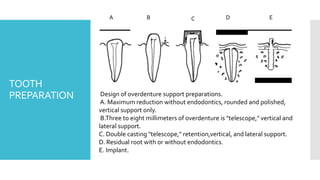
A B C D E
Design of overdenture support preparations.
A. Maximum reduction without endodontics, rounded and polished,
vertical support only.
B.Three to eight millimeters of overdenture is "telescope," vertical and
lateral support.
C. Double casting "telescope," retention,vertical, and lateral support.
D. Residual root with or without endodontics.
E. Implant.
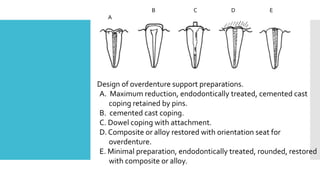
Design of overdenture support preparations.
A. Maximum reduction, endodontically treated, cemented cast
coping retained by pins.
B. cemented cast coping.
C. Dowel coping with attachment.
D. Composite or alloy restored with orientation seat for
overdenture.
E. Minimal preparation, endodontically treated, rounded, restored
with composite or alloy.
A
B C D E
IMPRESSION
TECHNIQUES
 The impression technique and materials vary with
personal preference. Elastomeric materials as well as
individual compound impressions allow the dentist to
choose silverplated or stone dies.
 hydrocolloid impressions permit to use only stone dies.
 Incorporations of a dowel in an impression can
complicate otherwise routine impression procedures .
 An alternative method is to make an individual or full
impression of preparations, join the dowels to the
copings with resin, transfer them,solder the dowels to
the copings, and prepare the casts and dowel copings
for subsequent attachment positioning and
overdenture fabrication .
LABORATORY
PROCEDURES
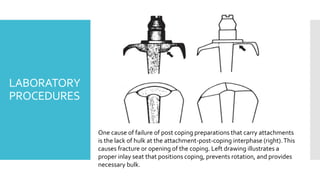
One cause of failure of post coping preparations that carry attachments
is the lack of hulk at the attachment-post-coping interphase (right).This
causes fracture or opening of the coping. Left drawing illustrates a
proper inlay seat that positions coping, prevents rotation, and provides
necessary bulk.
Dowelcopingshould
provideagradualgingival
bulgetoprotectmarginal
gingiva.
joint.
• The occlusal surface of the coping is modified
to accept the type of attachment used.
• The attachments are soldered to the coping
after it has been cast and rough finished.
• The orientation of most stud and bar
attachments is established with a
parallelometer.
• Generally attachment · orientation in relation
to the coping is dictated by the resin tooth
position and the buccolingual and
occlusogingival space available.
DOWEL
DESIGNS
 CUSTOMIZED CAST DOWELS
Waxed dowels require bulk for adaptation of the wax
pattern and usually are not long enough to provide
resistance against dislodgment.
 PRE FABRICATED RESIN PATTERNS
The prefabricated dowel patterns are provided with a
matched set of burs for preparing the dowel space.The
cross-sectional strength of a pattern dowel is
considerably less than that of a prefabricated metal
dowel of the same size,for the metal dowels are drawn
from a high-fusing alloy, different than that used for the
copings, and do not have the potential porosity and
fracture of a cast dowel.
PRE FABRICATED METAL DOWELS
• The cross-sectional strength of a pattern dowel is considerably less than that of a prefabricated metal dowel of the
same size,for the metal dowels are drawn from a h igh-fusingalloy, different than that used for the copings, and
do not have the potential porosity and fracture of a cast dowel.
THREADED DOWELS
• Threaded dowels provide mechanical fixation inaddition to cementation .TheVK and Kurer systems offer excellent
retention with the threading.
• A disadvantage with this type of dowel is that the tooth can be fractured during final cementation by using too
large a screw for the cross section of the tooth.
DOWEL SYSTEMS
• MOOSER SYSTEMS
• SCHENKER STEP PIVOT
• VK SCREW
• KURERSCREW
• WHALEDENT PARAPOST
• PARAKELCI KIT
ATTACHMENTS
Coronal
1. Intracoronal attachments
2. Extracoronal attachments
Raclicular
3.Telescope stud attachments
4. Bar attachments
 Joints
 Units
5. Auxiliary attachments
• Screw units
• Pawl ,Connectors
• Bolts
• Stabilizers/balancers
• Interlocks
• Pins/screws
• Rests
.
• Groups 3 through 5 are primarily related to the
overdenture service
TYPES
 RESILIENT STUDS
 act as a safety valve for any overload situation.
 No two resilient attachment systems should oppose
each other
 No attempt should be made at equilibrating or
establishing permanent records or relining procedures
without locking the resilient attachments.
 NON RESEILIENT STUDS
 The nonresilient stud attachments are used when
Interocclusal SPACE IS limited.They should be used
when the teeth are stable or when the dentist does not
desire movement or potential movement of the
overdenture
TYPESOFSTUD
ATTACHMENTS
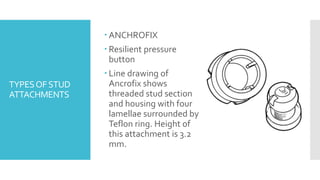
 ANCHROFIX
 Resilient pressure
button
 Line drawing of
Ancrofix shows
threaded stud section
and housing with four
lamellae surrounded by
Teflon ring. Height of
this attachment is 3.2
mm.
Baer F. G. (European).
• it is a small stud attachment (2.2mm high), has an integral post and
solder base. The housing has two horizontally opposing lamellae with a
PVC (polyvinyl chloride) ring to assure operation; the lamellae provide
adjustable friction grip retention.
Biaggi (European).
The Biaggi attachment is similar to the Baer series. The male component
consists of a solder base with an adjustable split ball.There is a spacing
ring for tissue resiliency. The female housing has two adjustable
horizontal lamellae (split ring) that thread into the female housing. The
movement is vertical, and rotational movement is available. The overall
height of the attachment is 3.4 mm.
BONA BALL ANCHOR
• IT consists of a solder base with a sphere, a spacing ring for mounting, and an
adjustable housing with four asymmetrical spring lamellae that provide the retention.
The lamellae are surrounded by a PVC ring to assure their action.The overall height of
the attachment is 4 mm.
Bona-Ball anchor is an example of a
tissue resilient rotational stud
attachment
The eight asymmetric lamellae provide a softer and more
precise retention than earlier model.
Overall height is 3.3 mm.
DALBO STUD ATTACHMENT
Rigid unit
Ball and socket unit
(Vertical and
rotational movement)
Nylon ring – protects the lamella
  Retention – altering the positions
of free ends of the lamella
ROTHERMAN ECCENTRICATTACHMENT
Button shaped attachment
Patrix – eccentric cylinder
with undercut or groove
Matrix – Clip or clasp arm
Activation : Bending the
clasp arm towards center
Resilient unit
Rigid units
GERBERATTACHMENT
Resilient gerber Rigid gerber
 Largest of the stud unit
 Resilient – spring
controlled vertical plane
 Patrix – threaded post
 Matrix – retention spring and
ring
Disadvantages :
Complex attachment system
Requires more space
Permits little rotation
BAR ATTACHMENTS
Bar can be attached to:-
• Coping or crowns over the vital teeth
• Post coping on endodontically treated teeth
• Screwed down into the coping (implant system)
Types of bar attachments :
Customised bar
Dolder bar
Ackermann’s bar
CM rider bar
Hader bar
Andrews bar
Two groups of bar attachments :
1) Bar units - rigid
2) Bar joints – permits rotation
Round / circular Oval / egg shaped „U‟shaped /
parallel sided bars
Multiple sleeve bar jointsSingle sleeve bar joints
Depending on cross section
BAR JOINTS
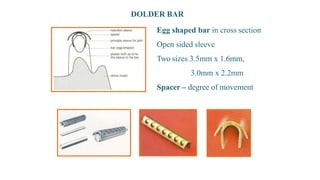
DOLDER BAR
Egg shaped bar in cross section
Open sided sleeve
Two sizes 3.5mm x 1.6mm,
3.0mm x 2.2mm
Spacer – degree of movement
ACKERMANN BAR
Available in different cross
section
Circular cross section – can
be bent in all planes
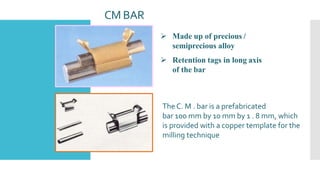
CM BAR
 Made up of precious /
semiprecious alloy
 Retention tags in long axis
of the bar
The C. M . bar is a prefabricated
bar 100 mm by 10 mm by 1 . 8 mm, which
is provided with a copper template for the
milling technique
Advantages of bar attachments :
Rigidly splint the teeth
Provides good retention, stability and support
Provides cross arch stabilization
Positioned close to the alveolar bone (exhibit less leverage)
Disadvantages :
Bulk of bar
Plaque accumulation
Wearing
Soldering procedure
Manual dexterity
DISADVANTAGES
Apart from the increased expense,
the risks are increased technical
demands and difficulties,
particularly when repairs are
required, oral hygiene maintenance
requirements may be more
demanding, and esthetic plus
interarch space concerns are usually
more severe.
LOSSOF
ABUTMENT
TEETH
 SEVERAL STUDIES have shown that After 5 to 6 years,
about 10% of abutment teeth supporting overdentures
were lost.The most frequent causes were periodontal
disease (about70%), caries (about 25%), and
endodontic complications(about 5%).
 Ideally the patient must be well motivated to maintain
the hygienic phase of periodontal care.
 Unfortunately actual “loss of dentures” was more a
problem then loss of abutments.
 Flouride applications are recommended to prevent
caries.
CLINICAL
PROCEDURES
TOOTH SUPPORTED COMPLETE
DENTURE
The important principles of complete
denture construction must be respected
and when required,matched to the
technical and laboratory dictates of
selected attachment type.
One frequently encountered problem of
tooth-supported complete denture
service is the tendency for an unfavorable
gingival response around the abutment
teeth.
1) movement
of the denture base
2) poor oral hygiene with
failure to remove plaque
3)excess space in the prosthesis
around the gingival margins of the
abutment teeth
GINGIVAL INFLAMMATION
TOOTH
SUPPORTED
IMMEDIATE
DENTURE
 The procedures for immediate tooth-supported
complete dentures are identical to those described ,
except that the coronal reduction of the selected
abutment teeth is done at the time the remaining teeth
are extracted.
 The teeth to Be retained are prepared on the master
cast to the approximate shape of the pending
abutment, and the remaining teeth are trimmed from
the cast in the usual manner.
 The endodontic treatment is completed during one or
more appointments before the immediate denture
insertion or just before the combined surgical-
prosthetic appointment.
• The need for refining the impression surface of the denture in the operated
on and abutment sites, by the addition of a treatment resin, is essential
because rapid tissue changes are to be anticipated.
• When healing has occurred and tissues and remodeling bone have achieved a
stable contour, additional coping preparation may be necessary with refitting
of the prosthesis in this area.
SUMMARY
Relatively short-term favorable outcomes with the
overdenture technique are well demonstrated and
endorse routine prescription of the technique.
Furthermore, the recent introduction of the
osseointegration technique created the possibility
of converting patients with maladaptive complete
dentures into ones with adaptive overdentures
when implants are used to stabilize “offending”
prostheses

TOOTH SUPPORTED OVERDENTURES

  • 1.
  • 2.
    INTRODUCTION  In thepast the extraction of entire dentitions with complete denture replacements used to be promoted as an inexpensive and permanent solution for oral health care.  Preventive prosthodontics emphasizes the importance of any procedure that can delay or eliminate future prosthodontic problems.The overdenture is a logical method for the dentist to use preventive prosthodontics.
  • 3.
    SEQUALAE OFACD PATIENT LOSS OF OCCLUSAL STABILITY RESIDUALRIDGE RESORPTION UNDERMINED ESTHETICS IMPAIRED MASTICATION
  • 4.
    NEED FOR OVERDENTURE ???? Reconcilea need for maximum support in morphologically compromised dental arches Equally compromised esthetic appearance resulting from undersupported circumoral tissues
  • 5.
    DEFINITION  An overdentureis defined as a removable prosthesis that covers the entire occlusal surface of root or implant (preiskel 1 edition)
  • 6.
    MORE RESIDUAL RIDGE INTEGRITY MOREDENTURE STABILITYAND RETENTION RETAINED “NATURAL FEELING” SIMPLEALTERNATIVE ADVANTAGES
  • 7.
    Disadvantages Depends on patientsoral hygiene comittments. Extensive abutment design modifications required in inadequate interarch space. Increases cost in the patients with compromised periodontal heath of the abutments. It is considered as a time dependent transition to complete denture therapy.
  • 8.
    INDICATIONS GROUP 1 GROUP2 • Few remaining teeth that may be healthy or reversible periodontal diseases. • Minimal prosthodontic intervention is required. • Mutilated or severly compromised dentitions. • Heading in edentulous direction. • Selective extraction required.
  • 9.
  • 10.
    PERIODONTAL STATUS  Should havehealthy periodontal tissues, if not rendered by appropriate PDL therapy.  Slight tooth mobility is not a contraindication.  A circumferential band of attached gingiva, albeit a narrow one is regarded as a mandatory requirement for abutment selection.
  • 11.
    ABUTMENTSELECTION IN mandible caninesand premolars are best overdenture abutments In maxilla incisors are frequently used.
  • 12.
    Maxillary teeth advantagesDisadvantages • CENTRAL INCISORS • LATERAL INCISORS  Ideal location, provide protection to premaxilla.  Widely separated, facilitating Diminished root surface area plaque control.  Tissue undercuts do not pose a problem.  Path of placement/removal is not compromised.  Ability to create a flange/ peripheral seal. × Proximity and alveolar prominence may complicate utilization. × Diminished root surface area.
  • 13.
    • CANINES Longest root of the anterior teeth. × Diverging facial tissue undercuts × Overcontoured flanges × Excessive lip support × Potentially uncomfortable placement/removal of prosthesis × Complicates placement of prosthetic teeth × compromise the peripheral seal From Nelson DR, von Gonten AS: Biomechanical and esthetic considerations for maxillary anterior overdenture abutment selection, J Prosthet Dent 72:133-136, 1994.
  • 14.
    One tooth perquadrant is recommended. If recommendations is exceeded, retained teeth should be preferably not the adjacent ones. or there should be several millimeters of space between the reduced tooth forms. Hammer and anvil concept should be kept in mind.
  • 15.
    ENDODONTIC AND PROSTHODONTIC STATUS Anterior single rootedteeth are easier and less expensive to manage . Recent year cast copings are eclipsed by composite and alloy restorations. The clinical crowns can be modified for technical convenience and treated with sealant restorations or fluoride applications.
  • 16.
    METHODOFABUTMENT PREPARATION It isour impression that the essential feature in this technique is not the type of attachment used per se but the following basic principles: 1. “Bare tooth”:-Maximum reduction of the coronal portion of the tooth should be accomplished.  Patients with advanced pulpal recession can undergo coronal reduction without the need for endodontic treatment.
  • 17.
     This preparationis made when time is needed to evaluate the status of selected abutment teeth and when a patient’s (usually an elderly one’s) general health precludes several dental appointments.  COST effective. 2. “GOLD COPING”:- a gold coping is necessary and can be prepared with or without a post or retentive pins, depending on the amount of tooth structure remaining above the gingival attachment.
  • 18.
     The goldcoping does involve an additional expense, but some patients are uncomfortable with the sight of discolored and “unprotected” roots in their mouth.  The patient’s susceptibility to caries must also be considered .  Tooth preparation is similar to that for a complete gold crown,with or without additional pin retention, and it includes a combination of shoulder and chamfered gingival margins as dictated by the amount of residual tooth structure.
  • 19.
    3. “Precision-retained abutmentconcept” :-  It is used in RPDs and modified for use with overdenture abutments.  It is a technically ingenious idea and offers a diversity of techniques. The Dalbo Rotex chairside attachment system: male portion cemented in the abutment teeth and female housing embedded in the acrylic of the overdenture
  • 20.
    Ceka-Revax attachment system:the male stud-type attachment is soldered to a coping. Fixation is achieved by the female housing embedded in the (maxillary) overdenture.
  • 21.
    SUPPORT FOR OVERDENTURES  Itis important to realize that the causes of failure inherent in the complete denture prosthesis are not overcome by using attachment fixation.  Failures of the hybrid prosthesis occur not because of the attachments hut because of improper attachment selection and failure of the dentist to develop maximum denture base extension, atmospheric seal, and, for mandibular bases, coverage of the retromolar pad.  Use of the attachment introduces another factor in basic prosthetic design, that is, the demand for an exact attachment-prosthesis relationship.
  • 22.
    TOOTH PREPARATION A B CD E Design of overdenture support preparations. A. Maximum reduction without endodontics, rounded and polished, vertical support only. B.Three to eight millimeters of overdenture is "telescope," vertical and lateral support. C. Double casting "telescope," retention,vertical, and lateral support. D. Residual root with or without endodontics. E. Implant.
  • 23.
    Design of overdenturesupport preparations. A. Maximum reduction, endodontically treated, cemented cast coping retained by pins. B. cemented cast coping. C. Dowel coping with attachment. D. Composite or alloy restored with orientation seat for overdenture. E. Minimal preparation, endodontically treated, rounded, restored with composite or alloy. A B C D E
  • 24.
    IMPRESSION TECHNIQUES  The impressiontechnique and materials vary with personal preference. Elastomeric materials as well as individual compound impressions allow the dentist to choose silverplated or stone dies.  hydrocolloid impressions permit to use only stone dies.  Incorporations of a dowel in an impression can complicate otherwise routine impression procedures .  An alternative method is to make an individual or full impression of preparations, join the dowels to the copings with resin, transfer them,solder the dowels to the copings, and prepare the casts and dowel copings for subsequent attachment positioning and overdenture fabrication .
  • 25.
    LABORATORY PROCEDURES One cause offailure of post coping preparations that carry attachments is the lack of hulk at the attachment-post-coping interphase (right).This causes fracture or opening of the coping. Left drawing illustrates a proper inlay seat that positions coping, prevents rotation, and provides necessary bulk.
  • 26.
    Dowelcopingshould provideagradualgingival bulgetoprotectmarginal gingiva. joint. • The occlusalsurface of the coping is modified to accept the type of attachment used. • The attachments are soldered to the coping after it has been cast and rough finished. • The orientation of most stud and bar attachments is established with a parallelometer. • Generally attachment · orientation in relation to the coping is dictated by the resin tooth position and the buccolingual and occlusogingival space available.
  • 27.
    DOWEL DESIGNS  CUSTOMIZED CASTDOWELS Waxed dowels require bulk for adaptation of the wax pattern and usually are not long enough to provide resistance against dislodgment.  PRE FABRICATED RESIN PATTERNS The prefabricated dowel patterns are provided with a matched set of burs for preparing the dowel space.The cross-sectional strength of a pattern dowel is considerably less than that of a prefabricated metal dowel of the same size,for the metal dowels are drawn from a high-fusing alloy, different than that used for the copings, and do not have the potential porosity and fracture of a cast dowel.
  • 28.
    PRE FABRICATED METALDOWELS • The cross-sectional strength of a pattern dowel is considerably less than that of a prefabricated metal dowel of the same size,for the metal dowels are drawn from a h igh-fusingalloy, different than that used for the copings, and do not have the potential porosity and fracture of a cast dowel. THREADED DOWELS • Threaded dowels provide mechanical fixation inaddition to cementation .TheVK and Kurer systems offer excellent retention with the threading. • A disadvantage with this type of dowel is that the tooth can be fractured during final cementation by using too large a screw for the cross section of the tooth. DOWEL SYSTEMS • MOOSER SYSTEMS • SCHENKER STEP PIVOT • VK SCREW • KURERSCREW • WHALEDENT PARAPOST • PARAKELCI KIT
  • 29.
    ATTACHMENTS Coronal 1. Intracoronal attachments 2.Extracoronal attachments Raclicular 3.Telescope stud attachments 4. Bar attachments  Joints  Units 5. Auxiliary attachments • Screw units • Pawl ,Connectors • Bolts • Stabilizers/balancers • Interlocks • Pins/screws • Rests . • Groups 3 through 5 are primarily related to the overdenture service
  • 31.
    TYPES  RESILIENT STUDS act as a safety valve for any overload situation.  No two resilient attachment systems should oppose each other  No attempt should be made at equilibrating or establishing permanent records or relining procedures without locking the resilient attachments.  NON RESEILIENT STUDS  The nonresilient stud attachments are used when Interocclusal SPACE IS limited.They should be used when the teeth are stable or when the dentist does not desire movement or potential movement of the overdenture
  • 32.
    TYPESOFSTUD ATTACHMENTS  ANCHROFIX  Resilientpressure button  Line drawing of Ancrofix shows threaded stud section and housing with four lamellae surrounded by Teflon ring. Height of this attachment is 3.2 mm.
  • 33.
    Baer F. G.(European). • it is a small stud attachment (2.2mm high), has an integral post and solder base. The housing has two horizontally opposing lamellae with a PVC (polyvinyl chloride) ring to assure operation; the lamellae provide adjustable friction grip retention. Biaggi (European). The Biaggi attachment is similar to the Baer series. The male component consists of a solder base with an adjustable split ball.There is a spacing ring for tissue resiliency. The female housing has two adjustable horizontal lamellae (split ring) that thread into the female housing. The movement is vertical, and rotational movement is available. The overall height of the attachment is 3.4 mm.
  • 34.
    BONA BALL ANCHOR •IT consists of a solder base with a sphere, a spacing ring for mounting, and an adjustable housing with four asymmetrical spring lamellae that provide the retention. The lamellae are surrounded by a PVC ring to assure their action.The overall height of the attachment is 4 mm. Bona-Ball anchor is an example of a tissue resilient rotational stud attachment The eight asymmetric lamellae provide a softer and more precise retention than earlier model. Overall height is 3.3 mm.
  • 35.
    DALBO STUD ATTACHMENT Rigidunit Ball and socket unit (Vertical and rotational movement) Nylon ring – protects the lamella   Retention – altering the positions of free ends of the lamella
  • 36.
    ROTHERMAN ECCENTRICATTACHMENT Button shapedattachment Patrix – eccentric cylinder with undercut or groove Matrix – Clip or clasp arm Activation : Bending the clasp arm towards center Resilient unit Rigid units
  • 37.
    GERBERATTACHMENT Resilient gerber Rigidgerber  Largest of the stud unit  Resilient – spring controlled vertical plane  Patrix – threaded post  Matrix – retention spring and ring Disadvantages : Complex attachment system Requires more space Permits little rotation
  • 39.
    BAR ATTACHMENTS Bar canbe attached to:- • Coping or crowns over the vital teeth • Post coping on endodontically treated teeth • Screwed down into the coping (implant system) Types of bar attachments : Customised bar Dolder bar Ackermann’s bar CM rider bar Hader bar Andrews bar
  • 40.
    Two groups ofbar attachments : 1) Bar units - rigid 2) Bar joints – permits rotation Round / circular Oval / egg shaped „U‟shaped / parallel sided bars Multiple sleeve bar jointsSingle sleeve bar joints Depending on cross section BAR JOINTS
  • 41.
    DOLDER BAR Egg shapedbar in cross section Open sided sleeve Two sizes 3.5mm x 1.6mm, 3.0mm x 2.2mm Spacer – degree of movement
  • 42.
    ACKERMANN BAR Available indifferent cross section Circular cross section – can be bent in all planes
  • 43.
    CM BAR  Madeup of precious / semiprecious alloy  Retention tags in long axis of the bar The C. M . bar is a prefabricated bar 100 mm by 10 mm by 1 . 8 mm, which is provided with a copper template for the milling technique
  • 44.
    Advantages of barattachments : Rigidly splint the teeth Provides good retention, stability and support Provides cross arch stabilization Positioned close to the alveolar bone (exhibit less leverage) Disadvantages : Bulk of bar Plaque accumulation Wearing Soldering procedure Manual dexterity
  • 45.
    DISADVANTAGES Apart from theincreased expense, the risks are increased technical demands and difficulties, particularly when repairs are required, oral hygiene maintenance requirements may be more demanding, and esthetic plus interarch space concerns are usually more severe.
  • 46.
    LOSSOF ABUTMENT TEETH  SEVERAL STUDIEShave shown that After 5 to 6 years, about 10% of abutment teeth supporting overdentures were lost.The most frequent causes were periodontal disease (about70%), caries (about 25%), and endodontic complications(about 5%).  Ideally the patient must be well motivated to maintain the hygienic phase of periodontal care.  Unfortunately actual “loss of dentures” was more a problem then loss of abutments.  Flouride applications are recommended to prevent caries.
  • 47.
    CLINICAL PROCEDURES TOOTH SUPPORTED COMPLETE DENTURE Theimportant principles of complete denture construction must be respected and when required,matched to the technical and laboratory dictates of selected attachment type. One frequently encountered problem of tooth-supported complete denture service is the tendency for an unfavorable gingival response around the abutment teeth.
  • 48.
    1) movement of thedenture base 2) poor oral hygiene with failure to remove plaque 3)excess space in the prosthesis around the gingival margins of the abutment teeth GINGIVAL INFLAMMATION
  • 49.
    TOOTH SUPPORTED IMMEDIATE DENTURE  The proceduresfor immediate tooth-supported complete dentures are identical to those described , except that the coronal reduction of the selected abutment teeth is done at the time the remaining teeth are extracted.  The teeth to Be retained are prepared on the master cast to the approximate shape of the pending abutment, and the remaining teeth are trimmed from the cast in the usual manner.  The endodontic treatment is completed during one or more appointments before the immediate denture insertion or just before the combined surgical- prosthetic appointment.
  • 50.
    • The needfor refining the impression surface of the denture in the operated on and abutment sites, by the addition of a treatment resin, is essential because rapid tissue changes are to be anticipated. • When healing has occurred and tissues and remodeling bone have achieved a stable contour, additional coping preparation may be necessary with refitting of the prosthesis in this area.
  • 51.
    SUMMARY Relatively short-term favorableoutcomes with the overdenture technique are well demonstrated and endorse routine prescription of the technique. Furthermore, the recent introduction of the osseointegration technique created the possibility of converting patients with maladaptive complete dentures into ones with adaptive overdentures when implants are used to stabilize “offending” prostheses