PARTS OF FIXED
PARTIAL DENTURE
Presented by:
Iqra Saman
GI5592(Batch 2k14)
Under the guidance of:
Dr. Pankaj Kharade
CONTENTS
• DEFINITION OF FPD
• COMPONENTS OF FPD
• RETAINER- Classification
-Criteria for Selection
• PONTIC - Ideal Requirements
-Classification
• CONNECTOR-Types
-Indication
• CONCLUSION
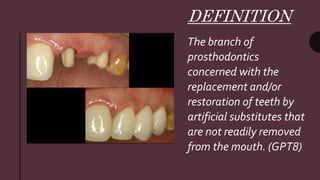
DEFINITION
The branch of
prosthodontics
concerned with the
replacement and/or
restoration of teeth by
artificial substitutes that
are not readily removed
from the mouth. (GPT8)
COMPONENTS
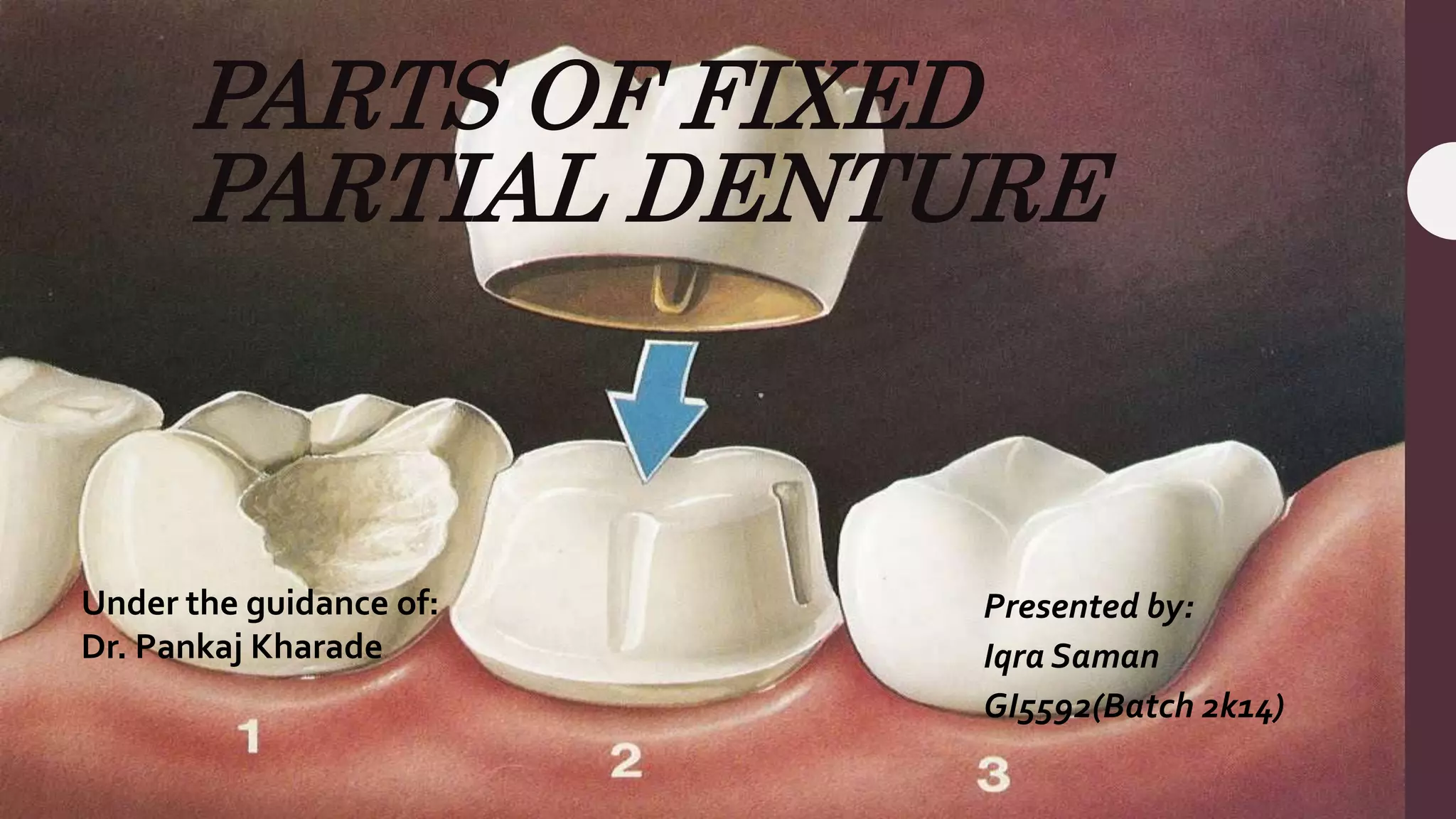
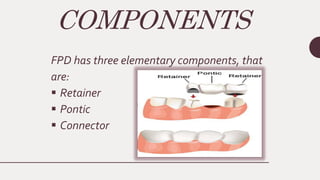
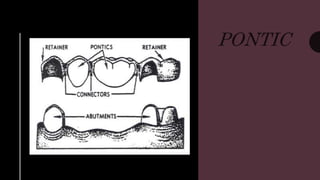
FPD has three elementary components, that
are:
 Retainer
 Pontic
 Connector
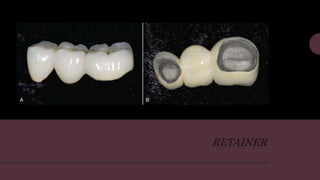
Retainer: The part of a fixed dental prosthesis that unites
the abutment(s) to the remainder of the restoration.
(GPT8)
Pontic: An artificial tooth on a fixed dental prosthesis
that replaces a missing natural tooth, restores its
function,and usually fills the space previously occupied by
the clinical crown.
Connector: The portion of a fixed dental prosthesis that
unites the retainer(s) and pontic(s).
RETAINER
Classification
A. Amount of tooth coverage
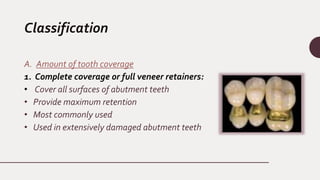
1. Complete coverage or full veneer retainers:
• Cover all surfaces of abutment teeth
• Provide maximum retention
• Most commonly used
• Used in extensively damaged abutment teeth
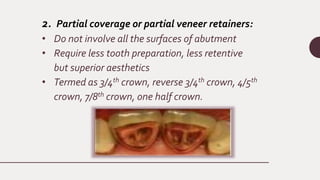
2. Partial coverage or partial veneer retainers:
• Do not involve all the surfaces of abutment
• Require less tooth preparation, less retentive
but superior aesthetics
• Termed as 3/4th crown, reverse 3/4th crown, 4/5th
crown, 7/8th crown, one half crown.
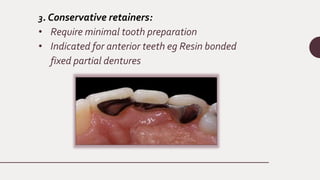
3. Conservative retainers:
• Require minimal tooth preparation
• Indicated for anterior teeth eg Resin bonded
fixed partial dentures
B. Mechanism of Retention
1. Extracoronal retainer:
• Retention from external surfaces of coronal part of abutment
teeth. Eg Full and partial veneer crowns
2. Intracoronal retainers:
• Retention from within the coronal tooth structure.
Eg Inlays, Onlays
3. Radicular retainers:
• Obtain retention from within the root of the
abutment.
• Eg Posts
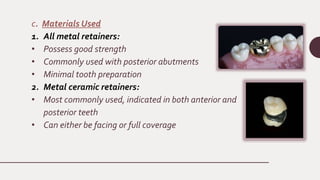
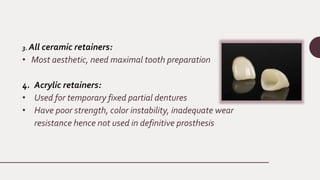
C. Materials Used
1. All metal retainers:
• Possess good strength
• Commonly used with posterior abutments
• Minimal tooth preparation
2. Metal ceramic retainers:
• Most commonly used, indicated in both anterior and
posterior teeth
• Can either be facing or full coverage
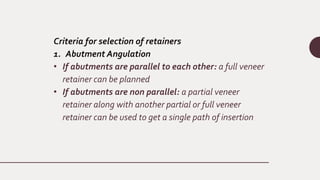
3. All ceramic retainers:
• Most aesthetic, need maximal tooth preparation
4. Acrylic retainers:
• Used for temporary fixed partial dentures
• Have poor strength, color instability, inadequate wear
resistance hence not used in definitive prosthesis
Criteria for selection of retainers
1. Abutment Angulation
• If abutments are parallel to each other: a full veneer
retainer can be planned
• If abutments are non parallel: a partial veneer
retainer along with another partial or full veneer
retainer can be used to get a single path of insertion
2. Condition of the Abutment
 Good health- partial veneer treatment option
 Endodontically treated or extensively damaged- full
veneer retainer recommended
 Periodontically weak- conservative resin bonded
retainers indicated
3. Asthetics
 Type of pontic
 In case of inadequate pontic space, a full veneer
retainer can help better in managing the space to get
better aesthetics.

4. Retention
 Molars and premolars exert more force- requires more
retention.
 More coverage- more retention- more life span.
5.Cost
 Full veneer all ceramic retainers are more expensive.
6. Preservation OfTooth structure.
 Partial veneer preparations more conservative.
 The buccal/facial surface should be preserved for
natural aesthetics.
Choice should be depending upon all the factors so
that the longevity of the prosthesis is no compromised.
PONTIC
IDEAL REQUIREMENTS
1. Restore function of replaced tooth
2. Provide aesthetic and comfort
3. Biologically acceptable
4. Oral hygiene
5. Preserve underlying ridge and mucosa
6. Adequate strength
CLASSIFICATION
I. Mucosal contact-With mucosal contact
-Ridge lap or saddle pontic
-Modified ridge lap
-Ovate pontic
-Conical pontic
-Without Mucosal Contact
-Sanitary/Hygienic pontic
-Modified sanitary/ Perel
II. Materials Used- All Metal Pontic
-All Ceramic Pontic
-Metal-Ceramic Pontic
-Metal with resin facing Pontic
-Fibre reinforced Composite Pontic
III. Method Of Fabrication- Custom made Pontics
-Prefabricated Pontic
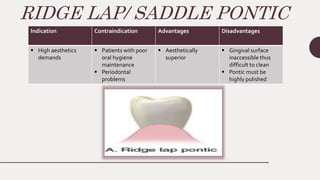
RIDGE LAP/ SADDLE PONTIC
Indication Contraindication Advantages Disadvantages
 High aesthetics
demands
 Patients with poor
oral hygiene
maintenance
 Periodontal
problems
 Aesthetically
superior
 Gingival surface
inaccessible thus
difficult to clean
 Pontic must be
highly polished
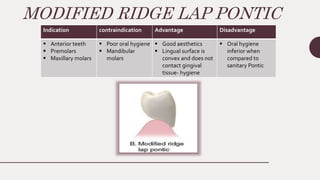
MODIFIED RIDGE LAP PONTIC
Indication contraindication Advantage Disadvantage
 Anterior teeth
 Premolars
 Maxillary molars
 Poor oral hygiene
 Mandibular
molars
 Good aesthetics
 Lingual surface is
convex and does not
contact gingival
tissue- hygiene
 Oral hygiene
inferior when
compared to
sanitary Pontic
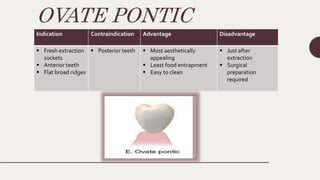
OVATE PONTIC
Indication Contraindication Advantage Disadvantage
 Fresh extraction
sockets
 Anterior teeth
 Flat broad ridges
 Posterior teeth  Most aesthetically
appealing
 Least food entrapment
 Easy to clean
 Just after
extraction
 Surgical
preparation
required
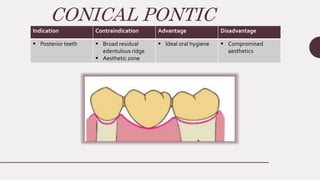
CONICAL PONTIC
Indication Contraindication Advantage Disadvantage
 Posterior teeth  Broad residual
edentulous ridge
 Aesthetic zone
 Ideal oral hygiene  Compromised
aesthetics
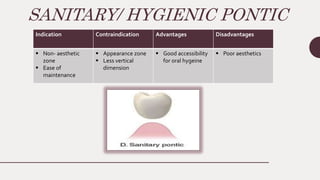
SANITARY/ HYGIENIC PONTIC
Indication Contraindication Advantages Disadvantages
 Non- aesthetic
zone
 Ease of
maintenance
 Appearance zone
 Less vertical
dimension
 Good accessibility
for oral hygeine
 Poor aesthetics
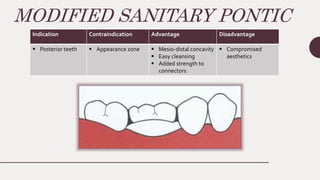
MODIFIED SANITARY PONTIC
Indication Contraindication Advantage Disadvantage
 Posterior teeth  Appearance zone  Mesio-distal concavity
 Easy cleansing
 Added strength to
connectors
 Compromised
aesthetics
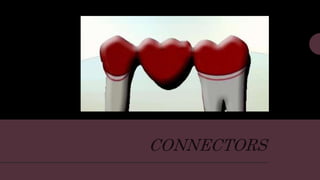
CONNECTORS
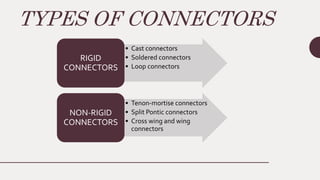
TYPES OF CONNECTORS
• Cast connectors
• Soldered connectors
• Loop connectors
RIGID
CONNECTORS
• Tenon-mortise connectors
• Split Pontic connectors
• Cross wing and wing
connectors
NON-RIGID
CONNECTORS
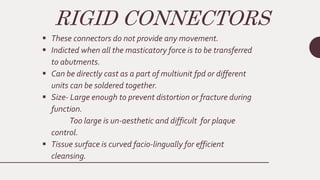
RIGID CONNECTORS
 These connectors do not provide any movement.
 Indicted when all the masticatory force is to be transferred
to abutments.
 Can be directly cast as a part of multiunit fpd or different
units can be soldered together.
 Size- Large enough to prevent distortion or fracture during
function.
Too large is un-aesthetic and difficult for plaque
control.
 Tissue surface is curved facio-lingually for efficient
cleansing.
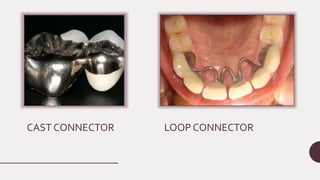
CAST CONNECTOR LOOP CONNECTOR
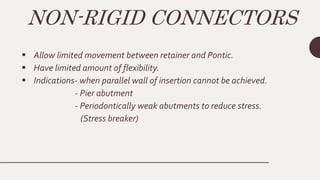
NON-RIGID CONNECTORS
 Allow limited movement between retainer and Pontic.
 Have limited amount of flexibility.
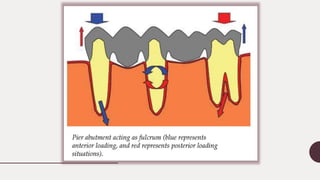
 Indications- when parallel wall of insertion cannot be achieved.
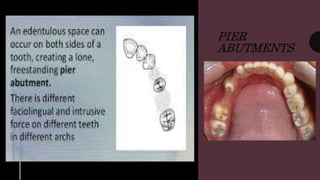
- Pier abutment
- Periodontically weak abutments to reduce stress.
(Stress breaker)
PIER
ABUTMENTS
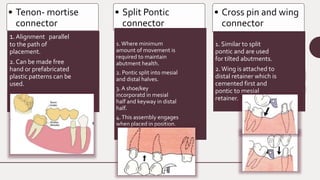
• Tenon- mortise
connector
1. Alignment parallel
to the path of
placement.
2. Can be made free
hand or prefabricated
plastic patterns can be
used.
• Split Pontic
connector
1.Where minimum
amount of movement is
required to maintain
abutment health.
2. Pontic split into mesial
and distal halves.
3. A shoe/key
incorporatd in mesial
half and keyway in distal
half.
4.This assembly engages
when placed in position.
• Cross pin and wing
connector
1. Similar to split
pontic and are used
for tilted abutments.
2.Wing is attached to
distal retainer which is
cemented first and
pontic to mesial
retainer.
CONCLUSION
Components of FPD need to be designed in harmony
with all the principles and fulfilling all the requirements
of each part.
After a thorough examination, the type of prosthesis is
determined such that it has a long term favourable
prognosis.
THANK YOU!

Parts of fixed partial denture

  • 1.
    PARTS OF FIXED PARTIALDENTURE Presented by: Iqra Saman GI5592(Batch 2k14) Under the guidance of: Dr. Pankaj Kharade
  • 2.
    CONTENTS • DEFINITION OFFPD • COMPONENTS OF FPD • RETAINER- Classification -Criteria for Selection • PONTIC - Ideal Requirements -Classification • CONNECTOR-Types -Indication • CONCLUSION
  • 3.
    DEFINITION The branch of prosthodontics concernedwith the replacement and/or restoration of teeth by artificial substitutes that are not readily removed from the mouth. (GPT8)
  • 4.
    COMPONENTS FPD has threeelementary components, that are:  Retainer  Pontic  Connector
  • 5.
    Retainer: The partof a fixed dental prosthesis that unites the abutment(s) to the remainder of the restoration. (GPT8) Pontic: An artificial tooth on a fixed dental prosthesis that replaces a missing natural tooth, restores its function,and usually fills the space previously occupied by the clinical crown. Connector: The portion of a fixed dental prosthesis that unites the retainer(s) and pontic(s).
  • 6.
  • 7.
    Classification A. Amount oftooth coverage 1. Complete coverage or full veneer retainers: • Cover all surfaces of abutment teeth • Provide maximum retention • Most commonly used • Used in extensively damaged abutment teeth
  • 8.
    2. Partial coverageor partial veneer retainers: • Do not involve all the surfaces of abutment • Require less tooth preparation, less retentive but superior aesthetics • Termed as 3/4th crown, reverse 3/4th crown, 4/5th crown, 7/8th crown, one half crown.
  • 9.
    3. Conservative retainers: •Require minimal tooth preparation • Indicated for anterior teeth eg Resin bonded fixed partial dentures
  • 10.
    B. Mechanism ofRetention 1. Extracoronal retainer: • Retention from external surfaces of coronal part of abutment teeth. Eg Full and partial veneer crowns 2. Intracoronal retainers: • Retention from within the coronal tooth structure. Eg Inlays, Onlays
  • 11.
    3. Radicular retainers: •Obtain retention from within the root of the abutment. • Eg Posts
  • 12.
    C. Materials Used 1.All metal retainers: • Possess good strength • Commonly used with posterior abutments • Minimal tooth preparation 2. Metal ceramic retainers: • Most commonly used, indicated in both anterior and posterior teeth • Can either be facing or full coverage
  • 13.
    3. All ceramicretainers: • Most aesthetic, need maximal tooth preparation 4. Acrylic retainers: • Used for temporary fixed partial dentures • Have poor strength, color instability, inadequate wear resistance hence not used in definitive prosthesis
  • 14.
    Criteria for selectionof retainers 1. Abutment Angulation • If abutments are parallel to each other: a full veneer retainer can be planned • If abutments are non parallel: a partial veneer retainer along with another partial or full veneer retainer can be used to get a single path of insertion
  • 15.
    2. Condition ofthe Abutment  Good health- partial veneer treatment option  Endodontically treated or extensively damaged- full veneer retainer recommended  Periodontically weak- conservative resin bonded retainers indicated
  • 16.
    3. Asthetics  Typeof pontic  In case of inadequate pontic space, a full veneer retainer can help better in managing the space to get better aesthetics. 4. Retention  Molars and premolars exert more force- requires more retention.  More coverage- more retention- more life span. 5.Cost  Full veneer all ceramic retainers are more expensive.
  • 17.
    6. Preservation OfToothstructure.  Partial veneer preparations more conservative.  The buccal/facial surface should be preserved for natural aesthetics. Choice should be depending upon all the factors so that the longevity of the prosthesis is no compromised.
  • 18.
  • 19.
    IDEAL REQUIREMENTS 1. Restorefunction of replaced tooth 2. Provide aesthetic and comfort 3. Biologically acceptable 4. Oral hygiene 5. Preserve underlying ridge and mucosa 6. Adequate strength
  • 20.
    CLASSIFICATION I. Mucosal contact-Withmucosal contact -Ridge lap or saddle pontic -Modified ridge lap -Ovate pontic -Conical pontic -Without Mucosal Contact -Sanitary/Hygienic pontic -Modified sanitary/ Perel
  • 21.
    II. Materials Used-All Metal Pontic -All Ceramic Pontic -Metal-Ceramic Pontic -Metal with resin facing Pontic -Fibre reinforced Composite Pontic III. Method Of Fabrication- Custom made Pontics -Prefabricated Pontic
  • 22.
    RIDGE LAP/ SADDLEPONTIC Indication Contraindication Advantages Disadvantages  High aesthetics demands  Patients with poor oral hygiene maintenance  Periodontal problems  Aesthetically superior  Gingival surface inaccessible thus difficult to clean  Pontic must be highly polished
  • 23.
    MODIFIED RIDGE LAPPONTIC Indication contraindication Advantage Disadvantage  Anterior teeth  Premolars  Maxillary molars  Poor oral hygiene  Mandibular molars  Good aesthetics  Lingual surface is convex and does not contact gingival tissue- hygiene  Oral hygiene inferior when compared to sanitary Pontic
  • 24.
    OVATE PONTIC Indication ContraindicationAdvantage Disadvantage  Fresh extraction sockets  Anterior teeth  Flat broad ridges  Posterior teeth  Most aesthetically appealing  Least food entrapment  Easy to clean  Just after extraction  Surgical preparation required
  • 25.
    CONICAL PONTIC Indication ContraindicationAdvantage Disadvantage  Posterior teeth  Broad residual edentulous ridge  Aesthetic zone  Ideal oral hygiene  Compromised aesthetics
  • 26.
    SANITARY/ HYGIENIC PONTIC IndicationContraindication Advantages Disadvantages  Non- aesthetic zone  Ease of maintenance  Appearance zone  Less vertical dimension  Good accessibility for oral hygeine  Poor aesthetics
  • 27.
    MODIFIED SANITARY PONTIC IndicationContraindication Advantage Disadvantage  Posterior teeth  Appearance zone  Mesio-distal concavity  Easy cleansing  Added strength to connectors  Compromised aesthetics
  • 28.
  • 29.
    TYPES OF CONNECTORS •Cast connectors • Soldered connectors • Loop connectors RIGID CONNECTORS • Tenon-mortise connectors • Split Pontic connectors • Cross wing and wing connectors NON-RIGID CONNECTORS
  • 30.
    RIGID CONNECTORS  Theseconnectors do not provide any movement.  Indicted when all the masticatory force is to be transferred to abutments.  Can be directly cast as a part of multiunit fpd or different units can be soldered together.  Size- Large enough to prevent distortion or fracture during function. Too large is un-aesthetic and difficult for plaque control.  Tissue surface is curved facio-lingually for efficient cleansing.
  • 31.
  • 32.
    NON-RIGID CONNECTORS  Allowlimited movement between retainer and Pontic.  Have limited amount of flexibility.  Indications- when parallel wall of insertion cannot be achieved. - Pier abutment - Periodontically weak abutments to reduce stress. (Stress breaker)
  • 33.
  • 35.
    • Tenon- mortise connector 1.Alignment parallel to the path of placement. 2. Can be made free hand or prefabricated plastic patterns can be used. • Split Pontic connector 1.Where minimum amount of movement is required to maintain abutment health. 2. Pontic split into mesial and distal halves. 3. A shoe/key incorporatd in mesial half and keyway in distal half. 4.This assembly engages when placed in position. • Cross pin and wing connector 1. Similar to split pontic and are used for tilted abutments. 2.Wing is attached to distal retainer which is cemented first and pontic to mesial retainer.
  • 36.
    CONCLUSION Components of FPDneed to be designed in harmony with all the principles and fulfilling all the requirements of each part. After a thorough examination, the type of prosthesis is determined such that it has a long term favourable prognosis.
  • 37.