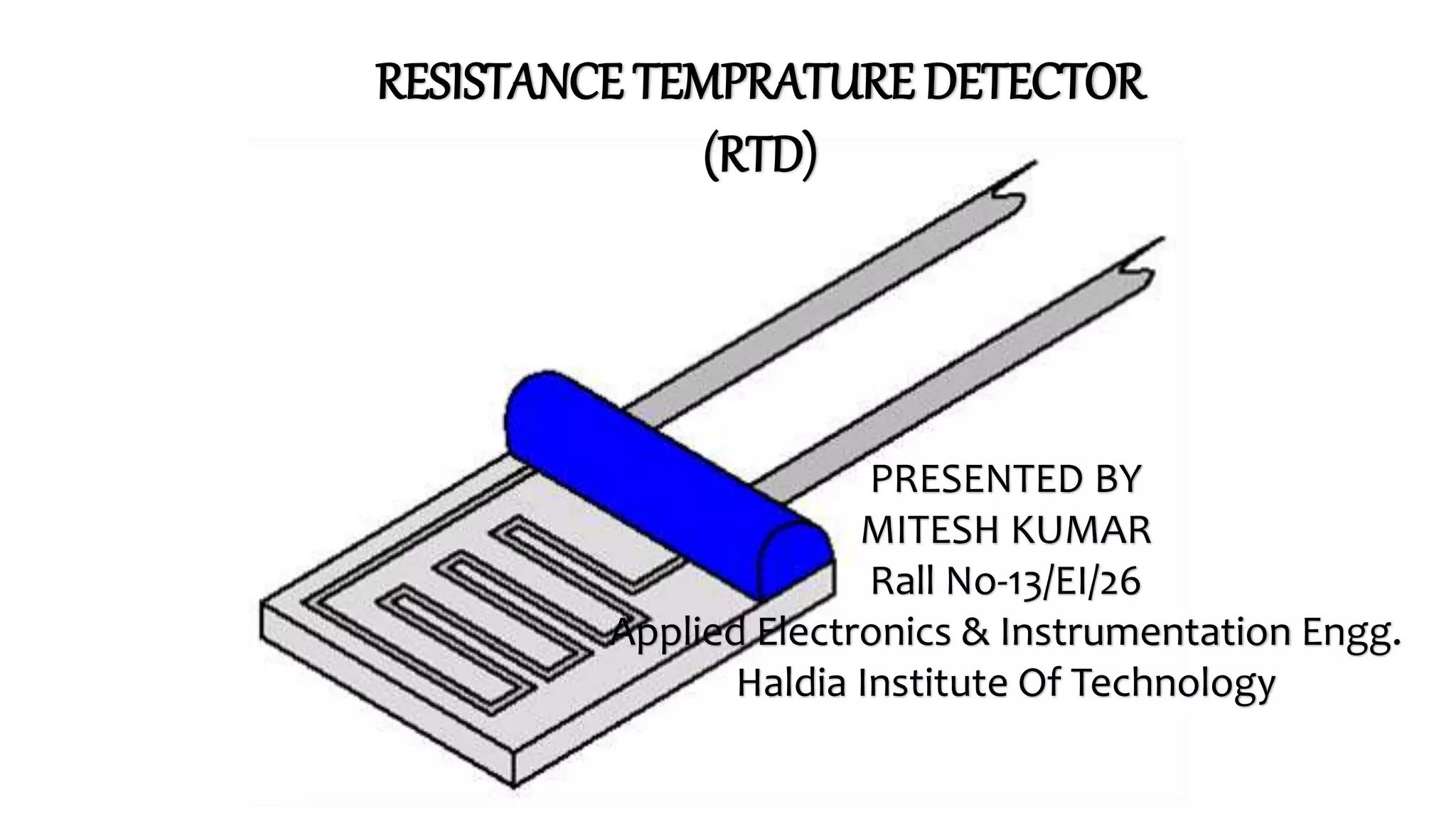
RESISTANCE TEMPRATURE DETECTOR
(RTD)
PRESENTED BY
MITESH KUMAR
Rall No-13/EI/26
Applied Electronics & Instrumentation Engg.
Haldia Institute Of Technology
INTRODUCTION
 CONSTRUCTION
 RESISTANCE MATERIALS FOR RTD
 CONFIGURATION
 APPLICATION
 ADVANTAGE
 DISADVANTAGE
 CONCLUSION
 REFERENCE
CONTENT
Resistance thermometers, also called resistance temperature detectors (RTDs), are sensors used to
measure temperature by correlating the resistance of the RTD element with temperature. Most RTD
elements consist of a length of fine coiled wire wrapped around a ceramic or glass core. The element is
usually quite fragile, so it is often placed inside a sheathed probe to protect it. The RTD element is made
from a pure material, typically platinum, nickel or copper. The material has a predictable change in
resistance as the temperature changes and it is this predictable change that is used to determine
temperature.
WHAT IS RTD?????
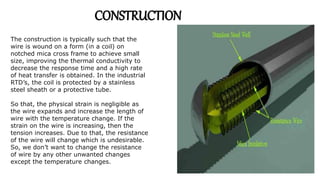
The construction is typically such that the
wire is wound on a form (in a coil) on
notched mica cross frame to achieve small
size, improving the thermal conductivity to
decrease the response time and a high rate
of heat transfer is obtained. In the industrial
RTD’s, the coil is protected by a stainless
steel sheath or a protective tube.
So that, the physical strain is negligible as
the wire expands and increase the length of
wire with the temperature change. If the
strain on the wire is increasing, then the
tension increases. Due to that, the resistance
of the wire will change which is undesirable.
So, we don’t want to change the resistance
of wire by any other unwanted changes
except the temperature changes.
CONSTRUCTION
COMMONRESISTANCE MATERIALS FOR
RTD:
1. PLATINUM (most popular and accurate)
2. NICKEL
3. COPPER
4. BALCO(rare)
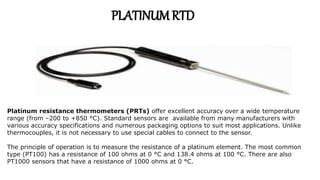
Platinum resistance thermometers (PRTs) offer excellent accuracy over a wide temperature
range (from –200 to +850 °C). Standard sensors are available from many manufacturers with
various accuracy specifications and numerous packaging options to suit most applications. Unlike
thermocouples, it is not necessary to use special cables to connect to the sensor.
The principle of operation is to measure the resistance of a platinum element. The most common
type (PT100) has a resistance of 100 ohms at 0 °C and 138.4 ohms at 100 °C. There are also
PT1000 sensors that have a resistance of 1000 ohms at 0 °C.
PLATINUMRTD
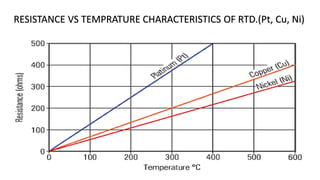
RESISTANCE VS TEMPRATURE CHARACTERISTICS OF RTD.(Pt, Cu, Ni)
If we now consider a four-wire configuration with a 1mA precision current source,[9] we obtain the following relationship between temperature and
measured voltage
TEMPRATURE AND RESISTANCE RELATIONSHIP
Here , R(t) is the resistance at temperature T,R(o) is the resistance at 0 °C, and the constants (for an alpha=0.00385 platinum
RTD) are
Since the B and C coefficients are relatively small, the resistance changes almost linearly with the temperature.
For positive temperature, if we resolve the quadratic equation we obtain the following relationship between temperature and
resistance:
The relation between temperature and resistance is given by the Callendar-Van Dusen- equation.
2-WIRE RTD(CONFIGuRATION)
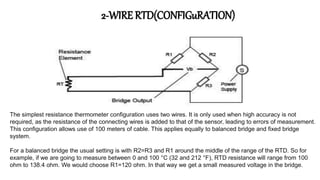
The simplest resistance thermometer configuration uses two wires. It is only used when high accuracy is not
required, as the resistance of the connecting wires is added to that of the sensor, leading to errors of measurement.
This configuration allows use of 100 meters of cable. This applies equally to balanced bridge and fixed bridge
system.
For a balanced bridge the usual setting is with R2=R3 and R1 around the middle of the range of the RTD. So for
example, if we are going to measure between 0 and 100 °C (32 and 212 °F), RTD resistance will range from 100
ohm to 138.4 ohm. We would choose R1=120 ohm. In that way we get a small measured voltage in the bridge.
3-WIRE RTD
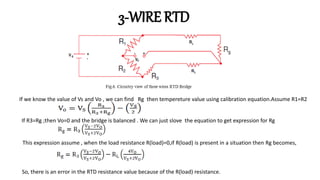
If we know the value of Vs and Vo , we can find Rg then tempereture value using calibration equation.Assume R1=R2
If R3=Rg ;then Vo=0 and the bridge is balanced . We can just slove the equation to get expression for Rg
This expression assume , when the load resistance R(load)=0,if R(load) is present in a situation then Rg becomes,
So, there is an error in the RTD resistance value because of the R(load) resistance.
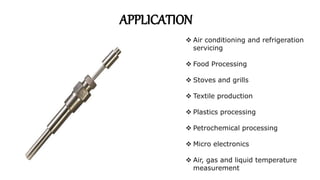
 Air conditioning and refrigeration
servicing
 Food Processing
 Stoves and grills
 Textile production
 Plastics processing
 Petrochemical processing
 Micro electronics
 Air, gas and liquid temperature
measurement
APPLICATION
Very high accuracy
Excellent stability
Interchangeable sensors
No drift
Ability to measure narrow spans
Suitability for remote measurement
Advantages
Low sensitivity
Higher cost than thermocouples
No point sensing
Affected by shock and vibration
Requires three or four-wire operation
DISADVANTAGES
CONCLUSION
RTD is most liner ,most accurate temperature sensors to measure temperature.
Right from the stoves and grills to the gain time Petrochemical processing industry ,
RTD sensors are used everywhere.
The worthiness of RTD far outweigh its disadvantage and this in turn
makes it a boon.
REFERENCE
 https://www.google.co.in/url?sa=t&rct=j&q=&esrc=s&source=web&cd=5&cad=rja&uact=8&ved=0ahUKEwjP2ZHsoqrMAhVIG
44KHYcxC58QFgg2MAQ&url=http%3A%2F%2Fwww.omega.com%2Fprodinfo%2Frtd.html&usg=AFQjCNHejCbJQ2n-yU-
2erDSSherIJ8F6w&sig2=idHtZePthjJGOxMK_GtvqA
 https://www.google.co.in/url?sa=t&rct=j&q=&esrc=s&source=web&cd=6&cad=rja&uact=8&ved=0ahUKEwjP2ZHsoqrMAhVIG44
KHYcxC58QFgg9MAU&url=http%3A%2F%2Fwww.omega.com%2Ftemperature%2Fpdf%2Frtd_gen_specs_ref.pdf&usg=AFQjCNE
u4PaDriKgKPbAxMWcpbLRkbQiZQ&sig2=B7o13K01t372PnLFKDZU5g
Resistance Temperature Detector By Mitesh Kumar

Resistance Temperature Detector By Mitesh Kumar

  • 1.
    RESISTANCE TEMPRATURE DETECTOR (RTD) PRESENTEDBY MITESH KUMAR Rall No-13/EI/26 Applied Electronics & Instrumentation Engg. Haldia Institute Of Technology
  • 2.
    INTRODUCTION  CONSTRUCTION  RESISTANCEMATERIALS FOR RTD  CONFIGURATION  APPLICATION  ADVANTAGE  DISADVANTAGE  CONCLUSION  REFERENCE CONTENT
  • 3.
    Resistance thermometers, alsocalled resistance temperature detectors (RTDs), are sensors used to measure temperature by correlating the resistance of the RTD element with temperature. Most RTD elements consist of a length of fine coiled wire wrapped around a ceramic or glass core. The element is usually quite fragile, so it is often placed inside a sheathed probe to protect it. The RTD element is made from a pure material, typically platinum, nickel or copper. The material has a predictable change in resistance as the temperature changes and it is this predictable change that is used to determine temperature. WHAT IS RTD?????
  • 4.
    The construction istypically such that the wire is wound on a form (in a coil) on notched mica cross frame to achieve small size, improving the thermal conductivity to decrease the response time and a high rate of heat transfer is obtained. In the industrial RTD’s, the coil is protected by a stainless steel sheath or a protective tube. So that, the physical strain is negligible as the wire expands and increase the length of wire with the temperature change. If the strain on the wire is increasing, then the tension increases. Due to that, the resistance of the wire will change which is undesirable. So, we don’t want to change the resistance of wire by any other unwanted changes except the temperature changes. CONSTRUCTION
  • 5.
    COMMONRESISTANCE MATERIALS FOR RTD: 1.PLATINUM (most popular and accurate) 2. NICKEL 3. COPPER 4. BALCO(rare)
  • 6.
    Platinum resistance thermometers(PRTs) offer excellent accuracy over a wide temperature range (from –200 to +850 °C). Standard sensors are available from many manufacturers with various accuracy specifications and numerous packaging options to suit most applications. Unlike thermocouples, it is not necessary to use special cables to connect to the sensor. The principle of operation is to measure the resistance of a platinum element. The most common type (PT100) has a resistance of 100 ohms at 0 °C and 138.4 ohms at 100 °C. There are also PT1000 sensors that have a resistance of 1000 ohms at 0 °C. PLATINUMRTD
  • 7.
    RESISTANCE VS TEMPRATURECHARACTERISTICS OF RTD.(Pt, Cu, Ni)
  • 8.
    If we nowconsider a four-wire configuration with a 1mA precision current source,[9] we obtain the following relationship between temperature and measured voltage TEMPRATURE AND RESISTANCE RELATIONSHIP Here , R(t) is the resistance at temperature T,R(o) is the resistance at 0 °C, and the constants (for an alpha=0.00385 platinum RTD) are Since the B and C coefficients are relatively small, the resistance changes almost linearly with the temperature. For positive temperature, if we resolve the quadratic equation we obtain the following relationship between temperature and resistance: The relation between temperature and resistance is given by the Callendar-Van Dusen- equation.
  • 9.
    2-WIRE RTD(CONFIGuRATION) The simplestresistance thermometer configuration uses two wires. It is only used when high accuracy is not required, as the resistance of the connecting wires is added to that of the sensor, leading to errors of measurement. This configuration allows use of 100 meters of cable. This applies equally to balanced bridge and fixed bridge system. For a balanced bridge the usual setting is with R2=R3 and R1 around the middle of the range of the RTD. So for example, if we are going to measure between 0 and 100 °C (32 and 212 °F), RTD resistance will range from 100 ohm to 138.4 ohm. We would choose R1=120 ohm. In that way we get a small measured voltage in the bridge.
  • 10.
    3-WIRE RTD If weknow the value of Vs and Vo , we can find Rg then tempereture value using calibration equation.Assume R1=R2 If R3=Rg ;then Vo=0 and the bridge is balanced . We can just slove the equation to get expression for Rg This expression assume , when the load resistance R(load)=0,if R(load) is present in a situation then Rg becomes, So, there is an error in the RTD resistance value because of the R(load) resistance.
  • 11.
     Air conditioningand refrigeration servicing  Food Processing  Stoves and grills  Textile production  Plastics processing  Petrochemical processing  Micro electronics  Air, gas and liquid temperature measurement APPLICATION
  • 12.
    Very high accuracy Excellentstability Interchangeable sensors No drift Ability to measure narrow spans Suitability for remote measurement Advantages
  • 13.
    Low sensitivity Higher costthan thermocouples No point sensing Affected by shock and vibration Requires three or four-wire operation DISADVANTAGES
  • 14.
    CONCLUSION RTD is mostliner ,most accurate temperature sensors to measure temperature. Right from the stoves and grills to the gain time Petrochemical processing industry , RTD sensors are used everywhere. The worthiness of RTD far outweigh its disadvantage and this in turn makes it a boon.
  • 15.