Made by:- Patel Dhrumil R
Introduction
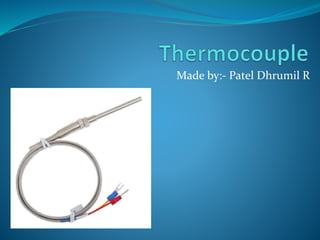
 A thermocouple is an electrical device consisting of two
dissimilar electrical conductors forming electric junction at
differing temperatures. A thermocouple produces a
temperature-dependent voltage as a result of the
thermoelectric effect , and this voltage can be interpreted to
measure temperature. Thermocouples are a widely used type
of temperature sensor.
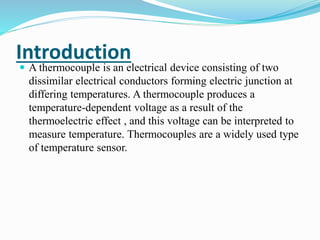
Types of Thermocouple
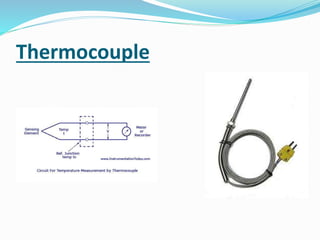
Thermocouple
Working Principal
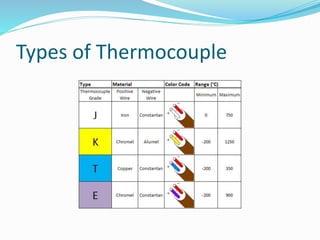
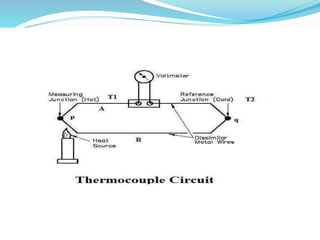
 If two wire of different metals M1 and M2 are joined together
to form a loop (thermocouple) as shown in Fig. with one
junction at temperature T1 and other at temperature T2, an
e.m.f. is generated and if an ammeter is connected , a current
flows in the circuit. This phenomenon is called seeback effect.
The magnitude of emf generated depends on the temperature of
the junction T1 and T2 and the material of M1 and M2. one of
the two junction is usually maintained at some constant known
temperature. The output voltage of the circuit then indicates the
temperature difference relative to the reference temperature .
Normally , the ice point of water(0c) is selected as are
reference junction.
Thermocouple effects
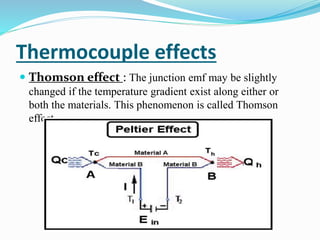
 Peltier effect:
 The temperatures T1 and T2 of junctions slightly
change if the thermoelectric current is allowed to flow
in the circuit.
 Heat is generated at cold junction and is absorbed from
the hot junction thereby heating the cold junction
slightly and cooling the hot junction slightly.
 This phenomenon is called Peltier effect.
 This effect takes place whether the current is
introduced extremely or is induced by the thermocouple
itself.
Thermocouple effects
 Thomson effect : The junction emf may be slightly
changed if the temperature gradient exist along either or
both the materials. This phenomenon is called Thomson
effect.
Application
 Thermocouples are suitable for measuring over a large
temperature range, from −270 up to 3000 °C (for a short time,
in inert atmosphere). Applications include temperature
measurement for kilns, gas turbine exhaust, diesel engines,
other industrial processes and fog machines. They are less
suitable for applications where smaller temperature differences
need to be measured with high accuracy, for example the range
0–100 °C with 0.1 °C accuracy. For such applications
thermistors , silicon bandgap temperature sensors and
resistance thermometers are more suitable.
Thank you

Thermocouple

  • 1.
    Made by:- PatelDhrumil R
  • 2.
    Introduction  A thermocoupleis an electrical device consisting of two dissimilar electrical conductors forming electric junction at differing temperatures. A thermocouple produces a temperature-dependent voltage as a result of the thermoelectric effect , and this voltage can be interpreted to measure temperature. Thermocouples are a widely used type of temperature sensor.
  • 3.
  • 4.
  • 5.
    Working Principal  Iftwo wire of different metals M1 and M2 are joined together to form a loop (thermocouple) as shown in Fig. with one junction at temperature T1 and other at temperature T2, an e.m.f. is generated and if an ammeter is connected , a current flows in the circuit. This phenomenon is called seeback effect. The magnitude of emf generated depends on the temperature of the junction T1 and T2 and the material of M1 and M2. one of the two junction is usually maintained at some constant known temperature. The output voltage of the circuit then indicates the temperature difference relative to the reference temperature . Normally , the ice point of water(0c) is selected as are reference junction.
  • 7.
    Thermocouple effects  Peltiereffect:  The temperatures T1 and T2 of junctions slightly change if the thermoelectric current is allowed to flow in the circuit.  Heat is generated at cold junction and is absorbed from the hot junction thereby heating the cold junction slightly and cooling the hot junction slightly.  This phenomenon is called Peltier effect.  This effect takes place whether the current is introduced extremely or is induced by the thermocouple itself.
  • 8.
    Thermocouple effects  Thomsoneffect : The junction emf may be slightly changed if the temperature gradient exist along either or both the materials. This phenomenon is called Thomson effect.
  • 9.
    Application  Thermocouples aresuitable for measuring over a large temperature range, from −270 up to 3000 °C (for a short time, in inert atmosphere). Applications include temperature measurement for kilns, gas turbine exhaust, diesel engines, other industrial processes and fog machines. They are less suitable for applications where smaller temperature differences need to be measured with high accuracy, for example the range 0–100 °C with 0.1 °C accuracy. For such applications thermistors , silicon bandgap temperature sensors and resistance thermometers are more suitable.
  • 10.