ACTIVE LEARNINGASSIGNMENT PRESENTATION
MECHANICAL MEASUREMENT & METROLOGY (2141901)
TOPIC
THERMOCOUPLES
PREPARED BY
MECHANICAL – 4B2
DEVANSU KHORASIYA (150120119066)
PREPARED BY : DEVANSU KHORASIYA(GIT-150120119066)
WHICH CONTENT WE WILL BE
GOINGTO LEARN INTHIS
PRESENTATION..
 DEFINITION
 GOVERNING EFFECTS
 WORKING PRINCIPLE
 TYPES OF THERMOCOUPLES
 COMPARISON B/W VARIOUS TYPES
 APPLICATION AND USES
Lets StartsThe Journey…
PREPARED BY : DEVANSU KHORASIYA(GIT-150120119066)
WHAT IS
THERMOCOUPLES
????
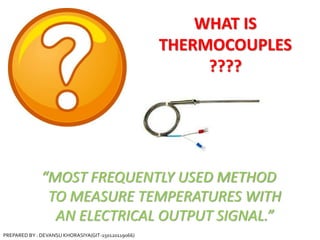
“MOST FREQUENTLY USED METHOD
TO MEASURE TEMPERATURES WITH
AN ELECTRICAL OUTPUT SIGNAL.”
PREPARED BY : DEVANSU KHORASIYA(GIT-150120119066)
WHAT ARE THERMOCOUPLES?
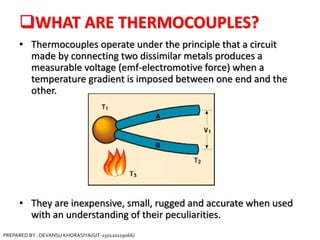
• Thermocouples operate under the principle that a circuit
made by connecting two dissimilar metals produces a
measurable voltage (emf-electromotive force) when a
temperature gradient is imposed between one end and the
other.
• They are inexpensive, small, rugged and accurate when used
with an understanding of their peculiarities.
PREPARED BY : DEVANSU KHORASIYA(GIT-150120119066)
THERMOCOUPLES
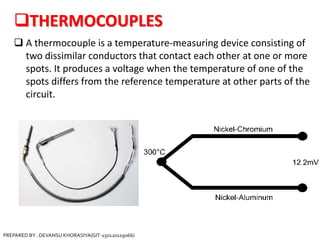
 A thermocouple is a temperature-measuring device consisting of
two dissimilar conductors that contact each other at one or more
spots. It produces a voltage when the temperature of one of the
spots differs from the reference temperature at other parts of the
circuit.
PREPARED BY : DEVANSU KHORASIYA(GIT-150120119066)
DEFINITION
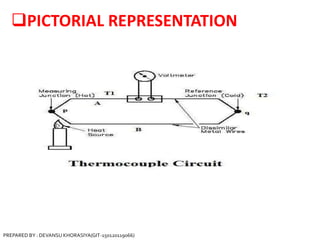
A Thermocouple is a device used for the measurement of temperature.
It can be even considered as a sensor for the measurement of temperature. The
device consists of two dissimilar metals or semiconductors that contact each other in
one are more points. The junction in most of the cases are welded.
Temperature is measured mostly at welded region. One end is connected to the
region where the temperature is to be measured. This end considered as the hot
region or the measuring region. The end is connected to the body of known
temperature. This end is considered as cold region or the reference junction. Thus the
thermocouple measures the temperature of the known region with respect to the
known junction.
PREPARED BY : DEVANSU KHORASIYA(GIT-150120119066)
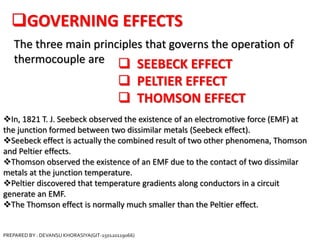
GOVERNING EFFECTS
The three main principles that governs the operation of
thermocouple are  SEEBECK EFFECT
 PELTIER EFFECT
 THOMSON EFFECT
In, 1821 T. J. Seebeck observed the existence of an electromotive force (EMF) at
the junction formed between two dissimilar metals (Seebeck effect).
Seebeck effect is actually the combined result of two other phenomena, Thomson
and Peltier effects.
Thomson observed the existence of an EMF due to the contact of two dissimilar
metals at the junction temperature.
Peltier discovered that temperature gradients along conductors in a circuit
generate an EMF.
The Thomson effect is normally much smaller than the Peltier effect.
PREPARED BY : DEVANSU KHORASIYA(GIT-150120119066)
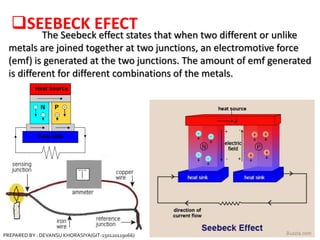
SEEBECK EFECT
The Seebeck effect states that when two different or unlike
metals are joined together at two junctions, an electromotive force
(emf) is generated at the two junctions. The amount of emf generated
is different for different combinations of the metals.
PREPARED BY : DEVANSU KHORASIYA(GIT-150120119066)
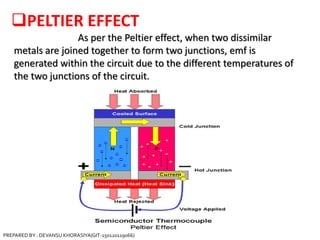
PELTIER EFFECT
As per the Peltier effect, when two dissimilar
metals are joined together to form two junctions, emf is
generated within the circuit due to the different temperatures of
the two junctions of the circuit.
PREPARED BY : DEVANSU KHORASIYA(GIT-150120119066)
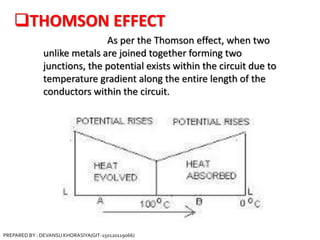
THOMSON EFFECT
As per the Thomson effect, when two
unlike metals are joined together forming two
junctions, the potential exists within the circuit due to
temperature gradient along the entire length of the
conductors within the circuit.
PREPARED BY : DEVANSU KHORASIYA(GIT-150120119066)
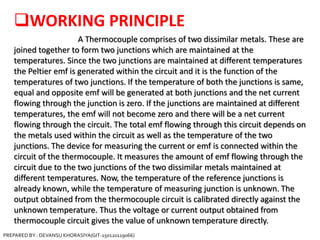
WORKING PRINCIPLE
A Thermocouple comprises of two dissimilar metals. These are
joined together to form two junctions which are maintained at the
temperatures. Since the two junctions are maintained at different temperatures
the Peltier emf is generated within the circuit and it is the function of the
temperatures of two junctions. If the temperature of both the junctions is same,
equal and opposite emf will be generated at both junctions and the net current
flowing through the junction is zero. If the junctions are maintained at different
temperatures, the emf will not become zero and there will be a net current
flowing through the circuit. The total emf flowing through this circuit depends on
the metals used within the circuit as well as the temperature of the two
junctions. The device for measuring the current or emf is connected within the
circuit of the thermocouple. It measures the amount of emf flowing through the
circuit due to the two junctions of the two dissimilar metals maintained at
different temperatures. Now, the temperature of the reference junctions is
already known, while the temperature of measuring junction is unknown. The
output obtained from the thermocouple circuit is calibrated directly against the
unknown temperature. Thus the voltage or current output obtained from
thermocouple circuit gives the value of unknown temperature directly.
PREPARED BY : DEVANSU KHORASIYA(GIT-150120119066)
PICTORIAL REPRESENTATION
PREPARED BY : DEVANSU KHORASIYA(GIT-150120119066)
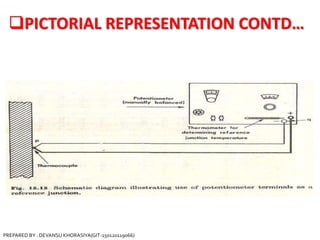
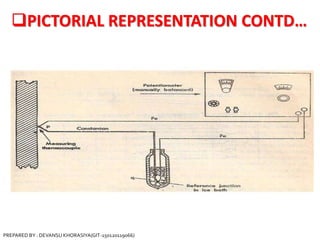
PICTORIAL REPRESENTATION CONTD…
PREPARED BY : DEVANSU KHORASIYA(GIT-150120119066)
PICTORIAL REPRESENTATION CONTD…
PREPARED BY : DEVANSU KHORASIYA(GIT-150120119066)
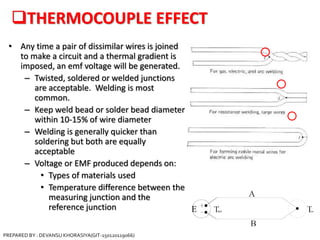
THERMOCOUPLE EFFECT
• Any time a pair of dissimilar wires is joined
to make a circuit and a thermal gradient is
imposed, an emf voltage will be generated.
– Twisted, soldered or welded junctions
are acceptable. Welding is most
common.
– Keep weld bead or solder bead diameter
within 10-15% of wire diameter
– Welding is generally quicker than
soldering but both are equally
acceptable
– Voltage or EMF produced depends on:
• Types of materials used
• Temperature difference between the
measuring junction and the
reference junction
PREPARED BY : DEVANSU KHORASIYA(GIT-150120119066)
WHAT THERMOCOUPLE MATERIALS
SHOULD BE USED?
• Depends on requirements:
– Temperature range?
– Required accuracy
– Chemical resistance issues
– Abrasion or vibration resistance
– Installation requirements (size of wire)
– Thermal conduction requirements
PREPARED BY : DEVANSU KHORASIYA(GIT-150120119066)
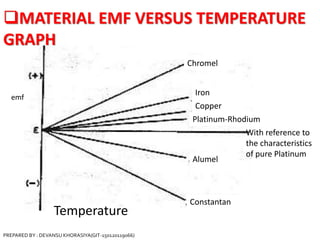
MATERIAL EMF VERSUS TEMPERATURE
GRAPH
With reference to
the characteristics
of pure Platinum
emf
Temperature
Chromel
Iron
Copper
Platinum-Rhodium
Alumel
Constantan
TEMPERATURE MEASUREMENT
ERRORS
Conduction
Convection
Radiation
Response Time
Noise
Grounding issues and shorts, especially on
metal surfaces
PREPARED BY : DEVANSU KHORASIYA(GIT-150120119066)
APPLICATIONS AND USES
 Steel industry
 Gas appliance safety
 Thermopile radiation sensors
 Power production
 Thermocouple as vacuum gauge
 Thermistor
 Other applications include temperature measurement for kilns,
gas turbine exhaust, diesel engines, other industrial processes
and fog machines etc..
PREPARED BY : DEVANSU KHORASIYA(GIT-150120119066)
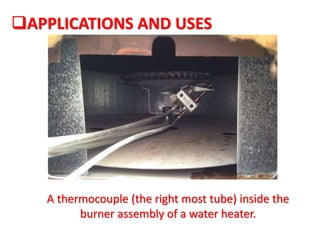
A thermocouple (the right most tube) inside the
burner assembly of a water heater.
APPLICATIONS AND USES
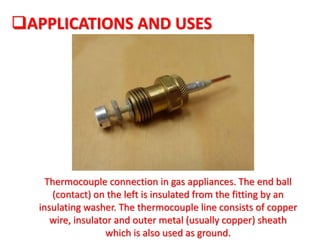
Thermocouple connection in gas appliances. The end ball
(contact) on the left is insulated from the fitting by an
insulating washer. The thermocouple line consists of copper
wire, insulator and outer metal (usually copper) sheath
which is also used as ground.
APPLICATIONS AND USES
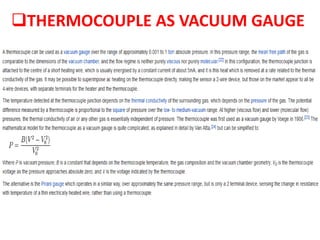
THERMOCOUPLE AS VACUUM GAUGE
ATTHE LAST…….
One Humble Request to all ofYOU….
Make sureYour House, School, College, Society, Road,
State, Nation, World is Neat and Clean……PREPARED BY : DEVANSU KHORASIYA(GIT-150120119066)
THANK YOU GUYS FOR LISTINING ME……
PRESENTATION & DESIGNED BY
DEVANSU KHORASIYA (150120119066)
MY AIM IS….
CLEAN INDIA
GREEN INDIA &
MAKE IN INDIA.
PREPARED BY : DEVANSU KHORASIYA(GIT-150120119066)

Thermocouples

  • 1.
    ACTIVE LEARNINGASSIGNMENT PRESENTATION MECHANICALMEASUREMENT & METROLOGY (2141901) TOPIC THERMOCOUPLES PREPARED BY MECHANICAL – 4B2 DEVANSU KHORASIYA (150120119066) PREPARED BY : DEVANSU KHORASIYA(GIT-150120119066)
  • 2.
    WHICH CONTENT WEWILL BE GOINGTO LEARN INTHIS PRESENTATION..  DEFINITION  GOVERNING EFFECTS  WORKING PRINCIPLE  TYPES OF THERMOCOUPLES  COMPARISON B/W VARIOUS TYPES  APPLICATION AND USES Lets StartsThe Journey… PREPARED BY : DEVANSU KHORASIYA(GIT-150120119066)
  • 3.
    WHAT IS THERMOCOUPLES ???? “MOST FREQUENTLYUSED METHOD TO MEASURE TEMPERATURES WITH AN ELECTRICAL OUTPUT SIGNAL.” PREPARED BY : DEVANSU KHORASIYA(GIT-150120119066)
  • 4.
    WHAT ARE THERMOCOUPLES? •Thermocouples operate under the principle that a circuit made by connecting two dissimilar metals produces a measurable voltage (emf-electromotive force) when a temperature gradient is imposed between one end and the other. • They are inexpensive, small, rugged and accurate when used with an understanding of their peculiarities. PREPARED BY : DEVANSU KHORASIYA(GIT-150120119066)
  • 5.
    THERMOCOUPLES  A thermocoupleis a temperature-measuring device consisting of two dissimilar conductors that contact each other at one or more spots. It produces a voltage when the temperature of one of the spots differs from the reference temperature at other parts of the circuit. PREPARED BY : DEVANSU KHORASIYA(GIT-150120119066)
  • 6.
    DEFINITION A Thermocouple isa device used for the measurement of temperature. It can be even considered as a sensor for the measurement of temperature. The device consists of two dissimilar metals or semiconductors that contact each other in one are more points. The junction in most of the cases are welded. Temperature is measured mostly at welded region. One end is connected to the region where the temperature is to be measured. This end considered as the hot region or the measuring region. The end is connected to the body of known temperature. This end is considered as cold region or the reference junction. Thus the thermocouple measures the temperature of the known region with respect to the known junction. PREPARED BY : DEVANSU KHORASIYA(GIT-150120119066)
  • 7.
    GOVERNING EFFECTS The threemain principles that governs the operation of thermocouple are  SEEBECK EFFECT  PELTIER EFFECT  THOMSON EFFECT In, 1821 T. J. Seebeck observed the existence of an electromotive force (EMF) at the junction formed between two dissimilar metals (Seebeck effect). Seebeck effect is actually the combined result of two other phenomena, Thomson and Peltier effects. Thomson observed the existence of an EMF due to the contact of two dissimilar metals at the junction temperature. Peltier discovered that temperature gradients along conductors in a circuit generate an EMF. The Thomson effect is normally much smaller than the Peltier effect. PREPARED BY : DEVANSU KHORASIYA(GIT-150120119066)
  • 8.
    SEEBECK EFECT The Seebeckeffect states that when two different or unlike metals are joined together at two junctions, an electromotive force (emf) is generated at the two junctions. The amount of emf generated is different for different combinations of the metals. PREPARED BY : DEVANSU KHORASIYA(GIT-150120119066)
  • 9.
    PELTIER EFFECT As perthe Peltier effect, when two dissimilar metals are joined together to form two junctions, emf is generated within the circuit due to the different temperatures of the two junctions of the circuit. PREPARED BY : DEVANSU KHORASIYA(GIT-150120119066)
  • 10.
    THOMSON EFFECT As perthe Thomson effect, when two unlike metals are joined together forming two junctions, the potential exists within the circuit due to temperature gradient along the entire length of the conductors within the circuit. PREPARED BY : DEVANSU KHORASIYA(GIT-150120119066)
  • 11.
    WORKING PRINCIPLE A Thermocouplecomprises of two dissimilar metals. These are joined together to form two junctions which are maintained at the temperatures. Since the two junctions are maintained at different temperatures the Peltier emf is generated within the circuit and it is the function of the temperatures of two junctions. If the temperature of both the junctions is same, equal and opposite emf will be generated at both junctions and the net current flowing through the junction is zero. If the junctions are maintained at different temperatures, the emf will not become zero and there will be a net current flowing through the circuit. The total emf flowing through this circuit depends on the metals used within the circuit as well as the temperature of the two junctions. The device for measuring the current or emf is connected within the circuit of the thermocouple. It measures the amount of emf flowing through the circuit due to the two junctions of the two dissimilar metals maintained at different temperatures. Now, the temperature of the reference junctions is already known, while the temperature of measuring junction is unknown. The output obtained from the thermocouple circuit is calibrated directly against the unknown temperature. Thus the voltage or current output obtained from thermocouple circuit gives the value of unknown temperature directly. PREPARED BY : DEVANSU KHORASIYA(GIT-150120119066)
  • 12.
    PICTORIAL REPRESENTATION PREPARED BY: DEVANSU KHORASIYA(GIT-150120119066)
  • 13.
    PICTORIAL REPRESENTATION CONTD… PREPAREDBY : DEVANSU KHORASIYA(GIT-150120119066)
  • 14.
    PICTORIAL REPRESENTATION CONTD… PREPAREDBY : DEVANSU KHORASIYA(GIT-150120119066)
  • 15.
    THERMOCOUPLE EFFECT • Anytime a pair of dissimilar wires is joined to make a circuit and a thermal gradient is imposed, an emf voltage will be generated. – Twisted, soldered or welded junctions are acceptable. Welding is most common. – Keep weld bead or solder bead diameter within 10-15% of wire diameter – Welding is generally quicker than soldering but both are equally acceptable – Voltage or EMF produced depends on: • Types of materials used • Temperature difference between the measuring junction and the reference junction PREPARED BY : DEVANSU KHORASIYA(GIT-150120119066)
  • 16.
    WHAT THERMOCOUPLE MATERIALS SHOULDBE USED? • Depends on requirements: – Temperature range? – Required accuracy – Chemical resistance issues – Abrasion or vibration resistance – Installation requirements (size of wire) – Thermal conduction requirements PREPARED BY : DEVANSU KHORASIYA(GIT-150120119066)
  • 17.
    PREPARED BY :DEVANSU KHORASIYA(GIT-150120119066) MATERIAL EMF VERSUS TEMPERATURE GRAPH With reference to the characteristics of pure Platinum emf Temperature Chromel Iron Copper Platinum-Rhodium Alumel Constantan
  • 18.
    TEMPERATURE MEASUREMENT ERRORS Conduction Convection Radiation Response Time Noise Groundingissues and shorts, especially on metal surfaces PREPARED BY : DEVANSU KHORASIYA(GIT-150120119066)
  • 20.
    APPLICATIONS AND USES Steel industry  Gas appliance safety  Thermopile radiation sensors  Power production  Thermocouple as vacuum gauge  Thermistor  Other applications include temperature measurement for kilns, gas turbine exhaust, diesel engines, other industrial processes and fog machines etc.. PREPARED BY : DEVANSU KHORASIYA(GIT-150120119066)
  • 21.
    A thermocouple (theright most tube) inside the burner assembly of a water heater. APPLICATIONS AND USES
  • 22.
    Thermocouple connection ingas appliances. The end ball (contact) on the left is insulated from the fitting by an insulating washer. The thermocouple line consists of copper wire, insulator and outer metal (usually copper) sheath which is also used as ground. APPLICATIONS AND USES
  • 23.
  • 24.
    ATTHE LAST……. One HumbleRequest to all ofYOU…. Make sureYour House, School, College, Society, Road, State, Nation, World is Neat and Clean……PREPARED BY : DEVANSU KHORASIYA(GIT-150120119066)
  • 25.
    THANK YOU GUYSFOR LISTINING ME…… PRESENTATION & DESIGNED BY DEVANSU KHORASIYA (150120119066) MY AIM IS…. CLEAN INDIA GREEN INDIA & MAKE IN INDIA. PREPARED BY : DEVANSU KHORASIYA(GIT-150120119066)