2. Temperature Transducers
▫ Thermocouples
▫ Resistance-Temperature Detectors (RTD)
▫ Thermistors
1
1. Thermocouple
• In 1821, T.J. Seebeck discovered that an electric potential
occurs when 2 different metals are joined into a loop and
the two junctions are held at different temperatures.
• Seebeck emf – a voltage difference between the two ends
of the conductor that depends on the temperature
difference of the ends and a material property.
• If the ends of the wire have the same temperature, no emf
occurs, even if the middle of the wire is hotter or colder.
2
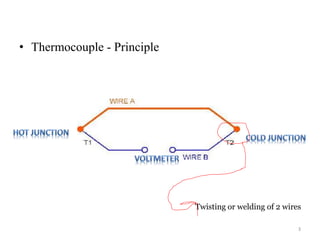
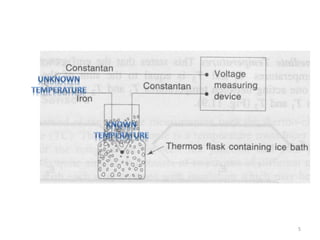
• Thermocouple - Principle
Twisting or welding of 2 wires
3
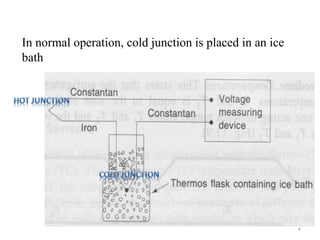
In normal operation, cold junction is placed in an ice
bath
4
5
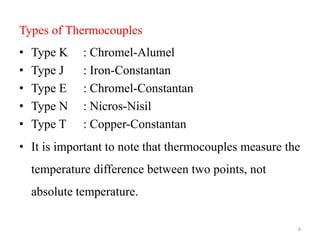
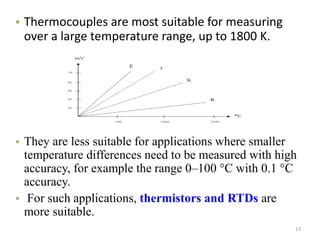
Types of Thermocouples
• Type K : Chromel-Alumel
• Type J : Iron-Constantan
• Type E : Chromel-Constantan
• Type N : Nicros-Nisil
• Type T : Copper-Constantan
• It is important to note that thermocouples measure the
temperature difference between two points, not
absolute temperature.
6
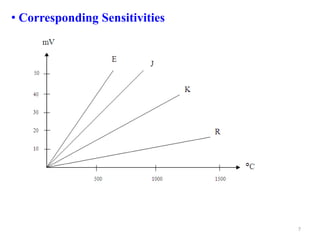
• Corresponding Sensitivities
7
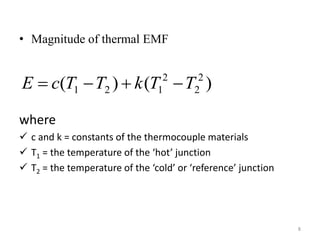
• Magnitude of thermal EMF
where
 c and k = constants of the thermocouple materials
 T1 = the temperature of the ‘hot’ junction
 T2 = the temperature of the ‘cold’ or ‘reference’ junction
)
(
)
( 2
2
2
1
2
1 T
T
k
T
T
c
E 



8
Example:
A thermocouple was found to have linear
calibration between 0⁰C and 400⁰C with emf at
maximum temperature (reference junction
temperature 0⁰C) equal to 20.68 mV.
a) Determine the correction which must be
made to the indicated emf if the cold junction
temperature is 25⁰C.
b) If the indicated emf is 8.82 mV in the
thermocouple circuit, determine the
temperature of the hot junction.
9
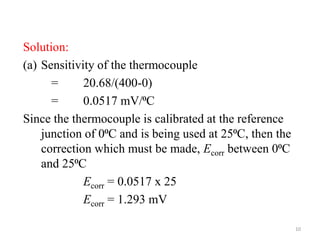
Solution:
(a) Sensitivity of the thermocouple
= 20.68/(400-0)
= 0.0517 mV/⁰C
Since the thermocouple is calibrated at the reference
junction of 0⁰C and is being used at 25⁰C, then the
correction which must be made, Ecorr between 0⁰C
and 25⁰C
Ecorr = 0.0517 x 25
Ecorr = 1.293 mV
10
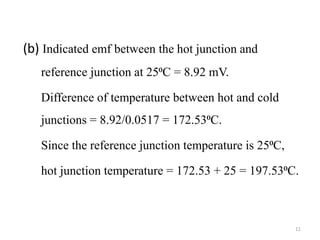
(b) Indicated emf between the hot junction and
reference junction at 25⁰C = 8.92 mV.
Difference of temperature between hot and cold
junctions = 8.92/0.0517 = 172.53⁰C.
Since the reference junction temperature is 25⁰C,
hot junction temperature = 172.53 + 25 = 197.53⁰C.
11
• Thermocouple - applications
• Thermocouples are most suitable for measuring over a
large temperature range, up to 1800 K.
• Example:
Type K : Chromel-Alumel (-190⁰C to 1260⁰C)
Type J : Iron-Constantan (-190⁰C to 760⁰C)
Type E : Chromel-Constantan (-100⁰C to 1260⁰C)
12
• Thermocouples are most suitable for measuring
over a large temperature range, up to 1800 K.
• They are less suitable for applications where smaller
temperature differences need to be measured with high
accuracy, for example the range 0–100 °C with 0.1 °C
accuracy.
• For such applications, thermistors and RTDs are
more suitable.
13
2. Resistance temperature detector (RTD)
• Resistance temperature detectors (RTDs), also called
resistance thermometers, are temperature sensors that
exploit the predictable change in electrical resistance of
some materials with changing temperature.
• Temperature Metal Resistance
• The resistance ideally varies linearly with temperature.
14
• RTD unlike thermocouples are passive sensors
requiring an excitation” current to be passed
through them.
• The RTD is normally manufactured through a
known resistance typically 100 ohms at ice
point. It has positive temperature of resistance.
15
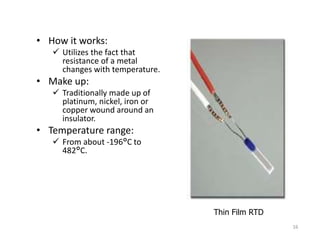
• How it works:
 Utilizes the fact that
resistance of a metal
changes with temperature.
• Make up:
 Traditionally made up of
platinum, nickel, iron or
copper wound around an
insulator.
• Temperature range:
 From about -196°C to
482°C.
Thin Film RTD
16
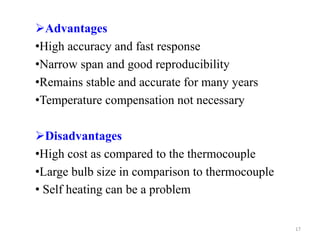
Advantages
•High accuracy and fast response
•Narrow span and good reproducibility
•Remains stable and accurate for many years
•Temperature compensation not necessary
Disadvantages
•High cost as compared to the thermocouple
•Large bulb size in comparison to thermocouple
• Self heating can be a problem
17
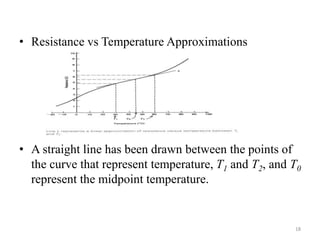
• Resistance vs Temperature Approximations
• A straight line has been drawn between the points of
the curve that represent temperature, T1 and T2, and T0
represent the midpoint temperature.
18
 RTD -Linear or Straight line equation
approximation
R(T)= approximation of resistance at temperature T
R(T0)= resistance at temperature T0
αo = fractional change in resistance per degree of temperature
at T0
ΔT= T - T0
2
1
]
1
)[
(
)
( T
T
T
T
T
R
T
R o
o 



 
19
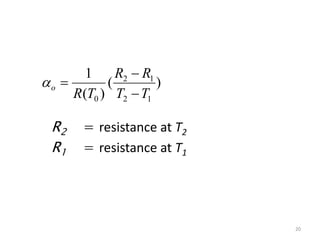
R2 = resistance at T2
R1 = resistance at T1
)
(
)
(
1
1
2
1
2
0 T
T
R
R
T
R
o




20
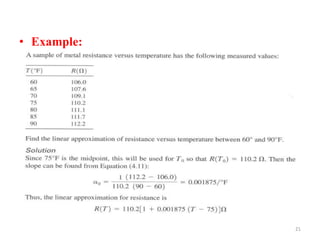
• Example:
21
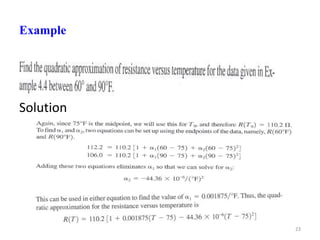
RTD – quadratic approximation
• More accurate representation of R-T curve over some span
of temperatures.
R(T) = quadratic approximation of resistance at temperature T
R(T0)= resistance at temperature T0
α1 = linear fractional change in resistance with temperature
α2 = quadratic fractional change in resistance with temperature
ΔT = T - T0
2
1
2
2
1 ]
)
(
1
)[
(
)
( T
T
T
T
T
T
R
T
R o 





 

22
Example
Solution
23
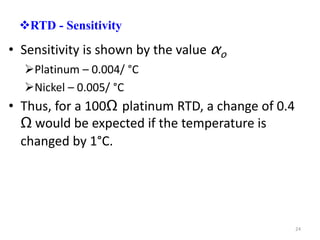
RTD - Sensitivity
• Sensitivity is shown by the value αo
Platinum – 0.004/ °C
Nickel – 0.005/ °C
• Thus, for a 100Ω platinum RTD, a change of 0.4
Ω would be expected if the temperature is
changed by 1°C.
24
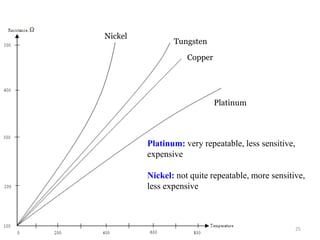
Platinum
Copper
Tungsten
Nickel
Platinum: very repeatable, less sensitive,
expensive
Nickel: not quite repeatable, more sensitive,
less expensive
25
RTD – response time
• Generally 0.5 to 5 seconds or more
• The slowness of response is due to the slowness of
thermal conductivity in bringing the device into
thermal equilibrium with its environment.
26
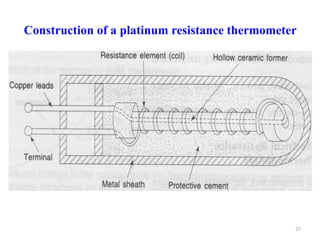
Construction of a platinum resistance thermometer
27
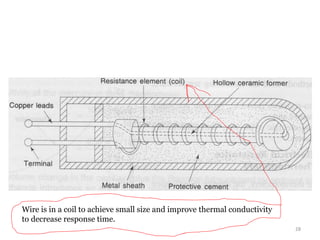
Wire is in a coil to achieve small size and improve thermal conductivity
to decrease response time.
28
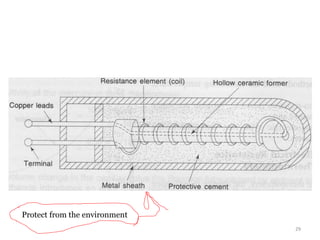
Protect from the environment
29
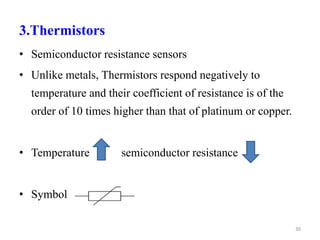
3.Thermistors
• Semiconductor resistance sensors
• Unlike metals, Thermistors respond negatively to
temperature and their coefficient of resistance is of the
order of 10 times higher than that of platinum or copper.
• Temperature semiconductor resistance
• Symbol
30
31
• How it works:
Like the RTD a thermistor uses the fact that
resistance of a metal changes with temperature.
• Make up:
Generally made up of semiconductor materials
• Temperature Range:
About -45°C - 150°C
Thermistor
32
• Advantages:
– Very sensitive (has
the largest output
change from input
temperature)
– Quick response
– More accurate than
RTD and
Thermocouples
• Disadvantages:
– Output is a non-
linear function
– Limited temperature
range.
– Require a current
source
– Self heating
– Fragile
Advantage of Thermistors:
• Has extremely high sensitivity. for example, a 2252 w
thermistor has a sensitivity of -100 w/°c at room
temperature.
• Higher resistance Thermistors can exhibit temperature
coefficients of -10 kw/°c or more. In comparison, a 100 w
platinum RTD has a sensitivity of only 0.4 w/°c.
• Physically small size which yields a very fast response to
temperature changes.
• The thermistor has been used primarily for high-resolution
measurements over limited temperature ranges. the classic
example of this type of application is motor winding
temperature and in medical thermometry
33
• Has relatively high resistance. Thermistors are
available with base resistances (at 25° c) ranging
from hundreds to millions of ohms.
• This high resistance diminishes the effect of inherent
resistances in the lead wires, which can cause
significant errors with low resistance devices such as
RTD
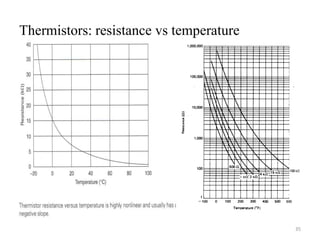
• The major tradeoff for the high resistance and
sensitivity of the thermistor is its highly nonlinear
output and relatively limited operating range.
• Depending on the type of Thermistors, upper ranges
are typically limited to max 300° c.
34
Thermistors: resistance vs temperature
35
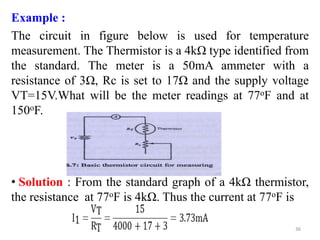
Example :
The circuit in figure below is used for temperature
measurement. The Thermistor is a 4kΩ type identified from
the standard. The meter is a 50mA ammeter with a
resistance of 3Ω, Rc is set to 17Ω and the supply voltage
VT=15V.What will be the meter readings at 77oF and at
150oF.
• Solution : From the standard graph of a 4kΩ thermistor,
the resistance at 77oF is 4kΩ. Thus the current at 77oF is
36
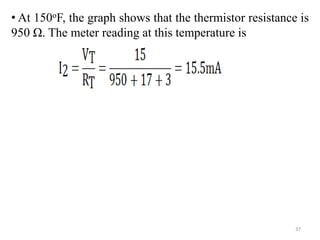
• At 150oF, the graph shows that the thermistor resistance is
950 Ω. The meter reading at this temperature is
37
Applications of temperature sensing
• Food industry
 Monitor temperature-time cycles to ensure high food quality
• Automotive industry
 Combustion and exhaust temperature
• Solar Energy conversion
 Accurate temperature measurement to achieve optimal heat
flow
• Energy efficiency in the home and industry
 Measurement of temperature
• Hospital infant incubator
 Temperature must be kept in the proper range
38

Temperature Transducers.pptx

  • 1.
    2. Temperature Transducers ▫Thermocouples ▫ Resistance-Temperature Detectors (RTD) ▫ Thermistors 1
  • 2.
    1. Thermocouple • In1821, T.J. Seebeck discovered that an electric potential occurs when 2 different metals are joined into a loop and the two junctions are held at different temperatures. • Seebeck emf – a voltage difference between the two ends of the conductor that depends on the temperature difference of the ends and a material property. • If the ends of the wire have the same temperature, no emf occurs, even if the middle of the wire is hotter or colder. 2
  • 3.
    • Thermocouple -Principle Twisting or welding of 2 wires 3
  • 4.
    In normal operation,cold junction is placed in an ice bath 4
  • 5.
  • 6.
    Types of Thermocouples •Type K : Chromel-Alumel • Type J : Iron-Constantan • Type E : Chromel-Constantan • Type N : Nicros-Nisil • Type T : Copper-Constantan • It is important to note that thermocouples measure the temperature difference between two points, not absolute temperature. 6
  • 7.
  • 8.
    • Magnitude ofthermal EMF where  c and k = constants of the thermocouple materials  T1 = the temperature of the ‘hot’ junction  T2 = the temperature of the ‘cold’ or ‘reference’ junction ) ( ) ( 2 2 2 1 2 1 T T k T T c E     8
  • 9.
    Example: A thermocouple wasfound to have linear calibration between 0⁰C and 400⁰C with emf at maximum temperature (reference junction temperature 0⁰C) equal to 20.68 mV. a) Determine the correction which must be made to the indicated emf if the cold junction temperature is 25⁰C. b) If the indicated emf is 8.82 mV in the thermocouple circuit, determine the temperature of the hot junction. 9
  • 10.
    Solution: (a) Sensitivity ofthe thermocouple = 20.68/(400-0) = 0.0517 mV/⁰C Since the thermocouple is calibrated at the reference junction of 0⁰C and is being used at 25⁰C, then the correction which must be made, Ecorr between 0⁰C and 25⁰C Ecorr = 0.0517 x 25 Ecorr = 1.293 mV 10
  • 11.
    (b) Indicated emfbetween the hot junction and reference junction at 25⁰C = 8.92 mV. Difference of temperature between hot and cold junctions = 8.92/0.0517 = 172.53⁰C. Since the reference junction temperature is 25⁰C, hot junction temperature = 172.53 + 25 = 197.53⁰C. 11
  • 12.
    • Thermocouple -applications • Thermocouples are most suitable for measuring over a large temperature range, up to 1800 K. • Example: Type K : Chromel-Alumel (-190⁰C to 1260⁰C) Type J : Iron-Constantan (-190⁰C to 760⁰C) Type E : Chromel-Constantan (-100⁰C to 1260⁰C) 12
  • 13.
    • Thermocouples aremost suitable for measuring over a large temperature range, up to 1800 K. • They are less suitable for applications where smaller temperature differences need to be measured with high accuracy, for example the range 0–100 °C with 0.1 °C accuracy. • For such applications, thermistors and RTDs are more suitable. 13
  • 14.
    2. Resistance temperaturedetector (RTD) • Resistance temperature detectors (RTDs), also called resistance thermometers, are temperature sensors that exploit the predictable change in electrical resistance of some materials with changing temperature. • Temperature Metal Resistance • The resistance ideally varies linearly with temperature. 14
  • 15.
    • RTD unlikethermocouples are passive sensors requiring an excitation” current to be passed through them. • The RTD is normally manufactured through a known resistance typically 100 ohms at ice point. It has positive temperature of resistance. 15
  • 16.
    • How itworks:  Utilizes the fact that resistance of a metal changes with temperature. • Make up:  Traditionally made up of platinum, nickel, iron or copper wound around an insulator. • Temperature range:  From about -196°C to 482°C. Thin Film RTD 16
  • 17.
    Advantages •High accuracy andfast response •Narrow span and good reproducibility •Remains stable and accurate for many years •Temperature compensation not necessary Disadvantages •High cost as compared to the thermocouple •Large bulb size in comparison to thermocouple • Self heating can be a problem 17
  • 18.
    • Resistance vsTemperature Approximations • A straight line has been drawn between the points of the curve that represent temperature, T1 and T2, and T0 represent the midpoint temperature. 18
  • 19.
     RTD -Linearor Straight line equation approximation R(T)= approximation of resistance at temperature T R(T0)= resistance at temperature T0 αo = fractional change in resistance per degree of temperature at T0 ΔT= T - T0 2 1 ] 1 )[ ( ) ( T T T T T R T R o o       19
  • 20.
    R2 = resistanceat T2 R1 = resistance at T1 ) ( ) ( 1 1 2 1 2 0 T T R R T R o     20
  • 21.
  • 22.
    RTD – quadraticapproximation • More accurate representation of R-T curve over some span of temperatures. R(T) = quadratic approximation of resistance at temperature T R(T0)= resistance at temperature T0 α1 = linear fractional change in resistance with temperature α2 = quadratic fractional change in resistance with temperature ΔT = T - T0 2 1 2 2 1 ] ) ( 1 )[ ( ) ( T T T T T T R T R o          22
  • 23.
  • 24.
    RTD - Sensitivity •Sensitivity is shown by the value αo Platinum – 0.004/ °C Nickel – 0.005/ °C • Thus, for a 100Ω platinum RTD, a change of 0.4 Ω would be expected if the temperature is changed by 1°C. 24
  • 25.
    Platinum Copper Tungsten Nickel Platinum: very repeatable,less sensitive, expensive Nickel: not quite repeatable, more sensitive, less expensive 25
  • 26.
    RTD – responsetime • Generally 0.5 to 5 seconds or more • The slowness of response is due to the slowness of thermal conductivity in bringing the device into thermal equilibrium with its environment. 26
  • 27.
    Construction of aplatinum resistance thermometer 27
  • 28.
    Wire is ina coil to achieve small size and improve thermal conductivity to decrease response time. 28
  • 29.
    Protect from theenvironment 29
  • 30.
    3.Thermistors • Semiconductor resistancesensors • Unlike metals, Thermistors respond negatively to temperature and their coefficient of resistance is of the order of 10 times higher than that of platinum or copper. • Temperature semiconductor resistance • Symbol 30
  • 31.
    31 • How itworks: Like the RTD a thermistor uses the fact that resistance of a metal changes with temperature. • Make up: Generally made up of semiconductor materials • Temperature Range: About -45°C - 150°C Thermistor
  • 32.
    32 • Advantages: – Verysensitive (has the largest output change from input temperature) – Quick response – More accurate than RTD and Thermocouples • Disadvantages: – Output is a non- linear function – Limited temperature range. – Require a current source – Self heating – Fragile
  • 33.
    Advantage of Thermistors: •Has extremely high sensitivity. for example, a 2252 w thermistor has a sensitivity of -100 w/°c at room temperature. • Higher resistance Thermistors can exhibit temperature coefficients of -10 kw/°c or more. In comparison, a 100 w platinum RTD has a sensitivity of only 0.4 w/°c. • Physically small size which yields a very fast response to temperature changes. • The thermistor has been used primarily for high-resolution measurements over limited temperature ranges. the classic example of this type of application is motor winding temperature and in medical thermometry 33
  • 34.
    • Has relativelyhigh resistance. Thermistors are available with base resistances (at 25° c) ranging from hundreds to millions of ohms. • This high resistance diminishes the effect of inherent resistances in the lead wires, which can cause significant errors with low resistance devices such as RTD • The major tradeoff for the high resistance and sensitivity of the thermistor is its highly nonlinear output and relatively limited operating range. • Depending on the type of Thermistors, upper ranges are typically limited to max 300° c. 34
  • 35.
  • 36.
    Example : The circuitin figure below is used for temperature measurement. The Thermistor is a 4kΩ type identified from the standard. The meter is a 50mA ammeter with a resistance of 3Ω, Rc is set to 17Ω and the supply voltage VT=15V.What will be the meter readings at 77oF and at 150oF. • Solution : From the standard graph of a 4kΩ thermistor, the resistance at 77oF is 4kΩ. Thus the current at 77oF is 36
  • 37.
    • At 150oF,the graph shows that the thermistor resistance is 950 Ω. The meter reading at this temperature is 37
  • 38.
    Applications of temperaturesensing • Food industry  Monitor temperature-time cycles to ensure high food quality • Automotive industry  Combustion and exhaust temperature • Solar Energy conversion  Accurate temperature measurement to achieve optimal heat flow • Energy efficiency in the home and industry  Measurement of temperature • Hospital infant incubator  Temperature must be kept in the proper range 38