UFC C055
Semiconductors & Devices
Slides by:
39120008
Syed Ibrahim J
CONTENTS
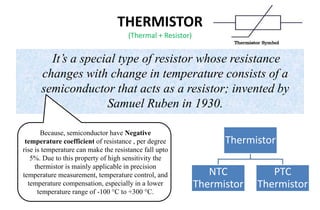
THERMISTOR
(Thermal + Resistor)
It’s a special type of resistor whose resistance
changes with change in temperature consists of a
semiconductor that acts as a resistor; invented by
Samuel Ruben in 1930.
Thermistor
NTC
Thermistor
PTC
Thermistor
Because, semiconductor have Negative
temperature coefficient of resistance , per degree
rise is temperature can make the resistance fall upto
5%. Due to this property of high sensitivity the
thermistor is mainly applicable in precision
temperature measurement, temperature control, and
temperature compensation, especially in a lower
temperature range of -100 °C to +300 °C.
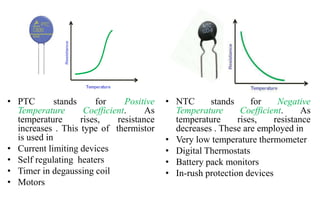
• PTC stands for Positive
Temperature Coefficient. As
temperature rises, resistance
increases . This type of thermistor
is used in
• Current limiting devices
• Self regulating heaters
• Timer in degaussing coil
• Motors
• NTC stands for Negative
Temperature Coefficient. As
temperature rises, resistance
decreases . These are employed in
• Very low temperature thermometer
• Digital Thermostats
• Battery pack monitors
• In-rush protection devices
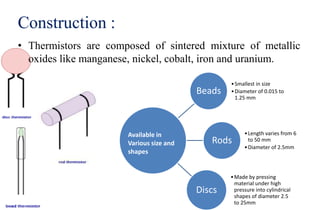
Beads
•Smallest in size
•Diameter of 0.015 to
1.25 mm
Rods
•Length varies from 6
to 50 mm
•Diameter of 2.5mm
Discs
•Made by pressing
material under high
pressure into cylindrical
shapes of diameter 2.5
to 25mm
Available in
Various size and
shapes
Construction :
• Thermistors are composed of sintered mixture of metallic
oxides like manganese, nickel, cobalt, iron and uranium.
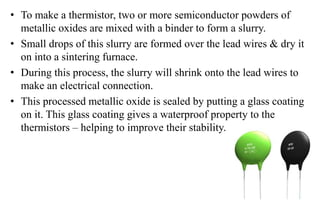
• To make a thermistor, two or more semiconductor powders of
metallic oxides are mixed with a binder to form a slurry.
• Small drops of this slurry are formed over the lead wires & dry it
on into a sintering furnace.
• During this process, the slurry will shrink onto the lead wires to
make an electrical connection.
• This processed metallic oxide is sealed by putting a glass coating
on it. This glass coating gives a waterproof property to the
thermistors – helping to improve their stability.
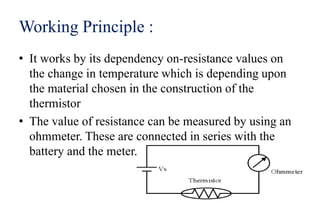
Working Principle :
• It works by its dependency on-resistance values on
the change in temperature which is depending upon
the material chosen in the construction of the
thermistor
• The value of resistance can be measured by using an
ohmmeter. These are connected in series with the
battery and the meter.
• The relation between the temperature and the resistance of the
thermistor is mathematically expressed by the equation :
Where,
RT1 - Resistance of the thermistor at temperature T1 in Kelvin.
RT2 - Resistance of the thermistor at temperature T2 in Kelvin.
β -temperature depending on the material of thermistor.
The resistance of the thermistor changes
from 105 to 10-2 at the temperature
between -100°C to 400°C.
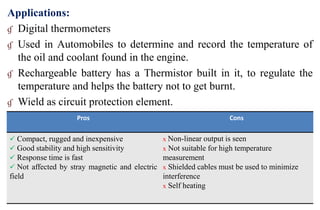
Applications:
ɠ Digital thermometers
ɠ Used in Automobiles to determine and record the temperature of
the oil and coolant found in the engine.
ɠ Rechargeable battery has a Thermistor built in it, to regulate the
temperature and helps the battery not to get burnt.
ɠ Wield as circuit protection element.
Pros Cons
 Compact, rugged and inexpensive
 Good stability and high sensitivity
 Response time is fast
 Not affected by stray magnetic and electric
field
x Non-linear output is seen
x Not suitable for high temperature
measurement
x Shielded cables must be used to minimize
interference
x Self heating
Reference:
 https://www.teamwavelength.com/info/thermistors.php
 https://en.wikipedia.org/wiki/Thermistor
 https://www.electrical4u.com/thermistor/
 https://www.omega.com/en-us/resources/thermistor

Thermistor

  • 1.
    UFC C055 Semiconductors &Devices Slides by: 39120008 Syed Ibrahim J
  • 2.
  • 3.
    THERMISTOR (Thermal + Resistor) It’sa special type of resistor whose resistance changes with change in temperature consists of a semiconductor that acts as a resistor; invented by Samuel Ruben in 1930. Thermistor NTC Thermistor PTC Thermistor Because, semiconductor have Negative temperature coefficient of resistance , per degree rise is temperature can make the resistance fall upto 5%. Due to this property of high sensitivity the thermistor is mainly applicable in precision temperature measurement, temperature control, and temperature compensation, especially in a lower temperature range of -100 °C to +300 °C.
  • 4.
    • PTC standsfor Positive Temperature Coefficient. As temperature rises, resistance increases . This type of thermistor is used in • Current limiting devices • Self regulating heaters • Timer in degaussing coil • Motors • NTC stands for Negative Temperature Coefficient. As temperature rises, resistance decreases . These are employed in • Very low temperature thermometer • Digital Thermostats • Battery pack monitors • In-rush protection devices
  • 5.
    Beads •Smallest in size •Diameterof 0.015 to 1.25 mm Rods •Length varies from 6 to 50 mm •Diameter of 2.5mm Discs •Made by pressing material under high pressure into cylindrical shapes of diameter 2.5 to 25mm Available in Various size and shapes Construction : • Thermistors are composed of sintered mixture of metallic oxides like manganese, nickel, cobalt, iron and uranium.
  • 6.
    • To makea thermistor, two or more semiconductor powders of metallic oxides are mixed with a binder to form a slurry. • Small drops of this slurry are formed over the lead wires & dry it on into a sintering furnace. • During this process, the slurry will shrink onto the lead wires to make an electrical connection. • This processed metallic oxide is sealed by putting a glass coating on it. This glass coating gives a waterproof property to the thermistors – helping to improve their stability.
  • 7.
    Working Principle : •It works by its dependency on-resistance values on the change in temperature which is depending upon the material chosen in the construction of the thermistor • The value of resistance can be measured by using an ohmmeter. These are connected in series with the battery and the meter.
  • 8.
    • The relationbetween the temperature and the resistance of the thermistor is mathematically expressed by the equation : Where, RT1 - Resistance of the thermistor at temperature T1 in Kelvin. RT2 - Resistance of the thermistor at temperature T2 in Kelvin. β -temperature depending on the material of thermistor. The resistance of the thermistor changes from 105 to 10-2 at the temperature between -100°C to 400°C.
  • 9.
    Applications: ɠ Digital thermometers ɠUsed in Automobiles to determine and record the temperature of the oil and coolant found in the engine. ɠ Rechargeable battery has a Thermistor built in it, to regulate the temperature and helps the battery not to get burnt. ɠ Wield as circuit protection element. Pros Cons  Compact, rugged and inexpensive  Good stability and high sensitivity  Response time is fast  Not affected by stray magnetic and electric field x Non-linear output is seen x Not suitable for high temperature measurement x Shielded cables must be used to minimize interference x Self heating
  • 10.
    Reference:  https://www.teamwavelength.com/info/thermistors.php  https://en.wikipedia.org/wiki/Thermistor https://www.electrical4u.com/thermistor/  https://www.omega.com/en-us/resources/thermistor