Topic:
Temperature
Transducer
Group Members
M.Faizan-Ul-Hassan 13EL34 (Leader)
Asim Raza 13EL08
M.Imran Firdos 13EL09
Contents
 Transducer
 Temperature Transducer
• Principle
• Working
• Applications
 Types
 RTD (Resistance Temperature Detector)
 Thermocouple
 Thermistors
Introduction
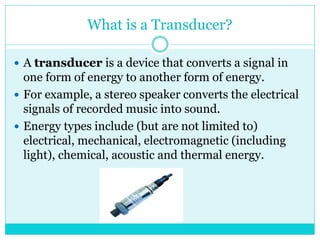
What is a Transducer?
 A transducer is a device that converts a signal in
one form of energy to another form of energy.
 For example, a stereo speaker converts the electrical
signals of recorded music into sound.
 Energy types include (but are not limited to)
electrical, mechanical, electromagnetic (including
light), chemical, acoustic and thermal energy.
BLOCK DIAGRAM OF TRANSDUCERS
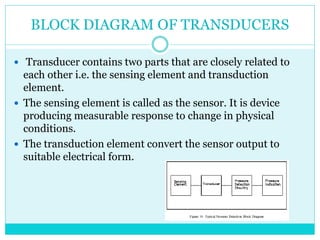
 Transducer contains two parts that are closely related to
each other i.e. the sensing element and transduction
element.
 The sensing element is called as the sensor. It is device
producing measurable response to change in physical
conditions.
 The transduction element convert the sensor output to
suitable electrical form.
What Is Temperature Transducer ?
 It is a temperature monitoring device.
 A device in an automatic temperature-
 control system that converts the temperature into
 some other quantity.
Principle
Principle
 A temperature transducer is an electrical device
usually used in automated air-temperature control
sequences. Its purpose is to take a measurement of
the air temperature and relay the information after
translating it into a readable form to a power source
for the mechanical part of the system.
Working
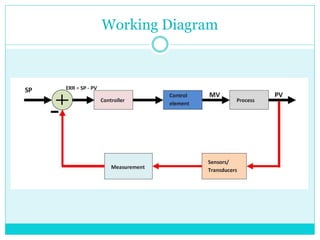
 A temperature transducer is an electrical device
usually used in automated air-temperature control
sequences. Its purpose is to take a measurement of
the air temperature and relay the information after
translating it into a readable form to a power source
for the mechanical part of the system.
Sensor
 Once the information has been taken by the
temperature transducer and relayed, the information
is sent to the unit power source. Usually, when a
transducer is telling a mechanical unit, such as a
furnace or a cooling system, that it needs to engage
in order to create the desired temperature, it will also
tell the unit when it has reached that desired
temperature.
Instructions
 When the unit power source reveals the information
from the temperature transducer, it either tells the
system to stand idle or engage depending on the
temperature that has been measured. If the
temperature reads lower than the setting input to the
system by the user, the heating unit is told to engage
until the air is measured by the temperature
transducer to be as high in temperature as the user
desires.
Digital Display
 Temperature transducers send the information they
collect to more sources than just the power source
for the heating or cooling unit. Digital thermostats
installed in many households and businesses utilize
digital LCD screens to display the information that is
read by the temperature transducer. The transducer
measures the air temperature and translates it into
information the screen is able to display at the same
time the information is being sent to the power
source telling it whether or not to engage.
Working Diagram
Applications 
 Steel industry
 Monitor temperature and chemistry throughout the steel making process
 Heating appliance safety
 Thermocouples in fail-safe mode are used in ovens and water heaters to detect if
pilot flame is burning to prevent fire and health hazard
 Manufacturing
 Used for testing prototype electrical and mechanical apparatus
 Process plants
 Chemical production plants and refineries use computer programs to view the
temperature at various locations. For this situation, a number of thermocouple
leads are brought to a common reference block.
Types Of Temp. Transducer
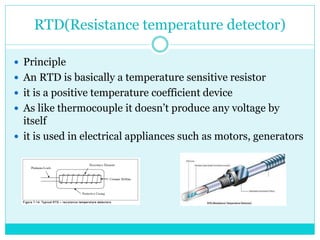
RTD(Resistance temperature detector)
 Principle
 An RTD is basically a temperature sensitive resistor
 it is a positive temperature coefficient device
 As like thermocouple it doesn’t produce any voltage by
itself
 it is used in electrical appliances such as motors, generators
Resistance temperature detector
Applications
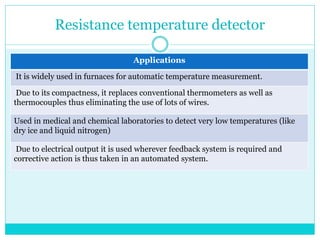
It is widely used in furnaces for automatic temperature measurement.
Due to its compactness, it replaces conventional thermometers as well as
thermocouples thus eliminating the use of lots of wires.
Used in medical and chemical laboratories to detect very low temperatures (like
dry ice and liquid nitrogen)
Due to electrical output it is used wherever feedback system is required and
corrective action is thus taken in an automated system.
Resistance temperature Detect0r
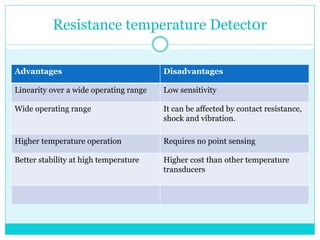
Advantages Disadvantages
Linearity over a wide operating range Low sensitivity
Wide operating range It can be affected by contact resistance,
shock and vibration.
Higher temperature operation Requires no point sensing
Better stability at high temperature Higher cost than other temperature
transducers
Thermocouple
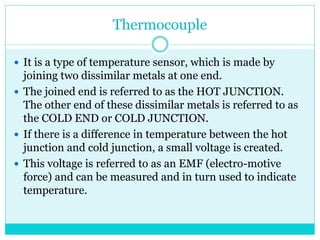
 It is a type of temperature sensor, which is made by
joining two dissimilar metals at one end.
 The joined end is referred to as the HOT JUNCTION.
The other end of these dissimilar metals is referred to as
the COLD END or COLD JUNCTION.
 If there is a difference in temperature between the hot
junction and cold junction, a small voltage is created.
 This voltage is referred to as an EMF (electro-motive
force) and can be measured and in turn used to indicate
temperature.
Thermocouple Applications
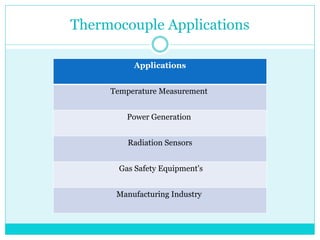
Applications
Temperature Measurement
Power Generation
Radiation Sensors
Gas Safety Equipment's
Manufacturing Industry
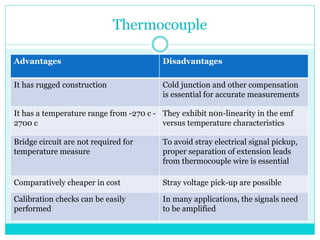
Thermocouple
Advantages Disadvantages
It has rugged construction Cold junction and other compensation
is essential for accurate measurements
It has a temperature range from -270 c -
2700 c
They exhibit n0n-linearity in the emf
versus temperature characteristics
Bridge circuit are not required for
temperature measure
To avoid stray electrical signal pickup,
proper separation of extension leads
from thermocouple wire is essential
Comparatively cheaper in cost Stray voltage pick-up are possible
Calibration checks can be easily
performed
In many applications, the signals need
to be amplified
Thermistor
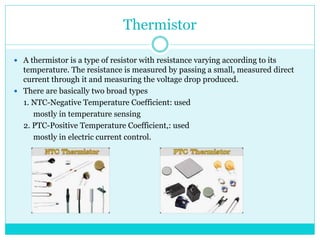
 A thermistor is a type of resistor with resistance varying according to its
temperature. The resistance is measured by passing a small, measured direct
current through it and measuring the voltage drop produced.
 There are basically two broad types
1. NTC-Negative Temperature Coefficient: used
mostly in temperature sensing
2. PTC-Positive Temperature Coefficient,: used
mostly in electric current control.
Thermistor
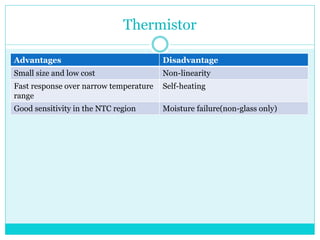
Advantages Disadvantage
Small size and low cost Non-linearity
Fast response over narrow temperature
range
Self-heating
Good sensitivity in the NTC region Moisture failure(non-glass only)
Applications of Thermistor
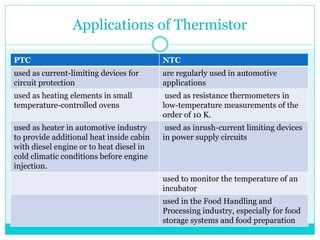
PTC NTC
used as current-limiting devices for
circuit protection
are regularly used in automotive
applications
used as heating elements in small
temperature-controlled ovens
used as resistance thermometers in
low-temperature measurements of the
order of 10 K.
used as heater in automotive industry
to provide additional heat inside cabin
with diesel engine or to heat diesel in
cold climatic conditions before engine
injection.
used as inrush-current limiting devices
in power supply circuits
used to monitor the temperature of an
incubator
used in the Food Handling and
Processing industry, especially for food
storage systems and food preparation
THANK YOU


Temperature Transducers

  • 1.
  • 2.
    Group Members M.Faizan-Ul-Hassan 13EL34(Leader) Asim Raza 13EL08 M.Imran Firdos 13EL09
  • 3.
    Contents  Transducer  TemperatureTransducer • Principle • Working • Applications  Types  RTD (Resistance Temperature Detector)  Thermocouple  Thermistors
  • 4.
  • 5.
    What is aTransducer?  A transducer is a device that converts a signal in one form of energy to another form of energy.  For example, a stereo speaker converts the electrical signals of recorded music into sound.  Energy types include (but are not limited to) electrical, mechanical, electromagnetic (including light), chemical, acoustic and thermal energy.
  • 6.
    BLOCK DIAGRAM OFTRANSDUCERS  Transducer contains two parts that are closely related to each other i.e. the sensing element and transduction element.  The sensing element is called as the sensor. It is device producing measurable response to change in physical conditions.  The transduction element convert the sensor output to suitable electrical form.
  • 7.
    What Is TemperatureTransducer ?  It is a temperature monitoring device.  A device in an automatic temperature-  control system that converts the temperature into  some other quantity.
  • 8.
  • 9.
    Principle  A temperaturetransducer is an electrical device usually used in automated air-temperature control sequences. Its purpose is to take a measurement of the air temperature and relay the information after translating it into a readable form to a power source for the mechanical part of the system.
  • 10.
  • 11.
     A temperaturetransducer is an electrical device usually used in automated air-temperature control sequences. Its purpose is to take a measurement of the air temperature and relay the information after translating it into a readable form to a power source for the mechanical part of the system.
  • 12.
    Sensor  Once theinformation has been taken by the temperature transducer and relayed, the information is sent to the unit power source. Usually, when a transducer is telling a mechanical unit, such as a furnace or a cooling system, that it needs to engage in order to create the desired temperature, it will also tell the unit when it has reached that desired temperature.
  • 13.
    Instructions  When theunit power source reveals the information from the temperature transducer, it either tells the system to stand idle or engage depending on the temperature that has been measured. If the temperature reads lower than the setting input to the system by the user, the heating unit is told to engage until the air is measured by the temperature transducer to be as high in temperature as the user desires.
  • 14.
    Digital Display  Temperaturetransducers send the information they collect to more sources than just the power source for the heating or cooling unit. Digital thermostats installed in many households and businesses utilize digital LCD screens to display the information that is read by the temperature transducer. The transducer measures the air temperature and translates it into information the screen is able to display at the same time the information is being sent to the power source telling it whether or not to engage.
  • 15.
  • 16.
    Applications   Steelindustry  Monitor temperature and chemistry throughout the steel making process  Heating appliance safety  Thermocouples in fail-safe mode are used in ovens and water heaters to detect if pilot flame is burning to prevent fire and health hazard  Manufacturing  Used for testing prototype electrical and mechanical apparatus  Process plants  Chemical production plants and refineries use computer programs to view the temperature at various locations. For this situation, a number of thermocouple leads are brought to a common reference block.
  • 17.
    Types Of Temp.Transducer
  • 18.
    RTD(Resistance temperature detector) Principle  An RTD is basically a temperature sensitive resistor  it is a positive temperature coefficient device  As like thermocouple it doesn’t produce any voltage by itself  it is used in electrical appliances such as motors, generators
  • 19.
    Resistance temperature detector Applications Itis widely used in furnaces for automatic temperature measurement. Due to its compactness, it replaces conventional thermometers as well as thermocouples thus eliminating the use of lots of wires. Used in medical and chemical laboratories to detect very low temperatures (like dry ice and liquid nitrogen) Due to electrical output it is used wherever feedback system is required and corrective action is thus taken in an automated system.
  • 20.
    Resistance temperature Detect0r AdvantagesDisadvantages Linearity over a wide operating range Low sensitivity Wide operating range It can be affected by contact resistance, shock and vibration. Higher temperature operation Requires no point sensing Better stability at high temperature Higher cost than other temperature transducers
  • 21.
    Thermocouple  It isa type of temperature sensor, which is made by joining two dissimilar metals at one end.  The joined end is referred to as the HOT JUNCTION. The other end of these dissimilar metals is referred to as the COLD END or COLD JUNCTION.  If there is a difference in temperature between the hot junction and cold junction, a small voltage is created.  This voltage is referred to as an EMF (electro-motive force) and can be measured and in turn used to indicate temperature.
  • 22.
    Thermocouple Applications Applications Temperature Measurement PowerGeneration Radiation Sensors Gas Safety Equipment's Manufacturing Industry
  • 23.
    Thermocouple Advantages Disadvantages It hasrugged construction Cold junction and other compensation is essential for accurate measurements It has a temperature range from -270 c - 2700 c They exhibit n0n-linearity in the emf versus temperature characteristics Bridge circuit are not required for temperature measure To avoid stray electrical signal pickup, proper separation of extension leads from thermocouple wire is essential Comparatively cheaper in cost Stray voltage pick-up are possible Calibration checks can be easily performed In many applications, the signals need to be amplified
  • 24.
    Thermistor  A thermistoris a type of resistor with resistance varying according to its temperature. The resistance is measured by passing a small, measured direct current through it and measuring the voltage drop produced.  There are basically two broad types 1. NTC-Negative Temperature Coefficient: used mostly in temperature sensing 2. PTC-Positive Temperature Coefficient,: used mostly in electric current control.
  • 25.
    Thermistor Advantages Disadvantage Small sizeand low cost Non-linearity Fast response over narrow temperature range Self-heating Good sensitivity in the NTC region Moisture failure(non-glass only)
  • 26.
    Applications of Thermistor PTCNTC used as current-limiting devices for circuit protection are regularly used in automotive applications used as heating elements in small temperature-controlled ovens used as resistance thermometers in low-temperature measurements of the order of 10 K. used as heater in automotive industry to provide additional heat inside cabin with diesel engine or to heat diesel in cold climatic conditions before engine injection. used as inrush-current limiting devices in power supply circuits used to monitor the temperature of an incubator used in the Food Handling and Processing industry, especially for food storage systems and food preparation
  • 27.