Name Zahid Abbas
Roll No 312/F17
Group No #02
BSc Mech Engr & Tech
RTD’S
Introduction
Resistance Temperature Detector
Configurations
Working of RTD
Applications
Advantages
Disadvantage
Contents
INTRODUCTION
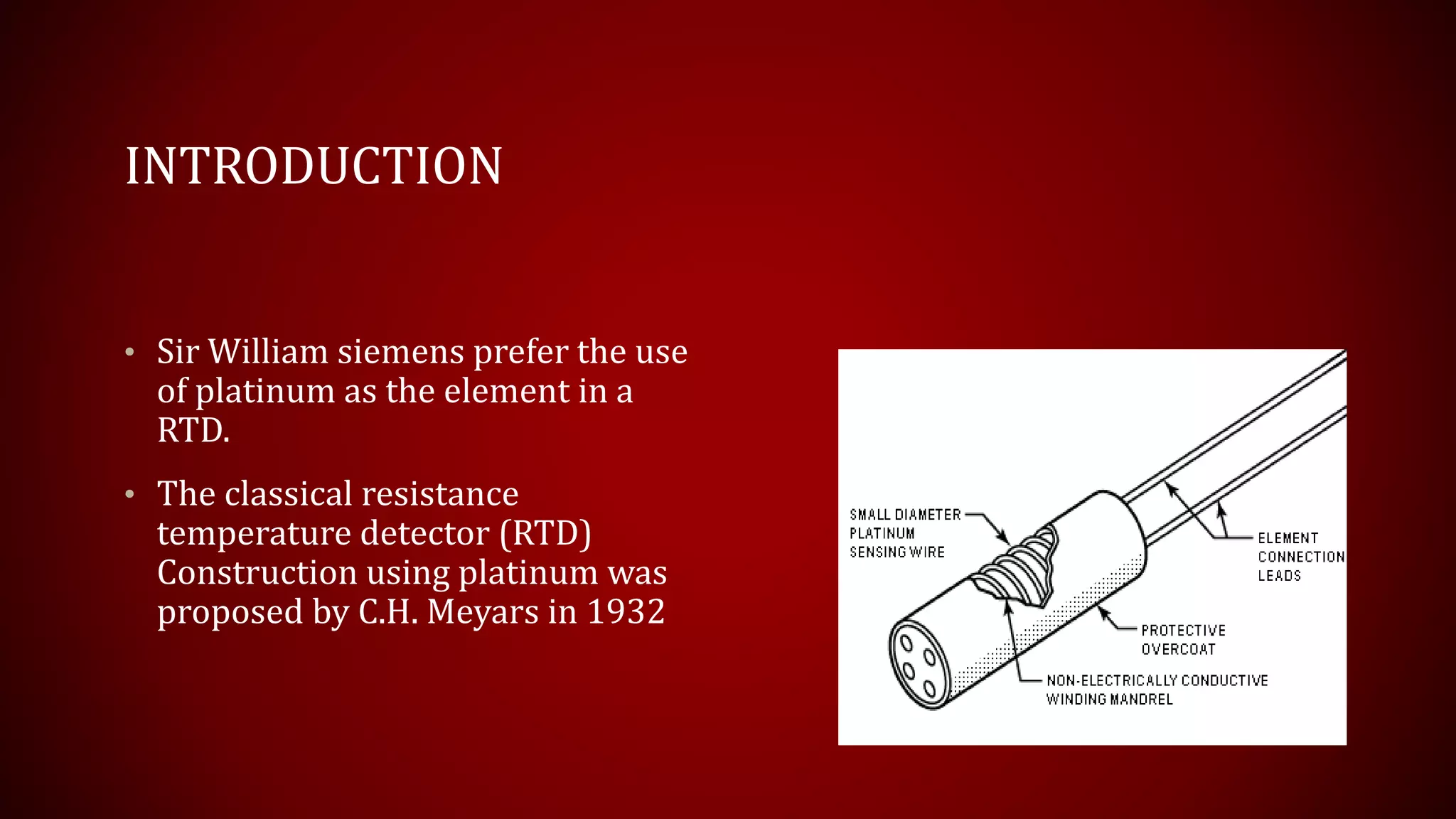
• Sir William siemens prefer the use
of platinum as the element in a
RTD.
• The classical resistance
temperature detector (RTD)
Construction using platinum was
proposed by C.H. Meyars in 1932
RESISTANCE TEMPERATURE DETECTOR(RTD’S)
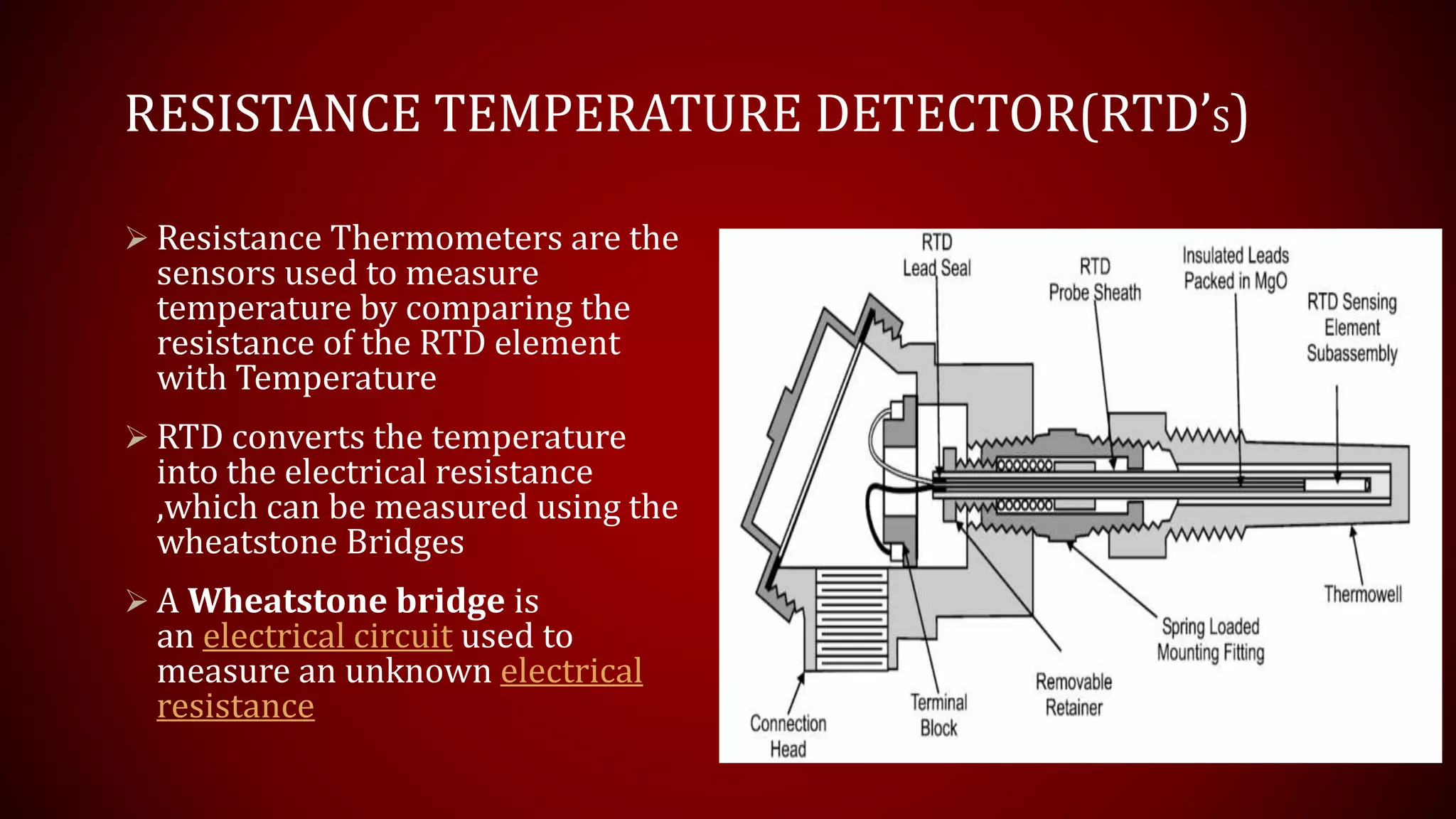
 Resistance Thermometers are the
sensors used to measure
temperature by comparing the
resistance of the RTD element
with Temperature
 RTD converts the temperature
into the electrical resistance
,which can be measured using the
wheatstone Bridges
 A Wheatstone bridge is
an electrical circuit used to
measure an unknown electrical
resistance
PT 100
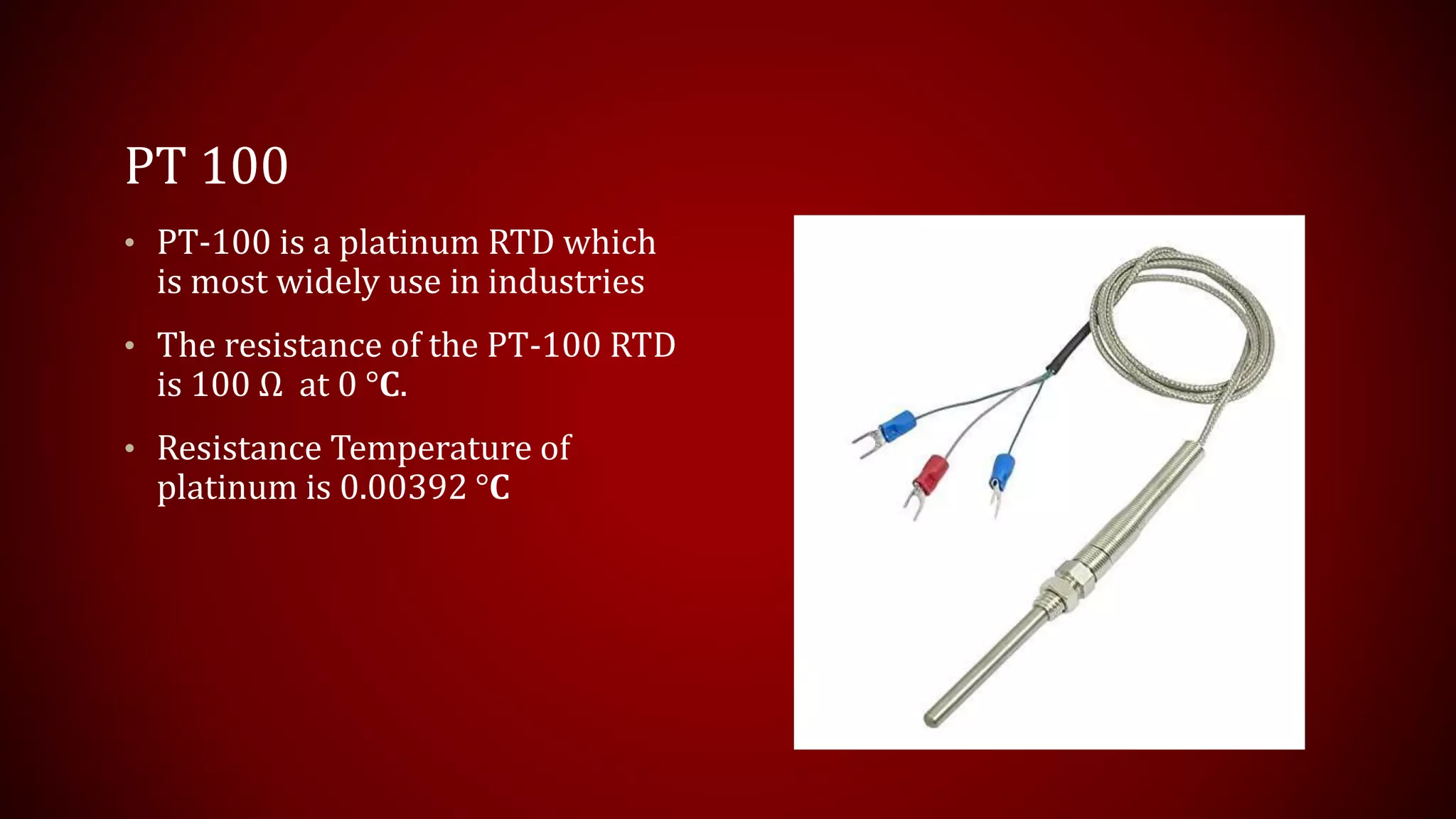
• PT-100 is a platinum RTD which
is most widely use in industries
• The resistance of the PT-100 RTD
is 100 Ω at 0 °C.
• Resistance Temperature of
platinum is 0.00392 °C
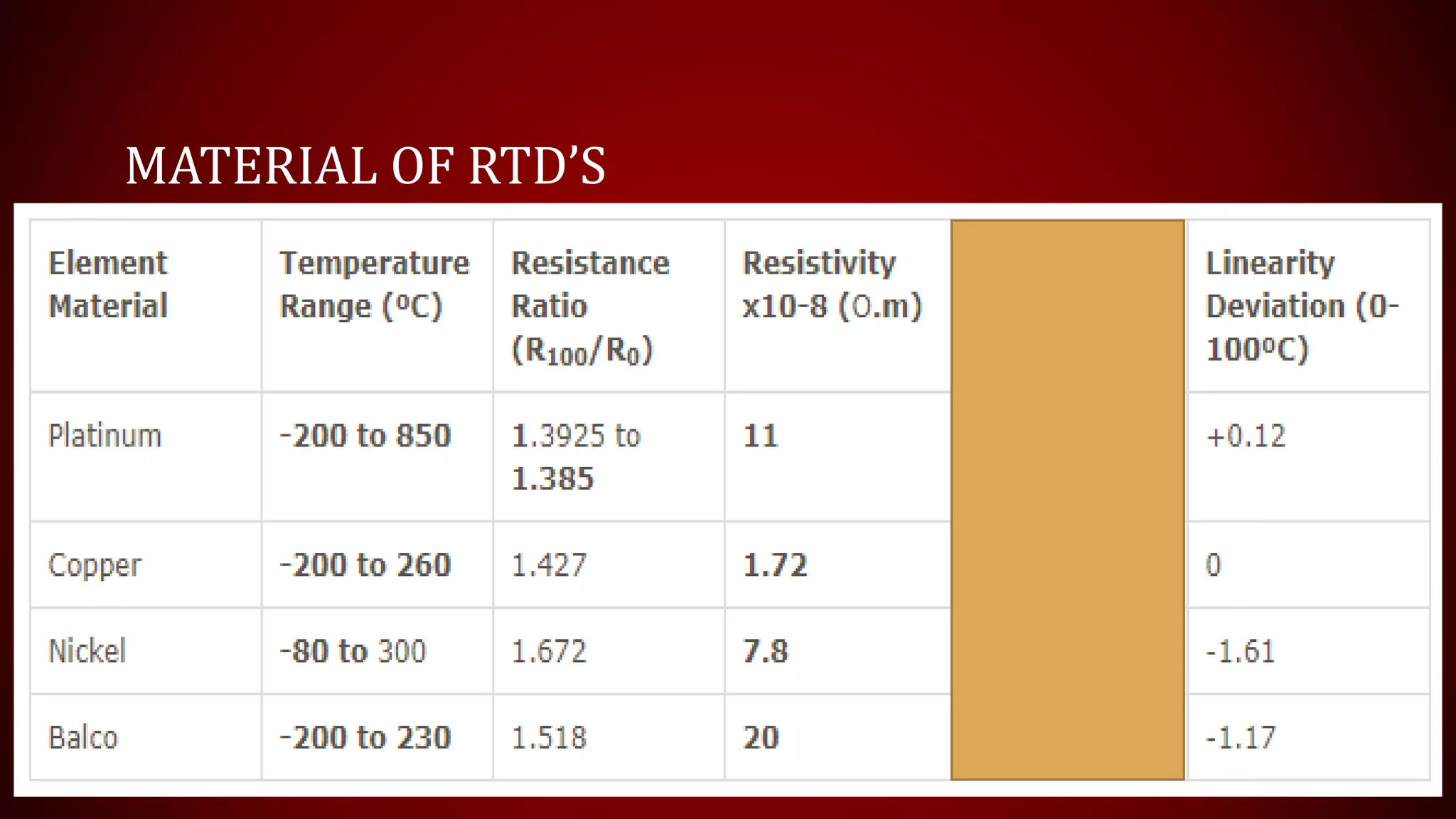
MATERIAL OF RTD’S
Name Ishtiaq Hussain
Roll No 304/F17
Group No #02
BSc Mech Engr & Tech
RTD’S CONFIGURATIONS
• RTD is available in basically three
configurations
• Two wire compensation
• Three wire compensation
• Four wire compensation
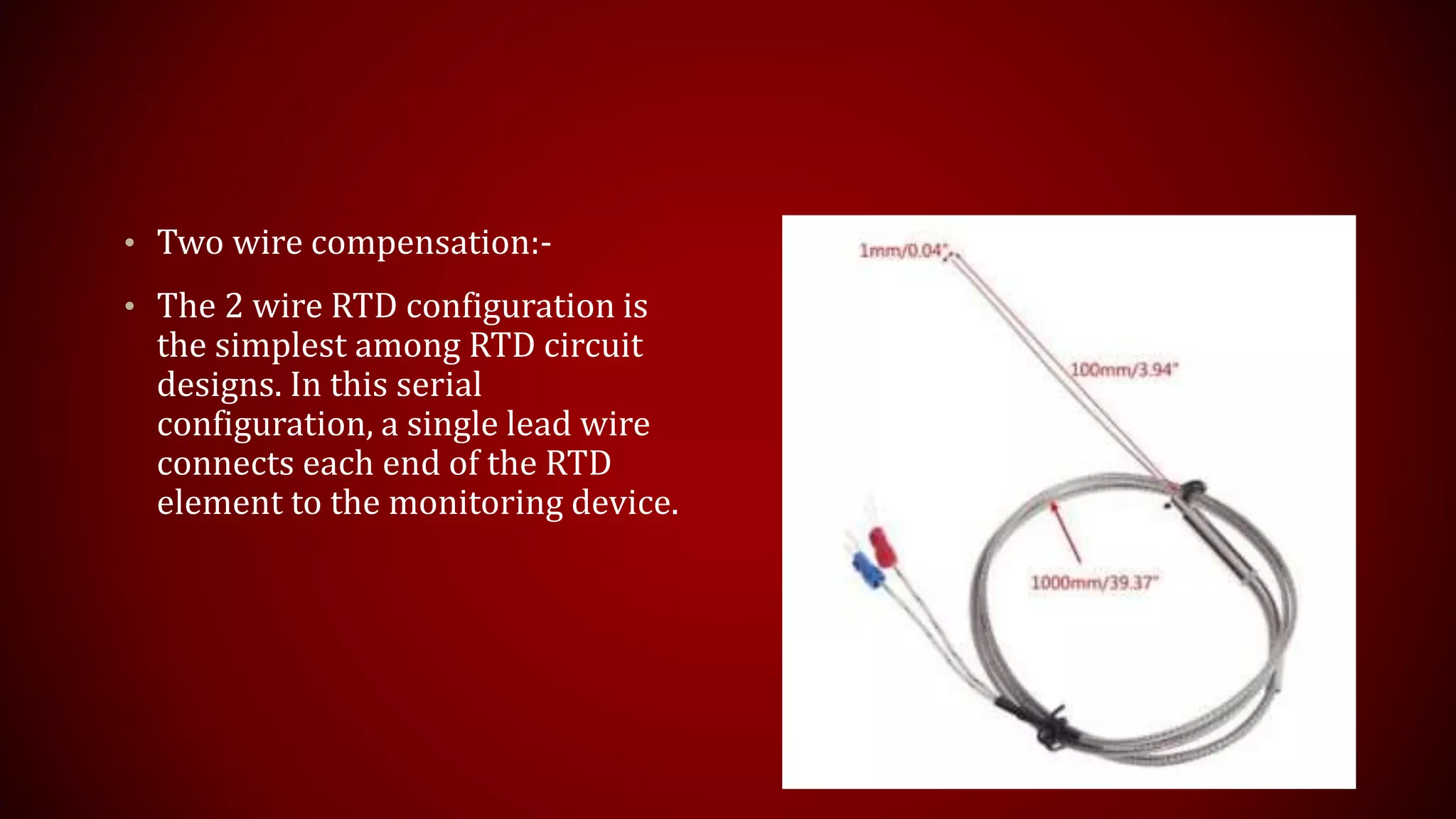
• Two wire compensation:-
• The 2 wire RTD configuration is
the simplest among RTD circuit
designs. In this serial
configuration, a single lead wire
connects each end of the RTD
element to the monitoring device.
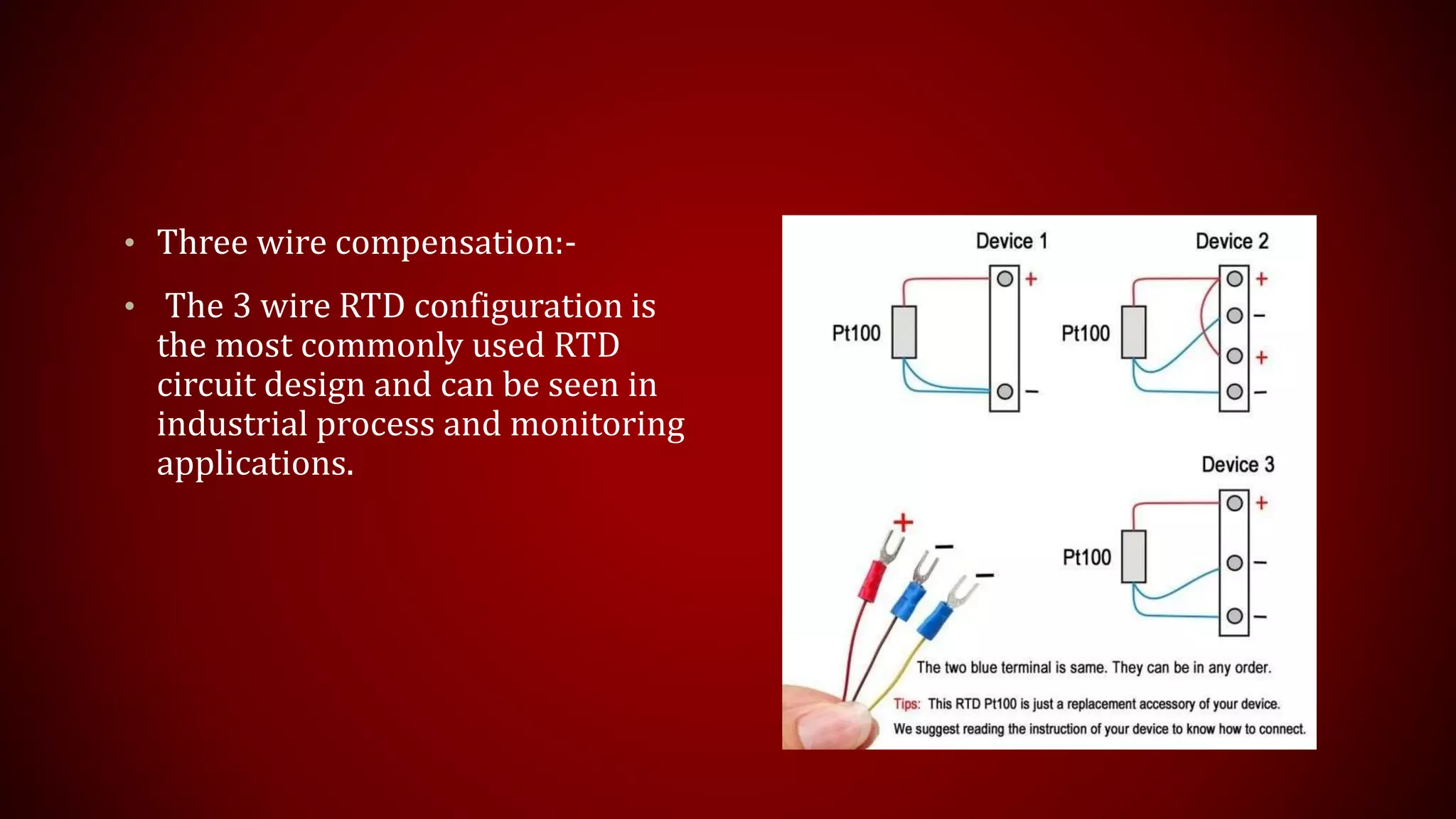
• Three wire compensation:-
• The 3 wire RTD configuration is
the most commonly used RTD
circuit design and can be seen in
industrial process and monitoring
applications.
Four wire compensation:-
This configuration is the most
complex and thus the most time-
consuming and expensive to install,
but it produces the most accurate
results.
WORKING OF RTD
Name Taimoor Hussain
Roll No 305/F17
Group No #02
BSc Mech Engr & Tech
APPLICATIONS OF RTD’S
• Air Conditioning and
Refrigeration
• Food processing
• Grills
• Plastics processing
• Petrochemical process
• Air temperature measurement
• Gas temperature measurement
• Liquid temperature measurement
• Exhaust gas temperature
measurement
ADVANTAGES OF RTD SENSORS
• RTD sensors have many
advantages.
 Highly accurate
 High repeatability
 Offer precise measurement even
in extreme environments
 Long term stability
 Platinum RTD are suitable for
higher temperature ranges
 No special wire required for
installation
 Easy Installation
•
DISADVANTAGE OF RTD SENSOR
 The RTD require more complex
measurement circuit.
 More limited temperature range
(-200 deg C to 500 deg C)
 High initial price
 Slower response time than a
thermocouple
 Possibility of self heating.
• It is affected by shock and
vibration.

What is RTD

  • 1.
    Name Zahid Abbas RollNo 312/F17 Group No #02 BSc Mech Engr & Tech
  • 2.
  • 3.
    Introduction Resistance Temperature Detector Configurations Workingof RTD Applications Advantages Disadvantage Contents
  • 4.
    INTRODUCTION • Sir Williamsiemens prefer the use of platinum as the element in a RTD. • The classical resistance temperature detector (RTD) Construction using platinum was proposed by C.H. Meyars in 1932
  • 5.
    RESISTANCE TEMPERATURE DETECTOR(RTD’S) Resistance Thermometers are the sensors used to measure temperature by comparing the resistance of the RTD element with Temperature  RTD converts the temperature into the electrical resistance ,which can be measured using the wheatstone Bridges  A Wheatstone bridge is an electrical circuit used to measure an unknown electrical resistance
  • 6.
    PT 100 • PT-100is a platinum RTD which is most widely use in industries • The resistance of the PT-100 RTD is 100 Ω at 0 °C. • Resistance Temperature of platinum is 0.00392 °C
  • 7.
  • 8.
    Name Ishtiaq Hussain RollNo 304/F17 Group No #02 BSc Mech Engr & Tech
  • 9.
    RTD’S CONFIGURATIONS • RTDis available in basically three configurations • Two wire compensation • Three wire compensation • Four wire compensation
  • 10.
    • Two wirecompensation:- • The 2 wire RTD configuration is the simplest among RTD circuit designs. In this serial configuration, a single lead wire connects each end of the RTD element to the monitoring device.
  • 11.
    • Three wirecompensation:- • The 3 wire RTD configuration is the most commonly used RTD circuit design and can be seen in industrial process and monitoring applications.
  • 12.
    Four wire compensation:- Thisconfiguration is the most complex and thus the most time- consuming and expensive to install, but it produces the most accurate results.
  • 13.
  • 14.
    Name Taimoor Hussain RollNo 305/F17 Group No #02 BSc Mech Engr & Tech
  • 15.
    APPLICATIONS OF RTD’S •Air Conditioning and Refrigeration • Food processing • Grills • Plastics processing • Petrochemical process • Air temperature measurement • Gas temperature measurement • Liquid temperature measurement • Exhaust gas temperature measurement
  • 16.
    ADVANTAGES OF RTDSENSORS • RTD sensors have many advantages.  Highly accurate  High repeatability  Offer precise measurement even in extreme environments  Long term stability  Platinum RTD are suitable for higher temperature ranges  No special wire required for installation  Easy Installation •
  • 17.
    DISADVANTAGE OF RTDSENSOR  The RTD require more complex measurement circuit.  More limited temperature range (-200 deg C to 500 deg C)  High initial price  Slower response time than a thermocouple  Possibility of self heating. • It is affected by shock and vibration.