Research Methods
It is actually way more exciting
than it sounds!!!!
Why do we have to learn this
stuff?
Psychology is first and foremost a science.
Thus it is based in research.
Before we delve into how to do research, you should be
aware of three hurdles that tend to skew our logic.
Hindsight Bias
• The tendency to
believe, after
learning the
outcome, that you
knew it all along.
Monday Morning
Quarterbacking!!!
After the Chris Brown/Rihanna
incident….my friend said she
knew Chris Brown was a violent
kid!!! Did she really?
Overconfidence
• We tend to think we
know more than we do.
• 82% of U.S. drivers consider
themselves to be in the top 30% of
their group in terms of safety.
• 81% of new business owners felt
they had an excellent chance of
their businesses succeeding. When
asked about the success of their
peers, the answer was only 39%.
(Now that's overconfidence!!!)
The Barnum Effect
• It is the tendency for
people to accept very
general or vague
characterizations of
themselves and take
them to be accurate.
Applied V. Basic Research
• Applied Research
has clear, practical
applications.
• YOU CAN USE IT!!!
• Basic Research
explores questions
that you may be
curious about, but
not intended to be
immediately used.
Research on therapies for drug addicts has
a clear purpose.
Studying how
kissing changes
when you get
older is
interesting…but
that’s about it.
Terminology
Hypothesis
• Expresses a relationship
between two variables.
• A variable is anything that
can vary among
participants in a study.
• Participating in class leads
to better grades than not
participating.
Independent Variable
• Whatever is being
manipulated in the
experiment.
• Hopefully the
independent variable
brings about change.
If there is a drug in an
experiment, the
drug is almost always
the independent
variable.
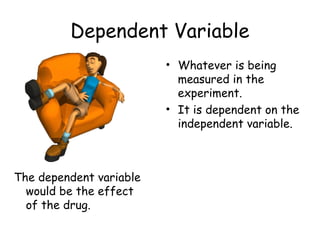
Dependent Variable
The dependent variable
would be the effect
of the drug.
• Whatever is being
measured in the
experiment.
• It is dependent on the
independent variable.
Operational Definitions
• Explain what you mean
in your hypothesis.
• How will the variables
be measured in “real
life” terms.
• How you
operationalize the
variables will tell us if
the study is valid and
reliable.
Let’s say your hypothesis
is that chocolate causes
violent behavior.
• What do you mean by
chocolate?
• What do you mean by
violent behavior?
Sampling
• Identify the
population you want
to study.
• The sample must be
representative of
the population you
want to study.
• GET A RANDOM
SAMPLE.
• Stratified Sampling
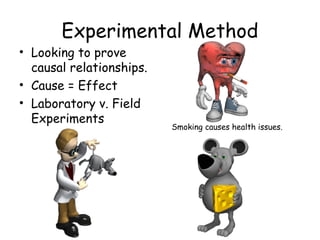
Experimental Method
• Looking to prove
causal relationships.
• Cause = Effect
• Laboratory v. Field
Experiments
Smoking causes health issues.
Beware of
Confounding Variables
If I wanted to prove that
smoking causes heart
issues, what are some
confounding variables?
• The object of an
experiment is to prove
that A causes B.
• A confounding variable
is anything that could
cause change in B, that
is not A.
Lifestyle and family
history may also
effect the heart.
Random Assignment
• Once you have a
random sample,
randomly assigning
them into two groups
helps control for
confounding variables.
• Experimental Group v.
Control Group.
• Group Matching
Hawthorne Effect
• But even the control
group may
experience changes.
• Just the fact that
you know you are in
an experiment can
cause change.
Whether the lights were brighter or
dimmer, production went up in the
Hawthorne electric plant.
Experimenter Bias
• Another confounding
variable.
• Not a conscious act.
• Double-Blind
Procedure.
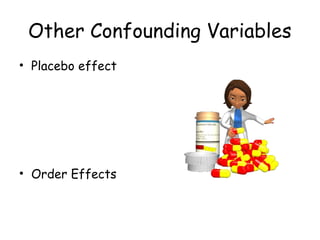
Other Confounding Variables
• Placebo effect
• Order Effects
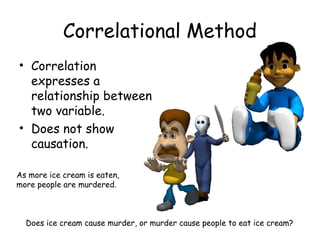
Correlational Method
• Correlation
expresses a
relationship between
two variable.
• Does not show
causation.
As more ice cream is eaten,
more people are murdered.
Does ice cream cause murder, or murder cause people to eat ice cream?
Types of Correlation
Positive Correlation
• The variables go in
the SAME direction.
Negative Correlation
• The variables go in
opposite directions.
Studying and
grades hopefully
has a positive
correlation.
Heroin use and
grades probably has
a negative
correlation.
Survey Method
•Most common type of
study in psychology
•Measures correlation
•Cheap and fast
•Need a good random
sample
•Low-response rate
Naturalistic Observation
• Watch subjects in their
natural environment.
• Do not manipulate the
environment.
• The good is that there is
Hawthorne effect.
• The bad is that we can
never really show cause
and effect.
Correlation Coefficient
• A number that
measures the
strength of a
relationship.
• Range is from -1 to +1
• The relationship gets
weaker the closer you
get to zero.
Which is a stronger
correlation?
• -.13 or +.38
• -.72 or +.59
• -.91 or +.04
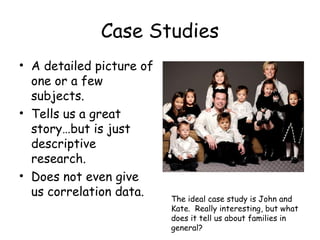
Case Studies
• A detailed picture of
one or a few
subjects.
• Tells us a great
story…but is just
descriptive
research.
• Does not even give
us correlation data. The ideal case study is John and
Kate. Really interesting, but what
does it tell us about families in
general?
Statistics
• Recording the
results from our
studies.
• Must use a common
language so we all
know what we are
talking about.
Descriptive Statistics
• Just describes sets
of data.
• You might create a
frequency distribution.
• Frequency polygons or
histograms.
Central Tendency
• Mean, Median and Mode.
• Watch out for extreme scores or outliers.
$25,000-Pam
$25,000- Kevin
$25,000- Angela
$100,000- Andy
$100,000- Dwight
$200,000- Jim
$300,000- Michael
Let’s look at the salaries of the
employees at Dunder Mifflen Paper
in Scranton:
The median salary looks good at
$100,000.
The mean salary also looks good at
about $110,000.
But the mode salary is only $25,000.
Maybe not the best place to work.
Then again living in Scranton is kind
of cheap.
Normal Distribution
• In a normal
distribution, the
mean, median and
mode are all the
same.
Distributions
• Outliers skew
distributions.
• If group has one high
score, the curve has a
positive skew
(contains more low
scores)
• If a group has a low
outlier, the curve has
a negative skew
(contains more high
scores)
Other measures of variability
• Range: distance from
highest to lowest
scores.
• Standard Deviation:
the variance of scores
around the mean.
• The higher the
variance or SD, the
more spread out the
distribution is.
• Do scientists want a
big or small SD?
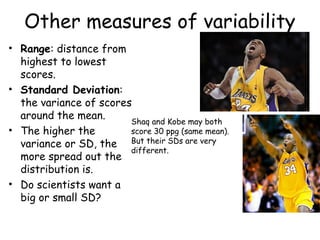
Shaq and Kobe may both
score 30 ppg (same mean).
But their SDs are very
different.
Scores
• A unit that measures
the distance of one
score from the mean.
• A positive z score
means a number above
the mean.
• A negative z score
means a number below
the mean.
Normal Distribution
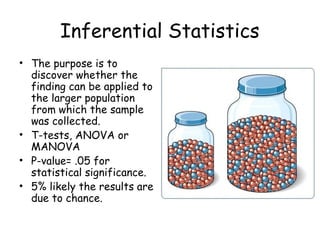
Inferential Statistics
• The purpose is to
discover whether the
finding can be applied to
the larger population
from which the sample
was collected.
• T-tests, ANOVA or
MANOVA
• P-value= .05 for
statistical significance.
• 5% likely the results are
due to chance.
APA Ethical Guidelines for
Research
• IRB- Internal Review
Board
• Both for humans and
animals.
Animal Research
• Clear purpose
• Treated in a humane
way
• Acquire animals
legally
• Least amount of
suffering possible.
Human Research
• No Coercion- must
be voluntary
• Informed consent
• Anonymity
• No significant risk
• Must debrief

Research methods

  • 1.
    Research Methods It isactually way more exciting than it sounds!!!!
  • 2.
    Why do wehave to learn this stuff? Psychology is first and foremost a science. Thus it is based in research. Before we delve into how to do research, you should be aware of three hurdles that tend to skew our logic.
  • 3.
    Hindsight Bias • Thetendency to believe, after learning the outcome, that you knew it all along. Monday Morning Quarterbacking!!! After the Chris Brown/Rihanna incident….my friend said she knew Chris Brown was a violent kid!!! Did she really?
  • 4.
    Overconfidence • We tendto think we know more than we do. • 82% of U.S. drivers consider themselves to be in the top 30% of their group in terms of safety. • 81% of new business owners felt they had an excellent chance of their businesses succeeding. When asked about the success of their peers, the answer was only 39%. (Now that's overconfidence!!!)
  • 5.
    The Barnum Effect •It is the tendency for people to accept very general or vague characterizations of themselves and take them to be accurate.
  • 6.
    Applied V. BasicResearch • Applied Research has clear, practical applications. • YOU CAN USE IT!!! • Basic Research explores questions that you may be curious about, but not intended to be immediately used. Research on therapies for drug addicts has a clear purpose. Studying how kissing changes when you get older is interesting…but that’s about it.
  • 7.
  • 8.
    Hypothesis • Expresses arelationship between two variables. • A variable is anything that can vary among participants in a study. • Participating in class leads to better grades than not participating.
  • 9.
    Independent Variable • Whateveris being manipulated in the experiment. • Hopefully the independent variable brings about change. If there is a drug in an experiment, the drug is almost always the independent variable.
  • 10.
    Dependent Variable The dependentvariable would be the effect of the drug. • Whatever is being measured in the experiment. • It is dependent on the independent variable.
  • 11.
    Operational Definitions • Explainwhat you mean in your hypothesis. • How will the variables be measured in “real life” terms. • How you operationalize the variables will tell us if the study is valid and reliable. Let’s say your hypothesis is that chocolate causes violent behavior. • What do you mean by chocolate? • What do you mean by violent behavior?
  • 12.
    Sampling • Identify the populationyou want to study. • The sample must be representative of the population you want to study. • GET A RANDOM SAMPLE. • Stratified Sampling
  • 13.
    Experimental Method • Lookingto prove causal relationships. • Cause = Effect • Laboratory v. Field Experiments Smoking causes health issues.
  • 14.
    Beware of Confounding Variables IfI wanted to prove that smoking causes heart issues, what are some confounding variables? • The object of an experiment is to prove that A causes B. • A confounding variable is anything that could cause change in B, that is not A. Lifestyle and family history may also effect the heart.
  • 15.
    Random Assignment • Onceyou have a random sample, randomly assigning them into two groups helps control for confounding variables. • Experimental Group v. Control Group. • Group Matching
  • 16.
    Hawthorne Effect • Buteven the control group may experience changes. • Just the fact that you know you are in an experiment can cause change. Whether the lights were brighter or dimmer, production went up in the Hawthorne electric plant.
  • 17.
    Experimenter Bias • Anotherconfounding variable. • Not a conscious act. • Double-Blind Procedure.
  • 18.
    Other Confounding Variables •Placebo effect • Order Effects
  • 19.
    Correlational Method • Correlation expressesa relationship between two variable. • Does not show causation. As more ice cream is eaten, more people are murdered. Does ice cream cause murder, or murder cause people to eat ice cream?
  • 20.
    Types of Correlation PositiveCorrelation • The variables go in the SAME direction. Negative Correlation • The variables go in opposite directions. Studying and grades hopefully has a positive correlation. Heroin use and grades probably has a negative correlation.
  • 21.
    Survey Method •Most commontype of study in psychology •Measures correlation •Cheap and fast •Need a good random sample •Low-response rate
  • 22.
    Naturalistic Observation • Watchsubjects in their natural environment. • Do not manipulate the environment. • The good is that there is Hawthorne effect. • The bad is that we can never really show cause and effect.
  • 23.
    Correlation Coefficient • Anumber that measures the strength of a relationship. • Range is from -1 to +1 • The relationship gets weaker the closer you get to zero. Which is a stronger correlation? • -.13 or +.38 • -.72 or +.59 • -.91 or +.04
  • 24.
    Case Studies • Adetailed picture of one or a few subjects. • Tells us a great story…but is just descriptive research. • Does not even give us correlation data. The ideal case study is John and Kate. Really interesting, but what does it tell us about families in general?
  • 25.
    Statistics • Recording the resultsfrom our studies. • Must use a common language so we all know what we are talking about.
  • 26.
    Descriptive Statistics • Justdescribes sets of data. • You might create a frequency distribution. • Frequency polygons or histograms.
  • 27.
    Central Tendency • Mean,Median and Mode. • Watch out for extreme scores or outliers. $25,000-Pam $25,000- Kevin $25,000- Angela $100,000- Andy $100,000- Dwight $200,000- Jim $300,000- Michael Let’s look at the salaries of the employees at Dunder Mifflen Paper in Scranton: The median salary looks good at $100,000. The mean salary also looks good at about $110,000. But the mode salary is only $25,000. Maybe not the best place to work. Then again living in Scranton is kind of cheap.
  • 28.
    Normal Distribution • Ina normal distribution, the mean, median and mode are all the same.
  • 29.
    Distributions • Outliers skew distributions. •If group has one high score, the curve has a positive skew (contains more low scores) • If a group has a low outlier, the curve has a negative skew (contains more high scores)
  • 30.
    Other measures ofvariability • Range: distance from highest to lowest scores. • Standard Deviation: the variance of scores around the mean. • The higher the variance or SD, the more spread out the distribution is. • Do scientists want a big or small SD? Shaq and Kobe may both score 30 ppg (same mean). But their SDs are very different.
  • 31.
    Scores • A unitthat measures the distance of one score from the mean. • A positive z score means a number above the mean. • A negative z score means a number below the mean.
  • 32.
  • 33.
    Inferential Statistics • Thepurpose is to discover whether the finding can be applied to the larger population from which the sample was collected. • T-tests, ANOVA or MANOVA • P-value= .05 for statistical significance. • 5% likely the results are due to chance.
  • 34.
    APA Ethical Guidelinesfor Research • IRB- Internal Review Board • Both for humans and animals.
  • 35.
    Animal Research • Clearpurpose • Treated in a humane way • Acquire animals legally • Least amount of suffering possible.
  • 36.
    Human Research • NoCoercion- must be voluntary • Informed consent • Anonymity • No significant risk • Must debrief