
RESEARCH METHODS http://crisbertcualteros.page.tl
KINDS OF RESEARCH A. Basic Research subjects are either healthy humans or experimental  animals aims to develop understanding of normal events in the human body
KINDS OF RESEARCH B. Epidemiological Research uses populations or groups of healthy and or diseased subjects primarily used for the identification of risk factors and causes of disease basis for development of preventive measures
KINDS OF RESEARCH C. Clinical Research done on patients understanding of disease process identification of determinants of outcome of disease for development of technology for diagnosis and treatment
BASIC STEPS OF RESEARCH   A. Technical 1. Identification and definition of the    problem analysis of needs review of literature determination of significance of the problem formulation of hypothesis and categorization of variables
BASIC STEPS OF RESEARCH A. Technical 2. Planning the Research statement of objectives selection of study population and subjects choosing research design method of data collection plan of data processing and analysis
BASIC STEPS OF RESEARCH A. Technical 3. Implementation of Plan data collection data processing data analysis 4. Interpretation and conclusion 5. Reporting of the study results
BASIC STEPS OF RESEARCH B. Administrative 1. General preparations secure resources for implementation hiring and training of personnel scheduling of activities preparation of study area sampling of study group
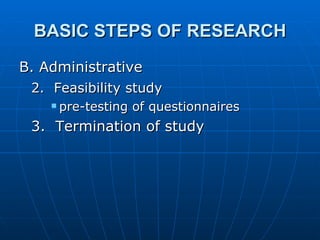
BASIC STEPS OF RESEARCH B. Administrative 2.  Feasibility study   pre-testing of questionnaires 3.  Termination of study
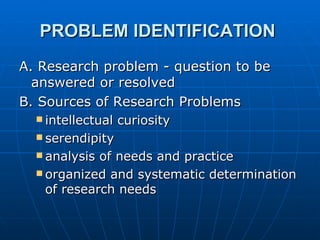
PROBLEM IDENTIFICATION  A. Research problem - question to be answered or resolved B. Sources of Research Problems intellectual curiosity serendipity analysis of needs and practice organized and systematic determination of research needs
PROBLEM IDENTIFICATION  C. Criteria for a Good Research Problem 1. researchability can be resolved through research does not require value judgment 2. significance problem: affects a large population has serious morbidity consequences is related to on-going projects
PROBLEM IDENTIFICATION  C. Criteria for a Good Research Problem 2. significance answer: fills a gap in knowledge has practical application will improve the practice of profession
PROBLEM IDENTIFICATION  C. Criteria for a Good Research Problem 3. feasibility Adequate number of subjects can be gathered. Procedures are technically possible. Information needed can be collected. Resources are available. Study can be completed within a reasonable period.
PROBLEM IDENTIFICATION  C. Criteria for a Good Research Problem 4. critical mass   broad in scope 5. interest   within national or institutional mission
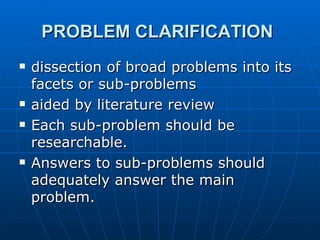
PROBLEM CLARIFICATION   dissection of broad problems into its facets or sub-problems aided by literature review Each sub-problem should be researchable. Answers to sub-problems should adequately answer the main problem.
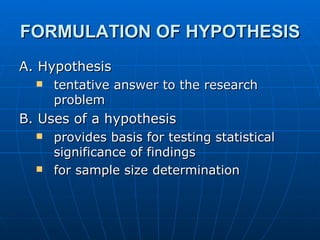
FORMULATION OF HYPOTHESIS   A. Hypothesis  tentative answer to the research problem B. Uses of a hypothesis provides basis for testing statistical significance of findings for sample size determination
FORMULATION OF HYPOTHESIS C. Types of Hypotheses Null Alternative One-tailed Two-tailed
FORMULATION OF HYPOTHESIS D. Uses of Null Hypothesis to test safety of drugs and other interventions for “proving” that a health belief is a myth or is erroneous E. Uses of Alternative Hypothesis for testing risk and prognostic factors for testing intervention
FORMULATION OF HYPOTHESIS F. Methods of Formulating Hypothesis 1. method of difference   If two different populations give rise to marked differences in frequency of disease and a particular factor can be identified in one population but not in the other, then the presence of this factor may be a cause of the disease. ex.: socio-economic factor and disease frequency
FORMULATION OF HYPOTHESIS F. Methods of Formulating Hypothesis 2. method of agreement If a factor is similarly distributed among different events or circumstances associated with the disease, then the factor may be a cause of the disease. ex.: blood and other body fluids are common to the different modes of transmission associated with HIV
FORMULATION OF HYPOTHESIS F. Methods of Formulating Hypothesis 3. method of concomitant variation If the frequency or strength of a factor correspondingly varies with the frequency of disease, the factor may be causally related to the disease. ex.: amount of alcohol consumption and frequency of primary liver cancer
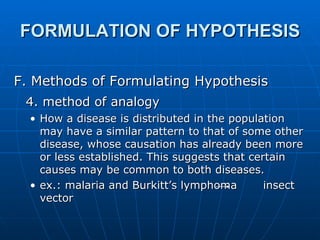
FORMULATION OF HYPOTHESIS F. Methods of Formulating Hypothesis 4. method of analogy   How a disease is distributed in the population may have a similar pattern to that of some other disease, whose causation has already been more or less established. This suggests that certain causes may be common to both diseases. ex.: malaria and Burkitt’s lymphoma  insect vector
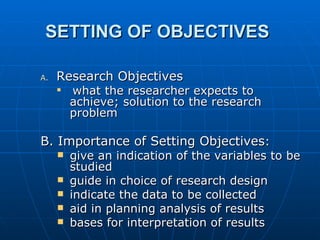
SETTING OF OBJECTIVES   Research Objectives  what the researcher expects to achieve; solution to the research problem B. Importance of Setting Objectives : give an indication of the variables to be studied guide in choice of research design indicate the data to be collected aid in planning analysis of results bases for interpretation of results
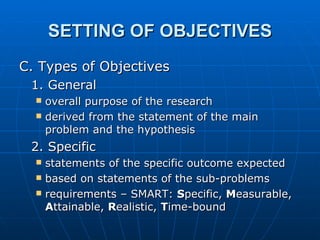
SETTING OF OBJECTIVES C. Types of Objectives 1. General overall purpose of the research derived from the statement of the main problem and the hypothesis 2. Specific statements of the specific outcome expected based on statements of the sub-problems requirements – SMART:  S pecific,  M easurable,  A ttainable,  R ealistic,  T ime-bound
SETTING OF OBJECTIVES D. Variables   Classification of Variables in an Association   independent variable  – variable which is assumed to be the factor or the cause dependent variable  – variable that is assumed to be the effect or outcome confounding variable  – variable other than the exposure variable under investigation that is a risk factor of the disease and is associated with but not a consequence of the exposure and is likewise associated with the dependent variable
CHOOSING THE APPROPRIATE RESEARCH DESIGN   Summary of Requirements of Each Type of Research Design  Requirements   Study Design   Descriptive  Cross-  Case-  Cohort    Sectional  Control Adequate Sample Size  √  √  √  √  Sample representative  of target  population  √  √  -  -  Controls  -  -  √  √  Similarity of  comparison groups  -  -  √  √
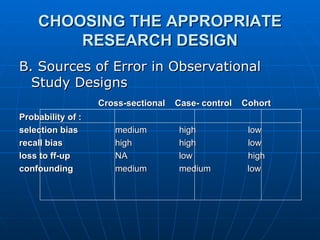
CHOOSING THE APPROPRIATE RESEARCH DESIGN B. Sources of Error in Observational Study Designs     Cross-sectional  Case- control  Cohort Probability of :  selection bias  medium   high   low recall bias  high  high   low  loss to ff-up  NA low   high confounding   medium  medium  low
Data Collection  (Note: see section on measurement of Health and Disease) Data Processing A. Data processing   process of converting data into a form that will facilitate    statistical analysis
DATA PROCESSING B. Steps 1. editing  – checking for completeness, consistency and accuracy of data 2. coding  - conversion of data into numbers or symbols which can be more easily tabulated and counted 3. creation of data file  - storing data for future processing 4. summarization  – creation of master tables, frequency tables, etc.
Data Analysis  (Note: see section on Statistical Inference and Hypothesis Testing and relevant sections in Epidemiology)
RESEARCH PROPOSAL WRITING A. Research Proposal/Protocol   written plan of the research process guides investigator in executing project basis for evaluation of merit and feasibility of the project
RESEARCH PROPOSAL WRITING B.  Stages in Preparation 1. Step 1 Technical procedure   Problem ID, Hypothesis formulation, Objectives, Research design, Data collection planning, Development of data processing, Choosing statistical analysis method
RESEARCH PROPOSAL WRITING B.  Stages in Preparation 2. Step 2 Administrative procedures  Scheduling of various phases, Determining personnel requirement, List needed facilities, Budget preparation 3. Step 3 Writing of proposal
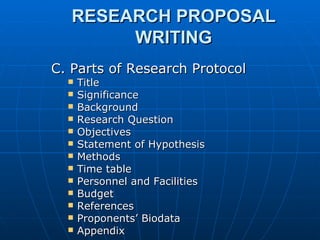
RESEARCH PROPOSAL WRITING C. Parts of Research Protocol Title Significance Background Research Question Objectives Statement of Hypothesis Methods Time table Personnel and Facilities Budget References Proponents’ Biodata Appendix

Research Methods

  • 1.
  • 2.
    KINDS OF RESEARCHA. Basic Research subjects are either healthy humans or experimental animals aims to develop understanding of normal events in the human body
  • 3.
    KINDS OF RESEARCHB. Epidemiological Research uses populations or groups of healthy and or diseased subjects primarily used for the identification of risk factors and causes of disease basis for development of preventive measures
  • 4.
    KINDS OF RESEARCHC. Clinical Research done on patients understanding of disease process identification of determinants of outcome of disease for development of technology for diagnosis and treatment
  • 5.
    BASIC STEPS OFRESEARCH A. Technical 1. Identification and definition of the problem analysis of needs review of literature determination of significance of the problem formulation of hypothesis and categorization of variables
  • 6.
    BASIC STEPS OFRESEARCH A. Technical 2. Planning the Research statement of objectives selection of study population and subjects choosing research design method of data collection plan of data processing and analysis
  • 7.
    BASIC STEPS OFRESEARCH A. Technical 3. Implementation of Plan data collection data processing data analysis 4. Interpretation and conclusion 5. Reporting of the study results
  • 8.
    BASIC STEPS OFRESEARCH B. Administrative 1. General preparations secure resources for implementation hiring and training of personnel scheduling of activities preparation of study area sampling of study group
  • 9.
    BASIC STEPS OFRESEARCH B. Administrative 2. Feasibility study pre-testing of questionnaires 3. Termination of study
  • 10.
    PROBLEM IDENTIFICATION A. Research problem - question to be answered or resolved B. Sources of Research Problems intellectual curiosity serendipity analysis of needs and practice organized and systematic determination of research needs
  • 11.
    PROBLEM IDENTIFICATION C. Criteria for a Good Research Problem 1. researchability can be resolved through research does not require value judgment 2. significance problem: affects a large population has serious morbidity consequences is related to on-going projects
  • 12.
    PROBLEM IDENTIFICATION C. Criteria for a Good Research Problem 2. significance answer: fills a gap in knowledge has practical application will improve the practice of profession
  • 13.
    PROBLEM IDENTIFICATION C. Criteria for a Good Research Problem 3. feasibility Adequate number of subjects can be gathered. Procedures are technically possible. Information needed can be collected. Resources are available. Study can be completed within a reasonable period.
  • 14.
    PROBLEM IDENTIFICATION C. Criteria for a Good Research Problem 4. critical mass broad in scope 5. interest within national or institutional mission
  • 15.
    PROBLEM CLARIFICATION dissection of broad problems into its facets or sub-problems aided by literature review Each sub-problem should be researchable. Answers to sub-problems should adequately answer the main problem.
  • 16.
    FORMULATION OF HYPOTHESIS A. Hypothesis tentative answer to the research problem B. Uses of a hypothesis provides basis for testing statistical significance of findings for sample size determination
  • 17.
    FORMULATION OF HYPOTHESISC. Types of Hypotheses Null Alternative One-tailed Two-tailed
  • 18.
    FORMULATION OF HYPOTHESISD. Uses of Null Hypothesis to test safety of drugs and other interventions for “proving” that a health belief is a myth or is erroneous E. Uses of Alternative Hypothesis for testing risk and prognostic factors for testing intervention
  • 19.
    FORMULATION OF HYPOTHESISF. Methods of Formulating Hypothesis 1. method of difference If two different populations give rise to marked differences in frequency of disease and a particular factor can be identified in one population but not in the other, then the presence of this factor may be a cause of the disease. ex.: socio-economic factor and disease frequency
  • 20.
    FORMULATION OF HYPOTHESISF. Methods of Formulating Hypothesis 2. method of agreement If a factor is similarly distributed among different events or circumstances associated with the disease, then the factor may be a cause of the disease. ex.: blood and other body fluids are common to the different modes of transmission associated with HIV
  • 21.
    FORMULATION OF HYPOTHESISF. Methods of Formulating Hypothesis 3. method of concomitant variation If the frequency or strength of a factor correspondingly varies with the frequency of disease, the factor may be causally related to the disease. ex.: amount of alcohol consumption and frequency of primary liver cancer
  • 22.
    FORMULATION OF HYPOTHESISF. Methods of Formulating Hypothesis 4. method of analogy How a disease is distributed in the population may have a similar pattern to that of some other disease, whose causation has already been more or less established. This suggests that certain causes may be common to both diseases. ex.: malaria and Burkitt’s lymphoma insect vector
  • 23.
    SETTING OF OBJECTIVES Research Objectives what the researcher expects to achieve; solution to the research problem B. Importance of Setting Objectives : give an indication of the variables to be studied guide in choice of research design indicate the data to be collected aid in planning analysis of results bases for interpretation of results
  • 24.
    SETTING OF OBJECTIVESC. Types of Objectives 1. General overall purpose of the research derived from the statement of the main problem and the hypothesis 2. Specific statements of the specific outcome expected based on statements of the sub-problems requirements – SMART: S pecific, M easurable, A ttainable, R ealistic, T ime-bound
  • 25.
    SETTING OF OBJECTIVESD. Variables Classification of Variables in an Association independent variable – variable which is assumed to be the factor or the cause dependent variable – variable that is assumed to be the effect or outcome confounding variable – variable other than the exposure variable under investigation that is a risk factor of the disease and is associated with but not a consequence of the exposure and is likewise associated with the dependent variable
  • 26.
    CHOOSING THE APPROPRIATERESEARCH DESIGN Summary of Requirements of Each Type of Research Design Requirements Study Design Descriptive Cross- Case- Cohort Sectional Control Adequate Sample Size √ √ √ √ Sample representative of target population √ √ - - Controls - - √ √ Similarity of comparison groups - - √ √
  • 27.
    CHOOSING THE APPROPRIATERESEARCH DESIGN B. Sources of Error in Observational Study Designs   Cross-sectional Case- control Cohort Probability of : selection bias medium high low recall bias high high low loss to ff-up NA low high confounding medium medium low
  • 28.
    Data Collection (Note: see section on measurement of Health and Disease) Data Processing A. Data processing process of converting data into a form that will facilitate statistical analysis
  • 29.
    DATA PROCESSING B.Steps 1. editing – checking for completeness, consistency and accuracy of data 2. coding - conversion of data into numbers or symbols which can be more easily tabulated and counted 3. creation of data file - storing data for future processing 4. summarization – creation of master tables, frequency tables, etc.
  • 30.
    Data Analysis (Note: see section on Statistical Inference and Hypothesis Testing and relevant sections in Epidemiology)
  • 31.
    RESEARCH PROPOSAL WRITINGA. Research Proposal/Protocol written plan of the research process guides investigator in executing project basis for evaluation of merit and feasibility of the project
  • 32.
    RESEARCH PROPOSAL WRITINGB. Stages in Preparation 1. Step 1 Technical procedure Problem ID, Hypothesis formulation, Objectives, Research design, Data collection planning, Development of data processing, Choosing statistical analysis method
  • 33.
    RESEARCH PROPOSAL WRITINGB. Stages in Preparation 2. Step 2 Administrative procedures Scheduling of various phases, Determining personnel requirement, List needed facilities, Budget preparation 3. Step 3 Writing of proposal
  • 34.
    RESEARCH PROPOSAL WRITINGC. Parts of Research Protocol Title Significance Background Research Question Objectives Statement of Hypothesis Methods Time table Personnel and Facilities Budget References Proponents’ Biodata Appendix