What is Research?
Definition According to Kerlinger (1986) as mentioned by Fonollera (1993),   Research  is a systematic, controlled, and critical investigation of natural phenomena guided by theory and hypotheses about the presumed relations among phenomena.
Charateristics Empirical Logical Cyclical Analytical Replicability Critical   (Calmorin & Calmorin, 1995;9-10)
Charateristics Research … 1. is directed to solve a problem. 2. generates generalization, principles, or theories. 3. is based upon observable experience or empirical evidence. 4. demands accurate observation and description. 5. involves gathering new data from primary sources or existing data for a new purpose. 6. is systematic and applies rigorous analysis. 7. requires expertise. 8. strives to objective and logical. 9. is charaterized by patient and unharried activity. 10. requires courage  (Best as mentioned by Aquino,1992;4-6).
Importance of Research Improves quality of life Improves instruction Improves students’ achievement Satisfies man’s needs Reduces the burden of work Has deep-seated psychological aspects Improves the exportation of food products (Calmorin & Calmorin, 1995;5-8)
Characteristics of a Researcher Intellectual Curiosity Prudence Healthy Criticism Intellectual Honesty  (Calmorin & Calmorin, 1995;1-2)
Qualities of a Good Researcher R esearch oriented E fficient S cientific E ffective A ctive R esourceful C reative H onest E conomical R eligious  (Calmorin & Calmorin, 1995;2-3)
Types of Research Exploratory Research: undertaken with the aim of clarifying ambiguous problems general problems usually known but not sufficiently understood  the purpose is to get more information, not to uncover specific courses of action (subsequent research) Determining a specific course of action to follow is not a  purpose of exploratory research! Example: Child-Care support programme for employees
Types of Research Descriptive Research undertaken with the aim of determining the characteristics of a population or phenomenon Previous knowledge of problem exists High degree of precision or accuracy required Examples:  Who are the main consumers of organic foods? How many students read the prescribed course literature? Where do most holiday-makers travelling overseas go? When do petrol stations tend to raise their prices?
Types of Research Causal Research undertaken with the aim of identifying cause and effect relationships amongst variables  are normally preceeded by exploratory and descriptive research studies Often difficult to determine because of the influence of other variables (concommitant Variation and the presence of other hidden variables) Example: Higher ice-cream consumption causes more  people to drown (indicative of a causal relationship (?))
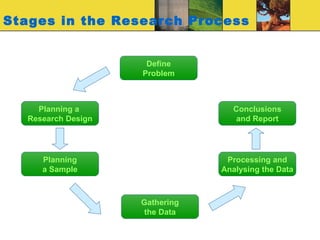
Stages in the Research Process Define Problem Planning a  Research Design Planning a Sample Gathering the Data Processing and Analysing the Data Conclusions and Report
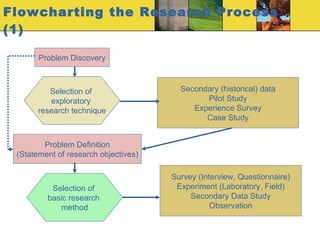
Flowcharting the Research Process (1) Problem Discovery Secondary (historical) data Pilot Study Experience Survey Case Study Problem Definition (Statement of research objectives) Selection of  exploratory  research technique Selection of  basic research  method Survey (Interview, Questionnaire) Experiment (Laboratory, Field) Secondary Data Study Observation
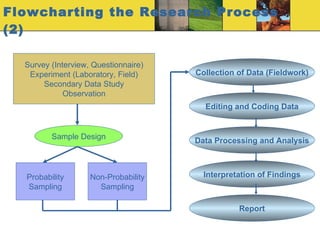
Flowcharting the Research Process (2) Survey (Interview, Questionnaire) Experiment (Laboratory, Field) Secondary Data Study Observation Sample Design Probability Sampling Non-Probability Sampling Collection of Data (Fieldwork) Editing and Coding Data Data Processing and Analysis Interpretation of Findings Report
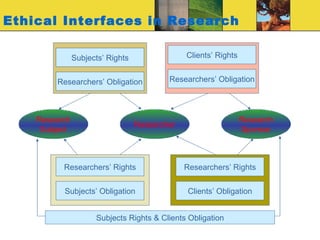
Ethical Interfaces in Research Subjects’ Rights Researchers’ Obligation Researchers’ Rights Clients’ Obligation Researchers’ Obligation Clients’ Rights Researchers’ Rights Subjects’ Obligation Research Subject Researcher Research Sponsor Subjects Rights & Clients Obligation
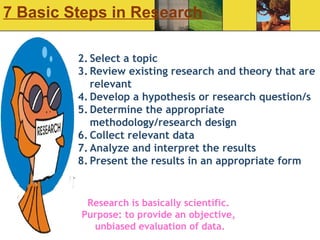
Select a topic Review existing research and theory that are relevant  Develop a hypothesis or research question/s Determine the appropriate methodology/research design Collect relevant data Analyze and interpret the results Present the results in an appropriate form Research is basically scientific.  Purpose: to provide an objective,  unbiased evaluation of data. 7 Basic Steps in Research
Factors to consider in the choice of a research topic Novel – When considering a research topic, the researcher has to focus on one which has not been investigated before. In the event that the problem has been studied before, he has to inject originality in it by coming up with another research design, using a different data-gathering tool or a different scheme for analyzing the research data.  2. Interesting – The researcher needs to consider his interest in the choice of a research problem. Interest counts a lot in the conduct of a study. If a researcher is not interested in the topic, it will be difficult on his part to put his heart and soul in it.
Factors to consider in the choice of a research problem 3. Relevant – The results of the study on a given problem should be of practical value to the researcher and the significant others in the field.  This means that once the study had been completed, its findings, its conclusions and recommendations can be used in improving practices or solving an identified difficulty.  Will the results add knowledge to information already available in the field?
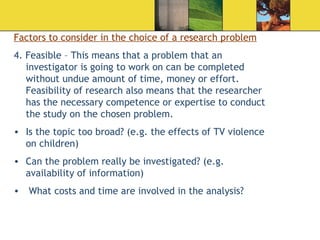
Factors to consider in the choice of a research problem 4. Feasible – This means that a problem that an investigator is going to work on can be completed without undue amount of time, money or effort. Feasibility of research also means that the researcher has the necessary competence or expertise to conduct the study on the chosen problem.  Is the topic too broad? (e.g. the effects of TV violence on children) Can the problem really be investigated? (e.g. availability of information) What costs and time are involved in the analysis?
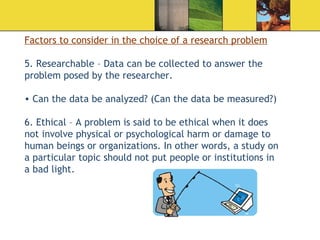
Factors to consider in the choice of a research problem 5. Researchable – Data can be collected to answer the problem posed by the researcher. Can the data be analyzed? (Can the data be measured?) 6. Ethical – A problem is said to be ethical when it does not involve physical or psychological harm or damage to human beings or organizations. In other words, a study on a particular topic should not put people or institutions in a bad light.
Reviewing the Literature The review of literature involves the critiquing or looking over what other researchers have done in relation to the topic to be studied.  Purpose:  the review of literature can broaden the researcher’s knowledge base in research area; it is a means of ensuring originality in the conduct of one’s research; it is a way of ensuring clarity and focus on one’s study; it can also provide the researcher insights on the weaknesses and strengths of previous studies;
Reviewing the Literature it can provide findings and conclusions of past studies, which a researcher can use in relating to his own study.  it can help the researcher in formulating the theoretical and conceptual framework for his research problem. #
Guidelines in doing the Review Search for existing literature in the library and on the web; 2. Prepare a working bibliography. Record all vital details concerning the books or research you are including in your bibliography (look at MLA style book) Write in 3x5 index cards; group together references from  a. books b. journals and periodicals c. unpublished material 3. Examine each material, then decide which ones will actually be included in your review
Characteristics of the Review  The text of the review should be brief and to the point. To ensure brevity and conciseness, you have to summarize or paraphrase important points. Avoid direct quotations of the author’s ideas or the results of the studies you are reviewing. 2. Have a plan on how you are to present the review. Prepare an outline before finally writing the review. This will ensure coherence and unity of ideas presented. The problem you are going to work on can serve as your outline for discussion of related literature and studies that are relevant to your proposed research.
Characteristics of the Review   3. Emphasize relatedness Keep the reader aware of the manner in which the literature you are discussing is related to your problem.  Try to point out what that relationship is. 4. Review the literature, don’t reproduce it Refrain from copying verbatim what authors and researchers say. Critically review and discuss the literature in relation to your research work.
Writing the Review Approaches to presenting the review: Chronological  Literature and studies are presented according to the year they were written. Sample outline: A. Introduction B. Recent literature & studies C. Least recent literature & studies D. Synthesis of the review
Writing the Review 2. Thematic Literature and studies with the same findings are grouped together. Sample outline: A. Introduction B. Literature & studies on Variable 1 C. Literature & studies on Variable 2   D. Synthesis of the review
Writing the Review 3. Country of origin  Literature and studies are categorized based on the country/continent where they came from. Sample outline: A. Introduction B. Foreign literature & studies  C. Local literature & studies    D. Synthesis of the review
Writing the Review Some notes: It is in the introduction where you make your readers aware of your approach in presenting the related literature; It is the synthesis where you specify the uniqueness of your study vis-à-vis the literature you had just discussed in the review. Assignment : After approval of topic. Start researching for and writing your Review of Related Literature.
Focusing on the Research Problem The problem is the    of any research project. Without a focused problem, there is no research.  In order to be able to identify a research problem, a researcher needs to know what are the available sources.  A research problem is usually posed as a question, preferably a direct and simple one.
Focusing on the Research Problem Types of Research Problems : Descriptive research – asks “what is” and suggests a survey research design; Some examples:  What is the prevailing organizational culture in broadcast networks? What is the status of the professional satisfaction of provincial radio journalists?  What is the level of ethical awareness of newspaper beat reporters in Metro Manila?
Focusing on the Research Problem 2. Relationship research – asks what is the relationship between two or more variables and implies a correlational design. Some examples: Does a commitment to ethics among media practitioners depend on their educational or professional training? Has the number of students pursuing a degree in journalism been affected by the issue of slain journalists? How does the relationship between the mayor and beat reporters affect the latters’ coverage of city hall?
Focusing on the Research Problem 3. Difference research – asks what is the difference between two or more groups/ approaches; Some examples: Is there a significant difference in the number of UP journalism and broadcast graduates who actually pursue a career in their field of study? Is there a difference between the work values of journalists who come from the State University vis-à-vis the private schools? How do male and female journalists compare in their coverage of disasters?
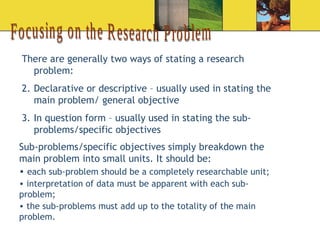
Focusing on the Research Problem There are generally two ways of stating a research problem: Declarative or descriptive – usually used in stating the main problem/ general objective  In question form – usually used in stating the sub-problems/specific objectives Sub-problems/specific objectives simply breakdown the main problem into small units. It should be: each sub-problem should be a completely researchable unit; interpretation of data must be apparent with each sub-problem; the sub-problems must add up to the totality of the main problem.
Defining Key Terms In any study, you need to define the key terms or concepts in the statement of the problem to avoid confusion or ambiguity. e.g. This research shall attempt to probe the relationship between the news about slain journalists and the number of students entering the journalism programs in Metro Manila universities.  Slain journalists Metro Manila universities  Journalism programs
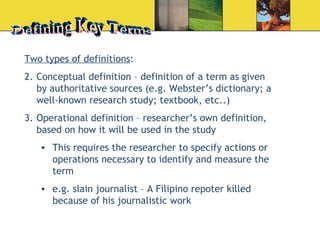
Defining Key Terms Two types of definitions : Conceptual definition – definition of a term as given by authoritative sources (e.g. Webster’s dictionary; a well-known research study; textbook, etc..) Operational definition – researcher’s own definition, based on how it will be used in the study This requires the researcher to specify actions or operations necessary to identify and measure the term  e.g. slain journalist – A Filipino repoter killed because of his journalistic work
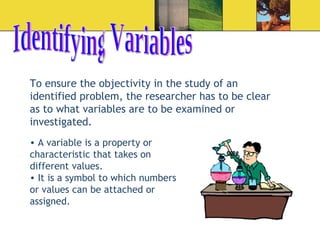
Identifying Variables To ensure the objectivity in the study of an identified problem, the researcher has to be clear as to what variables are to be examined or investigated.  A variable is a property or characteristic that takes on different values.  It is a symbol to which numbers or values can be attached or assigned.
Identifying Variables Types of variables : Independent variables – the cause supposed to be responsible for the bringing about change in a phenomenon or situation. Dependent variables – the outcome of change brought about by change in the independent variable Intervening variable – a variable whose existence is inferred but cannot be manipulated or controlled Moderator variable – a variable that may or may not be controlled but has an effect on the research situation/phenomenon.
Identifying Variables For example : Does a commitment to ethics among media practitioners depend on their educational or professional training? Independent variable: educational attainment of journalist. Dependent variables: ethical behavior, knowledge of Code of Ethics  Intervening variable: newsroom policies Moderator variables: civil status, age, years of work experience
Delimiting Research One way of making a study on a problem more focused is by delimiting it. Delimiting research is giving full disclosure of what the researcher intends to do or does not intend to do. When a researcher is able to set the scope and delimitation of his study, he can make his research manageable. At the same time, this can direct him to the choice of research method to employ.
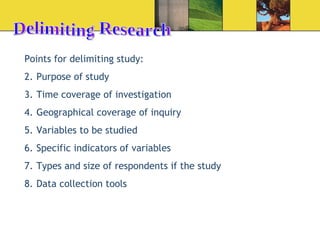
Delimiting Research Points for delimiting study: Purpose of study Time coverage of investigation Geographical coverage of inquiry Variables to be studied Specific indicators of variables Types and size of respondents if the study Data collection tools
Citing your Sources MLA – Modern Language of America   ( Philosophy, Languages, Literature, Communication) www.ccc.commnet.edu/ mla / format .shtml APA– American Psychological Association (Social and Behavioral Sciences, Education, Business) www.iirp.org/pdf/ APAFormat .pdf IEEE  (Institute of Electrical and Electronics Engineers)   (Engineering) www.library.uq.edu.au/pse/useits/ ieee _style.pdf CSE Council of Science Editors (Sciences [IT] and Natural Sciences) www.esf.edu/chemistry/FCH495/ CSE %20Citation%20Guide.pdf

What is research

  • 1.
  • 2.
    Definition According toKerlinger (1986) as mentioned by Fonollera (1993), Research is a systematic, controlled, and critical investigation of natural phenomena guided by theory and hypotheses about the presumed relations among phenomena.
  • 3.
    Charateristics Empirical LogicalCyclical Analytical Replicability Critical (Calmorin & Calmorin, 1995;9-10)
  • 4.
    Charateristics Research …1. is directed to solve a problem. 2. generates generalization, principles, or theories. 3. is based upon observable experience or empirical evidence. 4. demands accurate observation and description. 5. involves gathering new data from primary sources or existing data for a new purpose. 6. is systematic and applies rigorous analysis. 7. requires expertise. 8. strives to objective and logical. 9. is charaterized by patient and unharried activity. 10. requires courage (Best as mentioned by Aquino,1992;4-6).
  • 5.
    Importance of ResearchImproves quality of life Improves instruction Improves students’ achievement Satisfies man’s needs Reduces the burden of work Has deep-seated psychological aspects Improves the exportation of food products (Calmorin & Calmorin, 1995;5-8)
  • 6.
    Characteristics of aResearcher Intellectual Curiosity Prudence Healthy Criticism Intellectual Honesty (Calmorin & Calmorin, 1995;1-2)
  • 7.
    Qualities of aGood Researcher R esearch oriented E fficient S cientific E ffective A ctive R esourceful C reative H onest E conomical R eligious (Calmorin & Calmorin, 1995;2-3)
  • 8.
    Types of ResearchExploratory Research: undertaken with the aim of clarifying ambiguous problems general problems usually known but not sufficiently understood the purpose is to get more information, not to uncover specific courses of action (subsequent research) Determining a specific course of action to follow is not a purpose of exploratory research! Example: Child-Care support programme for employees
  • 9.
    Types of ResearchDescriptive Research undertaken with the aim of determining the characteristics of a population or phenomenon Previous knowledge of problem exists High degree of precision or accuracy required Examples: Who are the main consumers of organic foods? How many students read the prescribed course literature? Where do most holiday-makers travelling overseas go? When do petrol stations tend to raise their prices?
  • 10.
    Types of ResearchCausal Research undertaken with the aim of identifying cause and effect relationships amongst variables are normally preceeded by exploratory and descriptive research studies Often difficult to determine because of the influence of other variables (concommitant Variation and the presence of other hidden variables) Example: Higher ice-cream consumption causes more people to drown (indicative of a causal relationship (?))
  • 11.
    Stages in theResearch Process Define Problem Planning a Research Design Planning a Sample Gathering the Data Processing and Analysing the Data Conclusions and Report
  • 12.
    Flowcharting the ResearchProcess (1) Problem Discovery Secondary (historical) data Pilot Study Experience Survey Case Study Problem Definition (Statement of research objectives) Selection of exploratory research technique Selection of basic research method Survey (Interview, Questionnaire) Experiment (Laboratory, Field) Secondary Data Study Observation
  • 13.
    Flowcharting the ResearchProcess (2) Survey (Interview, Questionnaire) Experiment (Laboratory, Field) Secondary Data Study Observation Sample Design Probability Sampling Non-Probability Sampling Collection of Data (Fieldwork) Editing and Coding Data Data Processing and Analysis Interpretation of Findings Report
  • 14.
    Ethical Interfaces inResearch Subjects’ Rights Researchers’ Obligation Researchers’ Rights Clients’ Obligation Researchers’ Obligation Clients’ Rights Researchers’ Rights Subjects’ Obligation Research Subject Researcher Research Sponsor Subjects Rights & Clients Obligation
  • 15.
    Select a topicReview existing research and theory that are relevant Develop a hypothesis or research question/s Determine the appropriate methodology/research design Collect relevant data Analyze and interpret the results Present the results in an appropriate form Research is basically scientific. Purpose: to provide an objective, unbiased evaluation of data. 7 Basic Steps in Research
  • 16.
    Factors to considerin the choice of a research topic Novel – When considering a research topic, the researcher has to focus on one which has not been investigated before. In the event that the problem has been studied before, he has to inject originality in it by coming up with another research design, using a different data-gathering tool or a different scheme for analyzing the research data. 2. Interesting – The researcher needs to consider his interest in the choice of a research problem. Interest counts a lot in the conduct of a study. If a researcher is not interested in the topic, it will be difficult on his part to put his heart and soul in it.
  • 17.
    Factors to considerin the choice of a research problem 3. Relevant – The results of the study on a given problem should be of practical value to the researcher and the significant others in the field. This means that once the study had been completed, its findings, its conclusions and recommendations can be used in improving practices or solving an identified difficulty. Will the results add knowledge to information already available in the field?
  • 18.
    Factors to considerin the choice of a research problem 4. Feasible – This means that a problem that an investigator is going to work on can be completed without undue amount of time, money or effort. Feasibility of research also means that the researcher has the necessary competence or expertise to conduct the study on the chosen problem. Is the topic too broad? (e.g. the effects of TV violence on children) Can the problem really be investigated? (e.g. availability of information) What costs and time are involved in the analysis?
  • 19.
    Factors to considerin the choice of a research problem 5. Researchable – Data can be collected to answer the problem posed by the researcher. Can the data be analyzed? (Can the data be measured?) 6. Ethical – A problem is said to be ethical when it does not involve physical or psychological harm or damage to human beings or organizations. In other words, a study on a particular topic should not put people or institutions in a bad light.
  • 20.
    Reviewing the LiteratureThe review of literature involves the critiquing or looking over what other researchers have done in relation to the topic to be studied. Purpose: the review of literature can broaden the researcher’s knowledge base in research area; it is a means of ensuring originality in the conduct of one’s research; it is a way of ensuring clarity and focus on one’s study; it can also provide the researcher insights on the weaknesses and strengths of previous studies;
  • 21.
    Reviewing the Literatureit can provide findings and conclusions of past studies, which a researcher can use in relating to his own study. it can help the researcher in formulating the theoretical and conceptual framework for his research problem. #
  • 22.
    Guidelines in doingthe Review Search for existing literature in the library and on the web; 2. Prepare a working bibliography. Record all vital details concerning the books or research you are including in your bibliography (look at MLA style book) Write in 3x5 index cards; group together references from a. books b. journals and periodicals c. unpublished material 3. Examine each material, then decide which ones will actually be included in your review
  • 23.
    Characteristics of theReview The text of the review should be brief and to the point. To ensure brevity and conciseness, you have to summarize or paraphrase important points. Avoid direct quotations of the author’s ideas or the results of the studies you are reviewing. 2. Have a plan on how you are to present the review. Prepare an outline before finally writing the review. This will ensure coherence and unity of ideas presented. The problem you are going to work on can serve as your outline for discussion of related literature and studies that are relevant to your proposed research.
  • 24.
    Characteristics of theReview 3. Emphasize relatedness Keep the reader aware of the manner in which the literature you are discussing is related to your problem. Try to point out what that relationship is. 4. Review the literature, don’t reproduce it Refrain from copying verbatim what authors and researchers say. Critically review and discuss the literature in relation to your research work.
  • 25.
    Writing the ReviewApproaches to presenting the review: Chronological Literature and studies are presented according to the year they were written. Sample outline: A. Introduction B. Recent literature & studies C. Least recent literature & studies D. Synthesis of the review
  • 26.
    Writing the Review2. Thematic Literature and studies with the same findings are grouped together. Sample outline: A. Introduction B. Literature & studies on Variable 1 C. Literature & studies on Variable 2 D. Synthesis of the review
  • 27.
    Writing the Review3. Country of origin Literature and studies are categorized based on the country/continent where they came from. Sample outline: A. Introduction B. Foreign literature & studies C. Local literature & studies D. Synthesis of the review
  • 28.
    Writing the ReviewSome notes: It is in the introduction where you make your readers aware of your approach in presenting the related literature; It is the synthesis where you specify the uniqueness of your study vis-à-vis the literature you had just discussed in the review. Assignment : After approval of topic. Start researching for and writing your Review of Related Literature.
  • 29.
    Focusing on theResearch Problem The problem is the  of any research project. Without a focused problem, there is no research. In order to be able to identify a research problem, a researcher needs to know what are the available sources. A research problem is usually posed as a question, preferably a direct and simple one.
  • 30.
    Focusing on theResearch Problem Types of Research Problems : Descriptive research – asks “what is” and suggests a survey research design; Some examples: What is the prevailing organizational culture in broadcast networks? What is the status of the professional satisfaction of provincial radio journalists? What is the level of ethical awareness of newspaper beat reporters in Metro Manila?
  • 31.
    Focusing on theResearch Problem 2. Relationship research – asks what is the relationship between two or more variables and implies a correlational design. Some examples: Does a commitment to ethics among media practitioners depend on their educational or professional training? Has the number of students pursuing a degree in journalism been affected by the issue of slain journalists? How does the relationship between the mayor and beat reporters affect the latters’ coverage of city hall?
  • 32.
    Focusing on theResearch Problem 3. Difference research – asks what is the difference between two or more groups/ approaches; Some examples: Is there a significant difference in the number of UP journalism and broadcast graduates who actually pursue a career in their field of study? Is there a difference between the work values of journalists who come from the State University vis-à-vis the private schools? How do male and female journalists compare in their coverage of disasters?
  • 33.
    Focusing on theResearch Problem There are generally two ways of stating a research problem: Declarative or descriptive – usually used in stating the main problem/ general objective In question form – usually used in stating the sub-problems/specific objectives Sub-problems/specific objectives simply breakdown the main problem into small units. It should be: each sub-problem should be a completely researchable unit; interpretation of data must be apparent with each sub-problem; the sub-problems must add up to the totality of the main problem.
  • 34.
    Defining Key TermsIn any study, you need to define the key terms or concepts in the statement of the problem to avoid confusion or ambiguity. e.g. This research shall attempt to probe the relationship between the news about slain journalists and the number of students entering the journalism programs in Metro Manila universities. Slain journalists Metro Manila universities Journalism programs
  • 35.
    Defining Key TermsTwo types of definitions : Conceptual definition – definition of a term as given by authoritative sources (e.g. Webster’s dictionary; a well-known research study; textbook, etc..) Operational definition – researcher’s own definition, based on how it will be used in the study This requires the researcher to specify actions or operations necessary to identify and measure the term e.g. slain journalist – A Filipino repoter killed because of his journalistic work
  • 36.
    Identifying Variables Toensure the objectivity in the study of an identified problem, the researcher has to be clear as to what variables are to be examined or investigated. A variable is a property or characteristic that takes on different values. It is a symbol to which numbers or values can be attached or assigned.
  • 37.
    Identifying Variables Typesof variables : Independent variables – the cause supposed to be responsible for the bringing about change in a phenomenon or situation. Dependent variables – the outcome of change brought about by change in the independent variable Intervening variable – a variable whose existence is inferred but cannot be manipulated or controlled Moderator variable – a variable that may or may not be controlled but has an effect on the research situation/phenomenon.
  • 38.
    Identifying Variables Forexample : Does a commitment to ethics among media practitioners depend on their educational or professional training? Independent variable: educational attainment of journalist. Dependent variables: ethical behavior, knowledge of Code of Ethics Intervening variable: newsroom policies Moderator variables: civil status, age, years of work experience
  • 39.
    Delimiting Research Oneway of making a study on a problem more focused is by delimiting it. Delimiting research is giving full disclosure of what the researcher intends to do or does not intend to do. When a researcher is able to set the scope and delimitation of his study, he can make his research manageable. At the same time, this can direct him to the choice of research method to employ.
  • 40.
    Delimiting Research Pointsfor delimiting study: Purpose of study Time coverage of investigation Geographical coverage of inquiry Variables to be studied Specific indicators of variables Types and size of respondents if the study Data collection tools
  • 41.
    Citing your SourcesMLA – Modern Language of America ( Philosophy, Languages, Literature, Communication) www.ccc.commnet.edu/ mla / format .shtml APA– American Psychological Association (Social and Behavioral Sciences, Education, Business) www.iirp.org/pdf/ APAFormat .pdf IEEE (Institute of Electrical and Electronics Engineers) (Engineering) www.library.uq.edu.au/pse/useits/ ieee _style.pdf CSE Council of Science Editors (Sciences [IT] and Natural Sciences) www.esf.edu/chemistry/FCH495/ CSE %20Citation%20Guide.pdf