Thinking Critically with Psychological Science Chapter 1
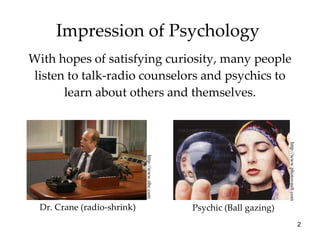
Impression of Psychology  With hopes of satisfying curiosity, many people listen to talk-radio counselors and psychics to learn about others and themselves. Dr. Crane (radio-shrink) http://www.nbc.com http://www.photovault.com Psychic (Ball gazing)
The Need for Psychological Science Intuition & Common Sense Many people believe that intuition and common sense are enough to bring forth answers regarding human nature. Intuition and common sense may aid queries, but they are not free of error.
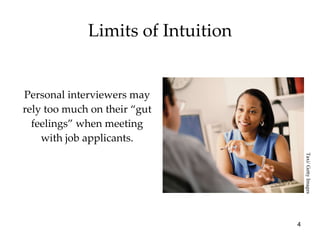
Limits of Intuition Personal interviewers may rely too much on their “gut feelings” when meeting with job applicants. Taxi/ Getty Images
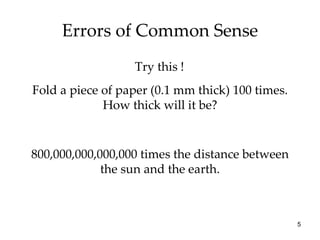
Errors of Common Sense Try this ! Fold a piece of paper (0.1 mm thick) 100 times. How thick will it be? 800,000,000,000,000 times the distance between the sun and the earth.
Hindsight Bias  is the “I-knew-it-all-along” phenomenon.   After learning the outcome of an event, many people believe they could have predicted that very outcome.  We only knew the dot.com stocks would plummet after they actually did plummet. Hindsight Bias
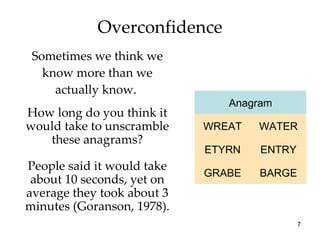
Overconfidence Sometimes we think we know more than we actually know.  Anagram BARGE GRABE ENTRY ETYRN WATER WREAT How long do you think it would take to unscramble these anagrams? People said it would take about 10 seconds, yet on average they took about 3 minutes (Goranson, 1978).
Psychological Science How can we differentiate between uniformed opinions and examined conclusions? The science of psychology helps make these examined conclusions, which leads to our understanding of how people  feel, think, and act   as they do!
The Scientific Attitude The scientific attitude is composed of  curiosity  (passion for exploration),  skepticism  (doubting and questioning) and  humility  (ability to accept responsibility when wrong).
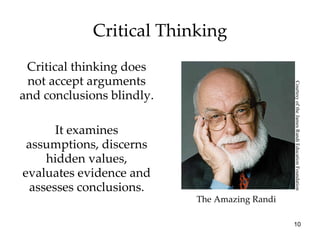
Critical Thinking Critical thinking does not accept arguments and conclusions blindly. It examines assumptions, discerns hidden values, evaluates evidence and assesses conclusions. The Amazing Randi Courtesy of the James Randi Education Foundation
Scientific Method Psychologists, like all scientists, use the scientific method to construct theories that organize, summarize and simplify observations.
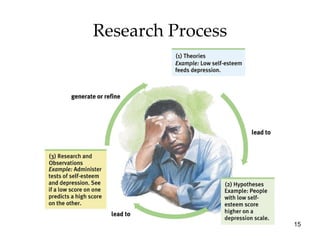
A  Theory  is   an explanation that integrates principles and organizes and predicts behavior or events. For example, low self-esteem contributes to depression. Theory
A  Hypothesis  is a testable prediction, often prompted by a theory, to enable us to accept, reject or revise the theory. People with low self-esteem are apt to feel more depressed. Hypothesis
Research  would require us to administer tests of self-esteem and depression. Individuals who score low on a self-esteem test and high on a depression test would confirm our hypothesis. Research Observations
Research Process
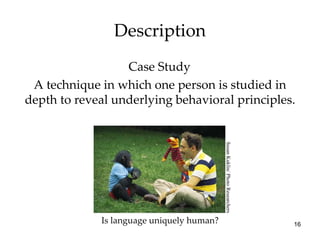
Description Case Study A technique in which one person is studied in depth to reveal underlying behavioral principles. Is language uniquely human? Susan Kuklin/ Photo Researchers
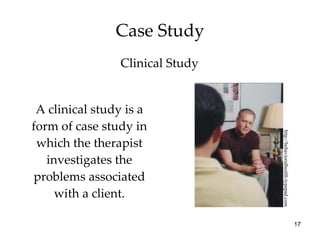
Case Study A clinical study is a form of case study in which the therapist investigates the problems associated with a client. http://behavioralhealth.typepad.com Clinical Study
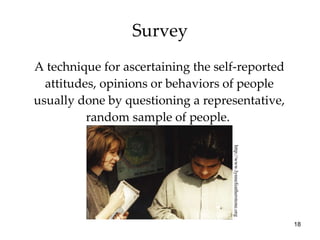
Survey A technique for ascertaining the self-reported attitudes, opinions or behaviors of people usually done by questioning a representative, random sample of people.  http://www.lynnefeatherstone.org
Survey Wording can change the results of a survey.  Q: Should cigarette ads and pornography be allowed on television? (not allowed vs. forbid) Wording Effect
Survey A tendency to overestimate the extent to which others share our beliefs and behaviors. False Consensus Effect
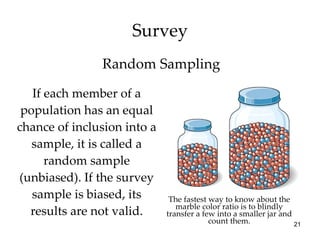
Survey If each member of a population has an equal chance of inclusion into a sample, it is called a random sample (unbiased). If the survey sample is biased, its results are not valid. Random Sampling The fastest way to know about the marble color ratio is to blindly transfer a few into a smaller jar and count them.
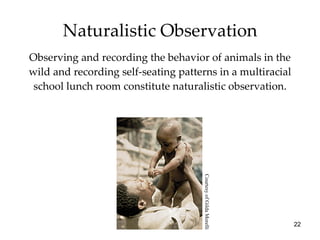
Naturalistic Observation Observing and recording the behavior of animals in the wild and recording self-seating patterns in a multiracial school lunch room constitute naturalistic observation. Courtesy of Gilda Morelli
Descriptive Methods Case studies, surveys, and naturalistic observation describe behaviors. Summary
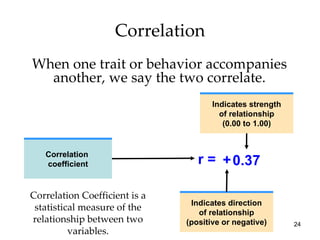
Correlation Correlation Coefficient is a statistical measure of the relationship between two variables. When one trait or behavior accompanies another, we say the two correlate. r = 0.37 + Correlation  coefficient Indicates direction of relationship (positive or negative) Indicates strength of relationship (0.00 to 1.00)
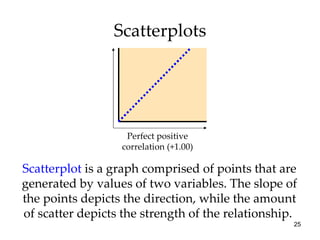
Scatterplots Perfect positive correlation (+1.00) Scatterplot   is a graph comprised of points that are generated by values of two variables. The slope of the points depicts the direction, while the amount of scatter depicts the strength of the relationship.
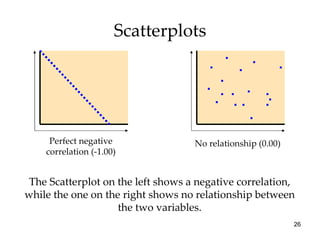
Scatterplots No relationship (0.00) Perfect negative correlation (-1.00) The Scatterplot on the left shows a negative correlation, while the one on the right shows no relationship between the two variables.
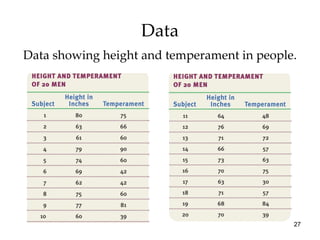
Data Data showing height and temperament in people.
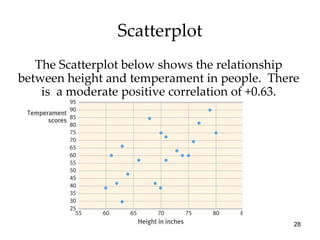
Scatterplot The Scatterplot below shows the relationship between height and temperament in people.  There is  a moderate positive correlation of +0.63.
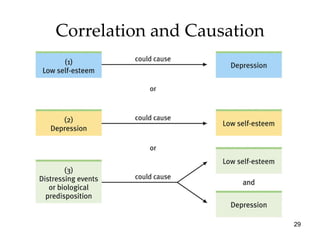
Correlation and Causation or
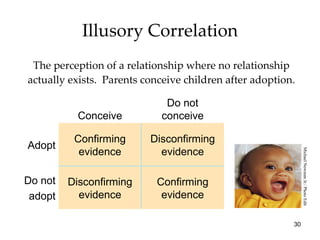
Illusory Correlation The perception of a relationship where no relationship actually exists.  Parents conceive children after adoption. Michael Newman Jr./ Photo Edit Confirming evidence Disconfirming evidence Do not adopt Disconfirming evidence Confirming evidence Adopt Do not conceive Conceive
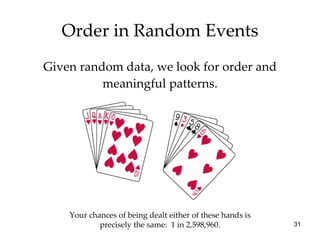
Given random data, we look for order and meaningful patterns. Order in Random Events Your chances of being dealt either of these hands is precisely the same:  1 in 2,598,960.
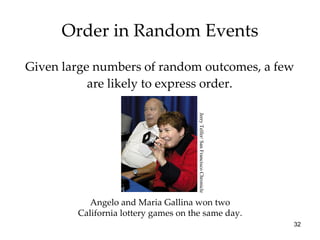
Order in Random Events Given large numbers of random outcomes, a few are likely to express order. Angelo and Maria Gallina won two California lottery games on the same day. Jerry Telfer/ San Francisco Chronicle
Experimentation Like other sciences, experimentation is the backbone of psychology research.  Experiments isolate causes and their effects. Exploring Cause and Effect
Many factors influence our behavior. Experiments  (1)   manipulate  factors that interest us, while other factors are kept under  (2) control . Effects generated by manipulated factors isolate cause and effect relationships. Exploring Cause & Effect
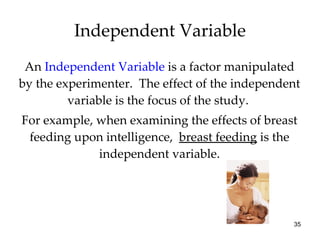
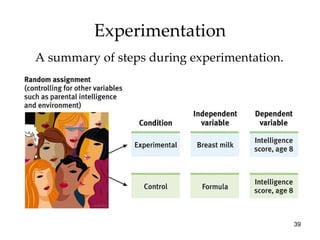
An  Independent Variable  is a factor manipulated by the experimenter.  The effect of the independent variable is the focus of the study.  For example, when examining the effects of breast feeding upon intelligence,  breast feeding  is the independent variable. Independent Variable
A  Dependent Variable  is a factor that may change in response to an independent variable. In psychology, it is usually a behavior or a mental process.  For example, in our study on the effect of breast feeding upon intelligence,  intelligence  is the dependent variable. Dependent Variable
In evaluating drug therapies, patients and experimenter’s assistants should remain unaware of which patients had the real treatment and which patients had the placebo treatment.  Evaluating Therapies Double-blind Procedure
Assigning participants to experimental (Breast-fed) and control (formula-fed) conditions by random assignment minimizes pre-existing differences between the two groups. Evaluating Therapies Random Assignment
Experimentation A summary of steps during experimentation.
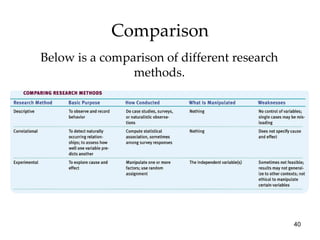
Comparison Below is a comparison of different research methods.
Statistical Reasoning Statistical procedures analyze and interpret data allowing us to see what the unaided eye misses. Composition of ethnicity in urban locales
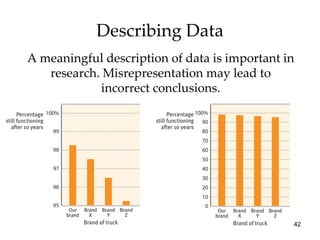
Describing Data A meaningful description of data is important in research. Misrepresentation may lead to incorrect conclusions.
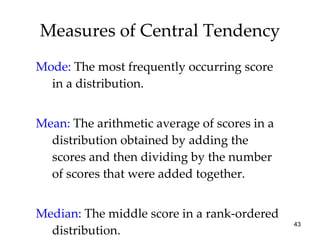
Measures of Central Tendency Mode:   The most frequently occurring score in a distribution. Mean:   The arithmetic average of scores in a distribution obtained by adding the scores and then dividing by the number of scores that were added together. Median:   The middle score in a rank-ordered distribution.
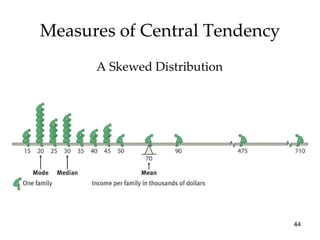
Measures of Central Tendency A Skewed Distribution
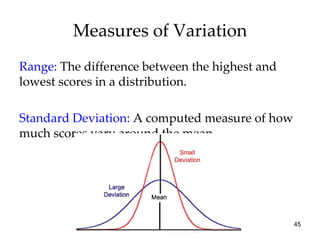
Measures of Variation Range:  The difference between the highest and lowest scores in a distribution. Standard Deviation:  A computed measure of how much scores vary around the mean.
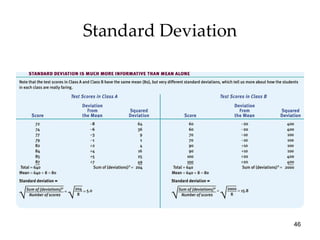
Standard Deviation
Making Inferences A statistical statement of how frequently an obtained result occurred by experimental manipulation or by chance.
Making Inferences Representative samples are better than biased samples. Less variable observations are more reliable than more variable ones. More cases are better than fewer cases. When is an Observed Difference Reliable?
Making Inferences When sample averages are reliable and the difference between them is relatively large, we say the difference has statistical significance. For psychologists this difference is measured through alpha level set at 5 percent. When is a Difference Significant?
FAQ Q1.  Can laboratory experiments illuminate everyday life? Ans:  Artificial laboratory conditions are created to study behavior in simplistic terms. The goal is to find underlying principles that govern behavior.
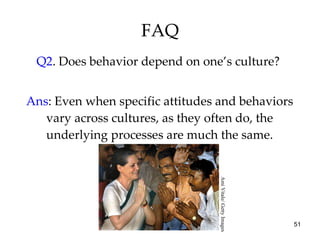
FAQ Q2 . Does behavior depend on one’s culture?  Ans : Even when specific attitudes and behaviors vary across cultures, as they often do, the underlying processes are much the same. Ami Vitale/ Getty Images
FAQ Q3.  Does behavior vary with gender? Ans : Yes. Biology determines our sex, and culture further bends the genders.  However, in many ways woman and man are similarly human.
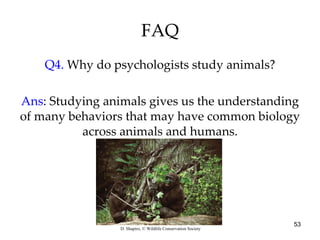
FAQ Q4.  Why do psychologists study animals? Ans : Studying animals gives us the understanding of many behaviors that may have common biology across animals and humans. D. Shapiro, © Wildlife Conservation Society
FAQ Q5.  Is it ethical to experiment on animals? Ans : Yes. To gain insights to devastating and fatal diseases. All researchers who deal with animal research are required to follow ethical guidelines in caring for these animals.
FAQ Q6.  Is it ethical to experiment on people? Ans : Yes. Experiments that do not involve any kind of physical or psychological harm beyond normal levels encountered in daily life may be carried out.
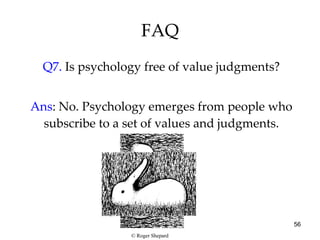
FAQ Q7.  Is psychology free of value judgments? Ans : No. Psychology emerges from people who subscribe to a set of values and judgments. © Roger Shepard
FAQ Q8.  Is psychology potentially dangerous? Ans : It can be, but it is not. The purpose of psychology is to help humanity with problems such as war, hunger, prejudice, crime, family dysfunction, etc.

Chapter 1 Ap Psych- Research Methods

  • 1.
    Thinking Critically withPsychological Science Chapter 1
  • 2.
    Impression of Psychology With hopes of satisfying curiosity, many people listen to talk-radio counselors and psychics to learn about others and themselves. Dr. Crane (radio-shrink) http://www.nbc.com http://www.photovault.com Psychic (Ball gazing)
  • 3.
    The Need forPsychological Science Intuition & Common Sense Many people believe that intuition and common sense are enough to bring forth answers regarding human nature. Intuition and common sense may aid queries, but they are not free of error.
  • 4.
    Limits of IntuitionPersonal interviewers may rely too much on their “gut feelings” when meeting with job applicants. Taxi/ Getty Images
  • 5.
    Errors of CommonSense Try this ! Fold a piece of paper (0.1 mm thick) 100 times. How thick will it be? 800,000,000,000,000 times the distance between the sun and the earth.
  • 6.
    Hindsight Bias is the “I-knew-it-all-along” phenomenon. After learning the outcome of an event, many people believe they could have predicted that very outcome. We only knew the dot.com stocks would plummet after they actually did plummet. Hindsight Bias
  • 7.
    Overconfidence Sometimes wethink we know more than we actually know. Anagram BARGE GRABE ENTRY ETYRN WATER WREAT How long do you think it would take to unscramble these anagrams? People said it would take about 10 seconds, yet on average they took about 3 minutes (Goranson, 1978).
  • 8.
    Psychological Science Howcan we differentiate between uniformed opinions and examined conclusions? The science of psychology helps make these examined conclusions, which leads to our understanding of how people feel, think, and act as they do!
  • 9.
    The Scientific AttitudeThe scientific attitude is composed of curiosity (passion for exploration), skepticism (doubting and questioning) and humility (ability to accept responsibility when wrong).
  • 10.
    Critical Thinking Criticalthinking does not accept arguments and conclusions blindly. It examines assumptions, discerns hidden values, evaluates evidence and assesses conclusions. The Amazing Randi Courtesy of the James Randi Education Foundation
  • 11.
    Scientific Method Psychologists,like all scientists, use the scientific method to construct theories that organize, summarize and simplify observations.
  • 12.
    A Theory is an explanation that integrates principles and organizes and predicts behavior or events. For example, low self-esteem contributes to depression. Theory
  • 13.
    A Hypothesis is a testable prediction, often prompted by a theory, to enable us to accept, reject or revise the theory. People with low self-esteem are apt to feel more depressed. Hypothesis
  • 14.
    Research wouldrequire us to administer tests of self-esteem and depression. Individuals who score low on a self-esteem test and high on a depression test would confirm our hypothesis. Research Observations
  • 15.
  • 16.
    Description Case StudyA technique in which one person is studied in depth to reveal underlying behavioral principles. Is language uniquely human? Susan Kuklin/ Photo Researchers
  • 17.
    Case Study Aclinical study is a form of case study in which the therapist investigates the problems associated with a client. http://behavioralhealth.typepad.com Clinical Study
  • 18.
    Survey A techniquefor ascertaining the self-reported attitudes, opinions or behaviors of people usually done by questioning a representative, random sample of people. http://www.lynnefeatherstone.org
  • 19.
    Survey Wording canchange the results of a survey. Q: Should cigarette ads and pornography be allowed on television? (not allowed vs. forbid) Wording Effect
  • 20.
    Survey A tendencyto overestimate the extent to which others share our beliefs and behaviors. False Consensus Effect
  • 21.
    Survey If eachmember of a population has an equal chance of inclusion into a sample, it is called a random sample (unbiased). If the survey sample is biased, its results are not valid. Random Sampling The fastest way to know about the marble color ratio is to blindly transfer a few into a smaller jar and count them.
  • 22.
    Naturalistic Observation Observingand recording the behavior of animals in the wild and recording self-seating patterns in a multiracial school lunch room constitute naturalistic observation. Courtesy of Gilda Morelli
  • 23.
    Descriptive Methods Casestudies, surveys, and naturalistic observation describe behaviors. Summary
  • 24.
    Correlation Correlation Coefficientis a statistical measure of the relationship between two variables. When one trait or behavior accompanies another, we say the two correlate. r = 0.37 + Correlation coefficient Indicates direction of relationship (positive or negative) Indicates strength of relationship (0.00 to 1.00)
  • 25.
    Scatterplots Perfect positivecorrelation (+1.00) Scatterplot is a graph comprised of points that are generated by values of two variables. The slope of the points depicts the direction, while the amount of scatter depicts the strength of the relationship.
  • 26.
    Scatterplots No relationship(0.00) Perfect negative correlation (-1.00) The Scatterplot on the left shows a negative correlation, while the one on the right shows no relationship between the two variables.
  • 27.
    Data Data showingheight and temperament in people.
  • 28.
    Scatterplot The Scatterplotbelow shows the relationship between height and temperament in people. There is a moderate positive correlation of +0.63.
  • 29.
  • 30.
    Illusory Correlation Theperception of a relationship where no relationship actually exists. Parents conceive children after adoption. Michael Newman Jr./ Photo Edit Confirming evidence Disconfirming evidence Do not adopt Disconfirming evidence Confirming evidence Adopt Do not conceive Conceive
  • 31.
    Given random data,we look for order and meaningful patterns. Order in Random Events Your chances of being dealt either of these hands is precisely the same: 1 in 2,598,960.
  • 32.
    Order in RandomEvents Given large numbers of random outcomes, a few are likely to express order. Angelo and Maria Gallina won two California lottery games on the same day. Jerry Telfer/ San Francisco Chronicle
  • 33.
    Experimentation Like othersciences, experimentation is the backbone of psychology research. Experiments isolate causes and their effects. Exploring Cause and Effect
  • 34.
    Many factors influenceour behavior. Experiments (1) manipulate factors that interest us, while other factors are kept under (2) control . Effects generated by manipulated factors isolate cause and effect relationships. Exploring Cause & Effect
  • 35.
    An IndependentVariable is a factor manipulated by the experimenter. The effect of the independent variable is the focus of the study. For example, when examining the effects of breast feeding upon intelligence, breast feeding is the independent variable. Independent Variable
  • 36.
    A DependentVariable is a factor that may change in response to an independent variable. In psychology, it is usually a behavior or a mental process. For example, in our study on the effect of breast feeding upon intelligence, intelligence is the dependent variable. Dependent Variable
  • 37.
    In evaluating drugtherapies, patients and experimenter’s assistants should remain unaware of which patients had the real treatment and which patients had the placebo treatment. Evaluating Therapies Double-blind Procedure
  • 38.
    Assigning participants toexperimental (Breast-fed) and control (formula-fed) conditions by random assignment minimizes pre-existing differences between the two groups. Evaluating Therapies Random Assignment
  • 39.
    Experimentation A summaryof steps during experimentation.
  • 40.
    Comparison Below isa comparison of different research methods.
  • 41.
    Statistical Reasoning Statisticalprocedures analyze and interpret data allowing us to see what the unaided eye misses. Composition of ethnicity in urban locales
  • 42.
    Describing Data Ameaningful description of data is important in research. Misrepresentation may lead to incorrect conclusions.
  • 43.
    Measures of CentralTendency Mode: The most frequently occurring score in a distribution. Mean: The arithmetic average of scores in a distribution obtained by adding the scores and then dividing by the number of scores that were added together. Median: The middle score in a rank-ordered distribution.
  • 44.
    Measures of CentralTendency A Skewed Distribution
  • 45.
    Measures of VariationRange: The difference between the highest and lowest scores in a distribution. Standard Deviation: A computed measure of how much scores vary around the mean.
  • 46.
  • 47.
    Making Inferences Astatistical statement of how frequently an obtained result occurred by experimental manipulation or by chance.
  • 48.
    Making Inferences Representativesamples are better than biased samples. Less variable observations are more reliable than more variable ones. More cases are better than fewer cases. When is an Observed Difference Reliable?
  • 49.
    Making Inferences Whensample averages are reliable and the difference between them is relatively large, we say the difference has statistical significance. For psychologists this difference is measured through alpha level set at 5 percent. When is a Difference Significant?
  • 50.
    FAQ Q1. Can laboratory experiments illuminate everyday life? Ans: Artificial laboratory conditions are created to study behavior in simplistic terms. The goal is to find underlying principles that govern behavior.
  • 51.
    FAQ Q2 .Does behavior depend on one’s culture? Ans : Even when specific attitudes and behaviors vary across cultures, as they often do, the underlying processes are much the same. Ami Vitale/ Getty Images
  • 52.
    FAQ Q3. Does behavior vary with gender? Ans : Yes. Biology determines our sex, and culture further bends the genders. However, in many ways woman and man are similarly human.
  • 53.
    FAQ Q4. Why do psychologists study animals? Ans : Studying animals gives us the understanding of many behaviors that may have common biology across animals and humans. D. Shapiro, © Wildlife Conservation Society
  • 54.
    FAQ Q5. Is it ethical to experiment on animals? Ans : Yes. To gain insights to devastating and fatal diseases. All researchers who deal with animal research are required to follow ethical guidelines in caring for these animals.
  • 55.
    FAQ Q6. Is it ethical to experiment on people? Ans : Yes. Experiments that do not involve any kind of physical or psychological harm beyond normal levels encountered in daily life may be carried out.
  • 56.
    FAQ Q7. Is psychology free of value judgments? Ans : No. Psychology emerges from people who subscribe to a set of values and judgments. © Roger Shepard
  • 57.
    FAQ Q8. Is psychology potentially dangerous? Ans : It can be, but it is not. The purpose of psychology is to help humanity with problems such as war, hunger, prejudice, crime, family dysfunction, etc.

Editor's Notes

  • #2 Psychology 7e in Modules
  • #4 Psychology 7e in Modules
  • #6 Psychology 7e in Modules
  • #7 Psychology 7e in Modules OBJECTIVE 1 | Describe hindsight bias and explain how it can make research findings seem like mere common sense. “ Anything seems commonplace, once explained.” Dr. Watson to Sherlock Holmes. Two phenomena – hindsight bias and judgmental overconfidence – illustrate why we cannot rely solely on intuition and common sense.
  • #8 Psychology 7e in Modules OBJECTIVE 2 | Describe how overconfidence contaminates our everyday judgments.
  • #10 Psychology 7e in Modules OBJECTIVE 3 | Explain how the scientific attitude encourages critical thinking.
  • #12 Psychology 7e in Modules OBJECTIVE 4 | Describe how psychological theories guide scientific research.
  • #13 Psychology 7e in Modules If we were to observe that depressed people talk about their past, present, and future in a gloomy manner, we may theorize that low-self-esteem contributes to depression.
  • #17 Psychology 7e in Modules OBJECTIVE 5 | Identify the advantages and disadvantages of case studies in studying behavior and mental processes.
  • #19 Psychology 7e in Modules OBJECTIVE 6 | Identify the advantages and disadvantages of surveys in studying behavior and mental processes, and explain the importance of wording effects and random sampling.
  • #23 Psychology 7e in Modules OBJECTIVE 7 | Identify the advantages and disadvantages of naturalistic observation in studying behavior and mental processes.
  • #25 Psychology 7e in Modules OBJECTIVE 8 | Describe positive and negative correlations and explain how correlational measures can aid the process of prediction.
  • #30 Psychology 7e in Modules OBJECTIVE 9 | Explain why correlational research fails to provide evidence of cause-effect relationships.
  • #31 Psychology 7e in Modules OBJECTIVE 10 | Describe how people form illusory correlations.
  • #32 Psychology 7e in Modules
  • #33 Psychology 7e in Modules OBJECTIVE 11 | Explain the human tendency to perceive order in random events.
  • #34 Psychology 7e in Modules OBJECTIVE 12 | Explain how experiments help researchers isolate cause and effect.
  • #36 Psychology 7e in Modules OBJECTIVE 14 | Explain the difference between an independent variable and a dependent variable.
  • #38 Psychology 7e in Modules OBJECTIVE 13 | Explain why random assignment and double-blind procedure build confidence in research findings.
  • #39 Psychology 7e in Modules Sometime research participants out of enthusiasm or personal beliefs can affect the out come of an experiment. To control for such affects, a double-blind procedure is used, in which the participants and the experimenter’s assistants are not aware of which participants got real treatment and who got placebo.
  • #42 Psychology 7e in Modules OBJECTIVE 15 | Explain the importance of statistical principles, and give an example of their use in daily life.
  • #43 Psychology 7e in Modules OBJECTIVE 16 | Explain how graphs can misrepresent data.
  • #44 Psychology 7e in Modules OBJECTIVE 17 | Describe three measures of central tendency and tell which is most affected by extreme scores.
  • #46 Psychology 7e in Modules OBJECTIVE 18 | Explain two measures of variation.
  • #48 Psychology 7e in Modules
  • #49 Psychology 7e in Modules OBJECTIVE 19 | Identify three principles for making generalizations from samples.
  • #50 Psychology 7e in Modules OBJECTIVE 20 | Explain how psychologists decide whether differences are meaningful.
  • #51 Psychology 7e in Modules OBJECTIVE 21 | Explain the value of simplified laboratory conditions in discovering general principles of behavior.
  • #52 Psychology 7e in Modules OBJECTIVE 22 | Discuss whether psychological research can be generalized across cultures and genders.
  • #54 Psychology 7e in Modules OBJECTIVE 23 | Explain why psychologists study animals, and discuss the ethics of experimentation with both animals and humans.
  • #57 Psychology 7e in Modules OBJECTIVE 24 | Describe how personal values can influence psychologists’ research and its application, and discuss psychology’s potential to manipulate people.