


RESEARCH DESIGN
Meaning

 A research design is the arrangement
 of conditions for collection & analysis
 of data in a manner that aims to
 combine relevance to the research
 purpose with economy in procedure.
 It constitutes the blue print for the
 collection , measurement & analysis
 of data.
                                           2
Features of research design

 Research design is a plan that specifies
  the sources and type of information
  relevant to the research problem.
 It is a strategy for solving the problem.
 It includes time & cost budget.
 It contains method to be used in proce-
  ssing & analyzing data.
 It contains procedures & techniques to
  be used for gathering information.
 It contains population to be studied.

                                              3
Important concepts relating to
research design.
   Dependent & independent variables.
   Extraneous variable.
   Controlled.
   Confounded relationship
   Research hypothesis
   Experimental & non-experimental hypothesis.
   Experimental & controlled groups.
   Treatment.
   Experiment
   Experimental units.

                                                  4
Different research designs.

 Research design for exploratory research :-
                                    There are
  three purpose for exploratory research…
  (a) diagnosing a situation.
  (b) screening alternatives.
  (c) discovering new ideas.


                                                5
Techniques

   Experience survey.
   Secondary Data analysis.
   Case study.
   Pilot study for qualitative analysis:-
                                  There are three
    categories in pilot study…
    (!) focus group interview.
    (!!) projective techniques.
    (!!!) depth interviews.
                                                    6
Experience survey

 It is an exploratory research technique in
  which individuals who are knowledgeable
  about a particular research problem are
  surveyed.
 The purpose of surveying such experts is to
  help formulate the problem and clarify
  concepts rather than develop conclusive
  evidence.


                                                7
Secondary data analysis

 It is an economical & quick source of
  background information.
 Preliminary review of data collected for
  another purpose to clarify issues in the early
  stages of research effort.
 Using secondary data may be equally
  important in applied research.


                                                   8
Case study

 The purpose of the case study method is to
  obtain information from one or a few
  situations that are similar to the researcher’s
  problem situation.
 Conducting a case study often requires the
  cooperation of the person whose history is
  being studied.
 Generalizing from a few cases can be
  dangerous, because most situations are
  atypical in some sense.
                                                    9
Pilot study for qualitative
analysis
 It includes any small scale exploratory research
  project that uses sampling but does not apply
  rigorous standards.
 A the primary data usually are collected from
  employees , consumers , voters or other subjects
  of ultimate concern rather than from experts.
 It’s three categories are…
                   - focus group interview
                   - projective techniques
                   - depth interviews
                                                     10
Focus group interview (FGI)

 There is one moderator/ interviewer and there is
   6 to 10 persons in one group.
 An unstructured free flowing
  interview with a small group of
  people and any issue we can
  discuss with the help of FGI.
 Focus group allow people to discuss their true
   feelings,
  anxiety & frustrations and to express the depth of
  their conviction in their own words.
                                                       11
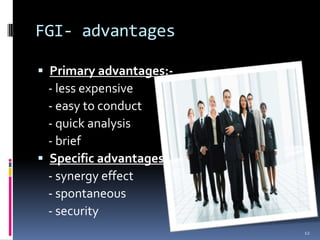
FGI- advantages

 Primary advantages:-
  - less expensive
  - easy to conduct
  - quick analysis
  - brief
 Specific advantages:-
  - synergy effect
  - spontaneous
  - security
                          12
- snow balling
- structured
- stimulation
- serendipity
- specialization
- speed


                   13
Points / factors to be
considered
 Group composition
 Environmental conditions
 Moderator
 Careful listening
 Planning the focus group outline


                                     14
FGI- weaknesses

 Out of control
 Dominating members
 Topic of discussion
  changes.
 Some members avoid active
  involvement.


                              15
16

Research Design

  • 1.
  • 2.
    Meaning  A researchdesign is the arrangement of conditions for collection & analysis of data in a manner that aims to combine relevance to the research purpose with economy in procedure.  It constitutes the blue print for the collection , measurement & analysis of data. 2
  • 3.
    Features of researchdesign  Research design is a plan that specifies the sources and type of information relevant to the research problem.  It is a strategy for solving the problem.  It includes time & cost budget.  It contains method to be used in proce- ssing & analyzing data.  It contains procedures & techniques to be used for gathering information.  It contains population to be studied. 3
  • 4.
    Important concepts relatingto research design.  Dependent & independent variables.  Extraneous variable.  Controlled.  Confounded relationship  Research hypothesis  Experimental & non-experimental hypothesis.  Experimental & controlled groups.  Treatment.  Experiment  Experimental units. 4
  • 5.
    Different research designs. Research design for exploratory research :- There are three purpose for exploratory research… (a) diagnosing a situation. (b) screening alternatives. (c) discovering new ideas. 5
  • 6.
    Techniques  Experience survey.  Secondary Data analysis.  Case study.  Pilot study for qualitative analysis:- There are three categories in pilot study… (!) focus group interview. (!!) projective techniques. (!!!) depth interviews. 6
  • 7.
    Experience survey  Itis an exploratory research technique in which individuals who are knowledgeable about a particular research problem are surveyed.  The purpose of surveying such experts is to help formulate the problem and clarify concepts rather than develop conclusive evidence. 7
  • 8.
    Secondary data analysis It is an economical & quick source of background information.  Preliminary review of data collected for another purpose to clarify issues in the early stages of research effort.  Using secondary data may be equally important in applied research. 8
  • 9.
    Case study  Thepurpose of the case study method is to obtain information from one or a few situations that are similar to the researcher’s problem situation.  Conducting a case study often requires the cooperation of the person whose history is being studied.  Generalizing from a few cases can be dangerous, because most situations are atypical in some sense. 9
  • 10.
    Pilot study forqualitative analysis  It includes any small scale exploratory research project that uses sampling but does not apply rigorous standards.  A the primary data usually are collected from employees , consumers , voters or other subjects of ultimate concern rather than from experts.  It’s three categories are… - focus group interview - projective techniques - depth interviews 10
  • 11.
    Focus group interview(FGI)  There is one moderator/ interviewer and there is 6 to 10 persons in one group.  An unstructured free flowing interview with a small group of people and any issue we can discuss with the help of FGI.  Focus group allow people to discuss their true feelings, anxiety & frustrations and to express the depth of their conviction in their own words. 11
  • 12.
    FGI- advantages  Primaryadvantages:- - less expensive - easy to conduct - quick analysis - brief  Specific advantages:- - synergy effect - spontaneous - security 12
  • 13.
    - snow balling -structured - stimulation - serendipity - specialization - speed 13
  • 14.
    Points / factorsto be considered  Group composition  Environmental conditions  Moderator  Careful listening  Planning the focus group outline 14
  • 15.
    FGI- weaknesses  Outof control  Dominating members  Topic of discussion changes.  Some members avoid active involvement. 15
  • 16.