Prepared By:

Sandeep Singh Saini
   The act came into effect first on December
    24, 1986 after being passed by the Indian
    Parliament and signed by the President of
    India. It was modified later on and the
    modifications came into effect on March
    15, 2003.
   The act is applicable in all states in India
    except in Jammu and Kashmir.
   The act makes provisions to include both
    tangible goods and intangible services
    (henceforth referred to as product) purchased
    from a trader or service provider (henceforth
    referred to as company).
   The act can apply to any consumer who uses the
    product for non-commercial activities, the only
    exception being use of it to earn his livelihood.
   In other words, the act excludes commercial
    customers fully, but includes individual domestic
    customers,        groups        of        domestic
    customers,      societies    and     not-for-profit
    organizations.
(68 of 1986)
             (24th December, 1986)

   An Act to provide for better protection of the
    interests of consumers and for that purpose to
    make provision for the establishment of
    consumer councils and other authorities for the
    settlement of consumers' disputes and for
    matters connected therewith.
   To protect the consumers from immoral
    activities and unfair trade practices of the
    traders.
   To protect and promote the rights of the
    consumers.
   To set up “Consumer Protection Councils” to
    educate the consumers and to make them aware
    of their rights.
   To redress disputes of the consumers, and
    matters connected with them, speedily.
   To make provision for Quasi Judicial machinery
    to control marketing.
   The Act aims to provide better and all-round protection to consumers.
   In terms of geographical application, it applies to the whole of India except the State of Jammu
    and Kashmir.
   It applies to all goods and services unless otherwise expressly notified by the Central
    Government.
   It is indeed a very unique and highly progressive piece of social welfare legislation and is
    acclaimed as the magna carta of Indian consumers. The Act has made the consumer movement
    really going and more powerful, broad-based and effective and people oriented. In fact, the Act
    and its Amendment in 1993 have brought fresh hopes to the beleaguered Indian consumer. This is
    the only law which directly pertains to market place and seeks to redress complaints arising from
    it. Even prior to 1986, there were in force a number of laws which could be interpreted in favour of
    the consumers. But, this Act is most powerful piece of legislation the consumer has had before
    1986. Its provisions are very comprehensive and highly efficacious.
    In fact, it provides more effective protection to consumers than any corresponding legislation in
    force even in countries which are considered to be much more advanced.
   It provides effective safeguards to the consumers against different types of exploitation such as
    defective goods, unsatisfactory (or deficient) services and unfair trade practices.
   (a) the right to be protected against marketing of goods
    which are hazardous to life and property;
   (b) the right to be informed about the quality, quantity,
    potency, purity, standard and price of goods to protect the
    consumer against unfair trade practices;
   (c) the right to be assured, wherever possible, access to an
    authority of goods at competitive prices;
   (d) the right to be heard and to be assured that consumers
    interests will receive due consideration at appropriate
    forums;
   (e) the right to seek redressal against unfair trade
    practices or unscrupulous exploitation of consumers; and
   (f) right to consumer education.
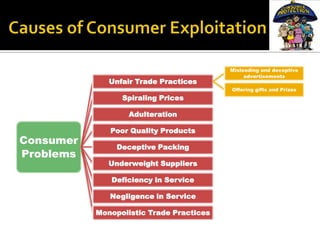
Misleading and deceptive
                                               advertisements
              Unfair Trade Practices
                                          Offering gifts and Prizes
                 Spiraling Prices

                   Adulteration

              Poor Quality Products
Consumer
                Deceptive Packing
Problems
              Underweight Suppliers

              Deficiency in Service

              Negligence in Service

           Monopolistic Trade Practices
   The act provisions the central and state
    government to create councils at the central,
    state and district level to promote
    consumerism.
   These consumer protection councils have
    very little statutory powers and as such any
    direct benefit you can get as a consumer from
    these councils is low to none.
   This section of the act provides for the
    creation of consumer courts.
     The central government is given the responsibility
      to create and maintain the National Consumer
      Disputes Redressal Commission in New Delhi.
     The state government is given the responsibility
      to create a State Consumer Disputes Redressal
      Commission at the state level and a District
      Consumer Disputes Redressal Forum at the
      district level.
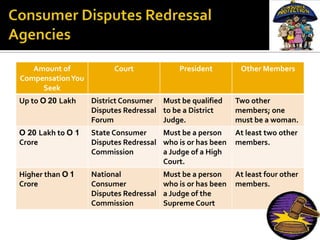
Amount of             Court              President         Other Members
Compensation You
     Seek
Up to O 20 Lakh    District Consumer Must be qualified       Two other
                   Disputes Redressal to be a District       members; one
                   Forum              Judge.                 must be a woman.
O 20 Lakh to O 1   State Consumer     Must be a person       At least two other
Crore              Disputes Redressal who is or has been     members.
                   Commission         a Judge of a High
                                      Court.
Higher than O 1    National             Must be a person     At least four other
Crore              Consumer             who is or has been   members.
                   Disputes Redressal   a Judge of the
                   Commission           Supreme Court
Consumer protection act, 1986

Consumer protection act, 1986

  • 1.
  • 2.
    The act came into effect first on December 24, 1986 after being passed by the Indian Parliament and signed by the President of India. It was modified later on and the modifications came into effect on March 15, 2003.  The act is applicable in all states in India except in Jammu and Kashmir.
  • 3.
    The act makes provisions to include both tangible goods and intangible services (henceforth referred to as product) purchased from a trader or service provider (henceforth referred to as company).  The act can apply to any consumer who uses the product for non-commercial activities, the only exception being use of it to earn his livelihood.  In other words, the act excludes commercial customers fully, but includes individual domestic customers, groups of domestic customers, societies and not-for-profit organizations.
  • 5.
    (68 of 1986) (24th December, 1986)  An Act to provide for better protection of the interests of consumers and for that purpose to make provision for the establishment of consumer councils and other authorities for the settlement of consumers' disputes and for matters connected therewith.
  • 6.
    To protect the consumers from immoral activities and unfair trade practices of the traders.  To protect and promote the rights of the consumers.  To set up “Consumer Protection Councils” to educate the consumers and to make them aware of their rights.  To redress disputes of the consumers, and matters connected with them, speedily.  To make provision for Quasi Judicial machinery to control marketing.
  • 7.
    The Act aims to provide better and all-round protection to consumers.  In terms of geographical application, it applies to the whole of India except the State of Jammu and Kashmir.  It applies to all goods and services unless otherwise expressly notified by the Central Government.  It is indeed a very unique and highly progressive piece of social welfare legislation and is acclaimed as the magna carta of Indian consumers. The Act has made the consumer movement really going and more powerful, broad-based and effective and people oriented. In fact, the Act and its Amendment in 1993 have brought fresh hopes to the beleaguered Indian consumer. This is the only law which directly pertains to market place and seeks to redress complaints arising from it. Even prior to 1986, there were in force a number of laws which could be interpreted in favour of the consumers. But, this Act is most powerful piece of legislation the consumer has had before 1986. Its provisions are very comprehensive and highly efficacious. In fact, it provides more effective protection to consumers than any corresponding legislation in force even in countries which are considered to be much more advanced.  It provides effective safeguards to the consumers against different types of exploitation such as defective goods, unsatisfactory (or deficient) services and unfair trade practices.
  • 9.
    (a) the right to be protected against marketing of goods which are hazardous to life and property;  (b) the right to be informed about the quality, quantity, potency, purity, standard and price of goods to protect the consumer against unfair trade practices;  (c) the right to be assured, wherever possible, access to an authority of goods at competitive prices;  (d) the right to be heard and to be assured that consumers interests will receive due consideration at appropriate forums;  (e) the right to seek redressal against unfair trade practices or unscrupulous exploitation of consumers; and  (f) right to consumer education.
  • 10.
    Misleading and deceptive advertisements Unfair Trade Practices Offering gifts and Prizes Spiraling Prices Adulteration Poor Quality Products Consumer Deceptive Packing Problems Underweight Suppliers Deficiency in Service Negligence in Service Monopolistic Trade Practices
  • 11.
    The act provisions the central and state government to create councils at the central, state and district level to promote consumerism.  These consumer protection councils have very little statutory powers and as such any direct benefit you can get as a consumer from these councils is low to none.
  • 12.
    This section of the act provides for the creation of consumer courts.  The central government is given the responsibility to create and maintain the National Consumer Disputes Redressal Commission in New Delhi.  The state government is given the responsibility to create a State Consumer Disputes Redressal Commission at the state level and a District Consumer Disputes Redressal Forum at the district level.
  • 13.
    Amount of Court President Other Members Compensation You Seek Up to O 20 Lakh District Consumer Must be qualified Two other Disputes Redressal to be a District members; one Forum Judge. must be a woman. O 20 Lakh to O 1 State Consumer Must be a person At least two other Crore Disputes Redressal who is or has been members. Commission a Judge of a High Court. Higher than O 1 National Must be a person At least four other Crore Consumer who is or has been members. Disputes Redressal a Judge of the Commission Supreme Court