INTRODUCTION TO RESEARCH
Research and experimental development is formal
work undertaken systematically to increase the stock
of knowledge, including knowledge of humanity,
culture and society, and the use of this stock of
knowledge to devise new applications It is used to
establish or confirm facts, reaffirm the results of
previous work, solve new or existing problems,
support theorem, or develop new theories.
DEFINATION OF RESEARCH
Systematic investigation into a problem or situation, where
    the intention is to identify facts and/or opinions that will
    assist in solving the problem or dealing with the situation
"Research is a process of steps used to collect and analyze
    information to increase ourunderstanding of a topic or
    issue".
 It consists of three steps:
a) Pose a question,
b)collect data to answer the question,
c) present an answer to the question.
TYPES OF RESEARCH
1) Fundamental research :
• Fundamental research means experimental or
  theoretical work under taken primarily to acquire
  new knowledge of the underlying foundations of
  phenomena and observable facts, without any
  direct practical application or use in view."
2) Quantitative research :
• Quantitative research aim to measure the quantity
  or amount and compares it with past records and
  tries to project for future period.
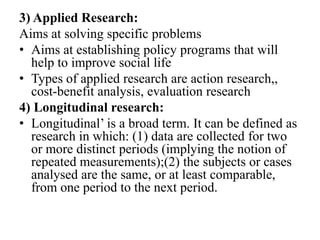
3) Applied Research:
Aims at solving specific problems
• Aims at establishing policy programs that will
  help to improve social life
• Types of applied research are action research,,
  cost-benefit analysis, evaluation research
4) Longitudinal research:
• Longitudinal’ is a broad term. It can be defined as
  research in which: (1) data are collected for two
  or more distinct periods (implying the notion of
  repeated measurements);(2) the subjects or cases
  analysed are the same, or at least comparable,
  from one period to the next period.
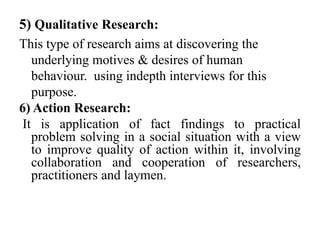
5) Qualitative Research:
This type of research aims at discovering the
   underlying motives & desires of human
   behaviour. using indepth interviews for this
   purpose.
6) Action Research:
 It is application of fact findings to practical
   problem solving in a social situation with a view
   to improve quality of action within it, involving
   collaboration and cooperation of researchers,
   practitioners and laymen.
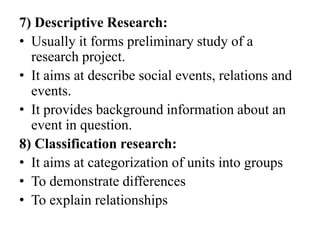
7) Descriptive Research:
• Usually it forms preliminary study of a
  research project.
• It aims at describe social events, relations and
  events.
• It provides background information about an
  event in question.
8) Classification research:
• It aims at categorization of units into groups
• To demonstrate differences
• To explain relationships
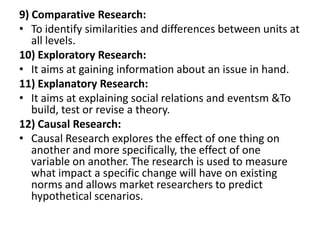
9) Comparative Research:
• To identify similarities and differences between units at
   all levels.
10) Exploratory Research:
• It aims at gaining information about an issue in hand.
11) Explanatory Research:
• It aims at explaining social relations and eventsm &To
   build, test or revise a theory.
12) Causal Research:
• Causal Research explores the effect of one thing on
   another and more specifically, the effect of one
   variable on another. The research is used to measure
   what impact a specific change will have on existing
   norms and allows market researchers to predict
   hypothetical scenarios.
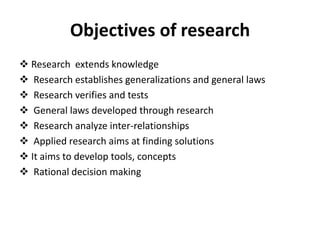
Objectives of research
 Research extends knowledge
 Research establishes generalizations and general laws
 Research verifies and tests
 General laws developed through research
 Research analyze inter-relationships
 Applied research aims at finding solutions
 It aims to develop tools, concepts
 Rational decision making
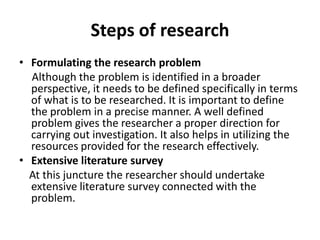
Steps of research
• Formulating the research problem
  Although the problem is identified in a broader
  perspective, it needs to be defined specifically in terms
  of what is to be researched. It is important to define
  the problem in a precise manner. A well defined
  problem gives the researcher a proper direction for
  carrying out investigation. It also helps in utilizing the
  resources provided for the research effectively.
• Extensive literature survey
  At this juncture the researcher should undertake
  extensive literature survey connected with the
  problem.
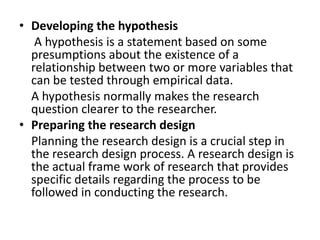
• Developing the hypothesis
   A hypothesis is a statement based on some
  presumptions about the existence of a
  relationship between two or more variables that
  can be tested through empirical data.
  A hypothesis normally makes the research
  question clearer to the researcher.
• Preparing the research design
  Planning the research design is a crucial step in
  the research design process. A research design is
  the actual frame work of research that provides
  specific details regarding the process to be
  followed in conducting the research.
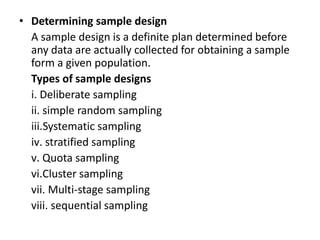
• Determining sample design
  A sample design is a definite plan determined before
  any data are actually collected for obtaining a sample
  form a given population.
  Types of sample designs
  i. Deliberate sampling
  ii. simple random sampling
  iii.Systematic sampling
  iv. stratified sampling
  v. Quota sampling
  vi.Cluster sampling
  vii. Multi-stage sampling
  viii. sequential sampling
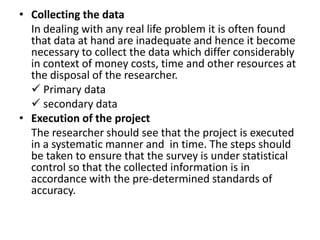
• Collecting the data
  In dealing with any real life problem it is often found
  that data at hand are inadequate and hence it become
  necessary to collect the data which differ considerably
  in context of money costs, time and other resources at
  the disposal of the researcher.
   Primary data
   secondary data
• Execution of the project
  The researcher should see that the project is executed
  in a systematic manner and in time. The steps should
  be taken to ensure that the survey is under statistical
  control so that the collected information is in
  accordance with the pre-determined standards of
  accuracy.
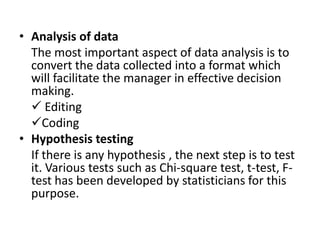
• Analysis of data
  The most important aspect of data analysis is to
  convert the data collected into a format which
  will facilitate the manager in effective decision
  making.
   Editing
  Coding
• Hypothesis testing
  If there is any hypothesis , the next step is to test
  it. Various tests such as Chi-square test, t-test, F-
  test has been developed by statisticians for this
  purpose.
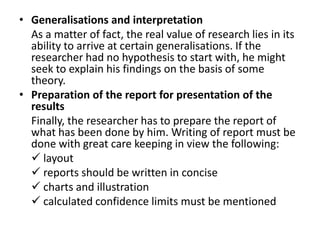
• Generalisations and interpretation
  As a matter of fact, the real value of research lies in its
  ability to arrive at certain generalisations. If the
  researcher had no hypothesis to start with, he might
  seek to explain his findings on the basis of some
  theory.
• Preparation of the report for presentation of the
  results
  Finally, the researcher has to prepare the report of
  what has been done by him. Writing of report must be
  done with great care keeping in view the following:
   layout
   reports should be written in concise
   charts and illustration
   calculated confidence limits must be mentioned
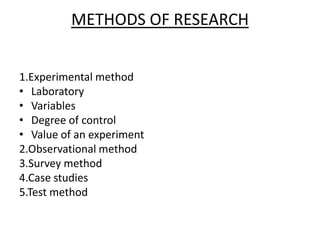
METHODS OF RESEARCH


1.Experimental method
• Laboratory
• Variables
• Degree of control
• Value of an experiment
2.Observational method
3.Survey method
4.Case studies
5.Test method
GENERAL INTRODUCTION

•   Statement of the problem
•   Objective of the study
•   Scope of study
•   Methodology

Introduction to research

  • 1.
    INTRODUCTION TO RESEARCH Researchand experimental development is formal work undertaken systematically to increase the stock of knowledge, including knowledge of humanity, culture and society, and the use of this stock of knowledge to devise new applications It is used to establish or confirm facts, reaffirm the results of previous work, solve new or existing problems, support theorem, or develop new theories.
  • 2.
    DEFINATION OF RESEARCH Systematicinvestigation into a problem or situation, where the intention is to identify facts and/or opinions that will assist in solving the problem or dealing with the situation "Research is a process of steps used to collect and analyze information to increase ourunderstanding of a topic or issue". It consists of three steps: a) Pose a question, b)collect data to answer the question, c) present an answer to the question.
  • 3.
    TYPES OF RESEARCH 1)Fundamental research : • Fundamental research means experimental or theoretical work under taken primarily to acquire new knowledge of the underlying foundations of phenomena and observable facts, without any direct practical application or use in view." 2) Quantitative research : • Quantitative research aim to measure the quantity or amount and compares it with past records and tries to project for future period.
  • 4.
    3) Applied Research: Aimsat solving specific problems • Aims at establishing policy programs that will help to improve social life • Types of applied research are action research,, cost-benefit analysis, evaluation research 4) Longitudinal research: • Longitudinal’ is a broad term. It can be defined as research in which: (1) data are collected for two or more distinct periods (implying the notion of repeated measurements);(2) the subjects or cases analysed are the same, or at least comparable, from one period to the next period.
  • 5.
    5) Qualitative Research: Thistype of research aims at discovering the underlying motives & desires of human behaviour. using indepth interviews for this purpose. 6) Action Research: It is application of fact findings to practical problem solving in a social situation with a view to improve quality of action within it, involving collaboration and cooperation of researchers, practitioners and laymen.
  • 6.
    7) Descriptive Research: •Usually it forms preliminary study of a research project. • It aims at describe social events, relations and events. • It provides background information about an event in question. 8) Classification research: • It aims at categorization of units into groups • To demonstrate differences • To explain relationships
  • 7.
    9) Comparative Research: •To identify similarities and differences between units at all levels. 10) Exploratory Research: • It aims at gaining information about an issue in hand. 11) Explanatory Research: • It aims at explaining social relations and eventsm &To build, test or revise a theory. 12) Causal Research: • Causal Research explores the effect of one thing on another and more specifically, the effect of one variable on another. The research is used to measure what impact a specific change will have on existing norms and allows market researchers to predict hypothetical scenarios.
  • 8.
    Objectives of research Research extends knowledge  Research establishes generalizations and general laws  Research verifies and tests  General laws developed through research  Research analyze inter-relationships  Applied research aims at finding solutions  It aims to develop tools, concepts  Rational decision making
  • 9.
    Steps of research •Formulating the research problem Although the problem is identified in a broader perspective, it needs to be defined specifically in terms of what is to be researched. It is important to define the problem in a precise manner. A well defined problem gives the researcher a proper direction for carrying out investigation. It also helps in utilizing the resources provided for the research effectively. • Extensive literature survey At this juncture the researcher should undertake extensive literature survey connected with the problem.
  • 10.
    • Developing thehypothesis A hypothesis is a statement based on some presumptions about the existence of a relationship between two or more variables that can be tested through empirical data. A hypothesis normally makes the research question clearer to the researcher. • Preparing the research design Planning the research design is a crucial step in the research design process. A research design is the actual frame work of research that provides specific details regarding the process to be followed in conducting the research.
  • 11.
    • Determining sampledesign A sample design is a definite plan determined before any data are actually collected for obtaining a sample form a given population. Types of sample designs i. Deliberate sampling ii. simple random sampling iii.Systematic sampling iv. stratified sampling v. Quota sampling vi.Cluster sampling vii. Multi-stage sampling viii. sequential sampling
  • 12.
    • Collecting thedata In dealing with any real life problem it is often found that data at hand are inadequate and hence it become necessary to collect the data which differ considerably in context of money costs, time and other resources at the disposal of the researcher.  Primary data  secondary data • Execution of the project The researcher should see that the project is executed in a systematic manner and in time. The steps should be taken to ensure that the survey is under statistical control so that the collected information is in accordance with the pre-determined standards of accuracy.
  • 13.
    • Analysis ofdata The most important aspect of data analysis is to convert the data collected into a format which will facilitate the manager in effective decision making.  Editing Coding • Hypothesis testing If there is any hypothesis , the next step is to test it. Various tests such as Chi-square test, t-test, F- test has been developed by statisticians for this purpose.
  • 14.
    • Generalisations andinterpretation As a matter of fact, the real value of research lies in its ability to arrive at certain generalisations. If the researcher had no hypothesis to start with, he might seek to explain his findings on the basis of some theory. • Preparation of the report for presentation of the results Finally, the researcher has to prepare the report of what has been done by him. Writing of report must be done with great care keeping in view the following:  layout  reports should be written in concise  charts and illustration  calculated confidence limits must be mentioned
  • 15.
    METHODS OF RESEARCH 1.Experimentalmethod • Laboratory • Variables • Degree of control • Value of an experiment 2.Observational method 3.Survey method 4.Case studies 5.Test method
  • 16.
    GENERAL INTRODUCTION • Statement of the problem • Objective of the study • Scope of study • Methodology