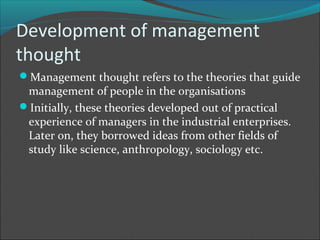
Development of management
thought
Management thought refers to the theories that guide
 management of people in the organisations
Initially, these theories developed out of practical
 experience of managers in the industrial enterprises.
 Later on, they borrowed ideas from other fields of
 study like science, anthropology, sociology etc.
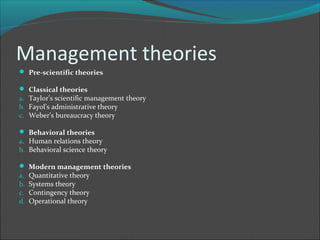
Management theories
 Pre-scientific theories

    Classical theories
a.   Taylor’s scientific management theory
b.   Fayol’s administrative theory
c.   Weber’s bureaucracy theory

 Behavioral theories
a. Human relations theory
b. Behavioral science theory

    Modern management theories
a.   Quantitative theory
b.   Systems theory
c.   Contingency theory
d.   Operational theory
Pre-scientific Management
Theories
Important contributions are made by
- Charles Babbage
- James Montgomery
- Robert Owen
- Andrew Ure
- Charles Dupin
- Henry Robinson Towne
- James Watt and Mathew Robinson Boulton Watt
- Captain Henry Metcafe
These theories solved specific organizational problems but
 these are not universally accepted theories that can be
 applied to all organisations
Classical theories
They represent early works on management and
 focus on increasing industrial output by providing
 financial incentives to employees. The classical
 approach was developed through three main streams:
 Scientific management, Administrative theory and
 Bureaucracy
Taylor’s scientific theory
Taylor developed his theory on the basis of his work
 experience in three companies: Midvale Steel works,
 Simond Rolling mills and Bethlehem Steel company.
 He is regarded as Father of Scientific Management.
He focused on finding the best way to do the job by
 eliminating wastage of men and material. He
 developed time and motion studies to find optimum
 time and nature of operations for successful
 completion of tasks.
He also introduced differential wage rate system to
 pay more to productive workers.
Principles of Taylor’s theory
Rule of thumb should be replaced with science
There should be harmony, not discord in group
 actions.
Cooperation, not individualism
Maximum output, not restricted output
Development of workers to their fullest capacity.
Techniques of scientific
management given by Taylor
Time study
Motion study
Scientific task planning
Standardization and simplification
Differential piece rate system
Functional foremanship
High speed steel
Evaluation of Taylor’s theory
Better management through scientific methods
Discovered true capacity of workers
Scientific selection of workers
 Mental revolution on the part of employers and employees.
In addition to Taylor, several other persons like Henry L Gantt,
  Harington Emerson, Frank Gilbreth and Lillian Gilbreth also
  supported and contributed in scientific management
  movement.
Limitations
Unrealistic assumptions
Mechanistic approach
Exploitation of labour
Impracticable
Narrow view
Fayol’s Administrative theory
Fayol focused on managing the organisation as a
  whole rather than lower levels of organisation only
His theory revolves around
-Activities of a business: Technical, commercial,
  financial, security, accounting and managerial
-Functions of a manager : Planning / organizing /
  commanding /coordinating/ controlling.
- Abilities of managers: Physical, Mental, Moral,
  General education, special knowledge and Experience
- Principles of management
Principles of management
 Division of work
 Authority and responsibility
 Unity of command
 Unity of direction
 Discipline
 Subordination of individual interest to general interest
 Remuneration
 Centralization
 Scaler chain
 Order
 Equity
 Stability of tenure of personnel
 Initiative
 Espirit-de-corps
Evaluation of Fayol’s Theory
His principles are widely accepted in business and
 non-business world.
He pioneered in highlighting the principles of
 management
Criticism
Too formal
Vague
Inconsistency
Pro-management bias
Historical value
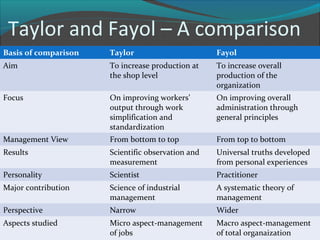
Taylor and Fayol – A comparison
Basis of comparison   Taylor                       Fayol
Aim                   To increase production at    To increase overall
                      the shop level               production of the
                                                   organization
Focus                 On improving workers’        On improving overall
                      output through work          administration through
                      simplification and           general principles
                      standardization
Management View       From bottom to top           From top to bottom
Results               Scientific observation and   Universal truths developed
                      measurement                  from personal experiences
Personality           Scientist                    Practitioner
Major contribution    Science of industrial        A systematic theory of
                      management                   management
Perspective           Narrow                       Wider
Aspects studied       Micro aspect-management      Macro aspect-management
                      of jobs                      of total organaization
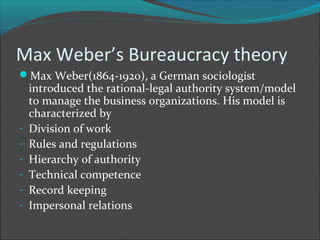
Max Weber’s Bureaucracy theory
Max Weber(1864-1920), a German sociologist
    introduced the rational-legal authority system/model
    to manage the business organizations. His model is
    characterized by
-   Division of work
-   Rules and regulations
-   Hierarchy of authority
-   Technical competence
-   Record keeping
-   Impersonal relations
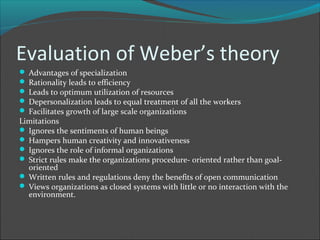
Evaluation of Weber’s theory
 Advantages of specialization
 Rationality leads to efficiency
 Leads to optimum utilization of resources
 Depersonalization leads to equal treatment of all the workers
 Facilitates growth of large scale organizations
Limitations
 Ignores the sentiments of human beings
 Hampers human creativity and innovativeness
 Ignores the role of informal organizations
 Strict rules make the organizations procedure- oriented rather than goal-
  oriented
 Written rules and regulations deny the benefits of open communication
 Views organizations as closed systems with little or no interaction with the
  environment.
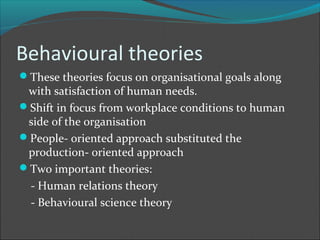
Behavioural theories
These theories focus on organisational goals along
 with satisfaction of human needs.
Shift in focus from workplace conditions to human
 side of the organisation
People- oriented approach substituted the
 production- oriented approach
Two important theories:
 - Human relations theory
 - Behavioural science theory
Human relations theory
Elton Mayo, the father of Human relation approach
 focuses on increasing organizational productivity by
 increasing the morale of workers
Results were obtained through experiments:
 - Test room studies
    (a) Illumination experiment
    (b) Relay assembly room experiment
 - Interviewing studies
 - Observation studies
Results of the experiment
Informal groups are important complements to
 formal groups
Social groups are more important than financial
 incentives to motivate the workers
Worker is a social man rather than rational man
 motivated by financial incentives
Work is considered as a group activity and not as
 operations performed by individuals.
Social and psychological factors influence employee
 behaviour and productivity more than physical work
 conditios
Evaluation of the theory
Focus on organizational efficiency through satisfaction of
 social and psychological needs of the workers
Participative management is better than authoritarian
 management.
Design of the theory: social needs are secondary to
 physiological needs
Analysis of the theory: group dynamics may not be as
 important as emphasized upon.
Interpretation of the theory: cordial relations are over
 emphasized . Conflict of opinion also generates new ideas
Human relations philosophy: informal relations are as
 important as formal motivation, communication and
 leadership styles
Behavioural science theory
It applies scientific vision to human relations theory
Concepts from Psychology, Sociology and
 Anthropology are applied to study human behaviour
Psychology – Study of individual behaviour
Sociology – Study of human behaviour in groups
Anthropology - Study of human behaviour as
 individuals and members of groups
Concepts from various disciplines are tested before
 applying them in business organisations.
Continued……………..
Several sociologists and psychologists like Abraham
 Maslow, Federick Herzberg, MC Gregor, Douglas,
 Rensis Likert, Kurt Lewin, Keith davis, Charles
 Angris,George Homans and others have made
 significant contribution to the development of this
 approach.
This approach is an extension and improvement of
 human relations movement. As this approach
 suggested that individuals differ in their attitudes,
 perceptions, their needs and goals also differ from
 organisation’s needs and goals. So the need is to
 achieve fusion between organisation’s goals and
 human needs.
Human relations theory and
Behavioural science theory- A
comparison
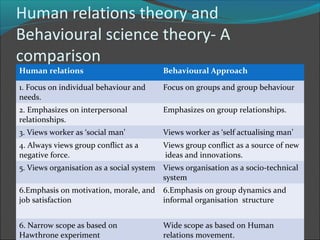
Human relations                          Behavioural Approach

1. Focus on individual behaviour and     Focus on groups and group behaviour
needs.
2. Emphasizes on interpersonal           Emphasizes on group relationships.
relationships.
3. Views worker as ‘social man’          Views worker as ‘self actualising man’
4. Always views group conflict as a      Views group conflict as a source of new
negative force.                          ideas and innovations.
5. Views organisation as a social system Views organisation as a socio-technical
                                         system
6.Emphasis on motivation, morale, and    6.Emphasis on group dynamics and
job satisfaction                         informal organisation structure


6. Narrow scope as based on              Wide scope as based on Human
Hawthrone experiment                     relations movement.
Modern management theories
 These theories are responsive to environment changes
 They view organisations as dynamic open systems having
  multiple objectives
 Management is multi-disciplinary and draws knowledge from
  various fields to solve complex business problems
 They forecast environment changes through scientific
  techniques and discount them to the present business
  situations
 These theories include:
   - Quantitative theory
    - Systems theory
    - Contingency theory
    - Operational theory
Quantitative theory
It uses the services of quantitative specialists to apply
 inter-disciplinary techniques to solve business
 problems
It includes:
  - Management science: it uses mathematical models
 like PERT, CPM, Simulation etc. to solve business
 problems.
 - Operations management: It applies quantitative
 techniques of inventory management, statistical
 quality control etc. to manage the production and
 delivery of goods and services
Continued………
 -Management information system: It uses computer
 based information to make business decisions
Evaluation of Quantitative
theory
It uses quantifiable data to frame mathematical
  models and handles complex decision- making
  problems
It uses comprehensive information through
  computers which could not otherwise have been
  available
Limitations
- It cannot be applied to study human behaviour as it
  cannot be predicted through mathematical equations
- The models may be used more for analysing the
  results than used for making decisions
Continued………….
- All the variables affecting the business decisions
  cannot be quantified in numeric terms
- It may land up making satisfying decisions rather
  than optimum decisions because of constraints of
  time and cost to collect the relevant data.
Systems Approach
As per this approach organisation is viewed from a
  systems point of view.
The main elements of systems approach are as
  follows:
 Organisation as a purposeful system consisting of
  several interconnected and interdependent parts.
 The parts or components of a system are called sub-
  systems.
 The position and function of each subsystem can be
  analyzed and understood only in relation to the other
  sub-systems and to the organisation as a whole.
 Synergy effect.
 Every system has a boundary that separates it from its
  environment.
 Feedback is useful in evaluating and improving the
 functioning of the system.

Evolution of Management

  • 2.
    Development of management thought Managementthought refers to the theories that guide management of people in the organisations Initially, these theories developed out of practical experience of managers in the industrial enterprises. Later on, they borrowed ideas from other fields of study like science, anthropology, sociology etc.
  • 3.
    Management theories  Pre-scientifictheories  Classical theories a. Taylor’s scientific management theory b. Fayol’s administrative theory c. Weber’s bureaucracy theory  Behavioral theories a. Human relations theory b. Behavioral science theory  Modern management theories a. Quantitative theory b. Systems theory c. Contingency theory d. Operational theory
  • 4.
    Pre-scientific Management Theories Important contributionsare made by - Charles Babbage - James Montgomery - Robert Owen - Andrew Ure - Charles Dupin - Henry Robinson Towne - James Watt and Mathew Robinson Boulton Watt - Captain Henry Metcafe These theories solved specific organizational problems but these are not universally accepted theories that can be applied to all organisations
  • 5.
    Classical theories They representearly works on management and focus on increasing industrial output by providing financial incentives to employees. The classical approach was developed through three main streams: Scientific management, Administrative theory and Bureaucracy
  • 6.
    Taylor’s scientific theory Taylordeveloped his theory on the basis of his work experience in three companies: Midvale Steel works, Simond Rolling mills and Bethlehem Steel company. He is regarded as Father of Scientific Management. He focused on finding the best way to do the job by eliminating wastage of men and material. He developed time and motion studies to find optimum time and nature of operations for successful completion of tasks. He also introduced differential wage rate system to pay more to productive workers.
  • 7.
    Principles of Taylor’stheory Rule of thumb should be replaced with science There should be harmony, not discord in group actions. Cooperation, not individualism Maximum output, not restricted output Development of workers to their fullest capacity.
  • 8.
    Techniques of scientific managementgiven by Taylor Time study Motion study Scientific task planning Standardization and simplification Differential piece rate system Functional foremanship High speed steel
  • 9.
    Evaluation of Taylor’stheory Better management through scientific methods Discovered true capacity of workers Scientific selection of workers  Mental revolution on the part of employers and employees. In addition to Taylor, several other persons like Henry L Gantt, Harington Emerson, Frank Gilbreth and Lillian Gilbreth also supported and contributed in scientific management movement. Limitations Unrealistic assumptions Mechanistic approach Exploitation of labour Impracticable Narrow view
  • 10.
    Fayol’s Administrative theory Fayolfocused on managing the organisation as a whole rather than lower levels of organisation only His theory revolves around -Activities of a business: Technical, commercial, financial, security, accounting and managerial -Functions of a manager : Planning / organizing / commanding /coordinating/ controlling. - Abilities of managers: Physical, Mental, Moral, General education, special knowledge and Experience - Principles of management
  • 11.
    Principles of management Division of work  Authority and responsibility  Unity of command  Unity of direction  Discipline  Subordination of individual interest to general interest  Remuneration  Centralization  Scaler chain  Order  Equity  Stability of tenure of personnel  Initiative  Espirit-de-corps
  • 12.
    Evaluation of Fayol’sTheory His principles are widely accepted in business and non-business world. He pioneered in highlighting the principles of management Criticism Too formal Vague Inconsistency Pro-management bias Historical value
  • 13.
    Taylor and Fayol– A comparison Basis of comparison Taylor Fayol Aim To increase production at To increase overall the shop level production of the organization Focus On improving workers’ On improving overall output through work administration through simplification and general principles standardization Management View From bottom to top From top to bottom Results Scientific observation and Universal truths developed measurement from personal experiences Personality Scientist Practitioner Major contribution Science of industrial A systematic theory of management management Perspective Narrow Wider Aspects studied Micro aspect-management Macro aspect-management of jobs of total organaization
  • 14.
    Max Weber’s Bureaucracytheory Max Weber(1864-1920), a German sociologist introduced the rational-legal authority system/model to manage the business organizations. His model is characterized by - Division of work - Rules and regulations - Hierarchy of authority - Technical competence - Record keeping - Impersonal relations
  • 15.
    Evaluation of Weber’stheory  Advantages of specialization  Rationality leads to efficiency  Leads to optimum utilization of resources  Depersonalization leads to equal treatment of all the workers  Facilitates growth of large scale organizations Limitations  Ignores the sentiments of human beings  Hampers human creativity and innovativeness  Ignores the role of informal organizations  Strict rules make the organizations procedure- oriented rather than goal- oriented  Written rules and regulations deny the benefits of open communication  Views organizations as closed systems with little or no interaction with the environment.
  • 16.
    Behavioural theories These theoriesfocus on organisational goals along with satisfaction of human needs. Shift in focus from workplace conditions to human side of the organisation People- oriented approach substituted the production- oriented approach Two important theories: - Human relations theory - Behavioural science theory
  • 17.
    Human relations theory EltonMayo, the father of Human relation approach focuses on increasing organizational productivity by increasing the morale of workers Results were obtained through experiments: - Test room studies (a) Illumination experiment (b) Relay assembly room experiment - Interviewing studies - Observation studies
  • 18.
    Results of theexperiment Informal groups are important complements to formal groups Social groups are more important than financial incentives to motivate the workers Worker is a social man rather than rational man motivated by financial incentives Work is considered as a group activity and not as operations performed by individuals. Social and psychological factors influence employee behaviour and productivity more than physical work conditios
  • 19.
    Evaluation of thetheory Focus on organizational efficiency through satisfaction of social and psychological needs of the workers Participative management is better than authoritarian management. Design of the theory: social needs are secondary to physiological needs Analysis of the theory: group dynamics may not be as important as emphasized upon. Interpretation of the theory: cordial relations are over emphasized . Conflict of opinion also generates new ideas Human relations philosophy: informal relations are as important as formal motivation, communication and leadership styles
  • 20.
    Behavioural science theory Itapplies scientific vision to human relations theory Concepts from Psychology, Sociology and Anthropology are applied to study human behaviour Psychology – Study of individual behaviour Sociology – Study of human behaviour in groups Anthropology - Study of human behaviour as individuals and members of groups Concepts from various disciplines are tested before applying them in business organisations.
  • 21.
    Continued…………….. Several sociologists andpsychologists like Abraham Maslow, Federick Herzberg, MC Gregor, Douglas, Rensis Likert, Kurt Lewin, Keith davis, Charles Angris,George Homans and others have made significant contribution to the development of this approach. This approach is an extension and improvement of human relations movement. As this approach suggested that individuals differ in their attitudes, perceptions, their needs and goals also differ from organisation’s needs and goals. So the need is to achieve fusion between organisation’s goals and human needs.
  • 22.
    Human relations theoryand Behavioural science theory- A comparison Human relations Behavioural Approach 1. Focus on individual behaviour and Focus on groups and group behaviour needs. 2. Emphasizes on interpersonal Emphasizes on group relationships. relationships. 3. Views worker as ‘social man’ Views worker as ‘self actualising man’ 4. Always views group conflict as a Views group conflict as a source of new negative force. ideas and innovations. 5. Views organisation as a social system Views organisation as a socio-technical system 6.Emphasis on motivation, morale, and 6.Emphasis on group dynamics and job satisfaction informal organisation structure 6. Narrow scope as based on Wide scope as based on Human Hawthrone experiment relations movement.
  • 23.
    Modern management theories These theories are responsive to environment changes  They view organisations as dynamic open systems having multiple objectives  Management is multi-disciplinary and draws knowledge from various fields to solve complex business problems  They forecast environment changes through scientific techniques and discount them to the present business situations  These theories include: - Quantitative theory - Systems theory - Contingency theory - Operational theory
  • 24.
    Quantitative theory It usesthe services of quantitative specialists to apply inter-disciplinary techniques to solve business problems It includes: - Management science: it uses mathematical models like PERT, CPM, Simulation etc. to solve business problems. - Operations management: It applies quantitative techniques of inventory management, statistical quality control etc. to manage the production and delivery of goods and services
  • 25.
    Continued……… -Management informationsystem: It uses computer based information to make business decisions
  • 26.
    Evaluation of Quantitative theory Ituses quantifiable data to frame mathematical models and handles complex decision- making problems It uses comprehensive information through computers which could not otherwise have been available Limitations - It cannot be applied to study human behaviour as it cannot be predicted through mathematical equations - The models may be used more for analysing the results than used for making decisions
  • 27.
    Continued…………. - All thevariables affecting the business decisions cannot be quantified in numeric terms - It may land up making satisfying decisions rather than optimum decisions because of constraints of time and cost to collect the relevant data.
  • 28.
    Systems Approach As perthis approach organisation is viewed from a systems point of view. The main elements of systems approach are as follows:  Organisation as a purposeful system consisting of several interconnected and interdependent parts.  The parts or components of a system are called sub- systems.  The position and function of each subsystem can be analyzed and understood only in relation to the other sub-systems and to the organisation as a whole.  Synergy effect.  Every system has a boundary that separates it from its environment.
  • 29.
     Feedback isuseful in evaluating and improving the functioning of the system.

Editor's Notes