MOBILE AND WIRELESS
COMPUTING
Mobile Computing
 Also called nomadic, tetherless, wireless,
  ubiquitous, remote computing
 User does not need to maintain a fixed
  position in the network
 Useful for persons who travel away from
  their primary work place
Mobile Computing
 Mobile   computing is "taking a computer
  and all necessary files and software out
  into the field.“
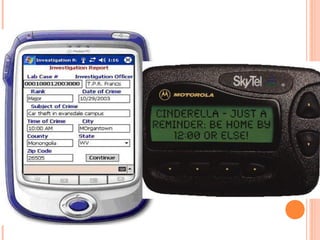
 Mobile commerce is any transaction,
  involving the transaction having
  monetary value, which is initiated and/or
  completed by using wireless electronic
  device such as mobile phones, PDAs,
  pagers etc. and mobile telecommunication
  network. It is subset of e-commerce.
Mobile & Wireless Computation
 Wireless    & Mobile are not synonymous
 Wireless
   Isa transmission or information transport
    method that enables mobile computing
   Communication is without wires
 MobileComputing focuses on the
 applications side .
   Ability   to compute no matter where the
    user is
   Infrared, cellular, radio waves, microwave,
    satellite services
Mobile Computing Framework
 Wireless delivery technology
 Mobile Information Access Devices

 Mobile Data Internetworking standards
  and equipment
 Mobile computing based business
  applications
Wireless delivery technology
1.   Radio-Based Systems
2.   Infrared or mobile based computing
Radio-Based Systems
  Thesesystems use radio frequency (RF)
  signals that range from 100 KHz to 20
  GHz

  RF   communication is of 3 types
    One way
    Two way

    Local way
Cont…
 Radio-Basedservices can be grouped in
 two main categories
  1.   Land Based
        Cellular Communications
        Wireless Packet Data networks(GPRS)

  1.   Satellite Based(Satellite Networks)
        Very Small Aperture Terminals(VSATs)
        Paging and Satellite networks
Cellular Communications
 In cellular system, the area of coverage is
  divided in to hexagonal cells that overlap
  at the outer boundaries
 Communication takes place with the help
  of transceivers
 A signal from the handset goes to nearest
  cell through telephone lines
 The size of cell is 2-10 miles

 Working
Wireless Packet data networks
 Uses   packet techniques for transferring
  data
 Packet radio is a communication method
  used to transmit packets of data over
  network via RF signals
 These services were designed with data
  only in mind
 Working
Satellite Networks
 Used  for global communication(broadcast)
 Useful where data need to be dispersed or
  gathered from many remote nodes and
  end to end delay is not of concern
 Cost effective

 Reliable

 Suitable for remote areas where poor or
  non existent phone services
 Disadv: poor choice for systems where a
  high degree of security is required
Very small aperture
terminals(VSATS)
 Uses a large no. of small dishes called
  VSATS for outlying nodes and one central
  hub with a big dish.
 This approach causes additional delay

 Typically used by the organizations that
  require data or voice communication
  between sites distributed over a wide
  geographical area
Paging and satellite networks
 Oldest   form of mobile communication
  (1949)
 One way mobile communication services

 Wireless communications

 Working

 Used for news, sports, weather, stock
  information etc at scheduled intervals
Infrared or light based mobile
computing
 Works  by sending pulses of light from a
  LED to a photo sensor that diverts signals
 Computing devices can send as well as
  receives signals
 Types of infrared equipments

   Low speed (115 kbps- 250 kbps)
   High speed (about 1.25 mbps)
 There  should not be any physical
  obstructions between sending and
  receiving
 Cost effective
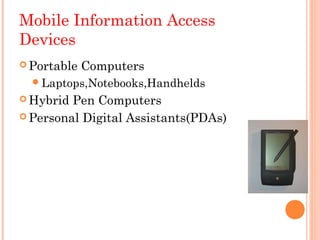
Mobile Information Access
Devices
 Portable   Computers
   Laptops,Notebooks,Handhelds
 Hybrid Pen Computers
 Personal Digital Assistants(PDAs)
Mobile Data Internetworking
standards and equipment
Reasons for analog to digital transition:
 Limited available bandwidth
 Overcrowding

Current analog system divides the available
  spectrum into 30 KHz wide channels.
Cont…
Technologies for multiple Channel Access
 CDMA(Code Division Multiple Access)
   Isa wideband spread-spectrum technology
   Uses specialized codes as the basis of
    channelization(division of the frequency
    spectrum into multiple channels)
 TDMA(Time      Division Multiple Access)
   GSM(Global
             System for Mobile
   Communications ) is a type of TDMA
   Addsa time sharing of 3 users on each
   frequency)
Mobile computing based business
applications
It is resulting in two changes:
 Remote Communications

 Remote data access

Applications:
 Health care

 Retail

 Field service

 Traveling professionals

 Sales and service
Cont…
Applications:
 Members of work groups

 Stock and commodity training
Technical and other limitations of
mobile computing
 Insufficientbandwidth
 Security standards

 Power consumption

 Transmission interferences

 Potential health hazards

 Human interface with device


(http://en.wikipedia.org/wiki/Mobile_comput
  ing)
Mobile Data Internetworking
standards and equipment
   Consider a room (channel) in which people wish to
    communicate with each other.
   To avoid confusion,
      people could take turns speaking (time division),
      speak at different pitches (frequency division),
      or speak in different directions (spatial division).
      In CDMA, they would speak different languages. People
       speaking the same language can understand each other,
       but not other people. Similarly, in radio CDMA, each
       group of users is given a shared code. Many codes
       occupy the same channel, but only users associated with
       a particular code can understand each other.
     http://www.broadbandreports.com/faq/5668

Mobile and wireless computing

  • 1.
  • 2.
    Mobile Computing  Alsocalled nomadic, tetherless, wireless, ubiquitous, remote computing  User does not need to maintain a fixed position in the network  Useful for persons who travel away from their primary work place
  • 3.
    Mobile Computing  Mobile computing is "taking a computer and all necessary files and software out into the field.“  Mobile commerce is any transaction, involving the transaction having monetary value, which is initiated and/or completed by using wireless electronic device such as mobile phones, PDAs, pagers etc. and mobile telecommunication network. It is subset of e-commerce.
  • 5.
    Mobile & WirelessComputation  Wireless & Mobile are not synonymous  Wireless  Isa transmission or information transport method that enables mobile computing  Communication is without wires  MobileComputing focuses on the applications side .  Ability to compute no matter where the user is  Infrared, cellular, radio waves, microwave, satellite services
  • 6.
    Mobile Computing Framework Wireless delivery technology  Mobile Information Access Devices  Mobile Data Internetworking standards and equipment  Mobile computing based business applications
  • 7.
    Wireless delivery technology 1. Radio-Based Systems 2. Infrared or mobile based computing
  • 8.
    Radio-Based Systems Thesesystems use radio frequency (RF) signals that range from 100 KHz to 20 GHz  RF communication is of 3 types  One way  Two way  Local way
  • 9.
    Cont…  Radio-Basedservices canbe grouped in two main categories 1. Land Based  Cellular Communications  Wireless Packet Data networks(GPRS) 1. Satellite Based(Satellite Networks)  Very Small Aperture Terminals(VSATs)  Paging and Satellite networks
  • 10.
    Cellular Communications  Incellular system, the area of coverage is divided in to hexagonal cells that overlap at the outer boundaries  Communication takes place with the help of transceivers  A signal from the handset goes to nearest cell through telephone lines  The size of cell is 2-10 miles  Working
  • 11.
    Wireless Packet datanetworks  Uses packet techniques for transferring data  Packet radio is a communication method used to transmit packets of data over network via RF signals  These services were designed with data only in mind  Working
  • 12.
    Satellite Networks  Used for global communication(broadcast)  Useful where data need to be dispersed or gathered from many remote nodes and end to end delay is not of concern  Cost effective  Reliable  Suitable for remote areas where poor or non existent phone services  Disadv: poor choice for systems where a high degree of security is required
  • 13.
    Very small aperture terminals(VSATS) Uses a large no. of small dishes called VSATS for outlying nodes and one central hub with a big dish.  This approach causes additional delay  Typically used by the organizations that require data or voice communication between sites distributed over a wide geographical area
  • 14.
    Paging and satellitenetworks  Oldest form of mobile communication (1949)  One way mobile communication services  Wireless communications  Working  Used for news, sports, weather, stock information etc at scheduled intervals
  • 15.
    Infrared or lightbased mobile computing  Works by sending pulses of light from a LED to a photo sensor that diverts signals  Computing devices can send as well as receives signals  Types of infrared equipments  Low speed (115 kbps- 250 kbps)  High speed (about 1.25 mbps)  There should not be any physical obstructions between sending and receiving  Cost effective
  • 16.
    Mobile Information Access Devices Portable Computers  Laptops,Notebooks,Handhelds  Hybrid Pen Computers  Personal Digital Assistants(PDAs)
  • 17.
    Mobile Data Internetworking standardsand equipment Reasons for analog to digital transition:  Limited available bandwidth  Overcrowding Current analog system divides the available spectrum into 30 KHz wide channels.
  • 18.
    Cont… Technologies for multipleChannel Access  CDMA(Code Division Multiple Access)  Isa wideband spread-spectrum technology  Uses specialized codes as the basis of channelization(division of the frequency spectrum into multiple channels)  TDMA(Time Division Multiple Access)  GSM(Global System for Mobile Communications ) is a type of TDMA  Addsa time sharing of 3 users on each frequency)
  • 19.
    Mobile computing basedbusiness applications It is resulting in two changes:  Remote Communications  Remote data access Applications:  Health care  Retail  Field service  Traveling professionals  Sales and service
  • 20.
    Cont… Applications:  Members ofwork groups  Stock and commodity training
  • 21.
    Technical and otherlimitations of mobile computing  Insufficientbandwidth  Security standards  Power consumption  Transmission interferences  Potential health hazards  Human interface with device (http://en.wikipedia.org/wiki/Mobile_comput ing)
  • 22.
    Mobile Data Internetworking standardsand equipment  Consider a room (channel) in which people wish to communicate with each other.  To avoid confusion,  people could take turns speaking (time division),  speak at different pitches (frequency division),  or speak in different directions (spatial division).  In CDMA, they would speak different languages. People speaking the same language can understand each other, but not other people. Similarly, in radio CDMA, each group of users is given a shared code. Many codes occupy the same channel, but only users associated with a particular code can understand each other. http://www.broadbandreports.com/faq/5668