ESSENTIALS OF A VALID
CONTRACT
As per Section 10 of Indian Contract
Act
 “All agreements are contracts if they are made by
  the free consent of the parties, competent to
  contract for a lawful consideration and with a
  lawful object and not here by expressly declared
  to be void.”
 As per this definition following are he essential
  elements for a valid contract:
1. PROPOSAL AND ACCEPTANCE

• For the formation of a valid contract it is necessary
  that one party should make the offer and the other
  party should accept it, as only after the acceptance
  contract will come into existence.

• Proposal: As per Section 2 (a) of Indian Contract
  Act, “ when a person signifies to another his
  willingness to do or abstain from doing something
  with a view to obtain the assent of that other to such
  act or abstinence , he is said to make a proposal.
Essential Elements of Proposal

• There must be two parties
• Willingness to do or not to do something
• Should be a proposal, not merely an intention to
  make proposal
Legal Rules as to Proposal
• The offer must be made to create legal obligation.
• The terms of proposal must be certain not vague.
• Proposal can be general or specific. (Case: Mrs. Carliee
  Vs Carbolic Smoke Ball Company)
• Proposal may be expressed or implied.
• Proposal must be in the form of a request and not an
  order.
• The offer must be communicated.
• Proposal must be for possible act.
Case: Mrs. Carliee Vs Carbolic Smoke Ball Company


• In this case the Carbolic Smoke Ball Co gave an
  advertisement in the newspaper, offering influenza after
  using their smoke ball 3 times daily for 2 weeks.
• Believing on the advertisement Mrs. Carliee used the same,
  but contracted influenza .
• Mrs. Carliee sued the company and claimed £ 100.

Judgment was in the favor of Mrs. Carliee.
Acceptance

• According to Section 2 (h): “when the person to
  whom the offer is made signifies his assent thereto,
  the offer is said to be accepted”.
Essentials for a Valid Acceptance
• Acceptance must be made by the person to whom the
  offer is made.

• Acceptance must be in the prescribed manner Sec 7(2)
  For example: If the offerer wants the acceptance by e-
  mail, then the acceptance must be given via e-mail.
  Similarly if any limit is fixed by the offerer for
  acceptance, then the acceptance must be given with in
  the specified time.

• Rejected offers cannot be accepted until it is renewed:
  It is a general rule that an offer once rejected cannot be
  accepted, until not presented again.
2. Intention to Create Legal Obligation

• There must be an intention among the parties to
  create legal obligation.

• If the intention of the parties is not to create legal
  obligation, then it will only remain an agreement
  and cannot be a valid contract.
3. Competency or Contractual Capacity of the Parties

 • According to Section 10 of Indian Contract Act: “All
   those agreements can be enforced by law, which are
   made by the person having contractual capacity.”
 • According to Section 11: “Every person is competent to
   contract who is of the age of majority according to the
   law of which he is subjet and who is of sound mind and
   is not disqualified from contracting by any law to which
   he is subject.”
 • As per above definition, following parties are
   incompetent to contract:
 • Minors
 • Persons of unsound Mind
 • Persons disqualified by law to which they are subject.
MINOR

• Minor is a person who has not attained the age of
  Majority according to the law of his country.

• According to Section 3 of Indian Majority
  Act: “A minor is a person who has not completed
  eighteen years of age.
Rules Regarding Contract with a Minor
• An agreement with or by a minor is void and inoperative
  ab-initio.
• Contract for Necessities of Life: As per Sec 68 of Indian
  Contract Act, if a person enters into a contract for
  necessities of life, then the person supplying such
  necessities have the right to reimburse the amount from
  the property of minor. The necessities basically include
  food, clothing, rent of house, educational expenditure etc.

• Minors’ Contract for his Benefit (can be enforced)
• Contract by parents or guardian of the minor: If
  a minor’s parents or guardian make a contract on the
  behalf of the minor and for his benefit, then such
  contracts are treated as valid. But if they enter into a
  contract for the employment of a minor, then such a
  contract will be invalid.
• Minor’s contracts cannot be ratified on his becoming
  major.
• Minor as an Agent: According to Sec 182 of Indian
  Contract Act, “An agent is a person employed to do an
  act for another or represents another in dealing with the
  third party.
• Minor as a partner: As per Sec 30 of Indian
  Partnership Act, A minor can be admitted as a
  partner, but such a partner will only share the
  profit not the losses, i.e. he cannot be held liable to
  share the loss.

• Liability for Minor for Torts: If a minor gets
  indulge in a crime such as murder, then he/she can
  be held liable just like adults.

• Minor cannot be adjudged Insolvent: A
  minor cannot be adjudged insolvent because due to
  his incompetency, he cannot be declared insolvent
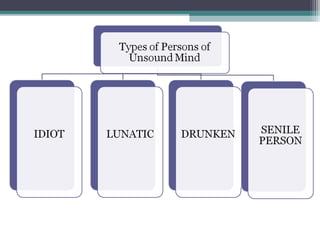
Persons of Unsound Mind
• According to Sec 11, “A person of unsound mind
  is incompetent to contract”

• According to Section 12’ “ A person is said to be
  of sound mind for the purpose of making a
  contract, if at the time when he makes it, he is
  capable of understanding it and forming a
  rational judgment as to its effects upon his
  interests”
4. LAWFUL CONSIDERATION
• Consideration means “Something for Something”
• Consideration is the price for which the promise of
  other is bought and a promise given for a lawful
  value is enforceable.
• As per Section 25 of Indian Contract Act, “An
  agreement without consideration is void”.
Essential Elements of Consideration
• Consideration must move at the desire of the
  promisor: one of the most important elements of
  consideration is that any promise to do something
  must be according to the desire of the promisor.
If any act is done voluntarily by the promisee such
  act will not be taken as consideration.
• Consideration may be a promise to do or to abstain
  from doing something. (Positive nad negative
  consideration)
• Consideration must be legal: According to Sec
  23, For the validity of a contract it is necessary
  that the consideration must be legal.
Contracts based on illegal consideration are
  considered void.
The consideration is not considered valid or it is
  considered as unlawful if:
 It is forbidden by law
It involves any injury to a person
It is against public policy
5. LAWFUL OBJECT
• An agreement can be enforceable by law only when
  its objective is lawful.
• If the agreement is having unlawful object, then no
  legal contract arises between the parties.
• According to Section 23, “If the object is unlawful
  for the reasons mentioned under then the
  agreement shall be void:
The object of a contract is forbidden by law.
If it involves injury to the person or property of
  another.
If the court regard it as immoral or opposed to
  public policy.
6. POSSIBILITY OF PERFORMANCE
• An essential of a valid contract is that it must be
  capable of performance.
• According to Section 56 of Indian Contract Act,
  “An agreement to do an impossible act is void
  ab-initio.”
• There may be two situations, one in which the
  act is completely impossible and other situation
  may be in which the parties are not aware of that
  the act is impossible.
7. COMMUNICATION OF THE CONTRACT
 • Both the parties as per Sec 4 of Indian Contract
   Act, must communicate to each other about the
   offer and acceptance, only then it will be
   considered as a valid contract.
8. FREE CONSENT OF PARTIES
• As per Sec 10 of Indian Contract Act, it is
  important that the consent of the parties of a
  contract must be free.
• According to Section 13 of Indian contract Act,
  “Two or more persons are said to consent when
  they agree upon the same thing in the same
  sense.”
• From the analysis of this definition it is clear
  that ‘consent’ is said between two parties, when:
Two or more persons in a contract agree upon a
  thing in a contract.
They agree upon the same thing in the same
  sense.
• This is also called identity of mind. In English law
  it is called consensus-ad-idem.
• If the parties to be contracted do not agree upon
  the same thing then no contract arises at all.
• According to Section 14 of Indian Contract Act,
  consent is said to be free when it is not caused by:
Coercion (Sec 15)
Undue Influence (Sec 16)
Fraud ( Sec 17)
Misrepresentation (Sec 18)
Mistakes (Sec 20 to 22)
9. Agreements Expressly Declared As
               Void
• Some agreements are expressly declared as Void from
  the side of law, such agreements are void-ab-initio,
  such as:
 Agreements made by Incompetent Parties.
Agreements made under Mutual Mistake of Facts.
Agreements with Unlawful Consideration and Object
Agreements without Consideration
Agreements in Restraint of Marriage
 Agreements in Restraint of Trade
Exceptions:
Sale of Goodwill
Restraint on Partner
In case of Separation from partnership
 On sale of Goodwill of the firm
 Trade combinations
Agreements of Service
 Agreements in Restraint of Legal Proceedings
 Agreements by way of wager or wagering
 Agreements.
Agreements to do Impossible Acts.
10. Legal Formalities- Written and
Registered

•   Contracts related to negotiable Instruments.
•   Contracts of lease, mortgage etc.
•   MOA, AOA
•   Insurance etc

Essentials of a valid contract

  • 1.
    ESSENTIALS OF AVALID CONTRACT
  • 2.
    As per Section10 of Indian Contract Act “All agreements are contracts if they are made by the free consent of the parties, competent to contract for a lawful consideration and with a lawful object and not here by expressly declared to be void.” As per this definition following are he essential elements for a valid contract:
  • 3.
    1. PROPOSAL ANDACCEPTANCE • For the formation of a valid contract it is necessary that one party should make the offer and the other party should accept it, as only after the acceptance contract will come into existence. • Proposal: As per Section 2 (a) of Indian Contract Act, “ when a person signifies to another his willingness to do or abstain from doing something with a view to obtain the assent of that other to such act or abstinence , he is said to make a proposal.
  • 4.
    Essential Elements ofProposal • There must be two parties • Willingness to do or not to do something • Should be a proposal, not merely an intention to make proposal
  • 5.
    Legal Rules asto Proposal • The offer must be made to create legal obligation. • The terms of proposal must be certain not vague. • Proposal can be general or specific. (Case: Mrs. Carliee Vs Carbolic Smoke Ball Company) • Proposal may be expressed or implied. • Proposal must be in the form of a request and not an order. • The offer must be communicated. • Proposal must be for possible act.
  • 6.
    Case: Mrs. CarlieeVs Carbolic Smoke Ball Company • In this case the Carbolic Smoke Ball Co gave an advertisement in the newspaper, offering influenza after using their smoke ball 3 times daily for 2 weeks. • Believing on the advertisement Mrs. Carliee used the same, but contracted influenza . • Mrs. Carliee sued the company and claimed £ 100. Judgment was in the favor of Mrs. Carliee.
  • 7.
    Acceptance • According toSection 2 (h): “when the person to whom the offer is made signifies his assent thereto, the offer is said to be accepted”.
  • 8.
    Essentials for aValid Acceptance • Acceptance must be made by the person to whom the offer is made. • Acceptance must be in the prescribed manner Sec 7(2) For example: If the offerer wants the acceptance by e- mail, then the acceptance must be given via e-mail. Similarly if any limit is fixed by the offerer for acceptance, then the acceptance must be given with in the specified time. • Rejected offers cannot be accepted until it is renewed: It is a general rule that an offer once rejected cannot be accepted, until not presented again.
  • 9.
    2. Intention toCreate Legal Obligation • There must be an intention among the parties to create legal obligation. • If the intention of the parties is not to create legal obligation, then it will only remain an agreement and cannot be a valid contract.
  • 10.
    3. Competency orContractual Capacity of the Parties • According to Section 10 of Indian Contract Act: “All those agreements can be enforced by law, which are made by the person having contractual capacity.” • According to Section 11: “Every person is competent to contract who is of the age of majority according to the law of which he is subjet and who is of sound mind and is not disqualified from contracting by any law to which he is subject.” • As per above definition, following parties are incompetent to contract: • Minors • Persons of unsound Mind • Persons disqualified by law to which they are subject.
  • 11.
    MINOR • Minor isa person who has not attained the age of Majority according to the law of his country. • According to Section 3 of Indian Majority Act: “A minor is a person who has not completed eighteen years of age.
  • 12.
    Rules Regarding Contractwith a Minor • An agreement with or by a minor is void and inoperative ab-initio. • Contract for Necessities of Life: As per Sec 68 of Indian Contract Act, if a person enters into a contract for necessities of life, then the person supplying such necessities have the right to reimburse the amount from the property of minor. The necessities basically include food, clothing, rent of house, educational expenditure etc. • Minors’ Contract for his Benefit (can be enforced)
  • 13.
    • Contract byparents or guardian of the minor: If a minor’s parents or guardian make a contract on the behalf of the minor and for his benefit, then such contracts are treated as valid. But if they enter into a contract for the employment of a minor, then such a contract will be invalid. • Minor’s contracts cannot be ratified on his becoming major. • Minor as an Agent: According to Sec 182 of Indian Contract Act, “An agent is a person employed to do an act for another or represents another in dealing with the third party.
  • 14.
    • Minor asa partner: As per Sec 30 of Indian Partnership Act, A minor can be admitted as a partner, but such a partner will only share the profit not the losses, i.e. he cannot be held liable to share the loss. • Liability for Minor for Torts: If a minor gets indulge in a crime such as murder, then he/she can be held liable just like adults. • Minor cannot be adjudged Insolvent: A minor cannot be adjudged insolvent because due to his incompetency, he cannot be declared insolvent
  • 15.
    Persons of UnsoundMind • According to Sec 11, “A person of unsound mind is incompetent to contract” • According to Section 12’ “ A person is said to be of sound mind for the purpose of making a contract, if at the time when he makes it, he is capable of understanding it and forming a rational judgment as to its effects upon his interests”
  • 17.
    4. LAWFUL CONSIDERATION •Consideration means “Something for Something” • Consideration is the price for which the promise of other is bought and a promise given for a lawful value is enforceable. • As per Section 25 of Indian Contract Act, “An agreement without consideration is void”.
  • 18.
    Essential Elements ofConsideration • Consideration must move at the desire of the promisor: one of the most important elements of consideration is that any promise to do something must be according to the desire of the promisor. If any act is done voluntarily by the promisee such act will not be taken as consideration. • Consideration may be a promise to do or to abstain from doing something. (Positive nad negative consideration)
  • 19.
    • Consideration mustbe legal: According to Sec 23, For the validity of a contract it is necessary that the consideration must be legal. Contracts based on illegal consideration are considered void. The consideration is not considered valid or it is considered as unlawful if:  It is forbidden by law It involves any injury to a person It is against public policy
  • 20.
    5. LAWFUL OBJECT •An agreement can be enforceable by law only when its objective is lawful. • If the agreement is having unlawful object, then no legal contract arises between the parties. • According to Section 23, “If the object is unlawful for the reasons mentioned under then the agreement shall be void: The object of a contract is forbidden by law. If it involves injury to the person or property of another. If the court regard it as immoral or opposed to public policy.
  • 21.
    6. POSSIBILITY OFPERFORMANCE • An essential of a valid contract is that it must be capable of performance. • According to Section 56 of Indian Contract Act, “An agreement to do an impossible act is void ab-initio.” • There may be two situations, one in which the act is completely impossible and other situation may be in which the parties are not aware of that the act is impossible.
  • 22.
    7. COMMUNICATION OFTHE CONTRACT • Both the parties as per Sec 4 of Indian Contract Act, must communicate to each other about the offer and acceptance, only then it will be considered as a valid contract.
  • 23.
    8. FREE CONSENTOF PARTIES • As per Sec 10 of Indian Contract Act, it is important that the consent of the parties of a contract must be free. • According to Section 13 of Indian contract Act, “Two or more persons are said to consent when they agree upon the same thing in the same sense.” • From the analysis of this definition it is clear that ‘consent’ is said between two parties, when: Two or more persons in a contract agree upon a thing in a contract. They agree upon the same thing in the same sense.
  • 24.
    • This isalso called identity of mind. In English law it is called consensus-ad-idem. • If the parties to be contracted do not agree upon the same thing then no contract arises at all. • According to Section 14 of Indian Contract Act, consent is said to be free when it is not caused by: Coercion (Sec 15) Undue Influence (Sec 16) Fraud ( Sec 17) Misrepresentation (Sec 18) Mistakes (Sec 20 to 22)
  • 25.
    9. Agreements ExpresslyDeclared As Void • Some agreements are expressly declared as Void from the side of law, such agreements are void-ab-initio, such as:  Agreements made by Incompetent Parties. Agreements made under Mutual Mistake of Facts. Agreements with Unlawful Consideration and Object Agreements without Consideration Agreements in Restraint of Marriage
  • 26.
     Agreements inRestraint of Trade Exceptions: Sale of Goodwill Restraint on Partner In case of Separation from partnership  On sale of Goodwill of the firm  Trade combinations Agreements of Service  Agreements in Restraint of Legal Proceedings  Agreements by way of wager or wagering Agreements. Agreements to do Impossible Acts.
  • 27.
    10. Legal Formalities-Written and Registered • Contracts related to negotiable Instruments. • Contracts of lease, mortgage etc. • MOA, AOA • Insurance etc