Variables &
Concepts
Concepts
• Concepts are highly subjective as their understanding
varies from person to person, and therefore, may not be
measurable. In a research study it is important that the
concepts used should be operationalised in measurable
terms so that the extent of variation in respondents’
understanding is reduced not eliminated.
• Measurability is the main difference between a concept
and a variable.
Concept—an Abstraction of
Reality
• Table, leadership, productivity, morale are all labels
given to some phenomenon (reality) 
• Concepts stand for phenomenon not the
phenomenon itself.
• It may be called an abstraction of empirical reality.
Concepts, Indicators &
Variables
• If you are using a concept in your study, you need to
consider its operataionalization, that is, how it will be
measured. In most cases, to operationalise a concept
you first need to go through the process of identifying
indicators—a set of criteria reflected of the concept—
which can then be converted into variables.
Variables
Example
• The concept ‘Richness’ can easily be converted into
indicators and then variables. To decide objectively if a
person is ‘rich’, one first needs to decide upon the
indicators of richness.
• Assume we decide upon income and assets as the
indicators.
• Income is also a variable since it can be measured in
dollars, therefore, you need not to convert this into a
variable. Although the assets owned by an individual are
indicators of his/her ‘richness’, they still belong to the
category of concepts. You need to look further at the
indicators of assets. For example, house, boat, car and
investments are indicators of assets.
Variable
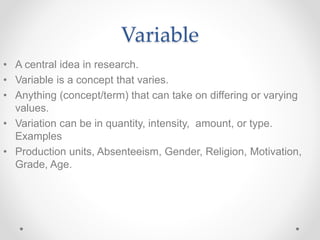
• A central idea in research.
• Variable is a concept that varies.
• Anything (concept/term) that can take on differing or varying
values.
• Variation can be in quantity, intensity, amount, or type.
Examples
• Production units, Absenteeism, Gender, Religion, Motivation,
Grade, Age.
Variable
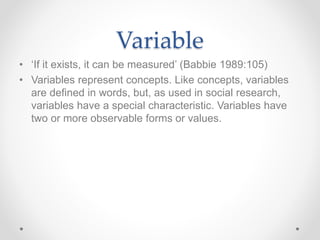
• ‘If it exists, it can be measured’ (Babbie 1989:105)
• Variables represent concepts. Like concepts, variables
are defined in words, but, as used in social research,
variables have a special characteristic. Variables have
two or more observable forms or values.
Concept and Variables
Concept Variable
Effectiveness Sex (male/female)
Satisfaction Income (Rs……)
Impact Age
Self esteem Height
Quality Weight
Variables & Attributes
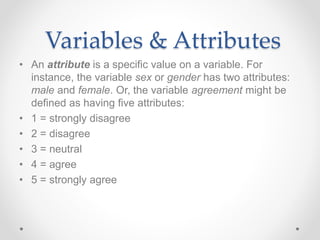
• An attribute is a specific value on a variable. For
instance, the variable sex or gender has two attributes:
male and female. Or, the variable agreement might be
defined as having five attributes:
• 1 = strongly disagree
• 2 = disagree
• 3 = neutral
• 4 = agree
• 5 = strongly agree
Types of Variables
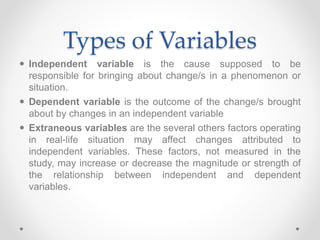
 Independent variable is the cause supposed to be
responsible for bringing about change/s in a phenomenon or
situation.
 Dependent variable is the outcome of the change/s brought
about by changes in an independent variable
 Extraneous variables are the several others factors operating
in real-life situation may affect changes attributed to
independent variables. These factors, not measured in the
study, may increase or decrease the magnitude or strength of
the relationship between independent and dependent
variables.
Types of Variables
• Intervening variables are sometimes called the
confounding variables. They link independent and
dependent variable. In some situations the relationship
between independent and dependent variables cannot
be established without the intervention of another
variable. The cause variable will have the assumed
effect only in the presence of an intervening variable.
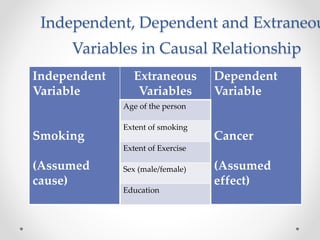
Independent, Dependent and Extraneou
Variables in Causal Relationship
Independent
Variable
Smoking
(Assumed
cause)
Extraneous
Variables
Dependent
Variable
Cancer
(Assumed
effect)
Age of the person
Extent of smoking
Extent of Exercise
Sex (male/female)
Education
Thank You

Variables & concepts

  • 1.
  • 2.
    Concepts • Concepts arehighly subjective as their understanding varies from person to person, and therefore, may not be measurable. In a research study it is important that the concepts used should be operationalised in measurable terms so that the extent of variation in respondents’ understanding is reduced not eliminated. • Measurability is the main difference between a concept and a variable.
  • 3.
    Concept—an Abstraction of Reality •Table, leadership, productivity, morale are all labels given to some phenomenon (reality)  • Concepts stand for phenomenon not the phenomenon itself. • It may be called an abstraction of empirical reality.
  • 4.
    Concepts, Indicators & Variables •If you are using a concept in your study, you need to consider its operataionalization, that is, how it will be measured. In most cases, to operationalise a concept you first need to go through the process of identifying indicators—a set of criteria reflected of the concept— which can then be converted into variables.
  • 5.
    Variables Example • The concept‘Richness’ can easily be converted into indicators and then variables. To decide objectively if a person is ‘rich’, one first needs to decide upon the indicators of richness. • Assume we decide upon income and assets as the indicators. • Income is also a variable since it can be measured in dollars, therefore, you need not to convert this into a variable. Although the assets owned by an individual are indicators of his/her ‘richness’, they still belong to the category of concepts. You need to look further at the indicators of assets. For example, house, boat, car and investments are indicators of assets.
  • 6.
    Variable • A centralidea in research. • Variable is a concept that varies. • Anything (concept/term) that can take on differing or varying values. • Variation can be in quantity, intensity, amount, or type. Examples • Production units, Absenteeism, Gender, Religion, Motivation, Grade, Age.
  • 7.
    Variable • ‘If itexists, it can be measured’ (Babbie 1989:105) • Variables represent concepts. Like concepts, variables are defined in words, but, as used in social research, variables have a special characteristic. Variables have two or more observable forms or values.
  • 8.
    Concept and Variables ConceptVariable Effectiveness Sex (male/female) Satisfaction Income (Rs……) Impact Age Self esteem Height Quality Weight
  • 9.
    Variables & Attributes •An attribute is a specific value on a variable. For instance, the variable sex or gender has two attributes: male and female. Or, the variable agreement might be defined as having five attributes: • 1 = strongly disagree • 2 = disagree • 3 = neutral • 4 = agree • 5 = strongly agree
  • 10.
    Types of Variables Independent variable is the cause supposed to be responsible for bringing about change/s in a phenomenon or situation.  Dependent variable is the outcome of the change/s brought about by changes in an independent variable  Extraneous variables are the several others factors operating in real-life situation may affect changes attributed to independent variables. These factors, not measured in the study, may increase or decrease the magnitude or strength of the relationship between independent and dependent variables.
  • 11.
    Types of Variables •Intervening variables are sometimes called the confounding variables. They link independent and dependent variable. In some situations the relationship between independent and dependent variables cannot be established without the intervention of another variable. The cause variable will have the assumed effect only in the presence of an intervening variable.
  • 12.
    Independent, Dependent andExtraneou Variables in Causal Relationship Independent Variable Smoking (Assumed cause) Extraneous Variables Dependent Variable Cancer (Assumed effect) Age of the person Extent of smoking Extent of Exercise Sex (male/female) Education
  • 13.