Enzymology of DNA
replication
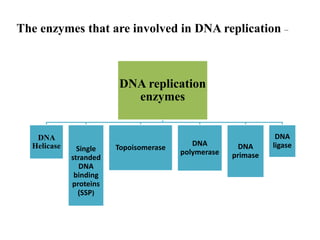
The enzymes that are involved in DNA replication –
DNA replication
enzymes
DNA
Helicase Single
stranded
DNA
binding
proteins
(SSP)
Topoisomerase
DNA
polymerase
DNA
primase
DNA
ligase
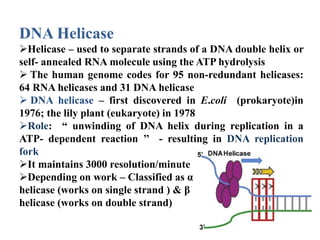
DNA Helicase
Helicase – used to separate strands of a DNA double helix or
self- annealed RNA molecule using the ATP hydrolysis
 The human genome codes for 95 non-redundant helicases:
64 RNA helicases and 31 DNA helicase
 DNA helicase – first discovered in E.coli (prokaryote)in
1976; the lily plant (eukaryote) in 1978
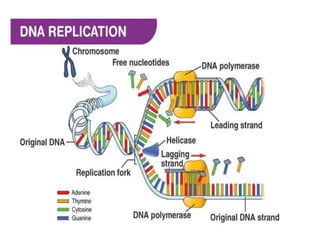
Role: “ unwinding of DNA helix during replication in a
ATP- dependent reaction ’’ - resulting in DNA replication
fork
It maintains 3000 resolution/minute
Depending on work – Classified as α
helicase (works on single strand ) & β
helicase (works on double strand)
Single stranded DNA-binding protein
(SSB)
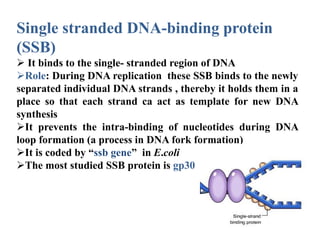
 It binds to the single- stranded region of DNA
Role: During DNA replication these SSB binds to the newly
separated individual DNA strands , thereby it holds them in a
place so that each strand ca act as template for new DNA
synthesis
It prevents the intra-binding of nucleotides during DNA
loop formation (a process in DNA fork formation)
It is coded by “ssb gene” in E.coli
The most studied SSB protein is gp30
Topoisomerase
 The coling of DNA molecule can lead to changes in topology
, including positive or negative supercoils
This leads to the stress on DNA duplexes.
Role: Controls the topology of the DNA duplex during
replication
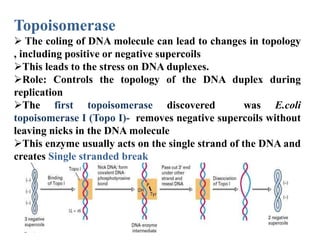
The first topoisomerase discovered was E.coli
topoisomerase I (Topo I)- removes negative supercoils without
leaving nicks in the DNA molecule
This enzyme usually acts on the single strand of the DNA and
creates Single stranded break
Topoisomerase II (Topo II) – was first discovered from E.coli
and named as DNA gyrase
It has the ability to cut both strands of a double-stranded
DNA molecule, pass the portion of the duplex through the cut
and reseal the cut in a process that utilizes ATP
DNA gyrase has 2 identical subunits
Role: 1) introduce negative supercoils at or near the OriC site
in DNA template
 2) to remove the postive supercoils that form ahead of the
growing fork during elongation
All type of Topo II catalyze the catenation and decatenation
(linking and unlinking) of two different DNA duplex
In E.coli decatenation is catalyzed by DNA gyrase and second
type II enzyme , called Topoisomerase IV (Topo IV)
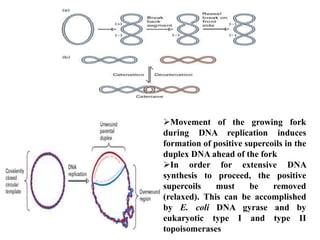
Movement of the growing fork
during DNA replication induces
formation of positive supercoils in the
duplex DNA ahead of the fork
In order for extensive DNA
synthesis to proceed, the positive
supercoils must be removed
(relaxed). This can be accomplished
by E. coli DNA gyrase and by
eukaryotic type I and type II
topoisomerases
DNA polymerase
 In 1957, Arthur Kornberg isolated an enzyme from E.coli
called “ kornberg enzyme” during an attempt of in-vitro DNA
synthesis
It is now known as DNA Polymerase I
It is encoded by dnaA gene
He reported that DNA polymerase I
-has 5′ to 3′ polymerase activity (that requires free 5′
phosphate group and 3′ OH group
- requires primer with free 3′ OH group for action
-has 5′ to 3′ exonuclease activity
-has 3′ to 5′ endonuclease activity
 Later , it was known that DNA polymerase I cannot initiate
replication
As the DNA Pol II, III, IV, V was identified, DNA pol III is
known to be a true replicase
DNA polymerase III
Has 5′ to 3′ polymerase activity
Has 3′ to 5′ exonuclease activity
Has high accuracy – process called Proof reading
 Other DNA Pol involves in the DNA repair machanism
Eukaryote DNA Polymerase
 It is found to contain 5 types of Polymerase
1) DNA polymerase α (alpha)- relatively high molecular
weight enzyme – also called as cytoplasmic polymerase or large
polymerase (found in nucleus & cytoplasma)
2) DNA polymerase β (beta)- also called as nuclear
polymerase or small polymerase – found in vertebrates
3) DNA polymerase γ (gamma)- called as mitochondrial
polymerase and is encoded in nucleus
4) DNA polymerase δ (delta) - is found in mammalian
cells and is PCNA dependent for DNA- sythesis processivity
5) DNA polymerase ε (epsilon) – known as DNA
polymerase δ II. This enzyme is PCNA independent
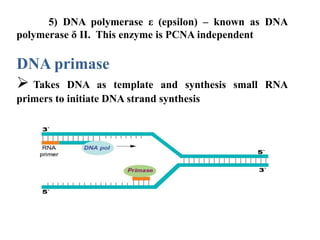
DNA primase
 Takes DNA as template and synthesis small RNA
primers to initiate DNA strand synthesis
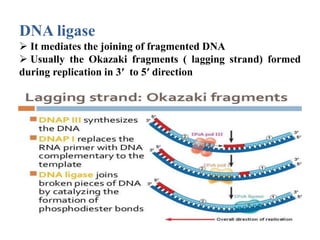
DNA ligase
 It mediates the joining of fragmented DNA
 Usually the Okazaki fragments ( lagging strand) formed
during replication in 3′ to 5′ direction

Enzyme in dna replication

  • 1.
  • 2.
    The enzymes thatare involved in DNA replication – DNA replication enzymes DNA Helicase Single stranded DNA binding proteins (SSP) Topoisomerase DNA polymerase DNA primase DNA ligase
  • 4.
    DNA Helicase Helicase –used to separate strands of a DNA double helix or self- annealed RNA molecule using the ATP hydrolysis  The human genome codes for 95 non-redundant helicases: 64 RNA helicases and 31 DNA helicase  DNA helicase – first discovered in E.coli (prokaryote)in 1976; the lily plant (eukaryote) in 1978 Role: “ unwinding of DNA helix during replication in a ATP- dependent reaction ’’ - resulting in DNA replication fork It maintains 3000 resolution/minute Depending on work – Classified as α helicase (works on single strand ) & β helicase (works on double strand)
  • 5.
    Single stranded DNA-bindingprotein (SSB)  It binds to the single- stranded region of DNA Role: During DNA replication these SSB binds to the newly separated individual DNA strands , thereby it holds them in a place so that each strand ca act as template for new DNA synthesis It prevents the intra-binding of nucleotides during DNA loop formation (a process in DNA fork formation) It is coded by “ssb gene” in E.coli The most studied SSB protein is gp30
  • 6.
    Topoisomerase  The colingof DNA molecule can lead to changes in topology , including positive or negative supercoils This leads to the stress on DNA duplexes. Role: Controls the topology of the DNA duplex during replication The first topoisomerase discovered was E.coli topoisomerase I (Topo I)- removes negative supercoils without leaving nicks in the DNA molecule This enzyme usually acts on the single strand of the DNA and creates Single stranded break
  • 7.
    Topoisomerase II (TopoII) – was first discovered from E.coli and named as DNA gyrase It has the ability to cut both strands of a double-stranded DNA molecule, pass the portion of the duplex through the cut and reseal the cut in a process that utilizes ATP DNA gyrase has 2 identical subunits Role: 1) introduce negative supercoils at or near the OriC site in DNA template  2) to remove the postive supercoils that form ahead of the growing fork during elongation All type of Topo II catalyze the catenation and decatenation (linking and unlinking) of two different DNA duplex In E.coli decatenation is catalyzed by DNA gyrase and second type II enzyme , called Topoisomerase IV (Topo IV)
  • 8.
    Movement of thegrowing fork during DNA replication induces formation of positive supercoils in the duplex DNA ahead of the fork In order for extensive DNA synthesis to proceed, the positive supercoils must be removed (relaxed). This can be accomplished by E. coli DNA gyrase and by eukaryotic type I and type II topoisomerases
  • 9.
    DNA polymerase  In1957, Arthur Kornberg isolated an enzyme from E.coli called “ kornberg enzyme” during an attempt of in-vitro DNA synthesis It is now known as DNA Polymerase I It is encoded by dnaA gene He reported that DNA polymerase I -has 5′ to 3′ polymerase activity (that requires free 5′ phosphate group and 3′ OH group - requires primer with free 3′ OH group for action -has 5′ to 3′ exonuclease activity -has 3′ to 5′ endonuclease activity  Later , it was known that DNA polymerase I cannot initiate replication As the DNA Pol II, III, IV, V was identified, DNA pol III is known to be a true replicase
  • 10.
    DNA polymerase III Has5′ to 3′ polymerase activity Has 3′ to 5′ exonuclease activity Has high accuracy – process called Proof reading  Other DNA Pol involves in the DNA repair machanism Eukaryote DNA Polymerase  It is found to contain 5 types of Polymerase 1) DNA polymerase α (alpha)- relatively high molecular weight enzyme – also called as cytoplasmic polymerase or large polymerase (found in nucleus & cytoplasma) 2) DNA polymerase β (beta)- also called as nuclear polymerase or small polymerase – found in vertebrates 3) DNA polymerase γ (gamma)- called as mitochondrial polymerase and is encoded in nucleus 4) DNA polymerase δ (delta) - is found in mammalian cells and is PCNA dependent for DNA- sythesis processivity
  • 11.
    5) DNA polymeraseε (epsilon) – known as DNA polymerase δ II. This enzyme is PCNA independent DNA primase  Takes DNA as template and synthesis small RNA primers to initiate DNA strand synthesis
  • 12.
    DNA ligase  Itmediates the joining of fragmented DNA  Usually the Okazaki fragments ( lagging strand) formed during replication in 3′ to 5′ direction