Polycistronic &
Monocistronic
RNA
INDRANI KAR
M.Sc Microbiology
St. George College of Management & Science
Bengaluru North University
INTRODUCTION
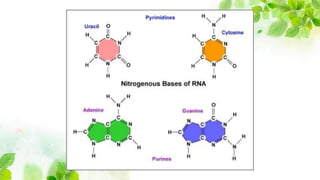
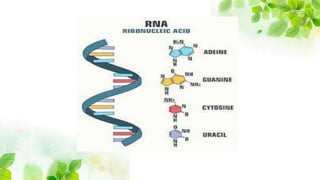
• RNA usually exists as single stranded polypeptid, and uracil is present
insead of thymine in RNA single strand.
• In bacteria there are 3 type of RNA present as ribosomal RNA, transfer
RNA and masses RNA.
• Ribosomal RNA are made of by ribosomal subunits, massenger RNA almost
are many types ,transfer RNA is of 50 different types.
• All of these three molecules resembles the single stranded structure of the
DNA, intramolecular and have some double strands regions.
Continue.....
• Typically one half and two third of bases in RNA are paired, the pairing
regions are short containing six or fewer bases.
• RNA is also hydrolyzed to free nucleotides either chemically or enzymatically,
at pH1 the phosphodiesters bond and the N-glycosidic bond between the
sugars and bases are broken, releasing the free bases.
• Some nuclease cleave only at the end of a nucleic acid, either the 3' or the 5'
terminus, removing the single nucleotide or short oligonucleotides.
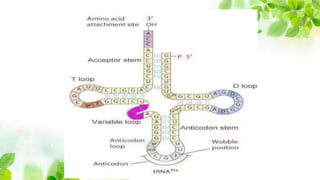
Transfer RNA ( t-RNA )
• Transfer RNA binds to the amino acids to the ribosome and start
translation, it carries the amino acids and binds to the messenger RNA.
• In primary structure it contact about 73 to 93 nucleotides, three
anticodon and all 4 bases are methylated.
• In the secondary structure it is look like cloverleaf structure, forms base
pairs loops, anticodon and fragments strands.
• In the tertiary structure it is formed as L shape structure, three
dimensional structure form D loop.
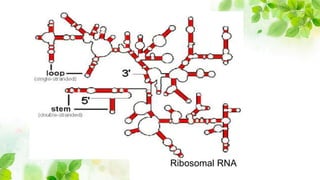
Ribosomal RNA (r-RNA)
• Ribosomal RNA is a fibricate part of the polypeptide and provides
mechanisms for decoding m-RNA and interacts with tRNA during translation.
• Ribosomal RNA is a structure component of the ribosome and actually found
in the catalytic element for proteins synthesis.
• It's most abundant type of RNA in the cell, it compromises the large and small
subunit.
• Prokaryotic RNA is 70 svedberg unit, a unit of the measurement for the
sedimentation coefficient or how fast molecular sediment when centrifuged.
Ribosomal RNA
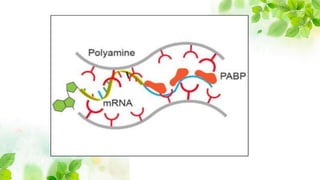
Messenger RNA (m-RNA )
• Messenger RNA is the blue print of protein reproduction, transcribed from the
DNA, transfer the information from cell to nucleus.
• Transfer of the information is done into protein nucleotides, that can in codon as
genetic information.
• Genetic codon are triple bases nucleotides, each codons corresponding to the
specific amino acids, sequence of codon ends with the a codon that is stop single.
• The protein synthesis process requires transfer RNA (t-RNA) for transferred the
information.
• The m-RNA makes up to only only about 5% of the different types of RNA found in
both prokaryotic and eukaryotic.
Type of messengerRNA
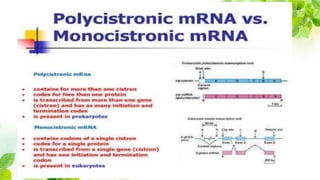
1.Polycistronic messenger RNA
2.Monocistronic messenger RNA
Polycistronic messenger RNA
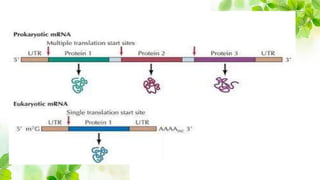
• The messenger RNA is translated into amino acids by protein synthesizing
machinery of the cell.
• In the prokaryotes the messenger RNA molecules often contain information
for the amino acids sequence of each different polypeptides chain, in these
case such molecules are called polycistronic messenger RNA.
• In polycistronic messenger RNA the cistron is used as the synonymous of the
gene ---- a base sequence encoding a single polypeptide chain.
• The gene that contain polycistronic messenger RNA molecules are often
encode different types of proteins of a metabolic pathway. For example S.
typhimurium.
Continue.....
• In the cell of S. typhimurium 10 enzymes needed to synthesize histidine are
encoded only one messenger RNA molecule.
• The use of polycistronic messenger RNA is an economical way for a cell to
regulate synthesis of related proteins in a coordinated way.
• The prokaryotes are the examples of the synthesis of the messenger RNA
molecule, the synthesis of the several related molecules.
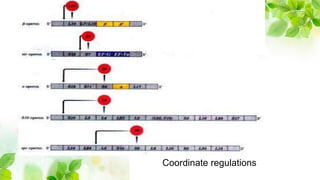
• With the polycistronic messenger RNA the synthesis is regulated by the single
signal made at the same time is called coordinate regulation.
Coordinate regulations
THANK YOU

Polycistronic and monocistronic RNA

  • 1.
    Polycistronic & Monocistronic RNA INDRANI KAR M.ScMicrobiology St. George College of Management & Science Bengaluru North University
  • 2.
    INTRODUCTION • RNA usuallyexists as single stranded polypeptid, and uracil is present insead of thymine in RNA single strand. • In bacteria there are 3 type of RNA present as ribosomal RNA, transfer RNA and masses RNA. • Ribosomal RNA are made of by ribosomal subunits, massenger RNA almost are many types ,transfer RNA is of 50 different types. • All of these three molecules resembles the single stranded structure of the DNA, intramolecular and have some double strands regions.
  • 4.
    Continue..... • Typically onehalf and two third of bases in RNA are paired, the pairing regions are short containing six or fewer bases. • RNA is also hydrolyzed to free nucleotides either chemically or enzymatically, at pH1 the phosphodiesters bond and the N-glycosidic bond between the sugars and bases are broken, releasing the free bases. • Some nuclease cleave only at the end of a nucleic acid, either the 3' or the 5' terminus, removing the single nucleotide or short oligonucleotides.
  • 6.
    Transfer RNA (t-RNA ) • Transfer RNA binds to the amino acids to the ribosome and start translation, it carries the amino acids and binds to the messenger RNA. • In primary structure it contact about 73 to 93 nucleotides, three anticodon and all 4 bases are methylated. • In the secondary structure it is look like cloverleaf structure, forms base pairs loops, anticodon and fragments strands. • In the tertiary structure it is formed as L shape structure, three dimensional structure form D loop.
  • 8.
    Ribosomal RNA (r-RNA) •Ribosomal RNA is a fibricate part of the polypeptide and provides mechanisms for decoding m-RNA and interacts with tRNA during translation. • Ribosomal RNA is a structure component of the ribosome and actually found in the catalytic element for proteins synthesis. • It's most abundant type of RNA in the cell, it compromises the large and small subunit. • Prokaryotic RNA is 70 svedberg unit, a unit of the measurement for the sedimentation coefficient or how fast molecular sediment when centrifuged.
  • 9.
  • 10.
    Messenger RNA (m-RNA) • Messenger RNA is the blue print of protein reproduction, transcribed from the DNA, transfer the information from cell to nucleus. • Transfer of the information is done into protein nucleotides, that can in codon as genetic information. • Genetic codon are triple bases nucleotides, each codons corresponding to the specific amino acids, sequence of codon ends with the a codon that is stop single. • The protein synthesis process requires transfer RNA (t-RNA) for transferred the information. • The m-RNA makes up to only only about 5% of the different types of RNA found in both prokaryotic and eukaryotic.
  • 12.
    Type of messengerRNA 1.Polycistronicmessenger RNA 2.Monocistronic messenger RNA
  • 13.
    Polycistronic messenger RNA •The messenger RNA is translated into amino acids by protein synthesizing machinery of the cell. • In the prokaryotes the messenger RNA molecules often contain information for the amino acids sequence of each different polypeptides chain, in these case such molecules are called polycistronic messenger RNA. • In polycistronic messenger RNA the cistron is used as the synonymous of the gene ---- a base sequence encoding a single polypeptide chain. • The gene that contain polycistronic messenger RNA molecules are often encode different types of proteins of a metabolic pathway. For example S. typhimurium.
  • 15.
    Continue..... • In thecell of S. typhimurium 10 enzymes needed to synthesize histidine are encoded only one messenger RNA molecule. • The use of polycistronic messenger RNA is an economical way for a cell to regulate synthesis of related proteins in a coordinated way. • The prokaryotes are the examples of the synthesis of the messenger RNA molecule, the synthesis of the several related molecules. • With the polycistronic messenger RNA the synthesis is regulated by the single signal made at the same time is called coordinate regulation.
  • 16.
  • 20.