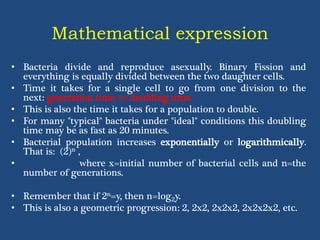
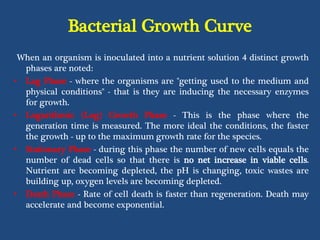
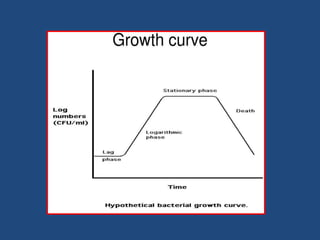
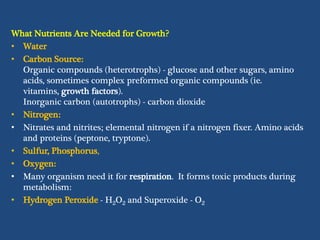
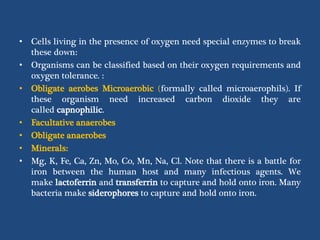
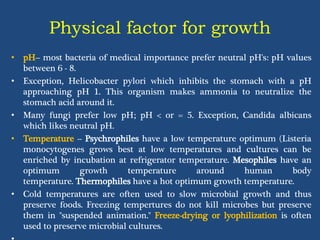
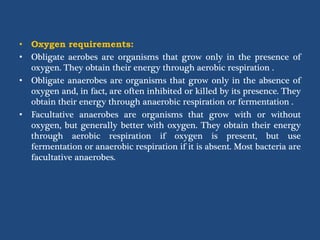
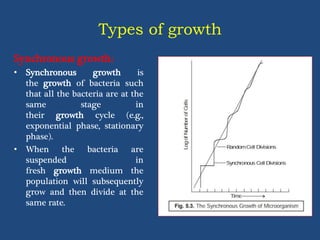
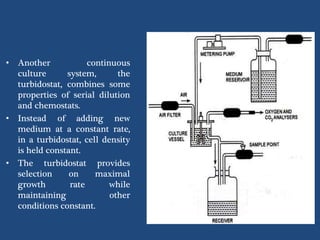
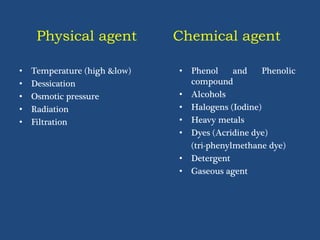
Microbial growth refers to the growth of a microbial population through cell division, not the growth of individual cells. Environmental factors like temperature, pH, nutrients, and oxygen levels influence the growth rate. Bacteria divide through binary fission and the population increases exponentially over time. A bacterial growth curve shows four phases: lag phase, logarithmic growth phase, stationary phase, and death phase. Microbes require water, carbon sources, nitrogen, sulfur, phosphorus, minerals, and optimal pH and temperature to grow. Their oxygen requirements classify them as aerobic, anaerobic, or facultative. Batch, continuous, synchronous, and diauxic growth describe different patterns of microbial population growth over time. Physical and chemical antimicrobial agents