Microbiology
Introduction, History And Application
Mrs. Praveen Garg
VITS College, Satna
Introduction
• Microbiology is the study of micro-organisms, those
being unicellular (single cell), multicellular (cell colony),
or acellular (lacking cells).
• Microbiology encompasses numerous branches
including virology, bacteriology, protistology, mycology,
and parasitology.
• Eukaryotic microorganisms possess membrane-
bound organelles and include fungi and protists,
• Whereas prokaryotic organisms, all of which are microorganisms
are conventionally classified as lacking membrane-bound
organelles and include Bacteria and Archaea.
• These micro-organisms may be harmful or beneficial.
• The branch microbiology starts from the invention of
microscope.
• “Antonie van leeuwenhoek” invented the first microscope.
• “Robert Hooks” firstly observe the cells from microscope.
• “Antonie van leeuwenhoek” firstly observe the bacterialcells.
• “Ferdinand Cohn” developed the classification scheme of
bacteria, based on shaped.
Such as:
 Spherobacteria- spherical shape
 Microbacteria- rod shaped
• Desmobacteria- filamentous
• Spirobacteria- spiral shaped
History
• “Louis Pasteur” given pasteurization process, germ theory and
developed vaccines.
• “Robert koch” identified the anthrax and discovered the
Mycobacterium tuberculosis, cause tuberculosis. He developed
the agar growth medium.
• “Paul ehrlich” developed the chemotherapy method to cure
disease and antibiotics for sleeping sickness and syphlis.
• “Alexender flaming” discovered the penicillin antibiotic.
• “Ivanovaski” discovered the first virus TMV.
• “Hershey and Chase” identified the genetic material of
Bacteriophage.
Characters of M.or.
 Morphological Characters
 Chemical composition
 Cultural Characters
 Metabolic Characters
 Antigenic Characters
 Genetic Characters
 Pathogenecity
 Ecological characters
• Micro-organisms are classified according to particular
characters.
 Three domain system of classification
 Five kingdom system of classification
 Eight kingdom system of classification
Classification of M.or.
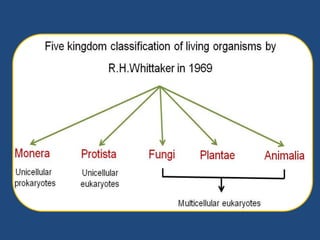
• ‘Whitaker’ in 1969 given five kingdom classification.
• He classified the organism according to their cell anatomy and
energy yielding system in to five systems.
• Monera, Protista, Fungi, Plantae, Animalia
• All prokaryotic organism kept into monera kingdom
• Unicellular and multicellular organism kept in to protista
kingdom.
• Multicellular eukaryotic kept in fungi kingdom, it is based upon
absorptive mode of nutrition.
• Multicellular eukaryotes kept in animalia and it is based on
ingestion and nutrition mode.
• Plantae kingdom based on photosynthesis mode and it is also
multicellular.
Five kingdom classification
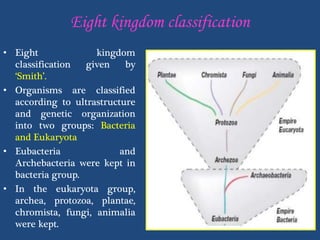
• Eight kingdom
classification given by
‘Smith’.
• Organisms are classified
according to ultrastructure
and genetic organization
into two groups: Bacteria
and Eukaryota
• Eubacteria and
Archebacteria were kept in
bacteria group.
• In the eukaryota group,
archea, protozoa, plantae,
chromista, fungi, animalia
were kept.
Eight kingdom classification
• ‘Woese’ in 1990 developed the three domain system.
• Bacteria, Archea, Eukarya
Three domain system classification
Three kingdom Classification
• Micro- organisms are classified according to particular
phenotypic characters.
 On the basis of morphology: M.Or. are divided into five
groups.
 Bacteria: it may be cocci and bacilli shape.
 Actinomycetes: it is filamentous structure.
 Spirochaets: it is spiral shaped.
 Mycoplasma: it is highly pleomorphic and indifinite shape.
 Ricketsia: small, obligate parasite, related to virus.
Classification and Identification of Bacteria
 On the basis of anatomical features:
 Capsule:
• Capsulated- S. Pneumoniae
• Non- capsulated- Viridans streptococci
 Flagilla:
• Flagillate - monotrichous, lophotrichous etc.
• Aflagillate - shigella species
 Spore:
• Spore forming- bacillus species
• Non- spore forming – e.coli
 On the basis of staining reaction:
 Gram stain:
• Gram +ve cocci- S. aureus
• Gram –ve cocci – Neisseria gonorrhoeae
• Gram +ve rod- Clostridium sp.
• Gram –ve rod- E.coli
 Acid fast stain:
• Acid fast bacilli- Mycobacterium tuberculosis
• Non acid fast bacilli- Staphylococcus aureus
 On the basis of staining reaction:
 Temperature:
• Psychrophiles- Pseudomonas fluorescence
• Mesophiles- E.coli, Salmonella enterica
• Thermophiles – Bacillus stearothermophiles
 Oxygen dependent:
• Aerobic- require oxygen
• Obligate aerobes- strictly require oxygen for growth
• Facultative anaerobes- grow in the presence or absence of
oxygen
 pH:
• Acidophiles- lactobacillus acidophiles
• Alkalophiles- Vibrio
• Neutrophiles- pH 6-8
 Morphological and Staining:
 Culture characteristics:
 Biochemical Reaction:
 Antigenic Characters:
Identification
Thank you

Microbiology

  • 1.
    Microbiology Introduction, History AndApplication Mrs. Praveen Garg VITS College, Satna
  • 2.
    Introduction • Microbiology isthe study of micro-organisms, those being unicellular (single cell), multicellular (cell colony), or acellular (lacking cells). • Microbiology encompasses numerous branches including virology, bacteriology, protistology, mycology, and parasitology. • Eukaryotic microorganisms possess membrane- bound organelles and include fungi and protists, • Whereas prokaryotic organisms, all of which are microorganisms are conventionally classified as lacking membrane-bound organelles and include Bacteria and Archaea. • These micro-organisms may be harmful or beneficial.
  • 3.
    • The branchmicrobiology starts from the invention of microscope. • “Antonie van leeuwenhoek” invented the first microscope. • “Robert Hooks” firstly observe the cells from microscope. • “Antonie van leeuwenhoek” firstly observe the bacterialcells. • “Ferdinand Cohn” developed the classification scheme of bacteria, based on shaped. Such as:  Spherobacteria- spherical shape  Microbacteria- rod shaped • Desmobacteria- filamentous • Spirobacteria- spiral shaped History
  • 4.
    • “Louis Pasteur”given pasteurization process, germ theory and developed vaccines. • “Robert koch” identified the anthrax and discovered the Mycobacterium tuberculosis, cause tuberculosis. He developed the agar growth medium. • “Paul ehrlich” developed the chemotherapy method to cure disease and antibiotics for sleeping sickness and syphlis. • “Alexender flaming” discovered the penicillin antibiotic. • “Ivanovaski” discovered the first virus TMV. • “Hershey and Chase” identified the genetic material of Bacteriophage.
  • 5.
    Characters of M.or. Morphological Characters  Chemical composition  Cultural Characters  Metabolic Characters  Antigenic Characters  Genetic Characters  Pathogenecity  Ecological characters
  • 6.
    • Micro-organisms areclassified according to particular characters.  Three domain system of classification  Five kingdom system of classification  Eight kingdom system of classification Classification of M.or.
  • 7.
    • ‘Whitaker’ in1969 given five kingdom classification. • He classified the organism according to their cell anatomy and energy yielding system in to five systems. • Monera, Protista, Fungi, Plantae, Animalia • All prokaryotic organism kept into monera kingdom • Unicellular and multicellular organism kept in to protista kingdom. • Multicellular eukaryotic kept in fungi kingdom, it is based upon absorptive mode of nutrition. • Multicellular eukaryotes kept in animalia and it is based on ingestion and nutrition mode. • Plantae kingdom based on photosynthesis mode and it is also multicellular. Five kingdom classification
  • 9.
    • Eight kingdom classificationgiven by ‘Smith’. • Organisms are classified according to ultrastructure and genetic organization into two groups: Bacteria and Eukaryota • Eubacteria and Archebacteria were kept in bacteria group. • In the eukaryota group, archea, protozoa, plantae, chromista, fungi, animalia were kept. Eight kingdom classification
  • 10.
    • ‘Woese’ in1990 developed the three domain system. • Bacteria, Archea, Eukarya Three domain system classification
  • 11.
  • 12.
    • Micro- organismsare classified according to particular phenotypic characters.  On the basis of morphology: M.Or. are divided into five groups.  Bacteria: it may be cocci and bacilli shape.  Actinomycetes: it is filamentous structure.  Spirochaets: it is spiral shaped.  Mycoplasma: it is highly pleomorphic and indifinite shape.  Ricketsia: small, obligate parasite, related to virus. Classification and Identification of Bacteria
  • 13.
     On thebasis of anatomical features:  Capsule: • Capsulated- S. Pneumoniae • Non- capsulated- Viridans streptococci  Flagilla: • Flagillate - monotrichous, lophotrichous etc. • Aflagillate - shigella species  Spore: • Spore forming- bacillus species • Non- spore forming – e.coli
  • 14.
     On thebasis of staining reaction:  Gram stain: • Gram +ve cocci- S. aureus • Gram –ve cocci – Neisseria gonorrhoeae • Gram +ve rod- Clostridium sp. • Gram –ve rod- E.coli  Acid fast stain: • Acid fast bacilli- Mycobacterium tuberculosis • Non acid fast bacilli- Staphylococcus aureus
  • 15.
     On thebasis of staining reaction:  Temperature: • Psychrophiles- Pseudomonas fluorescence • Mesophiles- E.coli, Salmonella enterica • Thermophiles – Bacillus stearothermophiles  Oxygen dependent: • Aerobic- require oxygen • Obligate aerobes- strictly require oxygen for growth • Facultative anaerobes- grow in the presence or absence of oxygen  pH: • Acidophiles- lactobacillus acidophiles • Alkalophiles- Vibrio • Neutrophiles- pH 6-8
  • 16.
     Morphological andStaining:  Culture characteristics:  Biochemical Reaction:  Antigenic Characters: Identification
  • 17.