Regulation and Renal Handling of
Water
Renal Physiology
January 30th, 2014
Wisit Cheungpasitporn
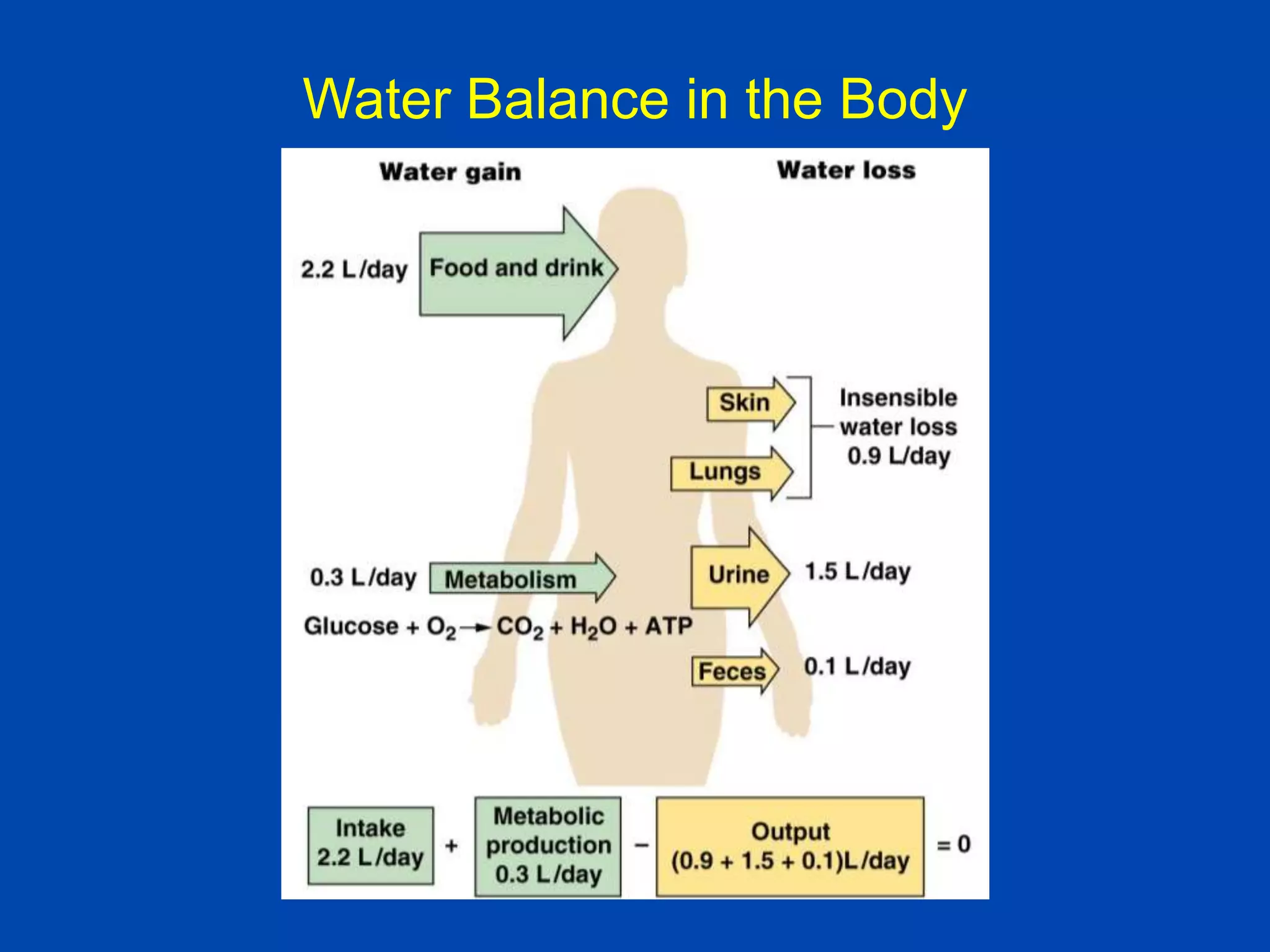
Water Balance in the Body
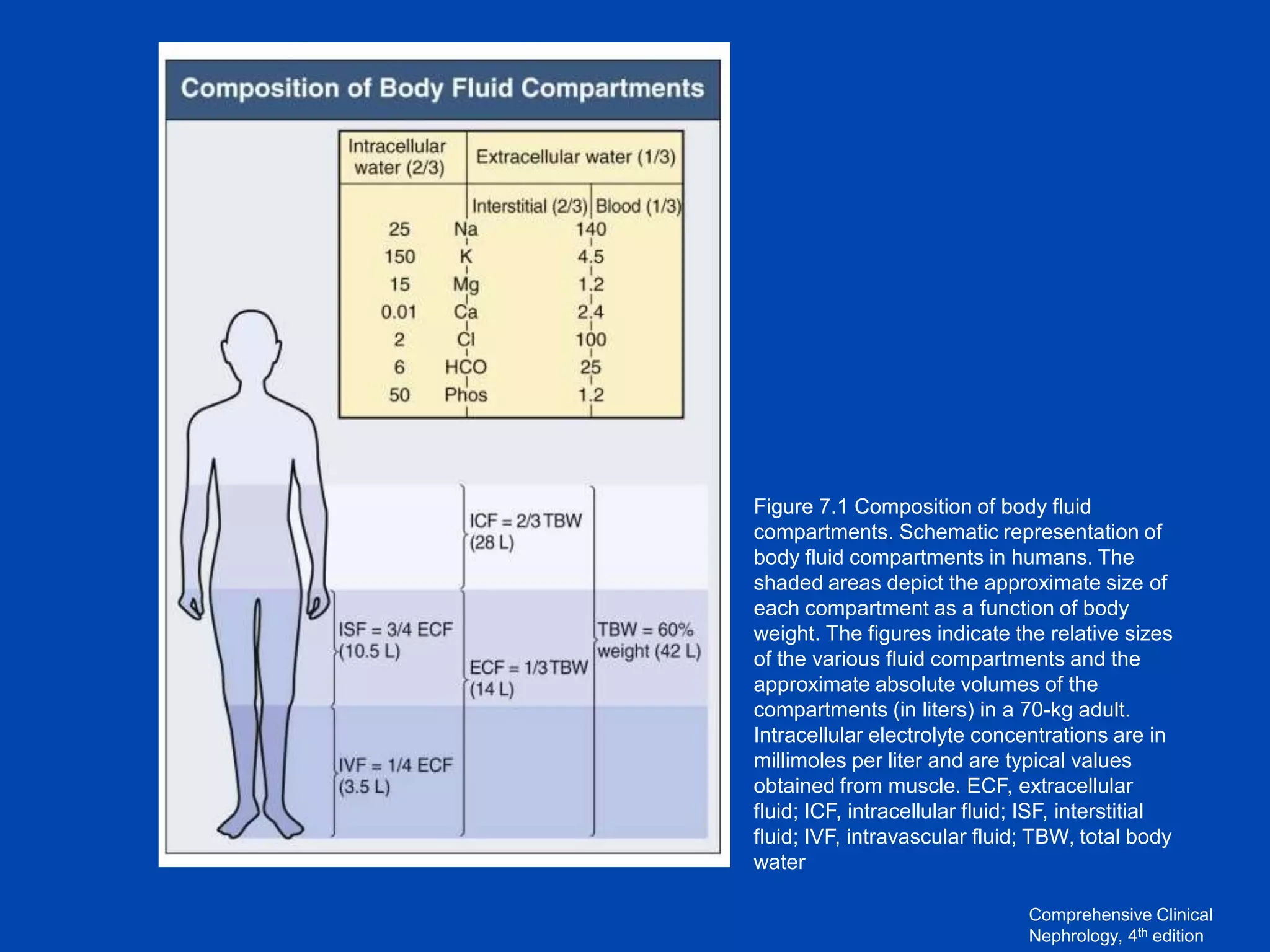
Figure 7.1 Composition of body fluid
compartments. Schematic representation of
body fluid compartments in humans. The
shaded areas depict the approximate size of
each compartment as a function of body
weight. The figures indicate the relative sizes
of the various fluid compartments and the
approximate absolute volumes of the
compartments (in liters) in a 70-kg adult.
Intracellular electrolyte concentrations are in
millimoles per liter and are typical values
obtained from muscle. ECF, extracellular
fluid; ICF, intracellular fluid; ISF, interstitial
fluid; IVF, intravascular fluid; TBW, total body
water
Comprehensive Clinical
Nephrology, 4th edition
Overview
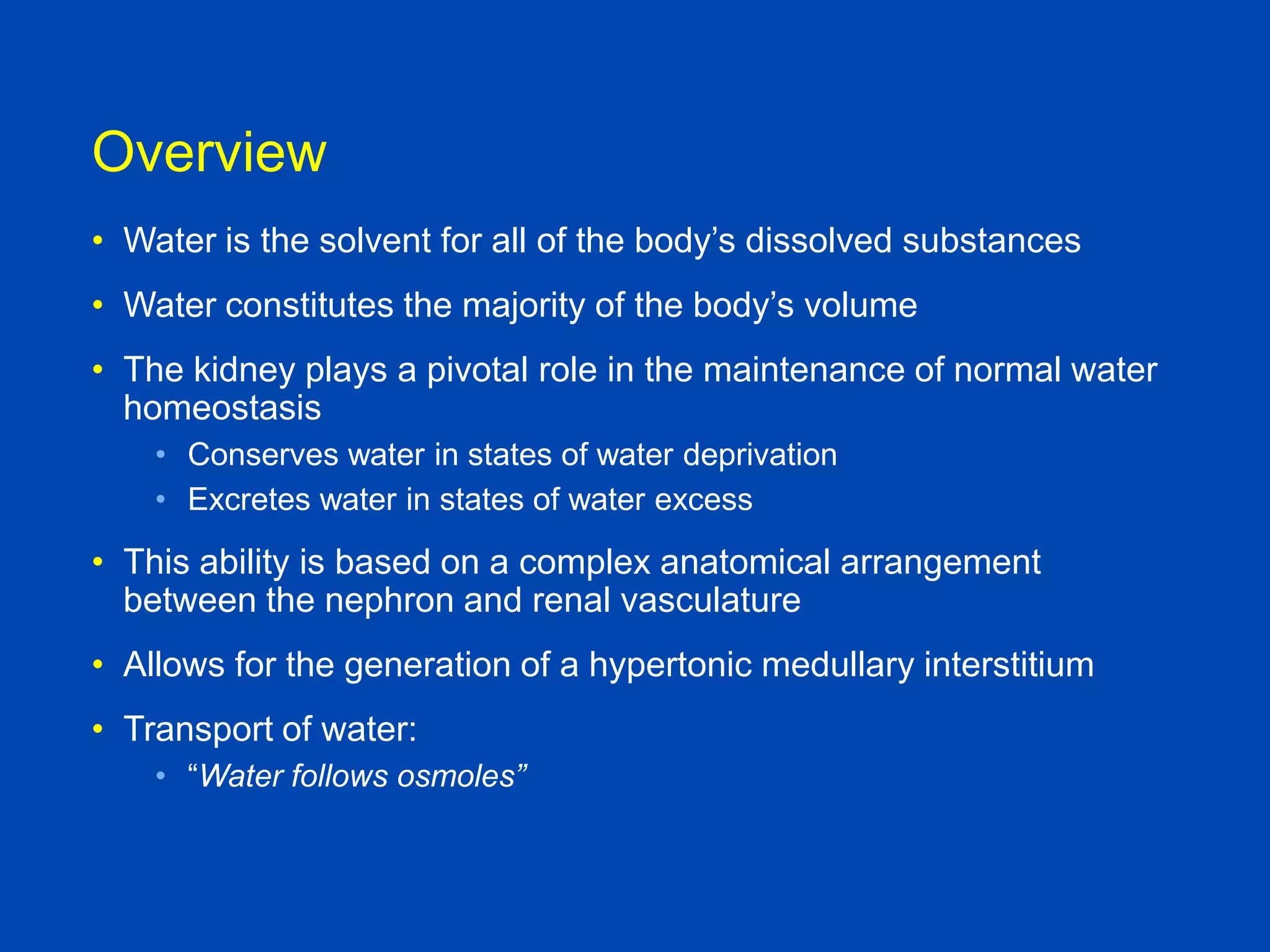
• Water is the solvent for all of the body’s dissolved substances
• Water constitutes the majority of the body’s volume
• The kidney plays a pivotal role in the maintenance of normal water
homeostasis
• Conserves water in states of water deprivation
• Excretes water in states of water excess

• This ability is based on a complex anatomical arrangement
between the nephron and renal vasculature
• Allows for the generation of a hypertonic medullary interstitium
• Transport of water:
• “Water follows osmoles”

Brenner and Rector, 9th edition
Overview
• Nephrons can be classified by 2 ways:
1. Location within the cortex
• Superficial
• Midcortical
• Juxtamedullary
2. Length of their Loop of Henle
• Short – Loop turns back in the outer medulla or cortex
• Long – Loop turns back in the inner medulla
• Thin Ascending limb (only found in inner medulla)

• Superficial and Midcortical Nephrons
• Short loops

• Juxtamedullary Nephrons
• Long Loops

Brenner and Rector, 9th edition
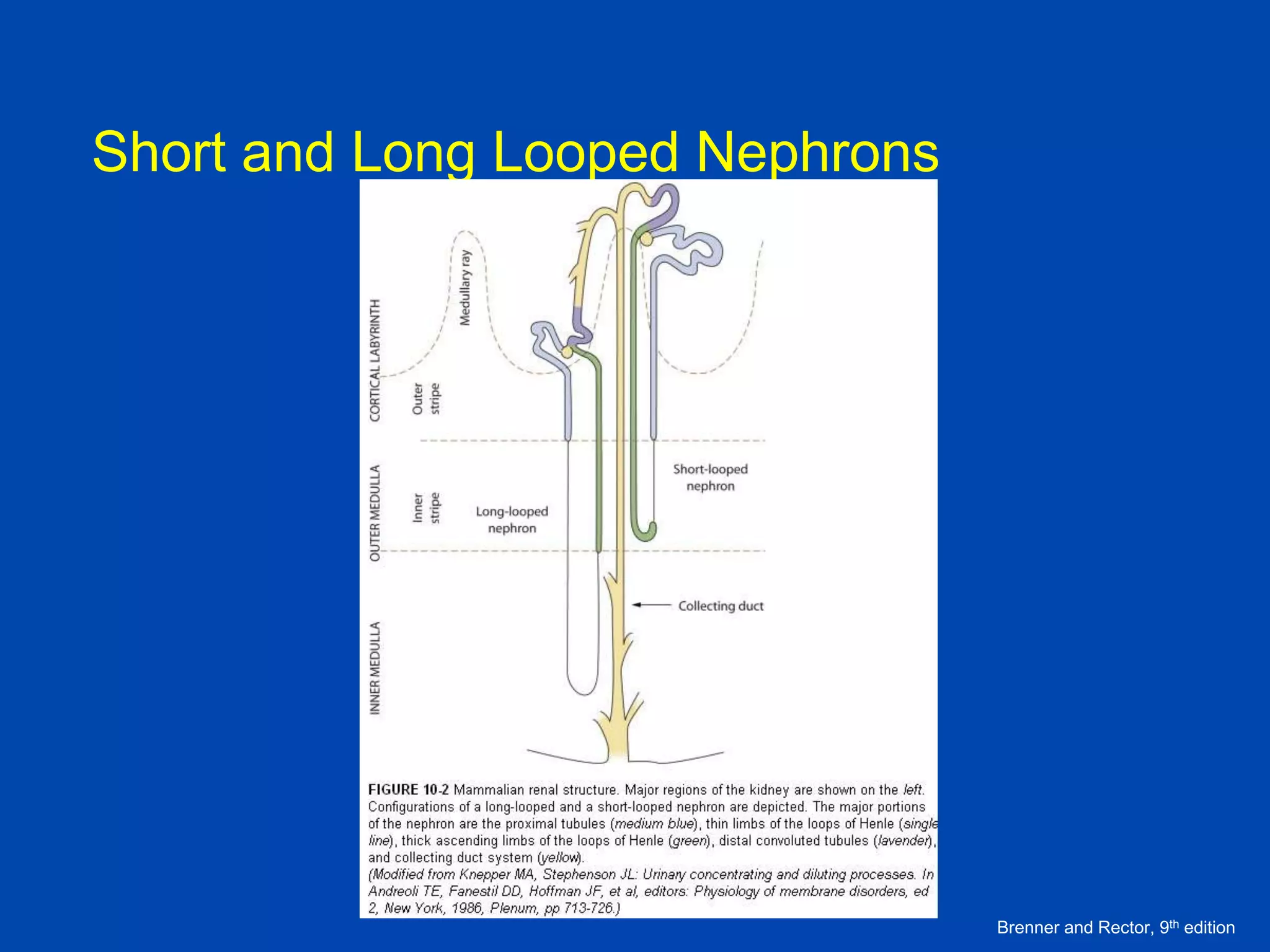
Short and Long Looped Nephrons

Brenner and Rector, 9th edition
Overview
• Renal blood vessel anatomy plays an important in maintaining the
hypertonic medullary interstitium

• Vasa Recta are major blood vessels that carry blood into & out of
the renal medulla
• Descending Vasa Recta
• Ascending Vasa Recta

• The counter flow arrangement promotes countercurrent exchange
of solutes and water
• Preserves medullary interstitial hypertonicity

Comprehensive Clinical
Nephrology, 4th edition
Overview
• Basic requirements for forming concentrated urine
1. Hypertonic Medullary Interstitium
• Generates osmotic gradient necessary for water reabsorption
2. High levels of ADH
• Increases water permeability of DCT and CD

Textbook of Medical
Physiology, Guyton and Hall, 10th
Hypertonic Medullary Interstitium
• Most parts of the body have an interstitial fluid osmolarity of 290
mOsm/L
• Similar to plasma osmolarity

• In the renal medulla, interstitial fluid osmolarity can be as high as
1200-1400 mOsm/L
• Near the pelvic tip of the medulla

• Occurs from accumulation of more solute than water
• Maintained by balanced inflow and outflow of solutes and water in
the medulla

Textbook of Medical
Physiology, Guyton and Hall, 10th
Hypertonic Medullary Interstitium
Major Factors that contribute to excess buildup of solute:
1. Thick ascending limb of Loop of Henle
• Active transport of Na+ ions out into interstitium
• Cotransport of Cl- ions, K+ ions, and other ions into interstitium
2. Collecting Ducts
• Active transport of ions out of CD into interstitium
3. Passive Urea Diffusion/Recycling
• From the inner medullary collecting ducts → medullary
Interstitium → Loop of Henle

4. Diffusion of only a small amount of water from medullary tubules into
interstitium
• Far less than solutes
Textbook of Medical
Physiology, Guyton and Hall, 10th
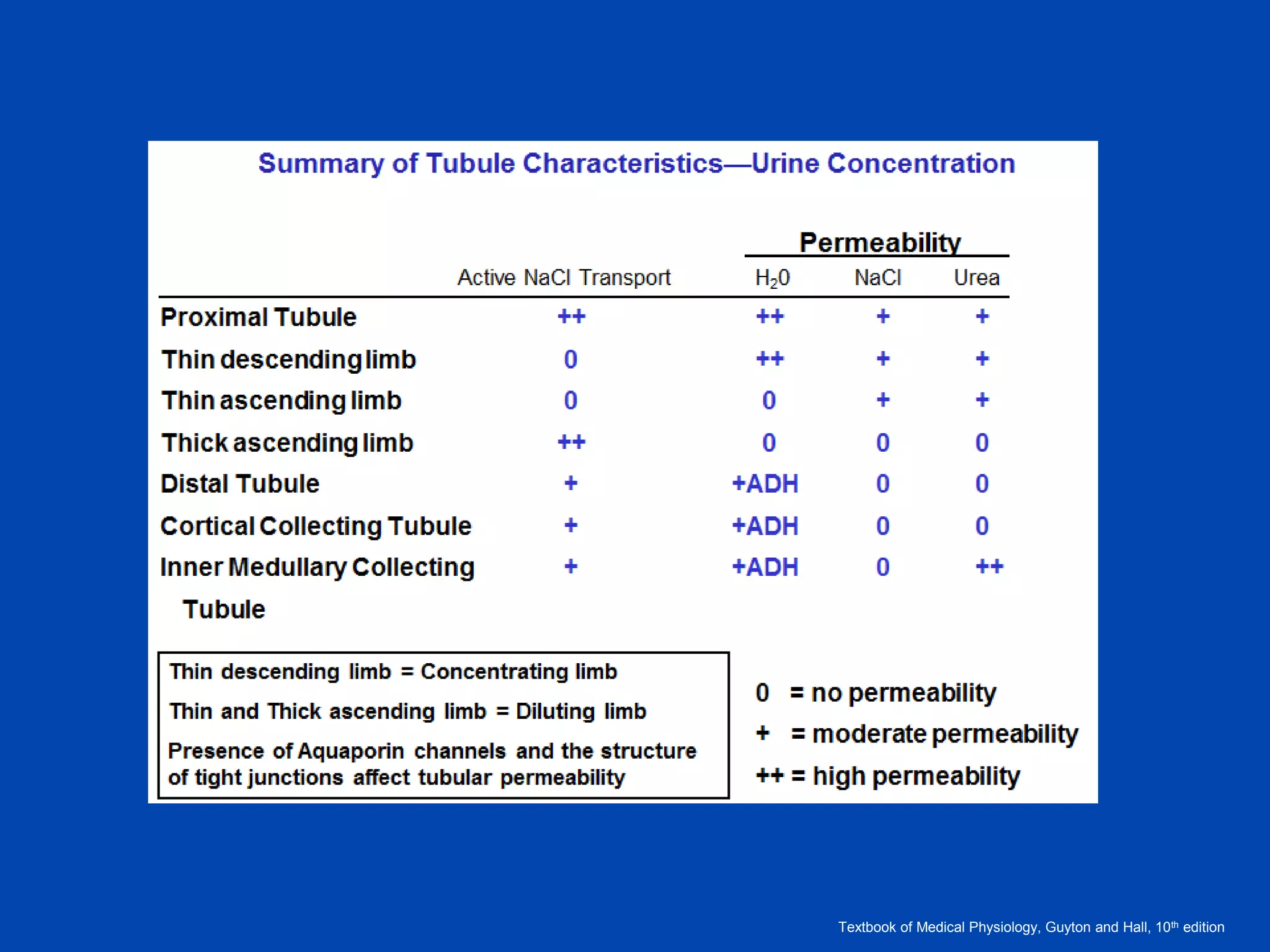
Textbook of Medical Physiology, Guyton and Hall, 10th edition
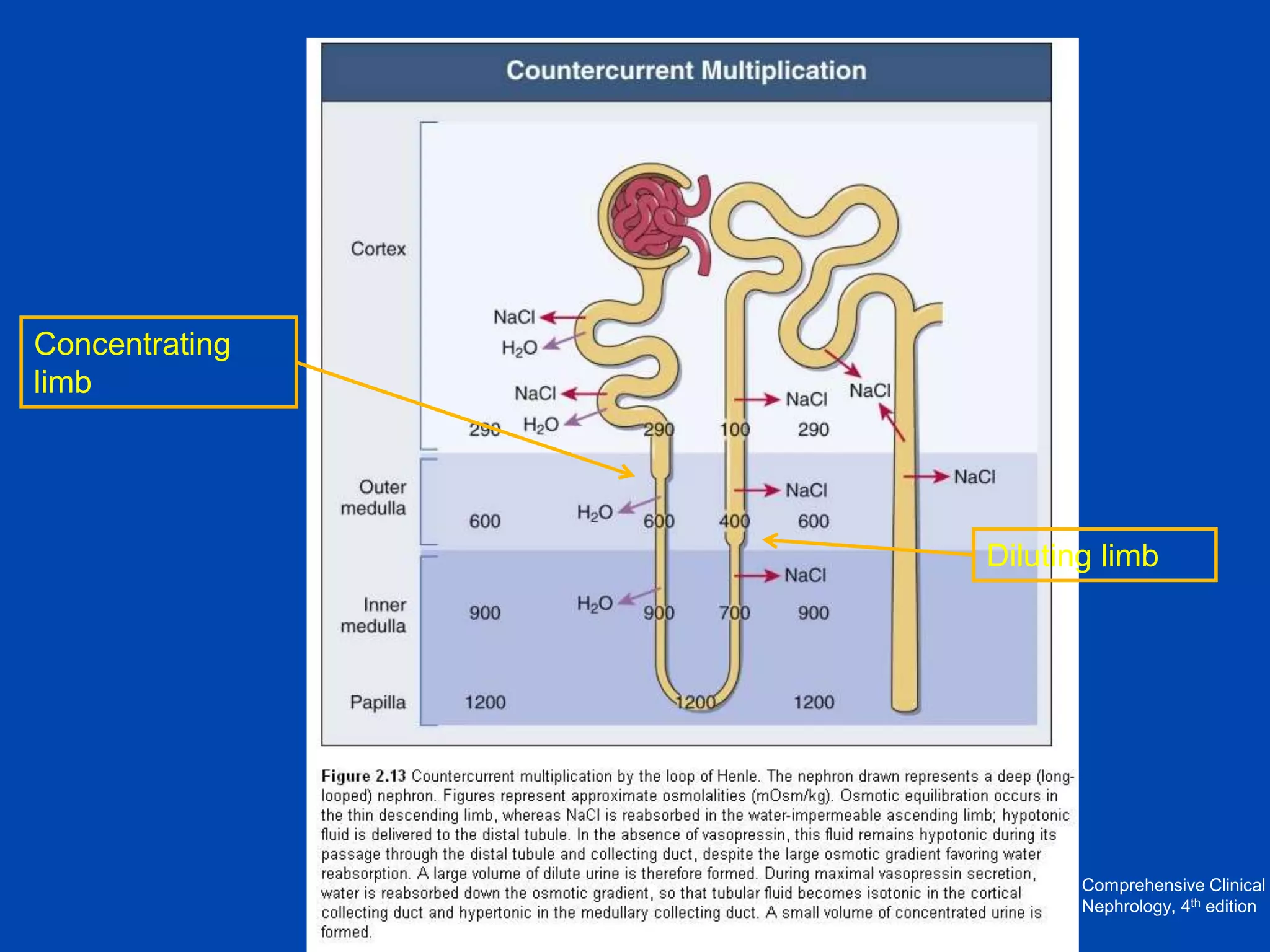
Concentrating
limb

Diluting limb

Comprehensive Clinical
Nephrology, 4th edition
•
•

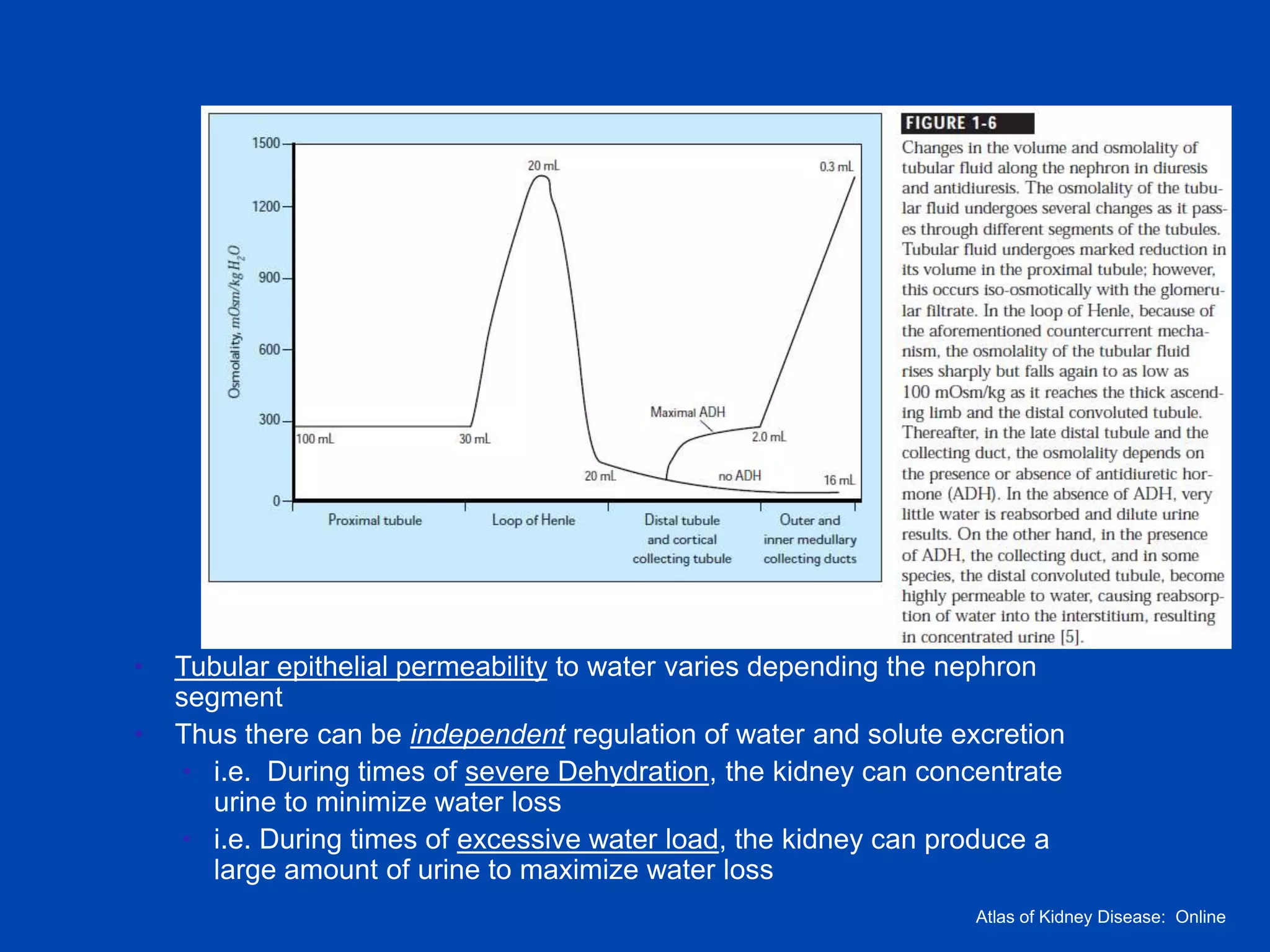
Tubular epithelial permeability to water varies depending the nephron
segment
Thus there can be independent regulation of water and solute excretion
• i.e. During times of severe Dehydration, the kidney can concentrate
urine to minimize water loss
• i.e. During times of excessive water load, the kidney can produce a
large amount of urine to maximize water loss
Atlas of Kidney Disease: Online
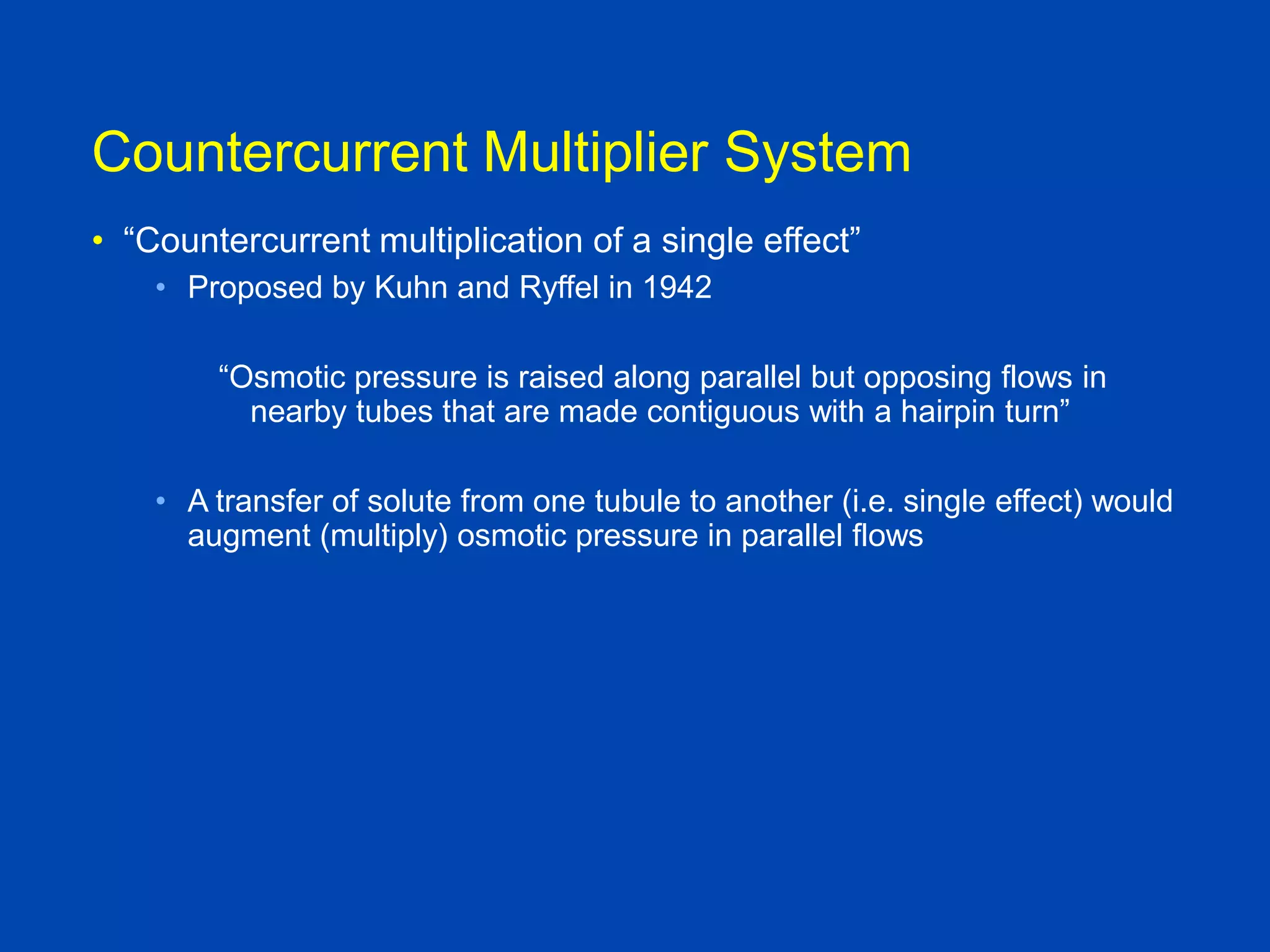
Countercurrent Multiplier System
• “Countercurrent multiplication of a single effect”
• Proposed by Kuhn and Ryffel in 1942
“Osmotic pressure is raised along parallel but opposing flows in
nearby tubes that are made contiguous with a hairpin turn”
• A transfer of solute from one tubule to another (i.e. single effect) would
augment (multiply) osmotic pressure in parallel flows

Brenner and Rector, 9th edition
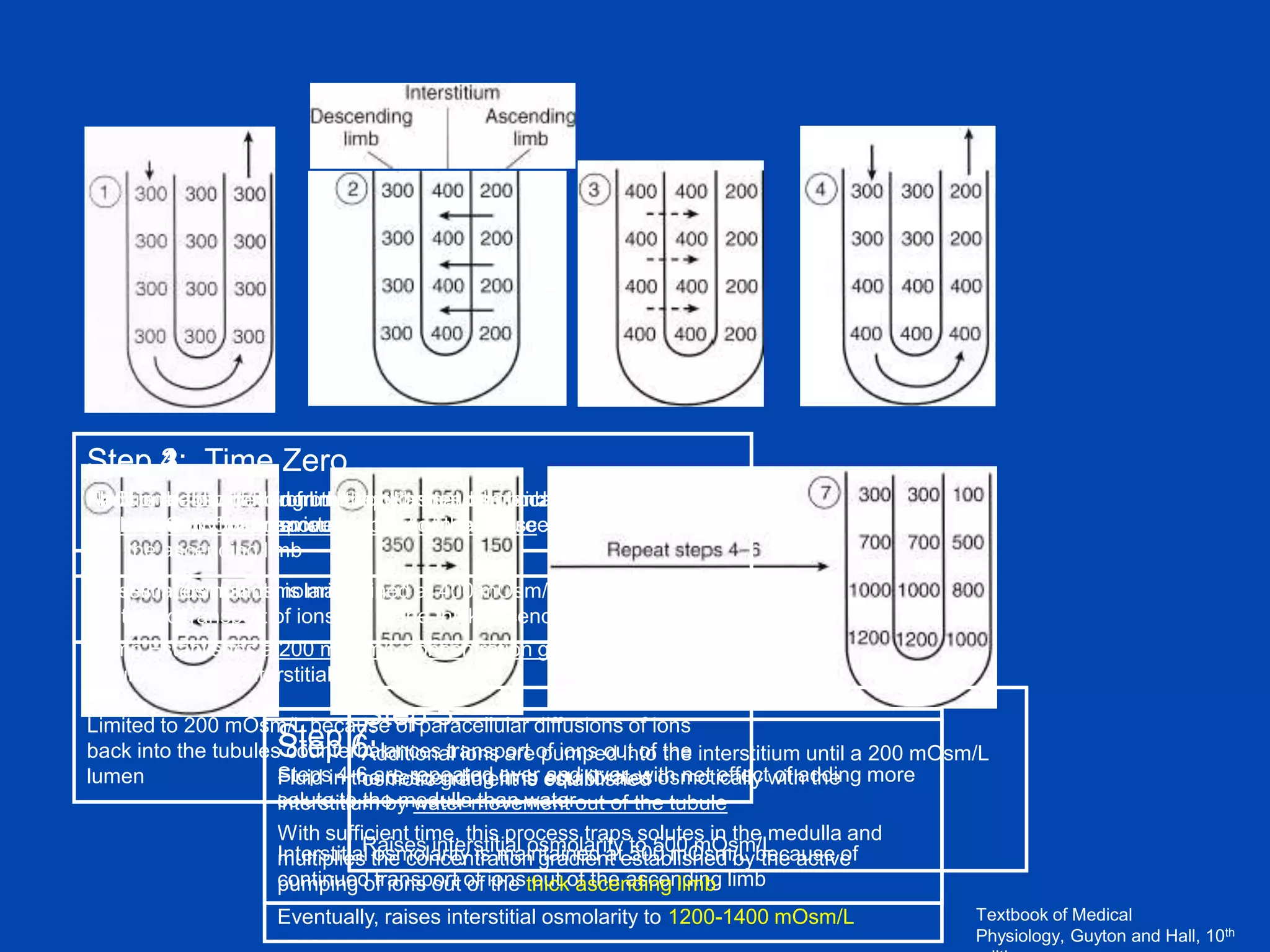
Step 1: Time Zero
4:
3:
2:
Additional flow of fluid from the proximal tubule causes theinterstitium
NaCl is reabsorbed from the thick ascending and interstitium
Fluid in the descending limb,equilibrateslimb, limb into thethe are
limb ascending osmotically with
hyperosmotic water movement
interstitium by fluid previously out of the tubule
via Na-2Cl-K the plasma
isoosmotic to Cotransporter formed in the descending limb to flow
into the ascending limb
Interstitial osmolarity is maintained at 400 mOsm/L because of
Raises interstitial osmolarity
continued transport of ions out of the thick ascending limb
Pump Establishes a 200 mOsm/L concentration gradient between
tubular fluid and interstitial fluid

Step 5:
Limited to 200 mOsm/L because of paracellular diffusions of ions
Step 7:
back into the tubulesStep 6:
counterbalances transport of ions out of the interstitium until a 200 mOsm/L
Additional ions are pumped into
Stepsin the descending over established osmotically with the more
4-6 are repeated limb equilibrates net effect of adding
lumen
Fluid
osmotic gradient is and over, with
solute to the medulla than water
interstitium by water movement out of the tubule
With sufficient time, this process traps solutes in the medulla and
Raises interstitial osmolarity to 500 mOsm/L
Interstitial the concentration gradient established bybecause of
multiplies osmolarity is maintained at 500 mOsm/L the active
continued transport of ionsthickof the ascending limb
pumping of ions out of the out ascending limb
Eventually, raises interstitial osmolarity to 1200-1400 mOsm/L

Textbook of Medical
Physiology, Guyton and Hall, 10th
Passive Urea Diffusion/Recycling
• The Hypertonic Medullary Interstitium is generated not only only by
NaCl but also by Urea
• Urea contributes about 40% to the interstitial osmolarity (~500
mOsm/L)
• Unlike NaCl, urea is passively reabsorbed from the tubule

• Recirculation of urea between the CD and Loop of Henle
• Thick Ascending Limb, Distal Tubule, and Cortical Collecting Duct
• Impermeable to Urea

• Rest of Nephron segments are permeable to Urea
• When ADH is present, more Urea is reabsorbed from the inner
medullary collecting ducts
• This is the reason for BUN/Cr ratio to increase in times of dehydration
Brenner and Rector, 9th edition
Textbook of Medical Physiology, Guyton and
Hall, 10th edition
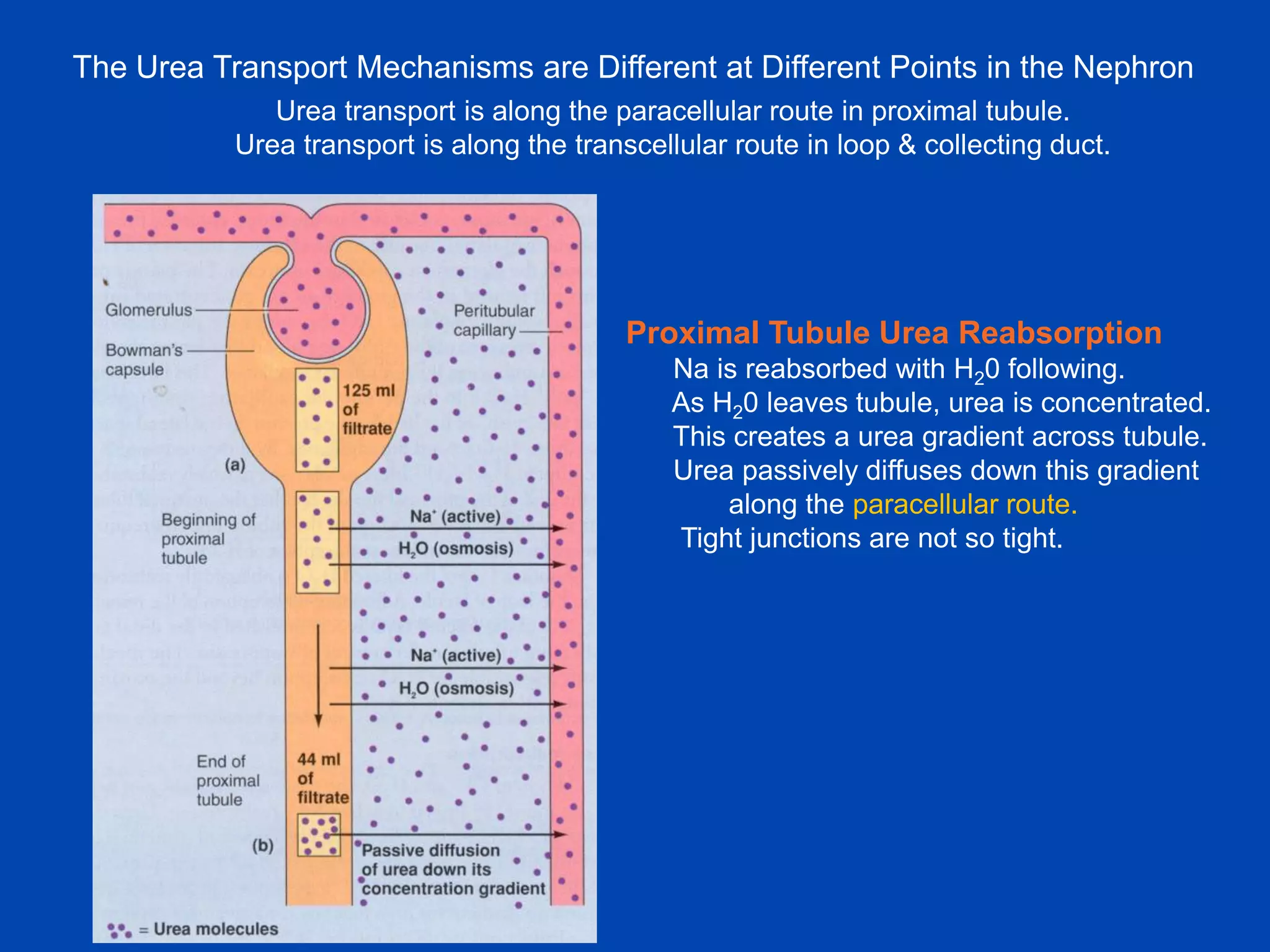
The Urea Transport Mechanisms are Different at Different Points in the Nephron
Urea transport is along the paracellular route in proximal tubule.
Urea transport is along the transcellular route in loop & collecting duct.

Proximal Tubule Urea Reabsorption
Na is reabsorbed with H20 following.
As H20 leaves tubule, urea is concentrated.
This creates a urea gradient across tubule.
Urea passively diffuses down this gradient
along the paracellular route.
Tight junctions are not so tight.
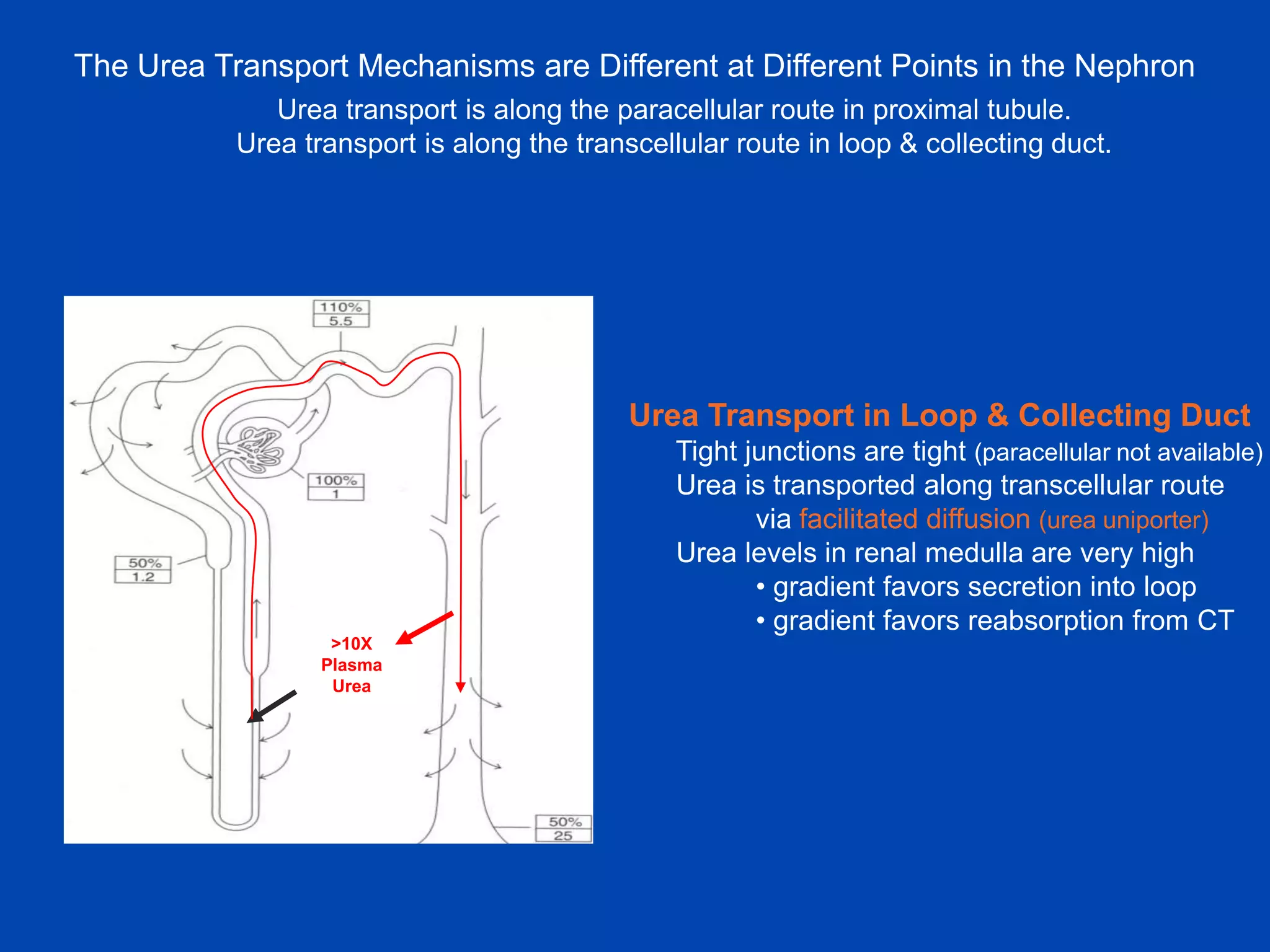
The Urea Transport Mechanisms are Different at Different Points in the Nephron
Urea transport is along the paracellular route in proximal tubule.
Urea transport is along the transcellular route in loop & collecting duct.

Urea Transport in Loop & Collecting Duct
Tight junctions are tight (paracellular not available)
Urea is transported along transcellular route
via facilitated diffusion (urea uniporter)
Urea levels in renal medulla are very high
• gradient favors secretion into loop
• gradient favors reabsorption from CT
>10X
Plasma
Urea
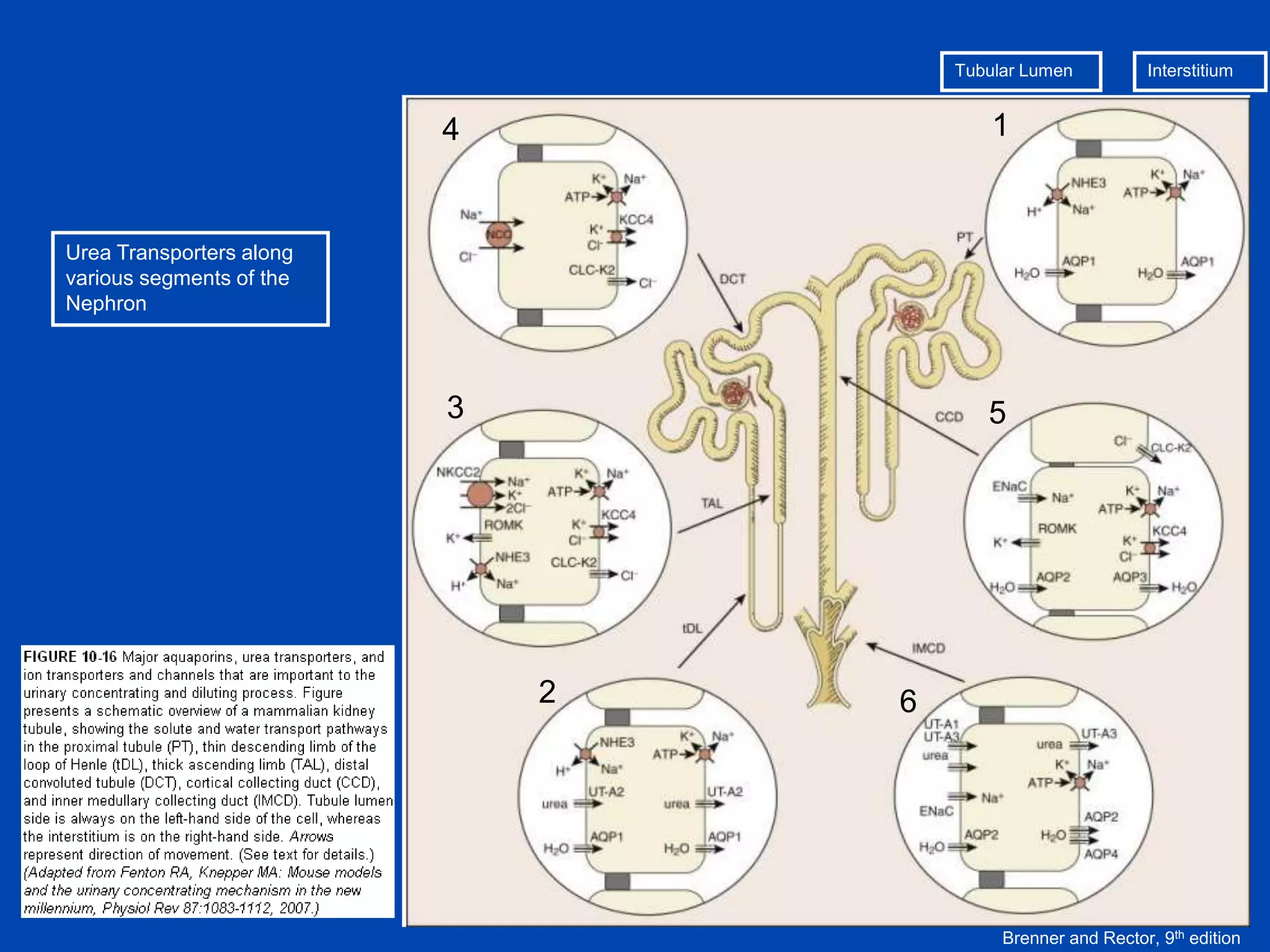
Tubular Lumen

4

1

3

Interstitium

5

Urea Transporters along
various segments of the
Nephron

2

6

Brenner and Rector, 9th edition
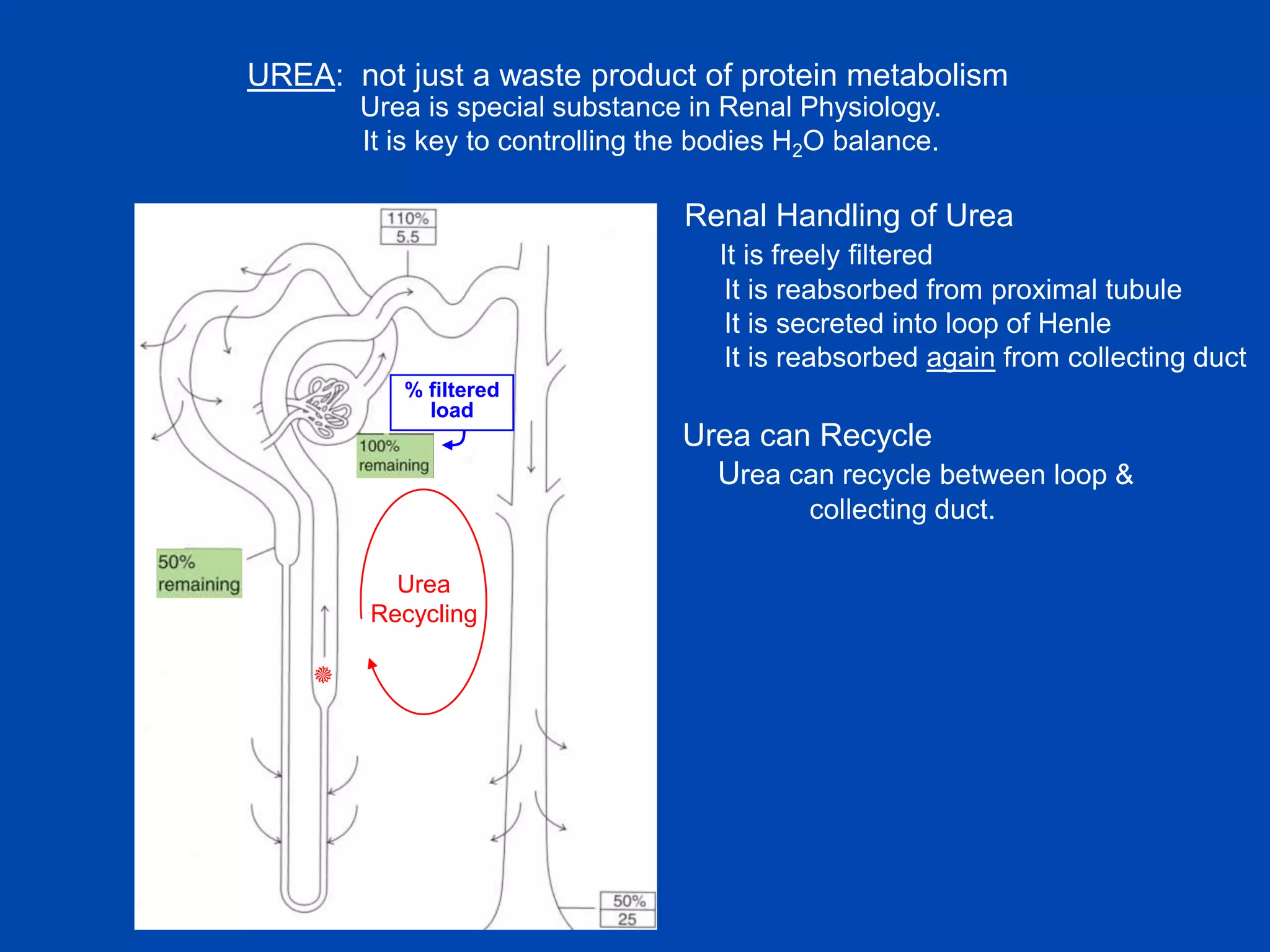
UREA: not just a waste product of protein metabolism
Urea is special substance in Renal Physiology.
It is key to controlling the bodies H2O balance.

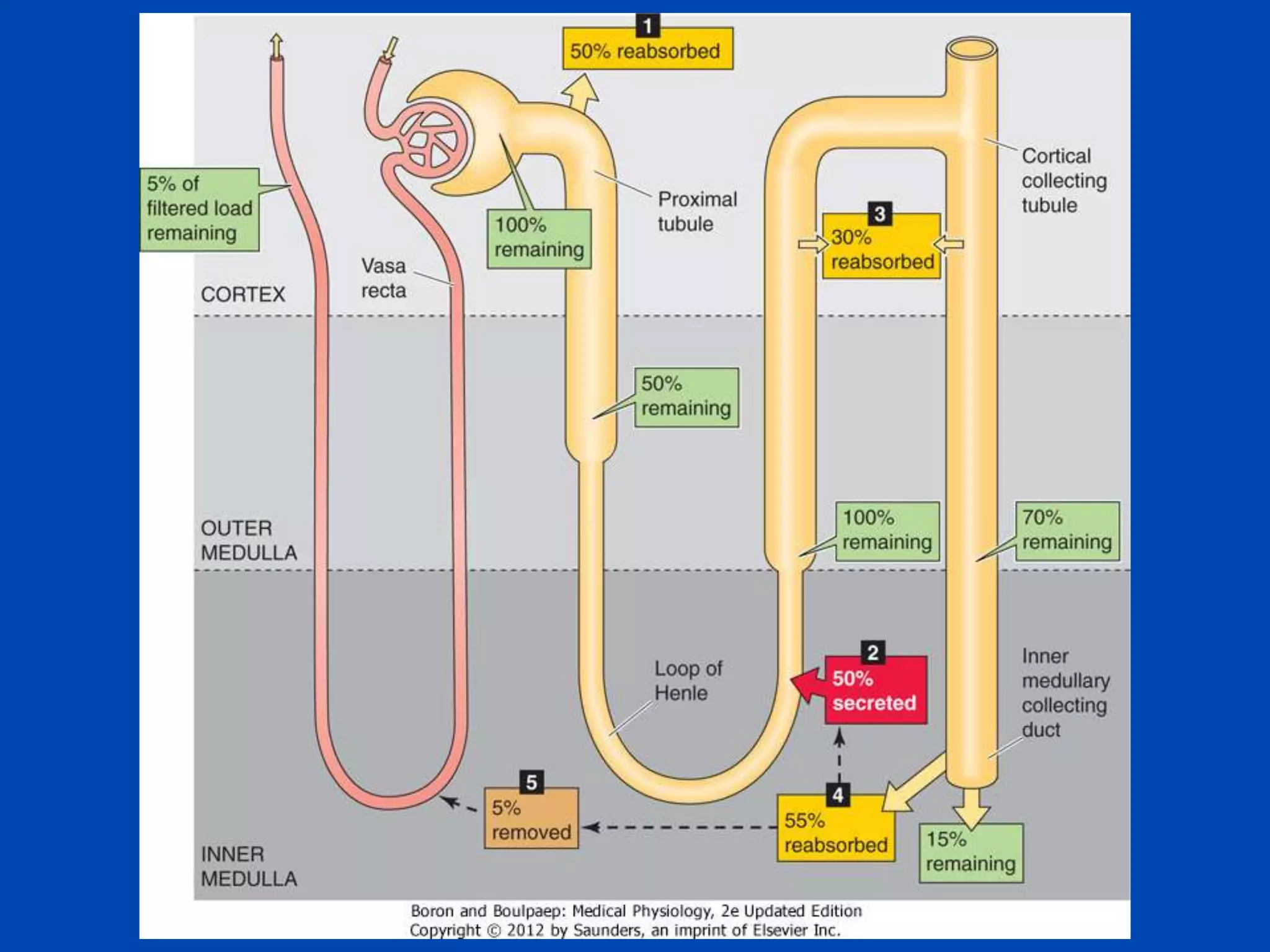
Renal Handling of Urea
It is freely filtered
It is reabsorbed from proximal tubule
It is secreted into loop of Henle
It is reabsorbed again from collecting duct

50% R

% filtered
load

Urea can Recycle
Urea can recycle between loop &
collecting duct.
Urea
Recycling

60% S
60% R
Vasa recta
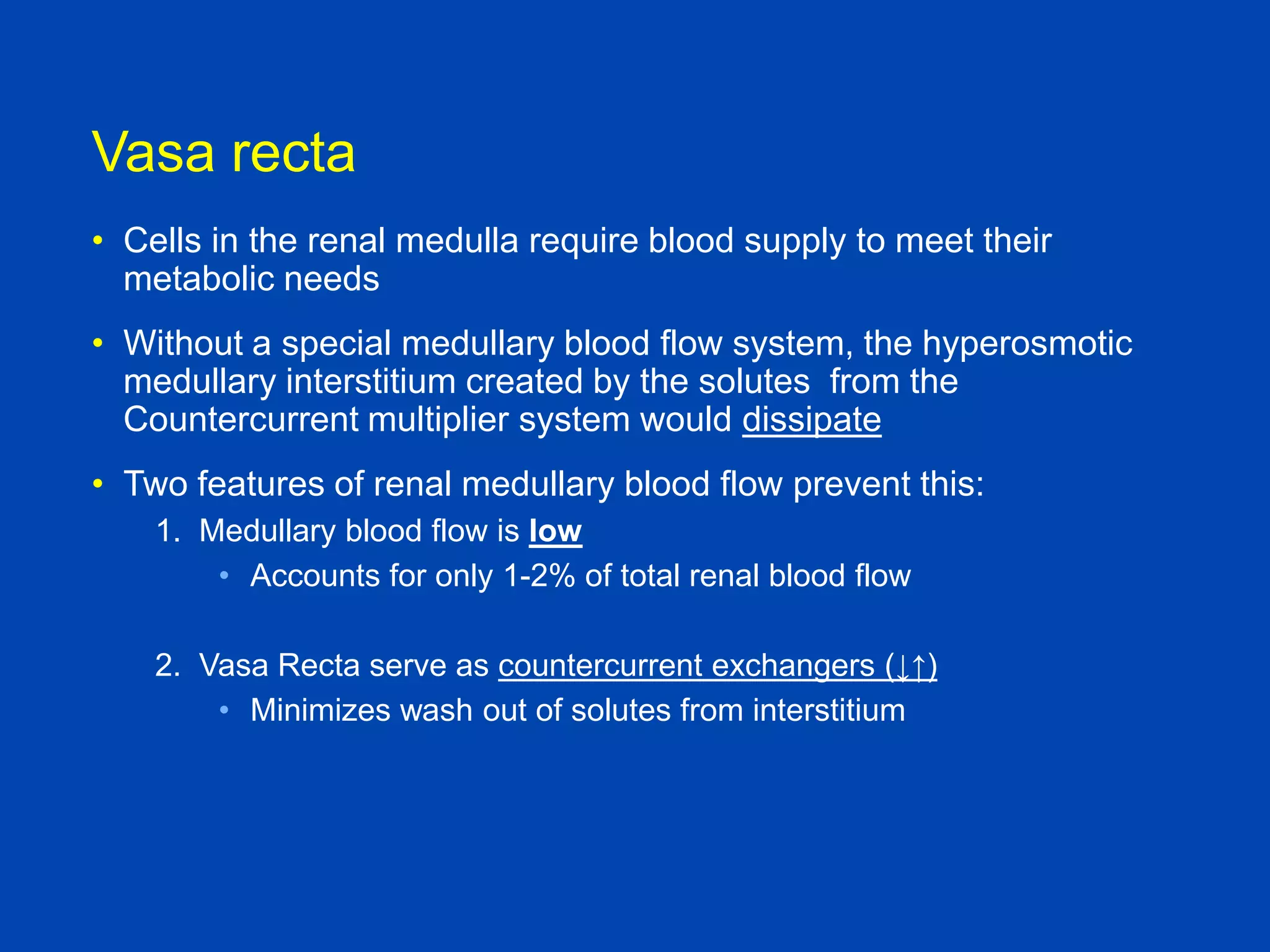
• Cells in the renal medulla require blood supply to meet their
metabolic needs

• Without a special medullary blood flow system, the hyperosmotic
medullary interstitium created by the solutes from the
Countercurrent multiplier system would dissipate
• Two features of renal medullary blood flow prevent this:
1. Medullary blood flow is low
• Accounts for only 1-2% of total renal blood flow
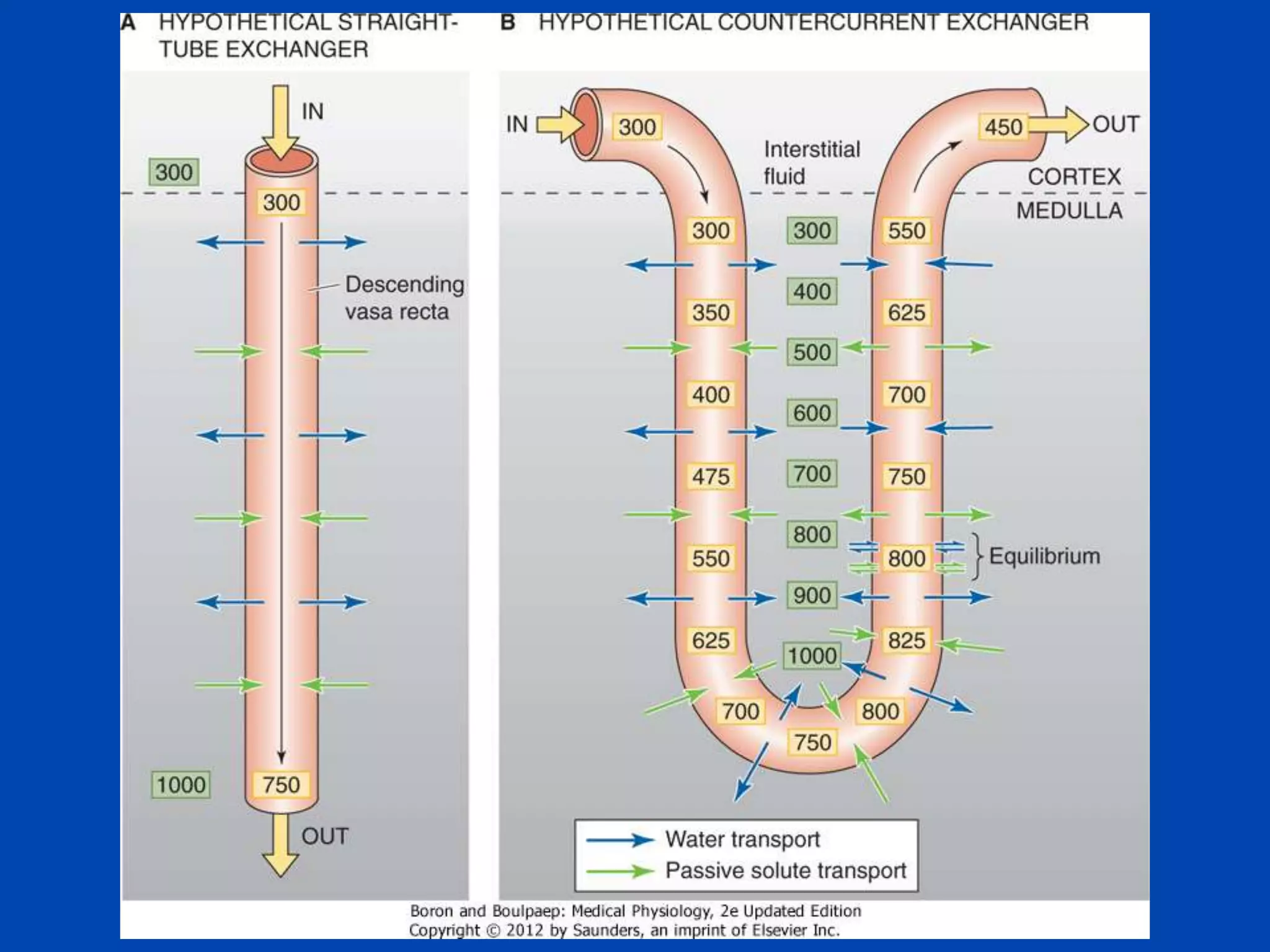
2. Vasa Recta serve as countercurrent exchangers (↓↑)
• Minimizes wash out of solutes from interstitium

Textbook of Medical Physiology, Guyton and
Hall, 10th edition
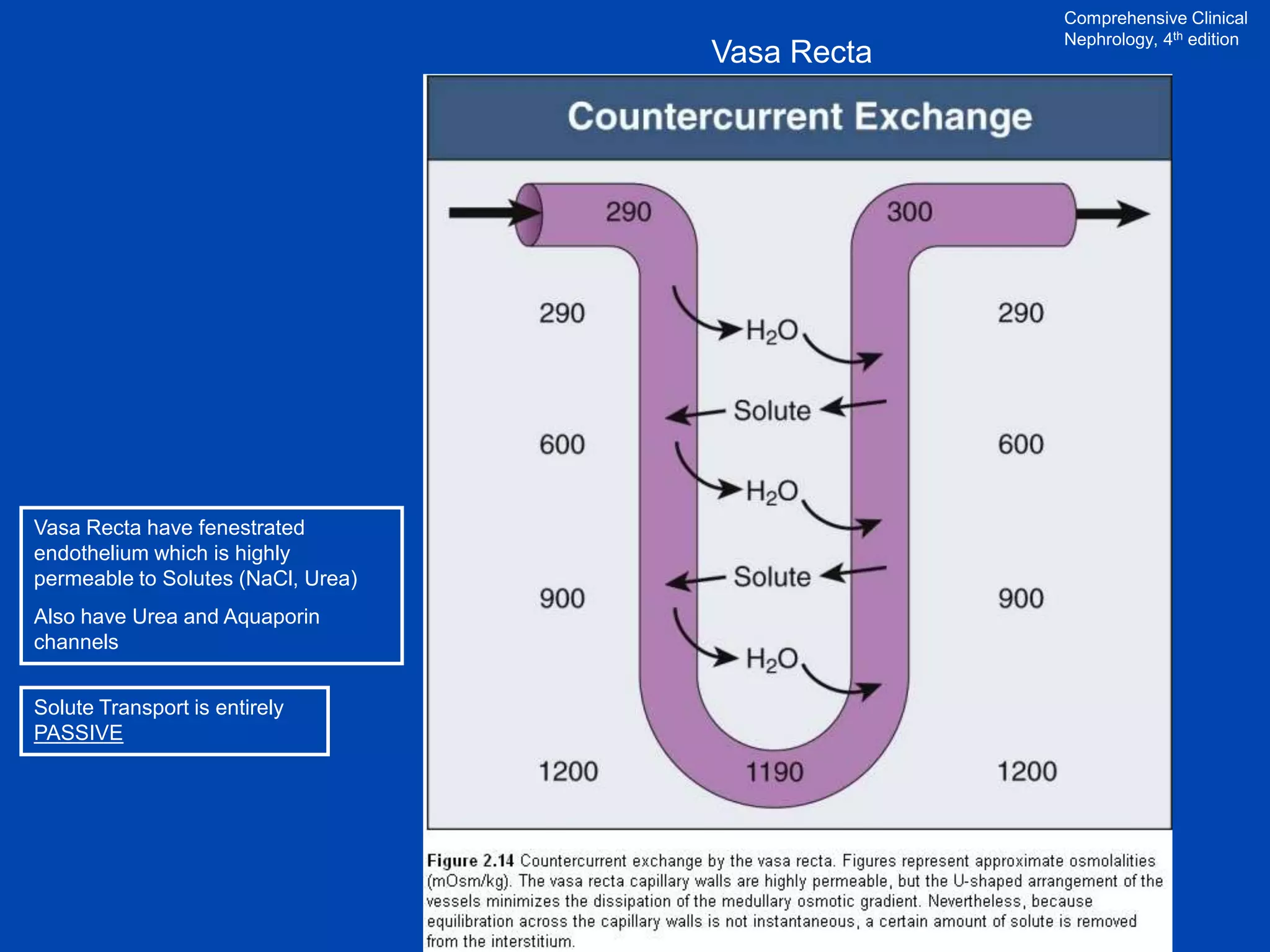
Vasa Recta

Vasa Recta have fenestrated
endothelium which is highly
permeable to Solutes (NaCl, Urea)
Also have Urea and Aquaporin
channels
Solute Transport is entirely
PASSIVE

Comprehensive Clinical
Nephrology, 4th edition
Overview
• Basic requirements for forming concentrated urine
1. Hypertonic Medullary Interstitium
• Generates osmotic gradient necessary for water reabsorption
2. High levels of ADH
• Increases water permeability of DCT and CD

Textbook of Medical
Physiology, Guyton and Hall, 10th
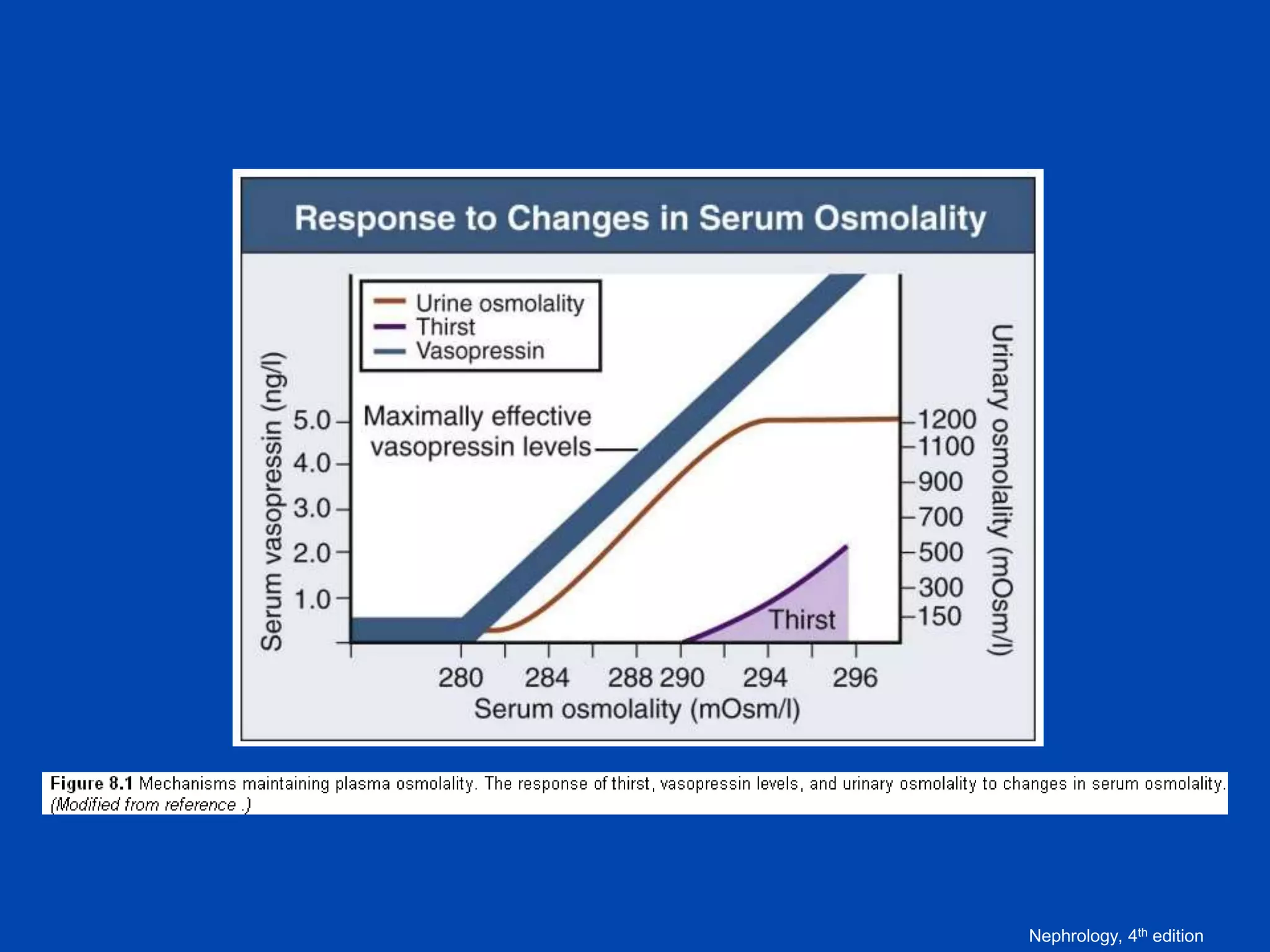
Plasma Osmolarity
• Plasma osmolarity is about 282 mOsm/L
• Varies less than

1-2% at any given time

• Regulated by two main systems:
• Osmorecepetor-ADH system
• Thirst mechanism
• ADH has a short half-life of about 15-20 minutes
• Metabolized rapidly by liver and kidney
• Allows for rapid means to alter water excretion

Textbook of Medical
Physiology, Guyton and Hall, 10th
Water transport & vasopressin (ADH) dependence
Transport mechanism:
passive diffusion through aquaporin channels down osmotic gradient
Reabsorption:
~99% of filtered water is reabsorbed
Sites of reabsorption:
~70% from proximal tubule

~15% from descending limb of loop of Henle
0% from Henle’s ascending limb & distal tubule
0-15% from collecting duct depending on plasma vasopressin level
Antidiuretic hormone (ADH)
• Glomerulus filters 180 L of fluid per day from the plasma
• 90% (or 162 L) is reabsorbed in the proximal tubule and descending
limb

• The remaining 18 L is reabsorbed under the regulation of:
• Arginine Vasopressin (or Antidiuretic hormone, ADH)

Brenner and Rector, 9th edition
Antidiuretic hormone (ADH)
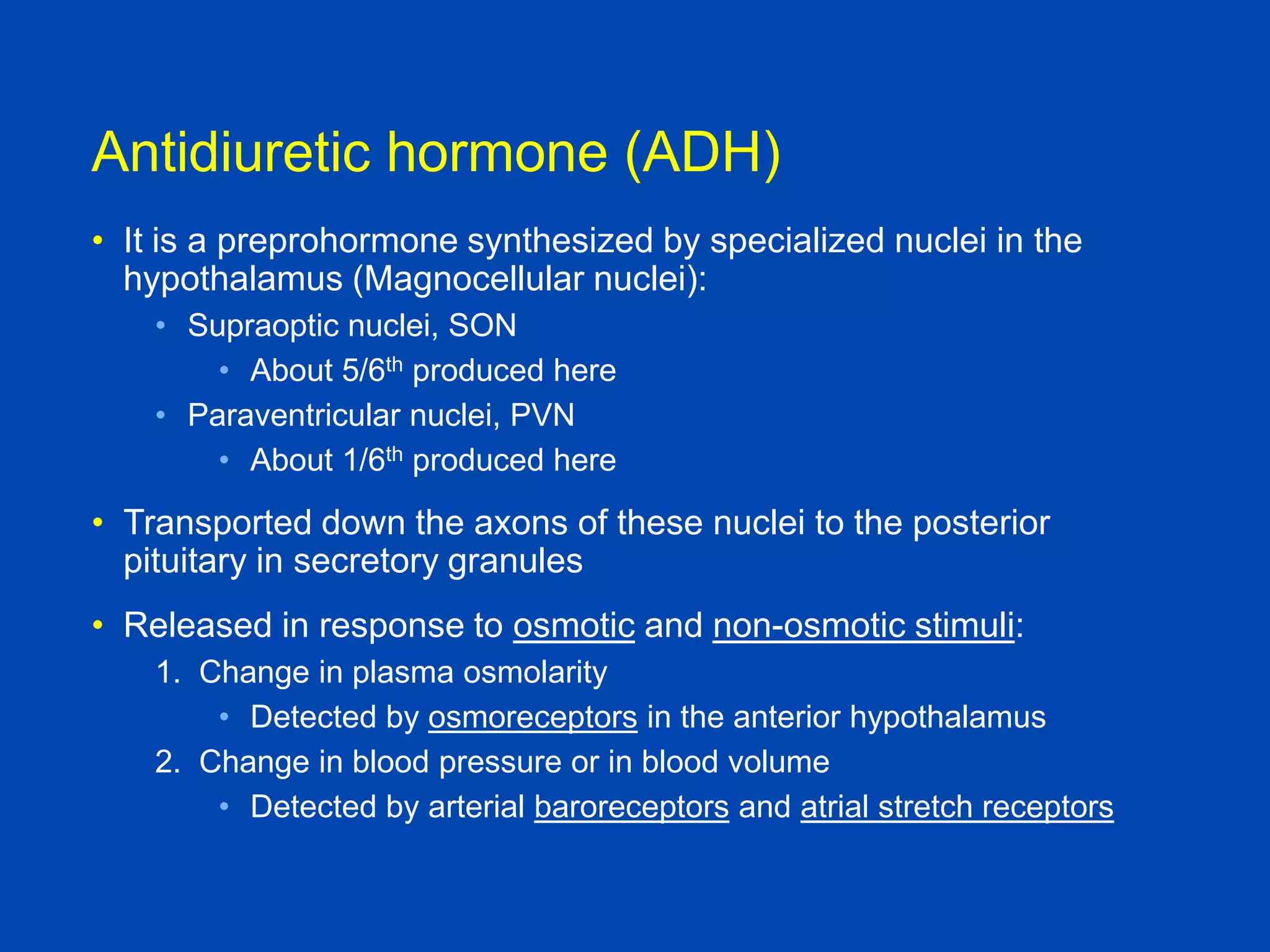
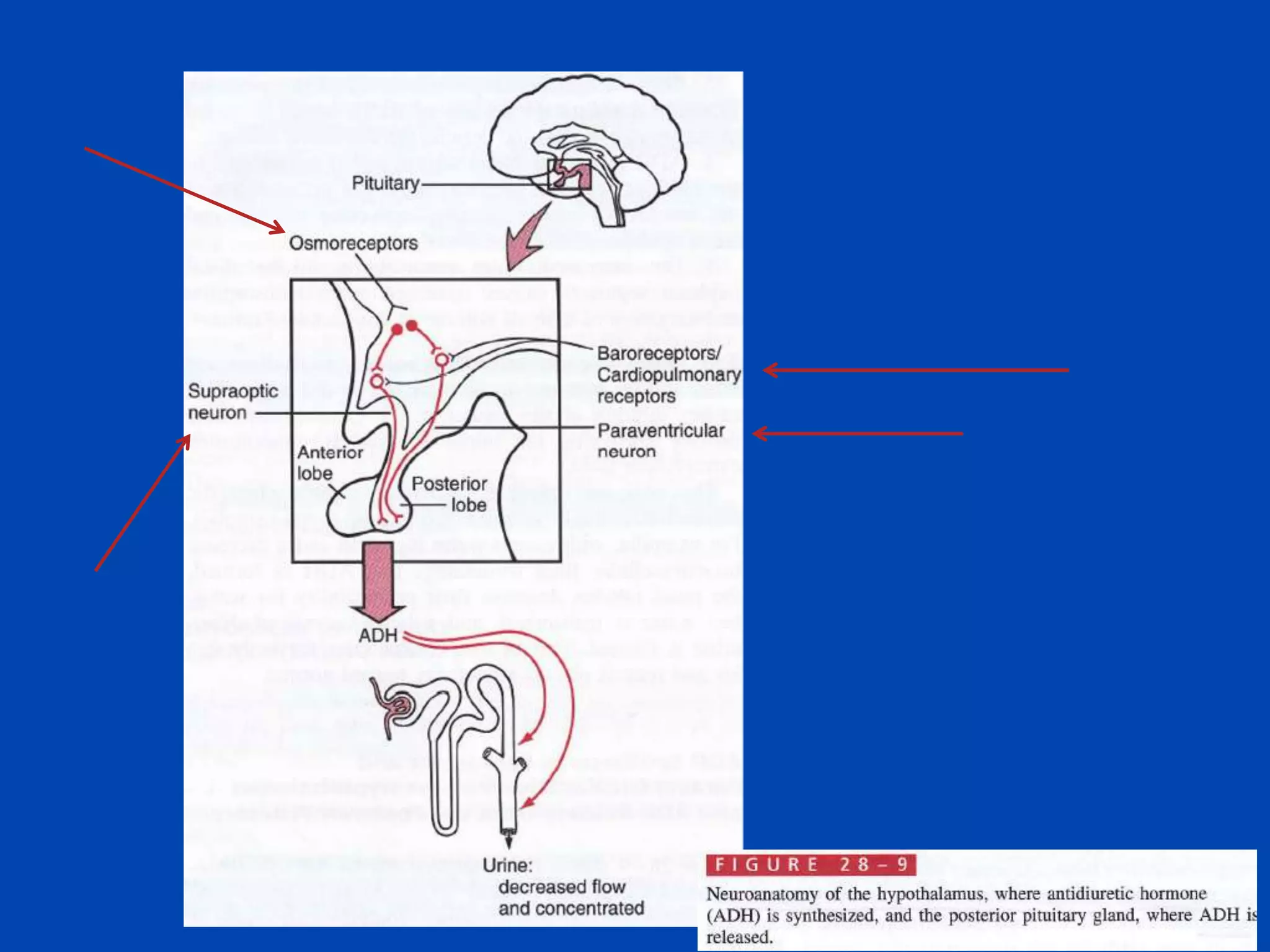
• It is a preprohormone synthesized by specialized nuclei in the
hypothalamus (Magnocellular nuclei):
• Supraoptic nuclei, SON
• About 5/6th produced here
• Paraventricular nuclei, PVN
• About 1/6th produced here

• Transported down the axons of these nuclei to the posterior
pituitary in secretory granules
• Released in response to osmotic and non-osmotic stimuli:
1. Change in plasma osmolarity
• Detected by osmoreceptors in the anterior hypothalamus
2. Change in blood pressure or in blood volume
• Detected by arterial baroreceptors and atrial stretch receptors
Brenner and Rector, 9th edition
Textbook of Medical Physiology, Guyton and
Hall, 10th edition
Textbook of Medical Physiology,
Guyton and Hall, 10th edition
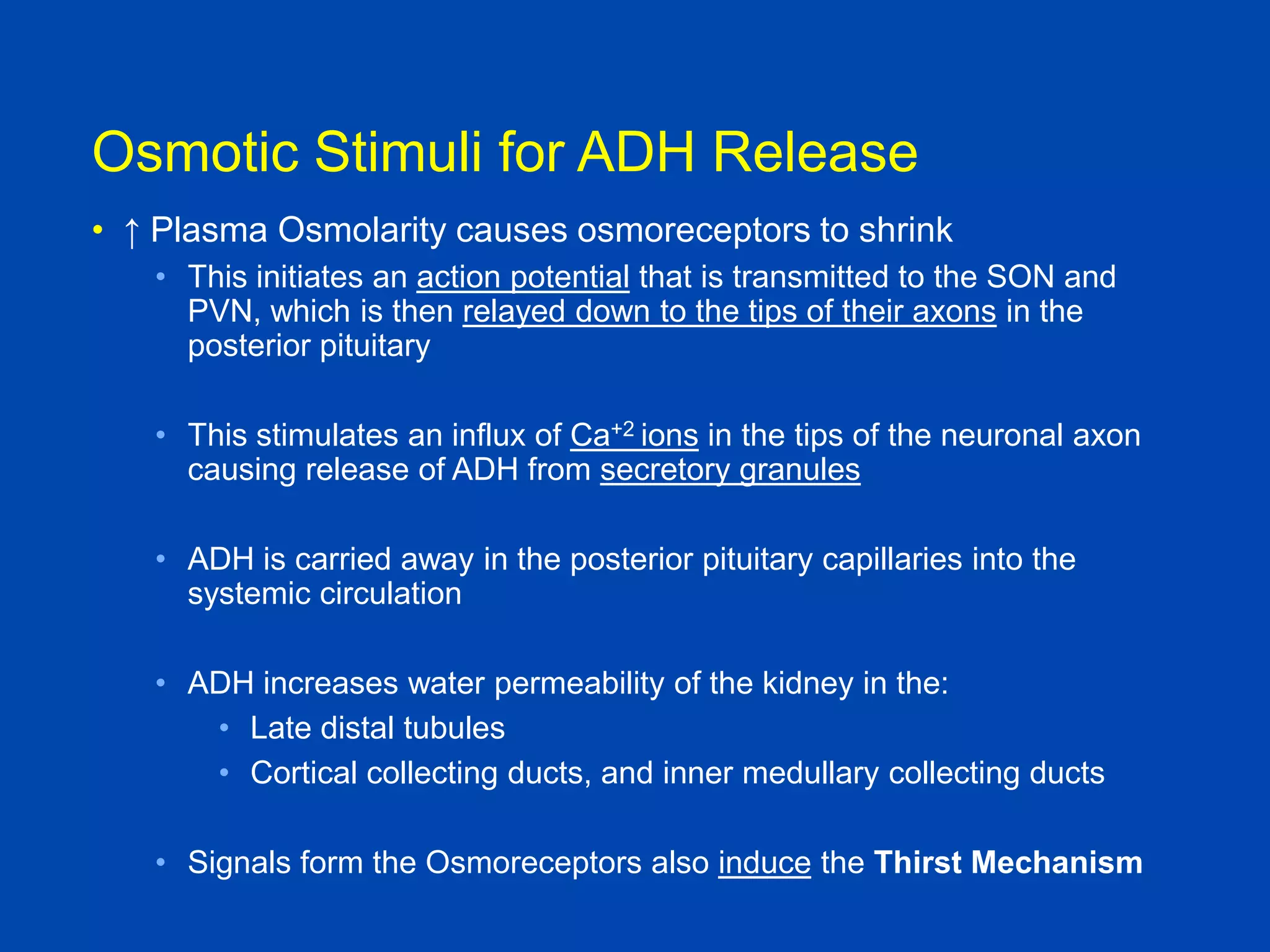
Osmotic Stimuli for ADH Release
• ↑ Plasma Osmolarity causes osmoreceptors to shrink
• This initiates an action potential that is transmitted to the SON and
PVN, which is then relayed down to the tips of their axons in the
posterior pituitary
• This stimulates an influx of Ca+2 ions in the tips of the neuronal axon
causing release of ADH from secretory granules

• ADH is carried away in the posterior pituitary capillaries into the
systemic circulation
• ADH increases water permeability of the kidney in the:
• Late distal tubules
• Cortical collecting ducts, and inner medullary collecting ducts
• Signals form the Osmoreceptors also induce the Thirst Mechanism
Brenner and Rector, 9th edition
Textbook of Medical Physiology, Guyton and
Hall, 10th edition
Comprehensive Clinical
Nephrology, 4th edition
Non-Osmotic Stimuli for ADH Release
• Decreased Blood Pressure/Volume
• Detected by Arterial baroreceptors
• Carotid sinus
• Aortic Arch
• Stimulates ADH release

• Increased Blood Volume
• Detected by Cardiopulmonary Reflexes
• Arial Stretch Receptors
• Decrease ADH release
• Stimulates Arial Natriuretic Peptide (ANP) release

Textbook of Medical
Physiology, Guyton and Hall, 10th
Antidiuretic hormone (ADH)
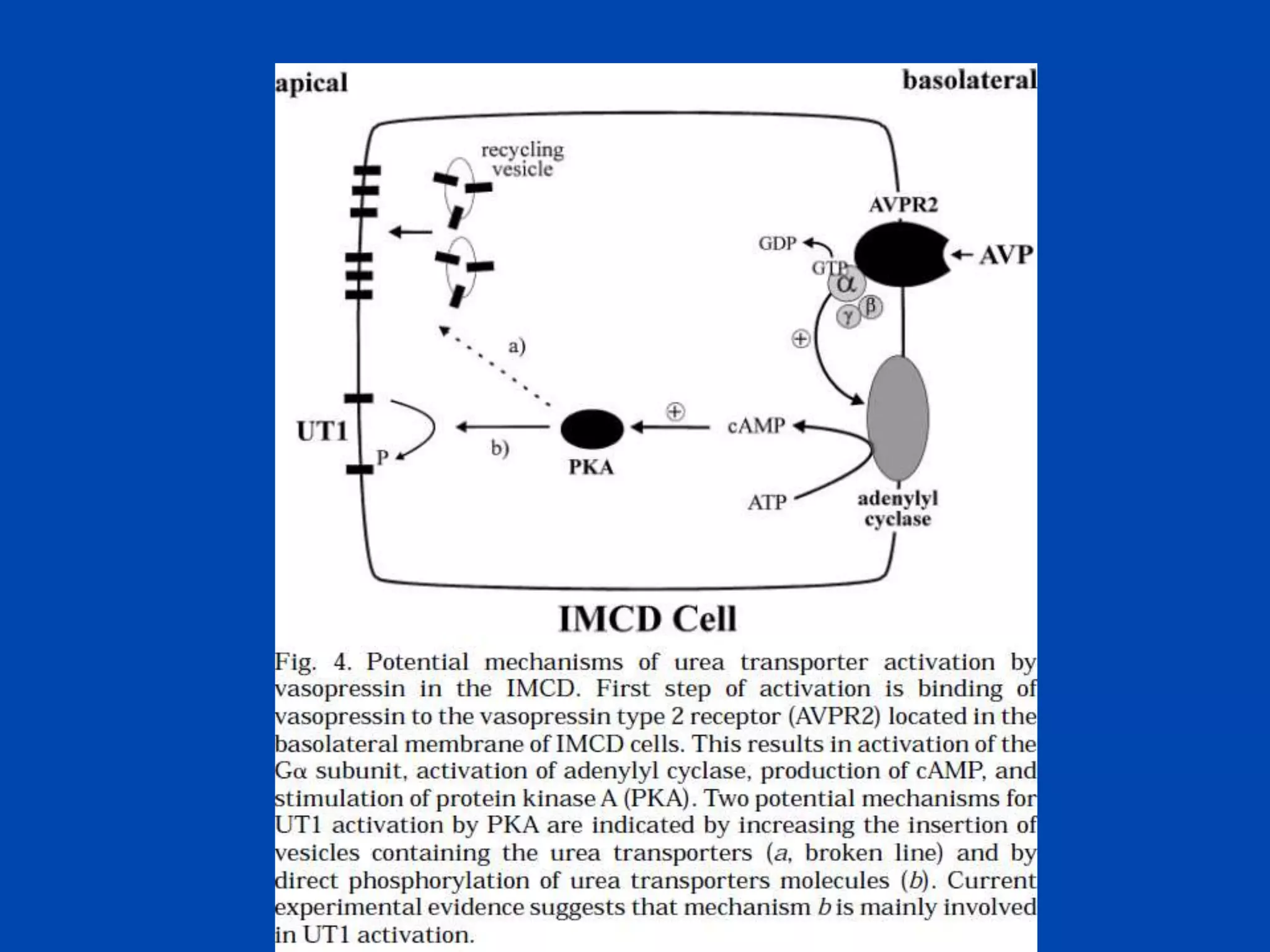
• Binds to 3 receptors coupled to G proteins
1. V1a receptor
• Found on vascular smooth muscle
• Activation increases intracellular Ca+2, resulting in contraction
2. V1b receptor
• Found in the Anterior Pituitary
• Modulates ACTH release
3. V2 receptor
• Found on the baslolateral membrane of Principle Cells from the
late distal tubule through the entire collecting duct
• Coupled by Gs protein to cAMP, which ultimately leads to insertion
of water channels (Aquaporins)

Comprehensive Clinical
Nephrology, 4th edition
Comprehensive Clinical
Nephrology, 4th edition
Comprehensive Clinical
Nephrology, 4th edition
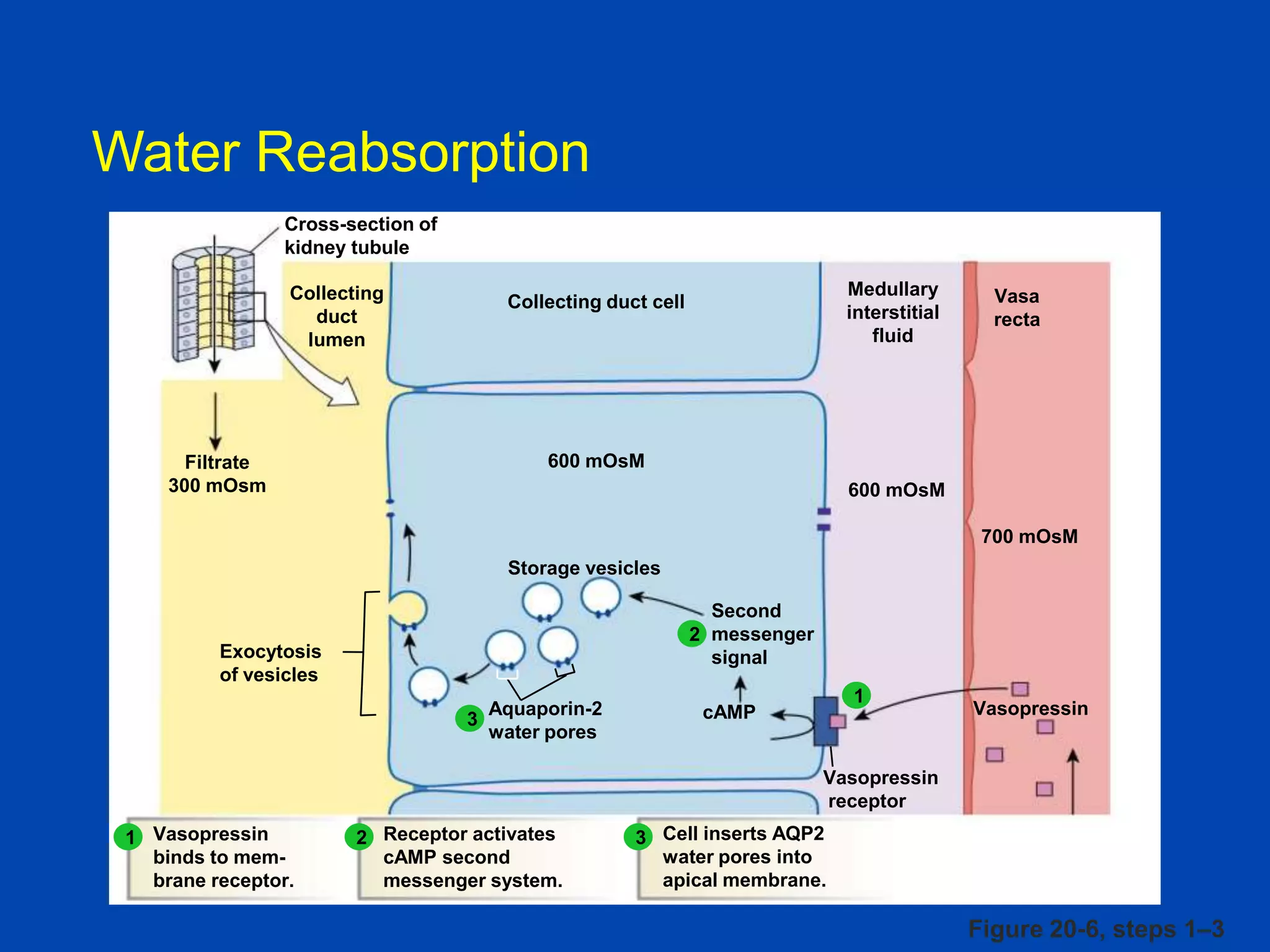
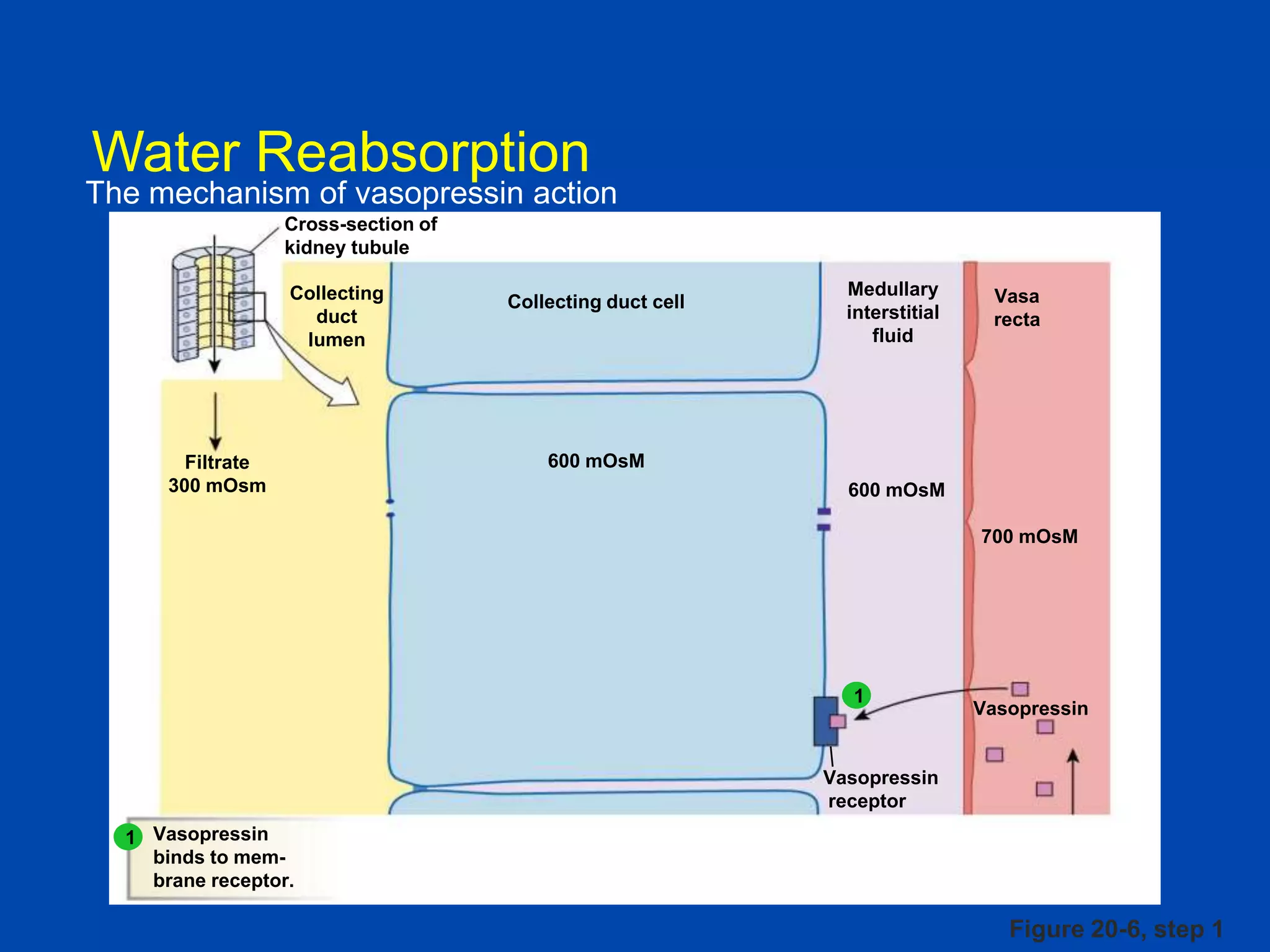
Water Reabsorption

The mechanism of vasopressin action
Cross-section of
kidney tubule
Collecting
duct
lumen

Filtrate
300 mOsm

Collecting duct cell

Medullary
interstitial
fluid

Vasa
recta

600 mOsM
600 mOsM
700 mOsM

1

Vasopressin

Vasopressin
receptor
1 Vasopressin
binds to membrane receptor.

Figure 20-6, step 1
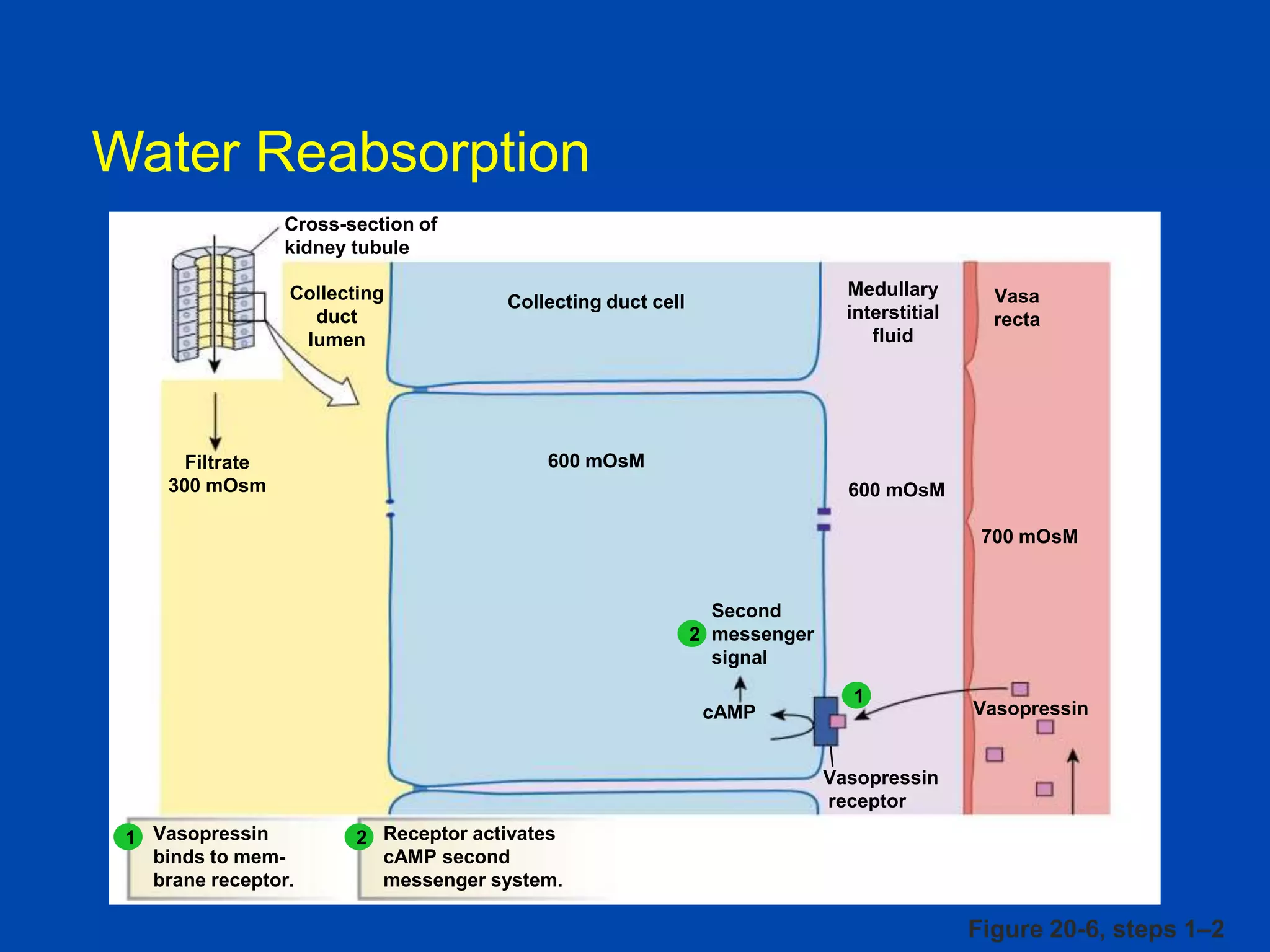
Water Reabsorption
Cross-section of
kidney tubule
Collecting
duct
lumen

Filtrate
300 mOsm

Medullary
interstitial
fluid

Collecting duct cell

Vasa
recta

600 mOsM
600 mOsM
700 mOsM

Second
2 messenger
signal
cAMP

1

Vasopressin

Vasopressin
receptor
1 Vasopressin
binds to membrane receptor.

2 Receptor activates
cAMP second
messenger system.

Figure 20-6, steps 1–2
Water Reabsorption
Cross-section of
kidney tubule
Collecting
duct
lumen

Medullary
interstitial
fluid

Collecting duct cell

Vasa
recta

600 mOsM

Filtrate
300 mOsm

600 mOsM
700 mOsM
Storage vesicles
Second
2 messenger
signal

Exocytosis
of vesicles
3

Aquaporin-2
water pores

1

cAMP

Vasopressin

Vasopressin
receptor
1 Vasopressin
binds to membrane receptor.

2 Receptor activates
cAMP second
messenger system.

3 Cell inserts AQP2
water pores into
apical membrane.

Figure 20-6, steps 1–3
Water Reabsorption
Cross-section of
kidney tubule
Collecting
duct
lumen

Medullary
interstitial
fluid

Collecting duct cell

600 mOsM

Filtrate
300 mOsm

H2O
600 mOsM

H2O

H2O

Vasa
recta

H2O
4

700 mOsM

Storage vesicles
Second
2 messenger
signal

Exocytosis
of vesicles
3

Aquaporin-2
water pores

1

cAMP

Vasopressin

Vasopressin
receptor
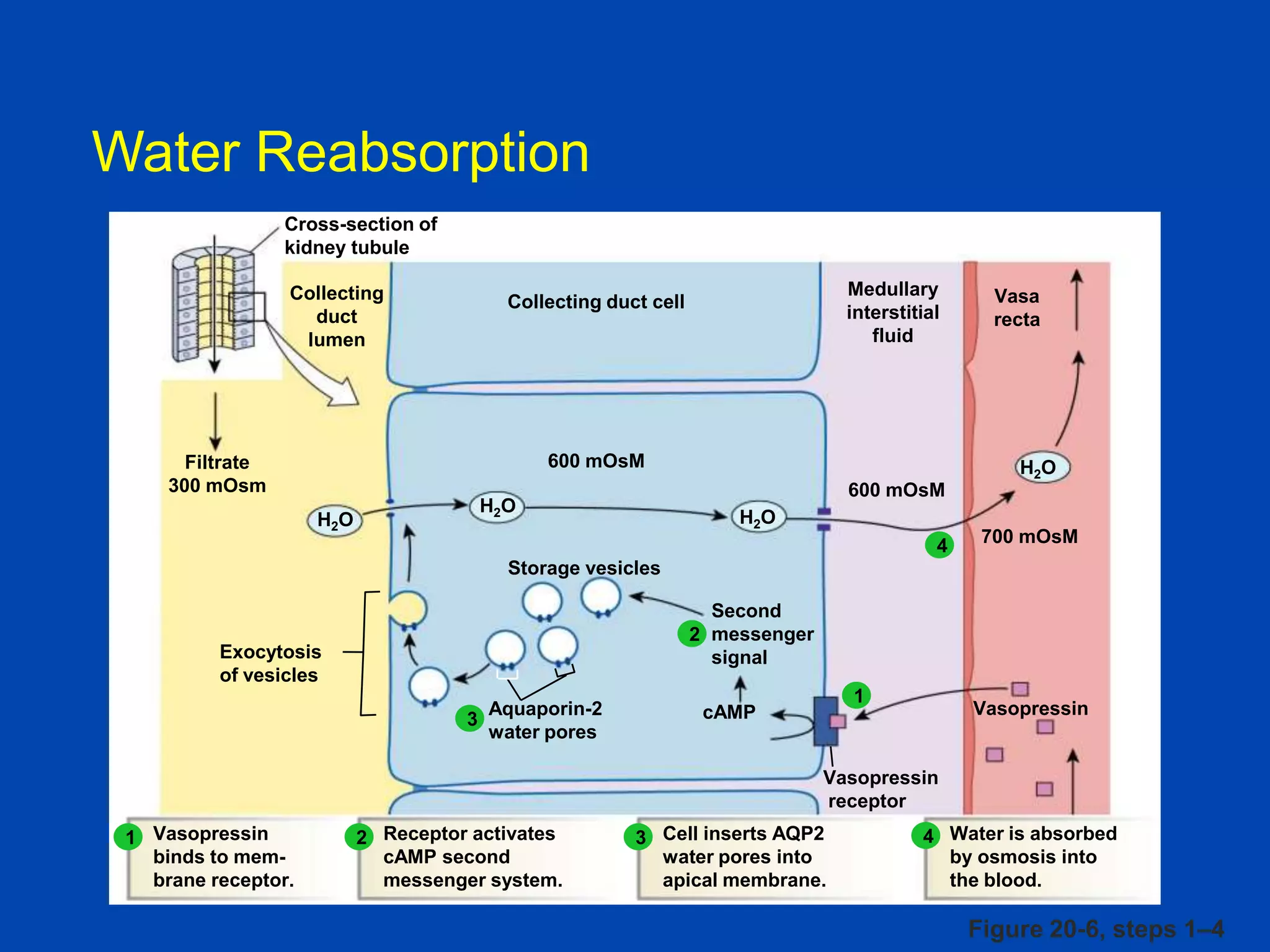
1 Vasopressin
binds to membrane receptor.

2 Receptor activates
cAMP second
messenger system.

3 Cell inserts AQP2
water pores into
apical membrane.

4 Water is absorbed
by osmosis into
the blood.

Figure 20-6, steps 1–4
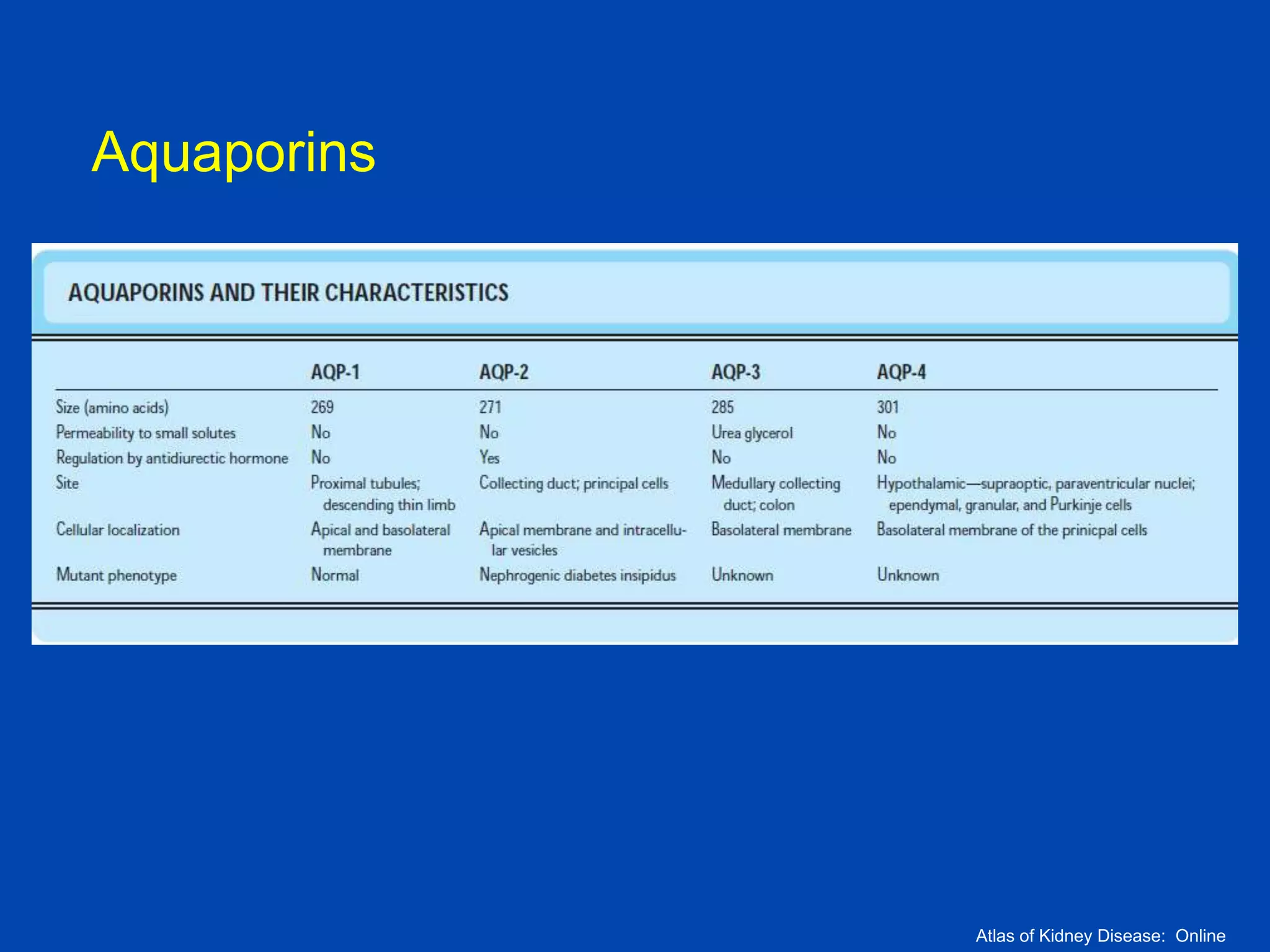
Aquaporins

Atlas of Kidney Disease: Online
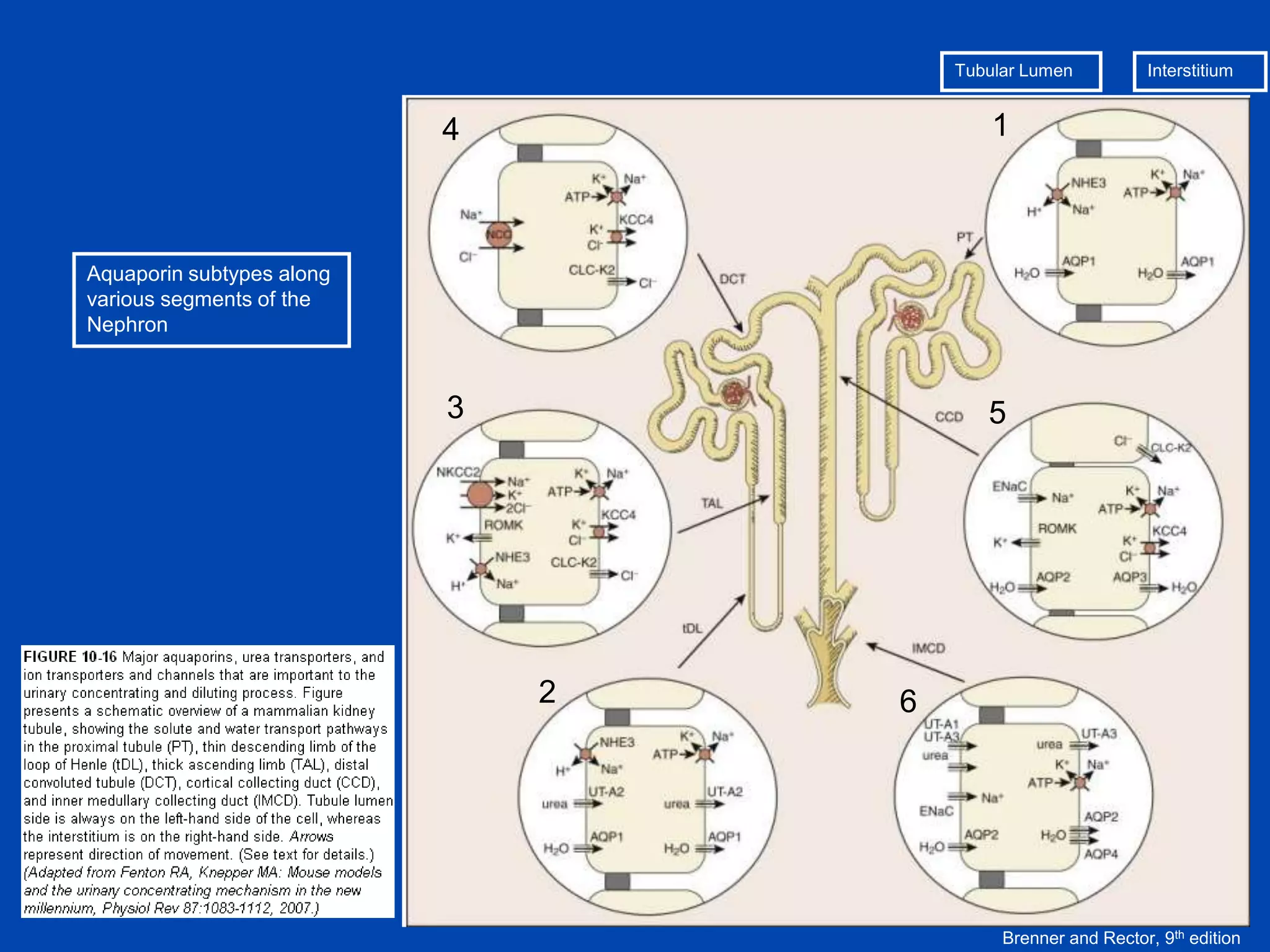
Tubular Lumen

4

1

3

Interstitium

5

Aquaporin subtypes along
various segments of the
Nephron

2

6

Brenner and Rector, 9th edition
Water Reabsorption

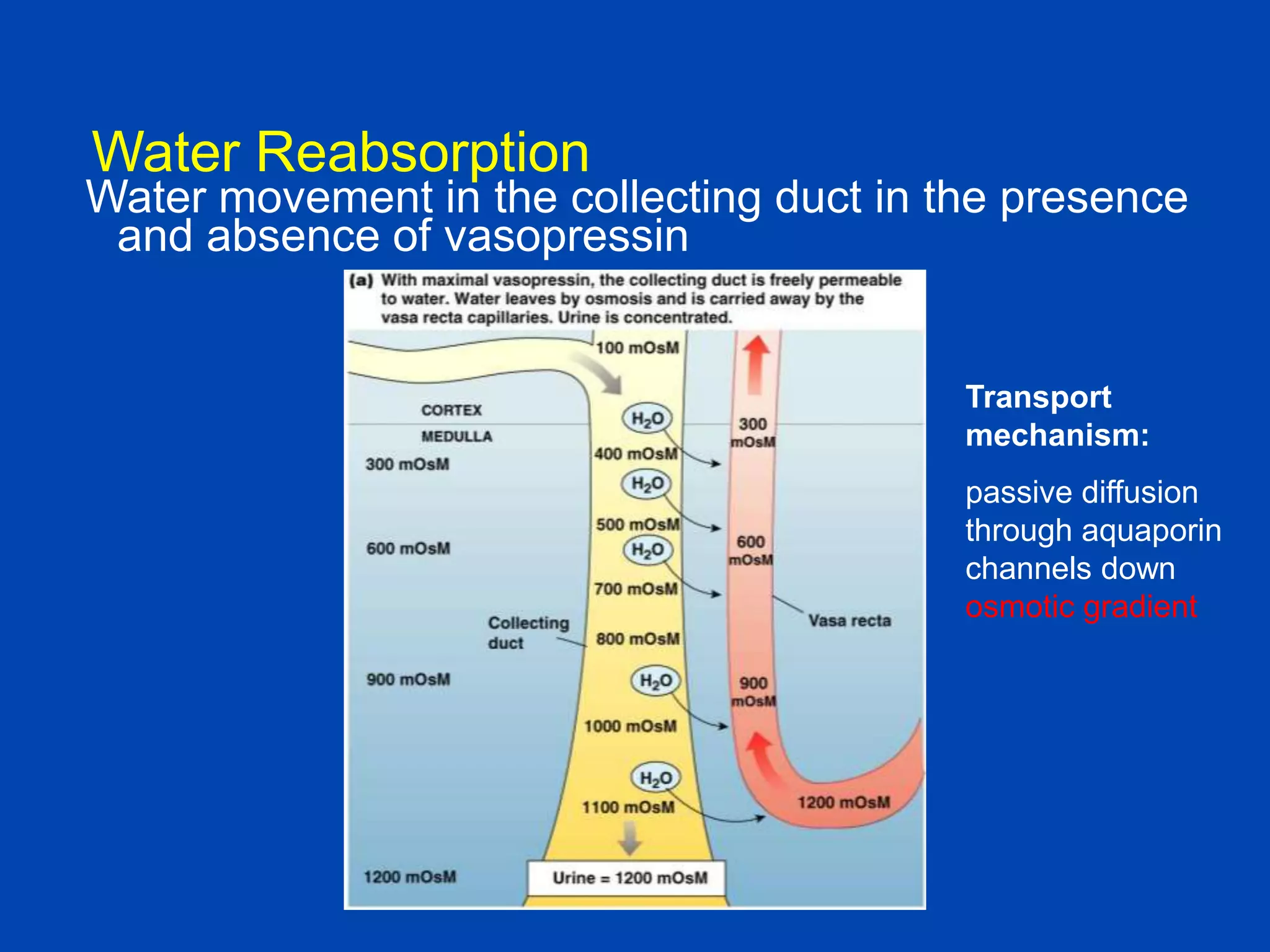
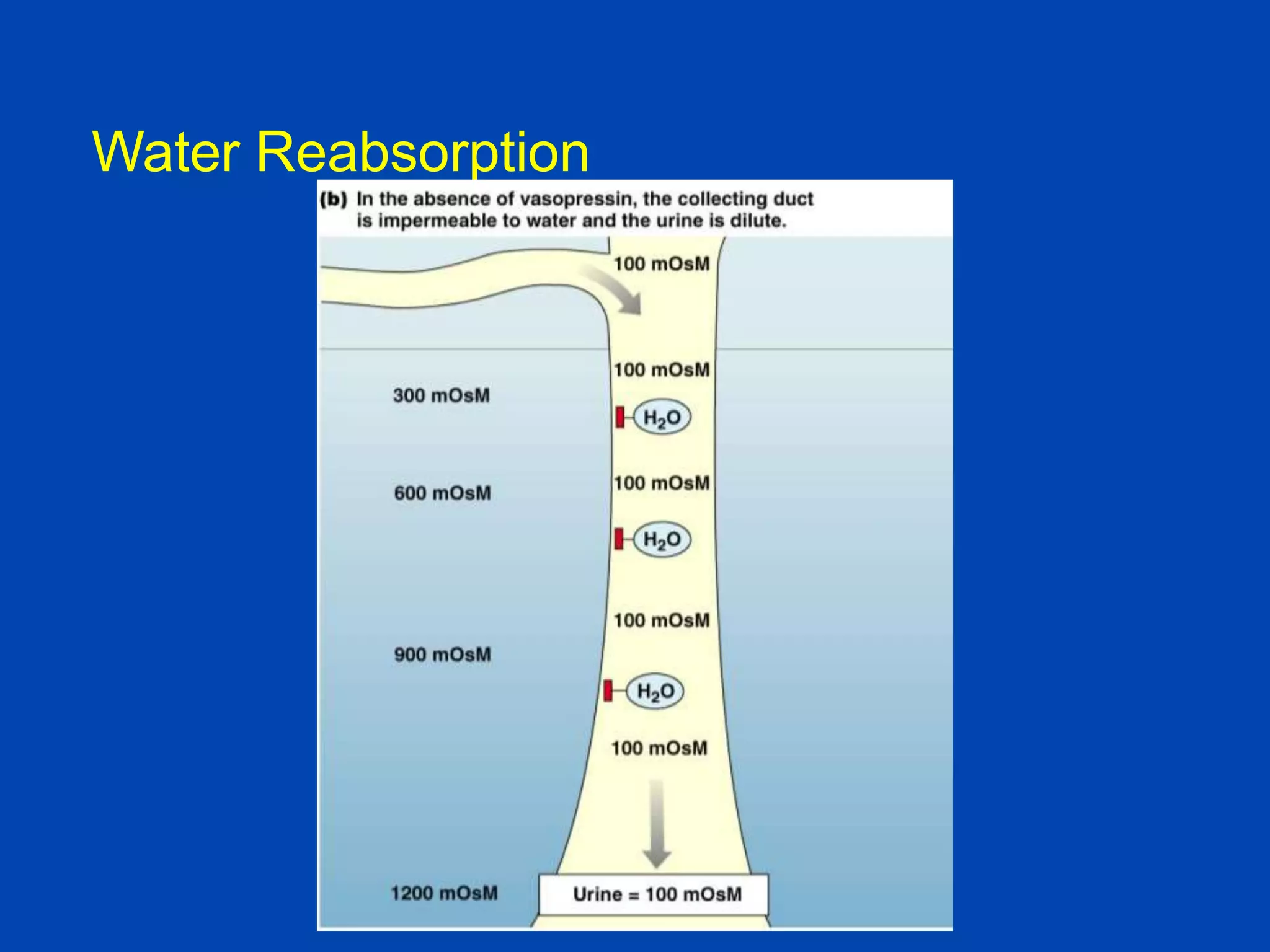
Water movement in the collecting duct in the presence
and absence of vasopressin

Transport
mechanism:
passive diffusion
through aquaporin
channels down
osmotic gradient
Water Reabsorption
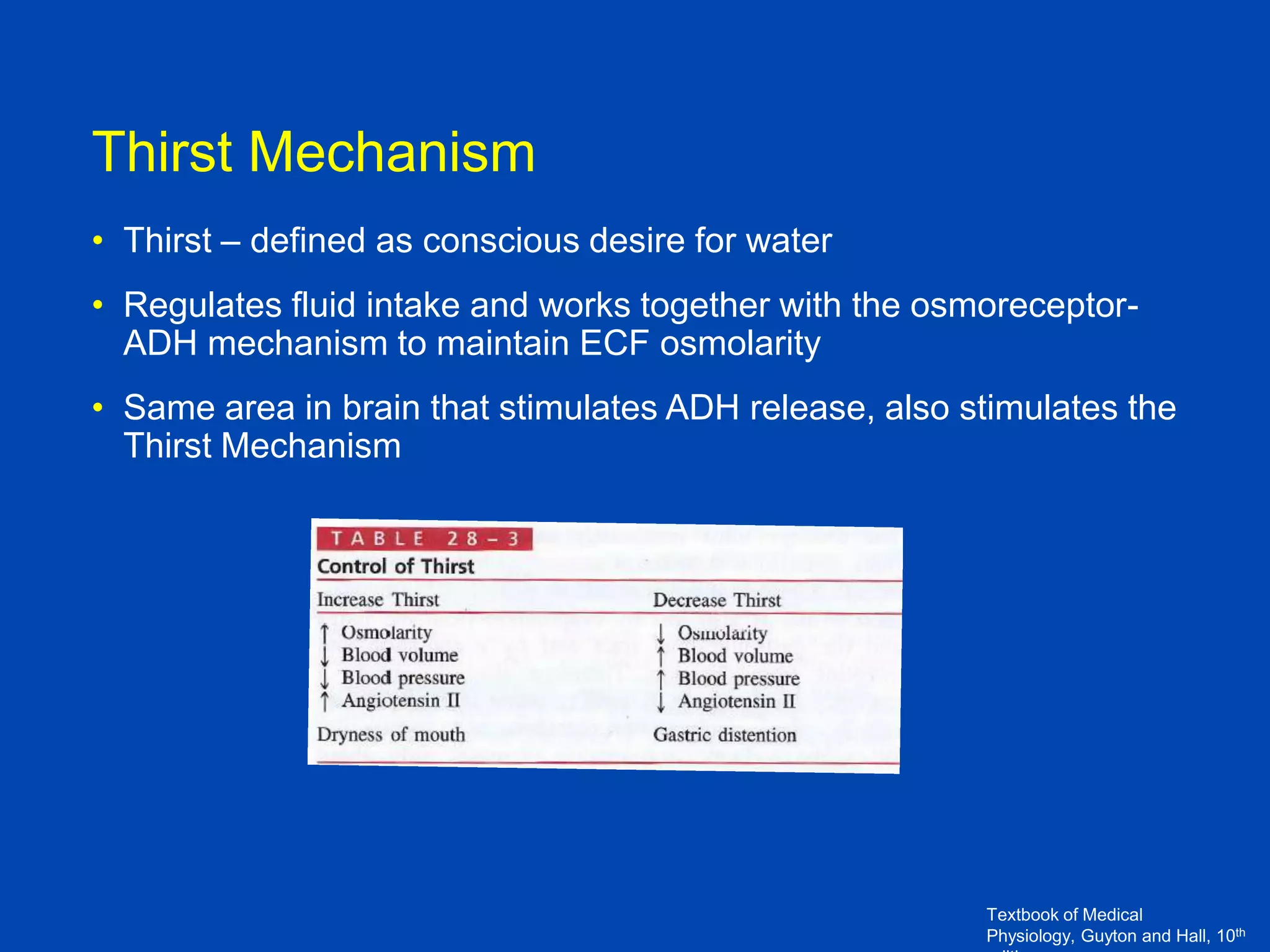
Thirst Mechanism
• Thirst – defined as conscious desire for water
• Regulates fluid intake and works together with the osmoreceptorADH mechanism to maintain ECF osmolarity
• Same area in brain that stimulates ADH release, also stimulates the
Thirst Mechanism

Textbook of Medical
Physiology, Guyton and Hall, 10th
Obligatory Urine Volume
• Minimal volume of water needed to excrete ingested and waste
produced osmoles
• The maximum concentrating ability of the kidney dictates how
much urine much be excreted each day
• A normal 70 kg human must excrete ~ 600 mOsm/day
• If the maximal concentrating ability of the kidney is 1200
mOsm/L, the minimal volume of water needed for excretion of
these osmoles is:
• (600 mOsm/day) / (1200 mOsm/L) = 0.5 L/day
• The concept of obligatory urine volume, is where the definition of
oliguria originated from
• Urine output below this per day would be pathologic

Textbook of Medical
Physiology, Guyton and Hall, 10th
KEY POINTS
• Nephron anatomy is key to generating a Hypertonic Medullary
Interstitium

• Renal blood vessel anatomy is key to maintaining the hypertonic
medullary interstitium
• ADH is also necessary for concentrating urine
• ADH has a complicated regulatory system from both osmotic and
non-osmotic stimuli
• Thirst Mechanism is another way of regulating ECF osmolarity
Questions & Discussion

Renal handling of water

  • 1.
    Regulation and RenalHandling of Water Renal Physiology January 30th, 2014 Wisit Cheungpasitporn
  • 2.
  • 3.
    Figure 7.1 Compositionof body fluid compartments. Schematic representation of body fluid compartments in humans. The shaded areas depict the approximate size of each compartment as a function of body weight. The figures indicate the relative sizes of the various fluid compartments and the approximate absolute volumes of the compartments (in liters) in a 70-kg adult. Intracellular electrolyte concentrations are in millimoles per liter and are typical values obtained from muscle. ECF, extracellular fluid; ICF, intracellular fluid; ISF, interstitial fluid; IVF, intravascular fluid; TBW, total body water Comprehensive Clinical Nephrology, 4th edition
  • 4.
    Overview • Water isthe solvent for all of the body’s dissolved substances • Water constitutes the majority of the body’s volume • The kidney plays a pivotal role in the maintenance of normal water homeostasis • Conserves water in states of water deprivation • Excretes water in states of water excess • This ability is based on a complex anatomical arrangement between the nephron and renal vasculature • Allows for the generation of a hypertonic medullary interstitium • Transport of water: • “Water follows osmoles” Brenner and Rector, 9th edition
  • 5.
    Overview • Nephrons canbe classified by 2 ways: 1. Location within the cortex • Superficial • Midcortical • Juxtamedullary 2. Length of their Loop of Henle • Short – Loop turns back in the outer medulla or cortex • Long – Loop turns back in the inner medulla • Thin Ascending limb (only found in inner medulla) • Superficial and Midcortical Nephrons • Short loops • Juxtamedullary Nephrons • Long Loops Brenner and Rector, 9th edition
  • 6.
    Short and LongLooped Nephrons Brenner and Rector, 9th edition
  • 7.
    Overview • Renal bloodvessel anatomy plays an important in maintaining the hypertonic medullary interstitium • Vasa Recta are major blood vessels that carry blood into & out of the renal medulla • Descending Vasa Recta • Ascending Vasa Recta • The counter flow arrangement promotes countercurrent exchange of solutes and water • Preserves medullary interstitial hypertonicity Comprehensive Clinical Nephrology, 4th edition
  • 8.
    Overview • Basic requirementsfor forming concentrated urine 1. Hypertonic Medullary Interstitium • Generates osmotic gradient necessary for water reabsorption 2. High levels of ADH • Increases water permeability of DCT and CD Textbook of Medical Physiology, Guyton and Hall, 10th
  • 9.
    Hypertonic Medullary Interstitium •Most parts of the body have an interstitial fluid osmolarity of 290 mOsm/L • Similar to plasma osmolarity • In the renal medulla, interstitial fluid osmolarity can be as high as 1200-1400 mOsm/L • Near the pelvic tip of the medulla • Occurs from accumulation of more solute than water • Maintained by balanced inflow and outflow of solutes and water in the medulla Textbook of Medical Physiology, Guyton and Hall, 10th
  • 10.
    Hypertonic Medullary Interstitium MajorFactors that contribute to excess buildup of solute: 1. Thick ascending limb of Loop of Henle • Active transport of Na+ ions out into interstitium • Cotransport of Cl- ions, K+ ions, and other ions into interstitium 2. Collecting Ducts • Active transport of ions out of CD into interstitium 3. Passive Urea Diffusion/Recycling • From the inner medullary collecting ducts → medullary Interstitium → Loop of Henle 4. Diffusion of only a small amount of water from medullary tubules into interstitium • Far less than solutes Textbook of Medical Physiology, Guyton and Hall, 10th
  • 11.
    Textbook of MedicalPhysiology, Guyton and Hall, 10th edition
  • 12.
  • 13.
    • • Tubular epithelial permeabilityto water varies depending the nephron segment Thus there can be independent regulation of water and solute excretion • i.e. During times of severe Dehydration, the kidney can concentrate urine to minimize water loss • i.e. During times of excessive water load, the kidney can produce a large amount of urine to maximize water loss Atlas of Kidney Disease: Online
  • 14.
    Countercurrent Multiplier System •“Countercurrent multiplication of a single effect” • Proposed by Kuhn and Ryffel in 1942 “Osmotic pressure is raised along parallel but opposing flows in nearby tubes that are made contiguous with a hairpin turn” • A transfer of solute from one tubule to another (i.e. single effect) would augment (multiply) osmotic pressure in parallel flows Brenner and Rector, 9th edition
  • 15.
    Step 1: TimeZero 4: 3: 2: Additional flow of fluid from the proximal tubule causes theinterstitium NaCl is reabsorbed from the thick ascending and interstitium Fluid in the descending limb,equilibrateslimb, limb into thethe are limb ascending osmotically with hyperosmotic water movement interstitium by fluid previously out of the tubule via Na-2Cl-K the plasma isoosmotic to Cotransporter formed in the descending limb to flow into the ascending limb Interstitial osmolarity is maintained at 400 mOsm/L because of Raises interstitial osmolarity continued transport of ions out of the thick ascending limb Pump Establishes a 200 mOsm/L concentration gradient between tubular fluid and interstitial fluid Step 5: Limited to 200 mOsm/L because of paracellular diffusions of ions Step 7: back into the tubulesStep 6: counterbalances transport of ions out of the interstitium until a 200 mOsm/L Additional ions are pumped into Stepsin the descending over established osmotically with the more 4-6 are repeated limb equilibrates net effect of adding lumen Fluid osmotic gradient is and over, with solute to the medulla than water interstitium by water movement out of the tubule With sufficient time, this process traps solutes in the medulla and Raises interstitial osmolarity to 500 mOsm/L Interstitial the concentration gradient established bybecause of multiplies osmolarity is maintained at 500 mOsm/L the active continued transport of ionsthickof the ascending limb pumping of ions out of the out ascending limb Eventually, raises interstitial osmolarity to 1200-1400 mOsm/L Textbook of Medical Physiology, Guyton and Hall, 10th
  • 16.
    Passive Urea Diffusion/Recycling •The Hypertonic Medullary Interstitium is generated not only only by NaCl but also by Urea • Urea contributes about 40% to the interstitial osmolarity (~500 mOsm/L) • Unlike NaCl, urea is passively reabsorbed from the tubule • Recirculation of urea between the CD and Loop of Henle • Thick Ascending Limb, Distal Tubule, and Cortical Collecting Duct • Impermeable to Urea • Rest of Nephron segments are permeable to Urea • When ADH is present, more Urea is reabsorbed from the inner medullary collecting ducts • This is the reason for BUN/Cr ratio to increase in times of dehydration Brenner and Rector, 9th edition Textbook of Medical Physiology, Guyton and Hall, 10th edition
  • 18.
    The Urea TransportMechanisms are Different at Different Points in the Nephron Urea transport is along the paracellular route in proximal tubule. Urea transport is along the transcellular route in loop & collecting duct. Proximal Tubule Urea Reabsorption Na is reabsorbed with H20 following. As H20 leaves tubule, urea is concentrated. This creates a urea gradient across tubule. Urea passively diffuses down this gradient along the paracellular route. Tight junctions are not so tight.
  • 19.
    The Urea TransportMechanisms are Different at Different Points in the Nephron Urea transport is along the paracellular route in proximal tubule. Urea transport is along the transcellular route in loop & collecting duct. Urea Transport in Loop & Collecting Duct Tight junctions are tight (paracellular not available) Urea is transported along transcellular route via facilitated diffusion (urea uniporter) Urea levels in renal medulla are very high • gradient favors secretion into loop • gradient favors reabsorption from CT >10X Plasma Urea
  • 20.
    Tubular Lumen 4 1 3 Interstitium 5 Urea Transportersalong various segments of the Nephron 2 6 Brenner and Rector, 9th edition
  • 21.
    UREA: not justa waste product of protein metabolism Urea is special substance in Renal Physiology. It is key to controlling the bodies H2O balance. Renal Handling of Urea It is freely filtered It is reabsorbed from proximal tubule It is secreted into loop of Henle It is reabsorbed again from collecting duct 50% R % filtered load Urea can Recycle Urea can recycle between loop & collecting duct. Urea Recycling  60% S 60% R
  • 23.
    Vasa recta • Cellsin the renal medulla require blood supply to meet their metabolic needs • Without a special medullary blood flow system, the hyperosmotic medullary interstitium created by the solutes from the Countercurrent multiplier system would dissipate • Two features of renal medullary blood flow prevent this: 1. Medullary blood flow is low • Accounts for only 1-2% of total renal blood flow 2. Vasa Recta serve as countercurrent exchangers (↓↑) • Minimizes wash out of solutes from interstitium Textbook of Medical Physiology, Guyton and Hall, 10th edition
  • 25.
    Vasa Recta Vasa Rectahave fenestrated endothelium which is highly permeable to Solutes (NaCl, Urea) Also have Urea and Aquaporin channels Solute Transport is entirely PASSIVE Comprehensive Clinical Nephrology, 4th edition
  • 26.
    Overview • Basic requirementsfor forming concentrated urine 1. Hypertonic Medullary Interstitium • Generates osmotic gradient necessary for water reabsorption 2. High levels of ADH • Increases water permeability of DCT and CD Textbook of Medical Physiology, Guyton and Hall, 10th
  • 27.
    Plasma Osmolarity • Plasmaosmolarity is about 282 mOsm/L • Varies less than 1-2% at any given time • Regulated by two main systems: • Osmorecepetor-ADH system • Thirst mechanism • ADH has a short half-life of about 15-20 minutes • Metabolized rapidly by liver and kidney • Allows for rapid means to alter water excretion Textbook of Medical Physiology, Guyton and Hall, 10th
  • 28.
    Water transport &vasopressin (ADH) dependence Transport mechanism: passive diffusion through aquaporin channels down osmotic gradient Reabsorption: ~99% of filtered water is reabsorbed Sites of reabsorption: ~70% from proximal tubule ~15% from descending limb of loop of Henle 0% from Henle’s ascending limb & distal tubule 0-15% from collecting duct depending on plasma vasopressin level
  • 29.
    Antidiuretic hormone (ADH) •Glomerulus filters 180 L of fluid per day from the plasma • 90% (or 162 L) is reabsorbed in the proximal tubule and descending limb • The remaining 18 L is reabsorbed under the regulation of: • Arginine Vasopressin (or Antidiuretic hormone, ADH) Brenner and Rector, 9th edition
  • 30.
    Antidiuretic hormone (ADH) •It is a preprohormone synthesized by specialized nuclei in the hypothalamus (Magnocellular nuclei): • Supraoptic nuclei, SON • About 5/6th produced here • Paraventricular nuclei, PVN • About 1/6th produced here • Transported down the axons of these nuclei to the posterior pituitary in secretory granules • Released in response to osmotic and non-osmotic stimuli: 1. Change in plasma osmolarity • Detected by osmoreceptors in the anterior hypothalamus 2. Change in blood pressure or in blood volume • Detected by arterial baroreceptors and atrial stretch receptors Brenner and Rector, 9th edition Textbook of Medical Physiology, Guyton and Hall, 10th edition
  • 31.
    Textbook of MedicalPhysiology, Guyton and Hall, 10th edition
  • 32.
    Osmotic Stimuli forADH Release • ↑ Plasma Osmolarity causes osmoreceptors to shrink • This initiates an action potential that is transmitted to the SON and PVN, which is then relayed down to the tips of their axons in the posterior pituitary • This stimulates an influx of Ca+2 ions in the tips of the neuronal axon causing release of ADH from secretory granules • ADH is carried away in the posterior pituitary capillaries into the systemic circulation • ADH increases water permeability of the kidney in the: • Late distal tubules • Cortical collecting ducts, and inner medullary collecting ducts • Signals form the Osmoreceptors also induce the Thirst Mechanism Brenner and Rector, 9th edition Textbook of Medical Physiology, Guyton and Hall, 10th edition
  • 33.
  • 34.
    Non-Osmotic Stimuli forADH Release • Decreased Blood Pressure/Volume • Detected by Arterial baroreceptors • Carotid sinus • Aortic Arch • Stimulates ADH release • Increased Blood Volume • Detected by Cardiopulmonary Reflexes • Arial Stretch Receptors • Decrease ADH release • Stimulates Arial Natriuretic Peptide (ANP) release Textbook of Medical Physiology, Guyton and Hall, 10th
  • 35.
    Antidiuretic hormone (ADH) •Binds to 3 receptors coupled to G proteins 1. V1a receptor • Found on vascular smooth muscle • Activation increases intracellular Ca+2, resulting in contraction 2. V1b receptor • Found in the Anterior Pituitary • Modulates ACTH release 3. V2 receptor • Found on the baslolateral membrane of Principle Cells from the late distal tubule through the entire collecting duct • Coupled by Gs protein to cAMP, which ultimately leads to insertion of water channels (Aquaporins) Comprehensive Clinical Nephrology, 4th edition
  • 36.
  • 37.
  • 38.
    Water Reabsorption The mechanismof vasopressin action Cross-section of kidney tubule Collecting duct lumen Filtrate 300 mOsm Collecting duct cell Medullary interstitial fluid Vasa recta 600 mOsM 600 mOsM 700 mOsM 1 Vasopressin Vasopressin receptor 1 Vasopressin binds to membrane receptor. Figure 20-6, step 1
  • 39.
    Water Reabsorption Cross-section of kidneytubule Collecting duct lumen Filtrate 300 mOsm Medullary interstitial fluid Collecting duct cell Vasa recta 600 mOsM 600 mOsM 700 mOsM Second 2 messenger signal cAMP 1 Vasopressin Vasopressin receptor 1 Vasopressin binds to membrane receptor. 2 Receptor activates cAMP second messenger system. Figure 20-6, steps 1–2
  • 40.
    Water Reabsorption Cross-section of kidneytubule Collecting duct lumen Medullary interstitial fluid Collecting duct cell Vasa recta 600 mOsM Filtrate 300 mOsm 600 mOsM 700 mOsM Storage vesicles Second 2 messenger signal Exocytosis of vesicles 3 Aquaporin-2 water pores 1 cAMP Vasopressin Vasopressin receptor 1 Vasopressin binds to membrane receptor. 2 Receptor activates cAMP second messenger system. 3 Cell inserts AQP2 water pores into apical membrane. Figure 20-6, steps 1–3
  • 41.
    Water Reabsorption Cross-section of kidneytubule Collecting duct lumen Medullary interstitial fluid Collecting duct cell 600 mOsM Filtrate 300 mOsm H2O 600 mOsM H2O H2O Vasa recta H2O 4 700 mOsM Storage vesicles Second 2 messenger signal Exocytosis of vesicles 3 Aquaporin-2 water pores 1 cAMP Vasopressin Vasopressin receptor 1 Vasopressin binds to membrane receptor. 2 Receptor activates cAMP second messenger system. 3 Cell inserts AQP2 water pores into apical membrane. 4 Water is absorbed by osmosis into the blood. Figure 20-6, steps 1–4
  • 42.
  • 43.
    Tubular Lumen 4 1 3 Interstitium 5 Aquaporin subtypesalong various segments of the Nephron 2 6 Brenner and Rector, 9th edition
  • 44.
    Water Reabsorption Water movementin the collecting duct in the presence and absence of vasopressin Transport mechanism: passive diffusion through aquaporin channels down osmotic gradient
  • 45.
  • 46.
    Thirst Mechanism • Thirst– defined as conscious desire for water • Regulates fluid intake and works together with the osmoreceptorADH mechanism to maintain ECF osmolarity • Same area in brain that stimulates ADH release, also stimulates the Thirst Mechanism Textbook of Medical Physiology, Guyton and Hall, 10th
  • 47.
    Obligatory Urine Volume •Minimal volume of water needed to excrete ingested and waste produced osmoles • The maximum concentrating ability of the kidney dictates how much urine much be excreted each day • A normal 70 kg human must excrete ~ 600 mOsm/day • If the maximal concentrating ability of the kidney is 1200 mOsm/L, the minimal volume of water needed for excretion of these osmoles is: • (600 mOsm/day) / (1200 mOsm/L) = 0.5 L/day • The concept of obligatory urine volume, is where the definition of oliguria originated from • Urine output below this per day would be pathologic Textbook of Medical Physiology, Guyton and Hall, 10th
  • 48.
    KEY POINTS • Nephronanatomy is key to generating a Hypertonic Medullary Interstitium • Renal blood vessel anatomy is key to maintaining the hypertonic medullary interstitium • ADH is also necessary for concentrating urine • ADH has a complicated regulatory system from both osmotic and non-osmotic stimuli • Thirst Mechanism is another way of regulating ECF osmolarity
  • 49.

Editor's Notes

  • #4 1/2 of body weight is water.Majority is in cells (2/3)Water loss mostly thru kidney.Pathological water loss:Excessive sweatingDiarrhea2 problems: volume depletion lowers BP, if hypoosmotic loss (sweating) increase body osmolarity damaging cells
  • #18 Urea recycling. Under conditions of water restriction (antidiuresis), the kidneys excrete ∼15% of the filtered urea. The numbered yellow boxes indicate the fraction of the filtered load that various nephron segments reabsorb. The single red box indicates the fraction of the filtered load secreted by the tALH, and the single brown box indicates the fraction of the filtered load carried away by the vasa recta. Thegreen boxes indicate the fraction of the filtered load that remains in the lumen after these segments. The values in the boxes are approximations.
  • #25 Model of countercurrent exchange. A, If blood simply flows from the cortex to the medulla through a straight tube, then the blood exiting the medulla will have a high osmolality (750 mOsm), thus washing out the osmolality gradient of the medullary interstitium. The numbers in theyellow boxes indicate the osmolality (in mOsm) inside the vasa recta, and the numbers in the green boxes indicate the osmolality of the interstitial fluid. B, If blood flows into and out of the medulla through a hairpin loop, then the water will leave the vessel, and solute will enter along the entire descending vessel and part of the ascending vessel. Along the rest of the ascending vessel, the fluxes of water and solute are reversed. The net effect is that the blood exiting the medulla is less hypertonic than that in A (450 versus 750 mOsm), so that the kidney better preserves the osmotic gradient in the medulla. The values in the boxes are approximations. (Data from a model by Pitts RF: Physiology of the Kidney and Body Fluids. Chicago: Year Book, 1974.)