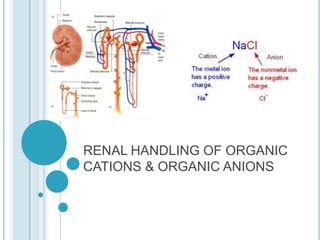
RENAL HANDLING OF ORGANIC
CATIONS & ORGANIC ANIONS
 RENAL REGULATION OF
 SODIUM
 CHLORIDE
 UREA
 GLUCOSE
 AMINO ACIDS
 CALCIUM
 POTASSIUM
RENAL REGULATION OF SODIUM
Transport of Sodium (Na+)
The filtered load of Na+ is the product of the glomerular filtration rate
(GFR, 180 liters/day) and the plasma Na+ concentration (142 mM), or
approximately 25,500 mM/day (equivalent to the Na+ in approximately
1.5 kg of table salt, more than nine times the total quantity of Na+
present in the body fluids.
With a typical Western diet consuming approximately 120 mM of Na+
per day, the kidneys reabsorb approximately 99.6% of the filtered Na+
by the time the tubule fluid reaches the renal pelvis.
The filtered load of Na is
25,500 mM/day, but the
intake is only 120
mM/day and the output
is 100 mM/day excreted
plus about 20 mM in the
feces and sweat.
Thus, the intake equals
output, so the body is in
sodium balance.
Reabsorption of
filtered Na load
along the each
nephron segment.
Yellow boxes are the
amount of filtered which is
reabsorbed.
Green boxes represent
the amount of filtered
which remains in each
portion of the nephron.
Pg 776
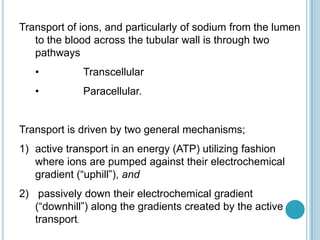
Transport of ions, and particularly of sodium from the lumen
to the blood across the tubular wall is through two
pathways
• Transcellular
• Paracellular.
Transport is driven by two general mechanisms;
1) active transport in an energy (ATP) utilizing fashion
where ions are pumped against their electrochemical
gradient (“uphill”), and
2) passively down their electrochemical gradient
(“downhill”) along the gradients created by the active
transport.
Na
Tubular
lumen
Apical
Membrane
Basal-lateral
membrane
Interstitial
space
Capillary
Lumen
Na
Na Na
Na
Tubular
epithelial wall
Capillary
wall
Net pathway for sodium (Na) reabsorption from tubular lumen to capillary
Start here with
Na delivery
End here with
sodium reabsorbed
and recovered
“Downhill” refers
to a passive flow
along an
electrochemical
gradient not
requiring active
transport.
There is a net driving
force due to the
active pump forcing
Na into the
interstitium, but a net
negative change
favoring the lumen to
draw Na back via
extracellular
junctions.
Sodium movement across the thin limbs (descending
and ascending limbs) of the loop of Henle
Virtually entirely passive down its electrochemical
gradient and paracellular.
Sodium movement across Thick Ascending Limb
(TAL) of the loop of Henle
Transcellular Na reabsorption includes
1) The Na/K/2Cl co-transporter (NKCC2) which couples inward
movement of these three ions in an electroneutral (2+ &2-) process
driven by the downhill gradient of Na and Cl into the cell. Much of
the K+ entering the cell is extruded via K channels down its own
gradient.
2) The Na+-H+ exchanger exchanging sodium for hydrogen in an
electroneutral process.
Sodium movement across Distal Convoluted
Tubule (DCT)
Sodium reabsorption in the distal tubule is almost entriely due to
transcellular transport.
Electroneutral passive apical Na entry is due to an Na/Cl cotransporter
(NCC).
Unlike the NKCC2, this is independent of K+
The net movement of transcellular sodium in the DCT is driven by an
ATP-utilizing basal-lateral Na+-K+ pump
Na+
reabsorption
in different
nephron
segments
Sodium movement across Collecting Tubules:
The relatively modest Sodium reabsorption in the collecting tubules is
entirely transcellular via the “principal cells.”
Na enters the apical membrane via a “voltage-gated sodium channel” or
“ENaC.”
The basolateral movement of sodium out of the cell is driven by an
energy requiring Na-K pump which establishes the gradient driving apical
sodium entry.
The movement of Na+ out of the lumen into the cell makes the lumen
negatively charged, and the movement of K out of the cell, primarily into
the basolateral interstitium makes the cell negative, for a net
transepithelial voltage of -40 mV.
The hormones aldosterone and vasopressin can change this site of
transport .
Sodium movement across Medullary Collecting
Duct:
The inner and outer medulalry collecting ducts reabsorb only a small
amount of sodium (3% of filtered load) and this is probably via ENaC on
the apical membrane and the Na-K pump driving Na movement on the
basal lateral membrane.
RENAL REGULATION OF CHLORIDE
Cl- transport and reabsorption:
Most Cl follows along with Na reabsorption, but the exact nature for the
movement is somewhat different.
In the Proximal tubule: Early proximal tubule Cl reabsorption is mostly
paracellular via solvent drag driven by the lumen negative potential.
However, in the late proximal it is reabsorbed by a predominantly by
transcellular pathway, driven by apical H+ exchange and active transport
with Na and a K cotransporter. The lumen becomes positive actually
retarding Cl reabsorption.
Thick ascending limb (TAL): Cl is primarly reabsorbed by the NaK2Cl
co-transsporteracross the apical membrane, and basal lateral Cl
channels along with active transport of sodium drive Cl into the
interstieium.
Distal Tubule: Apical Cl reabsorption occurs via a Na/Cl ccotransporter
and is driven by Cl following Na active extrusion via a Na/K pump.
Collecting ducts: The principal cell has an electrogenic pump that
creates a -40 mV lumen negative potential that drives Cl- out of the
lumen via paracellular routes.
However, the other cell type (the intercallated cell) drives transcellular Cl
movement powered by a basalateral H+ pump.
RENAL REGULATION OF UREA
• Produced primarly in the liver as a bi-product of amino acid
metabolism.
• The MAIN pathway for the body to eliminate this “waste product” is
through the kidney.
• Urea is freely filtered by the kidney, then both secreted and
reabsorbed (overall, there is net reabsorption, so the clearance of urea
is 60% less than the GFR).
• Proximal tubule and medullary collecting duct are the main sites for
reabsorption.
• The thin limbs of the loop of Henle are the primary sites for secretion.
Urea
Water leaves the proximal tubular lumen dragging urea, so
reabsorption is linked to flow. However, urea does not leave as
efficiently as sodium, so the luminal urea concentration rises, creating
a diffusion gradient out of the tubule.
In the loop of Henle, in the medullary interstitium, urea concentration
is high. The thin limbs of the loop have a urea transporter (UT2)
which secretes urea into the lumen via facillitated diffusion. Luminal
concentration rises to 110% of the filtered load by the end of the loop.
In the medullary collecting duct, urea is reabsorbed by apical and
basalateral facillitated transport (UT) due to the high luminal urea
concentration. This movement into the deep medulla helps keep
interstitial urea concentration high for the countercurrent system.
RENAL REGULATION OF GLUCOSE
• Glucose in the blood is tightly regulated by insulin at 4-5 mM (70-100
mg/dL).
• Glucose is freely filtered by the glomerulus, by 98% of the filtered
glucose is reabsorbed by the proximal tubule.
• Normally, virtually no glucose appears in the urine.
• Proximal glucose transport is active coupled to sodium transport via
sodium-glucose co-transporters (SGLT) on the apical membrane and
across the basalateral membrane by facillitated diffusion (via GLUT 1
and 2).
• In the early proximal it is driven by a high capacity, low affinity
transporter (SGLT2), but later along the proximal by a low capacity, high
affinity transporter (SGLT1).
While glucose is normaly totally reabsorbed, if the plasma levels start to
increase, the filtered load will increase and it can surpass the ability of
the nephron to totally reabsorb it. This maximum level is referred to as
the “transport maximum (Tm).” It reflects a point where the SGLT
transporters are totally saturated, so any filtered glucose beyond that
maximal amount reabsorbed will begin appearing in the urine.
Coupled to the saturation of the transporters, the clearance of glucose
(which is normally zero) will begin to rise, reflecting a fraction of the total
filtered which now appears in the urine.
Glucose filtration (yellow), reabsorption
(red) and excretion (green) vary as the
transport maximum of the nephron is
reached at around 250 mg/dL.
Glucose clearance is normally 0, but
beyond the capacity of the nephron to
reabsorb, it starts increasing as a
percentage of the filtered load spills over
into the urine.
RENAL REGULATION OF AMINO ACIDS
The body does not want to lose their nutrient substrate amino acids, so
while the kidney freely filters them, they are normally totally reabsorbed.
Apical amino acid transport is typically active by a sodium-dependent co-
transporter, though some amino acids are reabsorbed via Na-
independent facilitated diffusion.
On the basal lateral membrane most amino acids exit the cell by
facilitated diffusion.
In some cases, due to similar molecular structures, the amino acids may
exhibit competitive inhibition of transport.
Amino acid transport kinetics are similar to glucose, in that they exhibit a
transport maximum and may saturate if plasma levels are too high.
Reabsorption of other molecules by the kidney.
Oligopeptides: filtered oligopeptides are totally reabsorbed in the
proximal tubule.
Proteins: proteins (and protein fragments) are typically not filtered, but
those that are get reabsorbed by receptor-mediated
endocytosis, metabolized and taken back into the blood stream, so that
only trace amounts show up in the urine.
Carboxylates (pyruvate and lactate) are products of anaerobic glucose
matabolism and are sued as intermediates in the citric acid cycle. These
are totally conserved by reabsorption by the kidney
Organic anions and cations are metabolic products secreted by the late
proximal tubule.
Phosphate: Similar to calcium, 90% of filtered ionic free phosphate is
reabsorbed by the kidney, mostly in the proximal.
RENAL REGULATION OF CALCIUM
Calcium in the plasma:
The total concentration of calcium in plasma is normally 2.2 to 2.7 mM
(8.8-10.6 mg/dl).
Some 40% binds to plasma proteins, mainly albumin, and constitutes the
nonfilterable fraction.
The filterable portion, approximately 60% of total plasma calcium, consists
of two moieties.
1) approximately 15% of the total, complexes with small anions such as
carbonate, citrate, phosphate, and sulfate.
2) approximately 45% of total calcium, is the ionized Ca2+ that one may
measure with Ca2+ -sensitive electrodes or dyes. It is the concentration
of this free, ionized calcium that the body tightly regulates; plasma [Ca2+
] normally is 1.0 to 1.3 mM (4.0-5.2 mg/dl).
The renal tubule has the ability to vary its reabsorption of filtered
calcium to adjust for changes in intake or increased calcium
requirements. Under normal conditions, <1% of filtered calcium is
excreted in the urine.
Calcium is reabsorbed throughout the nephron;
Most of the regulation of reabsorption occurs in the distal nephron.
In the thick ascending limb of the loop of Henle (TAL), calcium
reabsorption occurs through a primarily paracellular pathway, but
active, transcellular reabsorption may occur as well during stimulation
with parathyroid hormone (PTH).
Calcium reabsorption in the PROXIMAL TUBULE.
The proximal tubule reabsorbs approximately 65% of the filtered Ca2+, a
process that is not subject to hormonal control.
A small part of the Ca2+ reabsorbed by the proximal tubule (20% of the
65%) moves via a transcellular route.
Most proximal tubule Ca2+ reabsorption (80% of the 65%) occurs via the
paracellular route.
Calcium Transport in the THICK ASCENDING LIMB.
The thick ascending limb (TAL) reabsorbs approximately 25% of the
filtered Ca2+.
Under normal conditions, about half of Ca2+ reabsorption in the TAL
occurs passively via a paracellular route, driven by the lumen-positive
voltage.
Thus, it is not surprising that hormones such as AVP, which make the
transepithelial voltage more positive, indirectly increase Ca2+
reabsorption.
The other half of Ca2+ reabsorption by the TAL occurs via the
transcellular pathway, which is stimulated by PTH .
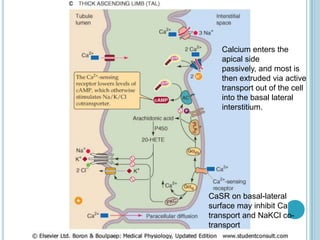
CaSR on basal-lateral
surface may inhibit Ca
transport and NaKCl co-
transport
Calcium enters the
apical side
passively, and most is
then extruded via active
transport out of the cell
into the basal lateral
interstitium.
Calcium in the DISTAL CONVOLUTED TUBULE.
This segment reabsorbs approximately 8% of the filtered Ca2+ load.
Despite the relatively small amount of Ca2+ delivered, the distal
convoluted tubule (DCT) is a major regulatory site for Ca2+ excretion. In
contrast to the proximal tubule and TAL, the DCT reabsorbs Ca2+
predominantly via an active, transcellular route.
PARATHYROID HORMONE
The most important regulator of renal Ca2+ reabsorption is PTH, which
stimulates Ca2+ reabsorption in the thick ascending limb, the distal
convoluted tubule, and the connecting tubule.
(PTH does NOT have a proximal action)
PTH appears to increase the open probability of apical Ca2+ channels.
Such an increase in Ca2+ permeability would increase intracellular
[Ca2+]i, which in turn would stimulate basolateral Ca2+ extrusion
mechanisms, increase Ca2+ reabsorption, and raise plasma [Ca2+ ].
Calcium reabsorption in the Distal Convoluted Tubule (DCT)
Because only a small percentage of filtered calcium is excreted in the
urine (0.5%), and the DCT is the last major sight for reabsorption of
calcium, relatively small changes in the fraction reabsorbed in the DCT
result in large changes in the total amount of calcium lost in the urine.
Reabsorption in the DCT is regulated by PTH. When serum calcium
concentration decreases, PTH release from the parathyroid glands
increases. This effect is mediated by the calcium-sensing receptor
(CaSR) in the parathyroid gland.
PTH acts on the DCT to increase calcium reabsorption.
RENAL REGULATION OF POTASSIUM
The distribution of potassium is very different from sodium, as it is the
most abundant intracellular cation, as 98% of the bodies K+ lies within
cells.
The circulating K+ is tightly regulated at a low 3.5-5.0 mM (compared to
145 mM for Na+).
K+ within cells is essential for maintaining cell volume, regulating
intracellular pH, controlling enzyme function, DNA, protein synthesis
and cell growth.
The ratio of intracellular to low extracellular K+ is critical in maintaining
the electrical potential across cell membrane (in both excitable and
non-excitable cells).
Potassium homeostasis:
The body must remain in “K+ balance,” such that intake equals output.
(about 80-120 mM K+/day; in and out).
Typically the kidney filters 800 mM/day, so the excretory load is about
10-15% of that filtered.
K+ handling and regulation by the kidney includes the ability both to
reabsorb and to secrete.
90% of filtered
K is reabsorbed
by the end of
the loop of
Henle.
Regulation of
K+ balance
depends on the
5 distal nephron
segments
Most (80%) of K+ reabsorption takes place in the Proximal tubule
Proximal reabsorption of 80% of the filtered load takes place by passive
paracellular movement via solvent drag and simple diffusion, driven by
the gradients established by active sodium reabsorption.
Potassium reabsorption in the proximal (because of its passive
paracellular nature) is highly dependent on fluid movement out of the
lumen, following sodium.
The basalateral Na-K pump does NOT directly affect K+ rabsorption
since the movement is mostly paracellular and not dependent on the
intracellular gradient
K+ reabsorption in the thick ascending limb accounts for an
unregulated additional 10% of the filtered load.
The thin limbs of the loop of Henle secrete K+ (passively) due to the
high K concentration in the medullary interstitium.
The TAL reabsorbs K+ by both paracellular and transcellular pathways,
Paracellular passive reabsorption is driven by both high K permeability
and the lumen positive voltage.
Transcellular reabsorption is driven by the NKCC2 co-transporter
moving sodium and K into the cell via the apical membrane, driven by
the active movement of Na (due to the basalateral Na-K pump) across
the cell.
Paracellular = 50%
Transcellular K+
50%
In the collecting ducts , the two cell types have different functions:
The principal cells secrete K+
Secretion requires a basalateral Na-K exchanger to let K enter the cell
against it gradient, and K channels on the apical side to allow K+ to flow
into the lumen, down its chemical gradient.
The intercalated cells reabsorb K+
Reabsorption requires an apical K+ pump to push K into the cell, and K
channels on the basalateral membrane to allow K to leave the cell down
its chemical gradient.
K+ SecretionK+ Reabsorption
THANK YOU

Cations and anions

  • 1.
    RENAL HANDLING OFORGANIC CATIONS & ORGANIC ANIONS
  • 2.
     RENAL REGULATIONOF  SODIUM  CHLORIDE  UREA  GLUCOSE  AMINO ACIDS  CALCIUM  POTASSIUM
  • 3.
  • 4.
    Transport of Sodium(Na+) The filtered load of Na+ is the product of the glomerular filtration rate (GFR, 180 liters/day) and the plasma Na+ concentration (142 mM), or approximately 25,500 mM/day (equivalent to the Na+ in approximately 1.5 kg of table salt, more than nine times the total quantity of Na+ present in the body fluids. With a typical Western diet consuming approximately 120 mM of Na+ per day, the kidneys reabsorb approximately 99.6% of the filtered Na+ by the time the tubule fluid reaches the renal pelvis.
  • 5.
    The filtered loadof Na is 25,500 mM/day, but the intake is only 120 mM/day and the output is 100 mM/day excreted plus about 20 mM in the feces and sweat. Thus, the intake equals output, so the body is in sodium balance.
  • 6.
    Reabsorption of filtered Naload along the each nephron segment. Yellow boxes are the amount of filtered which is reabsorbed. Green boxes represent the amount of filtered which remains in each portion of the nephron. Pg 776
  • 7.
    Transport of ions,and particularly of sodium from the lumen to the blood across the tubular wall is through two pathways • Transcellular • Paracellular. Transport is driven by two general mechanisms; 1) active transport in an energy (ATP) utilizing fashion where ions are pumped against their electrochemical gradient (“uphill”), and 2) passively down their electrochemical gradient (“downhill”) along the gradients created by the active transport.
  • 8.
    Na Tubular lumen Apical Membrane Basal-lateral membrane Interstitial space Capillary Lumen Na Na Na Na Tubular epithelial wall Capillary wall Netpathway for sodium (Na) reabsorption from tubular lumen to capillary Start here with Na delivery End here with sodium reabsorbed and recovered
  • 10.
    “Downhill” refers to apassive flow along an electrochemical gradient not requiring active transport. There is a net driving force due to the active pump forcing Na into the interstitium, but a net negative change favoring the lumen to draw Na back via extracellular junctions.
  • 11.
    Sodium movement acrossthe thin limbs (descending and ascending limbs) of the loop of Henle Virtually entirely passive down its electrochemical gradient and paracellular.
  • 12.
    Sodium movement acrossThick Ascending Limb (TAL) of the loop of Henle Transcellular Na reabsorption includes 1) The Na/K/2Cl co-transporter (NKCC2) which couples inward movement of these three ions in an electroneutral (2+ &2-) process driven by the downhill gradient of Na and Cl into the cell. Much of the K+ entering the cell is extruded via K channels down its own gradient. 2) The Na+-H+ exchanger exchanging sodium for hydrogen in an electroneutral process.
  • 13.
    Sodium movement acrossDistal Convoluted Tubule (DCT) Sodium reabsorption in the distal tubule is almost entriely due to transcellular transport. Electroneutral passive apical Na entry is due to an Na/Cl cotransporter (NCC). Unlike the NKCC2, this is independent of K+ The net movement of transcellular sodium in the DCT is driven by an ATP-utilizing basal-lateral Na+-K+ pump
  • 14.
  • 15.
    Sodium movement acrossCollecting Tubules: The relatively modest Sodium reabsorption in the collecting tubules is entirely transcellular via the “principal cells.” Na enters the apical membrane via a “voltage-gated sodium channel” or “ENaC.” The basolateral movement of sodium out of the cell is driven by an energy requiring Na-K pump which establishes the gradient driving apical sodium entry. The movement of Na+ out of the lumen into the cell makes the lumen negatively charged, and the movement of K out of the cell, primarily into the basolateral interstitium makes the cell negative, for a net transepithelial voltage of -40 mV. The hormones aldosterone and vasopressin can change this site of transport .
  • 16.
    Sodium movement acrossMedullary Collecting Duct: The inner and outer medulalry collecting ducts reabsorb only a small amount of sodium (3% of filtered load) and this is probably via ENaC on the apical membrane and the Na-K pump driving Na movement on the basal lateral membrane.
  • 17.
  • 18.
    Cl- transport andreabsorption: Most Cl follows along with Na reabsorption, but the exact nature for the movement is somewhat different. In the Proximal tubule: Early proximal tubule Cl reabsorption is mostly paracellular via solvent drag driven by the lumen negative potential. However, in the late proximal it is reabsorbed by a predominantly by transcellular pathway, driven by apical H+ exchange and active transport with Na and a K cotransporter. The lumen becomes positive actually retarding Cl reabsorption.
  • 19.
    Thick ascending limb(TAL): Cl is primarly reabsorbed by the NaK2Cl co-transsporteracross the apical membrane, and basal lateral Cl channels along with active transport of sodium drive Cl into the interstieium. Distal Tubule: Apical Cl reabsorption occurs via a Na/Cl ccotransporter and is driven by Cl following Na active extrusion via a Na/K pump. Collecting ducts: The principal cell has an electrogenic pump that creates a -40 mV lumen negative potential that drives Cl- out of the lumen via paracellular routes. However, the other cell type (the intercallated cell) drives transcellular Cl movement powered by a basalateral H+ pump.
  • 21.
  • 22.
    • Produced primarlyin the liver as a bi-product of amino acid metabolism. • The MAIN pathway for the body to eliminate this “waste product” is through the kidney. • Urea is freely filtered by the kidney, then both secreted and reabsorbed (overall, there is net reabsorption, so the clearance of urea is 60% less than the GFR). • Proximal tubule and medullary collecting duct are the main sites for reabsorption. • The thin limbs of the loop of Henle are the primary sites for secretion.
  • 23.
  • 24.
    Water leaves theproximal tubular lumen dragging urea, so reabsorption is linked to flow. However, urea does not leave as efficiently as sodium, so the luminal urea concentration rises, creating a diffusion gradient out of the tubule. In the loop of Henle, in the medullary interstitium, urea concentration is high. The thin limbs of the loop have a urea transporter (UT2) which secretes urea into the lumen via facillitated diffusion. Luminal concentration rises to 110% of the filtered load by the end of the loop. In the medullary collecting duct, urea is reabsorbed by apical and basalateral facillitated transport (UT) due to the high luminal urea concentration. This movement into the deep medulla helps keep interstitial urea concentration high for the countercurrent system.
  • 25.
  • 26.
    • Glucose inthe blood is tightly regulated by insulin at 4-5 mM (70-100 mg/dL). • Glucose is freely filtered by the glomerulus, by 98% of the filtered glucose is reabsorbed by the proximal tubule. • Normally, virtually no glucose appears in the urine. • Proximal glucose transport is active coupled to sodium transport via sodium-glucose co-transporters (SGLT) on the apical membrane and across the basalateral membrane by facillitated diffusion (via GLUT 1 and 2). • In the early proximal it is driven by a high capacity, low affinity transporter (SGLT2), but later along the proximal by a low capacity, high affinity transporter (SGLT1).
  • 29.
    While glucose isnormaly totally reabsorbed, if the plasma levels start to increase, the filtered load will increase and it can surpass the ability of the nephron to totally reabsorb it. This maximum level is referred to as the “transport maximum (Tm).” It reflects a point where the SGLT transporters are totally saturated, so any filtered glucose beyond that maximal amount reabsorbed will begin appearing in the urine. Coupled to the saturation of the transporters, the clearance of glucose (which is normally zero) will begin to rise, reflecting a fraction of the total filtered which now appears in the urine.
  • 30.
    Glucose filtration (yellow),reabsorption (red) and excretion (green) vary as the transport maximum of the nephron is reached at around 250 mg/dL. Glucose clearance is normally 0, but beyond the capacity of the nephron to reabsorb, it starts increasing as a percentage of the filtered load spills over into the urine.
  • 31.
  • 32.
    The body doesnot want to lose their nutrient substrate amino acids, so while the kidney freely filters them, they are normally totally reabsorbed. Apical amino acid transport is typically active by a sodium-dependent co- transporter, though some amino acids are reabsorbed via Na- independent facilitated diffusion. On the basal lateral membrane most amino acids exit the cell by facilitated diffusion. In some cases, due to similar molecular structures, the amino acids may exhibit competitive inhibition of transport. Amino acid transport kinetics are similar to glucose, in that they exhibit a transport maximum and may saturate if plasma levels are too high.
  • 34.
    Reabsorption of othermolecules by the kidney. Oligopeptides: filtered oligopeptides are totally reabsorbed in the proximal tubule. Proteins: proteins (and protein fragments) are typically not filtered, but those that are get reabsorbed by receptor-mediated endocytosis, metabolized and taken back into the blood stream, so that only trace amounts show up in the urine. Carboxylates (pyruvate and lactate) are products of anaerobic glucose matabolism and are sued as intermediates in the citric acid cycle. These are totally conserved by reabsorption by the kidney Organic anions and cations are metabolic products secreted by the late proximal tubule. Phosphate: Similar to calcium, 90% of filtered ionic free phosphate is reabsorbed by the kidney, mostly in the proximal.
  • 35.
  • 36.
    Calcium in theplasma: The total concentration of calcium in plasma is normally 2.2 to 2.7 mM (8.8-10.6 mg/dl). Some 40% binds to plasma proteins, mainly albumin, and constitutes the nonfilterable fraction. The filterable portion, approximately 60% of total plasma calcium, consists of two moieties. 1) approximately 15% of the total, complexes with small anions such as carbonate, citrate, phosphate, and sulfate. 2) approximately 45% of total calcium, is the ionized Ca2+ that one may measure with Ca2+ -sensitive electrodes or dyes. It is the concentration of this free, ionized calcium that the body tightly regulates; plasma [Ca2+ ] normally is 1.0 to 1.3 mM (4.0-5.2 mg/dl).
  • 38.
    The renal tubulehas the ability to vary its reabsorption of filtered calcium to adjust for changes in intake or increased calcium requirements. Under normal conditions, <1% of filtered calcium is excreted in the urine. Calcium is reabsorbed throughout the nephron; Most of the regulation of reabsorption occurs in the distal nephron. In the thick ascending limb of the loop of Henle (TAL), calcium reabsorption occurs through a primarily paracellular pathway, but active, transcellular reabsorption may occur as well during stimulation with parathyroid hormone (PTH).
  • 39.
    Calcium reabsorption inthe PROXIMAL TUBULE. The proximal tubule reabsorbs approximately 65% of the filtered Ca2+, a process that is not subject to hormonal control. A small part of the Ca2+ reabsorbed by the proximal tubule (20% of the 65%) moves via a transcellular route. Most proximal tubule Ca2+ reabsorption (80% of the 65%) occurs via the paracellular route.
  • 41.
    Calcium Transport inthe THICK ASCENDING LIMB. The thick ascending limb (TAL) reabsorbs approximately 25% of the filtered Ca2+. Under normal conditions, about half of Ca2+ reabsorption in the TAL occurs passively via a paracellular route, driven by the lumen-positive voltage. Thus, it is not surprising that hormones such as AVP, which make the transepithelial voltage more positive, indirectly increase Ca2+ reabsorption. The other half of Ca2+ reabsorption by the TAL occurs via the transcellular pathway, which is stimulated by PTH .
  • 42.
    CaSR on basal-lateral surfacemay inhibit Ca transport and NaKCl co- transport Calcium enters the apical side passively, and most is then extruded via active transport out of the cell into the basal lateral interstitium.
  • 43.
    Calcium in theDISTAL CONVOLUTED TUBULE. This segment reabsorbs approximately 8% of the filtered Ca2+ load. Despite the relatively small amount of Ca2+ delivered, the distal convoluted tubule (DCT) is a major regulatory site for Ca2+ excretion. In contrast to the proximal tubule and TAL, the DCT reabsorbs Ca2+ predominantly via an active, transcellular route.
  • 44.
    PARATHYROID HORMONE The mostimportant regulator of renal Ca2+ reabsorption is PTH, which stimulates Ca2+ reabsorption in the thick ascending limb, the distal convoluted tubule, and the connecting tubule. (PTH does NOT have a proximal action) PTH appears to increase the open probability of apical Ca2+ channels. Such an increase in Ca2+ permeability would increase intracellular [Ca2+]i, which in turn would stimulate basolateral Ca2+ extrusion mechanisms, increase Ca2+ reabsorption, and raise plasma [Ca2+ ].
  • 45.
    Calcium reabsorption inthe Distal Convoluted Tubule (DCT) Because only a small percentage of filtered calcium is excreted in the urine (0.5%), and the DCT is the last major sight for reabsorption of calcium, relatively small changes in the fraction reabsorbed in the DCT result in large changes in the total amount of calcium lost in the urine. Reabsorption in the DCT is regulated by PTH. When serum calcium concentration decreases, PTH release from the parathyroid glands increases. This effect is mediated by the calcium-sensing receptor (CaSR) in the parathyroid gland. PTH acts on the DCT to increase calcium reabsorption.
  • 46.
  • 47.
    The distribution ofpotassium is very different from sodium, as it is the most abundant intracellular cation, as 98% of the bodies K+ lies within cells. The circulating K+ is tightly regulated at a low 3.5-5.0 mM (compared to 145 mM for Na+). K+ within cells is essential for maintaining cell volume, regulating intracellular pH, controlling enzyme function, DNA, protein synthesis and cell growth. The ratio of intracellular to low extracellular K+ is critical in maintaining the electrical potential across cell membrane (in both excitable and non-excitable cells).
  • 48.
    Potassium homeostasis: The bodymust remain in “K+ balance,” such that intake equals output. (about 80-120 mM K+/day; in and out). Typically the kidney filters 800 mM/day, so the excretory load is about 10-15% of that filtered. K+ handling and regulation by the kidney includes the ability both to reabsorb and to secrete.
  • 49.
    90% of filtered Kis reabsorbed by the end of the loop of Henle. Regulation of K+ balance depends on the 5 distal nephron segments
  • 50.
    Most (80%) ofK+ reabsorption takes place in the Proximal tubule Proximal reabsorption of 80% of the filtered load takes place by passive paracellular movement via solvent drag and simple diffusion, driven by the gradients established by active sodium reabsorption. Potassium reabsorption in the proximal (because of its passive paracellular nature) is highly dependent on fluid movement out of the lumen, following sodium. The basalateral Na-K pump does NOT directly affect K+ rabsorption since the movement is mostly paracellular and not dependent on the intracellular gradient
  • 51.
    K+ reabsorption inthe thick ascending limb accounts for an unregulated additional 10% of the filtered load. The thin limbs of the loop of Henle secrete K+ (passively) due to the high K concentration in the medullary interstitium. The TAL reabsorbs K+ by both paracellular and transcellular pathways, Paracellular passive reabsorption is driven by both high K permeability and the lumen positive voltage. Transcellular reabsorption is driven by the NKCC2 co-transporter moving sodium and K into the cell via the apical membrane, driven by the active movement of Na (due to the basalateral Na-K pump) across the cell.
  • 52.
  • 53.
    In the collectingducts , the two cell types have different functions: The principal cells secrete K+ Secretion requires a basalateral Na-K exchanger to let K enter the cell against it gradient, and K channels on the apical side to allow K+ to flow into the lumen, down its chemical gradient. The intercalated cells reabsorb K+ Reabsorption requires an apical K+ pump to push K into the cell, and K channels on the basalateral membrane to allow K to leave the cell down its chemical gradient.
  • 54.
  • 55.

Editor's Notes

  • #10 Para-cellular movement incorporatesThe transepithelial electrochemical Na gradient drives passive Na reabsorption in the proximal and thick ascending limb of the nephron. Not so for later nephron segments where the net (passive) force favors movement into the lumen. Na can also move passively in the proximal tubule (without active transport) via “solvent drag” where the movement of water (driven by active Na transport) sweeps additional Na and Cl along with it (a sort of mass-action) out of the lumen into the lateral intracellular space. The leakiness of the nephron (facillitating passive reabsorption) is greatest in the proximal, and decreases along the nephron to the papillary collecting ducts.Trans-cellular movement incorporates 1) passive entry from the lumen via the “apical” membrane into the cell down an electro-chemical gradient. The proximal, TAL and DCT use various co-transporters and exchangers, while in the collecting ducts Na enters via Na channels.2) Active extrusion of Na out the basal-lateral membrane via a Na-K+ pump which maintains intracellular Na low and K high. This exchange keeps the voltage at 70 mV (cell interior negative vsinterstitium, or lumen) depending on pump activity and the voltage gradient it creates.