Countercurrent Multiplier 
(the original pyramid scheme)
Overview 
• Concentration mechanism 
– Role of the thick ascending limb 
– Role of the thin descending limb 
– Role of vasa recta 
– Role of the collecting ducts 
• Kidney’s response to diuresis/anti-diuresis 
• Current thoughts/active research
Concentrating ability of the 
Kidney 
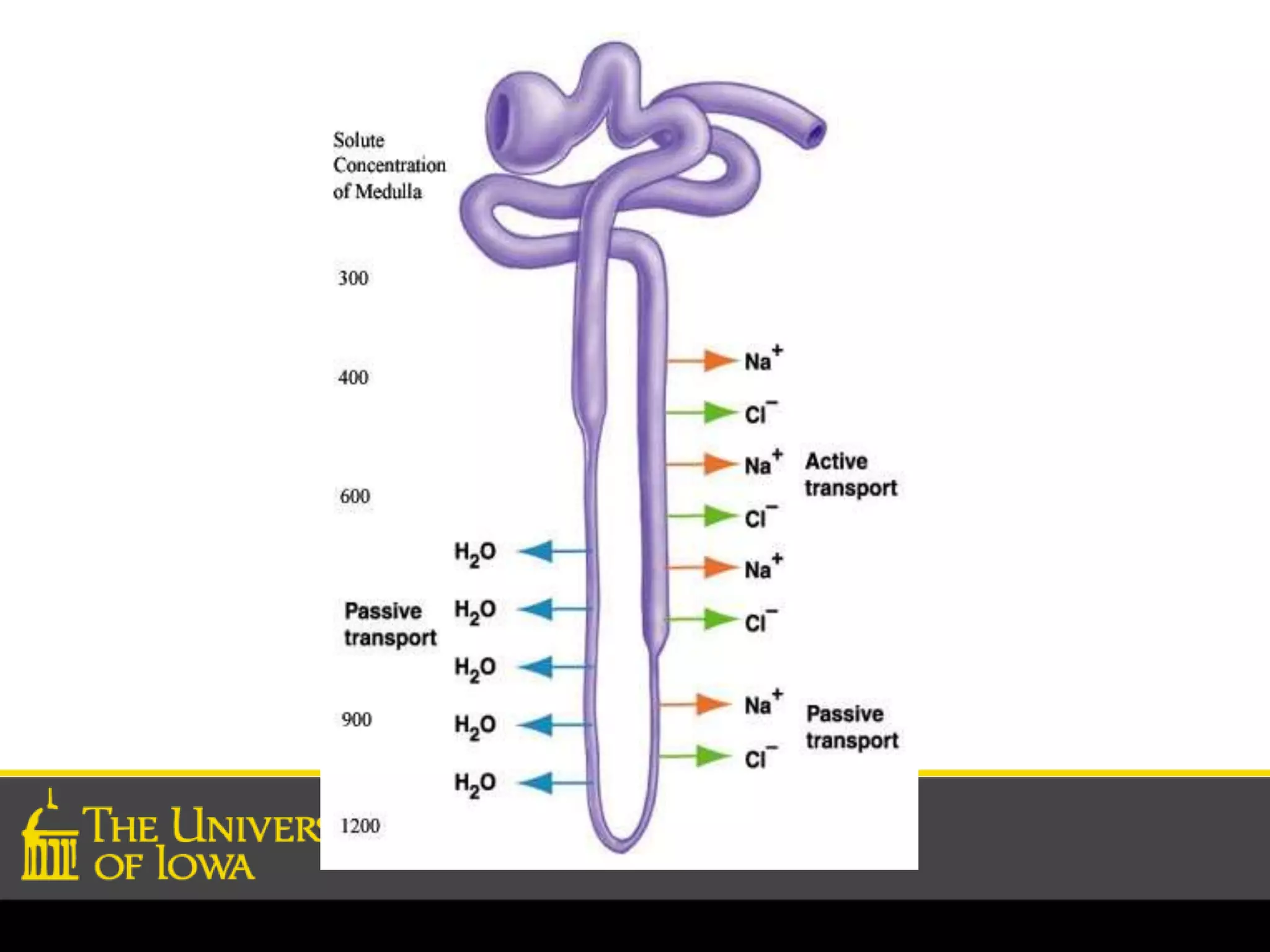
• Main role of loop of Henle 
• Enables “zones” of concentration 
– Proximal medulla/cortex ~300 mOsm 
– Deep medulla ~1200 mOsm
Concentrating ability of the 
Kidney 
• Major contributors 
– NaCl 
– Urea 
• Minor contributors 
– K salts 
– Non-urea nitrogens 
– Hydrogen (through Na/H exchangers)
Let’s start backwards 
• Thick ascending limb 
– Impermeable to water (efflux of NaCl without 
water following) 
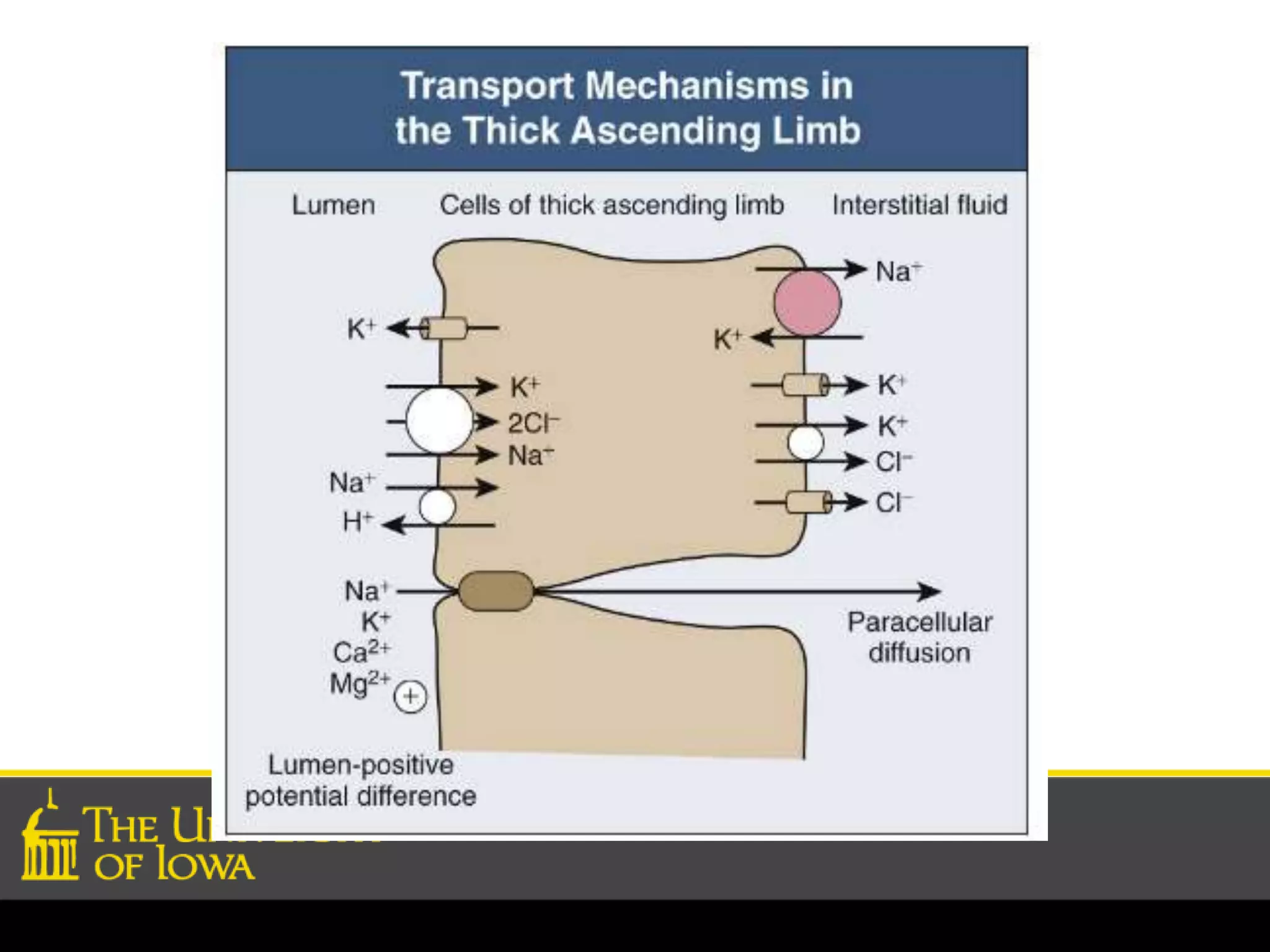
– Active transport of NaCl out of tubular fluid 
• Through Na/K ATP-ase on basilar side 
• Creates low intracellular Na gradient 
• NKCC (Na/K/2Cl) co-transporter and Na/H 
exchanger present on apical side 
– ~40% of NaCl reabsorbed in TAL 
– Availability of K is the rate limiting step
TAL 
• Active reabsorption of NaCl is the 
main step in countercurrent 
multiplication 
• NaCl is the main substance that 
creates osmotic gradient in superficial 
nephrons
TAL 
• Deeper medulla contains longer loops 
likely driven by urea (discussed later) 
– May also have some sodium (under 
investigation)
Thin descending limb 
• Full of aquaporins and urea transport 
channels 
• Relatively impermeable to ion 
excretion 
– Superficial nephrons mainly excrete 
water 
– Deeper nephrons may add some solute
Thin ascending limb 
• No active transport 
• NaCl passively diffuses out through 
gradient 
– Water reabsorption in thin descending 
limb makes for a highly NaCl 
concentrated tubular fluid 
• Impermeable to water 
• Adds a small amount to osmotic 
gradient
Putting it all together 
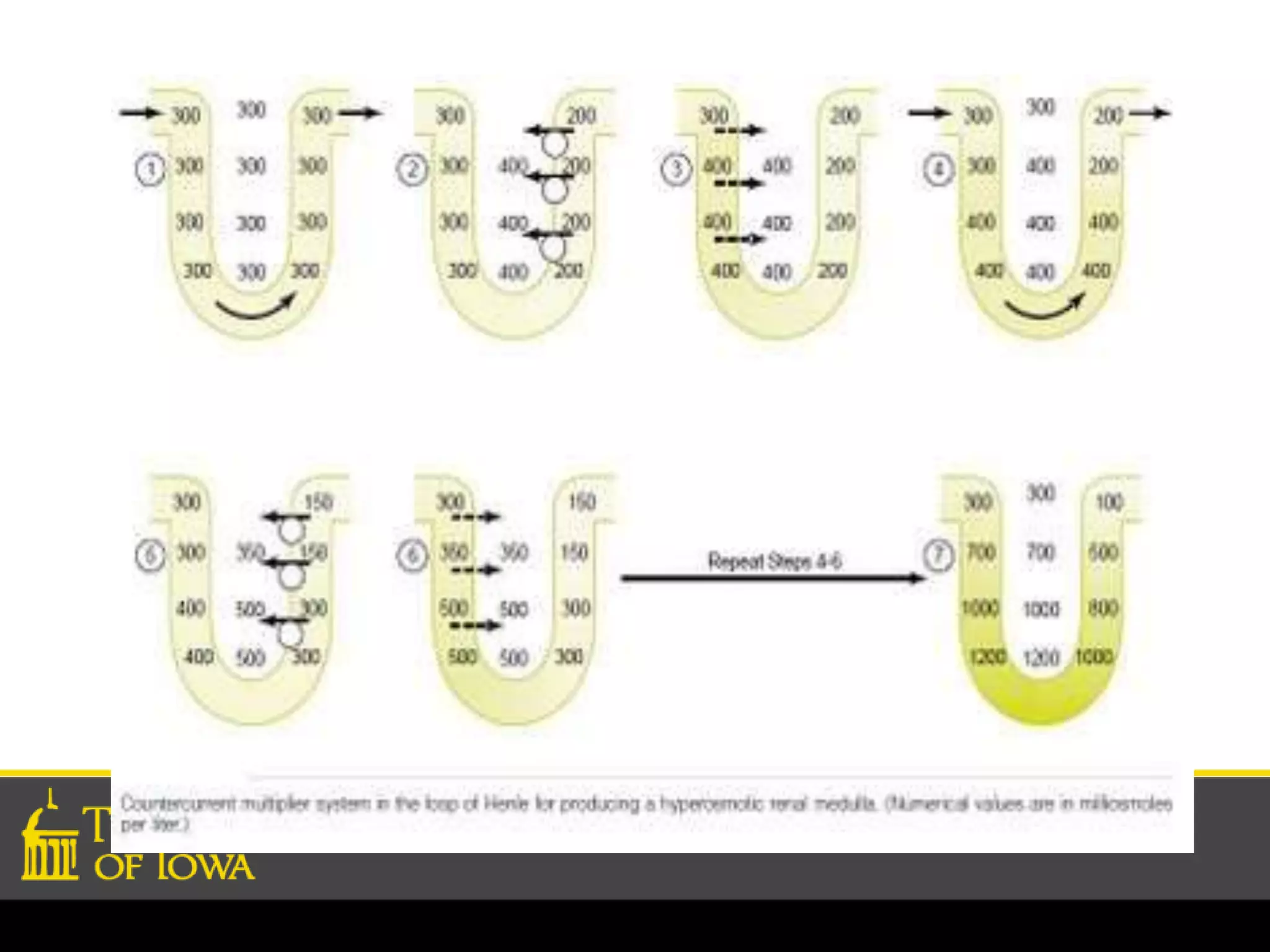
• Isotonic fluid enters loop 
• NaCl actively pumped out of TAL 
• Creates hyperosmolar interstitium (due to 
NaCl accumulation) and hypotonic fluid in 
TAL 
• Relative proximity of thin descending limb 
to TAL causes excretion of water into 
hyperosmotic interstitium
Putting it all together 
• Fluid flows down loop, process 
continues until gradient is created 
• Amount one can concentrate urine 
likely linked to length of loops of 
Henle 
– Kangaroo rat excretes ~5500 mOsm 
urine and loops so long they extrude into 
renal papilla and collecting system
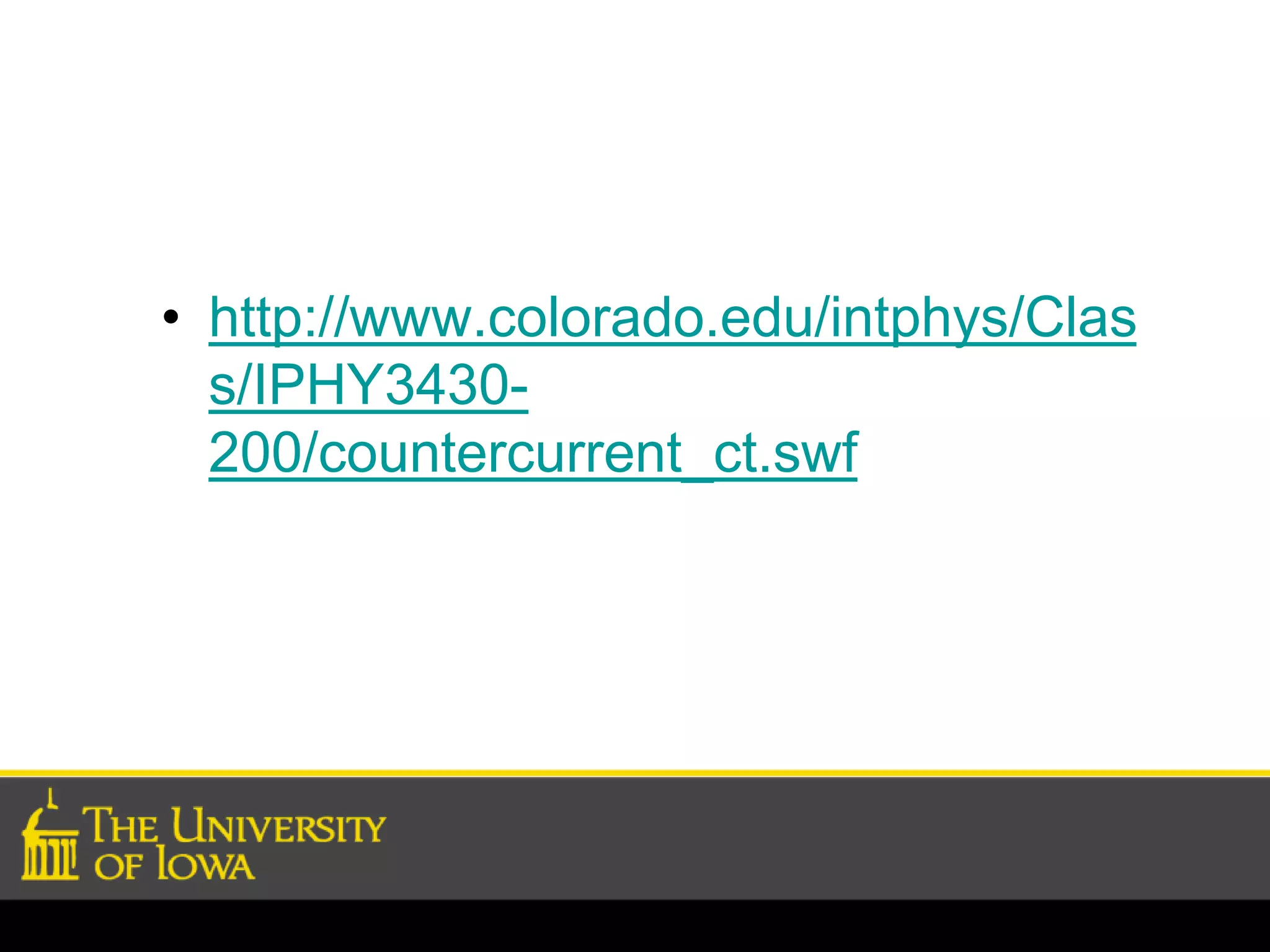
• http://www.colorado.edu/intphys/Clas 
s/IPHY3430- 
200/countercurrent_ct.swf
Vasa Recta 
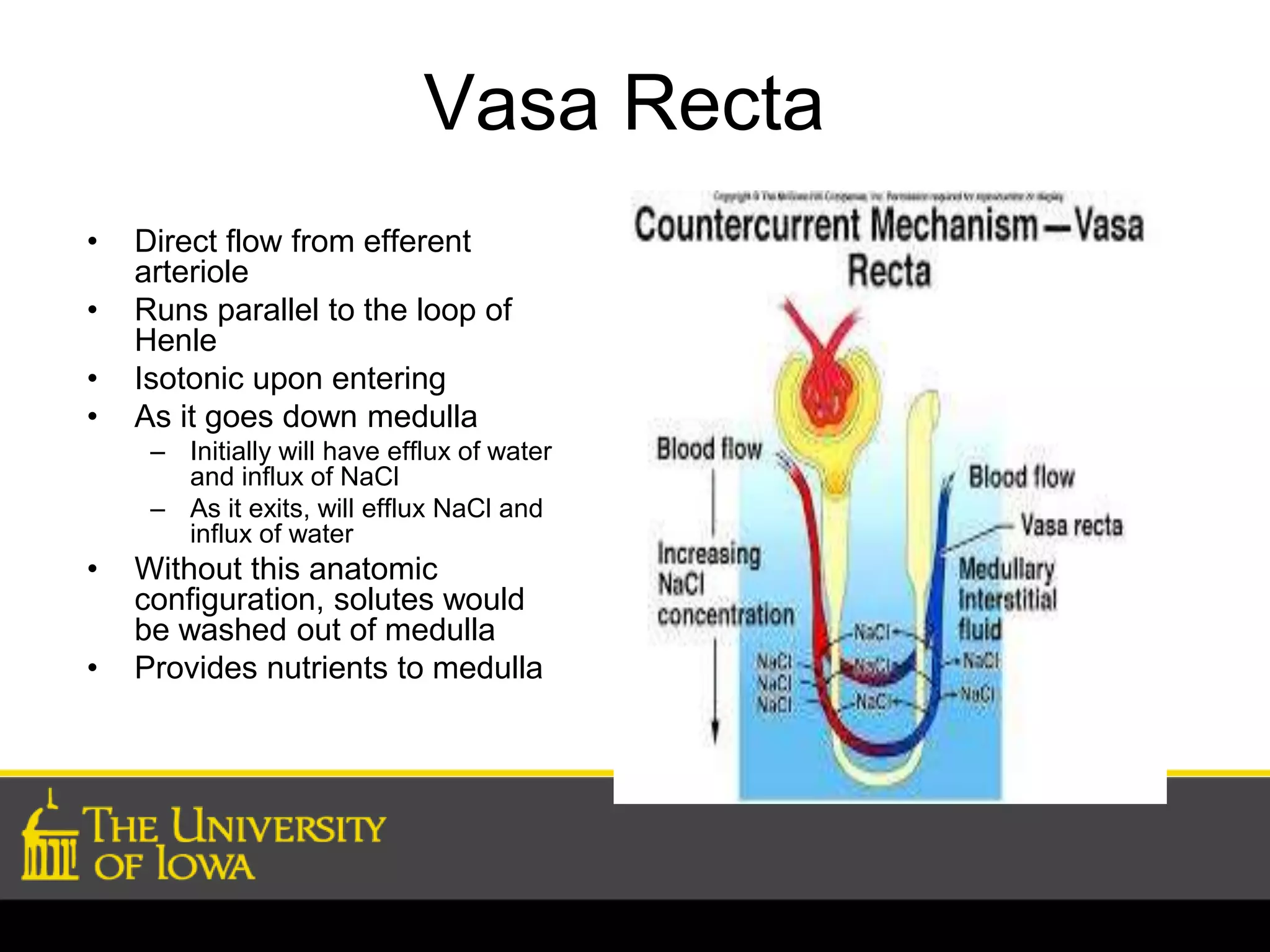
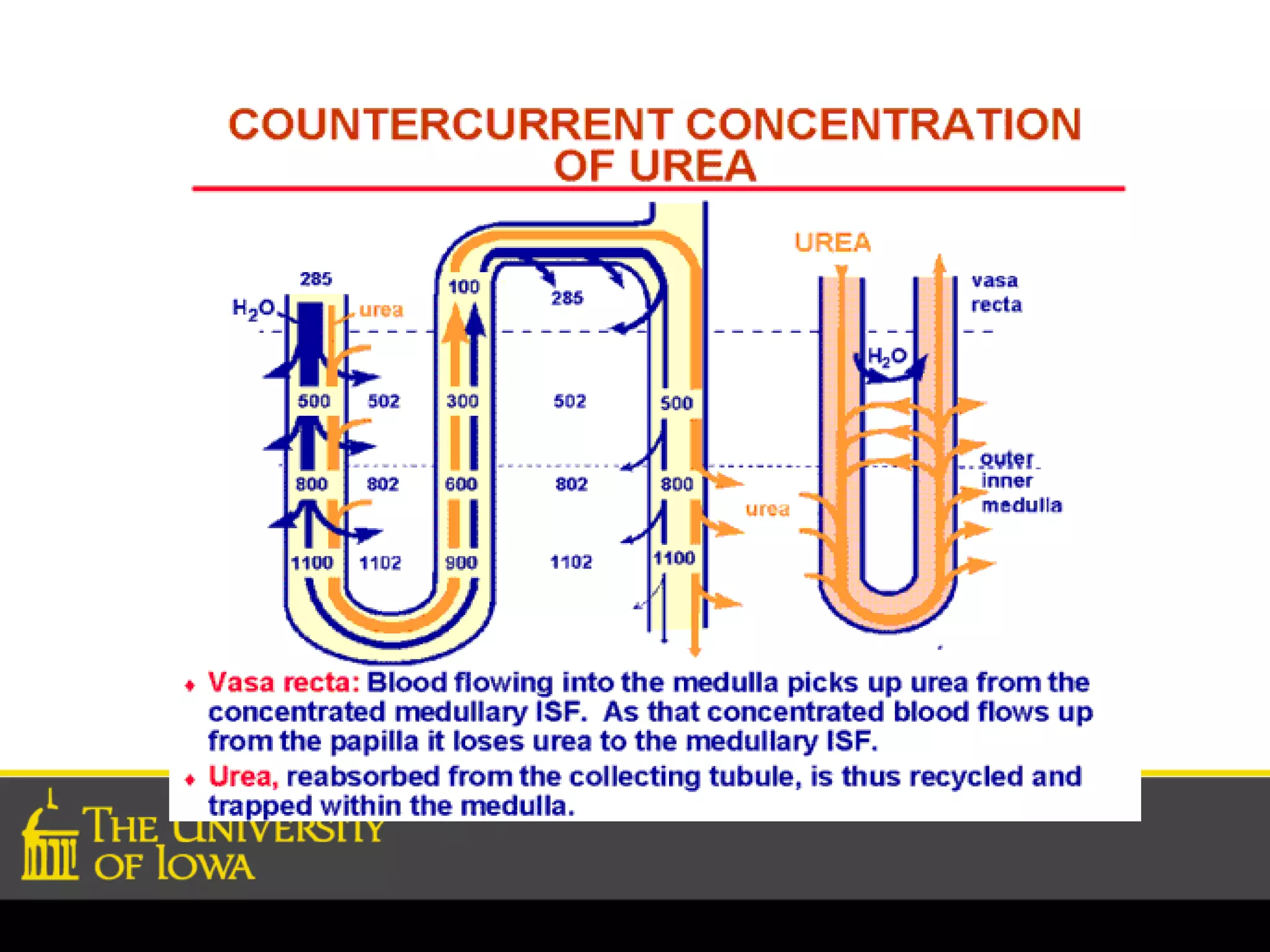
• Direct flow from efferent 
arteriole 
• Runs parallel to the loop of 
Henle 
• Isotonic upon entering 
• As it goes down medulla 
– Initially will have efflux of water 
and influx of NaCl 
– As it exits, will efflux NaCl and 
influx of water 
• Without this anatomic 
configuration, solutes would 
be washed out of medulla 
• Provides nutrients to medulla
Urea 
• Thin descending limb permeable to urea 
• TAL and beyond impermeable 
• Urea transport channels present in 
medullary collecting duct 
• As cortex and proximal medulla urea-poor, 
primary water efflux is seen leading to 
concentrated (higher urea) fluid
Urea 
• Distal collecting duct, urea flows out 
down concentration gradient 
– Suspected this is why inner medulla can 
reach ~1200 mOsm while only about 
600 mOsm can be explained by NaCl
Urea recycling 
• Can be transported from interstitium 
into descending tubule 
– Since rest of loop impermeable, will 
eventually be carried back to IMCD 
• Studies show more urea in distal 
tubule than enters from the proximal 
tubule 
– Likely because vasa recta carries from 
medulla to descending loop (through UT-A2 
transporter), then to IMCD
Antidiuresis 
• Body wants to make low volume, highly 
concentrated urine 
• Cortex is iso-osmotic (~300 mOsm) 
• Gradient goes down to inner medulla 
ranging 600-1200 mOsm (depending on 
urea reabsorption and length of loops)
Antidiuresis 
• In late distal tubule 
– ADH leads to aquaporins and water 
reabsorption 
• In cortical and superficial medullary 
collecting ducts 
– ADH leads to aquaporins and water 
reabsorption
Antidiuresis 
• In inner medullary collecting ducts 
– ADH leads to aquaporins and water 
reabsorption and UT insertion and 
increased urea reabsorption down 
concentration gradient, increasing 
insterstitial osmolarity
Diuresis 
• Body wants to make high volume, low 
concentration urine 
• Tubular fluid entering collecting hypo-osmolar 
~100 mOsm (due to active NaCl 
pumping in TAL) 
• With absence of ADH, little to no water or 
urea reabsorption in collecting duct
Diuresis 
• Leads to less water reabsorption also 
in descending tubule (but no change 
to NaCl pumping in TAL) 
• All this increases urine volume
Situations affecting concentrating 
ability (not related to ADH) 
• Usually result in hypo/hypernatremia 
• Decreased sodium absorption 
– Bartter’s, ATN 
• Decreased solute (urea and NaCl) 
– Poor intake, liver disease, CKD 
• Increased medullary blood flow 
(solute wash out) 
– Hypercalcemia, hyperthyroidism
Still unclear 
• Everything 
– Several of these things are theories based 
on mathematical models and indirect 
measures 
• Thin descending limb 
– Solute handling (unclear how urea and 
NaCl transported out of tubule with relative 
lack of aquaporins in inner medulla portion 
– Question of as yet unknown transporter, 
mathematical models to suggest urea-Na or 
urea-Cl cotransporter
Still unclear 
• Vasa Recta 
– Urea transporters (UTA1/3 in collecting 
duct is known) 
– here genetics have found UTA2 and 
UTB in thin descending limb and vasa 
recta 
• Knock out mice shows each knock out by 
themselves increases diuresis, but knocked 
out together counter-acts this diuresis
Still unclear 
• Outer medulla 
– Short loops are anatomically separated 
from ascending limbs, therefore 
nullifying idea of countercurrent 
multiplication 
• NaCl handling in the inner medulla 
– As there is no TAL 
– Limbs that do reach inner medulla are 
thin and don’t transport NaCl

Countercurrent mechanism in Kidney

  • 1.
    Countercurrent Multiplier (theoriginal pyramid scheme)
  • 2.
    Overview • Concentrationmechanism – Role of the thick ascending limb – Role of the thin descending limb – Role of vasa recta – Role of the collecting ducts • Kidney’s response to diuresis/anti-diuresis • Current thoughts/active research
  • 3.
    Concentrating ability ofthe Kidney • Main role of loop of Henle • Enables “zones” of concentration – Proximal medulla/cortex ~300 mOsm – Deep medulla ~1200 mOsm
  • 4.
    Concentrating ability ofthe Kidney • Major contributors – NaCl – Urea • Minor contributors – K salts – Non-urea nitrogens – Hydrogen (through Na/H exchangers)
  • 6.
    Let’s start backwards • Thick ascending limb – Impermeable to water (efflux of NaCl without water following) – Active transport of NaCl out of tubular fluid • Through Na/K ATP-ase on basilar side • Creates low intracellular Na gradient • NKCC (Na/K/2Cl) co-transporter and Na/H exchanger present on apical side – ~40% of NaCl reabsorbed in TAL – Availability of K is the rate limiting step
  • 8.
    TAL • Activereabsorption of NaCl is the main step in countercurrent multiplication • NaCl is the main substance that creates osmotic gradient in superficial nephrons
  • 9.
    TAL • Deepermedulla contains longer loops likely driven by urea (discussed later) – May also have some sodium (under investigation)
  • 10.
    Thin descending limb • Full of aquaporins and urea transport channels • Relatively impermeable to ion excretion – Superficial nephrons mainly excrete water – Deeper nephrons may add some solute
  • 11.
    Thin ascending limb • No active transport • NaCl passively diffuses out through gradient – Water reabsorption in thin descending limb makes for a highly NaCl concentrated tubular fluid • Impermeable to water • Adds a small amount to osmotic gradient
  • 12.
    Putting it alltogether • Isotonic fluid enters loop • NaCl actively pumped out of TAL • Creates hyperosmolar interstitium (due to NaCl accumulation) and hypotonic fluid in TAL • Relative proximity of thin descending limb to TAL causes excretion of water into hyperosmotic interstitium
  • 13.
    Putting it alltogether • Fluid flows down loop, process continues until gradient is created • Amount one can concentrate urine likely linked to length of loops of Henle – Kangaroo rat excretes ~5500 mOsm urine and loops so long they extrude into renal papilla and collecting system
  • 14.
  • 16.
    Vasa Recta •Direct flow from efferent arteriole • Runs parallel to the loop of Henle • Isotonic upon entering • As it goes down medulla – Initially will have efflux of water and influx of NaCl – As it exits, will efflux NaCl and influx of water • Without this anatomic configuration, solutes would be washed out of medulla • Provides nutrients to medulla
  • 17.
    Urea • Thindescending limb permeable to urea • TAL and beyond impermeable • Urea transport channels present in medullary collecting duct • As cortex and proximal medulla urea-poor, primary water efflux is seen leading to concentrated (higher urea) fluid
  • 18.
    Urea • Distalcollecting duct, urea flows out down concentration gradient – Suspected this is why inner medulla can reach ~1200 mOsm while only about 600 mOsm can be explained by NaCl
  • 19.
    Urea recycling •Can be transported from interstitium into descending tubule – Since rest of loop impermeable, will eventually be carried back to IMCD • Studies show more urea in distal tubule than enters from the proximal tubule – Likely because vasa recta carries from medulla to descending loop (through UT-A2 transporter), then to IMCD
  • 21.
    Antidiuresis • Bodywants to make low volume, highly concentrated urine • Cortex is iso-osmotic (~300 mOsm) • Gradient goes down to inner medulla ranging 600-1200 mOsm (depending on urea reabsorption and length of loops)
  • 22.
    Antidiuresis • Inlate distal tubule – ADH leads to aquaporins and water reabsorption • In cortical and superficial medullary collecting ducts – ADH leads to aquaporins and water reabsorption
  • 23.
    Antidiuresis • Ininner medullary collecting ducts – ADH leads to aquaporins and water reabsorption and UT insertion and increased urea reabsorption down concentration gradient, increasing insterstitial osmolarity
  • 24.
    Diuresis • Bodywants to make high volume, low concentration urine • Tubular fluid entering collecting hypo-osmolar ~100 mOsm (due to active NaCl pumping in TAL) • With absence of ADH, little to no water or urea reabsorption in collecting duct
  • 25.
    Diuresis • Leadsto less water reabsorption also in descending tubule (but no change to NaCl pumping in TAL) • All this increases urine volume
  • 26.
    Situations affecting concentrating ability (not related to ADH) • Usually result in hypo/hypernatremia • Decreased sodium absorption – Bartter’s, ATN • Decreased solute (urea and NaCl) – Poor intake, liver disease, CKD • Increased medullary blood flow (solute wash out) – Hypercalcemia, hyperthyroidism
  • 27.
    Still unclear •Everything – Several of these things are theories based on mathematical models and indirect measures • Thin descending limb – Solute handling (unclear how urea and NaCl transported out of tubule with relative lack of aquaporins in inner medulla portion – Question of as yet unknown transporter, mathematical models to suggest urea-Na or urea-Cl cotransporter
  • 28.
    Still unclear •Vasa Recta – Urea transporters (UTA1/3 in collecting duct is known) – here genetics have found UTA2 and UTB in thin descending limb and vasa recta • Knock out mice shows each knock out by themselves increases diuresis, but knocked out together counter-acts this diuresis
  • 29.
    Still unclear •Outer medulla – Short loops are anatomically separated from ascending limbs, therefore nullifying idea of countercurrent multiplication • NaCl handling in the inner medulla – As there is no TAL – Limbs that do reach inner medulla are thin and don’t transport NaCl