
HIV in Kidney Transplantation
Wisit Cheungpasitporn
May 22, 2015
Disclosure
• None
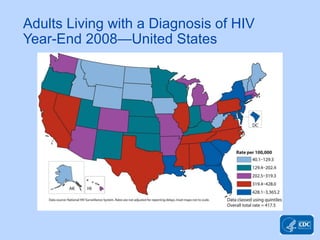
Adults Living with a Diagnosis of HIV
Year-End 2008—United States
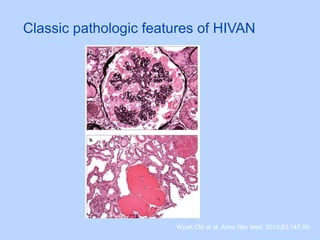
Classic pathologic features of HIVAN
Wyatt CM et al. Annu Rev Med. 2012;63:147-59.
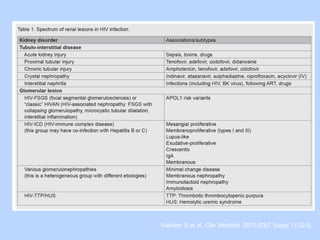
Naicker S et al. Clin Nephrol. 2015;83(7 Suppl 1):32-8.
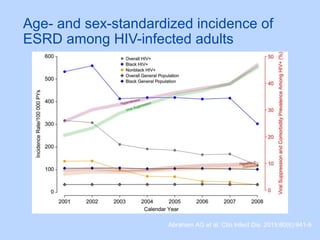
Age- and sex-standardized incidence of
ESRD among HIV-infected adults
Abraham AG et al. Clin Infect Dis. 2015;60(6):941-9.
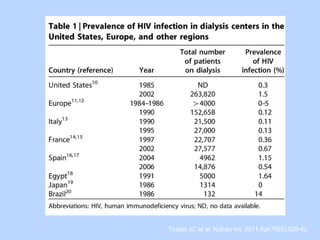
Trullas JC et al. Kidney Int. 2011 Apr;79(8):825-42
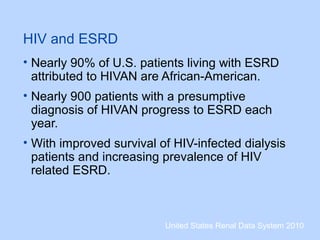
HIV and ESRD
• Nearly 90% of U.S. patients living with ESRD
attributed to HIVAN are African-American.
• Nearly 900 patients with a presumptive
diagnosis of HIVAN progress to ESRD each
year.
• With improved survival of HIV-infected dialysis
patients and increasing prevalence of HIV
related ESRD.
United States Renal Data System 2010
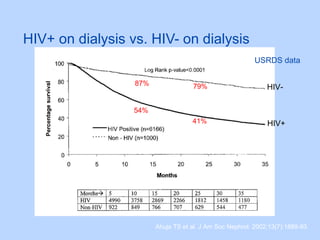
HIV+ on dialysis vs. HIV- on dialysis
87%
54%
79%
41% HIV+
HIV-
Ahuja TS et al. J Am Soc Nephrol. 2002;13(7):1889-93.
USRDS data
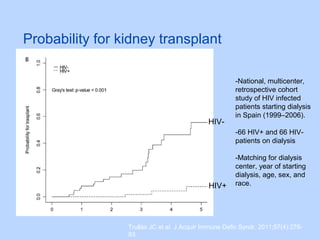
Probability for kidney transplant
HIV-
HIV+
-National, multicenter,
retrospective cohort
study of HIV infected
patients starting dialysis
in Spain (1999–2006).
-66 HIV+ and 66 HIV-
patients on dialysis
-Matching for dialysis
center, year of starting
dialysis, age, sex, and
race.
Trullàs JC et al. J Acquir Immune Defic Syndr. 2011;57(4):276-
83.
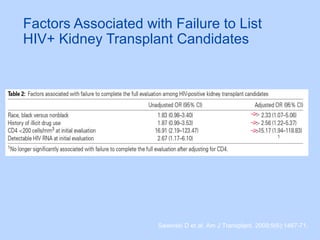
Factors Associated with Failure to List
HIV+ Kidney Transplant Candidates
Sawinski D et al. Am J Transplant. 2009;9(6):1467-71.
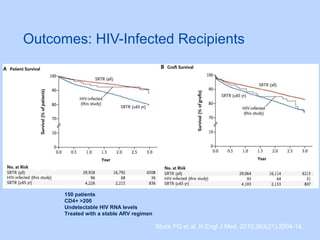
Outcomes: HIV-Infected Recipients
Stock PG et al. N Engl J Med. 2010;363(21):2004-14.
150 patients
CD4+ >200
Undetectable HIV RNA levels
Treated with a stable ARV regimen
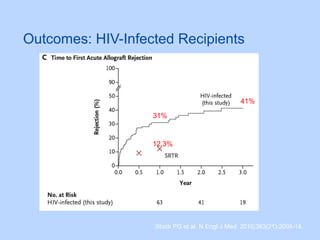
Outcomes: HIV-Infected Recipients
Stock PG et al. N Engl J Med. 2010;363(21):2004-14.
31%
41%
12.3%
• SRTR; 2002–2011
• 510 adult kidney transplant recipients with HIV
(median follow-up, 3.8 years) matched 1:10 to
HIV-negative controls
Locke JE et al. J Am Soc Nephrol. 2015. [Epub ahead of print]
The number of kidney transplants
Locke JE et al. J Am Soc Nephrol. 2015. [Epub ahead of print]
Graft survival
Locke JE et al. J Am Soc Nephrol. 2015. [Epub ahead of print]
HR 1.06; 95% CI, 0.85-1.33; P=0.61
HIV-/HCV-
HIV+/HCV-
Graft survival
Locke JE et al. J Am Soc Nephrol. 2015. [Epub ahead of print]
HR 1.38; 95% CI, 1.08-1.77; P=0.01
HIV-/HCV+
HIV+/HCV+
Patient survival
Locke JE et al. J Am Soc Nephrol. 2015. [Epub ahead of print]
HIV-/HCV-
HIV+/HCV-
Patient survival
Locke JE et al. J Am Soc Nephrol. 2015. [Epub ahead of print]
HIV-/HCV+
HIV+/HCV+
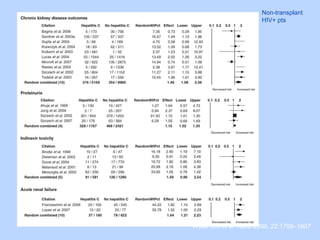
Wyatt CM et al. AIDS 2008, 22:1799–1807
Non-transplant
HIV+ pts
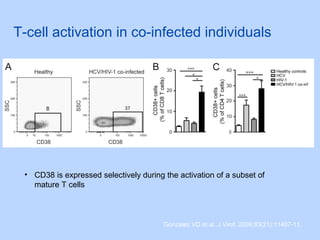
Gonzalez VD et al. J Virol. 2009;83(21):11407-11.
T-cell activation in co-infected individuals
• CD38 is expressed selectively during the activation of a subset of
mature T cells
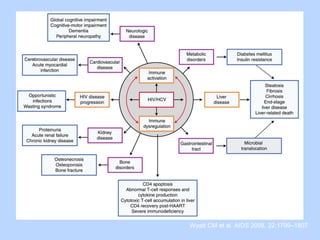
Wyatt CM et al. AIDS 2008, 22:1799–1807
HIV-Positive–to–HIV-Positive Kidney
Transplantation?
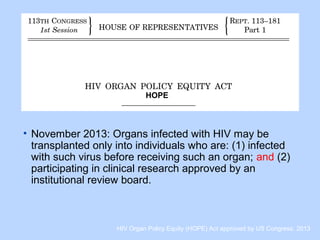
• November 2013: Organs infected with HIV may be
transplanted only into individuals who are: (1) infected
with such virus before receiving such an organ; and (2)
participating in clinical research approved by an
institutional review board.
HIV Organ Policy Equity (HOPE) Act approved by US Congress. 2013
HOPE
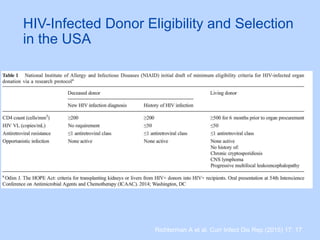
HIV-Infected Donor Eligibility and Selection
in the USA
Richterman A et al. Curr Infect Dis Rep (2015) 17: 17
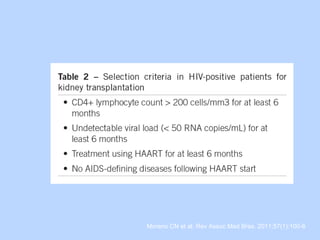
Moreno CN et al. Rev Assoc Med Bras. 2011;57(1):100-6
• Nationally, approximate 356 potential HIV+
deceased donors yielding 192 kidneys and 247
livers annually.
Richterman A et al. Am J Transplant. 2015 May 14. [Epub ahead of print]
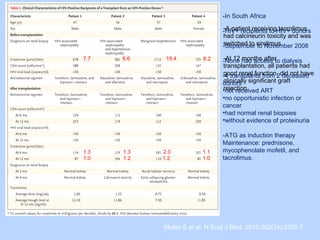
Muller E et al. N Engl J Med. 2010;362(24):2336-7.
-In South Africa
-HIV+ recipients to HIV+ donors
-September to November 2008
-None had access to dialysis
-4 transplants from 2 deceased
donors
•not received ART
•no opportunistic infection or
cancer
•had normal renal biopsies
•without evidence of proteinuria
-ATG as induction therapy
Maintenance: prednisone,
mycophenolate mofetil, and
tacrolimus.
7.7 6.6 19.4 8.2
1.3 1.3 2.0
1.2
1.1
1.0 1.2 1.0
-A patient receiving tacrolimus
had calcineurin toxicity and was
switched to sirolimus.
-At 12 months after
transplantation, all patients had
good renal function, did not have
clinically significant graft
rejection.
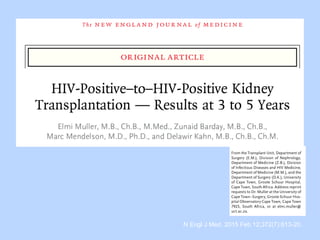
N Engl J Med. 2015 Feb 12;372(7):613-20.
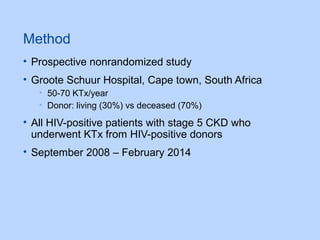
Method
• Prospective nonrandomized study
• Groote Schuur Hospital, Cape town, South Africa
• 50-70 KTx/year
• Donor: living (30%) vs deceased (70%)
• All HIV-positive patients with stage 5 CKD who
underwent KTx from HIV-positive donors
• September 2008 – February 2014
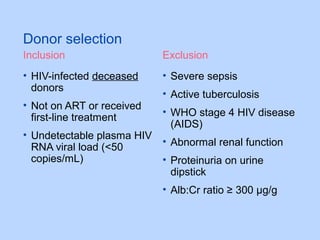
Donor selection
Inclusion
• HIV-infected deceased
donors
• Not on ART or received
first-line treatment
• Undetectable plasma HIV
RNA viral load (<50
copies/mL)
Exclusion
• Severe sepsis
• Active tuberculosis
• WHO stage 4 HIV disease
(AIDS)
• Abnormal renal function
• Proteinuria on urine
dipstick
• Alb:Cr ratio ≥ 300 µg/g
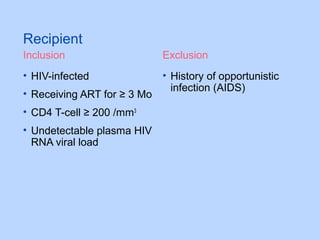
Recipient
Inclusion
• HIV-infected
• Receiving ART for ≥ 3 Mo
• CD4 T-cell ≥ 200 /mm3
• Undetectable plasma HIV
RNA viral load
Exclusion
• History of opportunistic
infection (AIDS)
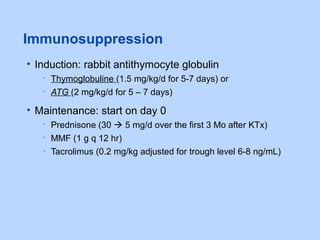
Immunosuppression
• Induction: rabbit antithymocyte globulin
• Thymoglobuline (1.5 mg/kg/d for 5-7 days) or
• ATG (2 mg/kg/d for 5 – 7 days)
• Maintenance: start on day 0
• Prednisone (30  5 mg/d over the first 3 Mo after KTx)
• MMF (1 g q 12 hr)
• Tacrolimus (0.2 mg/kg adjusted for trough level 6-8 ng/mL)
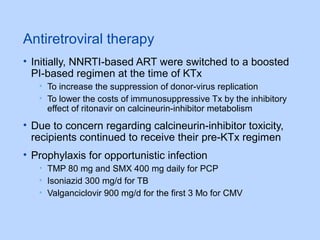
Antiretroviral therapy
• Initially, NNRTI-based ART were switched to a boosted
PI-based regimen at the time of KTx
• To increase the suppression of donor-virus replication
• To lower the costs of immunosuppressive Tx by the inhibitory
effect of ritonavir on calcineurin-inhibitor metabolism
• Due to concern regarding calcineurin-inhibitor toxicity,
recipients continued to receive their pre-KTx regimen
• Prophylaxis for opportunistic infection
• TMP 80 mg and SMX 400 mg daily for PCP
• Isoniazid 300 mg/d for TB
• Valganciclovir 900 mg/d for the first 3 Mo for CMV
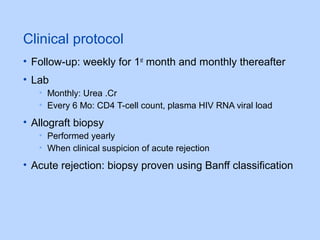
Clinical protocol
• Follow-up: weekly for 1st
month and monthly thereafter
• Lab
• Monthly: Urea .Cr
• Every 6 Mo: CD4 T-cell count, plasma HIV RNA viral load
• Allograft biopsy
• Performed yearly
• When clinical suspicion of acute rejection
• Acute rejection: biopsy proven using Banff classification
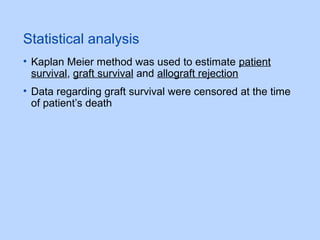
Statistical analysis
• Kaplan Meier method was used to estimate patient
survival, graft survival and allograft rejection
• Data regarding graft survival were censored at the time
of patient’s death
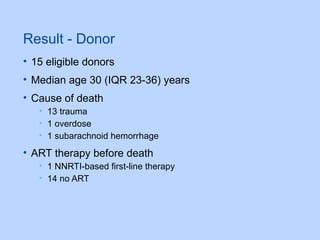
Result - Donor
• 15 eligible donors
• Median age 30 (IQR 23-36) years
• Cause of death
• 13 trauma
• 1 overdose
• 1 subarachnoid hemorrhage
• ART therapy before death
• 1 NNRTI-based first-line therapy
• 14 no ART
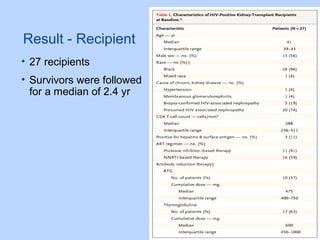
Result - Recipient
• 27 recipients
• Survivors were followed
for a median of 2.4 yr
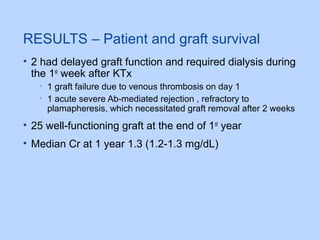
RESULTS – Patient and graft survival
• 2 had delayed graft function and required dialysis during
the 1st
week after KTx
• 1 graft failure due to venous thrombosis on day 1
• 1 acute severe Ab-mediated rejection , refractory to
plamapheresis, which necessitated graft removal after 2 weeks
• 25 well-functioning graft at the end of 1st
year
• Median Cr at 1 year 1.3 (1.2-1.3 mg/dL)
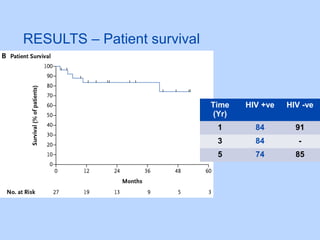
RESULTS – Patient survival
Time
(Yr)
HIV +ve HIV -ve
1 84 91
3 84 -
5 74 85
RESULTS – Patient survival
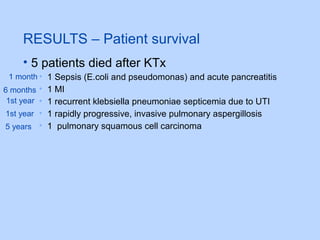
• 5 patients died after KTx
• 1 Sepsis (E.coli and pseudomonas) and acute pancreatitis
• 1 MI
• 1 recurrent klebsiella pneumoniae septicemia due to UTI
• 1 rapidly progressive, invasive pulmonary aspergillosis
• 1 pulmonary squamous cell carcinoma
1 month
6 months
1st year
1st year
5 years
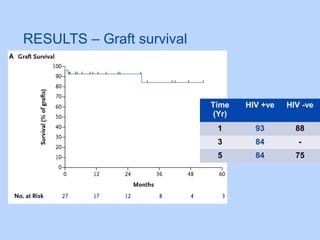
RESULTS – Graft survival
Time
(Yr)
HIV +ve HIV -ve
1 93 88
3 84 -
5 84 75
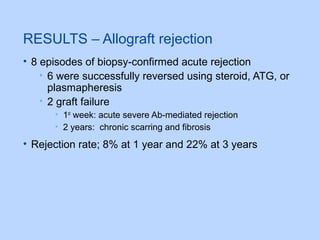
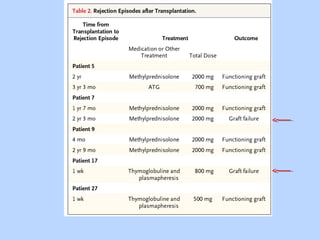
RESULTS – Allograft rejection
• 8 episodes of biopsy-confirmed acute rejection
• 6 were successfully reversed using steroid, ATG, or
plasmapheresis
• 2 graft failure
• 1st
week: acute severe Ab-mediated rejection
• 2 years: chronic scarring and fibrosis
• Rejection rate; 8% at 1 year and 22% at 3 years
RESULTS – Pharmacologic interactions
• Type of ART regimen had a consierable effect of the
tacrolimus dosing
• The median tacrolimus dose was 0.5 mg q 7 – 10 days
in PI-based regimen vs 8.5 mg q 12 hours in NNRTI-
based regimen
• Side effect of tacrolimus were more pronounced in PI-
based regimen
• 5 renal biopsy of calcineurin-inhibitor toxicity
RESULTS – Progression of HIV disease
• CD4 T-cell count
• Median was 179 (IQR 141-310) in 1st
year and 386 (IQR 307-
484) at 3 years
• Viral load
• All had undetectable viral load (<50 copies/mL) during F/U
• Histologic finding
• 3 routine renal biopsy revealed typical change of early HIV-
associated nephropathy; none had clinically significant renal
impairment, proteinuria or required dialysis
Discussion
• Outcomes in HIV+ patient who received kidneys from
HIV+ donors were comparable with those who received
from HIV- donor
• Concerns
• The risk of transmission of a new and possibly
resistant strain of HIV from donor to recipient
• The appearance in the postoperative biopsy
specimens of early changes related to HIV-
associated nephropathy that were not present in the
baseline biopsy specimens
• Interaction between medications
Discussion
• The patients in this study did not have any increase in
plasma viral load, and viral levels remained
undetectable after transplantation.
• All the donors in this study had not received ART
previously or had received first-line treatment with no
known virologic evidence that would suggest resistance,
although genotyping was not performed.
• Protocol renal transplant
biopsies performed at 3
months from 19
recipients with HIV-1
• Undetectable levels of
plasma HIV-1 RNA at
transplantation
• HIV-1 infected the kidney
allograft in 68% of these
patients
• Podocyte infection
associated with a faster
decline in allograft
function compared with
tubular cell infection.
Canaud G et al. J Am Soc Nephrol 2014;25:407-19
in situ hybridization of HIV-1 RNA
Discussion
• The interaction between ART and immunosuppressants
• Ritonavir and TAC
• Decreases the metabolism of TAC, resulting in a decrease
of more than 80% in the clearance of TAC
• Required minimal doses of TAC every 7 to 10 days to
maintain adequate levels.
• A higher incidence of CNI nephrotoxicity
• The NNRTIs and TAC
• Induce the cytochrome P450 enzyme system
• Increases the metabolism of tacrolimus, necessitating
higher doses (median, 8.5 mg twice daily) to maintain
adequate levels.
Discussion
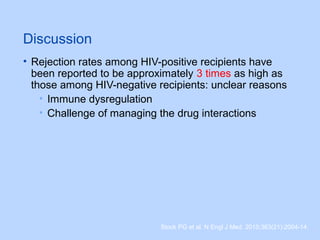
• Rejection rates among HIV-positive recipients have
been reported to be approximately 3 times as high as
those among HIV-negative recipients: unclear reasons
• Immune dysregulation
• Challenge of managing the drug interactions
Stock PG et al. N Engl J Med. 2010;363(21):2004-14.
Conclusions
• Kidney transplantation from an HIV-positive
donor appears to be an additional treatment
option for HIV-infected patients requiring renal-
replacement therapy.
Questions & Discussion
Apply to the United States?
• Lack of access to dialysis severely limits
options for HIV-infected individuals with ESRD
in South Africa, altering the risk–benefit
dynamic.
• South African donors have been untreated for
HIV; given the homogeneity of HIV infection in
South Africa, it is unlikely that there will be
resistance issues complicating management of
the recipients.
Apply to the United States?
• The population of HIV-infected individuals in
U.S.- higher rates of antiretroviral exposure and
resistance:
• making it less likely that a single empiric
choice of antiretrovirals will be sufficient to
treat both donor and recipient.
Ethics of HIV-Infected Donation
• Attitudes of HIV-Infected Patients on waiting list-
No data available
• Beneficence- strive to expand access to
transplant in novel ways because of the
discrepancy between the need for transplant
and organ shortage.
• Non-maleficence-requires a cautious process
forward because of limited outcomes data from
HIV-infected donors.
• Informed consent

HIV in Kidney Transplantation

  • 1.
    HIV in KidneyTransplantation Wisit Cheungpasitporn May 22, 2015
  • 2.
  • 4.
    Adults Living witha Diagnosis of HIV Year-End 2008—United States
  • 5.
    Classic pathologic featuresof HIVAN Wyatt CM et al. Annu Rev Med. 2012;63:147-59.
  • 6.
    Naicker S etal. Clin Nephrol. 2015;83(7 Suppl 1):32-8.
  • 7.
    Age- and sex-standardizedincidence of ESRD among HIV-infected adults Abraham AG et al. Clin Infect Dis. 2015;60(6):941-9.
  • 8.
    Trullas JC etal. Kidney Int. 2011 Apr;79(8):825-42
  • 9.
    HIV and ESRD •Nearly 90% of U.S. patients living with ESRD attributed to HIVAN are African-American. • Nearly 900 patients with a presumptive diagnosis of HIVAN progress to ESRD each year. • With improved survival of HIV-infected dialysis patients and increasing prevalence of HIV related ESRD. United States Renal Data System 2010
  • 10.
    HIV+ on dialysisvs. HIV- on dialysis 87% 54% 79% 41% HIV+ HIV- Ahuja TS et al. J Am Soc Nephrol. 2002;13(7):1889-93. USRDS data
  • 11.
    Probability for kidneytransplant HIV- HIV+ -National, multicenter, retrospective cohort study of HIV infected patients starting dialysis in Spain (1999–2006). -66 HIV+ and 66 HIV- patients on dialysis -Matching for dialysis center, year of starting dialysis, age, sex, and race. Trullàs JC et al. J Acquir Immune Defic Syndr. 2011;57(4):276- 83.
  • 12.
    Factors Associated withFailure to List HIV+ Kidney Transplant Candidates Sawinski D et al. Am J Transplant. 2009;9(6):1467-71.
  • 13.
    Outcomes: HIV-Infected Recipients StockPG et al. N Engl J Med. 2010;363(21):2004-14. 150 patients CD4+ >200 Undetectable HIV RNA levels Treated with a stable ARV regimen
  • 14.
    Outcomes: HIV-Infected Recipients StockPG et al. N Engl J Med. 2010;363(21):2004-14. 31% 41% 12.3%
  • 15.
    • SRTR; 2002–2011 •510 adult kidney transplant recipients with HIV (median follow-up, 3.8 years) matched 1:10 to HIV-negative controls Locke JE et al. J Am Soc Nephrol. 2015. [Epub ahead of print]
  • 16.
    The number ofkidney transplants Locke JE et al. J Am Soc Nephrol. 2015. [Epub ahead of print]
  • 17.
    Graft survival Locke JEet al. J Am Soc Nephrol. 2015. [Epub ahead of print] HR 1.06; 95% CI, 0.85-1.33; P=0.61 HIV-/HCV- HIV+/HCV-
  • 18.
    Graft survival Locke JEet al. J Am Soc Nephrol. 2015. [Epub ahead of print] HR 1.38; 95% CI, 1.08-1.77; P=0.01 HIV-/HCV+ HIV+/HCV+
  • 19.
    Patient survival Locke JEet al. J Am Soc Nephrol. 2015. [Epub ahead of print] HIV-/HCV- HIV+/HCV-
  • 20.
    Patient survival Locke JEet al. J Am Soc Nephrol. 2015. [Epub ahead of print] HIV-/HCV+ HIV+/HCV+
  • 21.
    Wyatt CM etal. AIDS 2008, 22:1799–1807 Non-transplant HIV+ pts
  • 22.
    Gonzalez VD etal. J Virol. 2009;83(21):11407-11. T-cell activation in co-infected individuals • CD38 is expressed selectively during the activation of a subset of mature T cells
  • 23.
    Wyatt CM etal. AIDS 2008, 22:1799–1807
  • 24.
  • 25.
    • November 2013:Organs infected with HIV may be transplanted only into individuals who are: (1) infected with such virus before receiving such an organ; and (2) participating in clinical research approved by an institutional review board. HIV Organ Policy Equity (HOPE) Act approved by US Congress. 2013 HOPE
  • 26.
    HIV-Infected Donor Eligibilityand Selection in the USA Richterman A et al. Curr Infect Dis Rep (2015) 17: 17
  • 27.
    Moreno CN etal. Rev Assoc Med Bras. 2011;57(1):100-6
  • 28.
    • Nationally, approximate356 potential HIV+ deceased donors yielding 192 kidneys and 247 livers annually. Richterman A et al. Am J Transplant. 2015 May 14. [Epub ahead of print]
  • 29.
    Muller E etal. N Engl J Med. 2010;362(24):2336-7. -In South Africa -HIV+ recipients to HIV+ donors -September to November 2008 -None had access to dialysis -4 transplants from 2 deceased donors •not received ART •no opportunistic infection or cancer •had normal renal biopsies •without evidence of proteinuria -ATG as induction therapy Maintenance: prednisone, mycophenolate mofetil, and tacrolimus. 7.7 6.6 19.4 8.2 1.3 1.3 2.0 1.2 1.1 1.0 1.2 1.0 -A patient receiving tacrolimus had calcineurin toxicity and was switched to sirolimus. -At 12 months after transplantation, all patients had good renal function, did not have clinically significant graft rejection.
  • 30.
    N Engl JMed. 2015 Feb 12;372(7):613-20.
  • 31.
    Method • Prospective nonrandomizedstudy • Groote Schuur Hospital, Cape town, South Africa • 50-70 KTx/year • Donor: living (30%) vs deceased (70%) • All HIV-positive patients with stage 5 CKD who underwent KTx from HIV-positive donors • September 2008 – February 2014
  • 32.
    Donor selection Inclusion • HIV-infecteddeceased donors • Not on ART or received first-line treatment • Undetectable plasma HIV RNA viral load (<50 copies/mL) Exclusion • Severe sepsis • Active tuberculosis • WHO stage 4 HIV disease (AIDS) • Abnormal renal function • Proteinuria on urine dipstick • Alb:Cr ratio ≥ 300 µg/g
  • 33.
    Recipient Inclusion • HIV-infected • ReceivingART for ≥ 3 Mo • CD4 T-cell ≥ 200 /mm3 • Undetectable plasma HIV RNA viral load Exclusion • History of opportunistic infection (AIDS)
  • 34.
    Immunosuppression • Induction: rabbitantithymocyte globulin • Thymoglobuline (1.5 mg/kg/d for 5-7 days) or • ATG (2 mg/kg/d for 5 – 7 days) • Maintenance: start on day 0 • Prednisone (30  5 mg/d over the first 3 Mo after KTx) • MMF (1 g q 12 hr) • Tacrolimus (0.2 mg/kg adjusted for trough level 6-8 ng/mL)
  • 35.
    Antiretroviral therapy • Initially,NNRTI-based ART were switched to a boosted PI-based regimen at the time of KTx • To increase the suppression of donor-virus replication • To lower the costs of immunosuppressive Tx by the inhibitory effect of ritonavir on calcineurin-inhibitor metabolism • Due to concern regarding calcineurin-inhibitor toxicity, recipients continued to receive their pre-KTx regimen • Prophylaxis for opportunistic infection • TMP 80 mg and SMX 400 mg daily for PCP • Isoniazid 300 mg/d for TB • Valganciclovir 900 mg/d for the first 3 Mo for CMV
  • 36.
    Clinical protocol • Follow-up:weekly for 1st month and monthly thereafter • Lab • Monthly: Urea .Cr • Every 6 Mo: CD4 T-cell count, plasma HIV RNA viral load • Allograft biopsy • Performed yearly • When clinical suspicion of acute rejection • Acute rejection: biopsy proven using Banff classification
  • 37.
    Statistical analysis • KaplanMeier method was used to estimate patient survival, graft survival and allograft rejection • Data regarding graft survival were censored at the time of patient’s death
  • 38.
    Result - Donor •15 eligible donors • Median age 30 (IQR 23-36) years • Cause of death • 13 trauma • 1 overdose • 1 subarachnoid hemorrhage • ART therapy before death • 1 NNRTI-based first-line therapy • 14 no ART
  • 39.
    Result - Recipient •27 recipients • Survivors were followed for a median of 2.4 yr
  • 40.
    RESULTS – Patientand graft survival • 2 had delayed graft function and required dialysis during the 1st week after KTx • 1 graft failure due to venous thrombosis on day 1 • 1 acute severe Ab-mediated rejection , refractory to plamapheresis, which necessitated graft removal after 2 weeks • 25 well-functioning graft at the end of 1st year • Median Cr at 1 year 1.3 (1.2-1.3 mg/dL)
  • 41.
    RESULTS – Patientsurvival Time (Yr) HIV +ve HIV -ve 1 84 91 3 84 - 5 74 85
  • 42.
    RESULTS – Patientsurvival • 5 patients died after KTx • 1 Sepsis (E.coli and pseudomonas) and acute pancreatitis • 1 MI • 1 recurrent klebsiella pneumoniae septicemia due to UTI • 1 rapidly progressive, invasive pulmonary aspergillosis • 1 pulmonary squamous cell carcinoma 1 month 6 months 1st year 1st year 5 years
  • 43.
    RESULTS – Graftsurvival Time (Yr) HIV +ve HIV -ve 1 93 88 3 84 - 5 84 75
  • 44.
    RESULTS – Allograftrejection • 8 episodes of biopsy-confirmed acute rejection • 6 were successfully reversed using steroid, ATG, or plasmapheresis • 2 graft failure • 1st week: acute severe Ab-mediated rejection • 2 years: chronic scarring and fibrosis • Rejection rate; 8% at 1 year and 22% at 3 years
  • 46.
    RESULTS – Pharmacologicinteractions • Type of ART regimen had a consierable effect of the tacrolimus dosing • The median tacrolimus dose was 0.5 mg q 7 – 10 days in PI-based regimen vs 8.5 mg q 12 hours in NNRTI- based regimen • Side effect of tacrolimus were more pronounced in PI- based regimen • 5 renal biopsy of calcineurin-inhibitor toxicity
  • 47.
    RESULTS – Progressionof HIV disease • CD4 T-cell count • Median was 179 (IQR 141-310) in 1st year and 386 (IQR 307- 484) at 3 years • Viral load • All had undetectable viral load (<50 copies/mL) during F/U • Histologic finding • 3 routine renal biopsy revealed typical change of early HIV- associated nephropathy; none had clinically significant renal impairment, proteinuria or required dialysis
  • 48.
    Discussion • Outcomes inHIV+ patient who received kidneys from HIV+ donors were comparable with those who received from HIV- donor • Concerns • The risk of transmission of a new and possibly resistant strain of HIV from donor to recipient • The appearance in the postoperative biopsy specimens of early changes related to HIV- associated nephropathy that were not present in the baseline biopsy specimens • Interaction between medications
  • 49.
    Discussion • The patientsin this study did not have any increase in plasma viral load, and viral levels remained undetectable after transplantation. • All the donors in this study had not received ART previously or had received first-line treatment with no known virologic evidence that would suggest resistance, although genotyping was not performed.
  • 50.
    • Protocol renaltransplant biopsies performed at 3 months from 19 recipients with HIV-1 • Undetectable levels of plasma HIV-1 RNA at transplantation • HIV-1 infected the kidney allograft in 68% of these patients • Podocyte infection associated with a faster decline in allograft function compared with tubular cell infection. Canaud G et al. J Am Soc Nephrol 2014;25:407-19 in situ hybridization of HIV-1 RNA
  • 51.
    Discussion • The interactionbetween ART and immunosuppressants • Ritonavir and TAC • Decreases the metabolism of TAC, resulting in a decrease of more than 80% in the clearance of TAC • Required minimal doses of TAC every 7 to 10 days to maintain adequate levels. • A higher incidence of CNI nephrotoxicity • The NNRTIs and TAC • Induce the cytochrome P450 enzyme system • Increases the metabolism of tacrolimus, necessitating higher doses (median, 8.5 mg twice daily) to maintain adequate levels.
  • 52.
    Discussion • Rejection ratesamong HIV-positive recipients have been reported to be approximately 3 times as high as those among HIV-negative recipients: unclear reasons • Immune dysregulation • Challenge of managing the drug interactions Stock PG et al. N Engl J Med. 2010;363(21):2004-14.
  • 53.
    Conclusions • Kidney transplantationfrom an HIV-positive donor appears to be an additional treatment option for HIV-infected patients requiring renal- replacement therapy.
  • 54.
  • 55.
    Apply to theUnited States? • Lack of access to dialysis severely limits options for HIV-infected individuals with ESRD in South Africa, altering the risk–benefit dynamic. • South African donors have been untreated for HIV; given the homogeneity of HIV infection in South Africa, it is unlikely that there will be resistance issues complicating management of the recipients.
  • 56.
    Apply to theUnited States? • The population of HIV-infected individuals in U.S.- higher rates of antiretroviral exposure and resistance: • making it less likely that a single empiric choice of antiretrovirals will be sufficient to treat both donor and recipient.
  • 57.
    Ethics of HIV-InfectedDonation • Attitudes of HIV-Infected Patients on waiting list- No data available • Beneficence- strive to expand access to transplant in novel ways because of the discrepancy between the need for transplant and organ shortage. • Non-maleficence-requires a cautious process forward because of limited outcomes data from HIV-infected donors. • Informed consent

Editor's Notes

  • #8 A nationwide cohort study of HIV-infected patients in Denmark found the risk of dialysis to be increased by three to four times compared with age- and gender-matched control The North American AIDS Cohort Collaboration on Research and Design (NA-ACCORD) is a consortium of clinical and interval HIV cohorts from Canada and the United States
  • #11 The 12- and 24-mo survival of these patients was 87 and 79%, respectively, compared with 58 and 41% of HIV-infected patients. 1990-2000
  • #13 This study was approved by the Institutional Review Board of the Mount Sinai School of Medicine. A list of adult HIV positive patients referred to our institution for kidney transplant evaluation between January 2000 and October 2007
  • #14 The largest prospective study was in the USA and described 150 HIVinfected patients who received kidney transplantation and were followed for a median of 1.7 years [7]. Patient survival in this study was similar to HIV-uninfected recipients older than 65 years. Recipients demonstrated rejection rates two to three times higher than HIV-uninfected individuals, although this did not significantly impact short-term graft survival. Scientific Registry of Transplant Recipients
  • #15 The 1-year and 3-year cumulative incidences of graft rejection in the study recipients were 31% (95% confidence interval [CI], 24 to 40) and 41% (95% CI, 32 to 52), respectively. 12.3% November 2003 and June 2009 Rejection episodes were also early and aggressive in kidney transplant recipients, suggesting a dysregulated immune response rather than an inflammatory response to HIV infection of the podocytes and tubular cells. These kinetics are more suggestive of immunologic memory associated with early and aggressive rejection. A plausible explanation for a dysregulated and highly active immune response could relate to homeostatic expansion of a skewed population of memory T cells associated with immune reconstitution and antiviral therapy observed in HIV-1–infected recipients.
  • #16 The Scientific Registry of Transplant Recipients
  • #17 Figure 1. The number of kidney transplants performed among the general ESRD population and the number of kidney transplants performed among HIV+ ESRD patients between 2002 and 2011. Since 2010 there has been a steady decline in the number of HIV+ kidney transplants performed annually.
  • #18 Figure 1. The number of kidney transplants performed among the general ESRD population and the number of kidney transplants performed among HIV+ ESRD patients between 2002 and 2011. Since 2010 there has been a steady decline in the number of HIV+ kidney transplants performed annually.
  • #19 Figure 1. The number of kidney transplants performed among the general ESRD population and the number of kidney transplants performed among HIV+ ESRD patients between 2002 and 2011. Since 2010 there has been a steady decline in the number of HIV+ kidney transplants performed annually.
  • #23 CD38 is expressed selectively during the activation of a subset of mature T cells
  • #27 In 2013, the U.S. Congress passed the HIV Organ Policy Equity (HOPE) Act organs infected with HIV may be transplanted only into individuals who are: (1) infected with such virus before receiving such an organ; and (2) participating in clinical research approved by an institutional review board under the criteria, standards, and regulations regarding organs infected with HIV developed under this Act or, if participation in such research is no longer warranted, receiving a transplant under such standards and regulations.
  • #36 [Sanofi] [Fresenius]
  • #50 The rates of patient survival (HIV+/HIV+), 84% at 1 year and 74% at 5 years The rates of graft survival, 93% at 1 year and 84% at 5 years. The patients in this study did not have any increase in plasma viral load, and viral levels remained undetectable after transplantation. Detailed viral sequencing in this group of patients is being undertaken currently.