

1


 RENAL PHYSIOLOGY
        (II)
           m
     GLOMERULAR
STRUCTURE & FILTRATION


       Mohammed Abdel Gawad
OBJECTIVES
2


       Be sure that you know what is NEPHRON
       Be sure that you know RENAL CIRCULATION
       Formation of URINE Steps (General Aspect)
       Glomerular Filtration Barrier
       Glomerular Filtrate & GFR (definitions)
       Starling’s Forces & Membrane Permeability
       Dynamics of Glomerular Filtration
       Glomerular Filtrate & Kf (definitions)
       Autoregulation of GFR
       Factors affecting GFR
OBJECTIVES
3


       Be sure that you know what is NEPHRON
       Be sure that you know RENAL CIRCULATION
       Formation of URINE Steps (General Aspect)
       Glomerular Filtration Barrier
       Glomerular Filtrate & GFR (definitions)
       Starling’s Forces & Membrane Permeability
       Dynamics of Glomerular Filtration
       Glomerular Filtrate & Kf (definitions)
       Autoregulation of GFR
       Factors affecting GFR
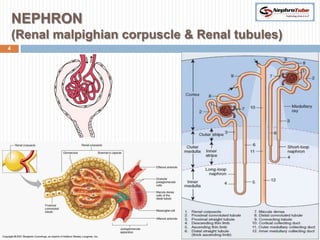
NEPHRON
    (Renal malpighian corpuscle & Renal tubules)
4
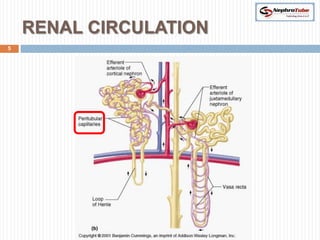
RENAL CIRCULATION
5
OBJECTIVES
6


       Be sure that you know what is NEPHRON
       Be sure that you know RENAL CIRCULATION
       Formation of URINE Steps (General Aspect)
       Glomerular Filtration Barrier
       Glomerular Filtrate & GFR (definitions)
       Starling’s Forces & Membrane Permeability
       Dynamics of Glomerular Filtration
       Glomerular Filtrate & Kf (definitions)
       Autoregulation of GFR
       Factors affecting GFR
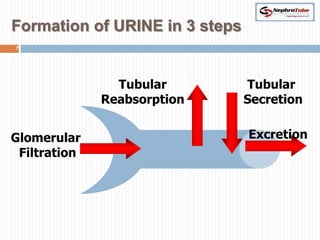
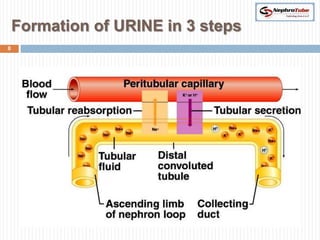
Formation of URINE in 3 steps
7


                Tubular         Tubular
              Reabsorption      Secretion


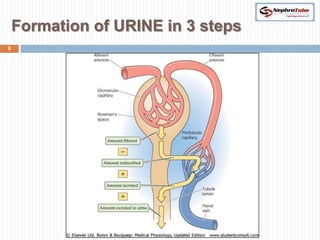
Glomerular                      Excretion
 Filtration
Formation of URINE in 3 steps
8
Formation of URINE in 3 steps
9
OBJECTIVES
10


        Be sure that you know what is NEPHRON
        Be sure that you know RENAL CIRCULATION
        Formation of URINE Steps (General Aspect)
        Glomerular Filtration Barrier
        Glomerular Filtrate & GFR (definitions)
        Starling’s Forces & Membrane Permeability
        Dynamics of Glomerular Filtration
        Glomerular Filtrate & Kf (definitions)
        Autoregulation of GFR
        Factors affecting GFR
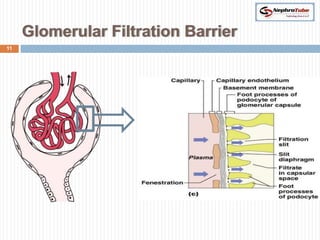
Glomerular Filtration Barrier
11
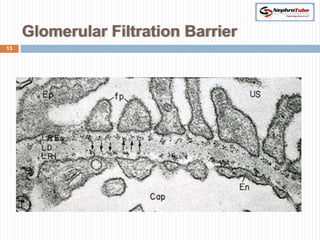
Glomerular Filtration Barrier
12


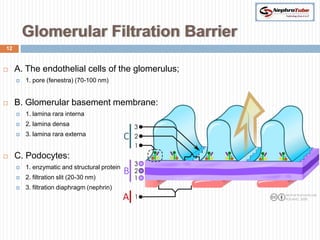
    A. The endothelial cells of the glomerulus;
        1. pore (fenestra) (70-100 nm)


    B. Glomerular basement membrane:
        1. lamina rara interna
        2. lamina densa
        3. lamina rara externa


    C. Podocytes:
        1. enzymatic and structural protein
        2. filtration slit (20-30 nm)
        3. filtration diaphragm (nephrin)
Glomerular Filtration Barrier
13
GLOMERULAR BASEMENT MEMBRANE
STRUCTURE
14


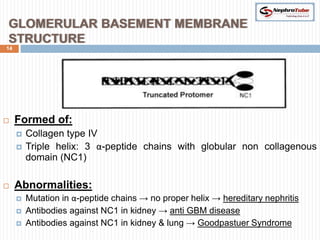
    Formed of:
        Collagen type IV
        Triple helix: 3 α-peptide chains with globular non collagenous
         domain (NC1)

    Abnormalities:
        Mutation in α-peptide chains → no proper helix → hereditary nephritis
        Antibodies against NC1 in kidney → anti GBM disease
        Antibodies against NC1 in kidney & lung → Goodpastuer Syndrome
OBJECTIVES
15


        Be sure that you know what is NEPHRON
        Be sure that you know RENAL CIRCULATION
        Formation of URINE Steps (General Aspect)
        Glomerular Filtration Barrier
        Glomerular Filtrate & GFR (definitions)
        Starling’s Forces & Membrane Permeability
        Dynamics of Glomerular Filtration
        Glomerular Filtrate & Kf (definitions)
        Autoregulation of GFR
        Factors affecting GFR
16
         Glomerular Filtrate & GFR
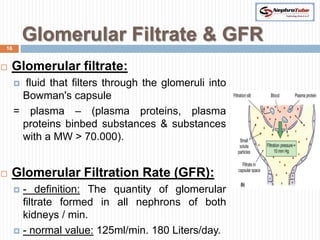
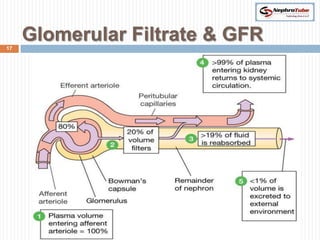
   Glomerular filtrate:
      fluid that filters through the glomeruli into
      Bowman's capsule
     = plasma – (plasma proteins, plasma
      proteins binbed substances & substances
      with a MW > 70.000).


   Glomerular Filtration Rate (GFR):
      - definition: The quantity of glomerular
       filtrate formed in all nephrons of both
       kidneys / min.
      - normal value: 125ml/min. 180 Liters/day.
17
     Glomerular Filtrate & GFR
OBJECTIVES
18


        Be sure that you know what is NEPHRON
        Be sure that you know RENAL CIRCULATION
        Formation of URINE Steps (General Aspect)
        Glomerular Filtration Barrier
        Glomerular Filtrate & GFR (definitions)
        Starling’s Forces & Membrane Permeability
        Dynamics of Glomerular Filtration
        Glomerular Filtrate & Kf (definitions)
        Autoregulation of GFR
        Factors affecting GFR
Movement of water:
     Starling’s Forces & Membrane Permeability
19


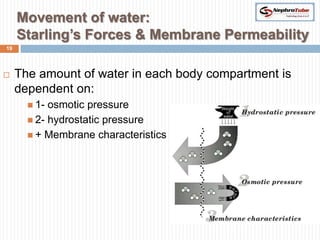
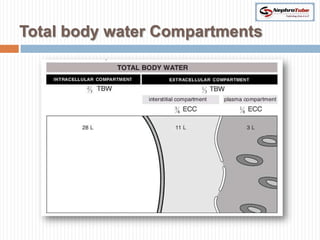
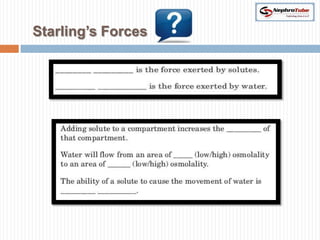
    The amount of water in each body compartment is
     dependent on:
        1- osmotic pressure
        2- hydrostatic pressure
        + Membrane characteristics
Total body water Compartments
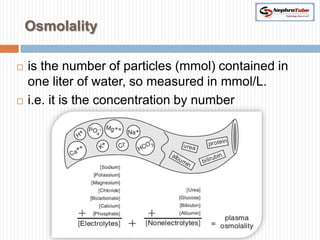
Osmolality

   is the number of particles (mmol) contained in
    one liter of water, so measured in mmol/L.
   i.e. it is the concentration by number
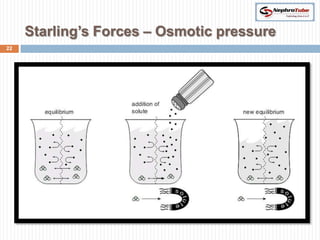
Starling’s Forces – Osmotic pressure
22
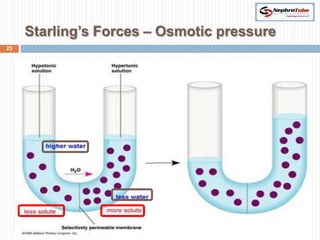
Starling’s Forces – Osmotic pressure
23
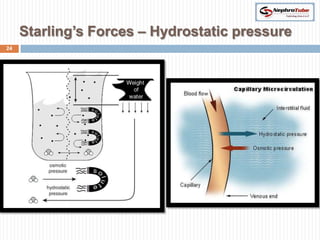
Starling’s Forces – Hydrostatic pressure
24
Starling’s Forces
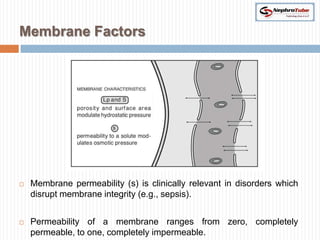
Membrane Factors


   Membrane permeability (s) is clinically relevant in disorders which
    disrupt membrane integrity (e.g., sepsis).


   Permeability of a membrane ranges from zero, completely
    permeable, to one, completely impermeable.
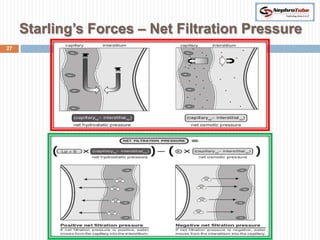
Starling’s Forces – Net Filtration Pressure
27
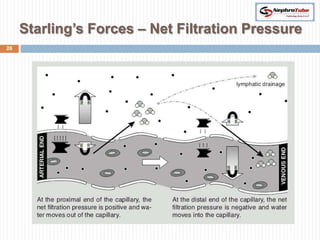
Starling’s Forces – Net Filtration Pressure
28
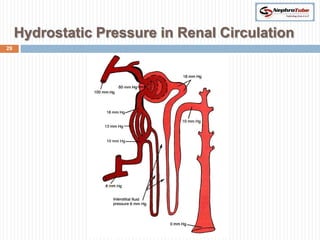
Hydrostatic Pressure in Renal Circulation
29
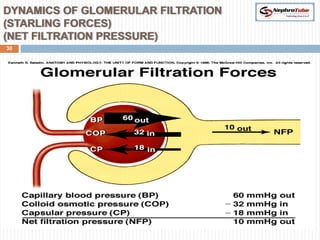
DYNAMICS OF GLOMERULAR FILTRATION
(STARLING FORCES)
(NET FILTRATION PRESSURE)
30
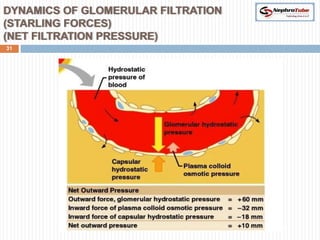
DYNAMICS OF GLOMERULAR FILTRATION
(STARLING FORCES)
(NET FILTRATION PRESSURE)
31
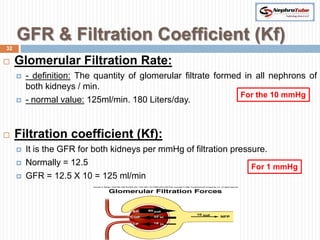
GFR & Filtration Coefficient (Kf)
32

    Glomerular Filtration Rate:
        - definition: The quantity of glomerular filtrate formed in all nephrons of
         both kidneys / min.
                                                                 For the 10 mmHg
        - normal value: 125ml/min. 180 Liters/day.


    Filtration coefficient (Kf):
        It is the GFR for both kidneys per mmHg of filtration pressure.
        Normally = 12.5                                            For 1 mmHg
        GFR = 12.5 X 10 = 125 ml/min
OBJECTIVES
33


        Be sure that you know what is NEPHRON
        Be sure that you know RENAL CIRCULATION
        Formation of URINE Steps (General Aspect)
        Glomerular Filtration Barrier
        Glomerular Filtrate & GFR (definitions)
        Starling’s Forces & Membrane Permeability
        Dynamics of Glomerular Filtration
        Glomerular Filtrate & Kf (definitions)
        Autoregulation of GFR
        Factors affecting GFR
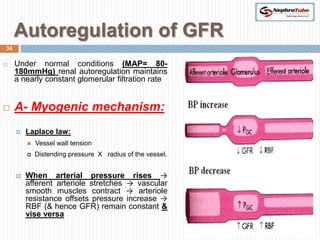
Autoregulation of GFR
34


    Under normal conditions (MAP= 80-
     180mmHg) renal autoregulation maintains
     a nearly constant glomerular filtration rate


    A- Myogenic mechanism:
        Laplace law:
            Vessel wall tension
         α Distending pressure X radius of the vessel.


        When arterial pressure rises →
         afferent arteriole stretches → vascular
         smooth muscles contract → arteriole
         resistance offsets pressure increase →
         RBF (& hence GFR) remain constant &
         vise versa
Autoregulation of GFR
35

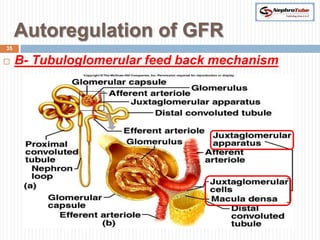
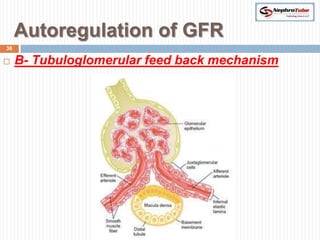
    B- Tubuloglomerular feed back mechanism
Autoregulation of GFR
36

    B- Tubuloglomerular feed back mechanism
Autoregulation of GFR
37

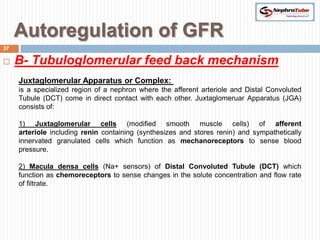
    B- Tubuloglomerular feed back mechanism
     Juxtaglomerular Apparatus or Complex:
     is a specialized region of a nephron where the afferent arteriole and Distal Convoluted
     Tubule (DCT) come in direct contact with each other. Juxtaglomeruar Apparatus (JGA)
     consists of:

     1) Juxtaglomerular cells (modified smooth muscle cells) of afferent
     arteriole including renin containing (synthesizes and stores renin) and sympathetically
     innervated granulated cells which function as mechanoreceptors to sense blood
     pressure.

     2) Macula densa cells (Na+ sensors) of Distal Convoluted Tubule (DCT) which
     function as chemoreceptors to sense changes in the solute concentration and flow rate
     of filtrate.
Autoregulation of GFR
38

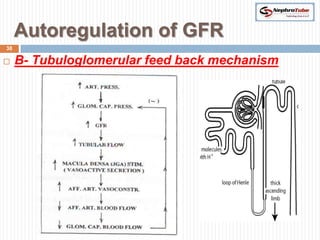
    B- Tubuloglomerular feed back mechanism
Autoregulation of GFR
39

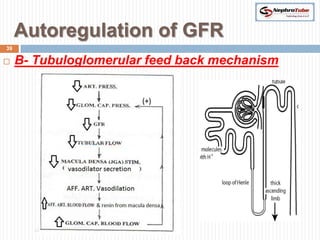
    B- Tubuloglomerular feed back mechanism
Autoregulation of GFR
40

    B- Tubuloglomerular feed back mechanism


                    See the video
                 on our facebook group
                      NephroTube
OBJECTIVES
41


        Be sure that you know what is NEPHRON
        Be sure that you know RENAL CIRCULATION
        Formation of URINE Steps (General Aspect)
        Glomerular Filtration Barrier
        Glomerular Filtrate & GFR (definitions)
        Starling’s Forces & Membrane Permeability
        Dynamics of Glomerular Filtration
        Glomerular Filtrate & Kf (definitions)
        Autoregulation of GFR
        Factors affecting GFR
Factors Affecting GFR
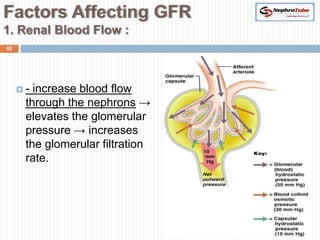
1. Renal Blood Flow :
42


     - increase blood flow
      through the nephrons →
      elevates the glomerular
      pressure → increases
      the glomerular filtration
      rate.
Factors Affecting GFR
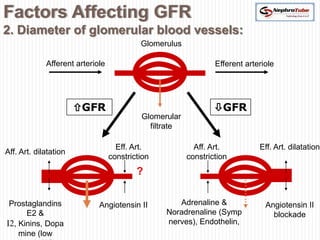
2. Diameter of glomerular blood vessels:
43
                                           Glomerulus

             Afferent arteriole                                 Efferent arteriole


                       GFR                                     GFR
                                           Glomerular
                                             filtrate

                                    Eff. Art.             Aff. Art.          Eff. Art. dilatation
Aff. Art. dilatation
                                  constriction          constriction
                                          ?

 Prostaglandins              Angiotensin II         Adrenaline &               Angiotensin II
      E2 &                                       Noradrenaline (Symp             blockade
I2, Kinins, Dopa                                 nerves), Endothelin,
    mine (low
Factors Affecting GFR
2. Diameter of glomerular blood vessels:
44


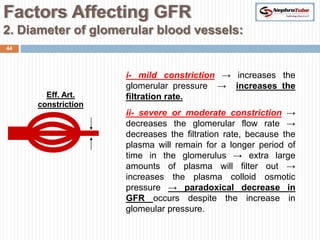
                    i- mild constriction → increases the
                    glomerular pressure → increases the
       Eff. Art.    filtration rate.
     constriction
                    ii- severe or moderate constriction →
                    decreases the glomerular flow rate →
                    decreases the filtration rate, because the
                    plasma will remain for a longer period of
                    time in the glomerulus → extra large
                    amounts of plasma will filter out →
                    increases the plasma colloid osmotic
                    pressure → paradoxical decrease in
                    GFR occurs despite the increase in
                    glomeular pressure.
Factors Affecting GFR
3. Factors affecting Net Filtration Pressure:
45


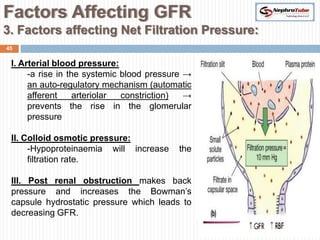
 I. Arterial blood pressure:
      -a rise in the systemic blood pressure →
      an auto-regulatory mechanism (automatic
      afferent     arteriolar constriction)  →
      prevents the rise in the glomerular
      pressure

 II. Colloid osmotic pressure:
      -Hypoproteinaemia will increase     the
      filtration rate.

 III. Post renal obstruction makes back
 pressure and increases the Bowman’s
 capsule hydrostatic pressure which leads to
 decreasing GFR.
Factors Affecting GFR
4. Factors affecting filtration coefficient (Kf):
46

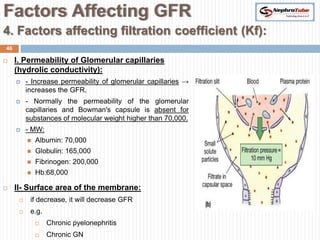
    I. Permeability of Glomerular capillaries
     (hydrolic conductivity):
         - Increase permeability of glomerular capillaries →
          increases the GFR.
         - Normally the permeability of the glomerular
          capillaries and Bowman's capsule is absent for
          substances of molecular weight higher than 70,000.
         - MW:
             Albumin: 70,000
             Globulin: 165,000
             Fibrinogen: 200,000
             Hb:68,000

    II- Surface area of the membrane:
          if decrease, it will decrease GFR
          e.g.
                 Chronic pyelonephritis
                 Chronic GN
The Concept Of Plasma
47
     Clearance
        Inulin clearance

        Creatinine clearance

        PAH clearance
48


            Follow On
     www.nephrotube.blogspot.com
                 &
           Facebook Group
             NephroTube
49


     Gawad

Renal Physiology (II) - Glomerular Structure & Filtration - Dr. Gawad

  • 1.
    1 RENAL PHYSIOLOGY (II) m GLOMERULAR STRUCTURE & FILTRATION Mohammed Abdel Gawad
  • 2.
    OBJECTIVES 2  Be sure that you know what is NEPHRON  Be sure that you know RENAL CIRCULATION  Formation of URINE Steps (General Aspect)  Glomerular Filtration Barrier  Glomerular Filtrate & GFR (definitions)  Starling’s Forces & Membrane Permeability  Dynamics of Glomerular Filtration  Glomerular Filtrate & Kf (definitions)  Autoregulation of GFR  Factors affecting GFR
  • 3.
    OBJECTIVES 3  Be sure that you know what is NEPHRON  Be sure that you know RENAL CIRCULATION  Formation of URINE Steps (General Aspect)  Glomerular Filtration Barrier  Glomerular Filtrate & GFR (definitions)  Starling’s Forces & Membrane Permeability  Dynamics of Glomerular Filtration  Glomerular Filtrate & Kf (definitions)  Autoregulation of GFR  Factors affecting GFR
  • 4.
    NEPHRON (Renal malpighian corpuscle & Renal tubules) 4
  • 5.
  • 6.
    OBJECTIVES 6  Be sure that you know what is NEPHRON  Be sure that you know RENAL CIRCULATION  Formation of URINE Steps (General Aspect)  Glomerular Filtration Barrier  Glomerular Filtrate & GFR (definitions)  Starling’s Forces & Membrane Permeability  Dynamics of Glomerular Filtration  Glomerular Filtrate & Kf (definitions)  Autoregulation of GFR  Factors affecting GFR
  • 7.
    Formation of URINEin 3 steps 7 Tubular Tubular Reabsorption Secretion Glomerular Excretion Filtration
  • 8.
    Formation of URINEin 3 steps 8
  • 9.
    Formation of URINEin 3 steps 9
  • 10.
    OBJECTIVES 10  Be sure that you know what is NEPHRON  Be sure that you know RENAL CIRCULATION  Formation of URINE Steps (General Aspect)  Glomerular Filtration Barrier  Glomerular Filtrate & GFR (definitions)  Starling’s Forces & Membrane Permeability  Dynamics of Glomerular Filtration  Glomerular Filtrate & Kf (definitions)  Autoregulation of GFR  Factors affecting GFR
  • 11.
  • 12.
    Glomerular Filtration Barrier 12  A. The endothelial cells of the glomerulus;  1. pore (fenestra) (70-100 nm)  B. Glomerular basement membrane:  1. lamina rara interna  2. lamina densa  3. lamina rara externa  C. Podocytes:  1. enzymatic and structural protein  2. filtration slit (20-30 nm)  3. filtration diaphragm (nephrin)
  • 13.
  • 14.
    GLOMERULAR BASEMENT MEMBRANE STRUCTURE 14  Formed of:  Collagen type IV  Triple helix: 3 α-peptide chains with globular non collagenous domain (NC1)  Abnormalities:  Mutation in α-peptide chains → no proper helix → hereditary nephritis  Antibodies against NC1 in kidney → anti GBM disease  Antibodies against NC1 in kidney & lung → Goodpastuer Syndrome
  • 15.
    OBJECTIVES 15  Be sure that you know what is NEPHRON  Be sure that you know RENAL CIRCULATION  Formation of URINE Steps (General Aspect)  Glomerular Filtration Barrier  Glomerular Filtrate & GFR (definitions)  Starling’s Forces & Membrane Permeability  Dynamics of Glomerular Filtration  Glomerular Filtrate & Kf (definitions)  Autoregulation of GFR  Factors affecting GFR
  • 16.
    16 Glomerular Filtrate & GFR  Glomerular filtrate:  fluid that filters through the glomeruli into Bowman's capsule = plasma – (plasma proteins, plasma proteins binbed substances & substances with a MW > 70.000).  Glomerular Filtration Rate (GFR):  - definition: The quantity of glomerular filtrate formed in all nephrons of both kidneys / min.  - normal value: 125ml/min. 180 Liters/day.
  • 17.
    17 Glomerular Filtrate & GFR
  • 18.
    OBJECTIVES 18  Be sure that you know what is NEPHRON  Be sure that you know RENAL CIRCULATION  Formation of URINE Steps (General Aspect)  Glomerular Filtration Barrier  Glomerular Filtrate & GFR (definitions)  Starling’s Forces & Membrane Permeability  Dynamics of Glomerular Filtration  Glomerular Filtrate & Kf (definitions)  Autoregulation of GFR  Factors affecting GFR
  • 19.
    Movement of water: Starling’s Forces & Membrane Permeability 19  The amount of water in each body compartment is dependent on:  1- osmotic pressure  2- hydrostatic pressure  + Membrane characteristics
  • 20.
    Total body waterCompartments
  • 21.
    Osmolality  is the number of particles (mmol) contained in one liter of water, so measured in mmol/L.  i.e. it is the concentration by number
  • 22.
    Starling’s Forces –Osmotic pressure 22
  • 23.
    Starling’s Forces –Osmotic pressure 23
  • 24.
    Starling’s Forces –Hydrostatic pressure 24
  • 25.
  • 26.
    Membrane Factors  Membrane permeability (s) is clinically relevant in disorders which disrupt membrane integrity (e.g., sepsis).  Permeability of a membrane ranges from zero, completely permeable, to one, completely impermeable.
  • 27.
    Starling’s Forces –Net Filtration Pressure 27
  • 28.
    Starling’s Forces –Net Filtration Pressure 28
  • 29.
    Hydrostatic Pressure inRenal Circulation 29
  • 30.
    DYNAMICS OF GLOMERULARFILTRATION (STARLING FORCES) (NET FILTRATION PRESSURE) 30
  • 31.
    DYNAMICS OF GLOMERULARFILTRATION (STARLING FORCES) (NET FILTRATION PRESSURE) 31
  • 32.
    GFR & FiltrationCoefficient (Kf) 32  Glomerular Filtration Rate:  - definition: The quantity of glomerular filtrate formed in all nephrons of both kidneys / min. For the 10 mmHg  - normal value: 125ml/min. 180 Liters/day.  Filtration coefficient (Kf):  It is the GFR for both kidneys per mmHg of filtration pressure.  Normally = 12.5 For 1 mmHg  GFR = 12.5 X 10 = 125 ml/min
  • 33.
    OBJECTIVES 33  Be sure that you know what is NEPHRON  Be sure that you know RENAL CIRCULATION  Formation of URINE Steps (General Aspect)  Glomerular Filtration Barrier  Glomerular Filtrate & GFR (definitions)  Starling’s Forces & Membrane Permeability  Dynamics of Glomerular Filtration  Glomerular Filtrate & Kf (definitions)  Autoregulation of GFR  Factors affecting GFR
  • 34.
    Autoregulation of GFR 34  Under normal conditions (MAP= 80- 180mmHg) renal autoregulation maintains a nearly constant glomerular filtration rate  A- Myogenic mechanism:  Laplace law:  Vessel wall tension α Distending pressure X radius of the vessel.  When arterial pressure rises → afferent arteriole stretches → vascular smooth muscles contract → arteriole resistance offsets pressure increase → RBF (& hence GFR) remain constant & vise versa
  • 35.
    Autoregulation of GFR 35  B- Tubuloglomerular feed back mechanism
  • 36.
    Autoregulation of GFR 36  B- Tubuloglomerular feed back mechanism
  • 37.
    Autoregulation of GFR 37  B- Tubuloglomerular feed back mechanism Juxtaglomerular Apparatus or Complex: is a specialized region of a nephron where the afferent arteriole and Distal Convoluted Tubule (DCT) come in direct contact with each other. Juxtaglomeruar Apparatus (JGA) consists of: 1) Juxtaglomerular cells (modified smooth muscle cells) of afferent arteriole including renin containing (synthesizes and stores renin) and sympathetically innervated granulated cells which function as mechanoreceptors to sense blood pressure. 2) Macula densa cells (Na+ sensors) of Distal Convoluted Tubule (DCT) which function as chemoreceptors to sense changes in the solute concentration and flow rate of filtrate.
  • 38.
    Autoregulation of GFR 38  B- Tubuloglomerular feed back mechanism
  • 39.
    Autoregulation of GFR 39  B- Tubuloglomerular feed back mechanism
  • 40.
    Autoregulation of GFR 40  B- Tubuloglomerular feed back mechanism  See the video on our facebook group NephroTube
  • 41.
    OBJECTIVES 41  Be sure that you know what is NEPHRON  Be sure that you know RENAL CIRCULATION  Formation of URINE Steps (General Aspect)  Glomerular Filtration Barrier  Glomerular Filtrate & GFR (definitions)  Starling’s Forces & Membrane Permeability  Dynamics of Glomerular Filtration  Glomerular Filtrate & Kf (definitions)  Autoregulation of GFR  Factors affecting GFR
  • 42.
    Factors Affecting GFR 1.Renal Blood Flow : 42 - increase blood flow through the nephrons → elevates the glomerular pressure → increases the glomerular filtration rate.
  • 43.
    Factors Affecting GFR 2.Diameter of glomerular blood vessels: 43 Glomerulus Afferent arteriole Efferent arteriole GFR GFR Glomerular filtrate Eff. Art. Aff. Art. Eff. Art. dilatation Aff. Art. dilatation constriction constriction ? Prostaglandins Angiotensin II Adrenaline & Angiotensin II E2 & Noradrenaline (Symp blockade I2, Kinins, Dopa nerves), Endothelin, mine (low
  • 44.
    Factors Affecting GFR 2.Diameter of glomerular blood vessels: 44 i- mild constriction → increases the glomerular pressure → increases the Eff. Art. filtration rate. constriction ii- severe or moderate constriction → decreases the glomerular flow rate → decreases the filtration rate, because the plasma will remain for a longer period of time in the glomerulus → extra large amounts of plasma will filter out → increases the plasma colloid osmotic pressure → paradoxical decrease in GFR occurs despite the increase in glomeular pressure.
  • 45.
    Factors Affecting GFR 3.Factors affecting Net Filtration Pressure: 45 I. Arterial blood pressure: -a rise in the systemic blood pressure → an auto-regulatory mechanism (automatic afferent arteriolar constriction) → prevents the rise in the glomerular pressure II. Colloid osmotic pressure: -Hypoproteinaemia will increase the filtration rate. III. Post renal obstruction makes back pressure and increases the Bowman’s capsule hydrostatic pressure which leads to decreasing GFR.
  • 46.
    Factors Affecting GFR 4.Factors affecting filtration coefficient (Kf): 46  I. Permeability of Glomerular capillaries (hydrolic conductivity):  - Increase permeability of glomerular capillaries → increases the GFR.  - Normally the permeability of the glomerular capillaries and Bowman's capsule is absent for substances of molecular weight higher than 70,000.  - MW:  Albumin: 70,000  Globulin: 165,000  Fibrinogen: 200,000  Hb:68,000  II- Surface area of the membrane:  if decrease, it will decrease GFR  e.g.  Chronic pyelonephritis  Chronic GN
  • 47.
    The Concept OfPlasma 47 Clearance  Inulin clearance  Creatinine clearance  PAH clearance
  • 48.
    48 Follow On www.nephrotube.blogspot.com & Facebook Group NephroTube
  • 49.
    49 Gawad