The Urinary System

• Functions of the urinary system
• Anatomy of the kidney
• Urine formation
  – glomerular filtration
  – tubular reabsorption
  – water conservation
• Urine and renal function tests
• Urine storage and elimination
Urinary System


• Two kidneys


• Two ureters


• Urethra
Kidney Functions
• Filters blood plasma, eliminates waste, returns
  useful chemicals to blood
• Regulates blood volume and pressure
• Regulates osmolarity of body fluids
• Secretes renin, activates angiotensin, aldosterone
  – controls BP, electrolyte balance
• Secretes erythropoietin, controls RBC count
• Regulates PCO2 and acid base balance
• Detoxifies free radicals and drugs
Nitrogenous Wastes
• Urea
  – proteins→amino acids →NH2 removed
    →forms ammonia, liver converts to urea
• Uric acid
  – nucleic acid catabolism
• Creatinine
  – creatinine phosphate catabolism
• Renal failure
  – azotemia: nitrogenous wastes in blood
  – uremia: toxic effects as wastes accumulate
Excretion
• Separation of wastes from body fluids and
  eliminating them
  – respiratory system: CO2
  – integumentary system: water, salts, lactic acid, urea
  – digestive system: water, salts, CO2, lipids, bile
    pigments, cholesterol
  – urinary system: many metabolic wastes, toxins, drugs,
    hormones, salts, H+ and water
Anatomy of Kidney
• Position, weight and size
  – retroperitoneal about 160 g each
  – about size of a bar of soap (12x6x3 cm)
• Shape
  – lateral surface - convex; medial - concave
• CT coverings
  – renal fascia: binds to abdominal wall
  – adipose capsule: cushions kidney
  – renal capsule: encloses kidney like cellophane wrap
Anatomy of Kidney


• Renal cortex: outer 1 cm
• Renal medulla: renal columns, pyramids - papilla
• Lobe of kidney: pyramid and it’s overlying cortex
Lobe of Kidney
Kidney: Frontal Section


• Minor calyx: cup over papilla collects urine
Path of Blood Through Kidney
• Renal artery
  → interlobar arteries (up renal columns, between lobes)
  → arcuate arteries (over pyramids)
  → interlobular arteries (up into cortex)
  → afferent arterioles
  → glomerulus (cluster of capillaries)
  → efferent arterioles (near medulla → vasa recta)
  → peritubular capillaries
   → interlobular veins → arcuate veins → interlobar veins
• Renal vein
Blood Supply Diagram
Renal Corpuscle


   Glomerular filtrate collects in capsular
     space, flows into renal tubule
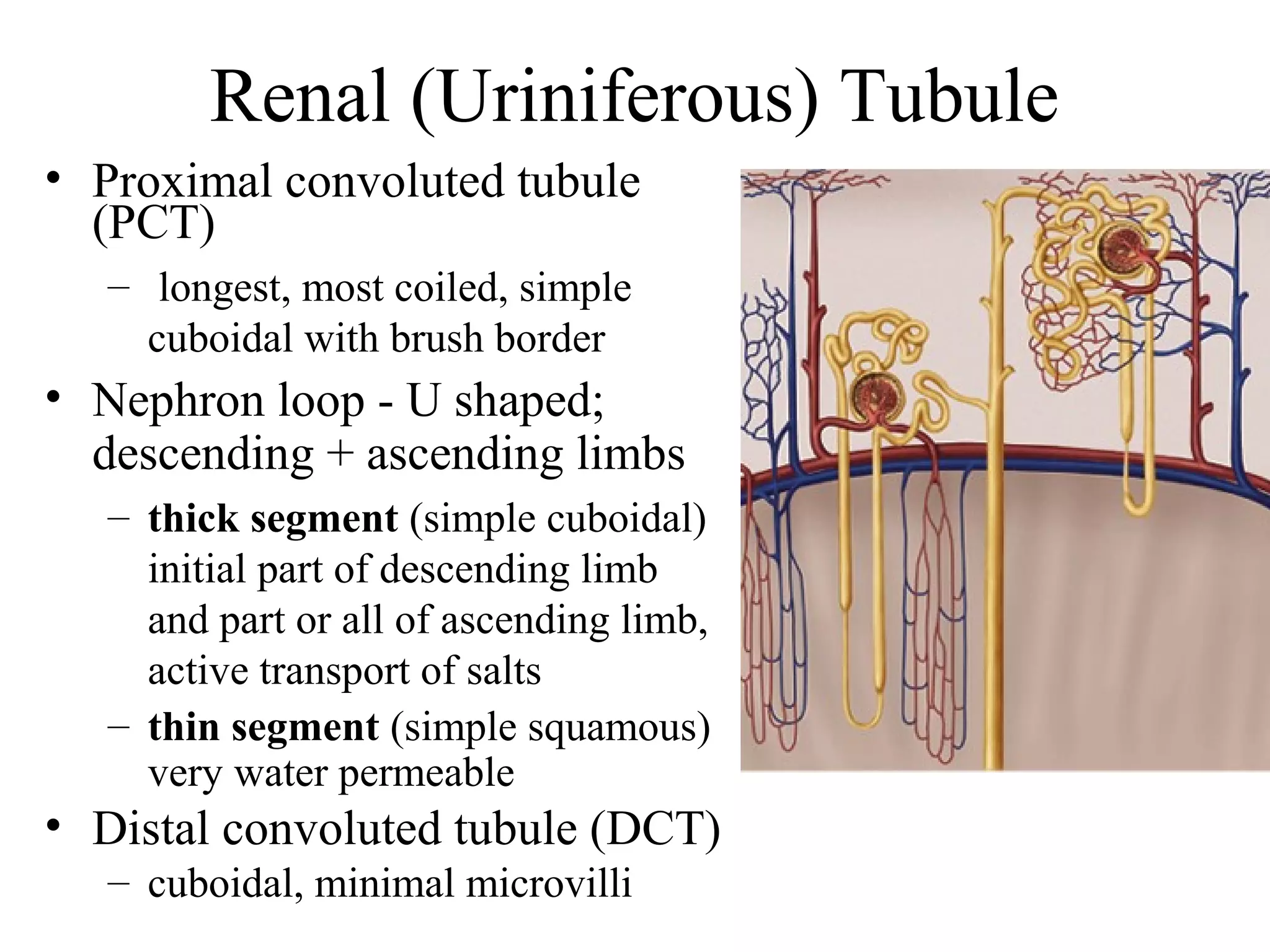
Renal (Uriniferous) Tubule
• Proximal convoluted tubule
  (PCT)
   – longest, most coiled, simple
     cuboidal with brush border
• Nephron loop - U shaped;
  descending + ascending limbs
   – thick segment (simple cuboidal)
     initial part of descending limb
     and part or all of ascending limb,
     active transport of salts
   – thin segment (simple squamous)
     very water permeable
• Distal convoluted tubule (DCT)
   – cuboidal, minimal microvilli
Renal (Uriniferous) Tubule 2
• Juxtaglomerular apparatus: DCT,
  afferent, efferent arterioles
• Collecting duct: several DCT’s join
• Flow of glomerular filtrate:
   – glomerular capsule → PCT →
     nephron loop → DCT → collecting
     duct → papillary duct → minor calyx
     → major calyx → renal pelvis →
     ureter → urinary bladder → urethra
Nephron Diagram

              • Peritubular
                capillaries
                shown only on
                right
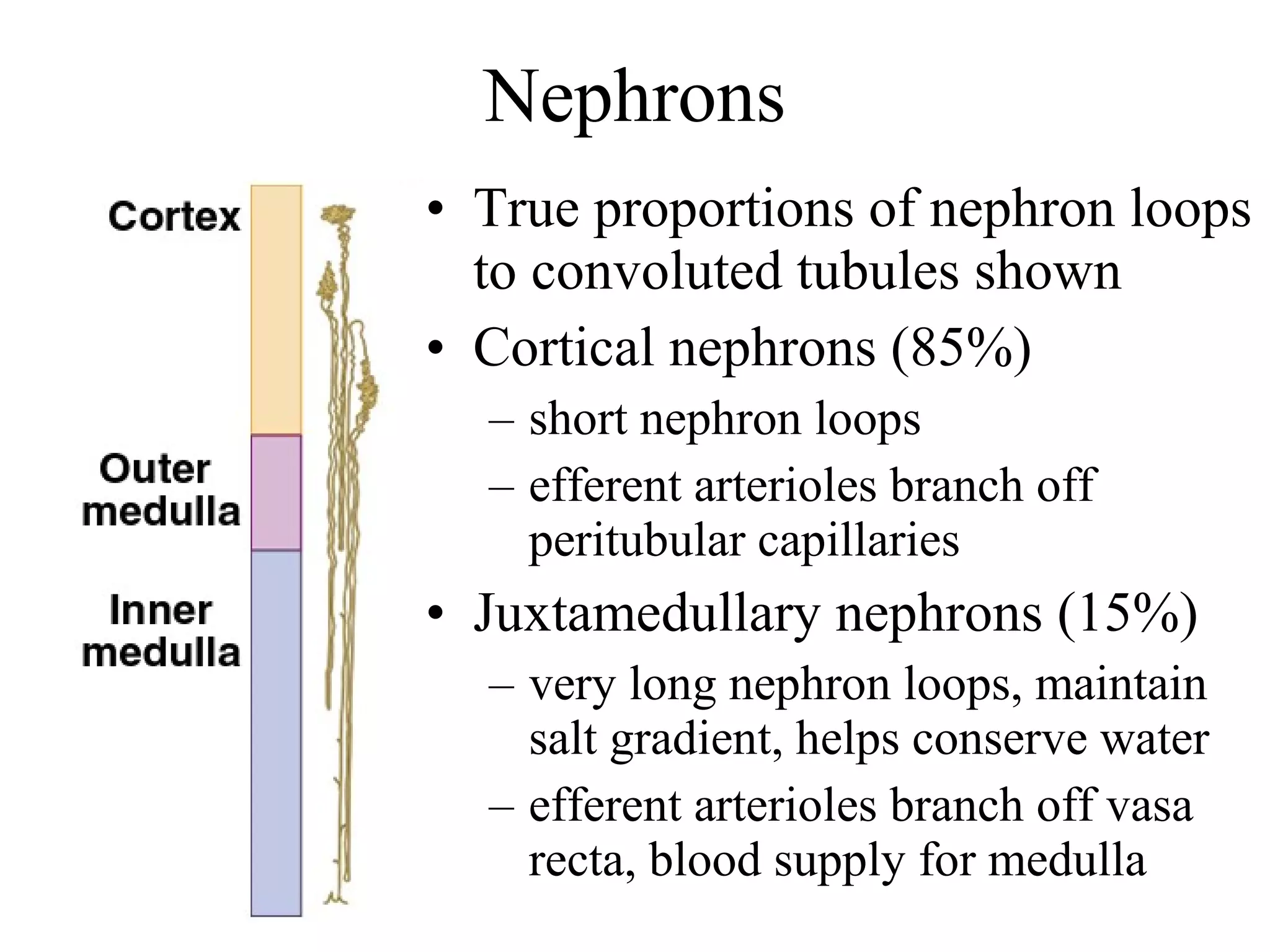
Nephrons
• True proportions of nephron loops
  to convoluted tubules shown
• Cortical nephrons (85%)
  – short nephron loops
  – efferent arterioles branch off
    peritubular capillaries
• Juxtamedullary nephrons (15%)
  – very long nephron loops, maintain
    salt gradient, helps conserve water
  – efferent arterioles branch off vasa
    recta, blood supply for medulla
Urine Formation Preview
Filtration Membrane Diagram
Filtration Membrane
    • Fenestrated endothelium
       – 70-90nm pores exclude blood cells
    • Basement membrane
       – proteoglycan gel, negative charge
         excludes molecules > 8nm
       – blood plasma 7% protein,
         glomerular filtrate 0.03%
    • Filtration slits
       – podocyte arms have pedicels with
         negatively charged filtration slits,
         allow particles < 3nm to pass
Filtration Pressure
Glomerular Filtration Rate (GFR)
• Filtrate formed per minute
• Filtration coefficient (Kf) depends on permeability
  and surface area of filtration barrier
• GFR = NFP x Kf ≈ 125 ml/min or 180 L/day
• 99% of filtrate reabsorbed, 1 to 2 L urine excreted
Effects of GFR Abnormalities
∀ ↑GFR, urine output rises → dehydration,
  electrolyte depletion
∀ ↓GFR → wastes reabsorbed (azotemia possible)
• GFR controlled by adjusting glomerular blood
  pressure
  – Auto regulation
  – sympathetic control
  – hormonal mechanism: renin and angiotensin
Juxtaglomerular Apparatus


                     - Vaso motion


                     - monitor salinity
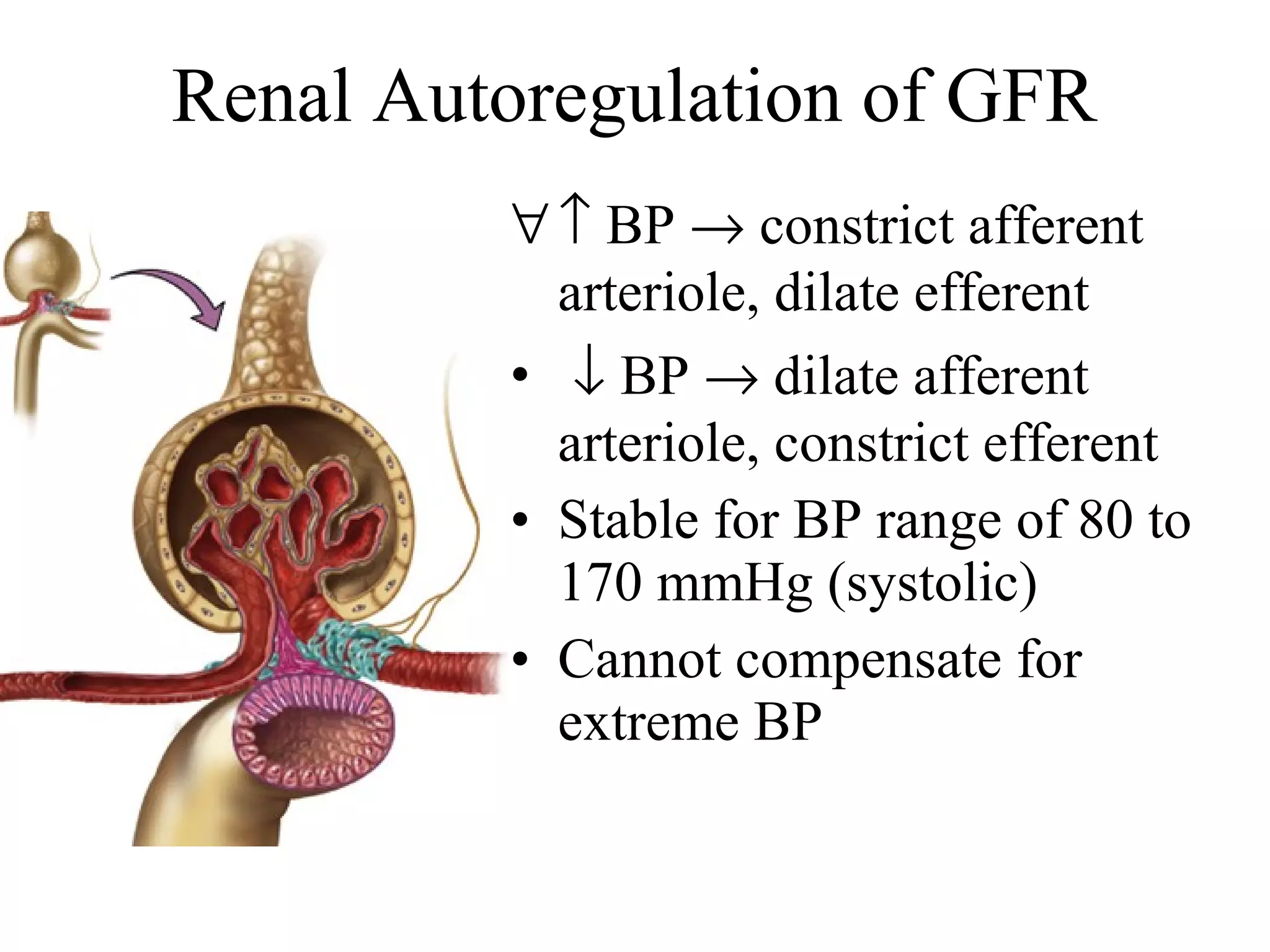
Renal Autoregulation of GFR
         ∀ ↑ BP → constrict afferent
           arteriole, dilate efferent
         • ↓ BP → dilate afferent
           arteriole, constrict efferent
         • Stable for BP range of 80 to
           170 mmHg (systolic)
         • Cannot compensate for
           extreme BP
Negative Feedback Control of GFR
Sympathetic Control of GFR
• Strenuous exercise or acute conditions (circulatory
  shock) stimulate afferent arterioles to constrict
∀ ↓ GFR and urine production, redirecting blood
  flow to heart, brain and skeletal muscles
Hormonal Control of GFR


          -efferent arterioles
Effects of Angiotensin II
Tubular Reabsorption and Secretion
Peritubular Capillaries
• Blood has unusually high COP here, and BHP is
  only 8 mm Hg (or lower when constricted by
  angiotensin II); this favors reabsorption
• Water absorbed by osmosis and carries other
  solutes with it (solvent drag)
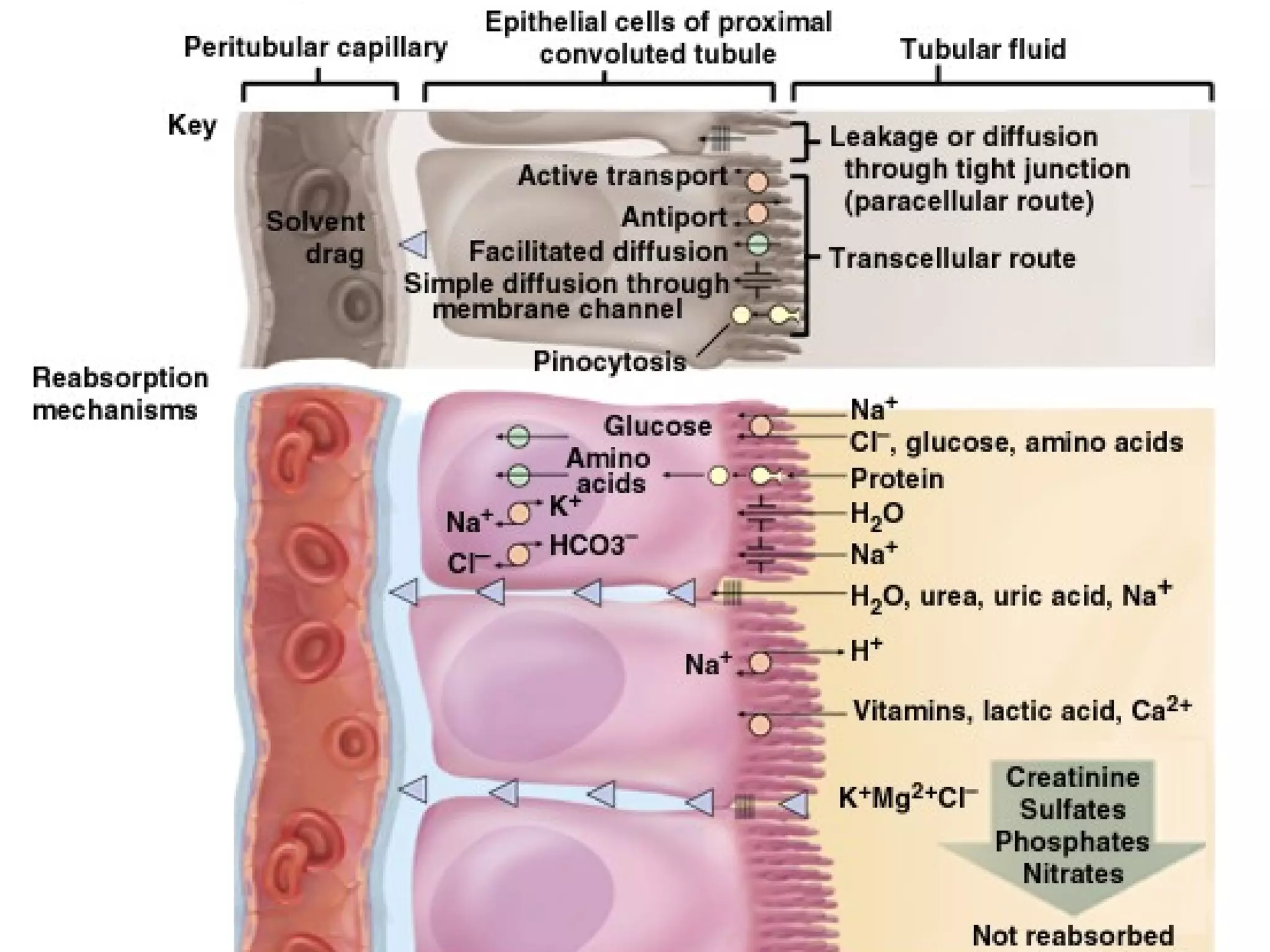
Proximal Convoluted Tubules (PCT)
• Reabsorbs 65% of GF to peritubular capillaries
• Great length, prominent microvilli and abundant
  mitochondria for active transport
• Reabsorbs greater variety of chemicals than other
  parts of nephron
  – transcellular route - through epithelial cells of PCT
  – paracellular route - between epithelial cells of PCT
• Transport maximum: when transport proteins of plasma
  membrane are saturated; glucose > 220 mg/dL remains in
  urine (glycosuria)
Tubular Secretion of PCT
          and Nephron Loop
• Waste removal
  – urea, uric acid, bile salts, ammonia, catecholamines,
    many drugs
• Acid-base balance
  – secretion of hydrogen and bicarbonate ions regulates
    pH of body fluids
• Primary function of nephron loop
  – water conservation, also involved in electrolyte
    reabsorption
DCT and Collecting Duct
• Effect of aldosterone
      ↓ BP causes angiotensin II formation
  –   angiotensin II stimulates adrenal cortex
  –   adrenal cortex secretes aldosterone
  –   aldosterone promotes Na+ reabsorption
  –   Na+ reabsorption promotes water reabsorption
  –   water reabsorption ↓ urine volume
  –   BP drops less rapidly
DCT and Collecting Duct 2
• Effect of atrial natriuretic factor (ANF)
    ↑ BP stimulates right atrium
  – atrium secretes ANF
  – ANF promotes Na+ and water excretion
  – BP drops
• Effect of ADH
  –   dehydration stimulates hypothalamus
  –   hypothalamus stimulates posterior pituitary
  –   posterior pituitary releases ADH
  –   ADH ↑ water reabsorption
  –   urine volume ↓
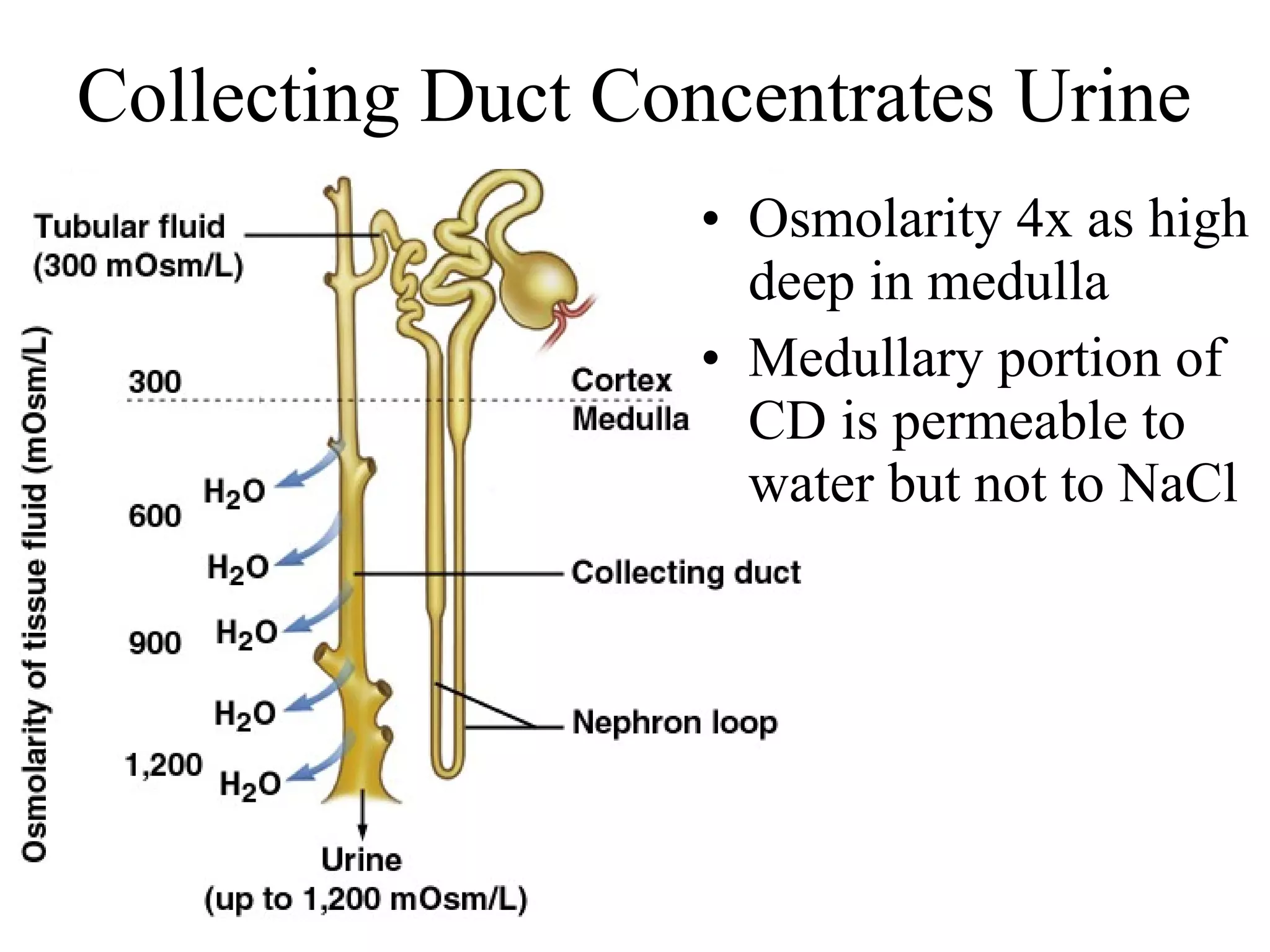
Collecting Duct Concentrates Urine
                   • Osmolarity 4x as high
                     deep in medulla
                   • Medullary portion of
                     CD is permeable to
                     water but not to NaCl
Control of Water Loss
• Producing hypotonic urine
  – NaCl reabsorbed by cortical CD
  – water remains in urine
• Producing hypertonic urine
  –   GFR drops
  –   tubular reabsorption ↑
  –   less NaCl remains in CD
  –   ADH ↑ CD’s water permeability
  –   more water is reabsorbed
  –   urine is more concentrated
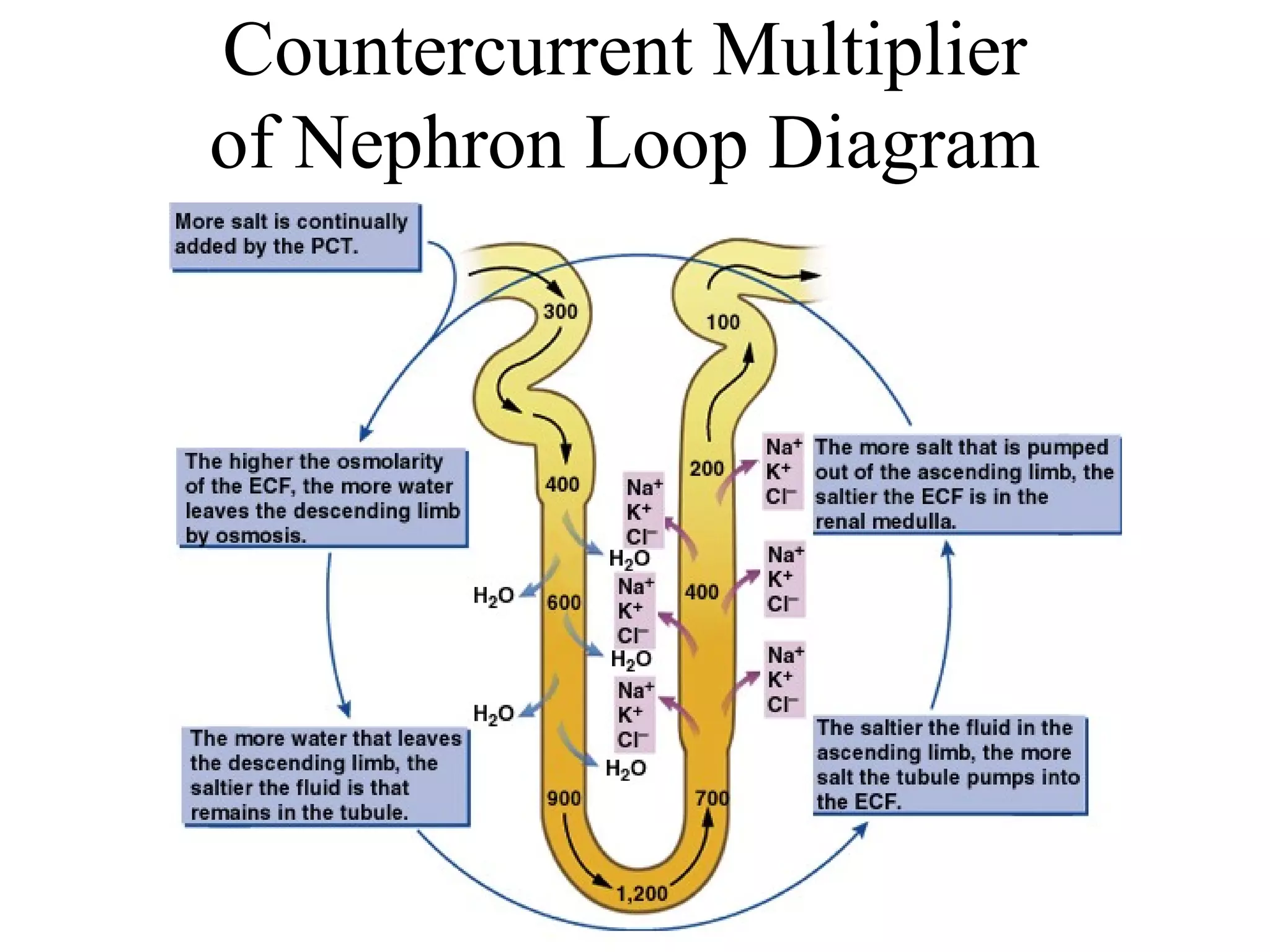
Countercurrent Multiplier
• Recaptures NaCl and returns it to renal medulla
• Descending limb
  – reabsorbs water but not salt
  – concentrates tubular fluid
• Ascending limb
  –   reabsorbs Na+, K+, and Cl-
  –   maintains high osmolarity of renal medulla
  –   impermeable to water
  –   tubular fluid becomes hypotonic
• Recycling of urea: collecting duct-medulla
  – urea accounts for 40% of high osmolarity of medulla
Countercurrent Multiplier
of Nephron Loop Diagram
Countercurrent Exchange System
• Formed by vasa recta
  – provide blood supply to medulla
  – do not remove NaCl from medulla
• Descending capillaries
  – water diffuses out of blood
  – NaCl diffuses into blood
• Ascending capillaries
  – water diffuses into blood
  – NaCl diffuses out of blood
Maintenance of Osmolarity
    in Renal Medulla
Summary of Tubular
Reabsorption and Secretion
Composition and Properties of Urine
• Appearance
  – almost colorless to deep amber; yellow color due to
    urochrome, from breakdown of hemoglobin (RBC’s)
• Odor - as it stands bacteria degrade urea to ammonia
• Specific gravity
   – density of urine ranges from 1.000 -1.035
• Osmolarity - (blood - 300 mOsm/L) ranges from
  50 mOsm/L to 1,200 mOsm/L in dehydrated person
• pH - range: 4.5 - 8.2, usually 6.0
• Chemical composition: 95% water, 5% solutes
   – urea, NaCl, KCl, creatinine, uric acid
Urine Volume
•   Normal volume - 1 to 2 L/day
•   Polyuria > 2L/day
•   Oliguria < 500 mL/day
•   Anuria - 0 to 100 mL
Diuretics
• Effects
    ↑ urine output
    ↓ blood volume
• Uses
  – hypertension and congestive heart failure
• Mechanisms of action
    ↑ GFR
    ↓ tubular reabsorption
Renal Function Tests
• Renal clearance: volume of blood plasma cleared
  of a waste in 1 minute
• Determine renal clearance (C) by assessing blood
  and urine samples: C = UV/P
  – U (waste concentration in urine)
  – V (rate of urine output)
  – P (waste concentration in plasma)
• Determine GFR: inulin is neither reabsorbed or
  secreted so for this solute GFR = renal clearance
  GFR = UV/P

702 kidney

  • 1.
    The Urinary System •Functions of the urinary system • Anatomy of the kidney • Urine formation – glomerular filtration – tubular reabsorption – water conservation • Urine and renal function tests • Urine storage and elimination
  • 2.
    Urinary System • Twokidneys • Two ureters • Urethra
  • 3.
    Kidney Functions • Filtersblood plasma, eliminates waste, returns useful chemicals to blood • Regulates blood volume and pressure • Regulates osmolarity of body fluids • Secretes renin, activates angiotensin, aldosterone – controls BP, electrolyte balance • Secretes erythropoietin, controls RBC count • Regulates PCO2 and acid base balance • Detoxifies free radicals and drugs
  • 4.
    Nitrogenous Wastes • Urea – proteins→amino acids →NH2 removed →forms ammonia, liver converts to urea • Uric acid – nucleic acid catabolism • Creatinine – creatinine phosphate catabolism • Renal failure – azotemia: nitrogenous wastes in blood – uremia: toxic effects as wastes accumulate
  • 5.
    Excretion • Separation ofwastes from body fluids and eliminating them – respiratory system: CO2 – integumentary system: water, salts, lactic acid, urea – digestive system: water, salts, CO2, lipids, bile pigments, cholesterol – urinary system: many metabolic wastes, toxins, drugs, hormones, salts, H+ and water
  • 6.
    Anatomy of Kidney •Position, weight and size – retroperitoneal about 160 g each – about size of a bar of soap (12x6x3 cm) • Shape – lateral surface - convex; medial - concave • CT coverings – renal fascia: binds to abdominal wall – adipose capsule: cushions kidney – renal capsule: encloses kidney like cellophane wrap
  • 7.
    Anatomy of Kidney •Renal cortex: outer 1 cm • Renal medulla: renal columns, pyramids - papilla • Lobe of kidney: pyramid and it’s overlying cortex
  • 8.
  • 9.
    Kidney: Frontal Section •Minor calyx: cup over papilla collects urine
  • 10.
    Path of BloodThrough Kidney • Renal artery → interlobar arteries (up renal columns, between lobes) → arcuate arteries (over pyramids) → interlobular arteries (up into cortex) → afferent arterioles → glomerulus (cluster of capillaries) → efferent arterioles (near medulla → vasa recta) → peritubular capillaries → interlobular veins → arcuate veins → interlobar veins • Renal vein
  • 11.
  • 12.
    Renal Corpuscle Glomerular filtrate collects in capsular space, flows into renal tubule
  • 13.
    Renal (Uriniferous) Tubule •Proximal convoluted tubule (PCT) – longest, most coiled, simple cuboidal with brush border • Nephron loop - U shaped; descending + ascending limbs – thick segment (simple cuboidal) initial part of descending limb and part or all of ascending limb, active transport of salts – thin segment (simple squamous) very water permeable • Distal convoluted tubule (DCT) – cuboidal, minimal microvilli
  • 14.
    Renal (Uriniferous) Tubule2 • Juxtaglomerular apparatus: DCT, afferent, efferent arterioles • Collecting duct: several DCT’s join • Flow of glomerular filtrate: – glomerular capsule → PCT → nephron loop → DCT → collecting duct → papillary duct → minor calyx → major calyx → renal pelvis → ureter → urinary bladder → urethra
  • 15.
    Nephron Diagram • Peritubular capillaries shown only on right
  • 16.
    Nephrons • True proportionsof nephron loops to convoluted tubules shown • Cortical nephrons (85%) – short nephron loops – efferent arterioles branch off peritubular capillaries • Juxtamedullary nephrons (15%) – very long nephron loops, maintain salt gradient, helps conserve water – efferent arterioles branch off vasa recta, blood supply for medulla
  • 17.
  • 18.
  • 19.
    Filtration Membrane • Fenestrated endothelium – 70-90nm pores exclude blood cells • Basement membrane – proteoglycan gel, negative charge excludes molecules > 8nm – blood plasma 7% protein, glomerular filtrate 0.03% • Filtration slits – podocyte arms have pedicels with negatively charged filtration slits, allow particles < 3nm to pass
  • 20.
  • 21.
    Glomerular Filtration Rate(GFR) • Filtrate formed per minute • Filtration coefficient (Kf) depends on permeability and surface area of filtration barrier • GFR = NFP x Kf ≈ 125 ml/min or 180 L/day • 99% of filtrate reabsorbed, 1 to 2 L urine excreted
  • 22.
    Effects of GFRAbnormalities ∀ ↑GFR, urine output rises → dehydration, electrolyte depletion ∀ ↓GFR → wastes reabsorbed (azotemia possible) • GFR controlled by adjusting glomerular blood pressure – Auto regulation – sympathetic control – hormonal mechanism: renin and angiotensin
  • 23.
    Juxtaglomerular Apparatus - Vaso motion - monitor salinity
  • 24.
    Renal Autoregulation ofGFR ∀ ↑ BP → constrict afferent arteriole, dilate efferent • ↓ BP → dilate afferent arteriole, constrict efferent • Stable for BP range of 80 to 170 mmHg (systolic) • Cannot compensate for extreme BP
  • 25.
  • 26.
    Sympathetic Control ofGFR • Strenuous exercise or acute conditions (circulatory shock) stimulate afferent arterioles to constrict ∀ ↓ GFR and urine production, redirecting blood flow to heart, brain and skeletal muscles
  • 27.
    Hormonal Control ofGFR -efferent arterioles
  • 28.
  • 29.
  • 30.
    Peritubular Capillaries • Bloodhas unusually high COP here, and BHP is only 8 mm Hg (or lower when constricted by angiotensin II); this favors reabsorption • Water absorbed by osmosis and carries other solutes with it (solvent drag)
  • 31.
    Proximal Convoluted Tubules(PCT) • Reabsorbs 65% of GF to peritubular capillaries • Great length, prominent microvilli and abundant mitochondria for active transport • Reabsorbs greater variety of chemicals than other parts of nephron – transcellular route - through epithelial cells of PCT – paracellular route - between epithelial cells of PCT • Transport maximum: when transport proteins of plasma membrane are saturated; glucose > 220 mg/dL remains in urine (glycosuria)
  • 33.
    Tubular Secretion ofPCT and Nephron Loop • Waste removal – urea, uric acid, bile salts, ammonia, catecholamines, many drugs • Acid-base balance – secretion of hydrogen and bicarbonate ions regulates pH of body fluids • Primary function of nephron loop – water conservation, also involved in electrolyte reabsorption
  • 34.
    DCT and CollectingDuct • Effect of aldosterone ↓ BP causes angiotensin II formation – angiotensin II stimulates adrenal cortex – adrenal cortex secretes aldosterone – aldosterone promotes Na+ reabsorption – Na+ reabsorption promotes water reabsorption – water reabsorption ↓ urine volume – BP drops less rapidly
  • 35.
    DCT and CollectingDuct 2 • Effect of atrial natriuretic factor (ANF) ↑ BP stimulates right atrium – atrium secretes ANF – ANF promotes Na+ and water excretion – BP drops • Effect of ADH – dehydration stimulates hypothalamus – hypothalamus stimulates posterior pituitary – posterior pituitary releases ADH – ADH ↑ water reabsorption – urine volume ↓
  • 36.
    Collecting Duct ConcentratesUrine • Osmolarity 4x as high deep in medulla • Medullary portion of CD is permeable to water but not to NaCl
  • 37.
    Control of WaterLoss • Producing hypotonic urine – NaCl reabsorbed by cortical CD – water remains in urine • Producing hypertonic urine – GFR drops – tubular reabsorption ↑ – less NaCl remains in CD – ADH ↑ CD’s water permeability – more water is reabsorbed – urine is more concentrated
  • 38.
    Countercurrent Multiplier • RecapturesNaCl and returns it to renal medulla • Descending limb – reabsorbs water but not salt – concentrates tubular fluid • Ascending limb – reabsorbs Na+, K+, and Cl- – maintains high osmolarity of renal medulla – impermeable to water – tubular fluid becomes hypotonic • Recycling of urea: collecting duct-medulla – urea accounts for 40% of high osmolarity of medulla
  • 39.
  • 40.
    Countercurrent Exchange System •Formed by vasa recta – provide blood supply to medulla – do not remove NaCl from medulla • Descending capillaries – water diffuses out of blood – NaCl diffuses into blood • Ascending capillaries – water diffuses into blood – NaCl diffuses out of blood
  • 41.
  • 42.
  • 43.
    Composition and Propertiesof Urine • Appearance – almost colorless to deep amber; yellow color due to urochrome, from breakdown of hemoglobin (RBC’s) • Odor - as it stands bacteria degrade urea to ammonia • Specific gravity – density of urine ranges from 1.000 -1.035 • Osmolarity - (blood - 300 mOsm/L) ranges from 50 mOsm/L to 1,200 mOsm/L in dehydrated person • pH - range: 4.5 - 8.2, usually 6.0 • Chemical composition: 95% water, 5% solutes – urea, NaCl, KCl, creatinine, uric acid
  • 44.
    Urine Volume • Normal volume - 1 to 2 L/day • Polyuria > 2L/day • Oliguria < 500 mL/day • Anuria - 0 to 100 mL
  • 45.
    Diuretics • Effects ↑ urine output ↓ blood volume • Uses – hypertension and congestive heart failure • Mechanisms of action ↑ GFR ↓ tubular reabsorption
  • 46.
    Renal Function Tests •Renal clearance: volume of blood plasma cleared of a waste in 1 minute • Determine renal clearance (C) by assessing blood and urine samples: C = UV/P – U (waste concentration in urine) – V (rate of urine output) – P (waste concentration in plasma) • Determine GFR: inulin is neither reabsorbed or secreted so for this solute GFR = renal clearance GFR = UV/P