Renal Physiology 1 Introduction
Aims & Content of this lecture To provide you with a reminder of what you covered in the dim and distant past at level 2! Brief review of renal anatomy Explanation of kidney function The 3 basic renal processes Processes of filtration at glomerular capillaries Processes of reabsorption at peritubular capillaries Renal handling of Na + , K + , glucose and amino acids The countercurrent multiplier
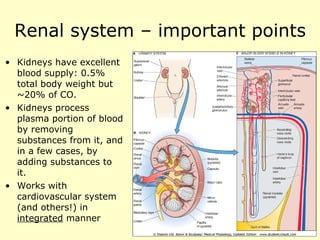
Renal system – important points Kidneys have excellent blood supply: 0.5% total body weight but ~20% of CO. Kidneys process plasma portion of blood by removing substances from it, and in a few cases, by adding substances to it. Works with cardiovascular system (and others!) in  integrated  manner
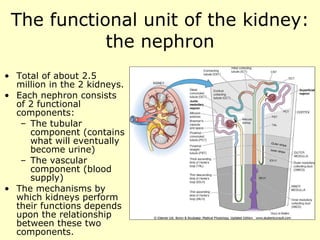
The functional unit of the kidney: the nephron Total of about 2.5 million in the 2 kidneys. Each nephron consists of 2 functional components: The tubular component (contains what will eventually become urine) The vascular component (blood supply) The mechanisms by which kidneys perform their functions depends upon the relationship between these two components.
Glomerulus and Bowman’s capsule Glomerular filtrate drains into Bowman’s space, and then into proximal convoluted tubule. Endothelium has pores to allow small molecules through. Podocytes have negative charge. This and the basement membrane stops proteins getting through into tubular fluid. Macula densa senses GFR by [Na + ] Juxtaglomerular (JG) apparatus includes JG cells that secrete renin. JGA helps regulate renal blood flow, GFR and also indirectly, modulates Na +  balance and systemic BP
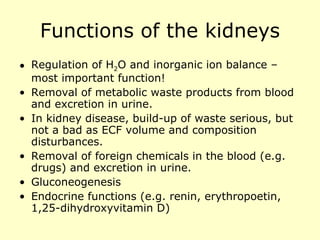
Functions of the kidneys Regulation of H 2 O and inorganic ion balance – most important function! Removal of metabolic waste products from blood and excretion in urine. In kidney disease, build-up of waste serious, but not a bad as ECF volume and composition disturbances. Removal of foreign chemicals in the blood (e.g. drugs) and excretion in urine. Gluconeogenesis Endocrine functions (e.g. renin, erythropoetin, 1,25-dihydroxyvitamin D)
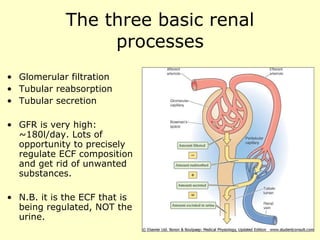
The three basic renal processes Glomerular filtration Tubular reabsorption Tubular secretion GFR is very high: ~180l/day. Lots of opportunity to precisely regulate ECF composition and get rid of unwanted substances. N.B. it is the ECF that is being regulated, NOT the urine.
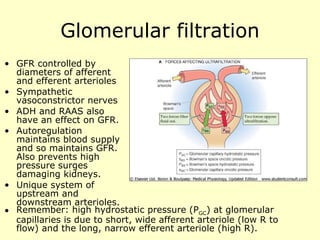
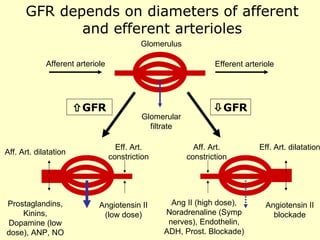
Glomerular filtration GFR controlled by diameters of afferent and efferent arterioles Sympathetic vasoconstrictor nerves ADH and RAAS also have an effect on GFR. Autoregulation maintains blood supply and so maintains GFR. Also prevents high pressure surges damaging kidneys. Unique system of upstream and downstream arterioles. Remember: high hydrostatic pressure (P GC ) at glomerular capillaries is due to short, wide afferent arteriole (low R to flow) and the long, narrow efferent arteriole (high R).
GFR depends on diameters of afferent and efferent arterioles  GFR  GFR Glomerulus Afferent arteriole Efferent arteriole Glomerular filtrate Aff. Art. dilatation Eff. Art. dilatation Eff. Art. constriction Aff. Art. constriction Prostaglandins, Kinins, Dopamine (low dose), ANP, NO Angiotensin II (low dose) Angiotensin II blockade Ang II (high dose), Noradrenaline (Symp nerves), Endothelin, ADH, Prost. Blockade)
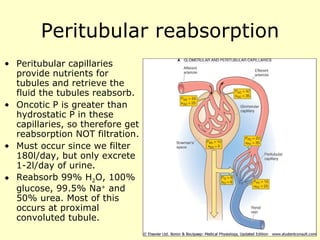
Peritubular reabsorption Peritubular capillaries provide nutrients for tubules and retrieve the fluid the tubules reabsorb. Oncotic P is greater than hydrostatic P in these capillaries, so therefore get reabsorption NOT filtration. Must occur since we filter 180l/day, but only excrete 1-2l/day of urine. Reabsorb 99% H 2 O, 100% glucose, 99.5% Na +  and 50% urea. Most of this occurs at proximal convoluted tubule.
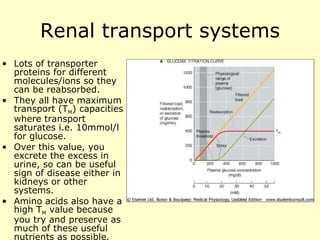
Renal transport systems Lots of transporter proteins for different molecules/ions so they can be reabsorbed. They all have maximum transport (T M ) capacities where transport saturates i.e. 10mmol/l for glucose. Over this value, you excrete the excess in urine, so can be useful sign of disease either in kidneys or other systems. Amino acids also have a high T M  value because you try and preserve as much of these useful nutrients as possible.
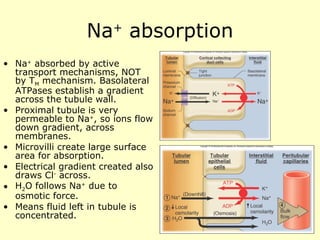
Na +  absorption Na +  absorbed by active transport mechanisms, NOT by T M  mechanism. Basolateral ATPases establish a gradient across the tubule wall. Proximal tubule is very permeable to Na + , so ions flow down gradient, across membranes. Microvilli create large surface area for absorption. Electrical gradient created also draws Cl -  across. H 2 O follows Na +  due to osmotic force. Means fluid left in tubule is concentrated.
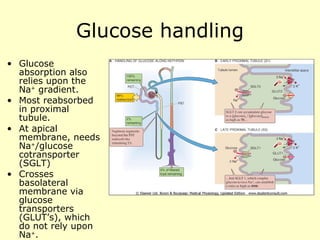
Glucose handling Glucose absorption also relies upon the Na +  gradient. Most reabsorbed in proximal tubule. At apical membrane, needs Na + /glucose cotransporter (SGLT) Crosses basolateral membrane via glucose transporters (GLUT’s), which do not rely upon Na + .
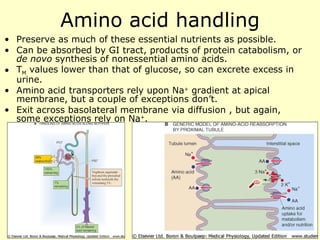
Amino acid handling Preserve as much of these essential nutrients as possible. Can be absorbed by GI tract, products of protein catabolism, or  de novo  synthesis of nonessential amino acids. T M  values lower than that of glucose, so can excrete excess in urine. Amino acid transporters rely upon Na +  gradient at apical membrane, but a couple of exceptions don’t. Exit across basolateral membrane via diffusion , but again, some exceptions rely on Na + .
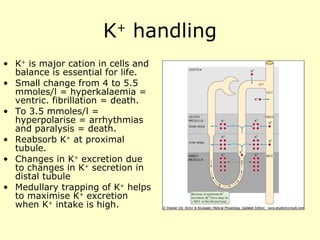
K +  handling K +  is major cation in cells and balance is essential for life. Small change from 4 to 5.5 mmoles/l = hyperkalaemia = ventric. fibrillation = death. To 3.5 mmoles/l = hyperpolarise = arrhythmias and paralysis = death. Reabsorb K +  at proximal tubule. Changes in K +  excretion due to changes in K +  secretion in distal tubule Medullary trapping of K +  helps to maximise K +  excretion when K +  intake is high.
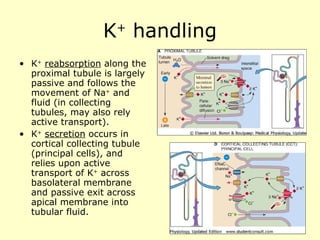
K +  handling K +   reabsorption  along the proximal tubule is largely passive and follows the movement of Na +  and fluid (in collecting tubules, may also rely active transport). K +   secretion  occurs in cortical collecting tubule (principal cells), and relies upon active transport of K +  across basolateral membrane and passive exit across apical membrane into tubular fluid.
Modulation of K +  secretion Luminal factors Stimulators Inhibitors    Flow rate    [K + ]    [Na + ]    [Cl - ]    [Cl - ]    [Ca 2+ ]    [HCO 3 - ] Ba 2+ -ve luminal voltage Amiloride Selected Diuretics Peritubular Factors Stimulators Inhibitors    K +  intake pH    [K + ] Adrenaline pH Aldosterone ADH
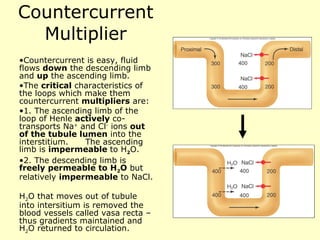
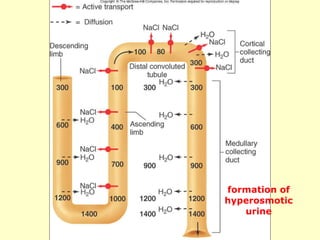
Countercurrent Multiplier Countercurrent is easy, fluid flows  down  the descending limb and  up  the ascending limb. The  critical  characteristics of the loops which make them countercurrent  multipliers  are: 1. The ascending limb of the loop of Henle  actively  co-transports Na +  and Cl -  ions  out of the tubule lumen  into the interstitium.  The ascending limb is  impermeable  to H 2 O. 2. The descending limb is  freely permeable to H 2 O  but relatively  impermeable  to NaCl. H 2 O that moves out of tubule into intersitium is removed the blood vessels called vasa recta – thus gradients maintained and H 2 O returned to circulation.
formation of hyperosmotic urine
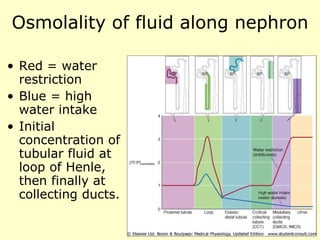
Osmolality of fluid along nephron Red = water restriction Blue = high water intake Initial concentration of tubular fluid at loop of Henle, then finally at collecting ducts.
Role of urea in concentrating urine Urea very useful in concentrating urine. High protein diet = more urea = more concentrated urine. Kidneys filter, reabsorb and secrete urea. Urea excretion rises with increasing urinary flow.
Urea recycling Urea toxic at high levels, but can be useful in small amounts. Urea recycling causes buildup of high [urea] in inner medulla. This helps create the osmotic gradient at loop of Henle so H 2 O can be reabsorbed.

Renal physiology introduction.

  • 1.
    Renal Physiology 1Introduction
  • 2.
    Aims & Contentof this lecture To provide you with a reminder of what you covered in the dim and distant past at level 2! Brief review of renal anatomy Explanation of kidney function The 3 basic renal processes Processes of filtration at glomerular capillaries Processes of reabsorption at peritubular capillaries Renal handling of Na + , K + , glucose and amino acids The countercurrent multiplier
  • 3.
    Renal system –important points Kidneys have excellent blood supply: 0.5% total body weight but ~20% of CO. Kidneys process plasma portion of blood by removing substances from it, and in a few cases, by adding substances to it. Works with cardiovascular system (and others!) in integrated manner
  • 4.
    The functional unitof the kidney: the nephron Total of about 2.5 million in the 2 kidneys. Each nephron consists of 2 functional components: The tubular component (contains what will eventually become urine) The vascular component (blood supply) The mechanisms by which kidneys perform their functions depends upon the relationship between these two components.
  • 5.
    Glomerulus and Bowman’scapsule Glomerular filtrate drains into Bowman’s space, and then into proximal convoluted tubule. Endothelium has pores to allow small molecules through. Podocytes have negative charge. This and the basement membrane stops proteins getting through into tubular fluid. Macula densa senses GFR by [Na + ] Juxtaglomerular (JG) apparatus includes JG cells that secrete renin. JGA helps regulate renal blood flow, GFR and also indirectly, modulates Na + balance and systemic BP
  • 6.
    Functions of thekidneys Regulation of H 2 O and inorganic ion balance – most important function! Removal of metabolic waste products from blood and excretion in urine. In kidney disease, build-up of waste serious, but not a bad as ECF volume and composition disturbances. Removal of foreign chemicals in the blood (e.g. drugs) and excretion in urine. Gluconeogenesis Endocrine functions (e.g. renin, erythropoetin, 1,25-dihydroxyvitamin D)
  • 7.
    The three basicrenal processes Glomerular filtration Tubular reabsorption Tubular secretion GFR is very high: ~180l/day. Lots of opportunity to precisely regulate ECF composition and get rid of unwanted substances. N.B. it is the ECF that is being regulated, NOT the urine.
  • 8.
    Glomerular filtration GFRcontrolled by diameters of afferent and efferent arterioles Sympathetic vasoconstrictor nerves ADH and RAAS also have an effect on GFR. Autoregulation maintains blood supply and so maintains GFR. Also prevents high pressure surges damaging kidneys. Unique system of upstream and downstream arterioles. Remember: high hydrostatic pressure (P GC ) at glomerular capillaries is due to short, wide afferent arteriole (low R to flow) and the long, narrow efferent arteriole (high R).
  • 9.
    GFR depends ondiameters of afferent and efferent arterioles  GFR  GFR Glomerulus Afferent arteriole Efferent arteriole Glomerular filtrate Aff. Art. dilatation Eff. Art. dilatation Eff. Art. constriction Aff. Art. constriction Prostaglandins, Kinins, Dopamine (low dose), ANP, NO Angiotensin II (low dose) Angiotensin II blockade Ang II (high dose), Noradrenaline (Symp nerves), Endothelin, ADH, Prost. Blockade)
  • 10.
    Peritubular reabsorption Peritubularcapillaries provide nutrients for tubules and retrieve the fluid the tubules reabsorb. Oncotic P is greater than hydrostatic P in these capillaries, so therefore get reabsorption NOT filtration. Must occur since we filter 180l/day, but only excrete 1-2l/day of urine. Reabsorb 99% H 2 O, 100% glucose, 99.5% Na + and 50% urea. Most of this occurs at proximal convoluted tubule.
  • 11.
    Renal transport systemsLots of transporter proteins for different molecules/ions so they can be reabsorbed. They all have maximum transport (T M ) capacities where transport saturates i.e. 10mmol/l for glucose. Over this value, you excrete the excess in urine, so can be useful sign of disease either in kidneys or other systems. Amino acids also have a high T M value because you try and preserve as much of these useful nutrients as possible.
  • 12.
    Na + absorption Na + absorbed by active transport mechanisms, NOT by T M mechanism. Basolateral ATPases establish a gradient across the tubule wall. Proximal tubule is very permeable to Na + , so ions flow down gradient, across membranes. Microvilli create large surface area for absorption. Electrical gradient created also draws Cl - across. H 2 O follows Na + due to osmotic force. Means fluid left in tubule is concentrated.
  • 13.
    Glucose handling Glucoseabsorption also relies upon the Na + gradient. Most reabsorbed in proximal tubule. At apical membrane, needs Na + /glucose cotransporter (SGLT) Crosses basolateral membrane via glucose transporters (GLUT’s), which do not rely upon Na + .
  • 14.
    Amino acid handlingPreserve as much of these essential nutrients as possible. Can be absorbed by GI tract, products of protein catabolism, or de novo synthesis of nonessential amino acids. T M values lower than that of glucose, so can excrete excess in urine. Amino acid transporters rely upon Na + gradient at apical membrane, but a couple of exceptions don’t. Exit across basolateral membrane via diffusion , but again, some exceptions rely on Na + .
  • 15.
    K + handling K + is major cation in cells and balance is essential for life. Small change from 4 to 5.5 mmoles/l = hyperkalaemia = ventric. fibrillation = death. To 3.5 mmoles/l = hyperpolarise = arrhythmias and paralysis = death. Reabsorb K + at proximal tubule. Changes in K + excretion due to changes in K + secretion in distal tubule Medullary trapping of K + helps to maximise K + excretion when K + intake is high.
  • 16.
    K + handling K + reabsorption along the proximal tubule is largely passive and follows the movement of Na + and fluid (in collecting tubules, may also rely active transport). K + secretion occurs in cortical collecting tubule (principal cells), and relies upon active transport of K + across basolateral membrane and passive exit across apical membrane into tubular fluid.
  • 17.
    Modulation of K+ secretion Luminal factors Stimulators Inhibitors  Flow rate  [K + ]  [Na + ]  [Cl - ]  [Cl - ]  [Ca 2+ ]  [HCO 3 - ] Ba 2+ -ve luminal voltage Amiloride Selected Diuretics Peritubular Factors Stimulators Inhibitors  K + intake pH  [K + ] Adrenaline pH Aldosterone ADH
  • 18.
    Countercurrent Multiplier Countercurrentis easy, fluid flows down the descending limb and up the ascending limb. The critical characteristics of the loops which make them countercurrent multipliers are: 1. The ascending limb of the loop of Henle actively co-transports Na + and Cl - ions out of the tubule lumen into the interstitium. The ascending limb is impermeable to H 2 O. 2. The descending limb is freely permeable to H 2 O but relatively impermeable to NaCl. H 2 O that moves out of tubule into intersitium is removed the blood vessels called vasa recta – thus gradients maintained and H 2 O returned to circulation.
  • 19.
  • 20.
    Osmolality of fluidalong nephron Red = water restriction Blue = high water intake Initial concentration of tubular fluid at loop of Henle, then finally at collecting ducts.
  • 21.
    Role of ureain concentrating urine Urea very useful in concentrating urine. High protein diet = more urea = more concentrated urine. Kidneys filter, reabsorb and secrete urea. Urea excretion rises with increasing urinary flow.
  • 22.
    Urea recycling Ureatoxic at high levels, but can be useful in small amounts. Urea recycling causes buildup of high [urea] in inner medulla. This helps create the osmotic gradient at loop of Henle so H 2 O can be reabsorbed.