

Evidence Based Medicine:


                     Wisit Cheungpasitporn, MD.
                        PGY-3, Internal Medicine
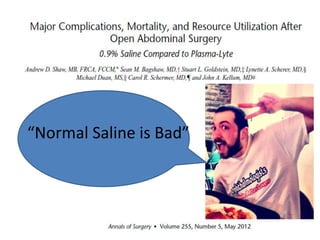
“Normal Saline is Bad”
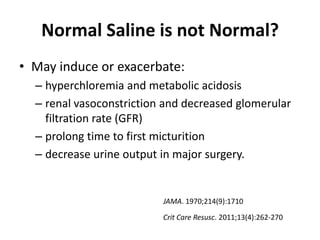
Normal Saline is not Normal?
• May induce or exacerbate:
  – hyperchloremia and metabolic acidosis
  – renal vasoconstriction and decreased glomerular
    filtration rate (GFR)
  – prolong time to first micturition
  – decrease urine output in major surgery.


                          JAMA. 1970;214(9):1710

                          Crit Care Resusc. 2011;13(4):262-270
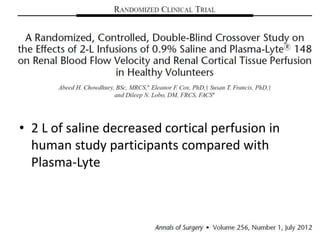
• 2 L of saline decreased cortical perfusion in
  human study participants compared with
  Plasma-Lyte
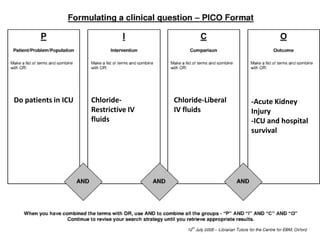
Do patients in ICU   Chloride-        Chloride-Liberal   -Acute Kidney
                     Restrictive IV   IV fluids          Injury
                     fluids                              -ICU and hospital
                                                         survival
Method
• A prospective, open-label, before-and-after
  pilot study in the 22-bed ICU.
• The Austin Hospital, a tertiary care hospital
  affiliated with the University of Melbourne.
• Control period: February 18 to August
  17, 2008
• Intervention period: February 18 to August
  17, 2009.
Method
• Control period: IV fluids were given according
  to clinician preferences with free use of
  Chloride-rich fluids.
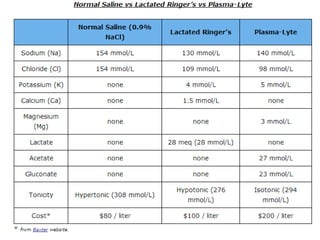
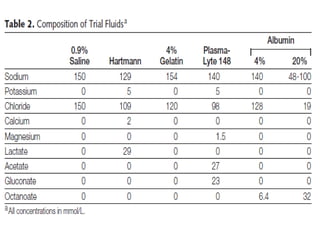
  – 0.9% saline (chloride concentration: 150 mmol/L)
    (Baxter Pty Ltd)
  – 4% succinylated gelatin solution (chloride
    concentration: 120 mmol/L) (Gelofusine, BBraun)
  – 4% albumin in sodium chloride (chloride
    concentration: 128 mmol/L) (4% Albumex, CSL
    Bioplasma).
Method
• Following a 6-month phase-out period that
  included education and preparation of all ICU
  staff and logistic arrangements for fluid
  accountability and delivery.
• No additional training was provided to nursing
  or medical staff.
Method
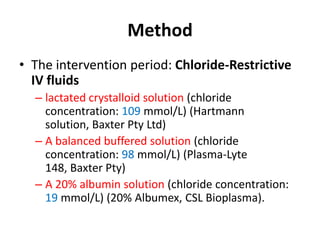
• The intervention period: Chloride-Restrictive
  IV fluids
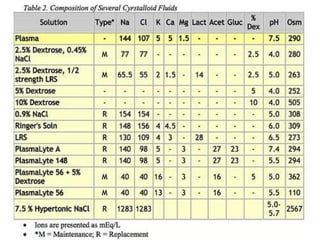
  – lactated crystalloid solution (chloride
    concentration: 109 mmol/L) (Hartmann
    solution, Baxter Pty Ltd)
  – A balanced buffered solution (chloride
    concentration: 98 mmol/L) (Plasma-Lyte
    148, Baxter Pty)
  – A 20% albumin solution (chloride concentration:
    19 mmol/L) (20% Albumex, CSL Bioplasma).
Method
• The intervention period:
  – Chloride-rich fluids available only after
    prescription by the attending for specific
    conditions (eg, hyponatremia, traumatic brain
    injury, and cerebral edema).
  – Similar fluid changes were instituted in the ED but
    not in the OR or general wards.
Method
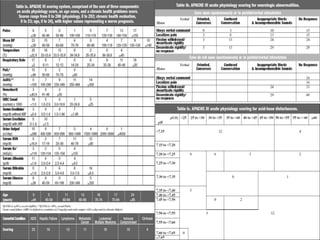
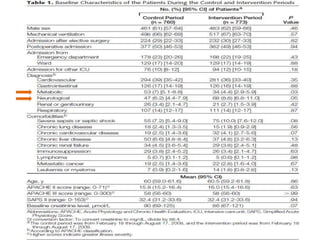
• Collected data on
  – Age, sex, APACHE II and III scores, SAPS II, and multiple
    clinical characteristics.
  – pre-ICU admission serum Cr levels and daily Cr during
    ICU admission.
  – RRT, excluding pts with preexisting ESRD on long-term
    dialysis and RRT for drug toxicity.
  – In RRT-treated survivors of ICU stay, data on dialysis
    status at 3 mths after discharge were obtained.
  – RRT was initiated according to the criteria of the
    Randomised Evaluation of Normal vs Augmented
    Level (RENAL) Replacement Therapy in ICU Trial.
Method
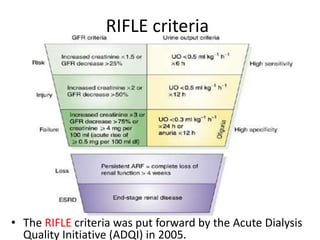
• Primary outcomes:
   – increase in Cr from baseline to peak ICU level and
     incidence of AKI according to the
     risk, injury, failure, loss, end-stage (RIFLE) system
     definitions.
• Secondary post hoc analysis outcomes:
   – the need for RRT
   – length of stay in ICU and hospital
   – survival.
RIFLE criteria


• The RIFLE criteria was put forward by the Acute Dialysis
  Quality Initiative (ADQI) in 2005.
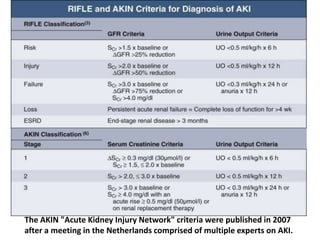
The AKIN "Acute Kidney Injury Network" criteria were published in 2007
after a meeting in the Netherlands comprised of multiple experts on AKI.
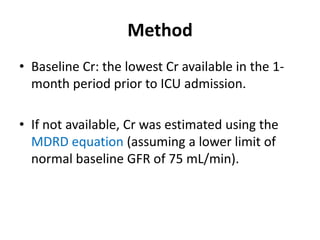
Method
• Baseline Cr: the lowest Cr available in the 1-
  month period prior to ICU admission.

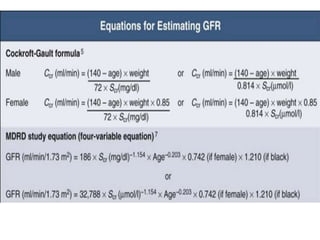
• If not available, Cr was estimated using the
  MDRD equation (assuming a lower limit of
  normal baseline GFR of 75 mL/min).
Statistical Analysis
• All statistical analysis was performed using Stata
  version 11 (StataCorp) and SAS version 9.2 (SAS
  Institute).
• Baseline comparisons were performed using χ2 tests
  for equal proportion.
• Continuously normally distributed variables were
  compared using t tests.
• Non–normally distributed data were compared using
  Wilcoxon rank sum tests.
• The increase in Cr from ICU admission to peak level
  was analyzed using generalized linear modeling.
Statistical Analysis
• AKI and the need for RRT were analyzed using
  logistic regression.
• Time-to-event analysis was performed using
  Cox proportional hazard modeling with
  results reported as HRs with 95% CIs and
  presented as Kaplan-Meier curves.
• Comparisons between survival curves were
  performed using log-rank tests.
Statistical Analysis
• Multivariable sensitivity analysis was
  performed on all outcomes, adjusting for
  covariates of sex, APACHE III
  score, diagnosis, operative status, admission
  type (elective or emergency) and baseline Cr.
Statistical Analysis
• Subgroup analyses according to time in
  ICU, APACHE score, risk of death, presence of
  sepsis, and cardiac surgery.
• Assessed all outcome variables after excluding
  pts in whom baseline Cr was not known.
• To reduce the chance of a type I error due to
  reporting multiple outcomes, a 2-sided P
  value of .01 was used to indicate statistical
  significance.
Results
Results
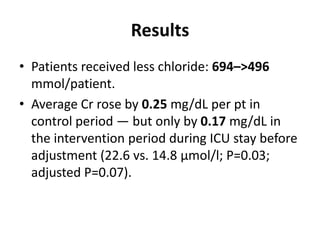
• Patients received less chloride: 694–>496
  mmol/patient.
• Average Cr rose by 0.25 mg/dL per pt in
  control period — but only by 0.17 mg/dL in
  the intervention period during ICU stay before
  adjustment (22.6 vs. 14.8 μmol/l; P=0.03;
  adjusted P=0.07).
Results
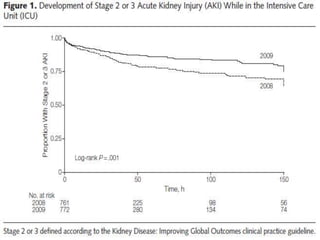
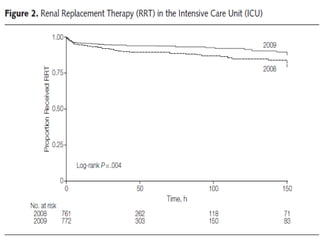
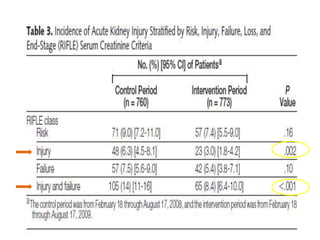
• 10% of pts needed RRT during control v.s.
  6.3% during intervention period (p = .005).
• After adjustment for covariates, this
  association remained for incidence of injury
  and failure class of RIFLE-defined AKI (OR, 0.52
  [95% CI, 0.35-0.75]; p<.001) and use of RRT
  (OR, 0.52 [95% CI, 0.33-0.81]; p = .004).
Results
• No differences in mortality, hospital or ICU
  length of stay or need for long-term dialysis
  requirements .
Conclusion
• The implementation of a chloride-restrictive
  strategy in a tertiary ICU was associated with a
  significant decrease in the incidence of AKI
  and use of RRT.
Strengths and Limitations
• This study raises very important questions on
  the safety of chloride-rich solutions and might
  lead to important changes in our fluid
  resuscitation strategies.
• One Center
• Not randomized/Not Blind
• The intervention was of bundle-of-care kind
  (Hawthorne effect)
• Heterogeneity of IV fluids
Strengths and Limitations
• Is IV fluid with bicarb(?cost) better than
  Saline?
• Cost?
• Future prospective trials have to confirm the
  findings.
Special Thanks to:

• Dr. Knight ; my EBM preceptor and fly fishing
  master

Normal Saline is not Normal? ; Chloride liberal vs. Chloride restrictive IV Fluid

  • 1.
    Evidence Based Medicine: Wisit Cheungpasitporn, MD. PGY-3, Internal Medicine
  • 2.
  • 3.
    Normal Saline isnot Normal? • May induce or exacerbate: – hyperchloremia and metabolic acidosis – renal vasoconstriction and decreased glomerular filtration rate (GFR) – prolong time to first micturition – decrease urine output in major surgery. JAMA. 1970;214(9):1710 Crit Care Resusc. 2011;13(4):262-270
  • 4.
    • 2 Lof saline decreased cortical perfusion in human study participants compared with Plasma-Lyte
  • 5.
    Do patients inICU Chloride- Chloride-Liberal -Acute Kidney Restrictive IV IV fluids Injury fluids -ICU and hospital survival
  • 9.
    Method • A prospective,open-label, before-and-after pilot study in the 22-bed ICU. • The Austin Hospital, a tertiary care hospital affiliated with the University of Melbourne. • Control period: February 18 to August 17, 2008 • Intervention period: February 18 to August 17, 2009.
  • 10.
    Method • Control period:IV fluids were given according to clinician preferences with free use of Chloride-rich fluids. – 0.9% saline (chloride concentration: 150 mmol/L) (Baxter Pty Ltd) – 4% succinylated gelatin solution (chloride concentration: 120 mmol/L) (Gelofusine, BBraun) – 4% albumin in sodium chloride (chloride concentration: 128 mmol/L) (4% Albumex, CSL Bioplasma).
  • 11.
    Method • Following a6-month phase-out period that included education and preparation of all ICU staff and logistic arrangements for fluid accountability and delivery. • No additional training was provided to nursing or medical staff.
  • 12.
    Method • The interventionperiod: Chloride-Restrictive IV fluids – lactated crystalloid solution (chloride concentration: 109 mmol/L) (Hartmann solution, Baxter Pty Ltd) – A balanced buffered solution (chloride concentration: 98 mmol/L) (Plasma-Lyte 148, Baxter Pty) – A 20% albumin solution (chloride concentration: 19 mmol/L) (20% Albumex, CSL Bioplasma).
  • 15.
    Method • The interventionperiod: – Chloride-rich fluids available only after prescription by the attending for specific conditions (eg, hyponatremia, traumatic brain injury, and cerebral edema). – Similar fluid changes were instituted in the ED but not in the OR or general wards.
  • 16.
    Method • Collected dataon – Age, sex, APACHE II and III scores, SAPS II, and multiple clinical characteristics. – pre-ICU admission serum Cr levels and daily Cr during ICU admission. – RRT, excluding pts with preexisting ESRD on long-term dialysis and RRT for drug toxicity. – In RRT-treated survivors of ICU stay, data on dialysis status at 3 mths after discharge were obtained. – RRT was initiated according to the criteria of the Randomised Evaluation of Normal vs Augmented Level (RENAL) Replacement Therapy in ICU Trial.
  • 18.
    Method • Primary outcomes: – increase in Cr from baseline to peak ICU level and incidence of AKI according to the risk, injury, failure, loss, end-stage (RIFLE) system definitions. • Secondary post hoc analysis outcomes: – the need for RRT – length of stay in ICU and hospital – survival.
  • 19.
    RIFLE criteria • TheRIFLE criteria was put forward by the Acute Dialysis Quality Initiative (ADQI) in 2005.
  • 20.
    The AKIN "AcuteKidney Injury Network" criteria were published in 2007 after a meeting in the Netherlands comprised of multiple experts on AKI.
  • 21.
    Method • Baseline Cr:the lowest Cr available in the 1- month period prior to ICU admission. • If not available, Cr was estimated using the MDRD equation (assuming a lower limit of normal baseline GFR of 75 mL/min).
  • 23.
    Statistical Analysis • Allstatistical analysis was performed using Stata version 11 (StataCorp) and SAS version 9.2 (SAS Institute). • Baseline comparisons were performed using χ2 tests for equal proportion. • Continuously normally distributed variables were compared using t tests. • Non–normally distributed data were compared using Wilcoxon rank sum tests. • The increase in Cr from ICU admission to peak level was analyzed using generalized linear modeling.
  • 24.
    Statistical Analysis • AKIand the need for RRT were analyzed using logistic regression. • Time-to-event analysis was performed using Cox proportional hazard modeling with results reported as HRs with 95% CIs and presented as Kaplan-Meier curves. • Comparisons between survival curves were performed using log-rank tests.
  • 25.
    Statistical Analysis • Multivariablesensitivity analysis was performed on all outcomes, adjusting for covariates of sex, APACHE III score, diagnosis, operative status, admission type (elective or emergency) and baseline Cr.
  • 26.
    Statistical Analysis • Subgroupanalyses according to time in ICU, APACHE score, risk of death, presence of sepsis, and cardiac surgery. • Assessed all outcome variables after excluding pts in whom baseline Cr was not known. • To reduce the chance of a type I error due to reporting multiple outcomes, a 2-sided P value of .01 was used to indicate statistical significance.
  • 27.
  • 29.
    Results • Patients receivedless chloride: 694–>496 mmol/patient. • Average Cr rose by 0.25 mg/dL per pt in control period — but only by 0.17 mg/dL in the intervention period during ICU stay before adjustment (22.6 vs. 14.8 μmol/l; P=0.03; adjusted P=0.07).
  • 31.
    Results • 10% ofpts needed RRT during control v.s. 6.3% during intervention period (p = .005). • After adjustment for covariates, this association remained for incidence of injury and failure class of RIFLE-defined AKI (OR, 0.52 [95% CI, 0.35-0.75]; p<.001) and use of RRT (OR, 0.52 [95% CI, 0.33-0.81]; p = .004).
  • 34.
    Results • No differencesin mortality, hospital or ICU length of stay or need for long-term dialysis requirements .
  • 35.
    Conclusion • The implementationof a chloride-restrictive strategy in a tertiary ICU was associated with a significant decrease in the incidence of AKI and use of RRT.
  • 36.
    Strengths and Limitations •This study raises very important questions on the safety of chloride-rich solutions and might lead to important changes in our fluid resuscitation strategies. • One Center • Not randomized/Not Blind • The intervention was of bundle-of-care kind (Hawthorne effect) • Heterogeneity of IV fluids
  • 37.
    Strengths and Limitations •Is IV fluid with bicarb(?cost) better than Saline? • Cost? • Future prospective trials have to confirm the findings.
  • 39.
    Special Thanks to: •Dr. Knight ; my EBM preceptor and fly fishing master