Renal System Anatomy
& PHYSIOLOGY
DR. AMAR UL-ALA BUTT
CONSULTANT UROLOGIST
06-R-M-12967 (MOH 88/458)
BURAIDAH CENTRAL HOSPITAL(7/1)
Renal system summary
Functions:
1. Remove wastes from the body (urine)
2. Regulates fluid balance, maintains homeostasis
Structures:
 2 kidneys - filter blood, produce urine
 2 ureters - transport urine (kidneys to bladder)
 bladder - reservoir for urine
 urethra - transport of urine
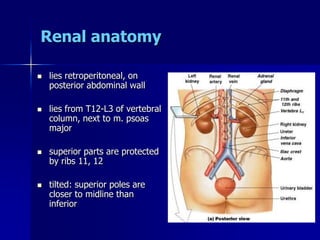
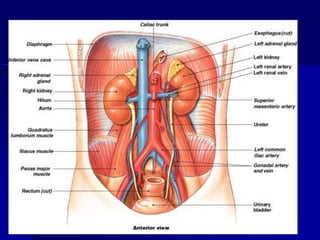
Renal anatomy
 lies retroperitoneal, on
posterior abdominal wall
 lies from T12-L3 of vertebral
column, next to m. psoas
major
 superior parts are protected
by ribs 11, 12
 tilted: superior poles are
closer to midline than
inferior
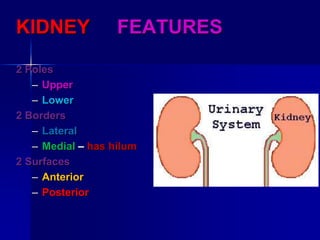
KIDNEY FEATURES
2 Poles
– Upper
– Lower
2 Borders
– Lateral
– Medial – has hilum
2 Surfaces
– Anterior
– Posterior
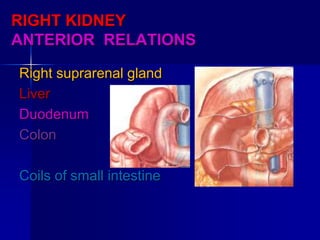
RIGHT KIDNEY
ANTERIOR RELATIONS
Right suprarenal gland
Liver
Duodenum
Colon
Coils of small intestine
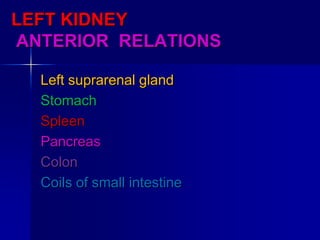
LEFT KIDNEY
ANTERIOR RELATIONS
Left suprarenal gland
Stomach
Spleen
Pancreas
Colon
Coils of small intestine
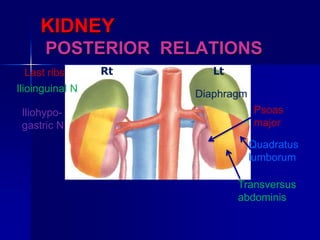
KIDNEY
POSTERIOR RELATIONS
Diaphragm
Psoas
major
Transversus
abdominis
Quadratus
lumborum
Last ribs
Ilioinguinal N
Iliohypo-
gastric N
Rt Lt
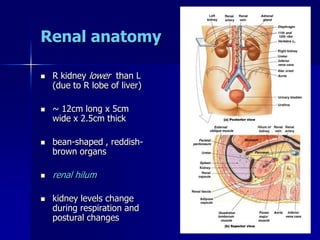
Renal anatomy
 R kidney lower than L
(due to R lobe of liver)
 ~ 12cm long x 5cm
wide x 2.5cm thick
 bean-shaped , reddish-
brown organs
 renal hilum
 kidney levels change
during respiration and
postural changes
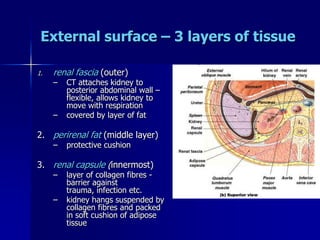
External surface – 3 layers of tissue
1. renal fascia (outer)

– CT attaches kidney to
posterior abdominal wall –
flexible, allows kidney to
move with respiration
– covered by layer of fat
2. perirenal fat (middle layer)
– protective cushion
3. renal capsule (innermost)
– layer of collagen fibres -
barrier against
trauma, infection etc.
– kidney hangs suspended by
collagen fibres and packed
in soft cushion of adipose
tissue
Internal anatomy
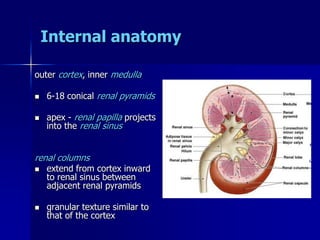
outer cortex, inner medulla
 6-18 conical renal pyramids
 apex - renal papilla projects
into the renal sinus
renal columns
 extend from cortex inward
to renal sinus between
adjacent renal pyramids
 granular texture similar to
that of the cortex
Internal anatomy
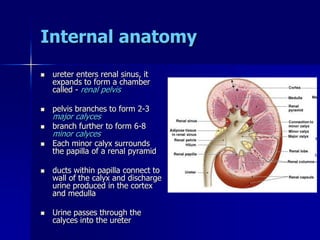
 ureter enters renal sinus, it
expands to form a chamber
called - renal pelvis
 pelvis branches to form 2-3
major calyces
 branch further to form 6-8
minor calyces
 Each minor calyx surrounds
the papilla of a renal pyramid
 ducts within papilla connect to
wall of the calyx and discharge
urine produced in the cortex
and medulla
 Urine passes through the
calyces into the ureter
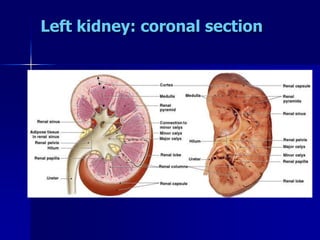
Left kidney: coronal section
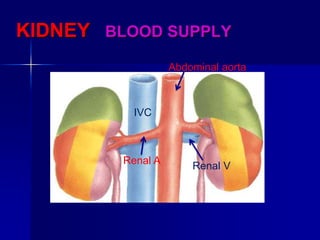
KIDNEY BLOOD SUPPLY
IVC
Abdominal aorta
Renal A
Renal V
Blood supply to the kidney:
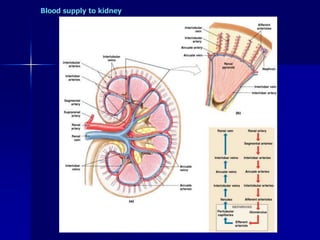
Renal arteries from abdominal aorta enter hilum and branch:
1. Interlobar arteries - pass through renal columns and reach junction
between medulla and cortex
2. Arcuate arteries run parallel with the base of the pyramids
3. Interlobular arteries move up into the cortex and branch to form
the afferent arteriole
The peritubular capillaries unite to form the interlobular veins, arcuate
vein, interlobar vein, renal vein
The renal vein exits at hilus and joins the IVC
Blood supply to kidney
Nephron
= Functional unit of the kidney, ~ 1.2 million nephrons per kidney!
Tubular components:
1. Glomerular (Bowman’s) capsule – double-walled cup
– simple squamous epithelium
2. Proximal convoluted tubule - coiled 1st section
– simple cuboidal epithelium with microvilli
3. Loop of Henle - hair-pin loop
– thin descending limb, thick ascending limb
4. Distal convoluted tubule - last section
– simple cuboidal epithelium
– specialised region - Juxta glomerular apparatus
Distal convoluted tubule opens into the collecting system
collecting ducts papillary ducts minor calyx…
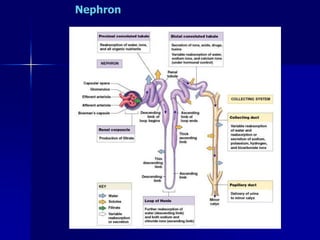
Nephron
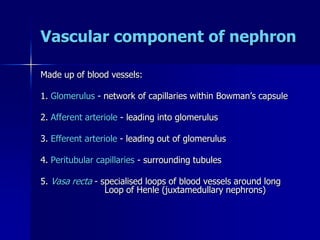
Vascular component of nephron
Made up of blood vessels:
1. Glomerulus - network of capillaries within Bowman’s capsule
2. Afferent arteriole - leading into glomerulus
3. Efferent arteriole - leading out of glomerulus
4. Peritubular capillaries - surrounding tubules
5. Vasa recta - specialised loops of blood vessels around long
Loop of Henle (juxtamedullary nephrons)
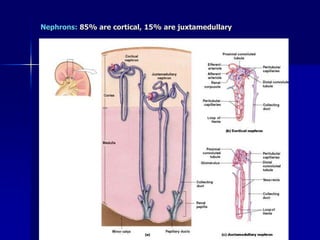
Nephrons: 85% are cortical, 15% are juxtamedullary
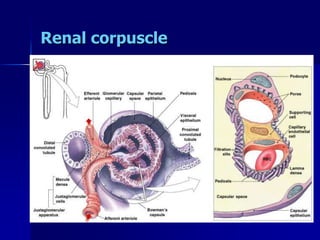
Renal corpuscle
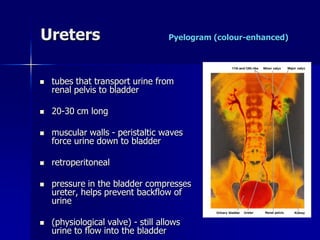
Ureters Pyelogram (colour-enhanced)
 tubes that transport urine from
renal pelvis to bladder
 20-30 cm long
 muscular walls - peristaltic waves
force urine down to bladder
 retroperitoneal
 pressure in the bladder compresses
ureter, helps prevent backflow of
urine
 (physiological valve) - still allows
urine to flow into the bladder
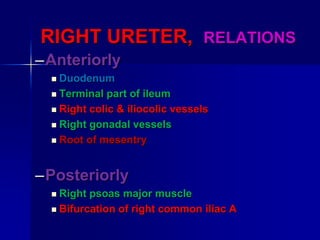
RIGHT URETER, RELATIONS
–Anteriorly
 Duodenum
 Terminal part of ileum
 Right colic & iliocolic vessels
 Right gonadal vessels
 Root of mesentry
–Posteriorly
 Right psoas major muscle
 Bifurcation of right common iliac A
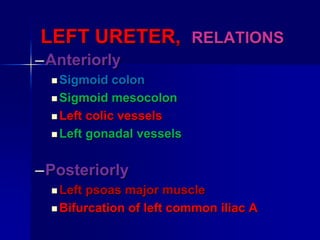
LEFT URETER, RELATIONS
–Anteriorly
 Sigmoid colon
 Sigmoid mesocolon
 Left colic vessels
 Left gonadal vessels
–Posteriorly
 Left psoas major muscle
 Bifurcation of left common iliac A
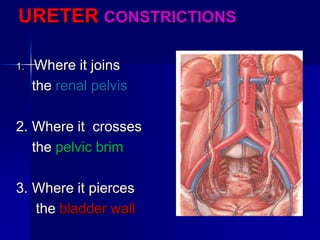
URETER CONSTRICTIONS
1. Where it joins
the renal pelvis
2. Where it crosses
the pelvic brim
3. Where it pierces
the bladder wall
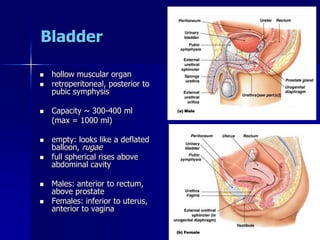
Bladder
 hollow muscular organ
 retroperitoneal, posterior to
pubic symphysis
 Capacity ~ 300-400 ml
(max = 1000 ml)
 empty: looks like a deflated
balloon, rugae
 full spherical rises above
abdominal cavity
 Males: anterior to rectum,
above prostate
 Females: inferior to uterus,
anterior to vagina
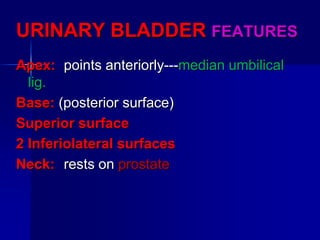
URINARY BLADDER FEATURES
Apex: points anteriorly---median umbilical
lig.
Base: (posterior surface)
Superior surface
2 Inferiolateral surfaces
Neck: rests on prostate
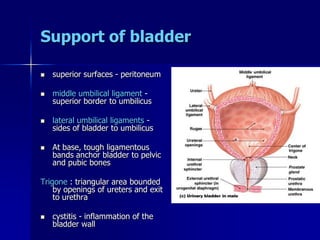
Support of bladder
 superior surfaces - peritoneum
 middle umbilical ligament -
superior border to umbilicus
 lateral umbilical ligaments -
sides of bladder to umbilicus
 At base, tough ligamentous
bands anchor bladder to pelvic
and pubic bones
Trigone : triangular area bounded
by openings of ureters and exit
to urethra
 cystitis - inflammation of the
bladder wall
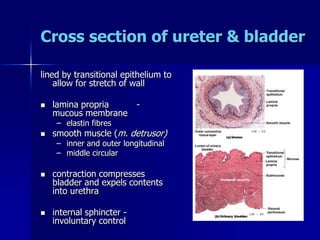
Cross section of ureter & bladder
lined by transitional epithelium to
allow for stretch of wall
 lamina propria -
mucous membrane
– elastin fibres
 smooth muscle (m. detrusor)
– inner and outer longitudinal
– middle circular
 contraction compresses
bladder and expels contents
into urethra
 internal sphincter -
involuntary control
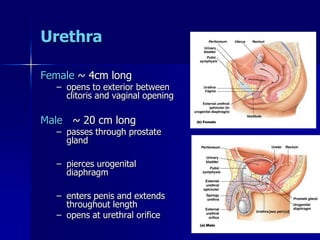
Urethra
Female ~ 4cm long
– opens to exterior between
clitoris and vaginal opening
Male ~ 20 cm long
– passes through prostate
gland
– pierces urogenital
diaphragm
– enters penis and extends
throughout length
– opens at urethral orifice
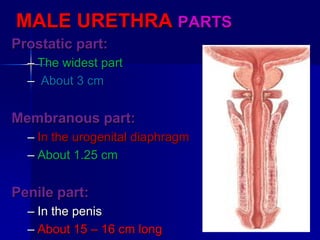
MALE URETHRA PARTS
Prostatic part:
– The widest part
– About 3 cm
Membranous part:
– In the urogenital diaphragm
– About 1.25 cm
Penile part:
– In the penis
– About 15 – 16 cm long
FUNCTIONS OF THE KIDNEY
1) Regulate the osmotic pressure (osmolality) of the
body fluids by excreting osmotically dilute or
concentrated urine.
2) Regulate the concentrations of numerous ions in
blood plasma, including Na, K, Ca, Mg, Cl,
bicarbonate (HCO3), phosphate, and sulfate.
3) Play an essential role in acid-base balance by
excreting H, when there is excess acid or HCO3,
when there is excess base.
FUNCTIONS OF THE KIDNEY
4) Regulate the volume of the ECF by controlling Na
and water excretion.
5) Help to regulate arterial blood pressure by adjusting
Na excretion and producing various substances
(e.g.,renin) that can affect blood pressure.
6) Eliminate the waste products of metabolism,
including urea (the main nitrogen-containing end-
product of protein metabolism in humans), uric acid
(an end-product of purine metabolism), and
creatinine (an end-product of muscle metabolism).
FUNCTIONS OF THE KIDNEY
7) Remove many drugs (e.g.penicillin) and foreign
or toxic compounds.
8) Are the major production sites of certain
hormones, including erythropoietin and 1,25-
dihydroxy vitamin D3
9) Degrade several polypeptide hormones, including
insulin, glucagon, and parathyroid hormone
10) Synthesize ammonia, which plays a role in acid-
base balance
FUNCTIONS OF THE
KIDNEY
11) Synthesize substances that affect renal blood
flow and Na excretion, including arachidonic
acid derivatives (prostaglandins, thromboxane
A2) and kallikrein (a proteolytic enzyme that
results in the production of kinins).
 When the kidneys fail, a host of problems
ensue. Dialysis and kidney transplantation
are commonly used treatments for advanced
(end-stage) renal failure
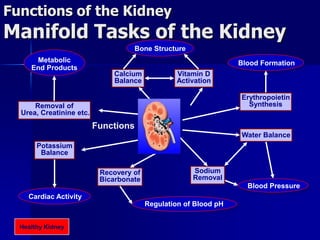
Bone Structure
Vitamin D
Activation
Calcium
Balance
Blood Formation
Erythropoietin
Synthesis
Cardiac Activity
Potassium
Balance
Regulation of Blood pH
Recovery of
Bicarbonate
Blood Pressure
Water Balance
Sodium
Removal
Metabolic
End Products
Removal of
Urea, Creatinine etc.
Functions of the Kidney
Manifold Tasks of the Kidney
Functions
Healthy Kidney
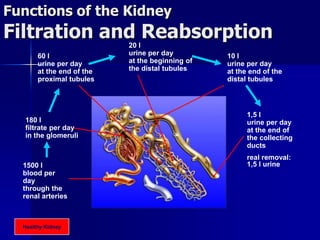
Functions of the Kidney
Filtration and Reabsorption
1500 l
blood per
day
through the
renal arteries
180 l
filtrate per day
in the glomeruli
60 l
urine per day
at the end of the
proximal tubules
20 l
urine per day
at the beginning of
the distal tubules
10 l
urine per day
at the end of the
distal tubules
1,5 l
urine per day
at the end of
the collecting
ducts
real removal:
1,5 l urine
Healthy Kidney
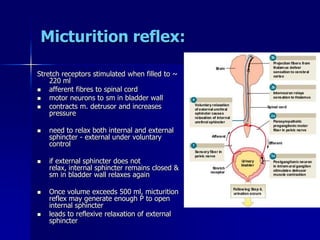
Micturition reflex:
Stretch receptors stimulated when filled to ~
220 ml
 afferent fibres to spinal cord
 motor neurons to sm in bladder wall
 contracts m. detrusor and increases
pressure
 need to relax both internal and external
sphincter - external under voluntary
control
 if external sphincter does not
relax, internal sphincter remains closed &
sm in bladder wall relaxes again
 Once volume exceeds 500 ml, micturition
reflex may generate enough P to open
internal sphincter
 leads to reflexive relaxation of external
sphincter
Thank you
All the best with your studies
ANY QUESTIONS

Renal anatomy& physiology

  • 1.
    Renal System Anatomy &PHYSIOLOGY DR. AMAR UL-ALA BUTT CONSULTANT UROLOGIST 06-R-M-12967 (MOH 88/458) BURAIDAH CENTRAL HOSPITAL(7/1)
  • 2.
    Renal system summary Functions: 1.Remove wastes from the body (urine) 2. Regulates fluid balance, maintains homeostasis Structures:  2 kidneys - filter blood, produce urine  2 ureters - transport urine (kidneys to bladder)  bladder - reservoir for urine  urethra - transport of urine
  • 3.
    Renal anatomy  liesretroperitoneal, on posterior abdominal wall  lies from T12-L3 of vertebral column, next to m. psoas major  superior parts are protected by ribs 11, 12  tilted: superior poles are closer to midline than inferior
  • 4.
    KIDNEY FEATURES 2 Poles –Upper – Lower 2 Borders – Lateral – Medial – has hilum 2 Surfaces – Anterior – Posterior
  • 5.
    RIGHT KIDNEY ANTERIOR RELATIONS Rightsuprarenal gland Liver Duodenum Colon Coils of small intestine
  • 6.
    LEFT KIDNEY ANTERIOR RELATIONS Leftsuprarenal gland Stomach Spleen Pancreas Colon Coils of small intestine
  • 7.
  • 8.
    Renal anatomy  Rkidney lower than L (due to R lobe of liver)  ~ 12cm long x 5cm wide x 2.5cm thick  bean-shaped , reddish- brown organs  renal hilum  kidney levels change during respiration and postural changes
  • 10.
    External surface –3 layers of tissue 1. renal fascia (outer) – CT attaches kidney to posterior abdominal wall – flexible, allows kidney to move with respiration – covered by layer of fat 2. perirenal fat (middle layer) – protective cushion 3. renal capsule (innermost) – layer of collagen fibres - barrier against trauma, infection etc. – kidney hangs suspended by collagen fibres and packed in soft cushion of adipose tissue
  • 11.
    Internal anatomy outer cortex,inner medulla  6-18 conical renal pyramids  apex - renal papilla projects into the renal sinus renal columns  extend from cortex inward to renal sinus between adjacent renal pyramids  granular texture similar to that of the cortex
  • 12.
    Internal anatomy  ureterenters renal sinus, it expands to form a chamber called - renal pelvis  pelvis branches to form 2-3 major calyces  branch further to form 6-8 minor calyces  Each minor calyx surrounds the papilla of a renal pyramid  ducts within papilla connect to wall of the calyx and discharge urine produced in the cortex and medulla  Urine passes through the calyces into the ureter
  • 13.
  • 14.
    KIDNEY BLOOD SUPPLY IVC Abdominalaorta Renal A Renal V
  • 15.
    Blood supply tothe kidney: Renal arteries from abdominal aorta enter hilum and branch: 1. Interlobar arteries - pass through renal columns and reach junction between medulla and cortex 2. Arcuate arteries run parallel with the base of the pyramids 3. Interlobular arteries move up into the cortex and branch to form the afferent arteriole The peritubular capillaries unite to form the interlobular veins, arcuate vein, interlobar vein, renal vein The renal vein exits at hilus and joins the IVC
  • 16.
  • 17.
    Nephron = Functional unitof the kidney, ~ 1.2 million nephrons per kidney! Tubular components: 1. Glomerular (Bowman’s) capsule – double-walled cup – simple squamous epithelium 2. Proximal convoluted tubule - coiled 1st section – simple cuboidal epithelium with microvilli 3. Loop of Henle - hair-pin loop – thin descending limb, thick ascending limb 4. Distal convoluted tubule - last section – simple cuboidal epithelium – specialised region - Juxta glomerular apparatus Distal convoluted tubule opens into the collecting system collecting ducts papillary ducts minor calyx…
  • 18.
  • 19.
    Vascular component ofnephron Made up of blood vessels: 1. Glomerulus - network of capillaries within Bowman’s capsule 2. Afferent arteriole - leading into glomerulus 3. Efferent arteriole - leading out of glomerulus 4. Peritubular capillaries - surrounding tubules 5. Vasa recta - specialised loops of blood vessels around long Loop of Henle (juxtamedullary nephrons)
  • 20.
    Nephrons: 85% arecortical, 15% are juxtamedullary
  • 21.
  • 22.
    Ureters Pyelogram (colour-enhanced) tubes that transport urine from renal pelvis to bladder  20-30 cm long  muscular walls - peristaltic waves force urine down to bladder  retroperitoneal  pressure in the bladder compresses ureter, helps prevent backflow of urine  (physiological valve) - still allows urine to flow into the bladder
  • 23.
    RIGHT URETER, RELATIONS –Anteriorly Duodenum  Terminal part of ileum  Right colic & iliocolic vessels  Right gonadal vessels  Root of mesentry –Posteriorly  Right psoas major muscle  Bifurcation of right common iliac A
  • 24.
    LEFT URETER, RELATIONS –Anteriorly Sigmoid colon  Sigmoid mesocolon  Left colic vessels  Left gonadal vessels –Posteriorly  Left psoas major muscle  Bifurcation of left common iliac A
  • 25.
    URETER CONSTRICTIONS 1. Whereit joins the renal pelvis 2. Where it crosses the pelvic brim 3. Where it pierces the bladder wall
  • 26.
    Bladder  hollow muscularorgan  retroperitoneal, posterior to pubic symphysis  Capacity ~ 300-400 ml (max = 1000 ml)  empty: looks like a deflated balloon, rugae  full spherical rises above abdominal cavity  Males: anterior to rectum, above prostate  Females: inferior to uterus, anterior to vagina
  • 27.
    URINARY BLADDER FEATURES Apex:points anteriorly---median umbilical lig. Base: (posterior surface) Superior surface 2 Inferiolateral surfaces Neck: rests on prostate
  • 28.
    Support of bladder superior surfaces - peritoneum  middle umbilical ligament - superior border to umbilicus  lateral umbilical ligaments - sides of bladder to umbilicus  At base, tough ligamentous bands anchor bladder to pelvic and pubic bones Trigone : triangular area bounded by openings of ureters and exit to urethra  cystitis - inflammation of the bladder wall
  • 29.
    Cross section ofureter & bladder lined by transitional epithelium to allow for stretch of wall  lamina propria - mucous membrane – elastin fibres  smooth muscle (m. detrusor) – inner and outer longitudinal – middle circular  contraction compresses bladder and expels contents into urethra  internal sphincter - involuntary control
  • 30.
    Urethra Female ~ 4cmlong – opens to exterior between clitoris and vaginal opening Male ~ 20 cm long – passes through prostate gland – pierces urogenital diaphragm – enters penis and extends throughout length – opens at urethral orifice
  • 31.
    MALE URETHRA PARTS Prostaticpart: – The widest part – About 3 cm Membranous part: – In the urogenital diaphragm – About 1.25 cm Penile part: – In the penis – About 15 – 16 cm long
  • 32.
    FUNCTIONS OF THEKIDNEY 1) Regulate the osmotic pressure (osmolality) of the body fluids by excreting osmotically dilute or concentrated urine. 2) Regulate the concentrations of numerous ions in blood plasma, including Na, K, Ca, Mg, Cl, bicarbonate (HCO3), phosphate, and sulfate. 3) Play an essential role in acid-base balance by excreting H, when there is excess acid or HCO3, when there is excess base.
  • 33.
    FUNCTIONS OF THEKIDNEY 4) Regulate the volume of the ECF by controlling Na and water excretion. 5) Help to regulate arterial blood pressure by adjusting Na excretion and producing various substances (e.g.,renin) that can affect blood pressure. 6) Eliminate the waste products of metabolism, including urea (the main nitrogen-containing end- product of protein metabolism in humans), uric acid (an end-product of purine metabolism), and creatinine (an end-product of muscle metabolism).
  • 34.
    FUNCTIONS OF THEKIDNEY 7) Remove many drugs (e.g.penicillin) and foreign or toxic compounds. 8) Are the major production sites of certain hormones, including erythropoietin and 1,25- dihydroxy vitamin D3 9) Degrade several polypeptide hormones, including insulin, glucagon, and parathyroid hormone 10) Synthesize ammonia, which plays a role in acid- base balance
  • 35.
    FUNCTIONS OF THE KIDNEY 11)Synthesize substances that affect renal blood flow and Na excretion, including arachidonic acid derivatives (prostaglandins, thromboxane A2) and kallikrein (a proteolytic enzyme that results in the production of kinins).  When the kidneys fail, a host of problems ensue. Dialysis and kidney transplantation are commonly used treatments for advanced (end-stage) renal failure
  • 36.
    Bone Structure Vitamin D Activation Calcium Balance BloodFormation Erythropoietin Synthesis Cardiac Activity Potassium Balance Regulation of Blood pH Recovery of Bicarbonate Blood Pressure Water Balance Sodium Removal Metabolic End Products Removal of Urea, Creatinine etc. Functions of the Kidney Manifold Tasks of the Kidney Functions Healthy Kidney
  • 37.
    Functions of theKidney Filtration and Reabsorption 1500 l blood per day through the renal arteries 180 l filtrate per day in the glomeruli 60 l urine per day at the end of the proximal tubules 20 l urine per day at the beginning of the distal tubules 10 l urine per day at the end of the distal tubules 1,5 l urine per day at the end of the collecting ducts real removal: 1,5 l urine Healthy Kidney
  • 38.
    Micturition reflex: Stretch receptorsstimulated when filled to ~ 220 ml  afferent fibres to spinal cord  motor neurons to sm in bladder wall  contracts m. detrusor and increases pressure  need to relax both internal and external sphincter - external under voluntary control  if external sphincter does not relax, internal sphincter remains closed & sm in bladder wall relaxes again  Once volume exceeds 500 ml, micturition reflex may generate enough P to open internal sphincter  leads to reflexive relaxation of external sphincter
  • 39.
    Thank you All thebest with your studies ANY QUESTIONS