• Renal Anatomy
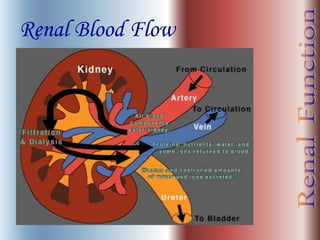
• Renal Blood Flow
• Renal Physiology
• Urine formation
– Glomerular Filtration
– Tubular Reabsorption
– Tubular Secretion
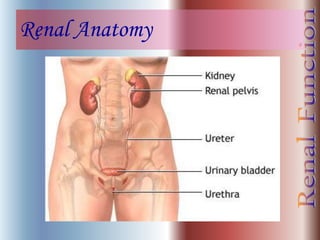
Renal Anatomy
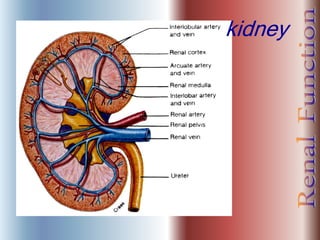
kidney
What is the average weight of the kidney?
115-170 g
What is its average size?
11 cm in length, 6 cm in width, 3 cm thick
What is the rate of blood flow into the kidney via
the renal artery?
600 mL/min
kidney
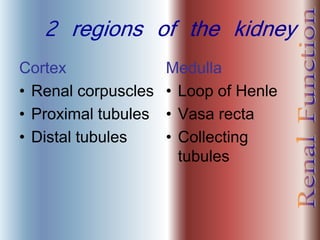
Cortex
• Renal corpuscles
• Proximal tubules
• Distal tubules
Medulla
• Loop of Henle
• Vasa recta
• Collecting
tubules
2 regions of the kidney
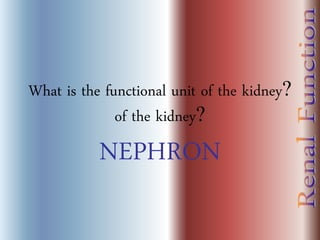
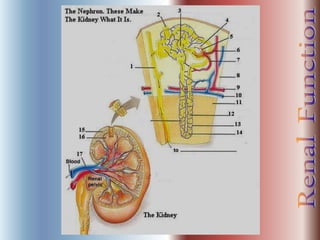
What is the functional unit of the kidney?
of the kidney?
NEPHRON
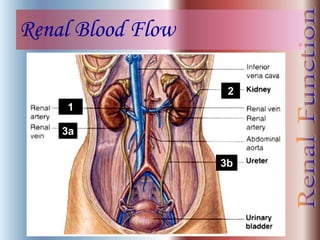
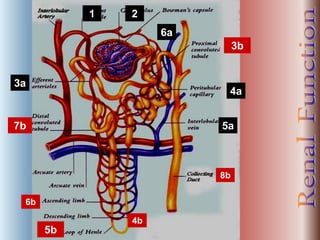
Renal Blood Flow
3a
2
1
3b
Renal Blood Flow
1 2
3a
4a
3b
5b
7b
4b
5a
6a
6b
8b
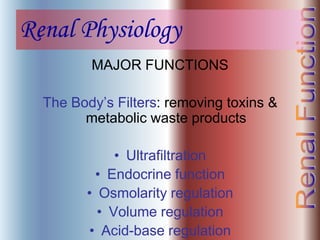
Renal Physiology
MAJOR FUNCTIONS
The Body’s Filters: removing toxins &
metabolic waste products
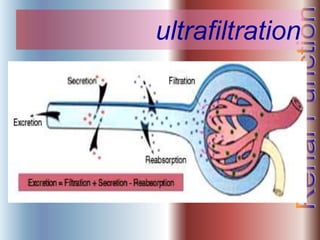
• Ultrafiltration
• Endocrine function
• Osmolarity regulation
• Volume regulation
• Acid-base regulation
ultrafiltration
ultrafiltration
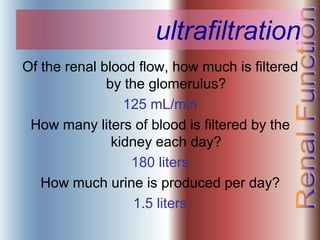
Of the renal blood flow, how much is filtered
by the glomerulus?
125 mL/min
How many liters of blood is filtered by the
kidney each day?
180 liters
How much urine is produced per day?
1.5 liters
ultrafiltration
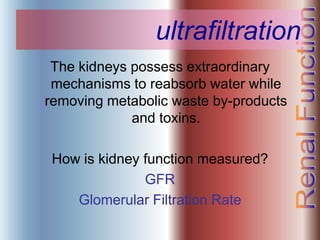
The kidneys possess extraordinary
mechanisms to reabsorb water while
removing metabolic waste by-products
and toxins.
How is kidney function measured?
GFR
Glomerular Filtration Rate
Endocrine function
1. Erythropoietin
2. Active form of vitamin D (1,25-
dihydroxy vitamin D3)
3. renin
Osmolarity regulation
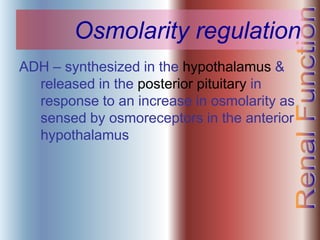
ADH – synthesized in the hypothalamus &
released in the posterior pituitary in
response to an increase in osmolarity as
sensed by osmoreceptors in the anterior
hypothalamus
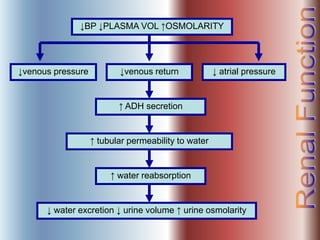
↓BP ↓PLASMA VOL ↑OSMOLARITY
↓venous pressure ↓venous return ↓ atrial pressure
↑ ADH secretion
↑ tubular permeability to water
↑ water reabsorption
↓ water excretion ↓ urine volume ↑ urine osmolarity
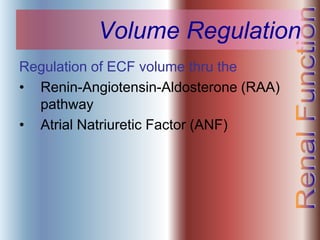
Volume Regulation
Regulation of ECF volume thru the
• Renin-Angiotensin-Aldosterone (RAA)
pathway
• Atrial Natriuretic Factor (ANF)
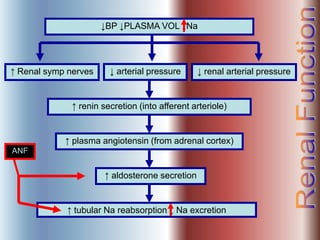
↓BP ↓PLASMA VOL ↓Na
↑ Renal symp nerves ↓ renal arterial pressure
↑ renin secretion (into afferent arteriole)
↑ plasma angiotensin (from adrenal cortex)
↑ aldosterone secretion
↑ tubular Na reabsorption ↓ Na excretion
↓ arterial pressure
ANF
Volume Regulation
Atrial Natriuretic Factor (ANF)
• Secreted by the cells in the atria of the
heart to inhibit Na+ reabsorption in the
kidneys
• Inhibits secretion of aldosterone which
stimulates Na+ reabsorption
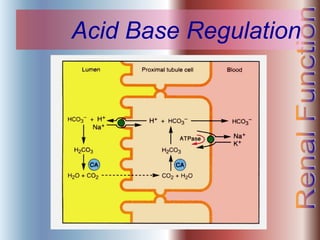
Acid Base Regulation
• To excrete X’s alkali:
– Na2HPO4
– NaHCO3
• To excrete X’s acid:
– NH4Cl
– (NH4)2SO4
– NaH2PO4
What is the first step in urine formation?
GLOMERULAR FILTRATION
Glomerular Filtration
The filtration of a solute that is not
reabsorbed or secreted
Unit: mL/min
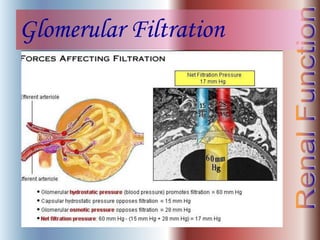
Affected by: hydrostatic & oncotic pressure,
Renin-angiotensin-aldosterone system,
structure
Glomerular Filtration
Substances retained:
• Blood cells
• Serum proteins
• Substances filtered:
• Water
• Smaller molecules
(MW: <70,000)
– Ions
– Amino acids
– Glucose
– Urea
– Creatinine
– Uric acid
– ammonia
Glomerular Filtration
• Approximately 20% of the volume of plasma
that passes through the glomerular tuft is
caught in Bowman’s space and is called the
glomerular filtrate.
• At this point, the filtrate is iso-osmotic with plasma and is
called an ultrafiltrate. (sp. gr. 1.010 +/-0.002 ; pH 7.4)
What barriers are there to
the passage of the filtrate?
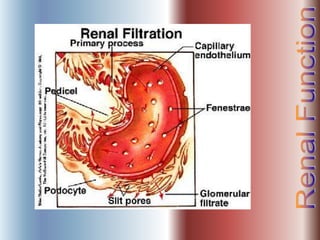
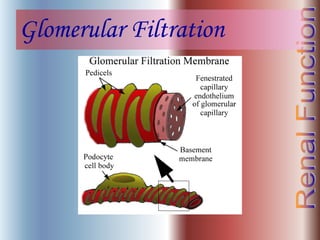
• Endothelium (glomerular capillary)
• Basement membrane
– Lamina rara interna
– Lamina densa
– Lamina rara externa
• Podocytes (visceral layer)
Glomerular Filtration
• To pass through the filtration barrier:
– <4 nm in size
– Threshold
Glomerular Filtration
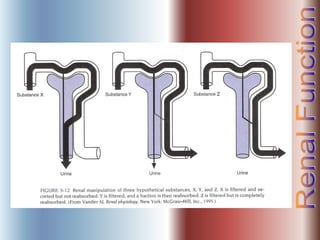
Tubular Reabsorption
• The movement of substances (by active or
passive transport)
– from the tubular ultrafiltrate into the
peritubular blood or the interstitium by the
renal tubular cells.
Tubular Reabsorption
Substances reabsorbed by active transport:
• Glucose, Amino acids, Salts (PCT)
• Chloride (LOH)
• Sodium (DCT)
Tubular Reabsorption
Substances reabsorbed by passive
transport:
• Water (all nephron parts except ascending
limb)
• Urea (PCT, ascending limb)
• Sodium (ascending limb)
Tubular Secretion
• The movement of substances (by active or
passive transport)
– from the peritubular blood or the interstitium
into the tubular ultrafiltrate by the renal tubular
cells
• To secrete substances the kidney is
unable to eliminate via ultrafiltration
Tubular Secretion
• Substances incompletely metabolized
– E.g. thiamine
• Substances not metabolized at all
– E.g. radiopaque contrast media / mannitol
• Substances not normally present
– Certain drugs
SUMMARY
• Close your notes...
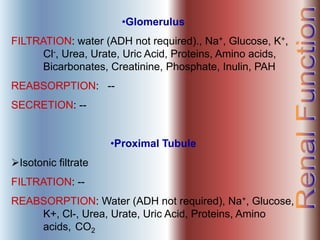
•Glomerulus
FILTRATION: water (ADH not required)., Na+, Glucose, K+,
Cl-, Urea, Urate, Uric Acid, Proteins, Amino acids,
Bicarbonates, Creatinine, Phosphate, Inulin, PAH
REABSORPTION: --
SECRETION: --
•Proximal Tubule
Isotonic filtrate
FILTRATION: --
REABSORPTION: Water (ADH not required), Na+, Glucose,
K+, Cl-, Urea, Urate, Uric Acid, Proteins, Amino
acids, CO2
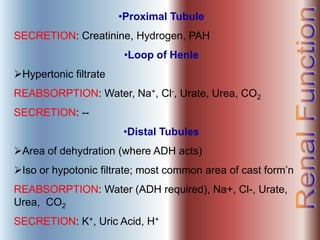
•Proximal Tubule
SECRETION: Creatinine, Hydrogen, PAH
•Loop of Henle
Hypertonic filtrate
REABSORPTION: Water, Na+, Cl-, Urate, Urea, CO2
SECRETION: --
•Distal Tubules
Area of dehydration (where ADH acts)
Iso or hypotonic filtrate; most common area of cast form’n
REABSORPTION: Water (ADH required), Na+, Cl-, Urate,
Urea, CO2
SECRETION: K+, Uric Acid, H+
 Collecting Duct
Hypertonic or Hypotonic filtrate
REABSORPTION: Water (ADH required), Na+, Cl-, Urate,
Urea, CO2
SECRETION: K+, H+

Cm5 renal function

  • 1.
    • Renal Anatomy •Renal Blood Flow • Renal Physiology • Urine formation – Glomerular Filtration – Tubular Reabsorption – Tubular Secretion
  • 2.
  • 3.
    kidney What is theaverage weight of the kidney? 115-170 g What is its average size? 11 cm in length, 6 cm in width, 3 cm thick What is the rate of blood flow into the kidney via the renal artery? 600 mL/min
  • 4.
  • 5.
    Cortex • Renal corpuscles •Proximal tubules • Distal tubules Medulla • Loop of Henle • Vasa recta • Collecting tubules 2 regions of the kidney
  • 6.
    What is thefunctional unit of the kidney? of the kidney? NEPHRON
  • 7.
  • 8.
  • 10.
  • 11.
    Renal Physiology MAJOR FUNCTIONS TheBody’s Filters: removing toxins & metabolic waste products • Ultrafiltration • Endocrine function • Osmolarity regulation • Volume regulation • Acid-base regulation
  • 12.
  • 13.
    ultrafiltration Of the renalblood flow, how much is filtered by the glomerulus? 125 mL/min How many liters of blood is filtered by the kidney each day? 180 liters How much urine is produced per day? 1.5 liters
  • 14.
    ultrafiltration The kidneys possessextraordinary mechanisms to reabsorb water while removing metabolic waste by-products and toxins. How is kidney function measured? GFR Glomerular Filtration Rate
  • 15.
    Endocrine function 1. Erythropoietin 2.Active form of vitamin D (1,25- dihydroxy vitamin D3) 3. renin
  • 16.
    Osmolarity regulation ADH –synthesized in the hypothalamus & released in the posterior pituitary in response to an increase in osmolarity as sensed by osmoreceptors in the anterior hypothalamus
  • 17.
    ↓BP ↓PLASMA VOL↑OSMOLARITY ↓venous pressure ↓venous return ↓ atrial pressure ↑ ADH secretion ↑ tubular permeability to water ↑ water reabsorption ↓ water excretion ↓ urine volume ↑ urine osmolarity
  • 18.
    Volume Regulation Regulation ofECF volume thru the • Renin-Angiotensin-Aldosterone (RAA) pathway • Atrial Natriuretic Factor (ANF)
  • 19.
    ↓BP ↓PLASMA VOL↓Na ↑ Renal symp nerves ↓ renal arterial pressure ↑ renin secretion (into afferent arteriole) ↑ plasma angiotensin (from adrenal cortex) ↑ aldosterone secretion ↑ tubular Na reabsorption ↓ Na excretion ↓ arterial pressure ANF
  • 20.
    Volume Regulation Atrial NatriureticFactor (ANF) • Secreted by the cells in the atria of the heart to inhibit Na+ reabsorption in the kidneys • Inhibits secretion of aldosterone which stimulates Na+ reabsorption
  • 21.
  • 22.
    Acid Base Regulation •To excrete X’s alkali: – Na2HPO4 – NaHCO3 • To excrete X’s acid: – NH4Cl – (NH4)2SO4 – NaH2PO4
  • 23.
    What is thefirst step in urine formation? GLOMERULAR FILTRATION
  • 24.
    Glomerular Filtration The filtrationof a solute that is not reabsorbed or secreted Unit: mL/min Affected by: hydrostatic & oncotic pressure, Renin-angiotensin-aldosterone system, structure
  • 25.
    Glomerular Filtration Substances retained: •Blood cells • Serum proteins • Substances filtered: • Water • Smaller molecules (MW: <70,000) – Ions – Amino acids – Glucose – Urea – Creatinine – Uric acid – ammonia
  • 26.
    Glomerular Filtration • Approximately20% of the volume of plasma that passes through the glomerular tuft is caught in Bowman’s space and is called the glomerular filtrate. • At this point, the filtrate is iso-osmotic with plasma and is called an ultrafiltrate. (sp. gr. 1.010 +/-0.002 ; pH 7.4)
  • 27.
    What barriers arethere to the passage of the filtrate? • Endothelium (glomerular capillary) • Basement membrane – Lamina rara interna – Lamina densa – Lamina rara externa • Podocytes (visceral layer)
  • 29.
  • 30.
    Glomerular Filtration • Topass through the filtration barrier: – <4 nm in size – Threshold
  • 31.
  • 32.
    Tubular Reabsorption • Themovement of substances (by active or passive transport) – from the tubular ultrafiltrate into the peritubular blood or the interstitium by the renal tubular cells.
  • 33.
    Tubular Reabsorption Substances reabsorbedby active transport: • Glucose, Amino acids, Salts (PCT) • Chloride (LOH) • Sodium (DCT)
  • 34.
    Tubular Reabsorption Substances reabsorbedby passive transport: • Water (all nephron parts except ascending limb) • Urea (PCT, ascending limb) • Sodium (ascending limb)
  • 35.
    Tubular Secretion • Themovement of substances (by active or passive transport) – from the peritubular blood or the interstitium into the tubular ultrafiltrate by the renal tubular cells • To secrete substances the kidney is unable to eliminate via ultrafiltration
  • 36.
    Tubular Secretion • Substancesincompletely metabolized – E.g. thiamine • Substances not metabolized at all – E.g. radiopaque contrast media / mannitol • Substances not normally present – Certain drugs
  • 37.
  • 39.
    •Glomerulus FILTRATION: water (ADHnot required)., Na+, Glucose, K+, Cl-, Urea, Urate, Uric Acid, Proteins, Amino acids, Bicarbonates, Creatinine, Phosphate, Inulin, PAH REABSORPTION: -- SECRETION: -- •Proximal Tubule Isotonic filtrate FILTRATION: -- REABSORPTION: Water (ADH not required), Na+, Glucose, K+, Cl-, Urea, Urate, Uric Acid, Proteins, Amino acids, CO2
  • 40.
    •Proximal Tubule SECRETION: Creatinine,Hydrogen, PAH •Loop of Henle Hypertonic filtrate REABSORPTION: Water, Na+, Cl-, Urate, Urea, CO2 SECRETION: -- •Distal Tubules Area of dehydration (where ADH acts) Iso or hypotonic filtrate; most common area of cast form’n REABSORPTION: Water (ADH required), Na+, Cl-, Urate, Urea, CO2 SECRETION: K+, Uric Acid, H+
  • 41.
     Collecting Duct Hypertonicor Hypotonic filtrate REABSORPTION: Water (ADH required), Na+, Cl-, Urate, Urea, CO2 SECRETION: K+, H+