Dr./ Hussein F. Sakr
Copyright 2008 PresentationFx.com | Redistribution Prohibited | Image © 2008 Thomas Brian | This text section may be deleted for presentation.
Renal Physiology
Anatomy of the kidney
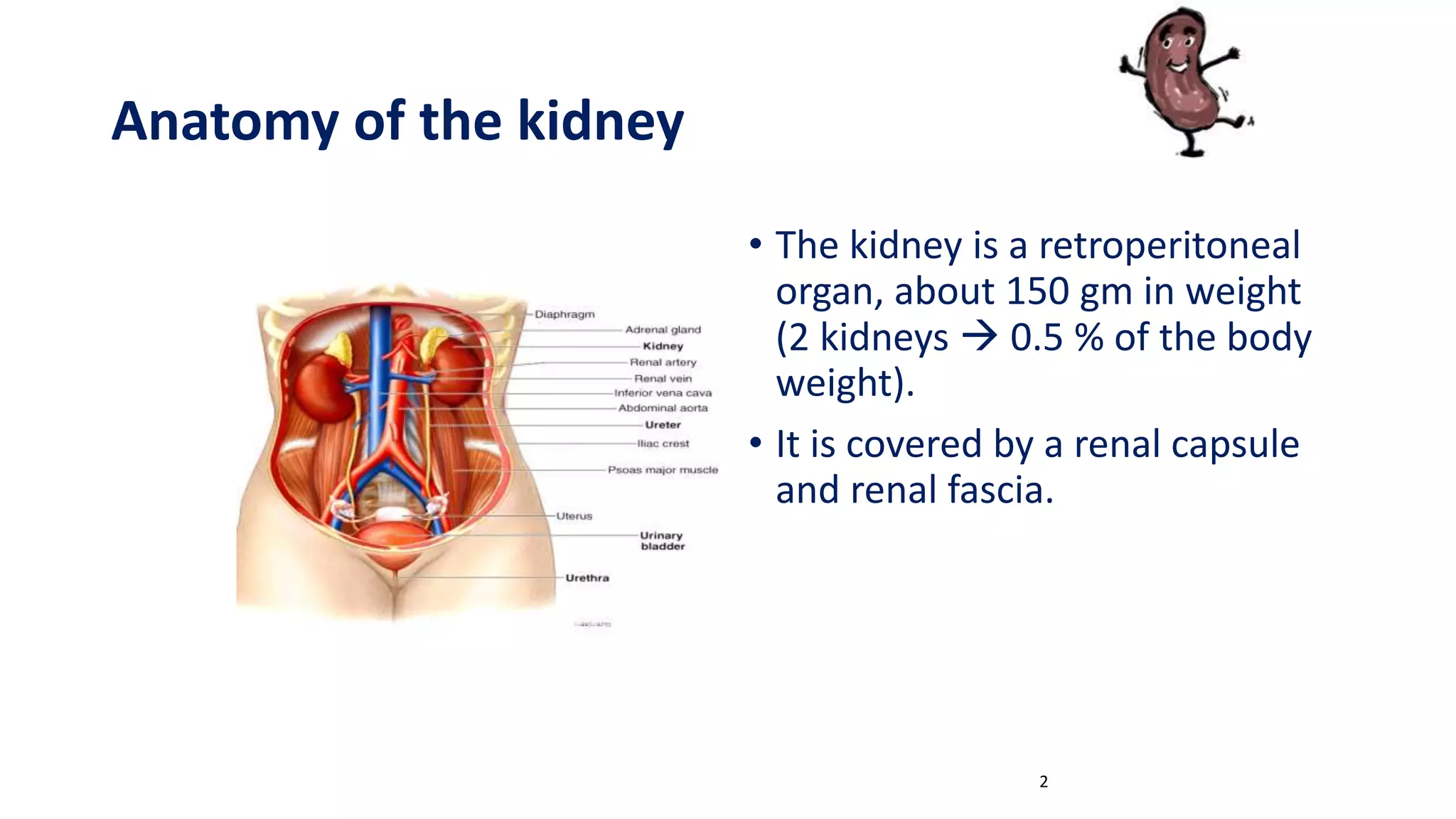
• The kidney is a retroperitoneal
organ, about 150 gm in weight
(2 kidneys  0.5 % of the body
weight).
• It is covered by a renal capsule
and renal fascia.
2
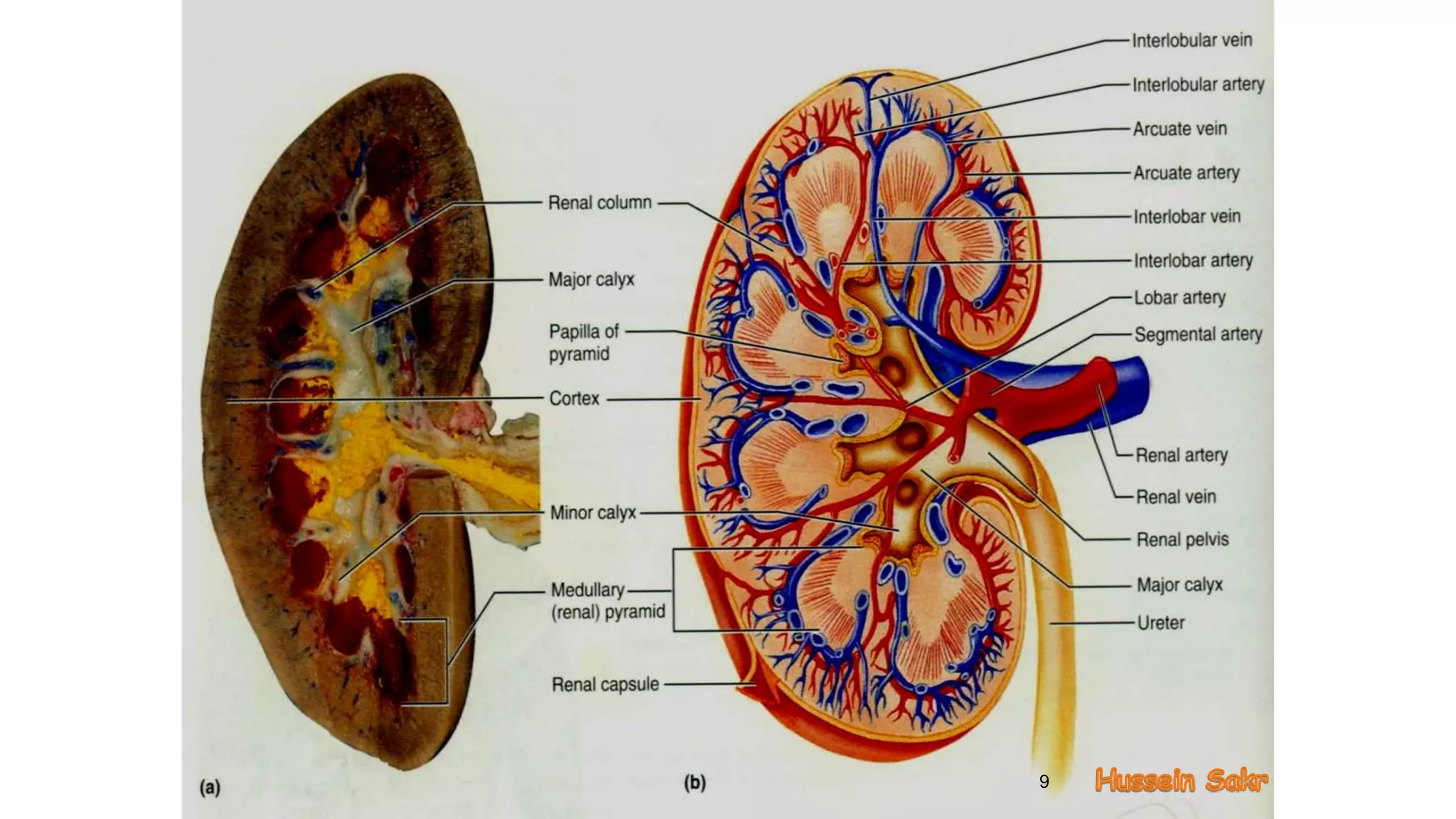
Structure of the kidney
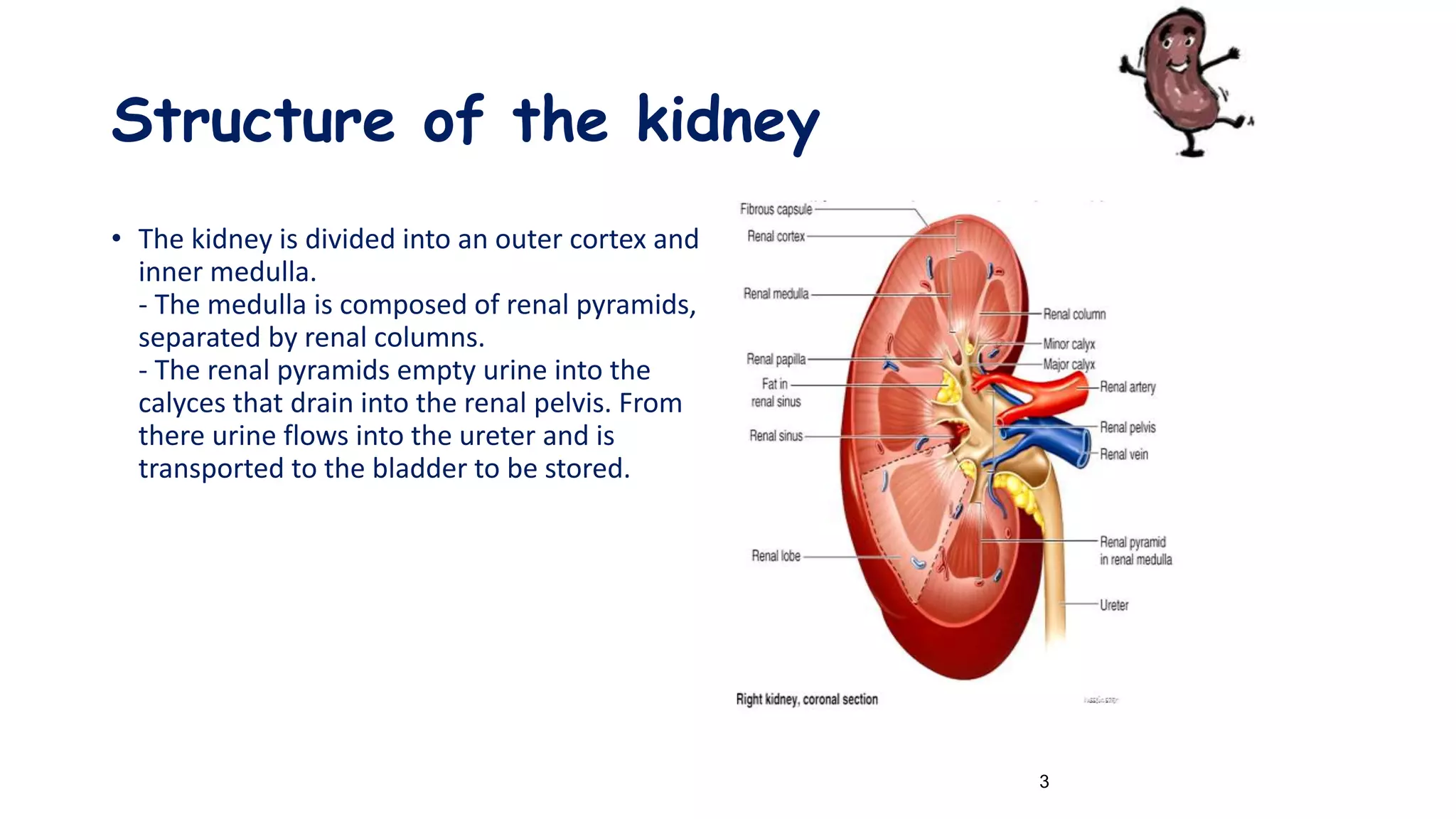
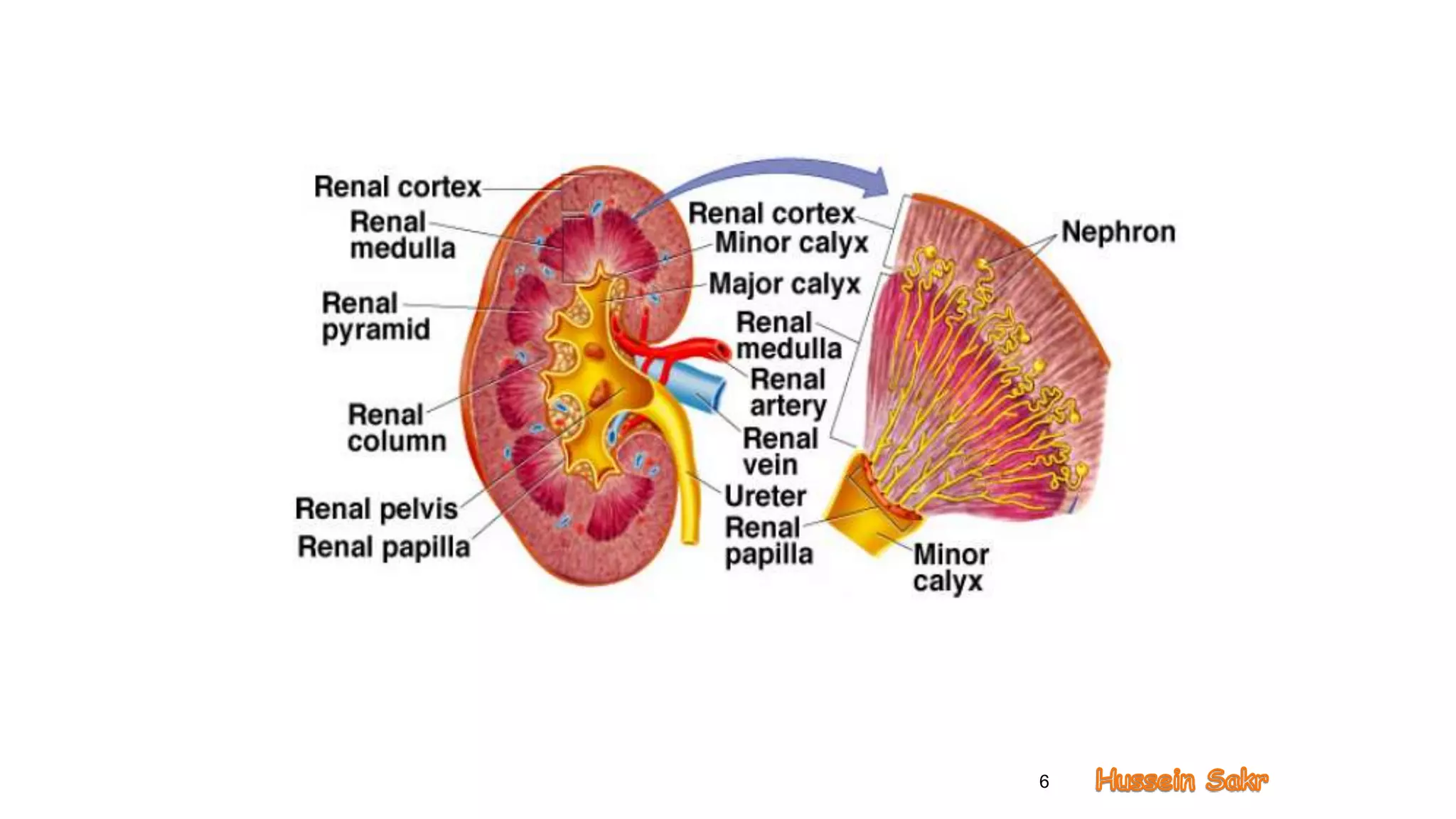
• The kidney is divided into an outer cortex and
inner medulla.
- The medulla is composed of renal pyramids,
separated by renal columns.
- The renal pyramids empty urine into the
calyces that drain into the renal pelvis. From
there urine flows into the ureter and is
transported to the bladder to be stored.
3
General function of the kidney
• Regulate ECF volume.
• Regulation of electrolytes.
• Regulation of arterial blood pressure.
• Regulation of pH (acid-base balance).
• Excretion of waste products.
• Endocrinal function (renin- erythropoietin- active vitamin D).
• Degradation of hormones.
4
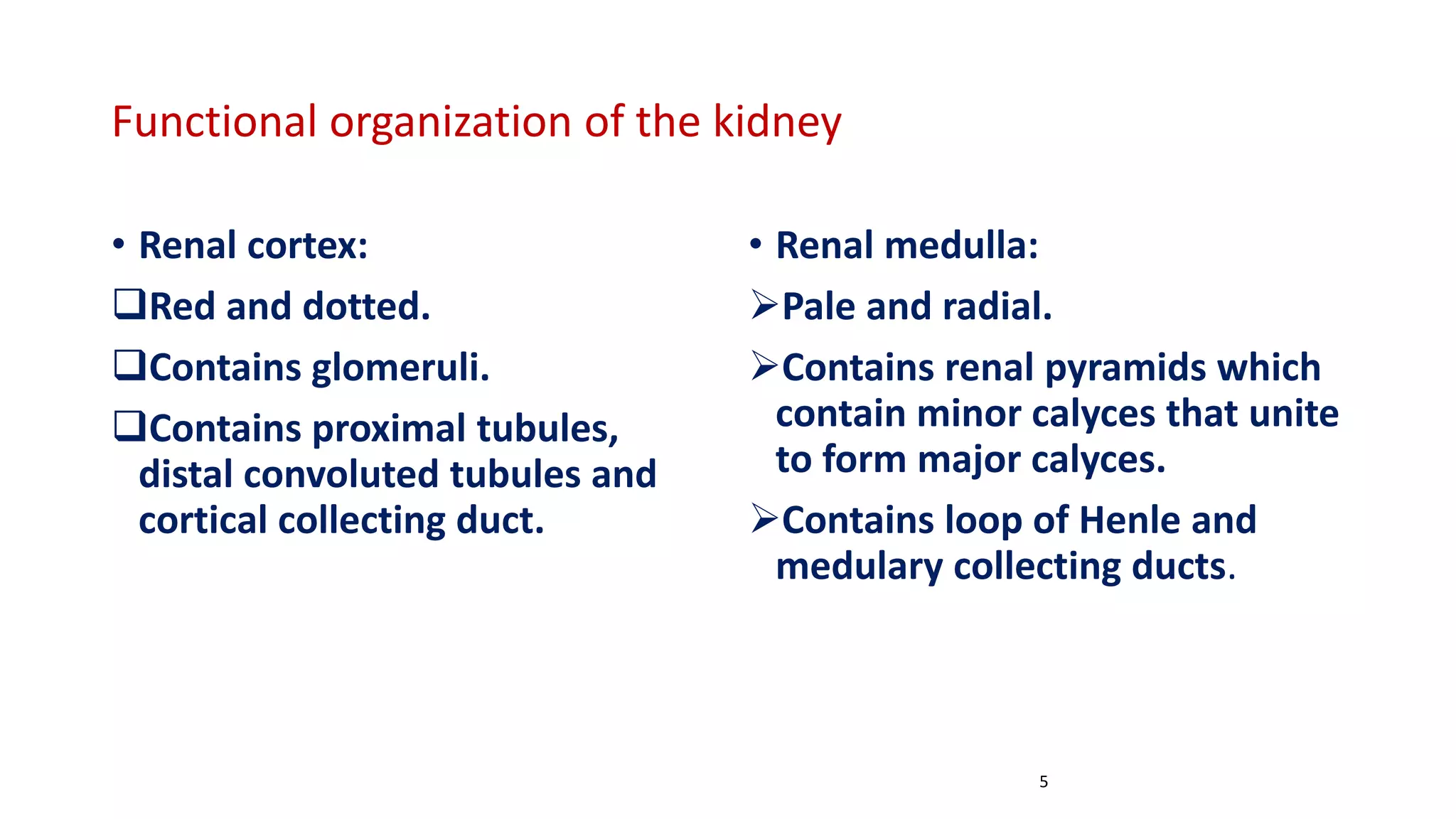
Functional organization of the kidney
• Renal cortex:
Red and dotted.
Contains glomeruli.
Contains proximal tubules,
distal convoluted tubules and
cortical collecting duct.
• Renal medulla:
Pale and radial.
Contains renal pyramids which
contain minor calyces that unite
to form major calyces.
Contains loop of Henle and
medulary collecting ducts.
5
6
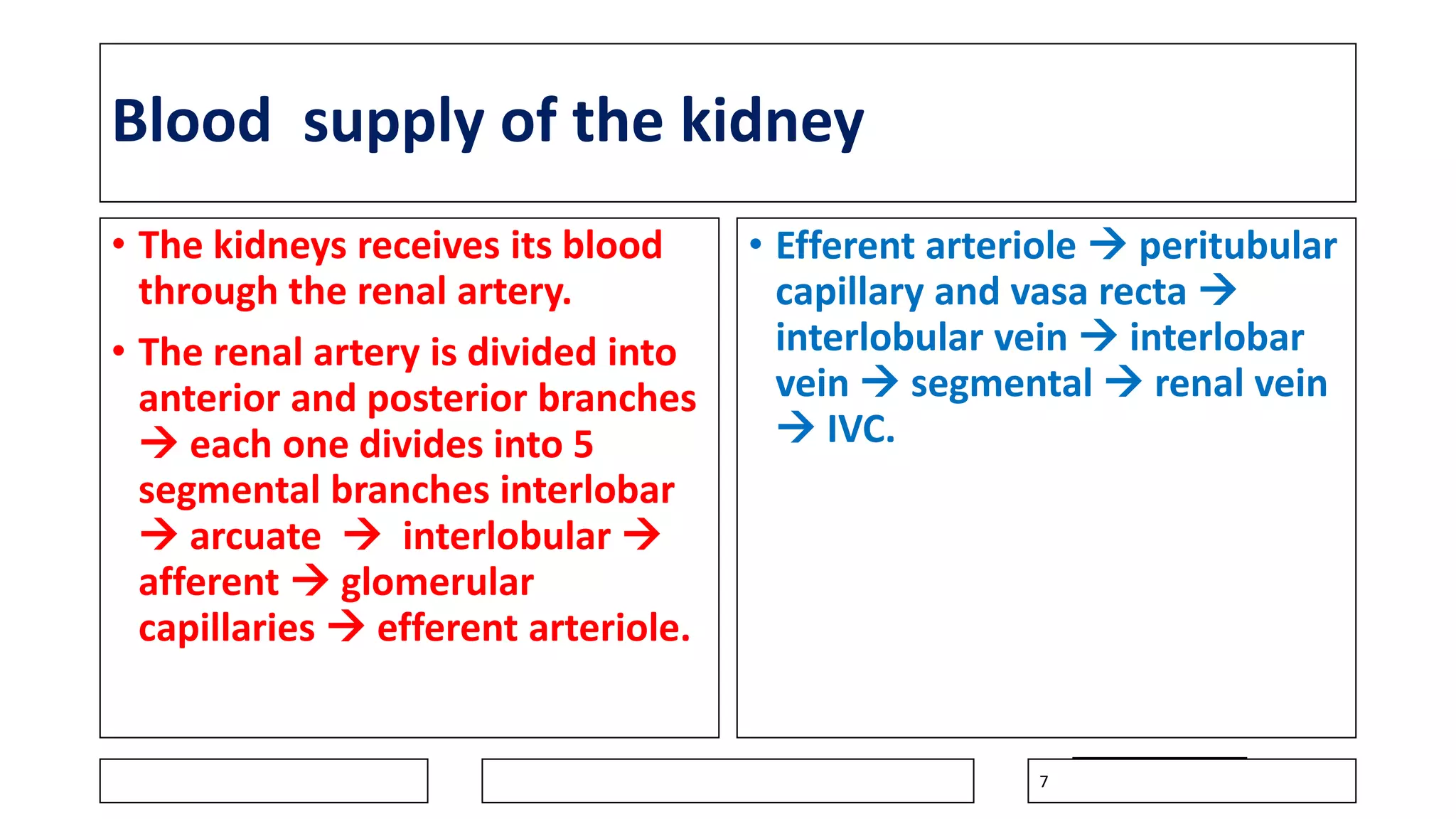
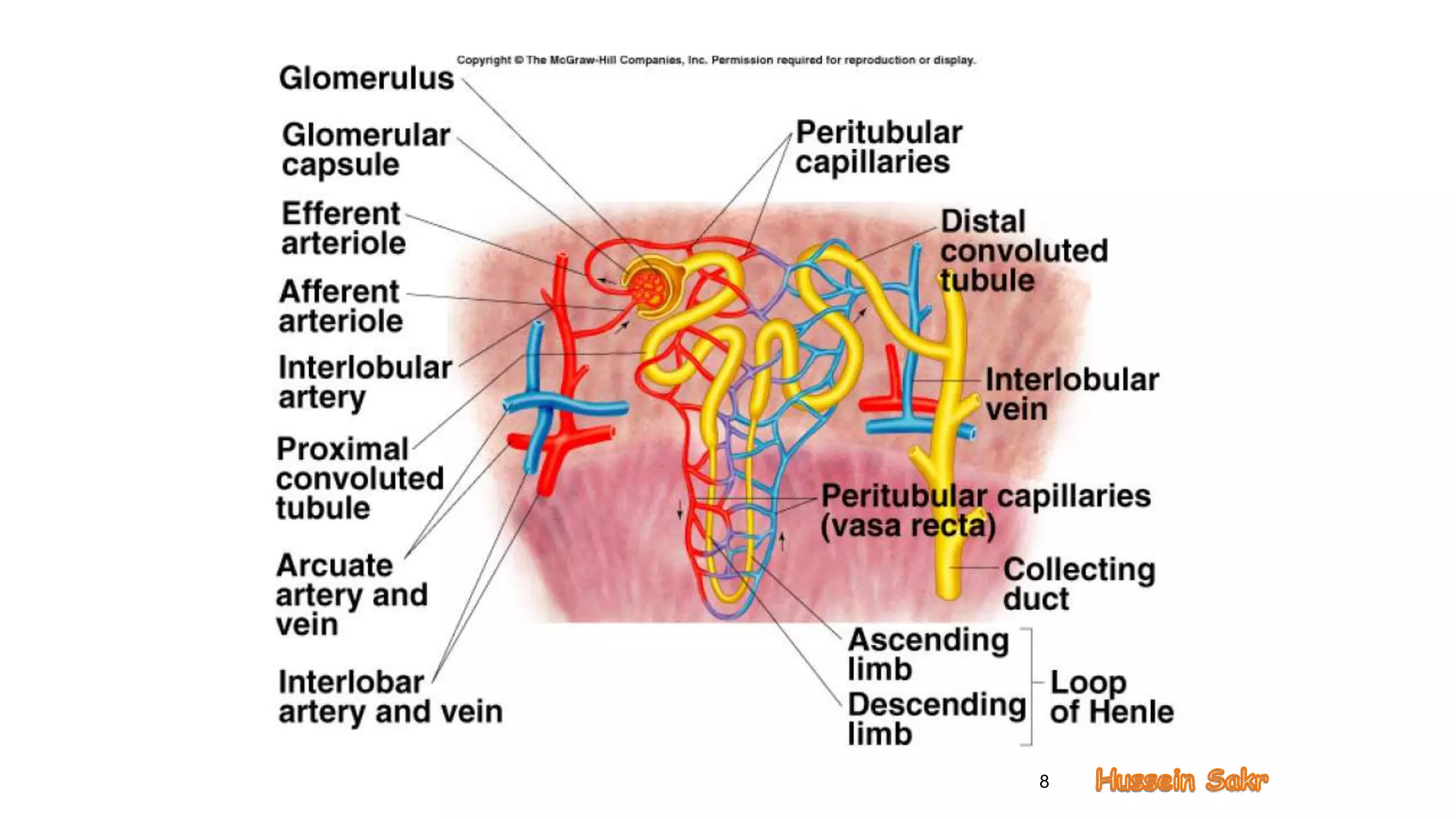
Blood supply of the kidney
• The kidneys receives its blood
through the renal artery.
• The renal artery is divided into
anterior and posterior branches
 each one divides into 5
segmental branches interlobar
 arcuate  interlobular 
afferent  glomerular
capillaries  efferent arteriole.
• Efferent arteriole  peritubular
capillary and vasa recta 
interlobular vein  interlobar
vein  segmental  renal vein
 IVC.
7
8
9
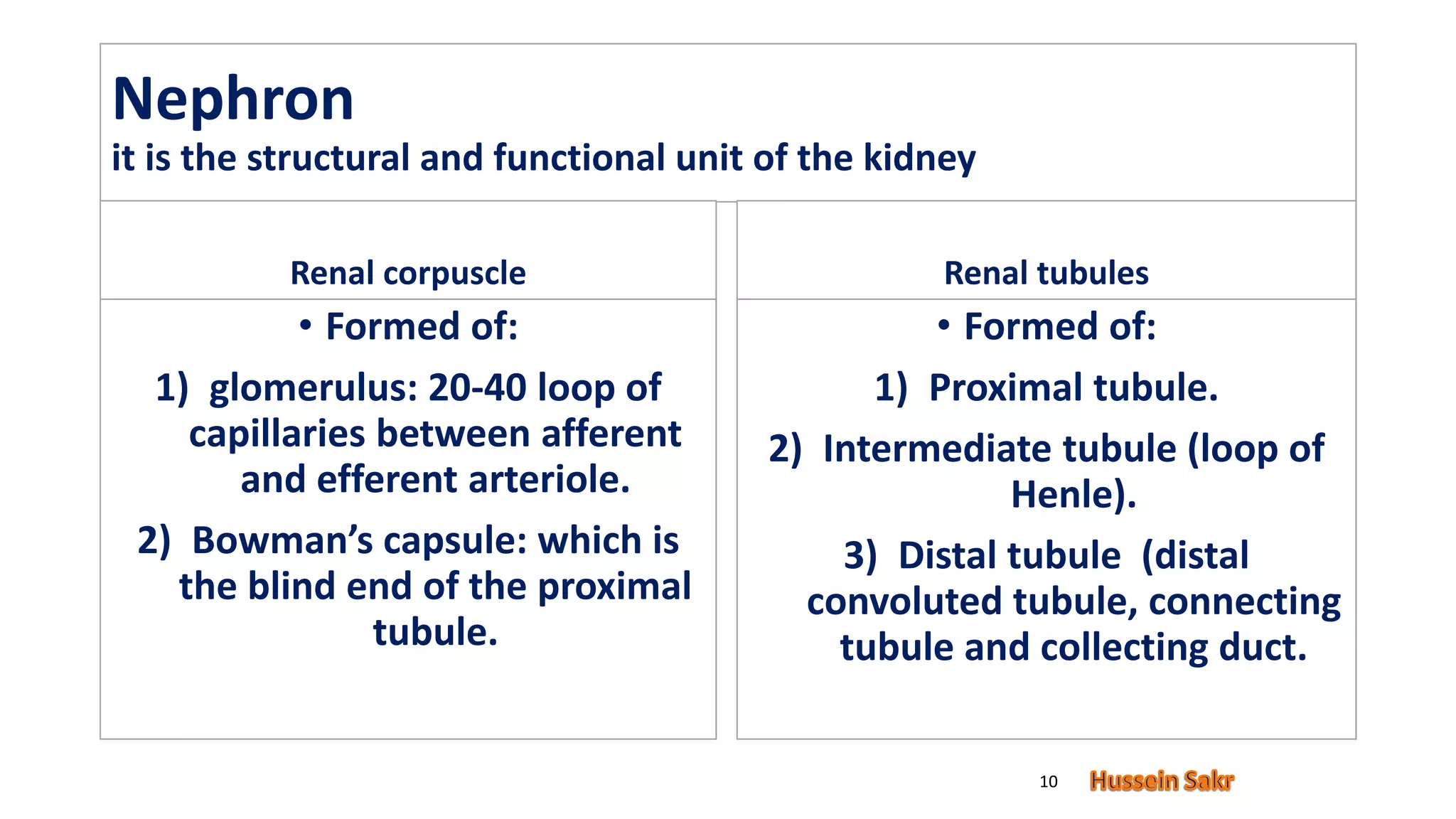
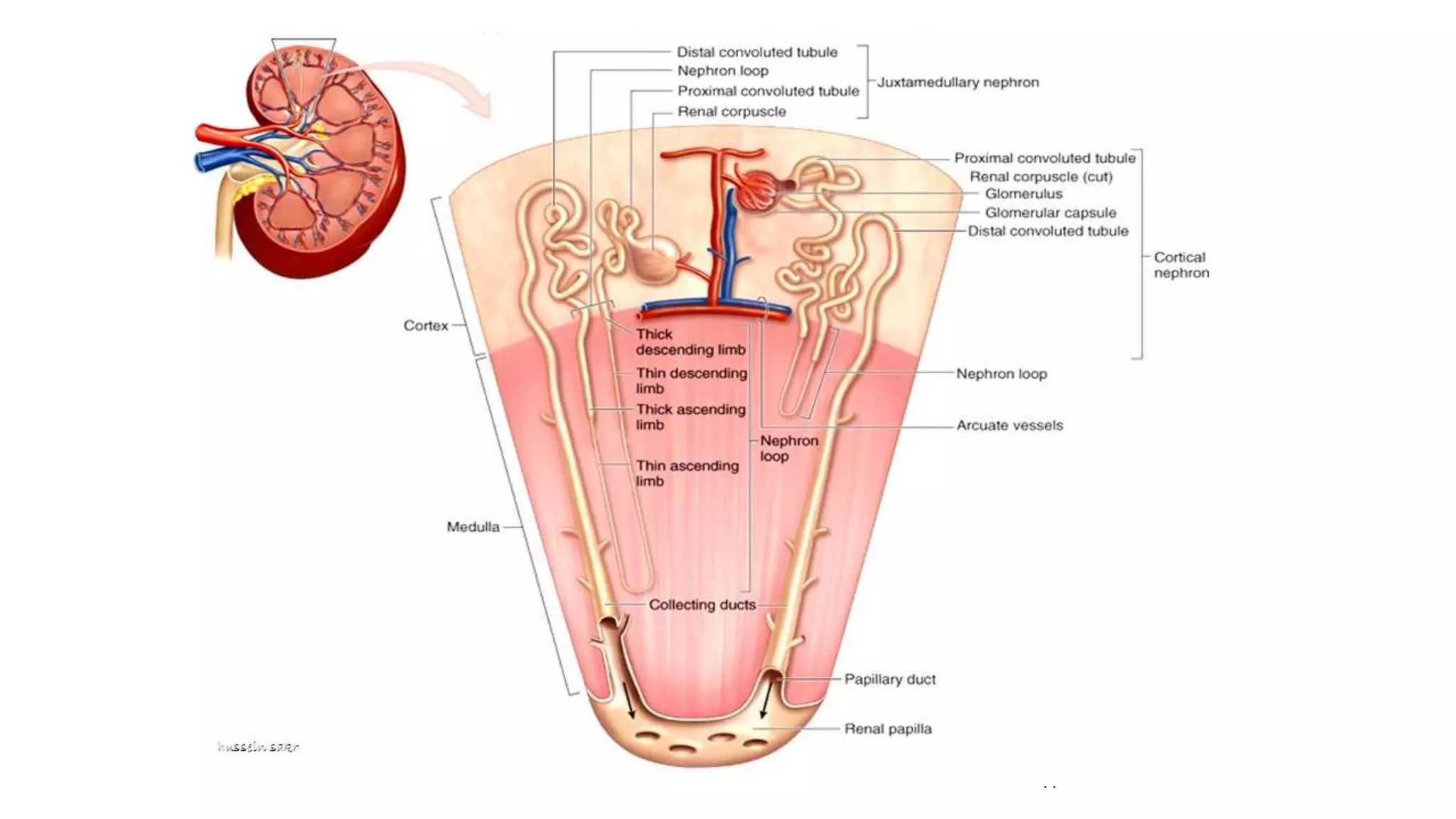
Nephron
it is the structural and functional unit of the kidney
Renal corpuscle
• Formed of:
1) glomerulus: 20-40 loop of
capillaries between afferent
and efferent arteriole.
2) Bowman’s capsule: which is
the blind end of the proximal
tubule.
Renal tubules
• Formed of:
1) Proximal tubule.
2) Intermediate tubule (loop of
Henle).
3) Distal tubule (distal
convoluted tubule, connecting
tubule and collecting duct.
10
11
12
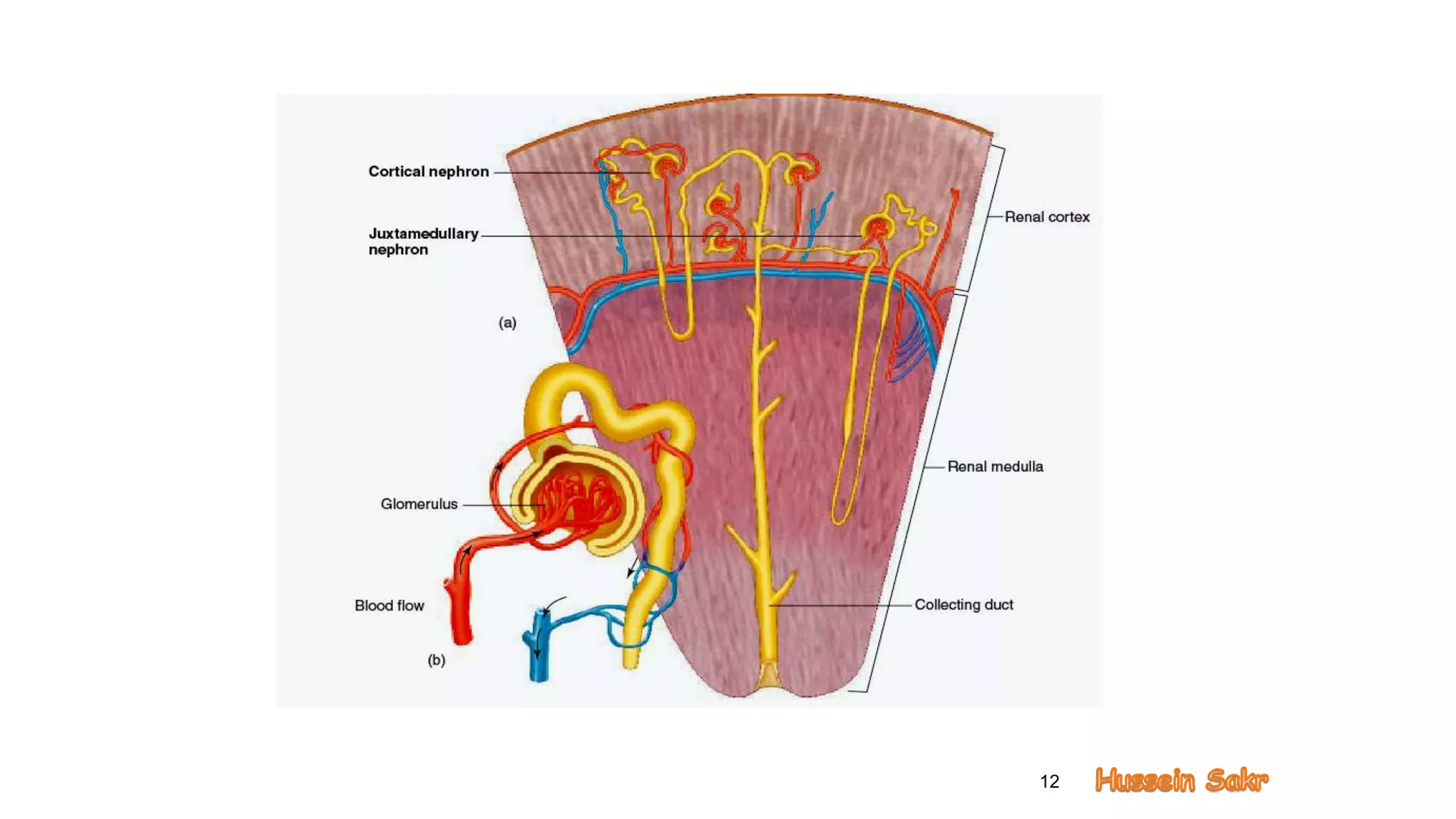
Types of nephrons
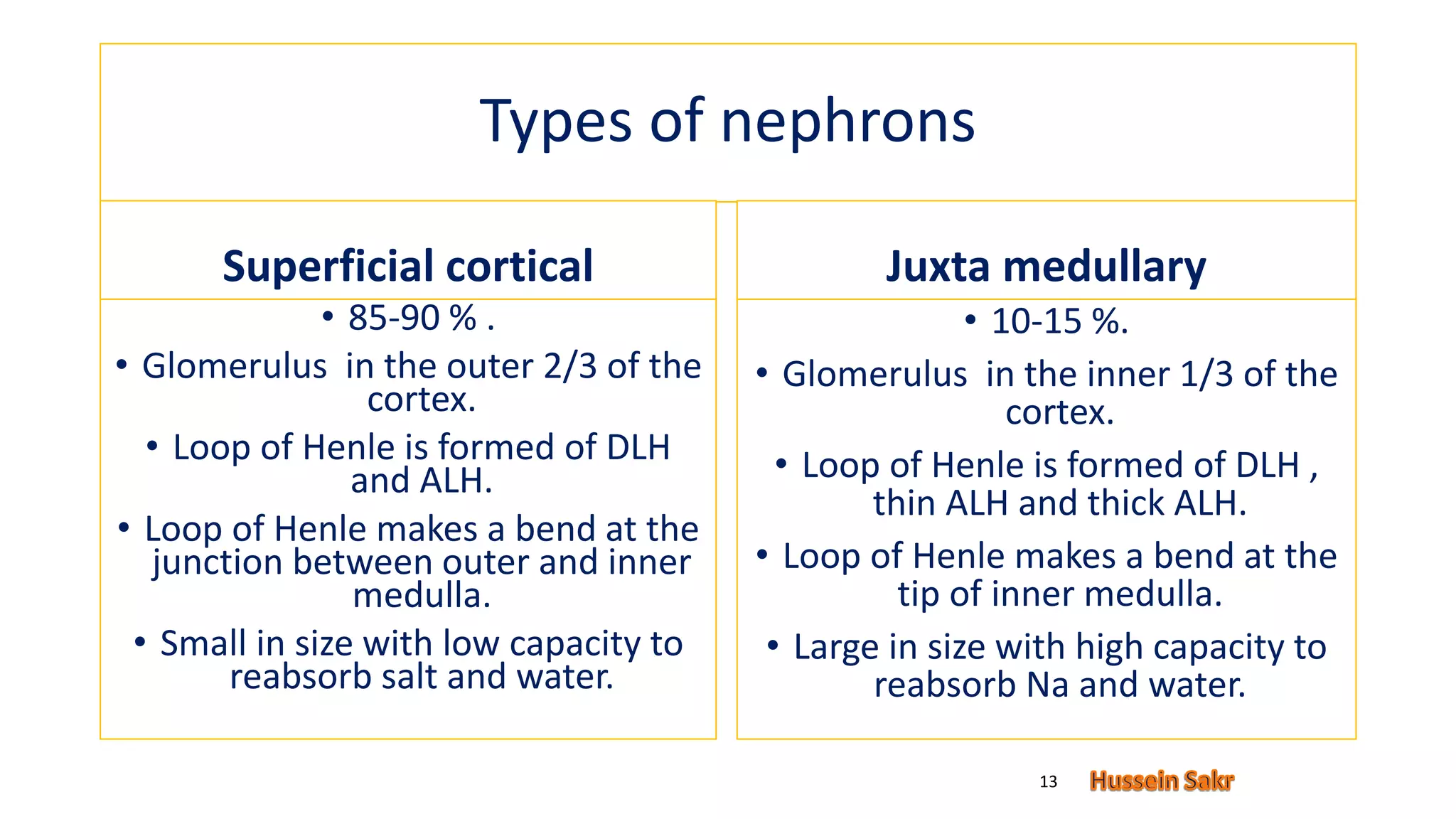
Superficial cortical
• 85-90 % .
• Glomerulus in the outer 2/3 of the
cortex.
• Loop of Henle is formed of DLH
and ALH.
• Loop of Henle makes a bend at the
junction between outer and inner
medulla.
• Small in size with low capacity to
reabsorb salt and water.
Juxta medullary
• 10-15 %.
• Glomerulus in the inner 1/3 of the
cortex.
• Loop of Henle is formed of DLH ,
thin ALH and thick ALH.
• Loop of Henle makes a bend at the
tip of inner medulla.
• Large in size with high capacity to
reabsorb Na and water.
13
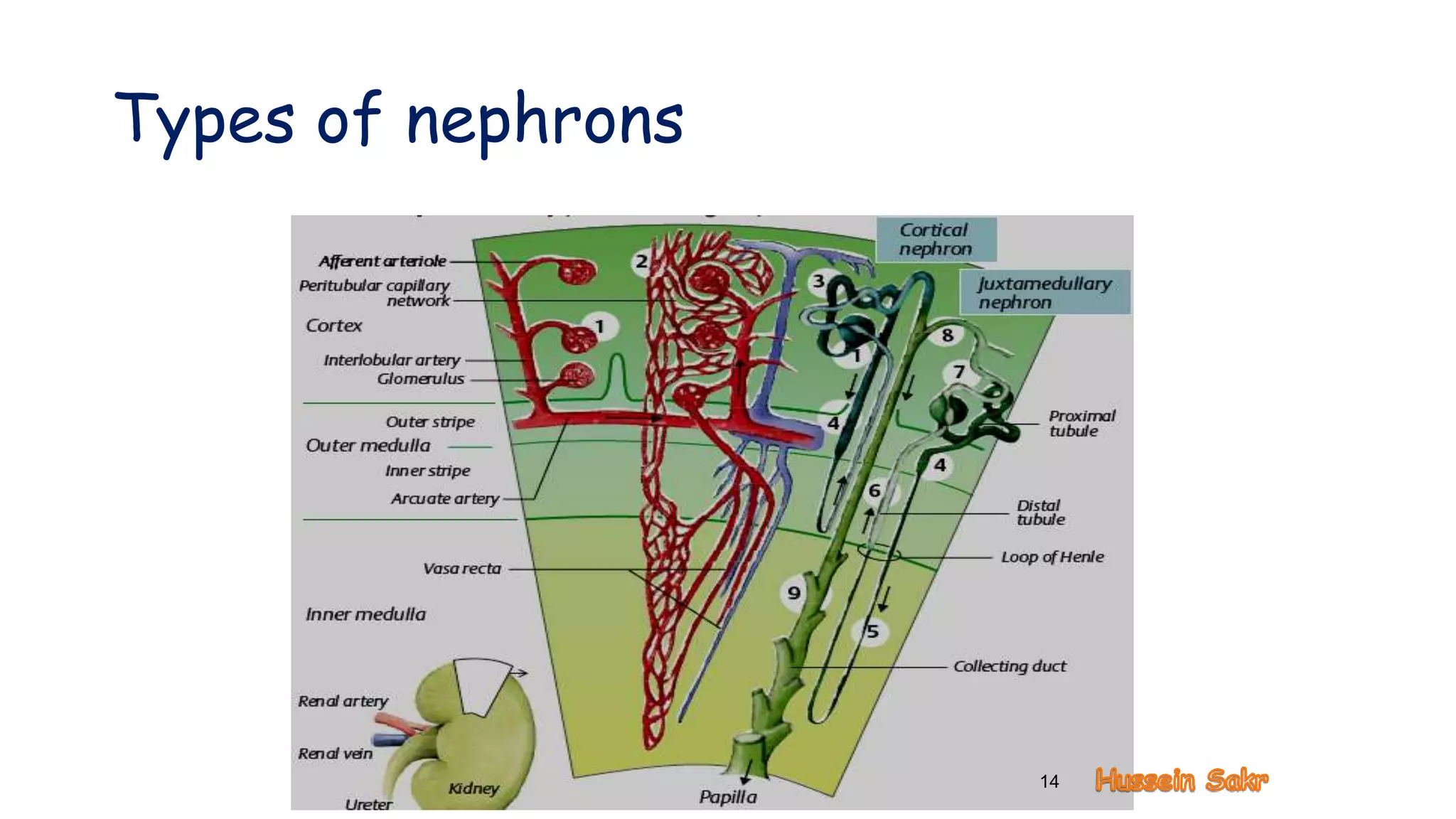
Types of nephrons
14
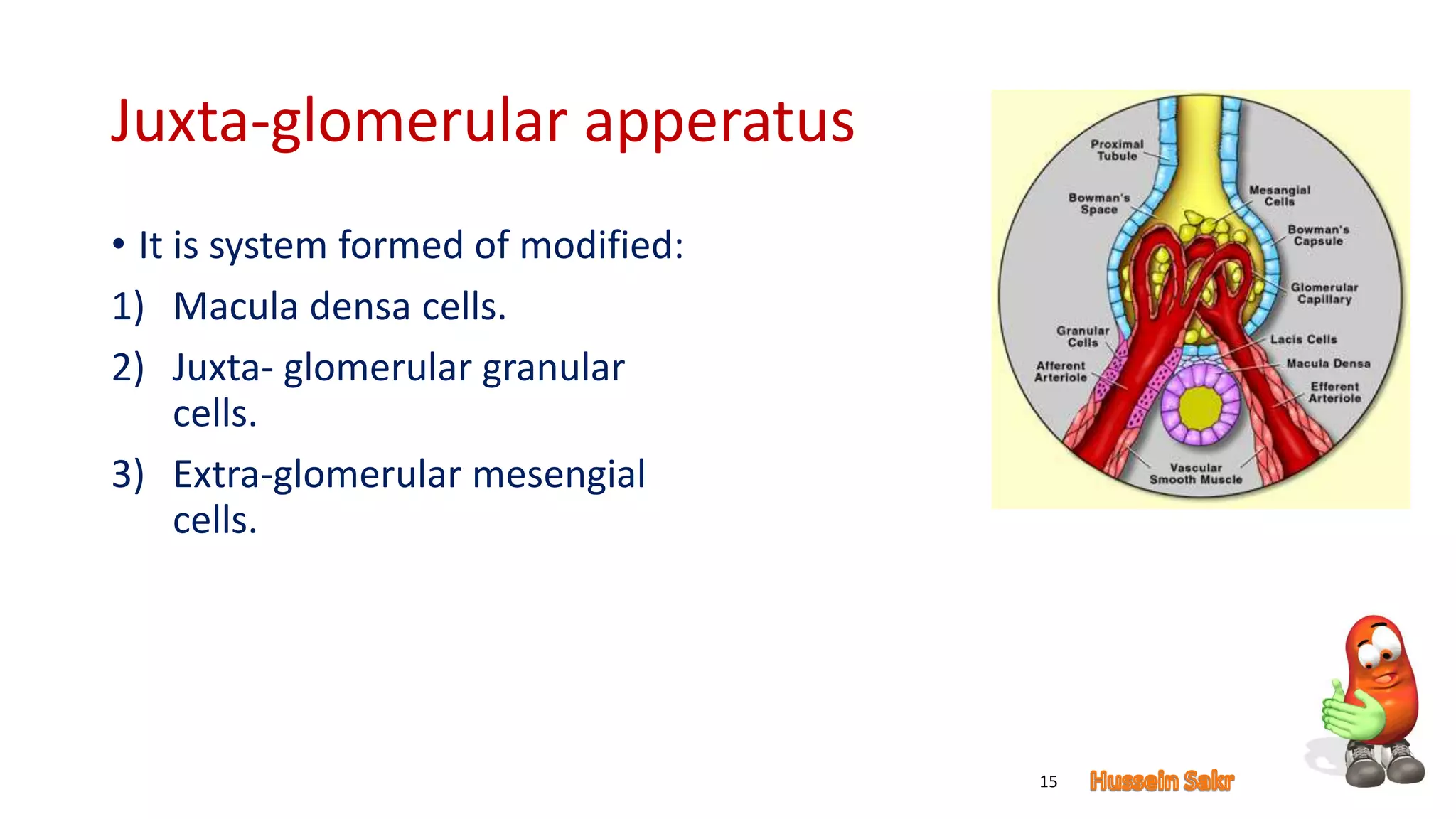
Juxta-glomerular apperatus
• It is system formed of modified:
1) Macula densa cells.
2) Juxta- glomerular granular
cells.
3) Extra-glomerular mesengial
cells.
15
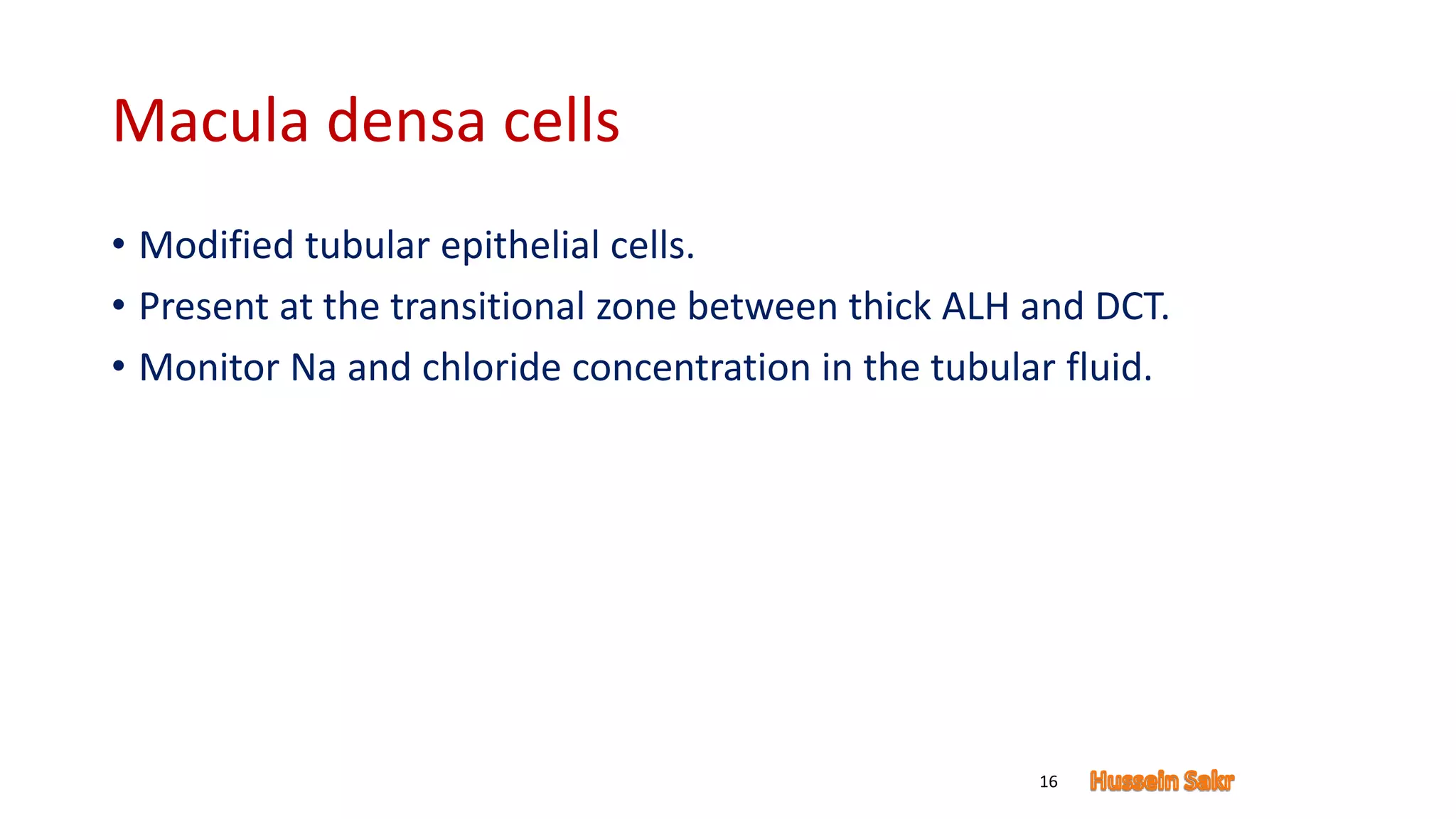
Macula densa cells
• Modified tubular epithelial cells.
• Present at the transitional zone between thick ALH and DCT.
• Monitor Na and chloride concentration in the tubular fluid.
16
Juxta glomerular granular cells
• Present in the wall of the afferent arteriole.
• Smooth muscles with epitheliod apperance.
• Forms , stores and secretes renin.
• Contains B1 adrenergic receptors.
• Acts also as baroreceptors.
17
Extraglomerular mesengial cells
• It is a continuation of the intraglomerular mesengial cells.
• It is in direct contact with the macula densa and juxtaglomerular
granular cells.
18
Stimuli for renin release
• Sympathetic stimulation.
• Renal ischemia.
• Decrease Na+ and Cl- concentration in the tubular fluid.
19
Mechanisms of stimulation:
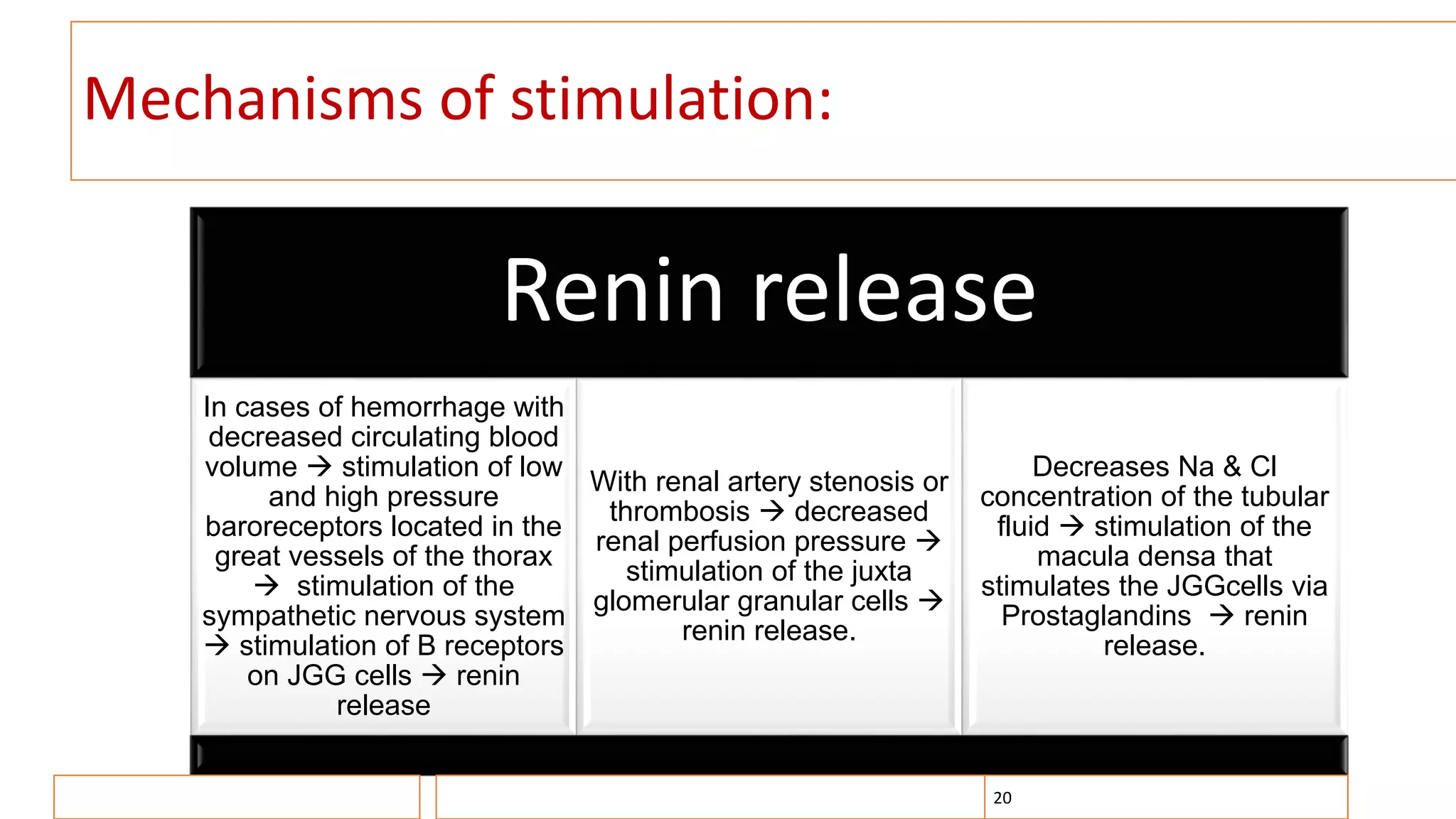
Renin release
In cases of hemorrhage with
decreased circulating blood
volume  stimulation of low
and high pressure
baroreceptors located in the
great vessels of the thorax
 stimulation of the
sympathetic nervous system
 stimulation of B receptors
on JGG cells  renin
release
With renal artery stenosis or
thrombosis  decreased
renal perfusion pressure 
stimulation of the juxta
glomerular granular cells 
renin release.
Decreases Na & Cl
concentration of the tubular
fluid  stimulation of the
macula densa that
stimulates the JGGcells via
Prostaglandins  renin
release.
20
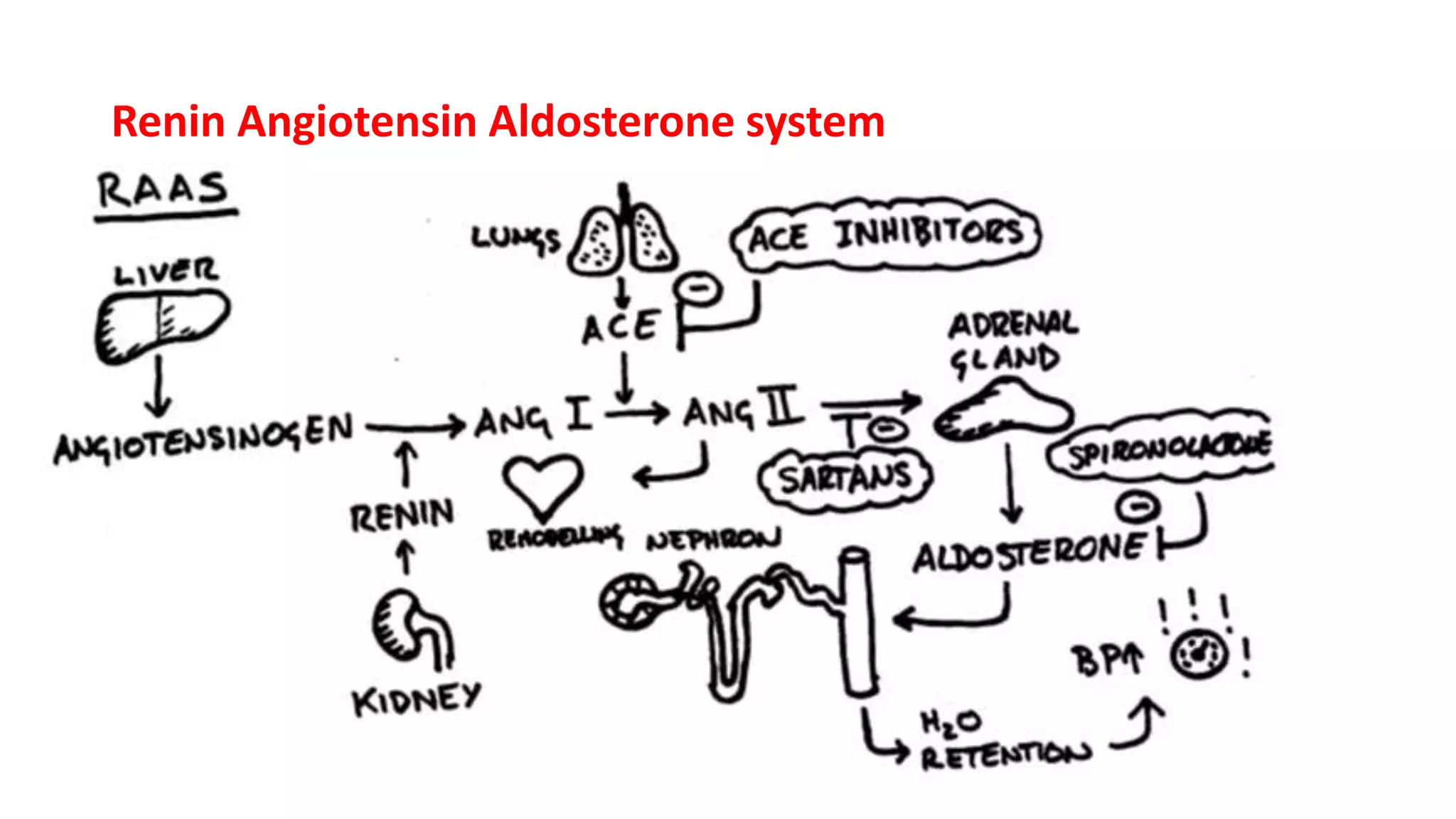
Renin Angiotensin Aldosterone system
21
Inhibitors of renin release
• Aldosterone .
• Atrial Nariuretic Peptide (ANP).
• AII.
• Hypernatremia.
22
Function of the renin angiotensin system
Salt and water retention
1- angitensin II increases Na
reabsorption from proximal
tubules.
2- AII stimulates the zona
glomerulosa of the adrenal
cortex to secrete aldoseterone
that increases Na reabsorption
from distal tubules.
Vasoconstriction
1- arteriolar constriction
increasing the afterload (arterial
blood pressure).
2- Venoconstriction increasing the
preload (venous return).
23
Pharmacological Inhibitors of the RAAS
• Angiotensin converting enzyme inhibitors: decreased the formation of
AII.
• Angiotensin II blockers: decreased aldosterone release.
• B- blockers.
24
25

Renal physiology, nephron structure, function,jga. hussein f. sakr

  • 1.
    Dr./ Hussein F.Sakr Copyright 2008 PresentationFx.com | Redistribution Prohibited | Image © 2008 Thomas Brian | This text section may be deleted for presentation. Renal Physiology
  • 2.
    Anatomy of thekidney • The kidney is a retroperitoneal organ, about 150 gm in weight (2 kidneys  0.5 % of the body weight). • It is covered by a renal capsule and renal fascia. 2
  • 3.
    Structure of thekidney • The kidney is divided into an outer cortex and inner medulla. - The medulla is composed of renal pyramids, separated by renal columns. - The renal pyramids empty urine into the calyces that drain into the renal pelvis. From there urine flows into the ureter and is transported to the bladder to be stored. 3
  • 4.
    General function ofthe kidney • Regulate ECF volume. • Regulation of electrolytes. • Regulation of arterial blood pressure. • Regulation of pH (acid-base balance). • Excretion of waste products. • Endocrinal function (renin- erythropoietin- active vitamin D). • Degradation of hormones. 4
  • 5.
    Functional organization ofthe kidney • Renal cortex: Red and dotted. Contains glomeruli. Contains proximal tubules, distal convoluted tubules and cortical collecting duct. • Renal medulla: Pale and radial. Contains renal pyramids which contain minor calyces that unite to form major calyces. Contains loop of Henle and medulary collecting ducts. 5
  • 6.
  • 7.
    Blood supply ofthe kidney • The kidneys receives its blood through the renal artery. • The renal artery is divided into anterior and posterior branches  each one divides into 5 segmental branches interlobar  arcuate  interlobular  afferent  glomerular capillaries  efferent arteriole. • Efferent arteriole  peritubular capillary and vasa recta  interlobular vein  interlobar vein  segmental  renal vein  IVC. 7
  • 8.
  • 9.
  • 10.
    Nephron it is thestructural and functional unit of the kidney Renal corpuscle • Formed of: 1) glomerulus: 20-40 loop of capillaries between afferent and efferent arteriole. 2) Bowman’s capsule: which is the blind end of the proximal tubule. Renal tubules • Formed of: 1) Proximal tubule. 2) Intermediate tubule (loop of Henle). 3) Distal tubule (distal convoluted tubule, connecting tubule and collecting duct. 10
  • 11.
  • 12.
  • 13.
    Types of nephrons Superficialcortical • 85-90 % . • Glomerulus in the outer 2/3 of the cortex. • Loop of Henle is formed of DLH and ALH. • Loop of Henle makes a bend at the junction between outer and inner medulla. • Small in size with low capacity to reabsorb salt and water. Juxta medullary • 10-15 %. • Glomerulus in the inner 1/3 of the cortex. • Loop of Henle is formed of DLH , thin ALH and thick ALH. • Loop of Henle makes a bend at the tip of inner medulla. • Large in size with high capacity to reabsorb Na and water. 13
  • 14.
  • 15.
    Juxta-glomerular apperatus • Itis system formed of modified: 1) Macula densa cells. 2) Juxta- glomerular granular cells. 3) Extra-glomerular mesengial cells. 15
  • 16.
    Macula densa cells •Modified tubular epithelial cells. • Present at the transitional zone between thick ALH and DCT. • Monitor Na and chloride concentration in the tubular fluid. 16
  • 17.
    Juxta glomerular granularcells • Present in the wall of the afferent arteriole. • Smooth muscles with epitheliod apperance. • Forms , stores and secretes renin. • Contains B1 adrenergic receptors. • Acts also as baroreceptors. 17
  • 18.
    Extraglomerular mesengial cells •It is a continuation of the intraglomerular mesengial cells. • It is in direct contact with the macula densa and juxtaglomerular granular cells. 18
  • 19.
    Stimuli for reninrelease • Sympathetic stimulation. • Renal ischemia. • Decrease Na+ and Cl- concentration in the tubular fluid. 19
  • 20.
    Mechanisms of stimulation: Reninrelease In cases of hemorrhage with decreased circulating blood volume  stimulation of low and high pressure baroreceptors located in the great vessels of the thorax  stimulation of the sympathetic nervous system  stimulation of B receptors on JGG cells  renin release With renal artery stenosis or thrombosis  decreased renal perfusion pressure  stimulation of the juxta glomerular granular cells  renin release. Decreases Na & Cl concentration of the tubular fluid  stimulation of the macula densa that stimulates the JGGcells via Prostaglandins  renin release. 20
  • 21.
  • 22.
    Inhibitors of reninrelease • Aldosterone . • Atrial Nariuretic Peptide (ANP). • AII. • Hypernatremia. 22
  • 23.
    Function of therenin angiotensin system Salt and water retention 1- angitensin II increases Na reabsorption from proximal tubules. 2- AII stimulates the zona glomerulosa of the adrenal cortex to secrete aldoseterone that increases Na reabsorption from distal tubules. Vasoconstriction 1- arteriolar constriction increasing the afterload (arterial blood pressure). 2- Venoconstriction increasing the preload (venous return). 23
  • 24.
    Pharmacological Inhibitors ofthe RAAS • Angiotensin converting enzyme inhibitors: decreased the formation of AII. • Angiotensin II blockers: decreased aldosterone release. • B- blockers. 24
  • 25.