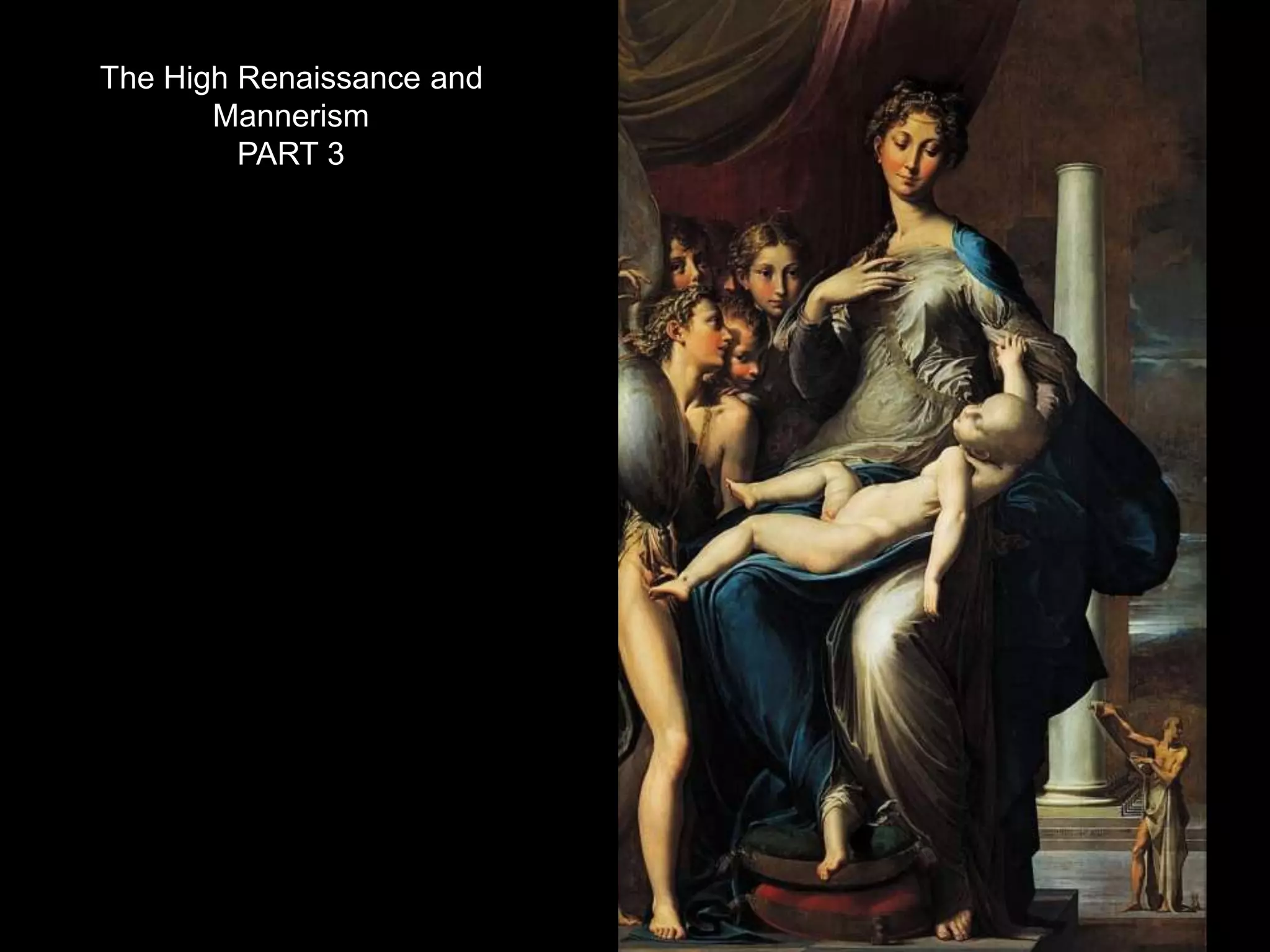
The High Renaissance and
Mannerism
PART 3
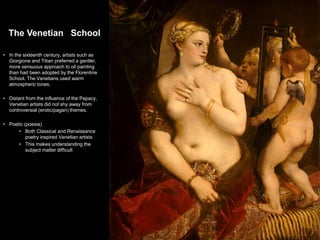
The Venetian School
• In the sixteenth century, artists such as
Giorgione and Titian preferred a gentler,
more sensuous approach to oil painting
than had been adopted by the Florentine
School. The Venetians used warm
atmospheric tones.
• Distant from the influence of the Papacy,
Venetian artists did not shy away from
controversial (erotic/pagan) themes.
• Poetic (poesia)
• Both Classical and Renaissance
poetry inspired Venetian artists
• This makes understanding the
subject matter difficult
2
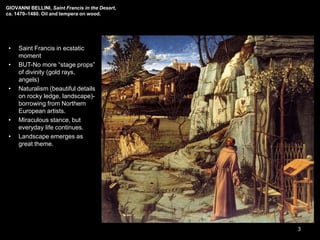
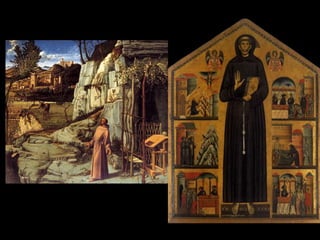
GIOVANNI BELLINI, Saint Francis in the Desert,
ca. 1470–1480. Oil and tempera on wood.
• Saint Francis in ecstatic
moment
• BUT-No more “stage props”
of divinity (gold rays,
angels)
• Naturalism (beautiful details
on rocky ledge, landscape)-
borrowing from Northern
European artists.
• Miraculous stance, but
everyday life continues.
• Landscape emerges as
great theme.
3
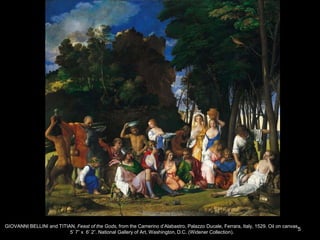
GIOVANNI BELLINI and TITIAN, Feast of the Gods, from the Camerino d’Alabastro, Palazzo Ducale, Ferrara, Italy, 1529. Oil on canvas,
5’ 7” x 6’ 2”. National Gallery of Art, Washington, D.C. (Widener Collection).
5
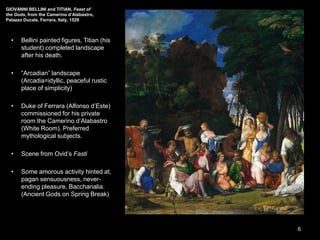
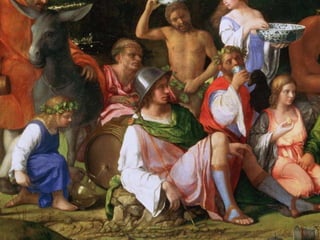
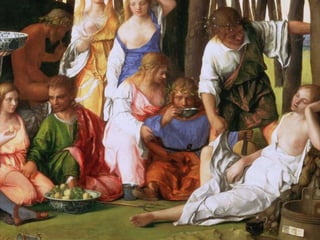
GIOVANNI BELLINI and TITIAN, Feast of
the Gods, from the Camerino d’Alabastro,
Palazzo Ducale, Ferrara, Italy, 1529
• Bellini painted figures, Titian (his
student) completed landscape
after his death.
• “Arcadian” landscape
(Arcadia=idyllic, peaceful rustic
place of simplicity)
• Duke of Ferrara (Alfonso d’Este)
commissioned for his private
room the Camerino d’Alabastro
(White Room). Preferred
mythological subjects.
• Scene from Ovid’s Fasti
• Some amorous activity hinted at,
pagan sensuousness, never-
ending pleasure. Bacchanalia.
(Ancient Gods on Spring Break)
6
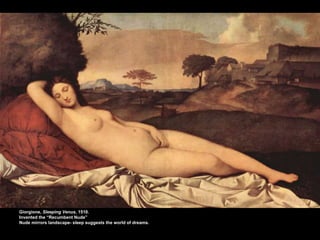
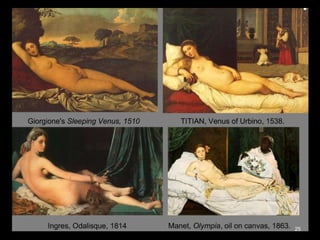
Giorgione, Sleeping Venus, 1510.
Invented the “Recumbent Nude”
Nude mirrors landscape- sleep suggests the world of dreams.
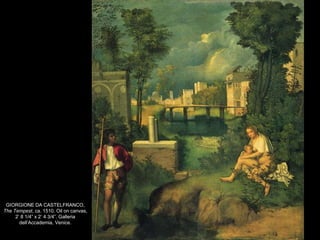
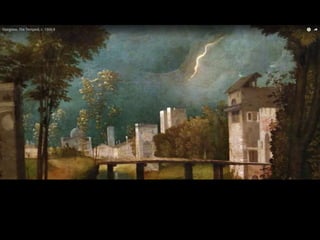
GIORGIONE DA CASTELFRANCO,
The Tempest, ca. 1510. Oil on canvas,
2’ 8 1/4” x 2’ 4 3/4”. Galleria
dell’Accademia, Venice.
11
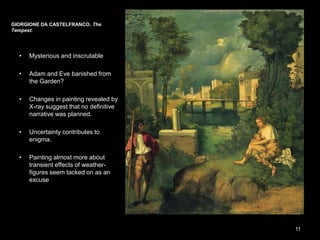
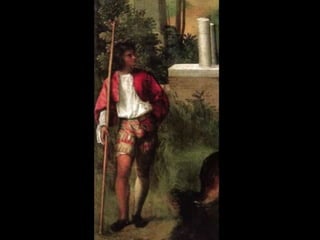
GIORGIONE DA CASTELFRANCO, The
Tempest.
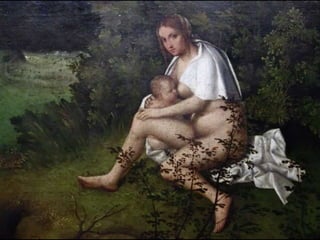
• Mysterious and inscrutable
• Adam and Eve banished from
the Garden?
• Changes in painting revealed by
X-ray suggest that no definitive
narrative was planned.
• Uncertainty contributes to
enigma.
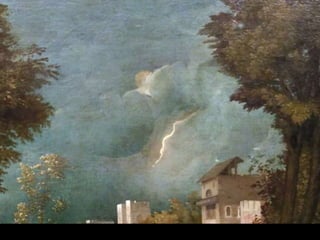
• Painting almost more about
transient effects of weather-
figures seem tacked on as an
excuse
12
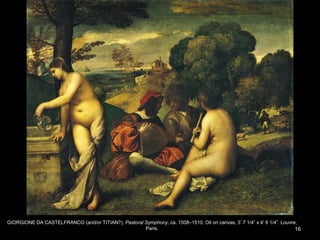
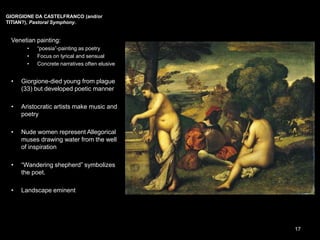
GIORGIONE DA CASTELFRANCO (and/or TITIAN?), Pastoral Symphony, ca. 1508–1510. Oil on canvas, 3’ 7 1/4” x 4’ 6 1/4”. Louvre,
Paris. 17
GIORGIONE DA CASTELFRANCO (and/or
TITIAN?), Pastoral Symphony.
Venetian painting:
• “poesia”-painting as poetry
• Focus on lyrical and sensual
• Concrete narratives often elusive
• Giorgione-died young from plague
(33) but developed poetic manner
• Aristocratic artists make music and
poetry
• Nude women represent Allegorical
muses drawing water from the well
of inspiration
• “Wandering shepherd” symbolizes
the poet.
• Landscape eminent
18
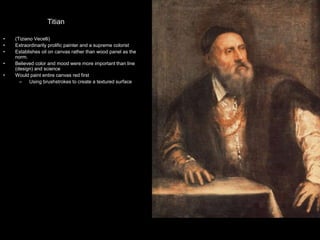
Titian
• (Tiziano Vecelli)
• Extraordinarily prolific painter and a supreme colorist
• Establishes oil on canvas rather than wood panel as the
norm.
• Believed color and mood were more important than line
(design) and science
• Would paint entire canvas red first
– Using brushstrokes to create a textured surface
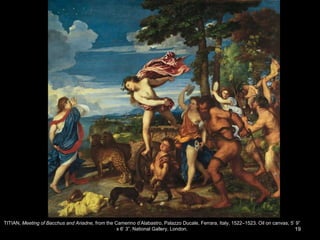
TITIAN, Meeting of Bacchus and Ariadne, from the Camerino d’Alabastro, Palazzo Ducale, Ferrara, Italy, 1522–1523. Oil on canvas, 5’ 9”
x 6’ 3”. National Gallery, London. 20
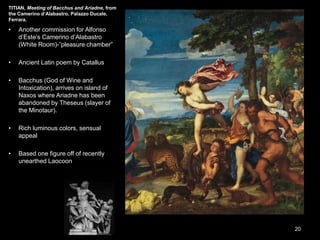
TITIAN, Meeting of Bacchus and Ariadne, from
the Camerino d’Alabastro, Palazzo Ducale,
Ferrara.
• Another commission for Alfonso
d’Este’s Camerino d’Alabastro
(White Room)-”pleasure chamber”
• Ancient Latin poem by Catallus
• Bacchus (God of Wine and
Intoxication), arrives on island of
Naxos where Ariadne has been
abandoned by Theseus (slayer of
the Minotaur).
• Rich luminous colors, sensual
appeal
• Based one figure off of recently
unearthed Laocoon
21
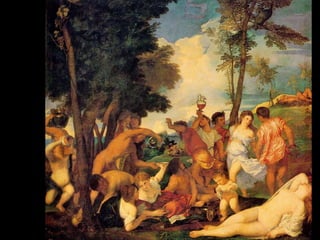
Titian, Bacchanal of the Andrians
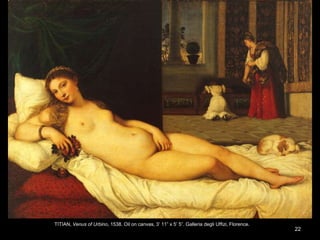
TITIAN, Venus of Urbino, 1538. Oil on canvas, 3’ 11” x 5’ 5”. Galleria degli Uffizi, Florence.
23
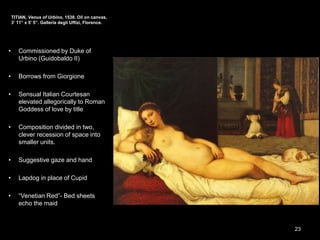
TITIAN, Venus of Urbino, 1538. Oil on canvas,
3’ 11” x 5’ 5”. Galleria degli Uffizi, Florence.
• Commissioned by Duke of
Urbino (Guidobaldo II)
• Borrows from Giorgione
• Sensual Italian Courtesan
elevated allegorically to Roman
Goddess of love by title
• Composition divided in two,
clever recession of space into
smaller units.
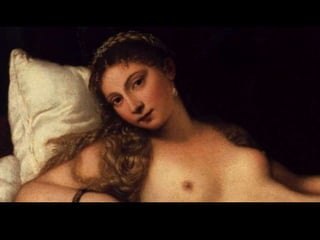
• Suggestive gaze and hand
• Lapdog in place of Cupid
• “Venetian Red”- Bed sheets
echo the maid
24
26
27
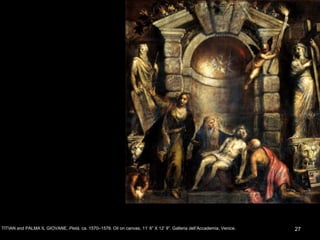
TITIAN and PALMA IL GIOVANE, Pietà, ca. 1570–1576. Oil on canvas, 11’ 6” X 12’ 9”. Galleria dell’Accademia, Venice. 28
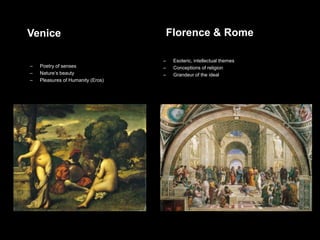
Venice
– Poetry of senses
– Nature’s beauty
– Pleasures of Humanity (Eros)
Florence & Rome
– Esoteric, intellectual themes
– Conceptions of religion
– Grandeur of the ideal
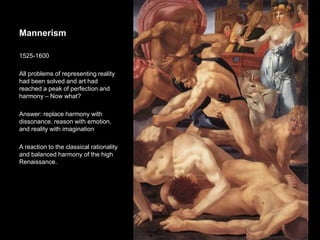
Mannerism
1525-1600
All problems of representing reality
had been solved and art had
reached a peak of perfection and
harmony – Now what?
Answer: replace harmony with
dissonance, reason with emotion,
and reality with imagination
A reaction to the classical rationality
and balanced harmony of the high
Renaissance.
30
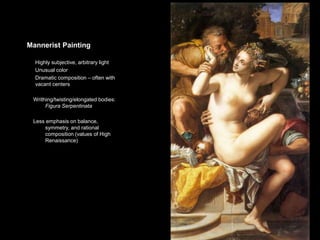
Mannerist Painting
Highly subjective, arbitrary light
Unusual color
Dramatic composition – often with
vacant centers
Writhing/twisting/elongated bodies:
Figura Serpentinata
Less emphasis on balance,
symmetry, and rational
composition (values of High
Renaissance)
31
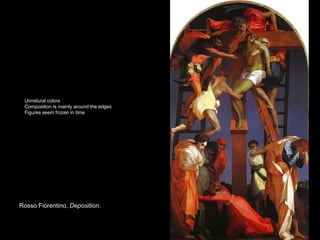
Rosso Fiorentino, Deposition.
Unnatural colors
Composition is mainly around the edges
Figures seem frozen in time
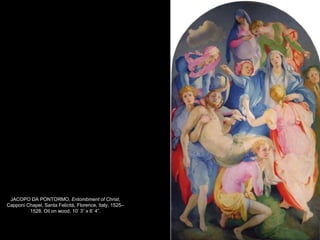
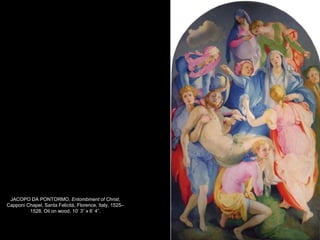
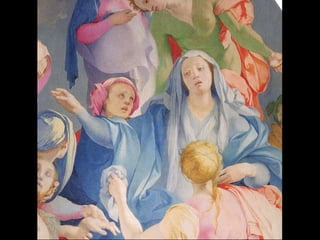
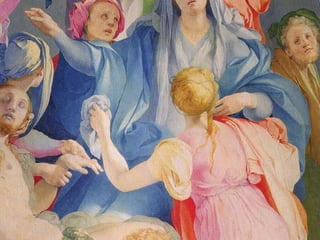
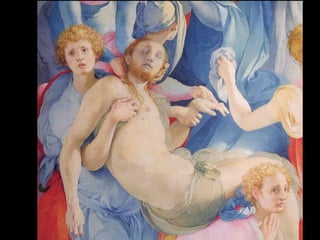
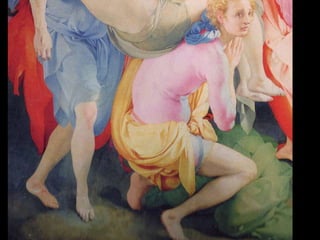
JACOPO DA PONTORMO, Entombment of Christ,
Capponi Chapel, Santa Felicità, Florence, Italy, 1525–
1528. Oil on wood, 10’ 3” x 6’ 4”.
33
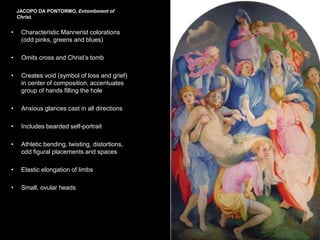
JACOPO DA PONTORMO, Entombment of
Christ.
• Characteristic Mannerist colorations
(odd pinks, greens and blues)
• Omits cross and Christ’s tomb
• Creates void (symbol of loss and grief)
in center of composition, accentuates
group of hands filling the hole
• Anxious glances cast in all directions
• Includes bearded self-portrait
• Athletic bending, twisting, distortions,
odd figural placements and spaces
• Elastic elongation of limbs
• Small, ovular heads
36
JACOPO DA PONTORMO, Entombment of Christ,
Capponi Chapel, Santa Felicità, Florence, Italy, 1525–
1528. Oil on wood, 10’ 3” x 6’ 4”.
37
40
43
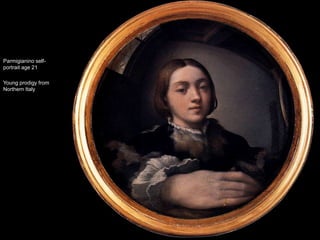
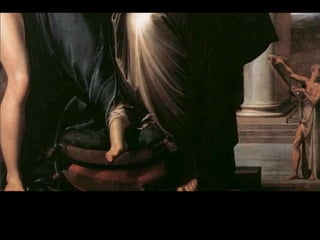
Parmigianino self-
portrait age 21
Young prodigy from
Northern Italy
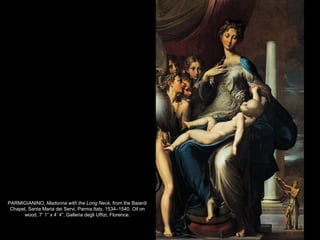
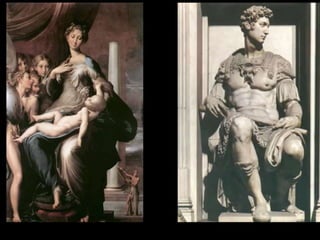
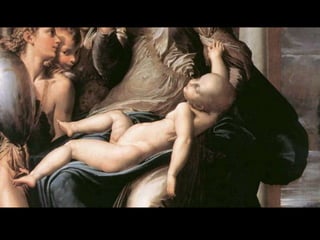
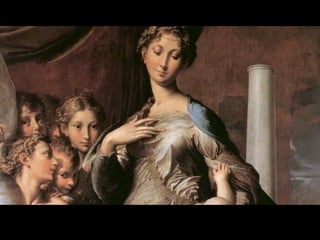
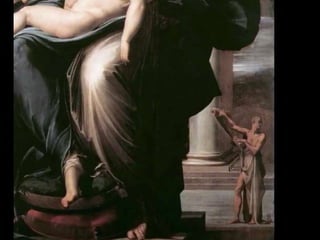
PARMIGIANINO, Madonna with the Long Neck, from the Baiardi
Chapel, Santa Maria dei Servi, Parma,Italy, 1534–1540. Oil on
wood, 7’ 1” x 4’ 4”. Galleria degli Uffizi, Florence.
44
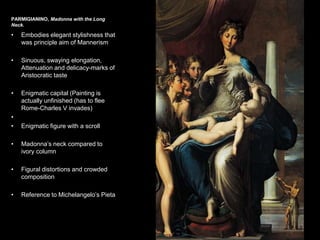
PARMIGIANINO, Madonna with the Long
Neck.
• Embodies elegant stylishness that
was principle aim of Mannerism
• Sinuous, swaying elongation,
Attenuation and delicacy-marks of
Aristocratic taste
• Enigmatic capital (Painting is
actually unfinished (has to flee
Rome-Charles V invades)
•
• Enigmatic figure with a scroll
• Madonna’s neck compared to
ivory column
• Figural distortions and crowded
composition
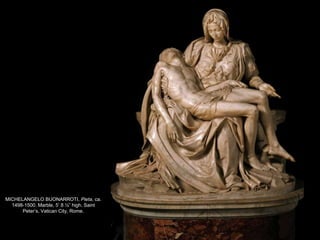
• Reference to Michelangelo’s Pieta
45
MICHELANGELO BUONARROTI, Pieta, ca.
1498-1500. Marble, 5’ 8 ½” high. Saint
Peter’s, Vatican City, Rome.
48
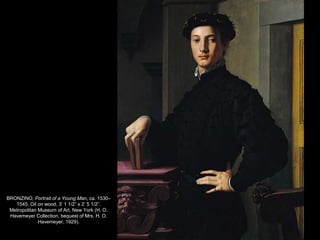
BRONZINO, Portrait of a Young Man, ca. 1530–
1545. Oil on wood, 3’ 1 1/2” x 2’ 5 1/2”.
Metropolitan Museum of Art, New York (H. O.
Havemeyer Collection, bequest of Mrs. H. O.
Havemeyer, 1929).
52
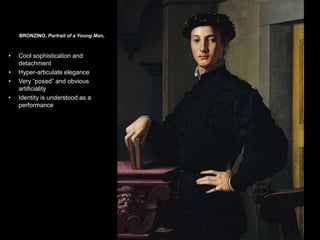
BRONZINO, Portrait of a Young Man,
• Cool sophistication and
detachment
• Hyper-articulate elegance
• Very “posed” and obvious
artificiality
• Identity is understood as a
performance
53
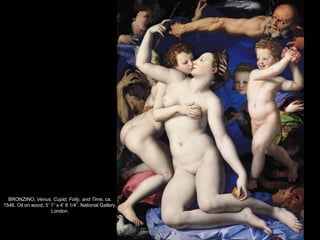
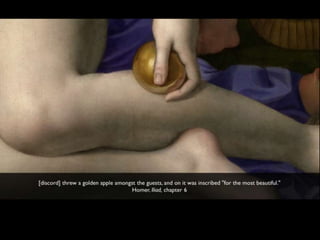
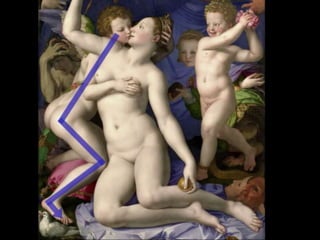
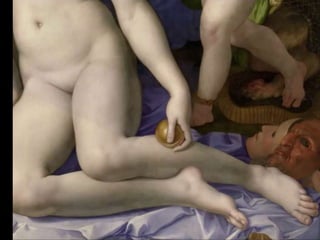
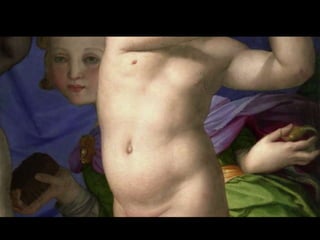
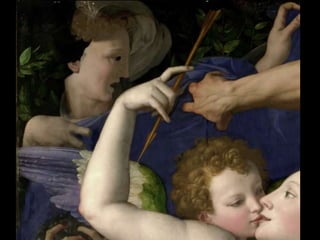
BRONZINO, Venus, Cupid, Folly, and Time, ca.
1546. Oil on wood, 5’ 1” x 4’ 8 1/4”. National Gallery,
London.
54
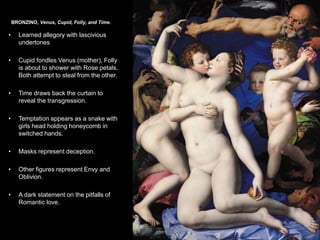
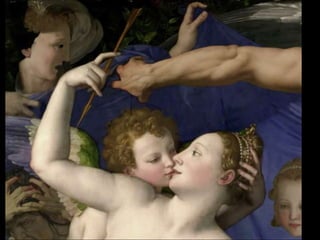
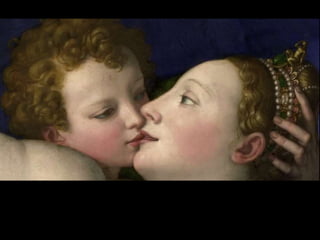
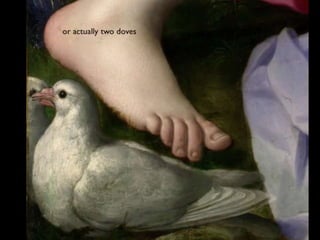
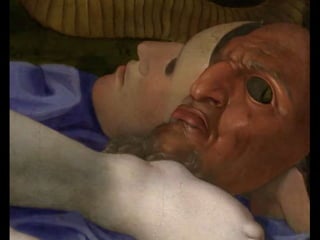
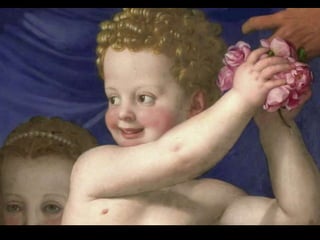
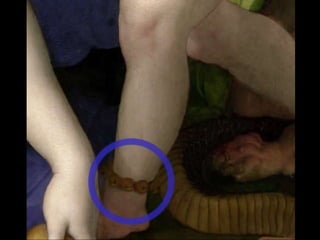
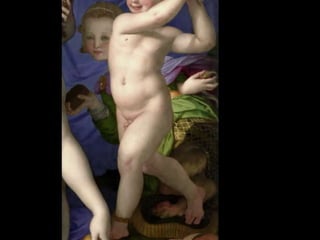
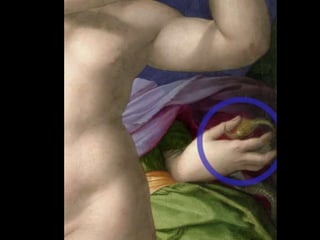
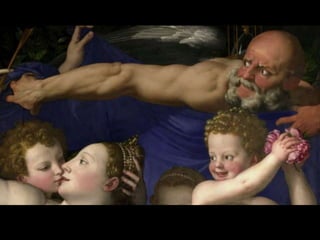
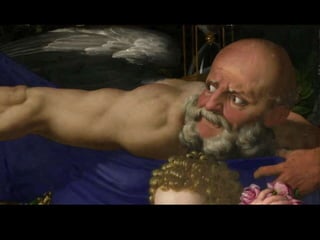
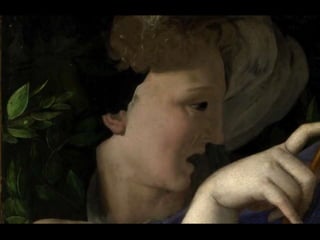
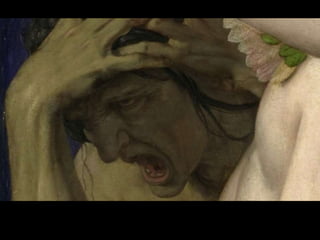
BRONZINO, Venus, Cupid, Folly, and Time.
• Learned allegory with lascivious
undertones
• Cupid fondles Venus (mother), Folly
is about to shower with Rose petals.
Both attempt to steal from the other.
• Time draws back the curtain to
reveal the transgression.
• Temptation appears as a snake with
girls head holding honeycomb in
switched hands.
• Masks represent deception.
• Other figures represent Envy and
Oblivion.
• A dark statement on the pitfalls of
Romantic love.
55
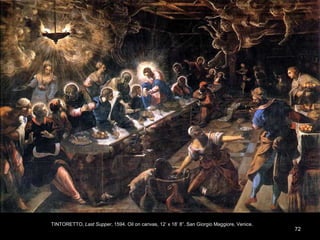
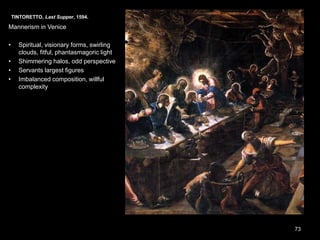
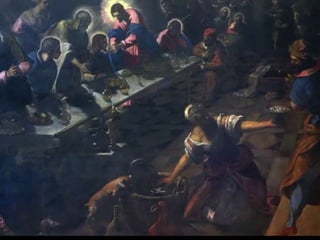
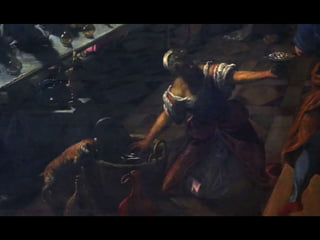
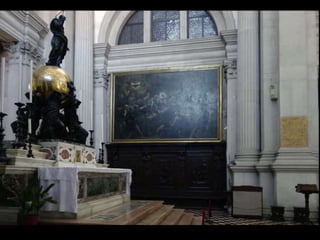
TINTORETTO, Last Supper, 1594. Oil on canvas, 12’ x 18’ 8”. San Giorgio Maggiore, Venice.
73
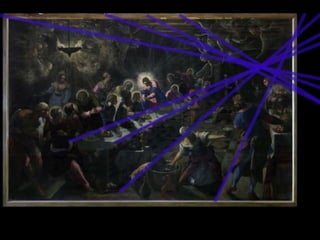
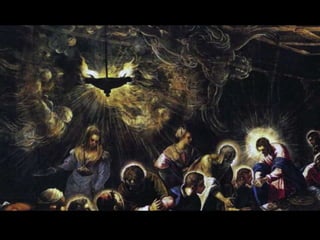
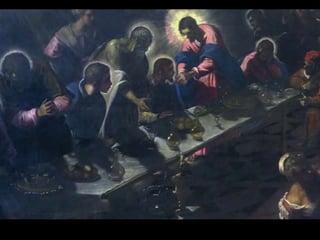
TINTORETTO, Last Supper, 1594.
Mannerism in Venice
• Spiritual, visionary forms, swirling
clouds, fitful, phantasmagoric light
• Shimmering halos, odd perspective
• Servants largest figures
• Imbalanced composition, willful
complexity
75
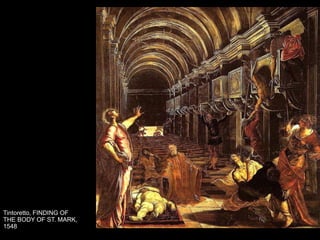
Tintoretto, FINDING OF
THE BODY OF ST. MARK,
1548
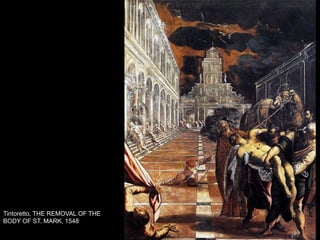
Tintoretto, THE REMOVAL OF THE
BODY OF ST. MARK, 1548
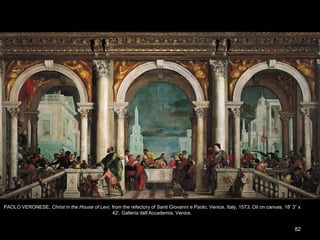
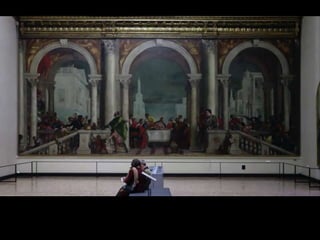
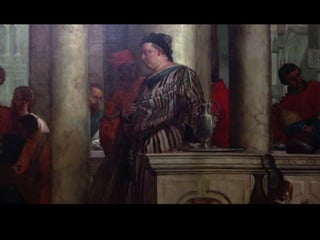
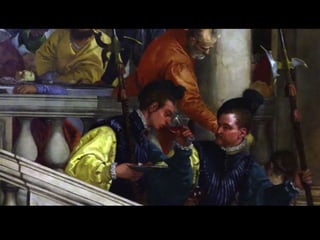
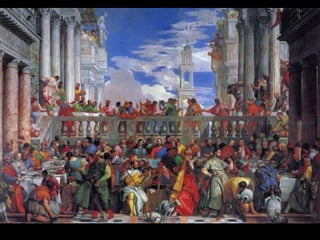
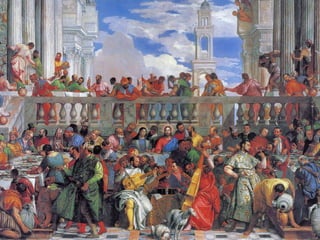
PAOLO VERONESE, Christ in the House of Levi, from the refectory of Santi Giovanni e Paolo, Venice, Italy, 1573. Oil on canvas, 18’ 3” x
42’. Galleria dell’Accademia, Venice.
84
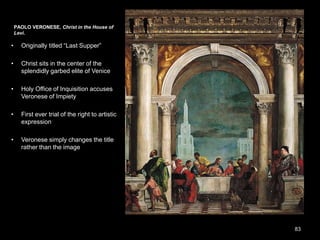
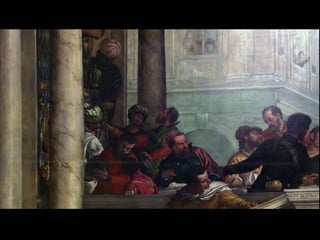
PAOLO VERONESE, Christ in the House of
Levi.
• Originally titled “Last Supper”
• Christ sits in the center of the
splendidly garbed elite of Venice
• Holy Office of Inquisition accuses
Veronese of Impiety
• First ever trial of the right to artistic
expression
• Veronese simply changes the title
rather than the image
85
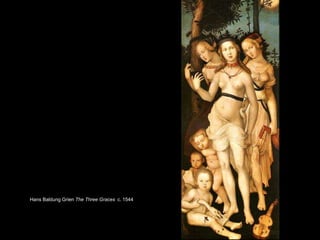
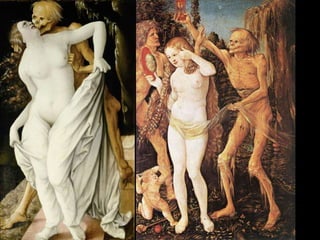
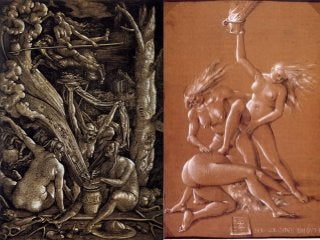
Hans Baldung Grien The Three Graces c. 1544
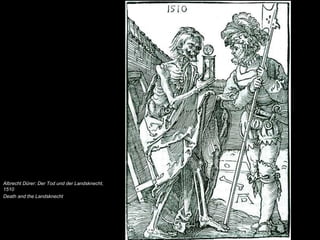
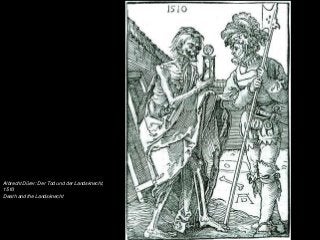
Albrecht Dürer: Der Tod und der Landsknecht,
1510
Death and the Landsknecht
105
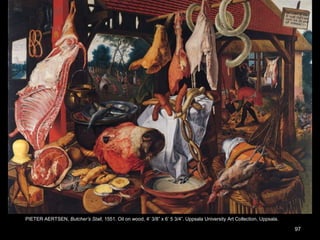
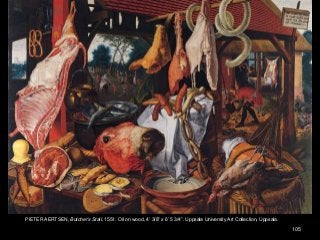
PIETER AERTSEN, Butcher’s Stall, 1551. Oil on wood, 4’ 3/8” x 6’ 5 3/4”. Uppsala University Art Collection, Uppsala.
106
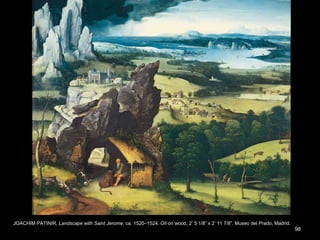
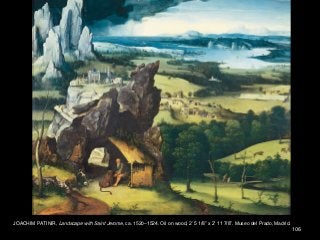
JOACHIM PATINIR, Landscape with Saint Jerome, ca. 1520–1524. Oil on wood, 2’ 5 1/8” x 2’ 11 7/8”. Museo del Prado, Madrid.
107
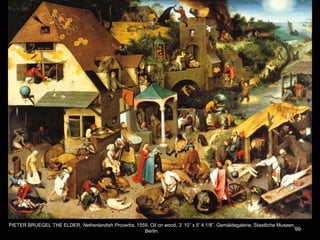
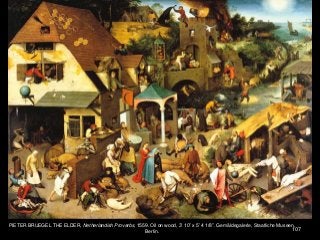
PIETER BRUEGEL THE ELDER, Netherlandish Proverbs, 1559. Oil on wood, 3’ 10” x 5’ 4 1/8”. Gemäldegalerie, Staatliche Museen,
Berlin.
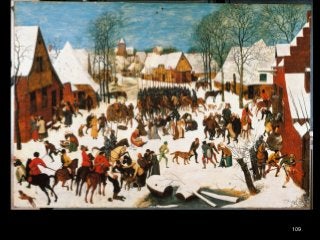
108
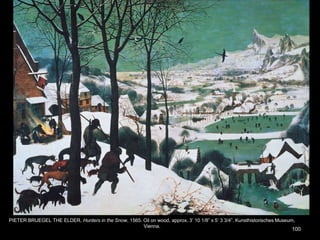
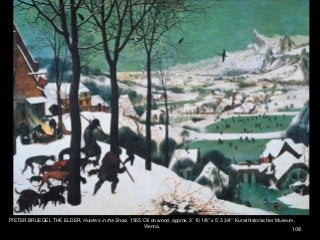
PIETER BRUEGEL THE ELDER, Hunters in the Snow, 1565. Oil on wood, approx. 3’ 10 1/8” x 5’ 3 3/4”. Kunsthistorisches Museum,
Vienna.
109

High Renaissance and Mannerism PART 3

  • 1.
    The High Renaissanceand Mannerism PART 3
  • 2.
    The Venetian School •In the sixteenth century, artists such as Giorgione and Titian preferred a gentler, more sensuous approach to oil painting than had been adopted by the Florentine School. The Venetians used warm atmospheric tones. • Distant from the influence of the Papacy, Venetian artists did not shy away from controversial (erotic/pagan) themes. • Poetic (poesia) • Both Classical and Renaissance poetry inspired Venetian artists • This makes understanding the subject matter difficult 2
  • 3.
    GIOVANNI BELLINI, SaintFrancis in the Desert, ca. 1470–1480. Oil and tempera on wood. • Saint Francis in ecstatic moment • BUT-No more “stage props” of divinity (gold rays, angels) • Naturalism (beautiful details on rocky ledge, landscape)- borrowing from Northern European artists. • Miraculous stance, but everyday life continues. • Landscape emerges as great theme. 3
  • 5.
    GIOVANNI BELLINI andTITIAN, Feast of the Gods, from the Camerino d’Alabastro, Palazzo Ducale, Ferrara, Italy, 1529. Oil on canvas, 5’ 7” x 6’ 2”. National Gallery of Art, Washington, D.C. (Widener Collection). 5
  • 6.
    GIOVANNI BELLINI andTITIAN, Feast of the Gods, from the Camerino d’Alabastro, Palazzo Ducale, Ferrara, Italy, 1529 • Bellini painted figures, Titian (his student) completed landscape after his death. • “Arcadian” landscape (Arcadia=idyllic, peaceful rustic place of simplicity) • Duke of Ferrara (Alfonso d’Este) commissioned for his private room the Camerino d’Alabastro (White Room). Preferred mythological subjects. • Scene from Ovid’s Fasti • Some amorous activity hinted at, pagan sensuousness, never- ending pleasure. Bacchanalia. (Ancient Gods on Spring Break) 6
  • 10.
    Giorgione, Sleeping Venus,1510. Invented the “Recumbent Nude” Nude mirrors landscape- sleep suggests the world of dreams.
  • 11.
    GIORGIONE DA CASTELFRANCO, TheTempest, ca. 1510. Oil on canvas, 2’ 8 1/4” x 2’ 4 3/4”. Galleria dell’Accademia, Venice. 11
  • 12.
    GIORGIONE DA CASTELFRANCO,The Tempest. • Mysterious and inscrutable • Adam and Eve banished from the Garden? • Changes in painting revealed by X-ray suggest that no definitive narrative was planned. • Uncertainty contributes to enigma. • Painting almost more about transient effects of weather- figures seem tacked on as an excuse 12
  • 17.
    GIORGIONE DA CASTELFRANCO(and/or TITIAN?), Pastoral Symphony, ca. 1508–1510. Oil on canvas, 3’ 7 1/4” x 4’ 6 1/4”. Louvre, Paris. 17
  • 18.
    GIORGIONE DA CASTELFRANCO(and/or TITIAN?), Pastoral Symphony. Venetian painting: • “poesia”-painting as poetry • Focus on lyrical and sensual • Concrete narratives often elusive • Giorgione-died young from plague (33) but developed poetic manner • Aristocratic artists make music and poetry • Nude women represent Allegorical muses drawing water from the well of inspiration • “Wandering shepherd” symbolizes the poet. • Landscape eminent 18
  • 19.
    Titian • (Tiziano Vecelli) •Extraordinarily prolific painter and a supreme colorist • Establishes oil on canvas rather than wood panel as the norm. • Believed color and mood were more important than line (design) and science • Would paint entire canvas red first – Using brushstrokes to create a textured surface
  • 20.
    TITIAN, Meeting ofBacchus and Ariadne, from the Camerino d’Alabastro, Palazzo Ducale, Ferrara, Italy, 1522–1523. Oil on canvas, 5’ 9” x 6’ 3”. National Gallery, London. 20
  • 21.
    TITIAN, Meeting ofBacchus and Ariadne, from the Camerino d’Alabastro, Palazzo Ducale, Ferrara. • Another commission for Alfonso d’Este’s Camerino d’Alabastro (White Room)-”pleasure chamber” • Ancient Latin poem by Catallus • Bacchus (God of Wine and Intoxication), arrives on island of Naxos where Ariadne has been abandoned by Theseus (slayer of the Minotaur). • Rich luminous colors, sensual appeal • Based one figure off of recently unearthed Laocoon 21
  • 22.
  • 23.
    TITIAN, Venus ofUrbino, 1538. Oil on canvas, 3’ 11” x 5’ 5”. Galleria degli Uffizi, Florence. 23
  • 24.
    TITIAN, Venus ofUrbino, 1538. Oil on canvas, 3’ 11” x 5’ 5”. Galleria degli Uffizi, Florence. • Commissioned by Duke of Urbino (Guidobaldo II) • Borrows from Giorgione • Sensual Italian Courtesan elevated allegorically to Roman Goddess of love by title • Composition divided in two, clever recession of space into smaller units. • Suggestive gaze and hand • Lapdog in place of Cupid • “Venetian Red”- Bed sheets echo the maid 24
  • 26.
  • 27.
  • 28.
    TITIAN and PALMAIL GIOVANE, Pietà, ca. 1570–1576. Oil on canvas, 11’ 6” X 12’ 9”. Galleria dell’Accademia, Venice. 28
  • 29.
    Venice – Poetry ofsenses – Nature’s beauty – Pleasures of Humanity (Eros) Florence & Rome – Esoteric, intellectual themes – Conceptions of religion – Grandeur of the ideal
  • 30.
    Mannerism 1525-1600 All problems ofrepresenting reality had been solved and art had reached a peak of perfection and harmony – Now what? Answer: replace harmony with dissonance, reason with emotion, and reality with imagination A reaction to the classical rationality and balanced harmony of the high Renaissance. 30
  • 31.
    Mannerist Painting Highly subjective,arbitrary light Unusual color Dramatic composition – often with vacant centers Writhing/twisting/elongated bodies: Figura Serpentinata Less emphasis on balance, symmetry, and rational composition (values of High Renaissance) 31
  • 32.
    Rosso Fiorentino, Deposition. Unnaturalcolors Composition is mainly around the edges Figures seem frozen in time
  • 33.
    JACOPO DA PONTORMO,Entombment of Christ, Capponi Chapel, Santa Felicità, Florence, Italy, 1525– 1528. Oil on wood, 10’ 3” x 6’ 4”. 33
  • 36.
    JACOPO DA PONTORMO,Entombment of Christ. • Characteristic Mannerist colorations (odd pinks, greens and blues) • Omits cross and Christ’s tomb • Creates void (symbol of loss and grief) in center of composition, accentuates group of hands filling the hole • Anxious glances cast in all directions • Includes bearded self-portrait • Athletic bending, twisting, distortions, odd figural placements and spaces • Elastic elongation of limbs • Small, ovular heads 36
  • 37.
    JACOPO DA PONTORMO,Entombment of Christ, Capponi Chapel, Santa Felicità, Florence, Italy, 1525– 1528. Oil on wood, 10’ 3” x 6’ 4”. 37
  • 40.
  • 43.
    43 Parmigianino self- portrait age21 Young prodigy from Northern Italy
  • 44.
    PARMIGIANINO, Madonna withthe Long Neck, from the Baiardi Chapel, Santa Maria dei Servi, Parma,Italy, 1534–1540. Oil on wood, 7’ 1” x 4’ 4”. Galleria degli Uffizi, Florence. 44
  • 45.
    PARMIGIANINO, Madonna withthe Long Neck. • Embodies elegant stylishness that was principle aim of Mannerism • Sinuous, swaying elongation, Attenuation and delicacy-marks of Aristocratic taste • Enigmatic capital (Painting is actually unfinished (has to flee Rome-Charles V invades) • • Enigmatic figure with a scroll • Madonna’s neck compared to ivory column • Figural distortions and crowded composition • Reference to Michelangelo’s Pieta 45
  • 48.
    MICHELANGELO BUONARROTI, Pieta,ca. 1498-1500. Marble, 5’ 8 ½” high. Saint Peter’s, Vatican City, Rome. 48
  • 52.
    BRONZINO, Portrait ofa Young Man, ca. 1530– 1545. Oil on wood, 3’ 1 1/2” x 2’ 5 1/2”. Metropolitan Museum of Art, New York (H. O. Havemeyer Collection, bequest of Mrs. H. O. Havemeyer, 1929). 52
  • 53.
    BRONZINO, Portrait ofa Young Man, • Cool sophistication and detachment • Hyper-articulate elegance • Very “posed” and obvious artificiality • Identity is understood as a performance 53
  • 54.
    BRONZINO, Venus, Cupid,Folly, and Time, ca. 1546. Oil on wood, 5’ 1” x 4’ 8 1/4”. National Gallery, London. 54
  • 55.
    BRONZINO, Venus, Cupid,Folly, and Time. • Learned allegory with lascivious undertones • Cupid fondles Venus (mother), Folly is about to shower with Rose petals. Both attempt to steal from the other. • Time draws back the curtain to reveal the transgression. • Temptation appears as a snake with girls head holding honeycomb in switched hands. • Masks represent deception. • Other figures represent Envy and Oblivion. • A dark statement on the pitfalls of Romantic love. 55
  • 73.
    TINTORETTO, Last Supper,1594. Oil on canvas, 12’ x 18’ 8”. San Giorgio Maggiore, Venice. 73
  • 75.
    TINTORETTO, Last Supper,1594. Mannerism in Venice • Spiritual, visionary forms, swirling clouds, fitful, phantasmagoric light • Shimmering halos, odd perspective • Servants largest figures • Imbalanced composition, willful complexity 75
  • 82.
    Tintoretto, FINDING OF THEBODY OF ST. MARK, 1548
  • 83.
    Tintoretto, THE REMOVALOF THE BODY OF ST. MARK, 1548
  • 84.
    PAOLO VERONESE, Christin the House of Levi, from the refectory of Santi Giovanni e Paolo, Venice, Italy, 1573. Oil on canvas, 18’ 3” x 42’. Galleria dell’Accademia, Venice. 84
  • 85.
    PAOLO VERONESE, Christin the House of Levi. • Originally titled “Last Supper” • Christ sits in the center of the splendidly garbed elite of Venice • Holy Office of Inquisition accuses Veronese of Impiety • First ever trial of the right to artistic expression • Veronese simply changes the title rather than the image 85
  • 100.
    Hans Baldung GrienThe Three Graces c. 1544
  • 104.
    Albrecht Dürer: DerTod und der Landsknecht, 1510 Death and the Landsknecht
  • 105.
    105 PIETER AERTSEN, Butcher’sStall, 1551. Oil on wood, 4’ 3/8” x 6’ 5 3/4”. Uppsala University Art Collection, Uppsala.
  • 106.
    106 JOACHIM PATINIR, Landscapewith Saint Jerome, ca. 1520–1524. Oil on wood, 2’ 5 1/8” x 2’ 11 7/8”. Museo del Prado, Madrid.
  • 107.
    107 PIETER BRUEGEL THEELDER, Netherlandish Proverbs, 1559. Oil on wood, 3’ 10” x 5’ 4 1/8”. Gemäldegalerie, Staatliche Museen, Berlin.
  • 108.
    108 PIETER BRUEGEL THEELDER, Hunters in the Snow, 1565. Oil on wood, approx. 3’ 10 1/8” x 5’ 3 3/4”. Kunsthistorisches Museum, Vienna.
  • 109.