RENAISSANC
         E
 Architectural Theories and their work


                   by MARION PALAMEÑA
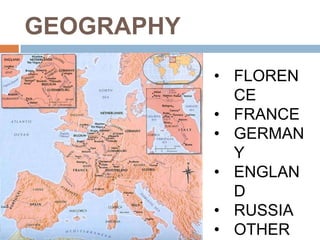
GEOGRAPHY
            • FLOREN
              CE
            • FRANCE
            • GERMAN
              Y
            • ENGLAN
              D
            • RUSSIA
            • OTHER
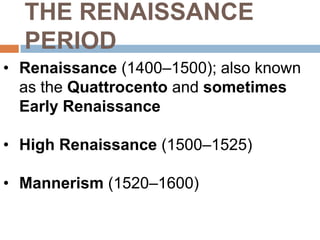
THE RENAISSANCE
  PERIOD
• Renaissance (1400–1500); also known
  as the Quattrocento and sometimes
  Early Renaissance

• High Renaissance (1500–1525)

• Mannerism (1520–1600)
RELIGIOUS
INFLUENCES
   The return of the Pope from Avignon in
    1377 and the resultant new emphasis on
    Rome as the center of Christian
    spirituality, brought about a boom in the
    building of churches in Rome such as had
    not taken place for nearly a thousand
    years.
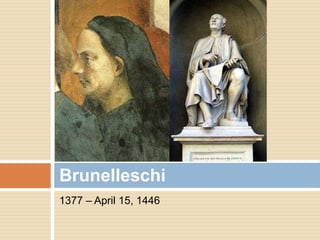
Brunelleschi
1377 – April 15, 1446
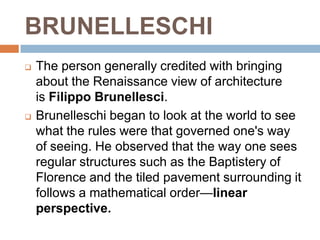
BRUNELLESCHI
   The person generally credited with bringing
    about the Renaissance view of architecture
    is Filippo Brunellesci.
   Brunelleschi began to look at the world to see
    what the rules were that governed one's way
    of seeing. He observed that the way one sees
    regular structures such as the Baptistery of
    Florence and the tiled pavement surrounding it
    follows a mathematical order—linear
    perspective.
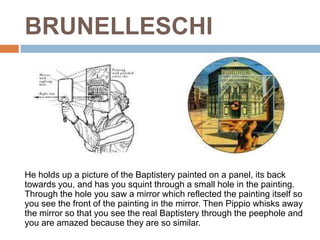
BRUNELLESCHI


He holds up a picture of the Baptistery painted on a panel, its back
towards you, and has you squint through a small hole in the painting.
Through the hole you saw a mirror which reflected the painting itself so
you see the front of the painting in the mirror. Then Pippio whisks away
the mirror so that you see the real Baptistery through the peephole and
you are amazed because they are so similar.
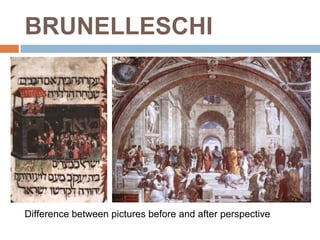
BRUNELLESCHI


Difference between pictures before and after perspective
BRUNELLESCHI
   The entire theory of perspective can be
    developed from a single fact: that the apparent
    size of an object decreases with increasing
    distance from the eye.
   No written record exists from Brunelleschi's
    experiments. He probably passed the method
    verbally to Masaccio, Masolino, and Donatello,
    who used it in their works.
BRUNELLESCHI
   Brunelleschi was the first architect to
    employ mathematical perspective to
    redefine Gothic and Romanesque space
    and to establish new rules of proportioning
    and symmetry. Although Brunelleschi was
    considered the main initiator of stylistic
    changes in Renaissance architecture,
    critics no longer consider him the "Father
    of the Renaissance".
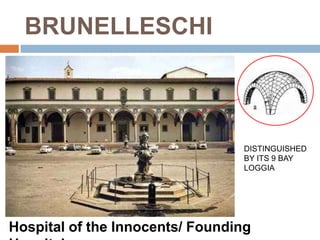
BRUNELLESCHI


                                 DISTINGUISHED
                                 BY ITS 9 BAY
                                 LOGGIA


Hospital of the Innocents/ Founding
BRUNELLESCHI
BRUNELLESCHI
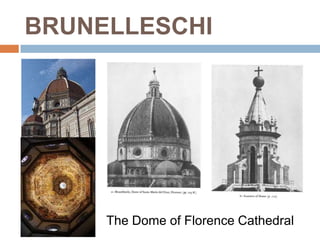
   Soon other commissions came, the most
    important of which were the designs for the
    dome of the Cathedral of Florence (1419-
    1436) and the Sagrestia Vecchia, or Old
    Sacristy of S. Lorenzo (1421-1440).
   As Brunelleschi began to build the dome, most
    people in Florence shook their heads and said
    it was impossible. There was no conceivable
    way to build a dome that size that would be
    self-supporting. Brunelleschi was undaunted,
    and his plans began to take form.
BRUNELLESCHI


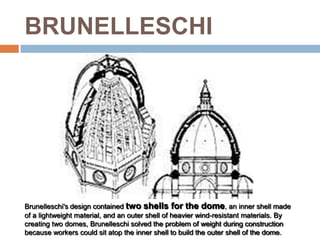
Brunelleschi's design contained two shells for the dome, an inner shell made
of a lightweight material, and an outer shell of heavier wind-resistant materials. By
creating two domes, Brunelleschi solved the problem of weight during construction
because workers could sit atop the inner shell to build the outer shell of the dome.
BRUNELLESCHI


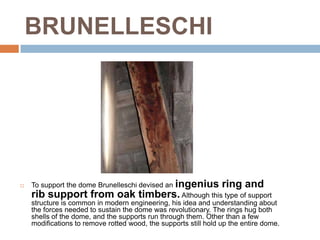
                               ingenius ring and
    To support the dome Brunelleschi devised an
    rib support from oak timbers. Although this type of support
    structure is common in modern engineering, his idea and understanding about
    the forces needed to sustain the dome was revolutionary. The rings hug both
    shells of the dome, and the supports run through them. Other than a few
    modifications to remove rotted wood, the supports still hold up the entire dome.
BRUNELLESCHI


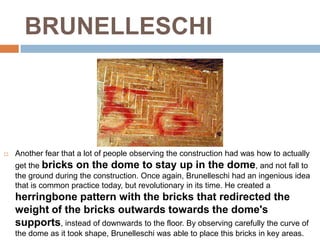
   Another fear that a lot of people observing the construction had was how to actually
    get the bricks on the dome to stay up in the dome, and not fall to
    the ground during the construction. Once again, Brunelleschi had an ingenious idea
    that is common practice today, but revolutionary in its time. He created a
    herringbone pattern with the bricks that redirected the
    weight of the bricks outwards towards the dome's
    supports, instead of downwards to the floor. By observing carefully the curve of
    the dome as it took shape, Brunelleschi was able to place this bricks in key areas.
BRUNELLESCHI


     The Dome of Florence Cathedral
BRUNELLESCHI
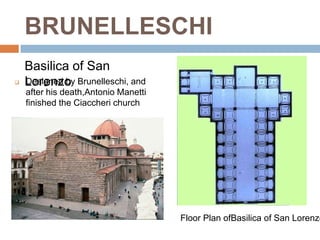
    Basilica of San
   Lorenzo Brunelleschi, and
    Designed by
    after his death,Antonio Manetti
    finished the Ciaccheri church


                                      Floor Plan ofBasilica of San Lorenzo
BRUNELLESCHI


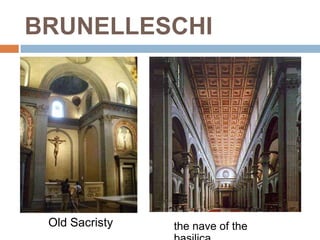
 Old Sacristy   the nave of the
BRUNELLESCHI
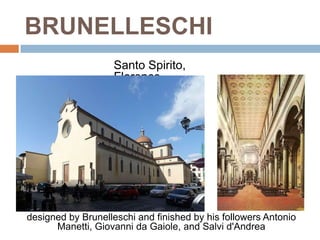
                    Santo Spirito,
                    Florence


designed by Brunelleschi and finished by his followers Antonio
      Manetti, Giovanni da Gaiole, and Salvi d'Andrea
RENAISSAINCE
       The Renaissance style places emphasis:

          on symmetry, proportion, geometry and the
        regularity of parts as they are demonstrated in
        the architecture of Classical antiquity and in
        particular, the architecture of Ancient Rome, of
        which many examples remained.

          Orderly arrangements of columns, pilasters
        and lintels, as well as the use of semicircular
        arches, hemispherical domes, niches and
        aedicules replaced the more complex
        proportional systems and irregular profiles of
        medieval buildings.
RENAISSAINCE
       Quattrocento
       In the Quattrocento, concepts of
        architectural order were explored and rules
        were formulated. Characteristics of
        Renaissance Architecture. The study of
        classical antiquity led in particular to the
        adoption of Classical detail and ornamentation.

       Space, as an element of architecture, was
        utilised differently to the way it had been in the
        Middle Ages. Space was organised by
        proportional logic, its form and
        rhythm subject to geometry, rather than
        being created by intuition as in Medieval
        buildings. The prime example of this is the
        Basilica di San Lorenzo in Florence by Filippo
        Brunelleschi (1377–1446).[6]
THEORIST
RENAISSANCE ARCH THEORY AND THEIR
WORK
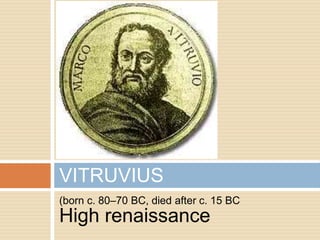
VITRUVIUS
(born c. 80–70 BC, died after c. 15 BC
High renaissance
VITRIVIUS
 Vitruvius is famous for asserting in his
  book De architectura that a structure must
  exhibit the three qualities of firmitas,
  utilitas, venustas – that is, it must be solid,
  useful, beautiful.
 Vitruvius Pollio’s treatise De Architectura,
  was written circa 27 BC and is the only
  book of its kind to survive from antiquity.
  These extracts from Vitruvius comprise
  the first Book and his comments on what
VITRIVIUS
 The Ten Books on Architecture, a treatise
  written in Latin and Greek on architecture,
  dedicated to the emperor Augustus.
 According to Vitruvius, architecture is an

  imitation of nature. As birds and bees built
  their nests, so humans constructed
  housing from natural materials, that gave
  them shelter against the elements.
VITRIVIUS
The subjects of Vitruvius Ten Books, using modern
terminology, are:
 Landscape architecture

 Construction materials

 Temples (Part 1)

 Temples (Part 2)

 Public places: square, meeting hall, theatre, park,
  gymnasium, harbour
 Private dwellings

 Finishes and colours

 Water supply

 Sundials and clocks

 Mechanical engineering
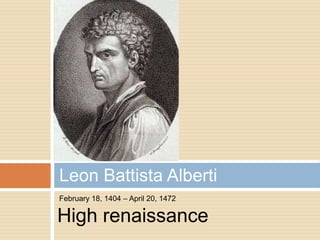
Leon Battista Alberti
February 18, 1404 – April 20, 1472

High renaissance
ALBERTI
   Leon Battista Alberti, born in Genoa (1402–
    1472), was an important Humanist theoretician
    and designer whose book on architecture De
    re Aedificatoria was to have lasting effect.
   An aspect of Humanism was an emphasis of
    the anatomy of nature, in particular the human
    form, a science first studied by the Ancient
    Greeks. Humanism made man the measure of
    things. Alberti perceived the architect as a
    person with great social responsibilities.
ALBERTI
   The first treatise on architecture was De re
    aedificatoria(English: On the Art of
    Building)

    by Leon Battista Alberti in 1450. It was to
    some degree dependent on Vitruvius' De
    architectura, a manuscript of which was
    discovered in 1414 in a library in
    Switzerland. De re aedificatoria in 1485
    became the first printed book on
ALBERTI
De re aedificatoria(English: On the Art of
Building)
   Lineaments
   Materials
   Construction
   Public Works
   Works of Individuals
   Ornament
   Ornament to Sacred Buildings
   Ornament to Public Secular Build
   Ornament to Private Buildings
ALBERTI
   The first was Della pittura [On Painting] in 1435 in
    which he provided the first systematic exposition of
    the rules of one-point perspective and the theory of
    painting as grounded in visual experience with
    geometrical principles. The second was Della statua
    (On Sculpture) in 1436 (with a later version in 1450) in
    which he argued that statues are geometric imitations
    of nature and for which he worked out a canon of
    human proportions.

   Alberti's own summary:
       Short: 1:1, 2:3, 3:4
       Middling: 2:4. 4:9, 9:16
       Long: 1:3, 3:8, 1:4
ALBERTI
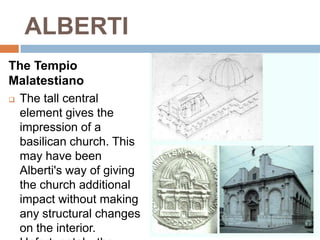
The Tempio
Malatestiano
 The tall central
  element gives the
  impression of a
  basilican church. This
  may have been
  Alberti's way of giving
  the church additional
  impact without making
  any structural changes
  on the interior.
ALBERTI
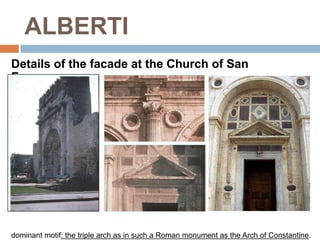
Details of the facade at the Church of San
Francesco


dominant motif: the triple arch as in such a Roman monument as the Arch of Constantine.
ALBERTI
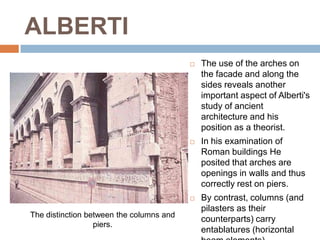
                                             The use of the arches on
                                              the facade and along the
                                              sides reveals another
                                              important aspect of Alberti's
                                              study of ancient
                                              architecture and his
                                              position as a theorist.
                                             In his examination of
                                              Roman buildings He
                                              posited that arches are
                                              openings in walls and thus
                                              correctly rest on piers.
                                             By contrast, columns (and
                                              pilasters as their
The distinction between the columns and
                                              counterparts) carry
                  piers.
                                              entablatures (horizontal
ALBERTI
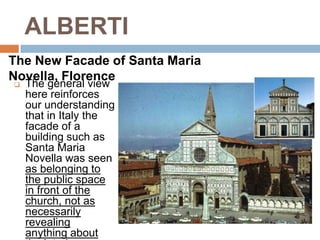
The New Facade of Santa Maria
Novella, Florence
   The general view
    here reinforces
    our understanding
    that in Italy the
    facade of a
    building such as
    Santa Maria
    Novella was seen
    as belonging to
    the public space
    in front of the
    church, not as
    necessarily
    revealing
    anything about
ALBERTI

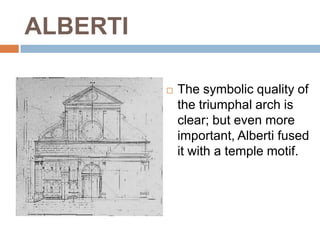
             The symbolic quality of
              the triumphal arch is
              clear; but even more
              important, Alberti fused
              it with a temple motif.
ALBERTI
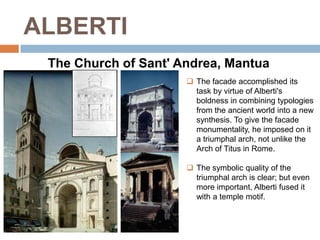
 The Church of Sant' Andrea, Mantua
                       The facade accomplished its
                        task by virtue of Alberti's
                        boldness in combining typologies
                        from the ancient world into a new
                        synthesis. To give the facade
                        monumentality, he imposed on it
                        a triumphal arch, not unlike the
                        Arch of Titus in Rome.

                       The symbolic quality of the
                        triumphal arch is clear; but even
                        more important, Alberti fused it
                        with a temple motif.
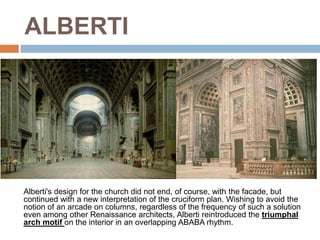
ALBERTI


Alberti's design for the church did not end, of course, with the facade, but
continued with a new interpretation of the cruciform plan. Wishing to avoid the
notion of an arcade on columns, regardless of the frequency of such a solution
even among other Renaissance architects, Alberti reintroduced the triumphal
arch motif on the interior in an overlapping ABABA rhythm.
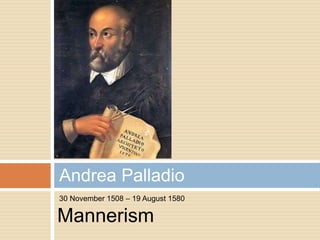
Andrea Palladio
30 November 1508 – 19 August 1580

Mannerism
PALLADIO
   Published I Quattro Libri dell'Architettura (The
    Four Books of Architecture) in Venice. This
    book was widely printed and responsible to a
    great degree of spreading the ideas of the
    Renaissance through Europe. All these books
    were intended to be read and studied not only
    by architects, but also by patrons.

   From his principle, Palladio said all
    architecture should have "Firmness,
    Commodity, and Delight."
PALLADIO
   Due to the new demand for villas in the
    sixteenth century, Palladio specialized in
    domestic architecture.

   Palladio's villas are often centrally planned,
    drawing on Roman models of country villas.

   Palladio based his principle design on
    classicism, like Vitruvius and Alberti. He mostly
    focused in building villas and churches.
PALLADIO


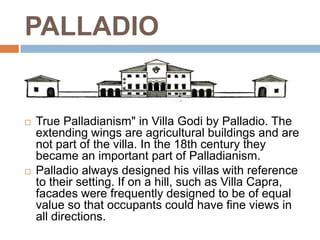
   True Palladianism" in Villa Godi by Palladio. The
    extending wings are agricultural buildings and are
    not part of the villa. In the 18th century they
    became an important part of Palladianism.
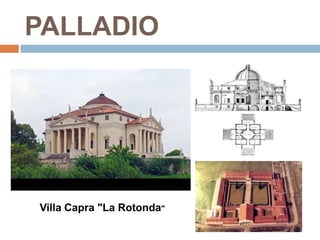
   Palladio always designed his villas with reference
    to their setting. If on a hill, such as Villa Capra,
    facades were frequently designed to be of equal
    value so that occupants could have fine views in
    all directions.
PALLADIO

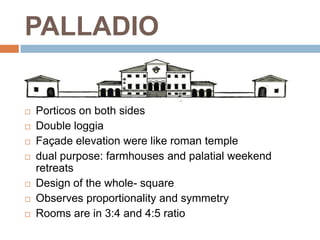
   Porticos on both sides
   Double loggia
   Façade elevation were like roman temple
   dual purpose: farmhouses and palatial weekend
    retreats
   Design of the whole- square
   Observes proportionality and symmetry
   Rooms are in 3:4 and 4:5 ratio
PALLADIO


Villa Capra "La Rotonda"
PALLADIO
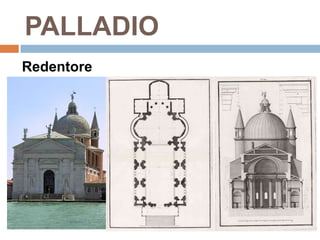
Redentore
PALLADIO


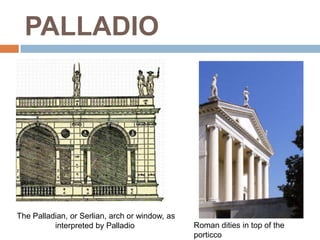
The Palladian, or Serlian, arch or window, as
          interpreted by Palladio               Roman dities in top of the
                                                porticco
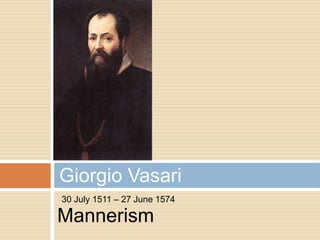
Giorgio Vasari
30 July 1511 – 27 June 1574

Mannerism
VASARI

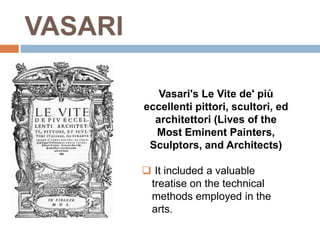
            Vasari's Le Vite de' più
         eccellenti pittori, scultori, ed
           architettori (Lives of the
           Most Eminent Painters,
          Sculptors, and Architects)

          It included a valuable
          treatise on the technical
          methods employed in the
          arts.
VASARI


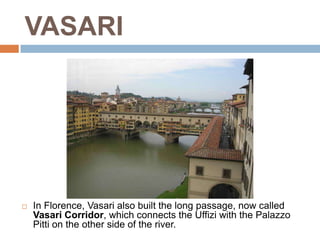
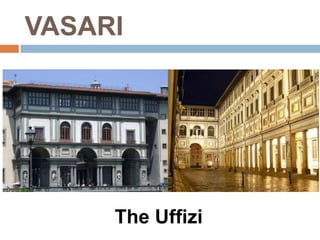
   In Florence, Vasari also built the long passage, now called
    Vasari Corridor, which connects the Uffizi with the Palazzo
    Pitti on the other side of the river.
VASARI


     The Uffizi
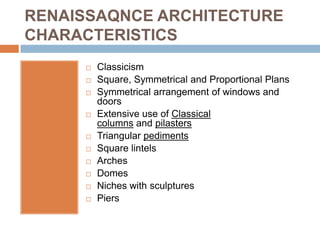
RENAISSAQNCE ARCHITECTURE
CHARACTERISTICS
        Classicism
        Square, Symmetrical and Proportional Plans
        Symmetrical arrangement of windows and
         doors
        Extensive use of Classical
         columns and pilasters
        Triangular pediments
        Square lintels
        Arches
        Domes
        Niches with sculptures
        Piers
BUILDING MATERIALS AND
 CONSTRUCTION SYSTEM

      Bricks
      Pietra Sirena
      Timber
      Stone
      Marble
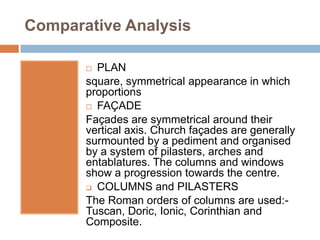
Comparative Analysis

        PLAN
       square, symmetrical appearance in which
       proportions
        FAÇADE

       Façades are symmetrical around their
       vertical axis. Church façades are generally
       surmounted by a pediment and organised
       by a system of pilasters, arches and
       entablatures. The columns and windows
       show a progression towards the centre.
        COLUMNS and PILASTERS

       The Roman orders of columns are used:-
       Tuscan, Doric, Ionic, Corinthian and
       Composite.
Comparative Analysis

          CEILINGS
       Roofs are fitted with flat or coffered ceilings. They
       are not left open as in Medieval architecture. They
       are frequently painted or decorated.
        DOORS

       Doors usually have square lintels. They may be
       set within an arch or a triangular or segmental
       pediment. Openings that do not have doors are
       usually arched and frequently have a large or
       decorative keystone.
        WINDOWS

       Windows may be paired and set within a semi-
       circular arch. They may have squarelintels and
       triangular or segmental pediments, which are
       often used alternately.
Comparative Analysis

        WALLS
       External walls are generally of highly-finished ashlar
       masonry, laid in straight courses. Internal walls are smoothly
       plastered and surfaced with white-chalk paint. For more formal
       spaces, internal surfaces are decorated with frescoes.
        DETAILS
       Courses, moldings and all decorative details are carved with
       great precision. Studying and mastering the details of the
       ancient Romans was one of the important aspects of
       Renaissance theory. The different orders each required
       different sets of details. Some architects were stricter in their
       use of classical details than others, but there was also a good
       deal of innovation in solving problems, especially at corners.
       Moldings stand out around doors and windows rather than
       being recessed, as in Gothic Architecture. Sculptured figures
       may be set in niches or placed on plinths. They are not integral
       to the building as in Medieval architecture.
Sources:
http://en.wikipedia.org/wiki/Renaissance_archite
cture
http://en.wikiarquitectura.com/index.php/Basilica
_of_San_Lorenzo
http://en.wikipedia.org/wiki/Vitruvius
http://arts.muohio.edu/faculty/benson/alberti/
http://architecture.about.com/od/periodsstyles/g/r
enaissance.htm

Renaissance- architects, influences, works

  • 1.
    RENAISSANC E Architectural Theories and their work by MARION PALAMEÑA
  • 2.
    GEOGRAPHY • FLOREN CE • FRANCE • GERMAN Y • ENGLAN D • RUSSIA • OTHER
  • 3.
    THE RENAISSANCE PERIOD • Renaissance (1400–1500); also known as the Quattrocento and sometimes Early Renaissance • High Renaissance (1500–1525) • Mannerism (1520–1600)
  • 4.
    RELIGIOUS INFLUENCES  The return of the Pope from Avignon in 1377 and the resultant new emphasis on Rome as the center of Christian spirituality, brought about a boom in the building of churches in Rome such as had not taken place for nearly a thousand years.
  • 5.
  • 6.
    BRUNELLESCHI  The person generally credited with bringing about the Renaissance view of architecture is Filippo Brunellesci.  Brunelleschi began to look at the world to see what the rules were that governed one's way of seeing. He observed that the way one sees regular structures such as the Baptistery of Florence and the tiled pavement surrounding it follows a mathematical order—linear perspective.
  • 7.
    BRUNELLESCHI He holds upa picture of the Baptistery painted on a panel, its back towards you, and has you squint through a small hole in the painting. Through the hole you saw a mirror which reflected the painting itself so you see the front of the painting in the mirror. Then Pippio whisks away the mirror so that you see the real Baptistery through the peephole and you are amazed because they are so similar.
  • 8.
    BRUNELLESCHI Difference between picturesbefore and after perspective
  • 9.
    BRUNELLESCHI  The entire theory of perspective can be developed from a single fact: that the apparent size of an object decreases with increasing distance from the eye.  No written record exists from Brunelleschi's experiments. He probably passed the method verbally to Masaccio, Masolino, and Donatello, who used it in their works.
  • 10.
    BRUNELLESCHI  Brunelleschi was the first architect to employ mathematical perspective to redefine Gothic and Romanesque space and to establish new rules of proportioning and symmetry. Although Brunelleschi was considered the main initiator of stylistic changes in Renaissance architecture, critics no longer consider him the "Father of the Renaissance".
  • 11.
    BRUNELLESCHI DISTINGUISHED BY ITS 9 BAY LOGGIA Hospital of the Innocents/ Founding
  • 12.
  • 13.
    BRUNELLESCHI  Soon other commissions came, the most important of which were the designs for the dome of the Cathedral of Florence (1419- 1436) and the Sagrestia Vecchia, or Old Sacristy of S. Lorenzo (1421-1440).  As Brunelleschi began to build the dome, most people in Florence shook their heads and said it was impossible. There was no conceivable way to build a dome that size that would be self-supporting. Brunelleschi was undaunted, and his plans began to take form.
  • 14.
    BRUNELLESCHI Brunelleschi's design containedtwo shells for the dome, an inner shell made of a lightweight material, and an outer shell of heavier wind-resistant materials. By creating two domes, Brunelleschi solved the problem of weight during construction because workers could sit atop the inner shell to build the outer shell of the dome.
  • 15.
    BRUNELLESCHI  ingenius ring and To support the dome Brunelleschi devised an rib support from oak timbers. Although this type of support structure is common in modern engineering, his idea and understanding about the forces needed to sustain the dome was revolutionary. The rings hug both shells of the dome, and the supports run through them. Other than a few modifications to remove rotted wood, the supports still hold up the entire dome.
  • 16.
    BRUNELLESCHI  Another fear that a lot of people observing the construction had was how to actually get the bricks on the dome to stay up in the dome, and not fall to the ground during the construction. Once again, Brunelleschi had an ingenious idea that is common practice today, but revolutionary in its time. He created a herringbone pattern with the bricks that redirected the weight of the bricks outwards towards the dome's supports, instead of downwards to the floor. By observing carefully the curve of the dome as it took shape, Brunelleschi was able to place this bricks in key areas.
  • 17.
    BRUNELLESCHI The Dome of Florence Cathedral
  • 18.
    BRUNELLESCHI Basilica of San  Lorenzo Brunelleschi, and Designed by after his death,Antonio Manetti finished the Ciaccheri church Floor Plan ofBasilica of San Lorenzo
  • 19.
    BRUNELLESCHI Old Sacristy the nave of the
  • 20.
    BRUNELLESCHI Santo Spirito, Florence designed by Brunelleschi and finished by his followers Antonio Manetti, Giovanni da Gaiole, and Salvi d'Andrea
  • 21.
    RENAISSAINCE  The Renaissance style places emphasis:  on symmetry, proportion, geometry and the regularity of parts as they are demonstrated in the architecture of Classical antiquity and in particular, the architecture of Ancient Rome, of which many examples remained.  Orderly arrangements of columns, pilasters and lintels, as well as the use of semicircular arches, hemispherical domes, niches and aedicules replaced the more complex proportional systems and irregular profiles of medieval buildings.
  • 22.
    RENAISSAINCE  Quattrocento  In the Quattrocento, concepts of architectural order were explored and rules were formulated. Characteristics of Renaissance Architecture. The study of classical antiquity led in particular to the adoption of Classical detail and ornamentation.  Space, as an element of architecture, was utilised differently to the way it had been in the Middle Ages. Space was organised by proportional logic, its form and rhythm subject to geometry, rather than being created by intuition as in Medieval buildings. The prime example of this is the Basilica di San Lorenzo in Florence by Filippo Brunelleschi (1377–1446).[6]
  • 23.
  • 24.
    VITRUVIUS (born c. 80–70BC, died after c. 15 BC High renaissance
  • 25.
    VITRIVIUS  Vitruvius isfamous for asserting in his book De architectura that a structure must exhibit the three qualities of firmitas, utilitas, venustas – that is, it must be solid, useful, beautiful.  Vitruvius Pollio’s treatise De Architectura, was written circa 27 BC and is the only book of its kind to survive from antiquity. These extracts from Vitruvius comprise the first Book and his comments on what
  • 26.
    VITRIVIUS  The TenBooks on Architecture, a treatise written in Latin and Greek on architecture, dedicated to the emperor Augustus.  According to Vitruvius, architecture is an imitation of nature. As birds and bees built their nests, so humans constructed housing from natural materials, that gave them shelter against the elements.
  • 27.
    VITRIVIUS The subjects ofVitruvius Ten Books, using modern terminology, are:  Landscape architecture  Construction materials  Temples (Part 1)  Temples (Part 2)  Public places: square, meeting hall, theatre, park, gymnasium, harbour  Private dwellings  Finishes and colours  Water supply  Sundials and clocks  Mechanical engineering
  • 28.
    Leon Battista Alberti February18, 1404 – April 20, 1472 High renaissance
  • 29.
    ALBERTI  Leon Battista Alberti, born in Genoa (1402– 1472), was an important Humanist theoretician and designer whose book on architecture De re Aedificatoria was to have lasting effect.  An aspect of Humanism was an emphasis of the anatomy of nature, in particular the human form, a science first studied by the Ancient Greeks. Humanism made man the measure of things. Alberti perceived the architect as a person with great social responsibilities.
  • 30.
    ALBERTI  The first treatise on architecture was De re aedificatoria(English: On the Art of Building)  by Leon Battista Alberti in 1450. It was to some degree dependent on Vitruvius' De architectura, a manuscript of which was discovered in 1414 in a library in Switzerland. De re aedificatoria in 1485 became the first printed book on
  • 31.
    ALBERTI De re aedificatoria(English:On the Art of Building)  Lineaments  Materials  Construction  Public Works  Works of Individuals  Ornament  Ornament to Sacred Buildings  Ornament to Public Secular Build  Ornament to Private Buildings
  • 32.
    ALBERTI  The first was Della pittura [On Painting] in 1435 in which he provided the first systematic exposition of the rules of one-point perspective and the theory of painting as grounded in visual experience with geometrical principles. The second was Della statua (On Sculpture) in 1436 (with a later version in 1450) in which he argued that statues are geometric imitations of nature and for which he worked out a canon of human proportions.  Alberti's own summary: Short: 1:1, 2:3, 3:4 Middling: 2:4. 4:9, 9:16 Long: 1:3, 3:8, 1:4
  • 33.
    ALBERTI The Tempio Malatestiano  Thetall central element gives the impression of a basilican church. This may have been Alberti's way of giving the church additional impact without making any structural changes on the interior.
  • 34.
    ALBERTI Details of thefacade at the Church of San Francesco dominant motif: the triple arch as in such a Roman monument as the Arch of Constantine.
  • 35.
    ALBERTI  The use of the arches on the facade and along the sides reveals another important aspect of Alberti's study of ancient architecture and his position as a theorist.  In his examination of Roman buildings He posited that arches are openings in walls and thus correctly rest on piers.  By contrast, columns (and pilasters as their The distinction between the columns and counterparts) carry piers. entablatures (horizontal
  • 36.
    ALBERTI The New Facadeof Santa Maria Novella, Florence  The general view here reinforces our understanding that in Italy the facade of a building such as Santa Maria Novella was seen as belonging to the public space in front of the church, not as necessarily revealing anything about
  • 37.
    ALBERTI  The symbolic quality of the triumphal arch is clear; but even more important, Alberti fused it with a temple motif.
  • 38.
    ALBERTI The Churchof Sant' Andrea, Mantua  The facade accomplished its task by virtue of Alberti's boldness in combining typologies from the ancient world into a new synthesis. To give the facade monumentality, he imposed on it a triumphal arch, not unlike the Arch of Titus in Rome.  The symbolic quality of the triumphal arch is clear; but even more important, Alberti fused it with a temple motif.
  • 39.
    ALBERTI Alberti's design forthe church did not end, of course, with the facade, but continued with a new interpretation of the cruciform plan. Wishing to avoid the notion of an arcade on columns, regardless of the frequency of such a solution even among other Renaissance architects, Alberti reintroduced the triumphal arch motif on the interior in an overlapping ABABA rhythm.
  • 40.
    Andrea Palladio 30 November1508 – 19 August 1580 Mannerism
  • 41.
    PALLADIO  Published I Quattro Libri dell'Architettura (The Four Books of Architecture) in Venice. This book was widely printed and responsible to a great degree of spreading the ideas of the Renaissance through Europe. All these books were intended to be read and studied not only by architects, but also by patrons.  From his principle, Palladio said all architecture should have "Firmness, Commodity, and Delight."
  • 42.
    PALLADIO  Due to the new demand for villas in the sixteenth century, Palladio specialized in domestic architecture.  Palladio's villas are often centrally planned, drawing on Roman models of country villas.  Palladio based his principle design on classicism, like Vitruvius and Alberti. He mostly focused in building villas and churches.
  • 43.
    PALLADIO  True Palladianism" in Villa Godi by Palladio. The extending wings are agricultural buildings and are not part of the villa. In the 18th century they became an important part of Palladianism.  Palladio always designed his villas with reference to their setting. If on a hill, such as Villa Capra, facades were frequently designed to be of equal value so that occupants could have fine views in all directions.
  • 44.
    PALLADIO  Porticos on both sides  Double loggia  Façade elevation were like roman temple  dual purpose: farmhouses and palatial weekend retreats  Design of the whole- square  Observes proportionality and symmetry  Rooms are in 3:4 and 4:5 ratio
  • 45.
  • 46.
  • 47.
    PALLADIO The Palladian, orSerlian, arch or window, as interpreted by Palladio Roman dities in top of the porticco
  • 48.
    Giorgio Vasari 30 July1511 – 27 June 1574 Mannerism
  • 49.
    VASARI Vasari's Le Vite de' più eccellenti pittori, scultori, ed architettori (Lives of the Most Eminent Painters, Sculptors, and Architects)  It included a valuable treatise on the technical methods employed in the arts.
  • 50.
    VASARI  In Florence, Vasari also built the long passage, now called Vasari Corridor, which connects the Uffizi with the Palazzo Pitti on the other side of the river.
  • 51.
    VASARI The Uffizi
  • 52.
    RENAISSAQNCE ARCHITECTURE CHARACTERISTICS  Classicism  Square, Symmetrical and Proportional Plans  Symmetrical arrangement of windows and doors  Extensive use of Classical columns and pilasters  Triangular pediments  Square lintels  Arches  Domes  Niches with sculptures  Piers
  • 53.
    BUILDING MATERIALS AND CONSTRUCTION SYSTEM  Bricks  Pietra Sirena  Timber  Stone  Marble
  • 54.
    Comparative Analysis  PLAN square, symmetrical appearance in which proportions  FAÇADE Façades are symmetrical around their vertical axis. Church façades are generally surmounted by a pediment and organised by a system of pilasters, arches and entablatures. The columns and windows show a progression towards the centre.  COLUMNS and PILASTERS The Roman orders of columns are used:- Tuscan, Doric, Ionic, Corinthian and Composite.
  • 55.
    Comparative Analysis  CEILINGS Roofs are fitted with flat or coffered ceilings. They are not left open as in Medieval architecture. They are frequently painted or decorated.  DOORS Doors usually have square lintels. They may be set within an arch or a triangular or segmental pediment. Openings that do not have doors are usually arched and frequently have a large or decorative keystone.  WINDOWS Windows may be paired and set within a semi- circular arch. They may have squarelintels and triangular or segmental pediments, which are often used alternately.
  • 56.
    Comparative Analysis  WALLS External walls are generally of highly-finished ashlar masonry, laid in straight courses. Internal walls are smoothly plastered and surfaced with white-chalk paint. For more formal spaces, internal surfaces are decorated with frescoes.  DETAILS Courses, moldings and all decorative details are carved with great precision. Studying and mastering the details of the ancient Romans was one of the important aspects of Renaissance theory. The different orders each required different sets of details. Some architects were stricter in their use of classical details than others, but there was also a good deal of innovation in solving problems, especially at corners. Moldings stand out around doors and windows rather than being recessed, as in Gothic Architecture. Sculptured figures may be set in niches or placed on plinths. They are not integral to the building as in Medieval architecture.
  • 57.