
Organicism and
architecture in the 50s
Revision
Introduction
• We know as organic architecture all
the architectonical manifestations
that aim at adequate and ally to the
nature.
• This idea can be found long ago in
History but the master in the
formulation of its principles was
Frank Lloyd Wright.
Characteristics
• Organicist architecture is defined by:
– the sense of the interior as a reality;
– the free plan as flexible and a way of
allowing the continuity of atmospheres;
– the unity between interior and exterior;
– the use of natural materials;
– the house as a place for shelter.
Wright: Influences
• This American born architect received
several influences:
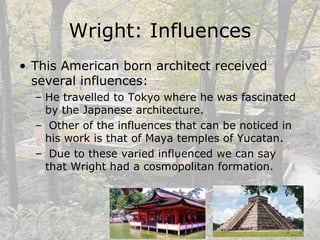
– He travelled to Tokyo where he was fascinated
by the Japanese architecture.
– Other of the influences that can be noticed in
his work is that of Maya temples of Yucatan.
– Due to these varied influenced we can say
that Wright had a cosmopolitan formation.
Wright: Evolution
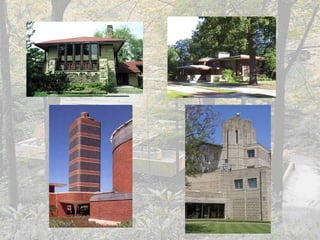
• His beginnings are associated to the
Chicago School but soon he started
developing his own style, in which
we can distinguish different periods:
– Early years: influenced by Chicago
School
– Prairie Style
– Skyscrapers
– Abstract sculptural ornamentation
Wright: Work
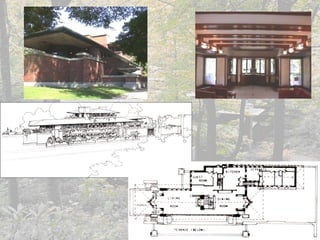
• Caracteristics of Prairie Style:
– simple structures consist of functional spaces,
– light and integrated with nature,
– at the same time that they are isolated enough
as to guarantee the intimacy of their
inhabitants
– the houses are frequently built in different
levels, and always a bit separated from the
floor, as in Japanese architecture.
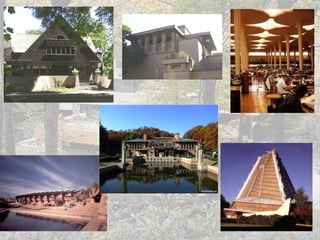
• One of the most famous houses is the
Robbie House
Wright: Work
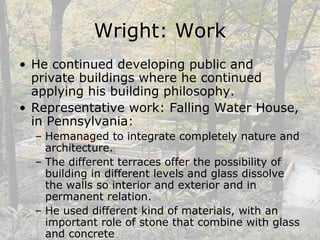
• He continued developing public and
private buildings where he continued
applying his building philosophy.
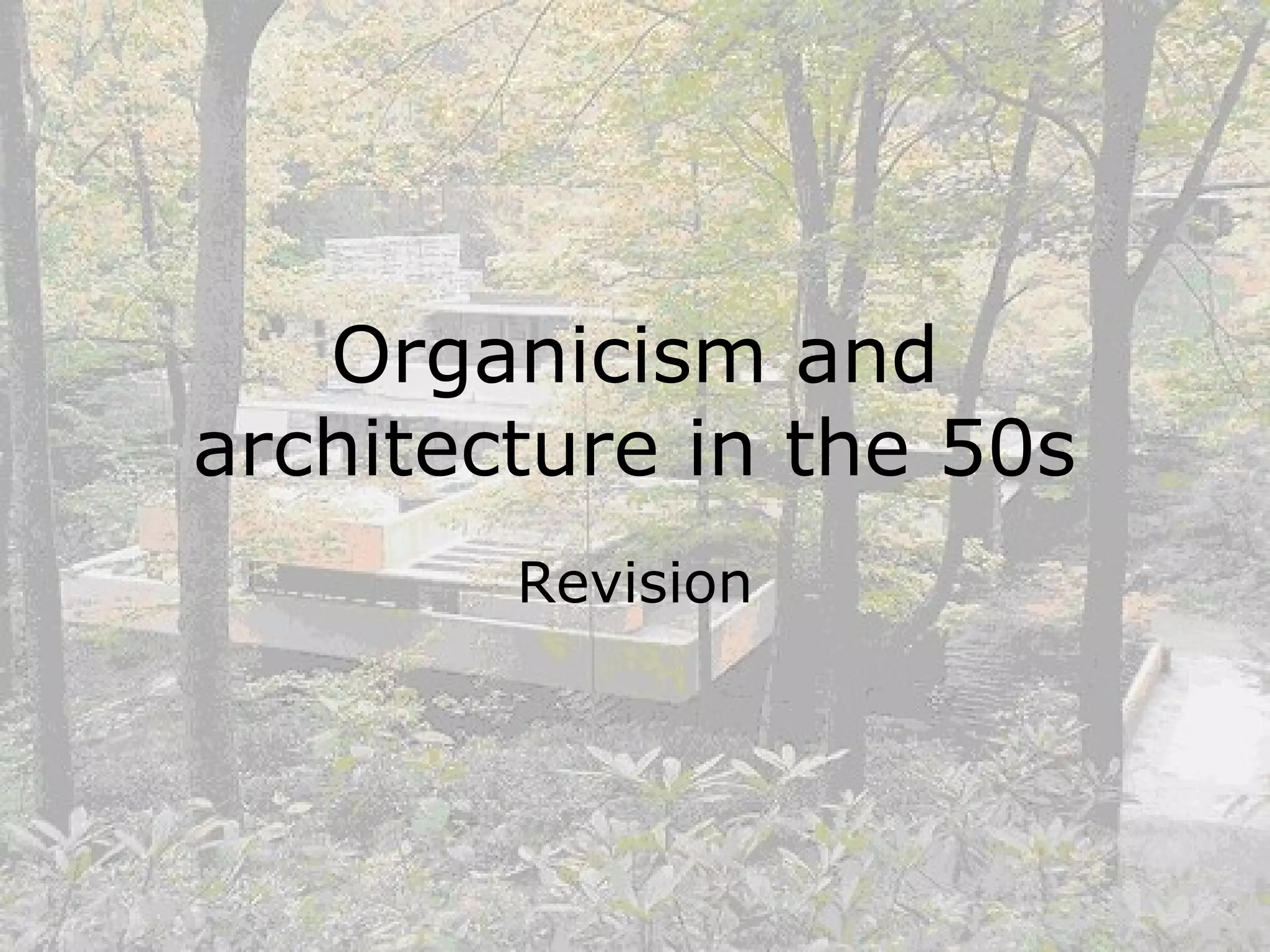
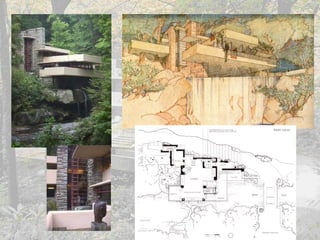
• Representative work: Falling Water House,
in Pennsylvania:
– Hemanaged to integrate completely nature and
architecture.
– The different terraces offer the possibility of
building in different levels and glass dissolve
the walls so interior and exterior and in
permanent relation.
– He used different kind of materials, with an
important role of stone that combine with glass
and concrete
Wright: Work
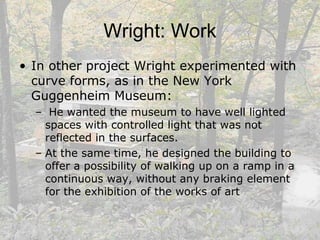
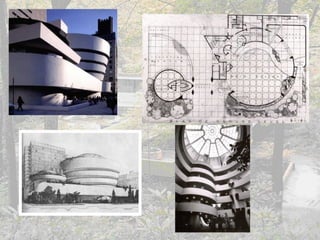
• In other project Wright experimented with
curve forms, as in the New York
Guggenheim Museum:
– He wanted the museum to have well lighted
spaces with controlled light that was not
reflected in the surfaces.
– At the same time, he designed the building to
offer a possibility of walking up on a ramp in a
continuous way, without any braking element
for the exhibition of the works of art
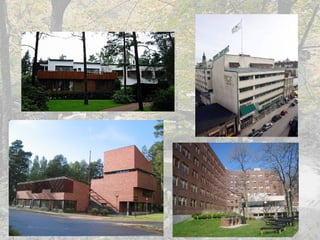
Alvar Aalto
• One of the most representative
architects of the 50s is the Finnish
Alvar Aalto.
• His works are characterised by
– imbued by rationalist spirit but
– mixed of popular tradition and local
materials, mainly wood, so common in
his native region.
Alvar Aalto
• Characteristics:
– His buildings are warm and thought to be
appropriate for human beings and the
dimension of human body, something in which
Wright influence can be noticed.
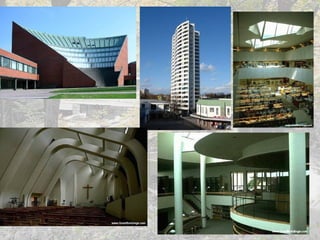
– Aalto’s mature work embodies a unique
functionalist/expressionist and human style,
successfully applied to libraries, civic centres,
churches, and housing.
Alvar Aalto
• Although Aalto borrowed from the
International Style, he utilized texture,
colour and structure in creative new ways.
• He refined the generic examples of
modern architecture that existed in most
of Europe.
• His designs were particularly significant
because of their response to site, material
and form
Organicism and-architecture-in-the-50s (new)

Organicism and-architecture-in-the-50s (new)

  • 1.
  • 2.
    Introduction • We knowas organic architecture all the architectonical manifestations that aim at adequate and ally to the nature. • This idea can be found long ago in History but the master in the formulation of its principles was Frank Lloyd Wright.
  • 3.
    Characteristics • Organicist architectureis defined by: – the sense of the interior as a reality; – the free plan as flexible and a way of allowing the continuity of atmospheres; – the unity between interior and exterior; – the use of natural materials; – the house as a place for shelter.
  • 4.
    Wright: Influences • ThisAmerican born architect received several influences: – He travelled to Tokyo where he was fascinated by the Japanese architecture. – Other of the influences that can be noticed in his work is that of Maya temples of Yucatan. – Due to these varied influenced we can say that Wright had a cosmopolitan formation.
  • 5.
    Wright: Evolution • Hisbeginnings are associated to the Chicago School but soon he started developing his own style, in which we can distinguish different periods: – Early years: influenced by Chicago School – Prairie Style – Skyscrapers – Abstract sculptural ornamentation
  • 7.
    Wright: Work • Caracteristicsof Prairie Style: – simple structures consist of functional spaces, – light and integrated with nature, – at the same time that they are isolated enough as to guarantee the intimacy of their inhabitants – the houses are frequently built in different levels, and always a bit separated from the floor, as in Japanese architecture. • One of the most famous houses is the Robbie House
  • 9.
    Wright: Work • Hecontinued developing public and private buildings where he continued applying his building philosophy. • Representative work: Falling Water House, in Pennsylvania: – Hemanaged to integrate completely nature and architecture. – The different terraces offer the possibility of building in different levels and glass dissolve the walls so interior and exterior and in permanent relation. – He used different kind of materials, with an important role of stone that combine with glass and concrete
  • 11.
    Wright: Work • Inother project Wright experimented with curve forms, as in the New York Guggenheim Museum: – He wanted the museum to have well lighted spaces with controlled light that was not reflected in the surfaces. – At the same time, he designed the building to offer a possibility of walking up on a ramp in a continuous way, without any braking element for the exhibition of the works of art
  • 14.
    Alvar Aalto • Oneof the most representative architects of the 50s is the Finnish Alvar Aalto. • His works are characterised by – imbued by rationalist spirit but – mixed of popular tradition and local materials, mainly wood, so common in his native region.
  • 15.
    Alvar Aalto • Characteristics: –His buildings are warm and thought to be appropriate for human beings and the dimension of human body, something in which Wright influence can be noticed. – Aalto’s mature work embodies a unique functionalist/expressionist and human style, successfully applied to libraries, civic centres, churches, and housing.
  • 16.
    Alvar Aalto • AlthoughAalto borrowed from the International Style, he utilized texture, colour and structure in creative new ways. • He refined the generic examples of modern architecture that existed in most of Europe. • His designs were particularly significant because of their response to site, material and form