SECONDARY
SECTOR.
INDUSTRIAL SPACES.
UNIT 6
IES CAMILO JOSÉ CELA
Teacher: Rocío Bautista
SECONDARY SECTOR:
ACTIVITES CONCERNED WITH
TRANSFORMING RAW MATERIALS INTO
PRODUCTS THAT SATISFY HUMANS’ NEEDS
 Industry  most important
 Mining
 Energy production
 Construction
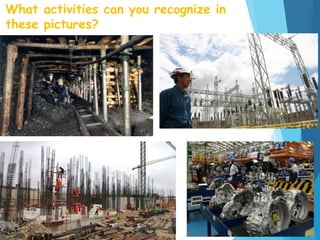
What activities can you recognize in
these pictures?
INDUSTRY
 TRANSFORMS RAW MATERIALS INTO…
 MANUFACTURED PRODUCTS  for direct consumption in the
market.
 SEMI-FINISHED PRODUCTS  to be used in other industrial
processes.
Industry
requires 3
elements
ENERGY SOURCES
PRODUCTION
FACTORS:
- Labour force (employees)
- Capital (buildings,
machinery, money…)
- Technology (knowledge)
RAW MATERIALS
MINING
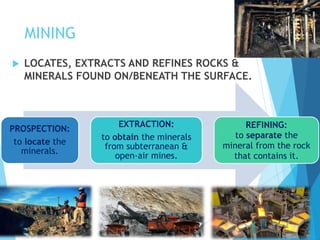
 LOCATES, EXTRACTS AND REFINES ROCKS &
MINERALS FOUND ON/BENEATH THE SURFACE.
PROSPECTION:
to locate the
minerals.
EXTRACTION:
to obtain the minerals
from subterranean &
open-air mines.
REFINING:
to separate the
mineral from the rock
that contains it.
ENERGY PRODUCTION
 CREATION OF ELECTRICITY & HEAT IN SPECIALISED
INSTALLATIONS (POWER STATIONS).
NUCLEAR
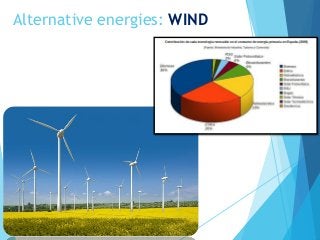
WIND
WATERSOLAR
THERMAL
CONSTRUCTION
 CREATES BUILDIGNS & INFRASTRUCTURES* (roads,
bridges, reservoirs,…)
PLANS
BUILDING
MATERIALS
CONSTRUC
TION
INDUSTRY
*INFRASTRUCTURES: basic facilities, services & installations needed for the functioning of a society and its economy (transportation &
communications systems such as roads, bridges, tunnels, etc., water supply, sewer systems, power lines…)
INDUSTRY
• Core elements:
• Raw materials
• Energy sources
• The world’s energy.
Energy saving.
• Industrial development and its landscapes:
• Artisanal industry
• Modern industry
• Contemporary industry
• Industry and globalisation
CORE ELEMENTS OF INDUSTRY:
RAW MATERIALS
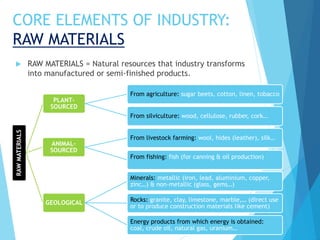
 RAW MATERIALS = Natural resources that industry transforms
into manufactured or semi-finished products.
RAWMATERIALS
PLANT-
SOURCED
From agriculture: sugar beets, cotton, linen, tobacco
From silviculture: wood, cellulose, rubber, cork…
ANIMAL-
SOURCED
From livestock farming: wool, hides (leather), silk…
From fishing: fish (for canning & oil production)
GEOLOGICAL
Minerals: metallic (iron, lead, aluminium, copper,
zinc…) & non-metallic (glass, gems…)
Rocks: granite, clay, limestone, marble,… (direct use
or to produce construction materials like cement)
Energy products from which energy is obtained:
coal, crude oil, natural gas, uranium…
CORE ELEMENTS OF INDUSTRY:
RAW MATERIALS  Production & trade
CONSUMPTION (demand): concentrated in INDUSTRIALIZED COUNTRIES
1) WESTERN EUROPE
2) JAPAN
3) USA
4) Emerging countries:
 CHINA
 INDIA
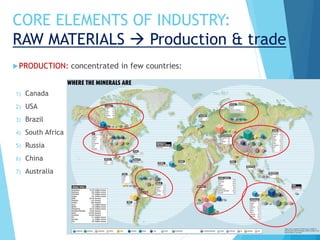
 Look at the map… is the distribution of minerals around the
world equal?
 Which countries produce large quantities of minerals?
CORE ELEMENTS OF INDUSTRY:
RAW MATERIALS  Production & trade
PRODUCTION: concentrated in few countries:
1) Canada
2) USA
3) Brazil
4) South Africa
5) Russia
6) China
7) Australia
 Which region produces the largest
quantities of oil?
 Do you know what COLTAN is?
What is it used for? Where
does it come from?
 COLTAN: essential mineral in modern technology (cell phones, laptops, cameras…)
 80% of World’s coltan  D.R.C. (Democratic Republic of Congo)
 D.R.C. / Uganda / Rwanda / different rebel paramilitary groups  WAR to
control the coltan mines.
 Consequences:
• Slavery, child-labour, violence, murder, violations,…
• 5 million deaths
• War refugees
• Destruction of rainforests & species (gorillas, elephants)
• Farms are abandoned
• Coltan contraband finances rebel paramilitary groups
B L O O D C O L TAN
CORE ELEMENTS OF INDUSTRY:
RAW MATERIALS  Contemporary problems
PROBLEMS RELATED TO
RAW MATERIALS
SCARCITY OF RAW
MATERIALS FOR
FOOD INDUSTRY
SCARCITY & UNEVEN
DISTRIBUTION OF
GEOLOGICAL RAW
MATERIALS
Food prices increase due to
a higher demand (increasing
population) of agrarian raw
materials. Worst impact on
the poorest people.
In order to ensure their supply,
wealthy countries try to control
trade with producer countries
& international markets.
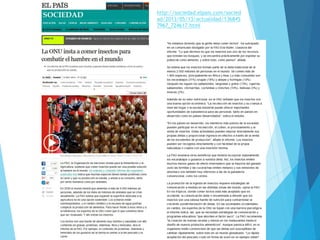
http://sociedad.elpais.com/socied
ad/2013/05/13/actualidad/136845
7967_724617.html
ACTIVITIES
 Define the following concepts:
 Secondary sector
 Raw materials
 Prospecting methods
 Refining systems
 Power stations
 Infrastructures
 Devise an outline about the main activities of the secondary
sector (p.130)
 P.132, exercise 1.
 Are raw materials distributed equally around the world? Where
do production & consumption concentrate?
CORE ELEMENTS OF INDUSTRY:
ENERGY SOURCES
ENERGY SOURCES
TRADITIONAL
OIL
COAL
NATURAL GAS
NUCLEAR FISSION
HYDROELECTRIC
ALTERNATIVE
BIOMASS
WIND
SOLAR
GEOTHERMAL
WAVE
NUCLEAR FUSION
•Most widely
used.
•Mostly non-
renewable
(except
hydroelectric).
•60%  oil &
coal.
Traditional energies
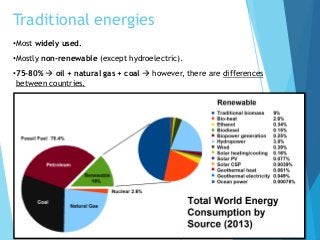
•Most widely used.
•Mostly non-renewable (except hydroelectric).
•75-80%  oil + natural gas + coal  however, there are differences
between countries.
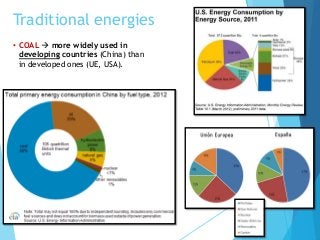
Traditional energies
• COAL  more widely used in
developing countries (China) than
in developed ones (UE, USA).
Traditional energies
• RENEWABLE ENERGIES  are gaining ground to
non-renewable energies, specially in developed
countries.
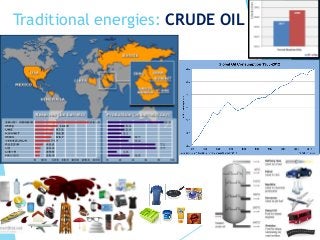
Traditional energies: CRUDE OIL
Traditional energies: NATURAL GAS
PRODUCCIÓN
MUNDIAL DE GAS,
2006
Traditional energies: COAL
COAL CONSUMPTION IS IN CLEAR
REGRESSION DO TO ITS HIGH
POLLUTION LEVELS (CO2 EMISSIONS)
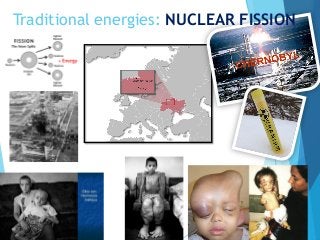
Traditional energies: NUCLEAR FISSION
Traditional energies: HYDROELECTRIC
• Only traditional energy that is
RENEWABLE!!!
• Growing importance.
1984-2009
Alternative energies
Development
after the
1973 Oil
Crisis 
NEED TO
SEEK NEW
ENERGY
SOURCES, TO
AVOID
EXTERNAL
ENERGETIC
DEPENDENCE.
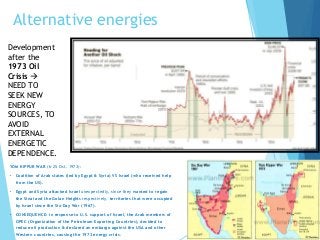
YOM KIPPUR WAR (6-25 Oct. 1973):
• Coalition of Arab states (led by Egypt & Syria) VS Israel (who received help
from the US).
• Egypt and Syria attacked Israel unexpectedly, since they wanted to regain
the Sinai and the Golan Heights respectively, territories that were occupied
by Israel since the Six-Day War (1967).
• CONSEQUENCE: in response to U.S. support of Israel, the Arab members of
OPEC (Organization of the Petroleum Exporting Countries), decided to
reduce oil production & declared an embargo against the USA and other
Western countries, causing the 1973 energy crisis.
Alternative energies
ADVANTEGES: they are renewable & clean (they don’t pollute or generate waste).
DISADVANTAGES: necessary technologies to develop them are still too expensive.
However, in time renewable energies are expected
to became cheaper, while fossil fuels will became
more expensive.
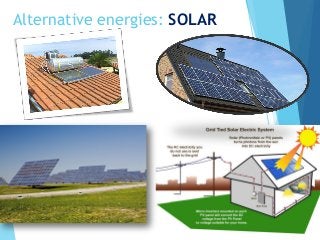
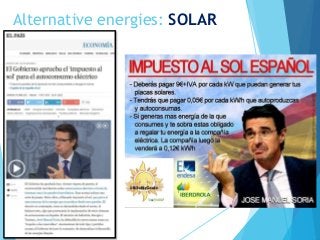
Alternative energies: SOLAR
Alternative energies: WIND
Alternative energies: BIOMASS
Alternative energies: GEOTHERMAL
Alternative energies: WAVE
Alternative energies: NUCLEAR FUSION
With 1gr of hydrogen we
could produce, by means of
nuclear fusion, in an hour,
11 times more energy than
by current nuclear fission.
ITER (International Thermonuclear
Experimental Reactor)
• International project to design and build an experimental fusion
reactor.
• South France.
• 7 member entities (EU, India, Japan, China, Russia, South Korea &
USA).
• EU (host party for the ITER complex), contributes with about 45 %
of the cost. The rest 9& each.
ACTIVITIES
 On the political World map, locate the main production
countries of traditional & alternative energy sources.
 In groups of 4-5, make up a song about the different types of
energy sources… BE CREATIVE!!!! Record it and send it to
rocio.sociales@gmail.com.
THE WORLD’S ENERGY
Essential in our daily lives:
• Transport
• Machines & household appliances
• Lights
• …
WHICH IS THE BIG
PROBLEM
CONCERNING
ENERGY??!
THE WORLD’S ENERGY
ENERGY
PROBLEMS
SUPREMACY
OF NON-
RENEWABLE
ENERGY
SOURCES
UNEQUAL
DISTRIBUTION
OF ENERGY
SOURCES
ENVIRNMENTAL
PROBLEMS
CONSTANT RISE
IN ENERGY
CONSUMPTION
http://www.rtve.es/noticias/20141029/claves-guerra-
del-gas-entre-rusia-ucrania/1038365.shtml
THE WORLD’S ENERGY
SOLUTIONS TO
ENERGY
PROBLEMS
ENVIRONMENTAL
POLICIES
ENERGY-SAVING
POLICIES
http://www.rtve.es/alacarta/videos/programa/spot-campana-ahorra-
energia-protagonizado-seleccion-espanola/1131287/
• The Kyoto Protocol: UN international treaty that
committed State Parties to reduce greenhouse gases
emissions (CO2), to stop global warming. It was adopted in
Kyoto (Japan) in 1997.
• SPECIFIL GOAL: to reduce, in the period 2005 - 2012,
collective emissions of greenhouse gases by 5%
compared to the year 1990.
• 2012: technically the K.P. was extended until 2020, but
limited to only 15% of the global C02 emissions, due to the
lack of participation of many industrialized & emerging
countries such as: USA, Canada, Japan, Russia, Belarus,
Ukraine, New Zealand, China, India & Brazil.
• 2014: new negotiations were held in Lima (Peru) to agree
on a post-Kyoto legal framework that would obligate all
major polluters to pay for CO2 emissions. However, some
large polluting countries (China, India, USA) indicated that
they will not ratify any treaty that will commit them legally
to reduce CO2 emissions.
ACTIVITIES
 P. 138  ex.1
 Indicate which energy sources do these countries produce:
 USA
 Canada
 Venezuela
 Norway
 Russia
 Saudi Arabia, Iraq, Kuwait, U.A.E., Iran, Qatar, Algeria, Lybia & Nigeria.
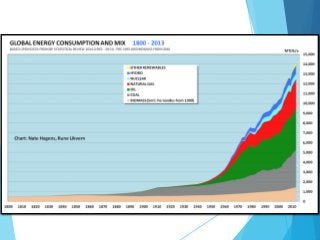
 Comment the graph about “Evolution of energy consumption in
the world” on page 139.
 DESCRIPTION (what information does the graph gives us? Source?)
 ANALYSIS:
 Describe the contribution & evolution of renewable & non-renewable energies.
 Explain some problems (consequences) related to such energetic consumption.
 Give some possible solutions.
INDUSTRIAL DEVELOPMENT
ARTISANAL
INDUSTRY
(until mid-18th
century)
MODERN
INDUSTRY
(1770 – 1950)
CONTEMPORARY
INDUSTRY
(Mid-20th century
onwards)
1º) Artisanal industry
2º) Modern Industry:
1st I.R. (1770 – 1850)
STEAM ENGINE (“Máquina de vapor”)  powered
by burning coal; moved other machines.
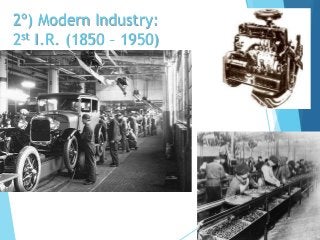
2º) Modern Industry:
2st I.R. (1850 – 1950)
3º) Contemporary industry
• Have relocated to cheaper areas:
• Developing countries
• Industrial estates (polígonos industriales)
in the outskirts of cities.
TRADITIONAL
INDUSTRIES
Industrial estate: physical
place that gathers several
industrial activities.
3º) Contemporary industry
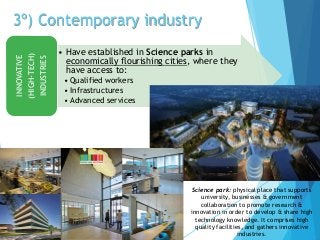
• Have established in Science parks in
economically flourishing cities, where they
have access to:
• Qualified workers
• Infrastructures
• Advanced services
INNOVATIVE
(HIGH-TECH)
INDUSTRIES
Science park: physical place that supports
university, businesses & government
collaboration to promote research &
innovation in order to develop & share high
technology knowledge. It comprises high
quality facilities, and gathers innovative
industries.
ACTIVITIES
 Fill in the worksheet comparing the 3 phases of industrial
development.
 P. 141  ex.2
 Research activity at home: what is “Silicon Valley”?
 What is the difference between an industrial estate & a science
park?
Industry & globalisation:
TYPES OF INDUSTRY
Heavy
industry
Industria de base
o pesada
Transforms raw materials into semi-finished products to
be used in other industries (steel, petrochemistry).
Uses large quantities of heavy raw materials.
Capital goods
industry /
Semi-heavy
industry
Industria de
bienes de equipo
Transforms semi-finished products into equipment
needed for other industries, transport & construction
(machinery, vehicles…).
Uses less raw materials.
Consumer
goods industry
/ Light
industry
Industria de bienes
de consumo o
industria ligera
Makes products intended directly for consumers
(textiles, food, household appliances…).
Uses lightweight materials.
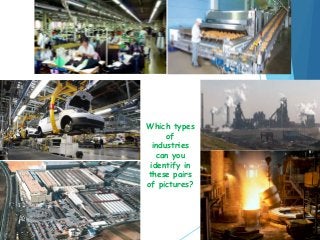
Which types
of
industries
can you
identify in
these pairs
of pictures?
Industry & globalisation:
FACTORS OF INDUSTRIAL LOCATION
Imagine you’re going to
set up an industry and
you have to decide
where to locate it…
what factors would
condition your choice?
Industry & globalisation:
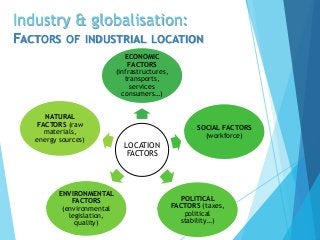
FACTORS OF INDUSTRIAL LOCATION
LOCATION
FACTORS
ECONOMIC
FACTORS
(infrastructures,
transports,
services
consumers…)
SOCIAL FACTORS
(workforce)
POLITICAL
FACTORS (taxes,
political
stability…)
ENVIRONMENTAL
FACTORS
(environmental
legislation,
quality)
NATURAL
FACTORS (raw
materials,
energy sources)
Industry & globalisation:
FACTORS OF INDUSTRIAL LOCATION
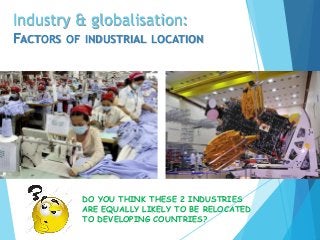
DO YOU THINK THESE 2 INDUSTRIES
ARE EQUALLY LIKELY TO BE RELOCATED
TO DEVELOPING COUNTRIES?
Industry & globalisation:
FACTORS OF INDUSTRIAL LOCATION
INNOVATIVE (HIGH-TECH)
INDUSTRIES
TRADITIONAL (MATURE)
INDUSTRIES
• Located in developed countries:
 Advanced services.
 Infrastructures.
 Qualified labour force.
 High purchase power
consumers.
• Located in developing countries:
 Abundant but unqualified
labour force.
 Special conditions (duty-free
zones) & permissive
environmental legislations.
Industry & globalisation:
RELOCATION
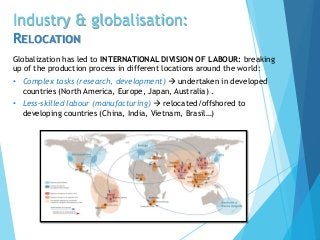
Globalization has led to INTERNATIONAL DIVISION OF LABOUR: breaking
up of the production process in different locations around the world:
• Complex tasks (research, development)  undertaken in developed
countries (North America, Europe, Japan, Australia) .
• Less-skilled labour (manufacturing)  relocated/offshored to
developing countries (China, India, Vietnam, Brasil…)
ACTIVITIES
 P. 144-145: ex. 1, 3 & 4
 Why do innovative (high-tech) industries prefer to locate in
developed countries?
Industry & globalisation:
THE WORLD’S INDUSTRIAL AREAS
HISTORICAL INDUSTRIAL
REGIONS
• USA, _______, EU.
• World’s ______
______________
industrial areas.
• Extensive industrial areas
that use _____________
_____________.
• Benefit from high
_____________-
__________ markets.
• _________________ of
large companies; but
have relocated many
manufacturing parts of
the production process
to _____________
countries.
EMERGING COUNTRIES
• ________ (Brazil, Russia,
India, China, South
Africa)
• Growing industrialization
due to:
• Abundant __________
resources
• _________________ 
attracts the
___________ of
developed countries’
low-technology
industries. This
provides them with
capital to -
____________ in new &
more innovative
industries.
LEAST INDUSTRIALISED
AREAS
• Poorest countries on
Earth (Sub-Saharan
_________)
• Lack of industrialisation
due to:
• Lack of ___________.
• Limited market (small
& poor
_______________).
• __________ because of
poor communications.
• Politic __________.
ACTIVITIES: fill in the worksheet.
ACTIVITIES
 P.151, exercises 2 / 3 / 4 / 5.

U6. secondary sector

  • 1.
    SECONDARY SECTOR. INDUSTRIAL SPACES. UNIT 6 IESCAMILO JOSÉ CELA Teacher: Rocío Bautista
  • 2.
    SECONDARY SECTOR: ACTIVITES CONCERNEDWITH TRANSFORMING RAW MATERIALS INTO PRODUCTS THAT SATISFY HUMANS’ NEEDS  Industry  most important  Mining  Energy production  Construction
  • 3.
    What activities canyou recognize in these pictures?
  • 4.
    INDUSTRY  TRANSFORMS RAWMATERIALS INTO…  MANUFACTURED PRODUCTS  for direct consumption in the market.  SEMI-FINISHED PRODUCTS  to be used in other industrial processes. Industry requires 3 elements ENERGY SOURCES PRODUCTION FACTORS: - Labour force (employees) - Capital (buildings, machinery, money…) - Technology (knowledge) RAW MATERIALS
  • 5.
    MINING  LOCATES, EXTRACTSAND REFINES ROCKS & MINERALS FOUND ON/BENEATH THE SURFACE. PROSPECTION: to locate the minerals. EXTRACTION: to obtain the minerals from subterranean & open-air mines. REFINING: to separate the mineral from the rock that contains it.
  • 6.
    ENERGY PRODUCTION  CREATIONOF ELECTRICITY & HEAT IN SPECIALISED INSTALLATIONS (POWER STATIONS). NUCLEAR WIND WATERSOLAR THERMAL
  • 7.
    CONSTRUCTION  CREATES BUILDIGNS& INFRASTRUCTURES* (roads, bridges, reservoirs,…) PLANS BUILDING MATERIALS CONSTRUC TION INDUSTRY *INFRASTRUCTURES: basic facilities, services & installations needed for the functioning of a society and its economy (transportation & communications systems such as roads, bridges, tunnels, etc., water supply, sewer systems, power lines…)
  • 8.
    INDUSTRY • Core elements: •Raw materials • Energy sources • The world’s energy. Energy saving. • Industrial development and its landscapes: • Artisanal industry • Modern industry • Contemporary industry • Industry and globalisation
  • 9.
    CORE ELEMENTS OFINDUSTRY: RAW MATERIALS  RAW MATERIALS = Natural resources that industry transforms into manufactured or semi-finished products. RAWMATERIALS PLANT- SOURCED From agriculture: sugar beets, cotton, linen, tobacco From silviculture: wood, cellulose, rubber, cork… ANIMAL- SOURCED From livestock farming: wool, hides (leather), silk… From fishing: fish (for canning & oil production) GEOLOGICAL Minerals: metallic (iron, lead, aluminium, copper, zinc…) & non-metallic (glass, gems…) Rocks: granite, clay, limestone, marble,… (direct use or to produce construction materials like cement) Energy products from which energy is obtained: coal, crude oil, natural gas, uranium…
  • 10.
    CORE ELEMENTS OFINDUSTRY: RAW MATERIALS  Production & trade CONSUMPTION (demand): concentrated in INDUSTRIALIZED COUNTRIES 1) WESTERN EUROPE 2) JAPAN 3) USA 4) Emerging countries:  CHINA  INDIA
  • 11.
     Look atthe map… is the distribution of minerals around the world equal?  Which countries produce large quantities of minerals?
  • 12.
    CORE ELEMENTS OFINDUSTRY: RAW MATERIALS  Production & trade PRODUCTION: concentrated in few countries: 1) Canada 2) USA 3) Brazil 4) South Africa 5) Russia 6) China 7) Australia
  • 13.
     Which regionproduces the largest quantities of oil?
  • 14.
     Do youknow what COLTAN is? What is it used for? Where does it come from?
  • 15.
     COLTAN: essentialmineral in modern technology (cell phones, laptops, cameras…)  80% of World’s coltan  D.R.C. (Democratic Republic of Congo)  D.R.C. / Uganda / Rwanda / different rebel paramilitary groups  WAR to control the coltan mines.  Consequences: • Slavery, child-labour, violence, murder, violations,… • 5 million deaths • War refugees • Destruction of rainforests & species (gorillas, elephants) • Farms are abandoned • Coltan contraband finances rebel paramilitary groups B L O O D C O L TAN
  • 16.
    CORE ELEMENTS OFINDUSTRY: RAW MATERIALS  Contemporary problems PROBLEMS RELATED TO RAW MATERIALS SCARCITY OF RAW MATERIALS FOR FOOD INDUSTRY SCARCITY & UNEVEN DISTRIBUTION OF GEOLOGICAL RAW MATERIALS Food prices increase due to a higher demand (increasing population) of agrarian raw materials. Worst impact on the poorest people. In order to ensure their supply, wealthy countries try to control trade with producer countries & international markets.
  • 17.
  • 18.
    ACTIVITIES  Define thefollowing concepts:  Secondary sector  Raw materials  Prospecting methods  Refining systems  Power stations  Infrastructures  Devise an outline about the main activities of the secondary sector (p.130)  P.132, exercise 1.  Are raw materials distributed equally around the world? Where do production & consumption concentrate?
  • 19.
    CORE ELEMENTS OFINDUSTRY: ENERGY SOURCES ENERGY SOURCES TRADITIONAL OIL COAL NATURAL GAS NUCLEAR FISSION HYDROELECTRIC ALTERNATIVE BIOMASS WIND SOLAR GEOTHERMAL WAVE NUCLEAR FUSION •Most widely used. •Mostly non- renewable (except hydroelectric). •60%  oil & coal.
  • 20.
    Traditional energies •Most widelyused. •Mostly non-renewable (except hydroelectric). •75-80%  oil + natural gas + coal  however, there are differences between countries.
  • 21.
    Traditional energies • COAL more widely used in developing countries (China) than in developed ones (UE, USA).
  • 22.
    Traditional energies • RENEWABLEENERGIES  are gaining ground to non-renewable energies, specially in developed countries.
  • 23.
  • 24.
    Traditional energies: NATURALGAS PRODUCCIÓN MUNDIAL DE GAS, 2006
  • 25.
    Traditional energies: COAL COALCONSUMPTION IS IN CLEAR REGRESSION DO TO ITS HIGH POLLUTION LEVELS (CO2 EMISSIONS)
  • 26.
  • 27.
    Traditional energies: HYDROELECTRIC •Only traditional energy that is RENEWABLE!!! • Growing importance. 1984-2009
  • 28.
    Alternative energies Development after the 1973Oil Crisis  NEED TO SEEK NEW ENERGY SOURCES, TO AVOID EXTERNAL ENERGETIC DEPENDENCE. YOM KIPPUR WAR (6-25 Oct. 1973): • Coalition of Arab states (led by Egypt & Syria) VS Israel (who received help from the US). • Egypt and Syria attacked Israel unexpectedly, since they wanted to regain the Sinai and the Golan Heights respectively, territories that were occupied by Israel since the Six-Day War (1967). • CONSEQUENCE: in response to U.S. support of Israel, the Arab members of OPEC (Organization of the Petroleum Exporting Countries), decided to reduce oil production & declared an embargo against the USA and other Western countries, causing the 1973 energy crisis.
  • 29.
    Alternative energies ADVANTEGES: theyare renewable & clean (they don’t pollute or generate waste). DISADVANTAGES: necessary technologies to develop them are still too expensive. However, in time renewable energies are expected to became cheaper, while fossil fuels will became more expensive.
  • 30.
  • 31.
  • 32.
  • 33.
  • 34.
  • 35.
  • 36.
    Alternative energies: NUCLEARFUSION With 1gr of hydrogen we could produce, by means of nuclear fusion, in an hour, 11 times more energy than by current nuclear fission. ITER (International Thermonuclear Experimental Reactor) • International project to design and build an experimental fusion reactor. • South France. • 7 member entities (EU, India, Japan, China, Russia, South Korea & USA). • EU (host party for the ITER complex), contributes with about 45 % of the cost. The rest 9& each.
  • 37.
    ACTIVITIES  On thepolitical World map, locate the main production countries of traditional & alternative energy sources.  In groups of 4-5, make up a song about the different types of energy sources… BE CREATIVE!!!! Record it and send it to rocio.sociales@gmail.com.
  • 38.
    THE WORLD’S ENERGY Essentialin our daily lives: • Transport • Machines & household appliances • Lights • … WHICH IS THE BIG PROBLEM CONCERNING ENERGY??!
  • 39.
    THE WORLD’S ENERGY ENERGY PROBLEMS SUPREMACY OFNON- RENEWABLE ENERGY SOURCES UNEQUAL DISTRIBUTION OF ENERGY SOURCES ENVIRNMENTAL PROBLEMS CONSTANT RISE IN ENERGY CONSUMPTION
  • 42.
  • 43.
    THE WORLD’S ENERGY SOLUTIONSTO ENERGY PROBLEMS ENVIRONMENTAL POLICIES ENERGY-SAVING POLICIES
  • 44.
  • 47.
    • The KyotoProtocol: UN international treaty that committed State Parties to reduce greenhouse gases emissions (CO2), to stop global warming. It was adopted in Kyoto (Japan) in 1997. • SPECIFIL GOAL: to reduce, in the period 2005 - 2012, collective emissions of greenhouse gases by 5% compared to the year 1990. • 2012: technically the K.P. was extended until 2020, but limited to only 15% of the global C02 emissions, due to the lack of participation of many industrialized & emerging countries such as: USA, Canada, Japan, Russia, Belarus, Ukraine, New Zealand, China, India & Brazil. • 2014: new negotiations were held in Lima (Peru) to agree on a post-Kyoto legal framework that would obligate all major polluters to pay for CO2 emissions. However, some large polluting countries (China, India, USA) indicated that they will not ratify any treaty that will commit them legally to reduce CO2 emissions.
  • 48.
    ACTIVITIES  P. 138 ex.1  Indicate which energy sources do these countries produce:  USA  Canada  Venezuela  Norway  Russia  Saudi Arabia, Iraq, Kuwait, U.A.E., Iran, Qatar, Algeria, Lybia & Nigeria.  Comment the graph about “Evolution of energy consumption in the world” on page 139.  DESCRIPTION (what information does the graph gives us? Source?)  ANALYSIS:  Describe the contribution & evolution of renewable & non-renewable energies.  Explain some problems (consequences) related to such energetic consumption.  Give some possible solutions.
  • 49.
    INDUSTRIAL DEVELOPMENT ARTISANAL INDUSTRY (until mid-18th century) MODERN INDUSTRY (1770– 1950) CONTEMPORARY INDUSTRY (Mid-20th century onwards)
  • 50.
  • 51.
    2º) Modern Industry: 1stI.R. (1770 – 1850) STEAM ENGINE (“Máquina de vapor”)  powered by burning coal; moved other machines.
  • 52.
    2º) Modern Industry: 2stI.R. (1850 – 1950)
  • 53.
  • 54.
    3º) Contemporary industry •Have relocated to cheaper areas: • Developing countries • Industrial estates (polígonos industriales) in the outskirts of cities. TRADITIONAL INDUSTRIES Industrial estate: physical place that gathers several industrial activities.
  • 55.
    3º) Contemporary industry •Have established in Science parks in economically flourishing cities, where they have access to: • Qualified workers • Infrastructures • Advanced services INNOVATIVE (HIGH-TECH) INDUSTRIES Science park: physical place that supports university, businesses & government collaboration to promote research & innovation in order to develop & share high technology knowledge. It comprises high quality facilities, and gathers innovative industries.
  • 56.
    ACTIVITIES  Fill inthe worksheet comparing the 3 phases of industrial development.  P. 141  ex.2  Research activity at home: what is “Silicon Valley”?  What is the difference between an industrial estate & a science park?
  • 57.
    Industry & globalisation: TYPESOF INDUSTRY Heavy industry Industria de base o pesada Transforms raw materials into semi-finished products to be used in other industries (steel, petrochemistry). Uses large quantities of heavy raw materials. Capital goods industry / Semi-heavy industry Industria de bienes de equipo Transforms semi-finished products into equipment needed for other industries, transport & construction (machinery, vehicles…). Uses less raw materials. Consumer goods industry / Light industry Industria de bienes de consumo o industria ligera Makes products intended directly for consumers (textiles, food, household appliances…). Uses lightweight materials.
  • 58.
    Which types of industries can you identifyin these pairs of pictures?
  • 59.
    Industry & globalisation: FACTORSOF INDUSTRIAL LOCATION Imagine you’re going to set up an industry and you have to decide where to locate it… what factors would condition your choice?
  • 60.
    Industry & globalisation: FACTORSOF INDUSTRIAL LOCATION LOCATION FACTORS ECONOMIC FACTORS (infrastructures, transports, services consumers…) SOCIAL FACTORS (workforce) POLITICAL FACTORS (taxes, political stability…) ENVIRONMENTAL FACTORS (environmental legislation, quality) NATURAL FACTORS (raw materials, energy sources)
  • 61.
    Industry & globalisation: FACTORSOF INDUSTRIAL LOCATION DO YOU THINK THESE 2 INDUSTRIES ARE EQUALLY LIKELY TO BE RELOCATED TO DEVELOPING COUNTRIES?
  • 62.
    Industry & globalisation: FACTORSOF INDUSTRIAL LOCATION INNOVATIVE (HIGH-TECH) INDUSTRIES TRADITIONAL (MATURE) INDUSTRIES • Located in developed countries:  Advanced services.  Infrastructures.  Qualified labour force.  High purchase power consumers. • Located in developing countries:  Abundant but unqualified labour force.  Special conditions (duty-free zones) & permissive environmental legislations.
  • 63.
    Industry & globalisation: RELOCATION Globalizationhas led to INTERNATIONAL DIVISION OF LABOUR: breaking up of the production process in different locations around the world: • Complex tasks (research, development)  undertaken in developed countries (North America, Europe, Japan, Australia) . • Less-skilled labour (manufacturing)  relocated/offshored to developing countries (China, India, Vietnam, Brasil…)
  • 64.
    ACTIVITIES  P. 144-145:ex. 1, 3 & 4  Why do innovative (high-tech) industries prefer to locate in developed countries?
  • 65.
    Industry & globalisation: THEWORLD’S INDUSTRIAL AREAS
  • 66.
    HISTORICAL INDUSTRIAL REGIONS • USA,_______, EU. • World’s ______ ______________ industrial areas. • Extensive industrial areas that use _____________ _____________. • Benefit from high _____________- __________ markets. • _________________ of large companies; but have relocated many manufacturing parts of the production process to _____________ countries. EMERGING COUNTRIES • ________ (Brazil, Russia, India, China, South Africa) • Growing industrialization due to: • Abundant __________ resources • _________________  attracts the ___________ of developed countries’ low-technology industries. This provides them with capital to - ____________ in new & more innovative industries. LEAST INDUSTRIALISED AREAS • Poorest countries on Earth (Sub-Saharan _________) • Lack of industrialisation due to: • Lack of ___________. • Limited market (small & poor _______________). • __________ because of poor communications. • Politic __________. ACTIVITIES: fill in the worksheet.
  • 67.