RENAISSANCE
ART
The Rebirth of Classicism
Western Europe Eastern Europe
Deësis Mosaic (Hagia Sophia)
Raphael, The School of Athens (1511)
2. Perspective
– Depth, Realism
3.Balance
4.Classical Themes
– Greek, Roman, and Biblical figures
predominate
Donatello,
St. Mark (1413)
Donatello, St. George (1417)
Donatello, David (1430)
Donatello’s David was the
first free-standing nude
statue since the classical
period.
Masaccio, The Tribute Money (c. 1420)
Note the use of chiaroscuro.
Leonardo da
Vinci,
Mona Lisa
(c. 1503-1519)
Leonardo da Vinci, The Last Supper (1498)
Giampietrino, The Last Supper (c. 1520)
Leonardo Da Vinci,
Vitruvian Man
(1487)
Michelangelo, Pieta (1499)
The Pride of
the Artist
Michelangelo, David (1504)
Compare to
Donatello’s David
Note David’s contrapposto
stance, a common feature
of Greco-Roman sculpture
Michelangelo,
Moses (1515)
Moses was commonly
pictured with horns during
the Middle Ages because of a
mistranslation in the Latin
Vulgate
The Moses statue
was commissioned
by Pope Julius II, an
enthusiastic patron
of the arts.
Sistine Chapel
(Vatican City, Rome)
Michelangelo, The Creation of Adam (1511)
Michelangelo,
Last Judgment
(1541)
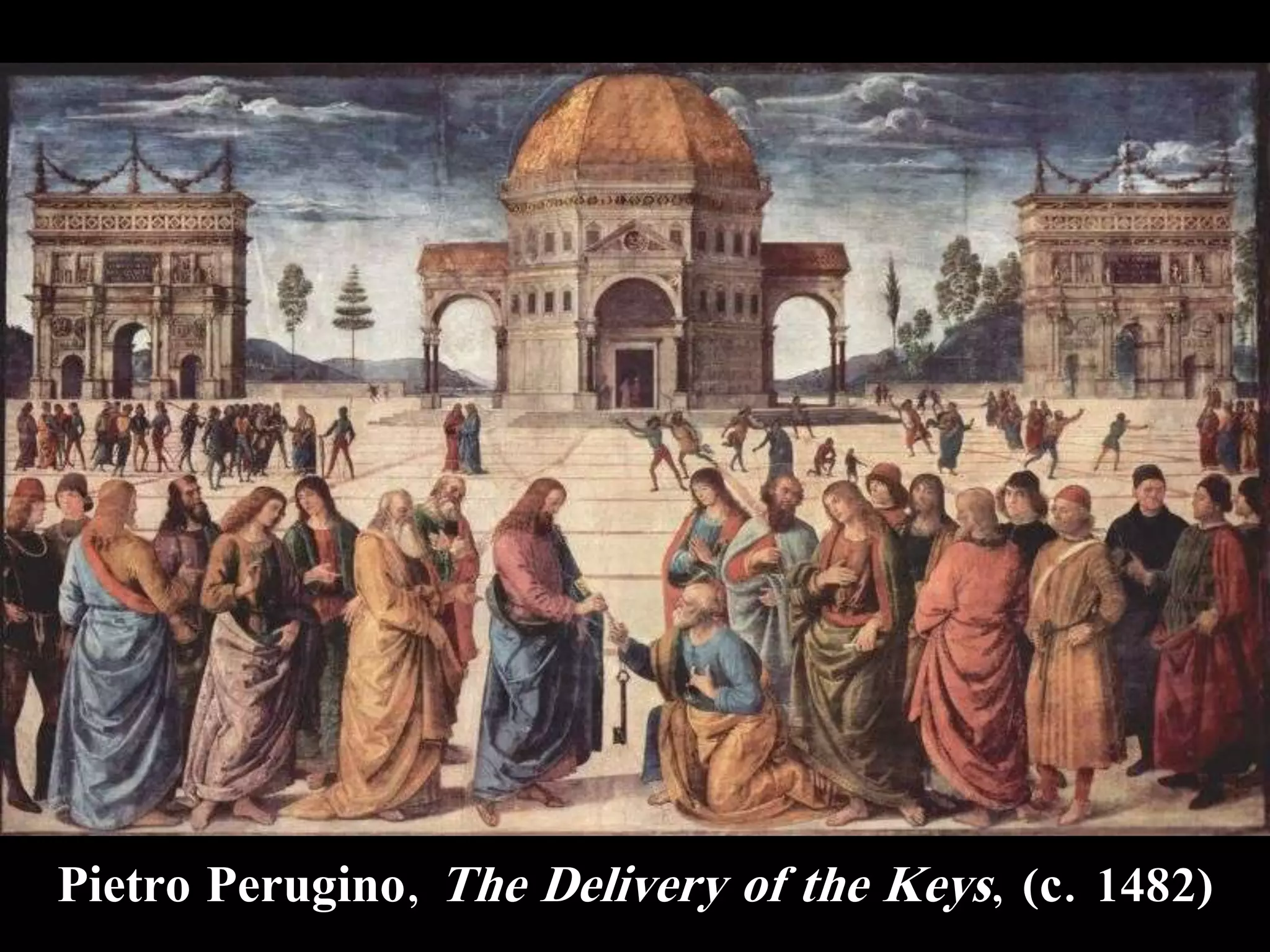
Pietro Perugino, The Delivery of the Keys, (c. 1482)
Michelangelo, The Conversion of Saul (1545)
Raphael, The School of Athens, (1510)
ID the Figures
Paint a picture… It’ll last longer.
Raphael painted
several portraits
of females during
his brief career.
Raphael
Raphael,
La fornarina (1520)
Raphael,
La velata (1515)
Raphael,
Young Woman with
Unicorn (c. 1506)
Classical
• Symmetry
• Proportion
• Domes
• Columns
St. Peter’s Basilica (Vatican City)
Villa Capra "La Rotonda" in Vicenza.
Renaissance Art

Renaissance Art