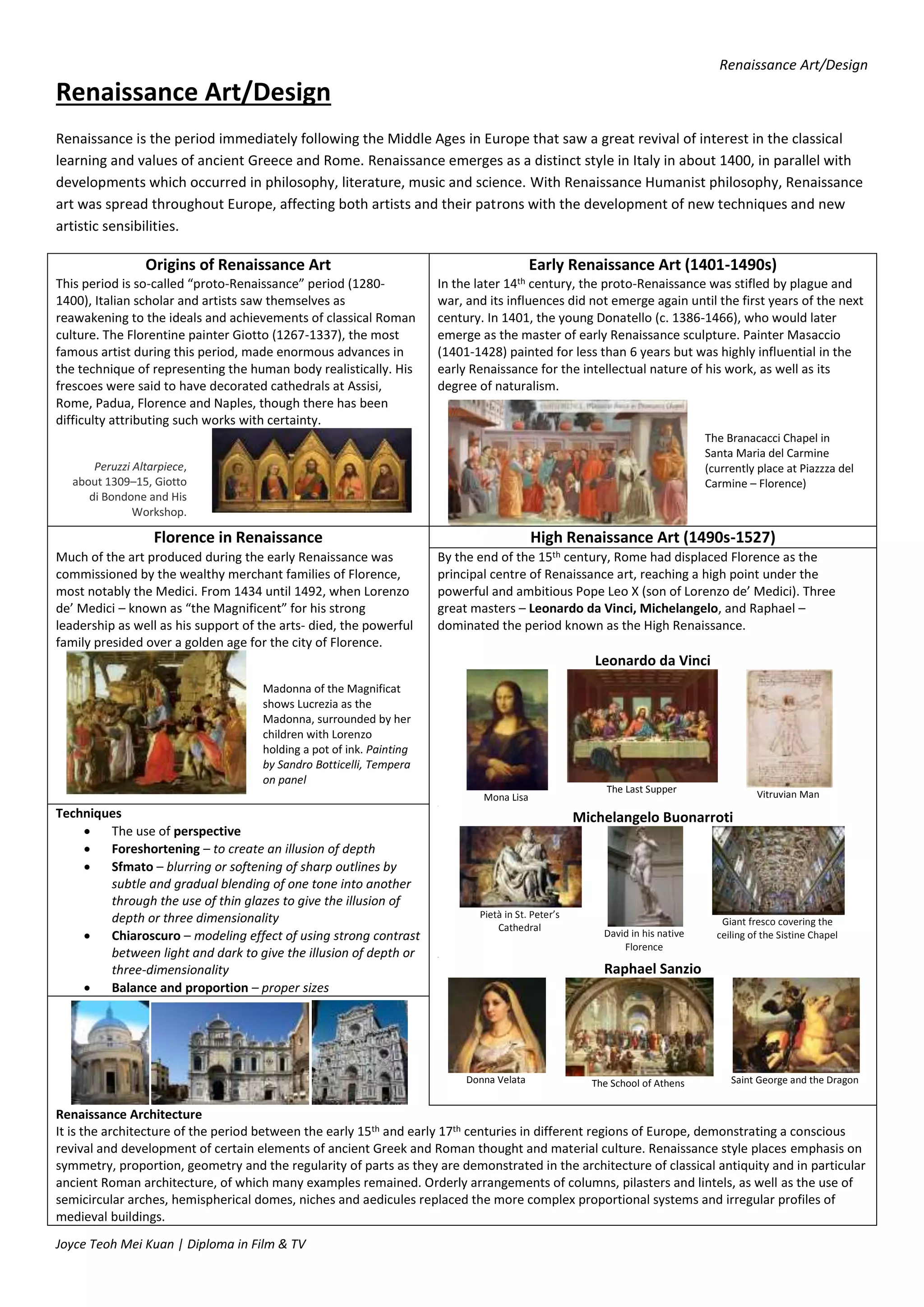

Renaissance Art/Design
Joyce Teoh Mei Kuan | Diploma in Film & TV
Renaissance Art/Design
Renaissance is the period immediately following the Middle Ages in Europe that saw a great revival of interest in the classical
learning and values of ancient Greece and Rome. Renaissance emerges as a distinct style in Italy in about 1400, in parallel with
developments which occurred in philosophy, literature, music and science. With Renaissance Humanist philosophy, Renaissance
art was spread throughout Europe, affecting both artists and their patrons with the development of new techniques and new
artistic sensibilities.
Origins of Renaissance Art Early Renaissance Art (1401-1490s)
This period is so-called “proto-Renaissance” period (1280-
1400), Italian scholar and artists saw themselves as
reawakening to the ideals and achievements of classical Roman
culture. The Florentine painter Giotto (1267-1337), the most
famous artist during this period, made enormous advances in
the technique of representing the human body realistically. His
frescoes were said to have decorated cathedrals at Assisi,
Rome, Padua, Florence and Naples, though there has been
difficulty attributing such works with certainty.
Peruzzi Altarpiece,
about 1309–15, Giotto
di Bondone and His
Workshop.
In the later 14th century, the proto-Renaissance was stifled by plague and
war, and its influences did not emerge again until the first years of the next
century. In 1401, the young Donatello (c. 1386-1466), who would later
emerge as the master of early Renaissance sculpture. Painter Masaccio
(1401-1428) painted for less than 6 years but was highly influential in the
early Renaissance for the intellectual nature of his work, as well as its
degree of naturalism.
The Branacacci Chapel in
Santa Maria del Carmine
(currently place at Piazzza del
Carmine – Florence)
Florence in Renaissance High Renaissance Art (1490s-1527)
Much of the art produced during the early Renaissance was
commissioned by the wealthy merchant families of Florence,
most notably the Medici. From 1434 until 1492, when Lorenzo
de’ Medici – known as “the Magnificent” for his strong
leadership as well as his support of the arts- died, the powerful
family presided over a golden age for the city of Florence.
Madonna of the Magnificat
shows Lucrezia as the
Madonna, surrounded by her
children with Lorenzo
holding a pot of ink. Painting
by Sandro Botticelli, Tempera
on panel
By the end of the 15th century, Rome had displaced Florence as the
principal centre of Renaissance art, reaching a high point under the
powerful and ambitious Pope Leo X (son of Lorenzo de’ Medici). Three
great masters – Leonardo da Vinci, Michelangelo, and Raphael –
dominated the period known as the High Renaissance.
Leonardo da Vinci
Mona Lisa
The Last Supper Vitruvian Man
.
Michelangelo Buonarroti
Pietà in St. Peter’s
Cathedral
David in his native
Florence
Giant fresco covering the
ceiling of the Sistine Chapel
.
Raphael Sanzio
Donna Velata The School of Athens Saint George and the Dragon
Techniques
 The use of perspective
 Foreshortening – to create an illusion of depth
 Sfmato – blurring or softening of sharp outlines by
subtle and gradual blending of one tone into another
through the use of thin glazes to give the illusion of
depth or three dimensionality
 Chiaroscuro – modeling effect of using strong contrast
between light and dark to give the illusion of depth or
three-dimensionality
 Balance and proportion – proper sizes
Renaissance Architecture
It is the architecture of the period between the early 15th and early 17th centuries in different regions of Europe, demonstrating a conscious
revival and development of certain elements of ancient Greek and Roman thought and material culture. Renaissance style places emphasis on
symmetry, proportion, geometry and the regularity of parts as they are demonstrated in the architecture of classical antiquity and in particular
ancient Roman architecture, of which many examples remained. Orderly arrangements of columns, pilasters and lintels, as well as the use of
semicircular arches, hemispherical domes, niches and aedicules replaced the more complex proportional systems and irregular profiles of
medieval buildings.
Renaissance Art/Design
Joyce Teoh Mei Kuan | Diploma in Film & TV

Renaissance Art/Design

  • 1.
    Renaissance Art/Design Joyce TeohMei Kuan | Diploma in Film & TV Renaissance Art/Design Renaissance is the period immediately following the Middle Ages in Europe that saw a great revival of interest in the classical learning and values of ancient Greece and Rome. Renaissance emerges as a distinct style in Italy in about 1400, in parallel with developments which occurred in philosophy, literature, music and science. With Renaissance Humanist philosophy, Renaissance art was spread throughout Europe, affecting both artists and their patrons with the development of new techniques and new artistic sensibilities. Origins of Renaissance Art Early Renaissance Art (1401-1490s) This period is so-called “proto-Renaissance” period (1280- 1400), Italian scholar and artists saw themselves as reawakening to the ideals and achievements of classical Roman culture. The Florentine painter Giotto (1267-1337), the most famous artist during this period, made enormous advances in the technique of representing the human body realistically. His frescoes were said to have decorated cathedrals at Assisi, Rome, Padua, Florence and Naples, though there has been difficulty attributing such works with certainty. Peruzzi Altarpiece, about 1309–15, Giotto di Bondone and His Workshop. In the later 14th century, the proto-Renaissance was stifled by plague and war, and its influences did not emerge again until the first years of the next century. In 1401, the young Donatello (c. 1386-1466), who would later emerge as the master of early Renaissance sculpture. Painter Masaccio (1401-1428) painted for less than 6 years but was highly influential in the early Renaissance for the intellectual nature of his work, as well as its degree of naturalism. The Branacacci Chapel in Santa Maria del Carmine (currently place at Piazzza del Carmine – Florence) Florence in Renaissance High Renaissance Art (1490s-1527) Much of the art produced during the early Renaissance was commissioned by the wealthy merchant families of Florence, most notably the Medici. From 1434 until 1492, when Lorenzo de’ Medici – known as “the Magnificent” for his strong leadership as well as his support of the arts- died, the powerful family presided over a golden age for the city of Florence. Madonna of the Magnificat shows Lucrezia as the Madonna, surrounded by her children with Lorenzo holding a pot of ink. Painting by Sandro Botticelli, Tempera on panel By the end of the 15th century, Rome had displaced Florence as the principal centre of Renaissance art, reaching a high point under the powerful and ambitious Pope Leo X (son of Lorenzo de’ Medici). Three great masters – Leonardo da Vinci, Michelangelo, and Raphael – dominated the period known as the High Renaissance. Leonardo da Vinci Mona Lisa The Last Supper Vitruvian Man . Michelangelo Buonarroti Pietà in St. Peter’s Cathedral David in his native Florence Giant fresco covering the ceiling of the Sistine Chapel . Raphael Sanzio Donna Velata The School of Athens Saint George and the Dragon Techniques  The use of perspective  Foreshortening – to create an illusion of depth  Sfmato – blurring or softening of sharp outlines by subtle and gradual blending of one tone into another through the use of thin glazes to give the illusion of depth or three dimensionality  Chiaroscuro – modeling effect of using strong contrast between light and dark to give the illusion of depth or three-dimensionality  Balance and proportion – proper sizes Renaissance Architecture It is the architecture of the period between the early 15th and early 17th centuries in different regions of Europe, demonstrating a conscious revival and development of certain elements of ancient Greek and Roman thought and material culture. Renaissance style places emphasis on symmetry, proportion, geometry and the regularity of parts as they are demonstrated in the architecture of classical antiquity and in particular ancient Roman architecture, of which many examples remained. Orderly arrangements of columns, pilasters and lintels, as well as the use of semicircular arches, hemispherical domes, niches and aedicules replaced the more complex proportional systems and irregular profiles of medieval buildings.
  • 2.
    Renaissance Art/Design Joyce TeohMei Kuan | Diploma in Film & TV